Pages

Friday, May 22, 2026

Remembering on Memorial Day

Flanders Field


Memorial Day started after the American Civil War. It was created to remember and mourn the U.S. military personnel who died while serving in the United States Armed Forces. There have been many wars since that "Civil" War, or as I say when performing as local woman, Liberetta Lerich Green,

although that program mainly is about the Lerich family Underground Railroad Station.

Yet another  historical person I portray is Michigan "Hello Girl", Oleda Joure Christides. These bilingual switchboard operators were sworn into the army for World War I, but it took them 60 years to finally receive Veteran Status, including honorable discharges. In December 2024 the group finally was awarded the Congressional Gold Medal.

While the Army in World War I bragged about its vaccination program, Hello Girl, Cora H. Bartlett, died of Typhoid and was initially buried in Tours, France, where she died. The people there gave her a funeral cortege with a floral blanket over her casket, which was rolled to their cemetery in June of 1919. Her casket was later removed in 1922 and sent to be re-buried at her family plot in the Hillsdale, Michigan cemetery of King Lake Cemetery

The Hillsdale County Historical Society has a page memorializing Cora

It also has a general page about the Hello Girls as well as about her fellow Hillsdale operator who was yet another Hello Girl, Norma Finch Carman. She survived the war and later married a Captain, Joel Carman, after they both saw action coming home from "Over There." That was the song Enrico Caruso sang to support all from the United States who accepted service in Europe.  

World War I was supposedly the "War to End All Wars." Of course it wasn't, but on this Memorial Day we should remember both those who died in their service or survived.

Thursday, May 14, 2026

Griffis - The Unmannerly Tiger - Keeping the Public in Public Domain

May 15th is Endangered Species Day and this entire month is dedicated to Asian Americans. Many of those Asian Americans are adopted from Korea, including my own two daughters! Of course my folklore collection includes a lot of Korean tales. William Elliot Griffis was an early collector of it, as part of his series of the fairy tales of half a dozen countries. His Korean Fairy Tales opens with a tale of a tiger who has difficulty with the concept of Gratitude. As tigers are predators not known for their gratitude, the conclusion is easily seen coming. It also gives me an opportunity to highlight an organization doing important work with Endangered Species.


THE UNMANNERLY TIGER

“Mountain Uncle” was the name given by the villagers to a splendid striped tiger that lived among the highlands of Kang Wen, the long province which from its cliffs overlooks the Sea of Japan. Hunters rarely saw him, and among his fellow-tigers the Mountain Uncle boasted that, though often fired at, he had never been wounded; while as for traps—he knew all about them and laughed at the devices used by man to catch him and to strip him of his coveted skin. In summer he kept among the high hills and lived on fat deer. In winter, when heavy snow, biting winds, and terrible cold kept human beings within doors, old Mountain Uncle would sally forth to the villages. There he would prowl around the stables, the cattle enclosures, or the pig pens, in hopes of clawing and dragging out a young donkey, a fat calf, or a suckling pig. Too often he succeeded, so that he was the terror of the country for leagues around.

One day in autumn, Mountain Uncle was rambling among the lower hills. Though far from any village, he kept a sharp lookout for traps and hunters, but none seemed to be near. He was very hungry and hoped for game.

But on coming round a great rock, Mountain Uncle suddenly saw in his path some feet ahead, as he thought, a big tiger like himself.

He stopped, twitched his tail most ferociously as a challenge, showed fight by growling, and got ready to spring. What was his surprise to see the other tiger doing exactly the same things. Mountain Uncle was sure there would be a terrible struggle, but this was just what he wanted, for he expected to win.

But after a tremendous leap in the air he landed in a pit and all of a heap, bruised and disappointed. There was no tiger to be seen, but instead a heavy lid of logs had closed over his head with a crash and he lay in darkness. Old Mountain Uncle was caught at last. Yes, the hunter had concealed the pit with sticks and leaves, and on the upright timbers, covered with vines and brushwood, had hung a looking-glass. Mountain Uncle had often beheld his own face and body in the water, when he stooped to drink, but this time not seeing any water he was deceived into thinking a real tiger wanted to fight him.

By and by, a Buddhist priest came along, who believed in being kind to all living creatures. Hearing an animal moaning, he opened the trap and lifting the lid saw old Mountain Uncle at the bottom licking his bruised paw.

“Oh, please, Mr. Man, let me get out. I’m hurt badly,” said the tiger.

Thereupon the priest lifted up one of the logs and slid it down, until it rested on the bottom of the pit. Then the tiger climbed up and out. Old Mountain Uncle expressed his thanks volubly, saying to the shaven head:

“I am deeply grateful to you, sir, for helping me out of my trouble. Nevertheless, as I am very hungry, I must eat you up.”

The priest, very much surprised and indignant, protested against such vile ingratitude. To say the least, it was very bad manners and entirely against the law of the mountains, and he appealed to a big tree to decide between them.

The spirit in the tree spoke through the rustling leaves and declared that the man should go free and that the tiger was both ungrateful and unmannerly.

Old Mountain Uncle was not satisfied yet, especially as the priest was unusually fat and would make a very good dinner. However, he allowed the man to appeal once more and this time to a big rock.

“The man is certainly right venerable Mountain Uncle, and you are wholly wrong,” said the spirit in the rock. “Your master, the Mountain Spirit, who rides on the green bull and the piebald horse to punish his enemies, will certainly chastise you if you devour this priest. You will be no fit messenger of the Mountain Lord if you are so ungrateful as to eat the man who saved you from starvation or death in the trap. It is shockingly bad manners even to think of such a thing.”

The tiger felt ashamed, but his eyes still glared with hunger; so, to be sure of saving his own skin, the priest proposed to make the toad a judge. The tiger agreed.

But the toad, with his gold-rimmed eyes, looked very wise, and instead of answering quickly, as the tree and rock did, deliberated a long time. The priest’s heart sank while the tiger moved his jaws as if anticipating his feast. He felt sure that Old Speckled Back would decide in his favor.

“I must go and see the trap before I can make up my mind,” said the toad, who looked as solemn as a magistrate. So all three leaped, hopped, or walked to the trap. The tiger, moving fast, was there first, which was just what the toad, who was a friend of the priest, wanted. Besides, Old Speckled Back was diligently looking for a crack in the rocks near by.

So while the toad and the tiger were studying the matter, the priest ran off and saved himself within the monastery gates. When at last Old Speckled Back decided against Mountain Uncle and in favor of the man, he had no sooner finished his judgment than he hopped into the rock crevice, and, crawling far inside defied the tiger, calling him an unmannerly brute and an ungrateful beast, and daring him to do his worst.

Old Mountain Uncle was so mad with rage and hunger that his craftiness seemed turned into stupidity. He clawed at the rock to get at the toad, but Speckled Back, safe within, only laughed. Unable to do any harm, the tiger flew into a passion of rage. The hotter his temper grew, the more he lost his wit. Poking his nose inside the crack he rubbed it so hard on the rough rock that he soon bled to death.

When the hunter came along he marveled at what he saw, but he was glad to get rich by selling the tiger’s fur, bones, and claws; for in Korea nothing sells so well as a tiger. As for the toad, he told to several generations of his descendants the story of how he outwitted the old Mountain Uncle.

***

The wildlife rescue group, Turpentine Creek, explains "The enduring symbolism of tigers in Korean culture."  It's rather unusual and worth reading. Presently no wild tigers are known in Korea, even though the Korean Peninsula once was home to the Siberian tiger (or Amur tiger) before hunting and habitat loss is believed to have eliminated them in the early 20th century. Perhaps this story would say it is the result of not having gratitude. Looking at their endangered status, I'm grateful that organizations like Turpentine Creek exist.

Read the story of the tiger, Abigail, at Turpentine Creek Wildlife Refuge


 ******************

This is part of a series of postings of stories under the category, “Keeping the Public in Public Domain.” The idea behind Public Domain was to preserve our cultural heritage after the authors and their immediate heirs were compensated. I feel strongly current copyright law delays this intent on works of the 20th century. My own library of folklore includes so many books within the Public Domain I decided to share stories from them. I hope you enjoy discovering them.

At the same time, my own involvement in storytelling regularly creates projects requiring research as part of my sharing stories with an audience.  Whenever that research needs to be shown here, the publishing of Public Domain stories will not occur that week.  This is a return to my regular posting of a research project here.  (Don't worry, this isn't dry research, my research is always geared towards future storytelling to an audience.)  Response has convinced me that "Keeping the Public in Public Domain" should continue along with my other postings as often as I can manage it.

See the sidebar for other Public Domain story resources I recommend on the page “Public Domain Story Resources."


Friday, May 8, 2026

Jacobs - The Tail - Keeping the Public in Public Domain

This brief story is simply a wee bit of chuckling. Joseph Jacobs ends his More Celtic Fairy Tales with the following story. 

The Tail.

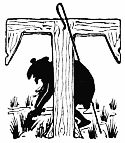
T
here was a shepherd once who went out to the hill to look after his sheep. It was misty and cold, and he had much trouble to find them. At last he had them all but one; and after much searching he found that one too in a peat hag, half drowned; so he took off his plaid, and bent down and took hold of the sheep's tail, and he pulled! The sheep was heavy with water, and he could not lift her, so he took off his coat and he pulled!! but it was too much for him, so he spit on his hands, and took a good hold of the tail and he pulled!! and the tail broke! and if it had not been for that this tale would have been a great deal longer.


Jacobs always gave thorough notes about each story, but only after the following warning:

XLVI. THE TAIL.

Source.—Campbell, No. lvii.

Parallels.—Most story-tellers have some formula of this kind to conclude their narrations. Prof. Crane gives some examples in his Italian Popular Tales, pp. 155-7. The English have: "I'll tell you a story of Jack a Nory," and "The Three Wise Men of Gotham" who went to Sea in a Bowl:

"If the bowl had been stronger, My song would have been longer."

 ***********

This is part of a series of postings of stories under the category, “Keeping the Public in Public Domain.” The idea behind Public Domain was to preserve our cultural heritage after the authors and their immediate heirs were compensated. I feel strongly current copyright law delays this intent on works of the 20th century. My own library of folklore includes so many books within the Public Domain I decided to share stories from them. I hope you enjoy discovering them.

At the same time, my own involvement in storytelling regularly creates projects requiring research as part of my sharing stories with an audience.  Whenever that research needs to be shown here, the publishing of Public Domain stories will not occur that week.  This is a return to my regular posting of a research project here.  (Don't worry, this isn't dry research, my research is always geared towards future storytelling to an audience.)  Response has convinced me that "Keeping the Public in Public Domain" should continue along with my other postings as often as I can manage it.

See the sidebar for other Public Domain story resources I recommend on the page “Public Domain Story Resources."

************


Friday, May 1, 2026

Anonymous - The Dandelion - Keeping the Public in Public Domain


                                                        Photo by Viridi Green on Unsplash

Years of searching led me to today's story. Is it the source of my mother's gleeful shouting when spring dandelions are scattered over a lawn? She would shout "Oh, the old man spilled his bag of gold!" I presume it goes back to a much loved story or poem from her childhood. 

If you have another source, please tell me! 

It seems the closest I've found to an old man scattering something golden that became dandelions. 


This story was published originally in "The Presbyterian" and republished by Carolyn Sherwin Bailey in For the Children's Hour.  Archive.org has that book in its database, but it was down when I went later to the site to copy it. Fortunately my own book let me copy it, even if the conclusion is slightly crooked.

************** 

This is part of a series of postings of stories under the category, “Keeping the Public in Public Domain.” The idea behind Public Domain was to preserve our cultural heritage after the authors and their immediate heirs were compensated. I feel strongly current copyright law delays this intent on works of the 20th century. My own library of folklore includes so many books within the Public Domain I decided to share stories from them. I hope you enjoy discovering them.

At the same time, my own involvement in storytelling regularly creates projects requiring research as part of my sharing stories with an audience.  Whenever that research needs to be shown here, the publishing of Public Domain stories will not occur that week.  This is a return to my regular posting of a research project here.  (Don't worry, this isn't dry research, my research is always geared towards future storytelling to an audience.)  Response has convinced me that "Keeping the Public in Public Domain" should continue along with my other postings as often as I can manage it.

See the sidebar for other Public Domain story resources I recommend on the page “Public Domain Story Resources."