Tell me if you have a topic you'd like to see. (Contact: LoiS-sez@LoiS-sez.com .)
Please also let others know about this site.
Showing posts with label Joseph Jacobs. Show all posts

Friday, September 4, 2026

Jacobs - Keep Cool - Keeping the Public in Public Domain


I must confess I love telling stories collected by Joseph Jacobs, but there's one book I've barely opened: Europa's Fairy Tales. It's every bit as good as his other work. Once again the illustrations are by John D. Batten. Jacobs says "It must, of course, be understood that the tales I now give are only those found practically identical in all European countries." 

As this weekend is the long Labor Day weekend, I went looking for a story about "laboring" or work. "Keep Cool" offers an unusual look at it.  At the end of the book Jacobs gives notes about the various stories. While he waits until the book's end, I think it's worth knowing how it is handled around the world. For this story he provides this information:

XV. KEEP COOL

There is no doubt about the European character of this tale, which is found in Brittany, Picardy, Lorraine, among the Basques, in Spain, Corsica, Italy, Tyrol, Germany (though not in Grimm), among Lithuanians, Moravians, Roumanians, Greeks, Irish, Scotch, Danes, Norwegians (Cosquin, ii., 50). The central idea of the Rage-Wager is retained throughout, and in many places the punishment is the same—the loss of a strip of skin. In all but three instances the story is told of three brothers, which practically proves its identity. I have given the Irish version in More Celtic Fairy Tales.

The "sells" however change considerably, though in most of them the final dénoument comes with the death or wounding of the wife. The pigs' tails incident is also very common and is indeed found in another set of tales, more of the Master Thief type. Campbell's No. 45 had an entirely different set, some of them very amusing. Mac-A-Rusgaich has all three meals at once and lies down. He holds the plough and does nothing else; he sees after themountain; literally casts ox-eyes at the master, and makes a sheep foot-path out of sheep's feet. I have taken from Campbell the direction to wash horses and stable within and without, though it does not occur elsewhere. Yet Mac-A-Rusgaich has a bout with a giant, in which he slits an artificial stomach, like Jack the Giant Killer; and this incident occurs in four other of the European tales, again showing identity. "Keep cool" is thus an interesting example of identity of framework, with variation of incident.

Hmmm. I knew I recognized this story even if it seemed a bit different. Now I need to check More Celtic Fairy Tales. 

But Labor Day is a time to relax from our labors, so for now I will tell myself to "Keep Cool."


KEEP COOL

There was once a man and he had three sons, and when he died they all had to go out to seek a living. So the eldest went out first, leaving his two brothers at home, and went to a neighbouring farmer to try and get work from him.

"Well, well, my man," said the farmer, "I can give you work but on only one condition."

"What is that?"

"I cannot abear any high talk on my farm. You must keep cool and not lose your temper."

"Oh, never bother about that," said the youngster, "I never lose my temper, or scarcely ever."

"Ah, but if you do," said the farmer, "I make it a condition that I shall tear a strip of your skin from your nape to your waist; that will make a pretty ribbon to tie around the throat of my dog there."

"That doesn't suit me," was the reply. "So fare thee well, master, I must try another place."

"Keep cool, keep cool," said the farmer. "I am a just man; what's good for the man I consider good for the master. So if I should lose my temper I am quite willing that you should take the ribbon of flesh from my back."

"Oh, if that's so," said the youngster, "I'll agree to stay. But we must have it in black and white."

So they sent for the notary and wrote it all down that if either lost his temper he should also lose a strip of skin from his back. But the eldest son had not been in the house a week when the master gave him so hard a task that he lost his temper and had to give up a strip of skin from his back. So he went home and told his brothers about it.

Well, the brothers were savage at hearing what he had suffered. And the second son went to the same man in the hope of getting revenge for his brother. But the same thing happened to him, and he had to come with a strip of skin from his back like his elder brother.

Now the third son, whose name was Jack, made up his mind he wouldn't be done like the other two. And he went to the man and he engaged himself to serve him for the same wage but on the same conditions that his two brothers had done.

The very first morning that Jack had to go out to work his master gave him a piece of dry bread and told him to mind the sheep.

"Is this all I'm to get to eat?" said Jack.

"Why, yes," said the master; "there'll be supper when you come home."

Jack was going to complain when his master called out to him, "Keep cool, Jack, keep cool," and pointed to his back.

So Jack swallowed his rage and went out into the field. But on his way he met a man, to whom he sold one of the sheep for five shillings, and went and bought enough to eat and drink for a whole week.

When he got home that evening his master began to count the sheep, and when he found one was missing, he said to Jack:

"You've let one of the sheep run away."

"No, no, sir," said Jack, "I sold him to a man passing along."

"You shouldn't have done that without my telling you; but where's the money?"

"Oh, with the money," said Jack, "I went and bought me some eats." And he showed him what he had bought.

The master was going to fly in a rage, but Jack said to him: "Keep cool, master, keep cool," and pointed to his back. So he remembered and said nothing more.

The next day Jack was ordered to take the pigs to market to sell them, and after he had cut off all their tails he sold them and pocketed the money; and then he went to a marsh near the farm and planted all the tails in the marsh.

When he got home the master asked him if he had sold the pigs.

He said: "No, they all rushed into the marsh at the foot of the valley."

"I don't believe you," said the master, and was going to get into a rage when Jack said to him:

"Keep cool, master, keep cool."

So he went with Jack to the marsh, and when he saw the pigs' tails all peeping out the marsh he went and plucked one of them out of the ground, and Jack said:

"There, you've torn the tail from the poor pig's back."

Then the master was going to get into a rage again but Jack said: "Keep cool, master, keep cool," and pointed to his back.

Next day the master didn't like sending Jack out with the animals or else he might sell them to get some dinner. So he said to him:

"Jack, I want you today to clean the horses and the stable within and without."

"Very well, master," said Jack, and went to the stable; and he whitewashed it within and he whitewashed it without. Then he went to the horses and killed them and took out their insides and cleaned them within; and then he washed their skins.

In the evening the master came to see how Jack had got on with his work and was delighted to find the stable looking so clean.

"But where are the horses?" he said; and Jack pointed to them lying dead on their backs.

"Why, what have you done?" said the master.

"You told me to clean them within and without and how could I clean them within without killing them?" said Jack.

Then the master was just going to fly into a rage, when Jack said to him: "Keep cool, master, keep cool," and pointed to his back.

So next day the master had sent Jack out with the sheep, but so that he should not sell any of them to get money for his lunch he sent his wife with them telling her to watch Jack from behind a bush, and if he tried to sell any of the sheep to stop him. But Jack saw her and didn't say anything or try and sell any of the sheep.

But next day, when he went out with them, he took with him his gun, and when the farmer's wife got behind the bush to watch him, he called out: "Ah, wolf, I see you," and fired his gun at her and hit her in the leg. She screamed out, and the master came running up and said:

"What's this, Jack, what's this?"

Then Jack said: "Why, master, I thought that was a wolf and I shot my gun at it and it turned out to be the missus."

"How dare you, you scoundrel, shoot my wife!" cried out the master.

"Don't be in a rage, master, don't be in a rage," said Jack.

"Anybody would be in a rage if his wife was shot," said the master.

"Well, then," said Jack, "I'll have that strip off your back." And as there were witnesses present the master had to let Jack take a strip of skin from his back.

And with that he went home to his brothers.
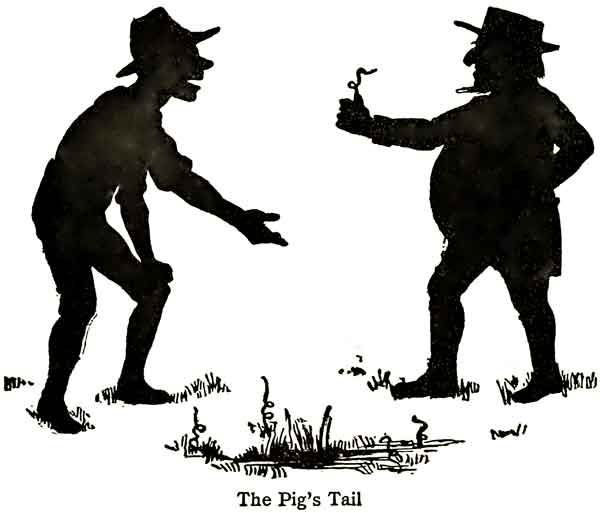
The Pig's Tail 
******************** 

This is part of a series of postings of stories under the category, “Keeping the Public in Public Domain.” The idea behind Public Domain was to preserve our cultural heritage after the authors and their immediate heirs were compensated. I feel strongly current copyright law delays this intent on works of the 20th century. My own library of folklore includes so many books within the Public Domain I decided to share stories from them. I hope you enjoy discovering them.

At the same time, my own involvement in storytelling regularly creates projects requiring research as part of my sharing stories with an audience.  Whenever that research needs to be shown here, the publishing of Public Domain stories will not occur that week.  This is a return to my regular posting of a research project here.  (Don't worry, this isn't dry research, my research is always geared towards future storytelling to an audience.)  Response has convinced me that "Keeping the Public in Public Domain" should continue along with my other postings as often as I can manage it.

See the sidebar for other Public Domain story resources I recommend on the page “Public Domain Story Resources."


Friday, July 24, 2026

Jacobs - The Tiger, The Brahmin and the Jackal - Keeping the Public in Public Domain

Next week on July 29 is World Tiger Day. This beautiful but dangerous creature has a long history with people. World Wildlife Fund has an interesting quiz worth taking to learn more about them. There also are many stories about them including today's tale said to have more than a hundred variants! If you start with what is probably the oldest, the Panchatantra, it would be about 28 or 29 THOUSAND! years old. 

Obviously it is a story worth telling. The question becomes where to start?

Joseph Jacobs is excellent at handling something with such a varied history. (He's the one noting more than a hundred variants when he discussed it in Europa's Fairy Book.) There's no room here to give a hundred versions for comparison, but I do want to mention Sara Cone Bryant's version in Stories to Tell Children because she can always be depended on to offer a tellable story. In it she explains, " Do you know what a Brahmin is? A Brahmin is a very good and gentle kind of man who lives in India, and who treats all the beasts as if they were his brothers. There is a great deal more to know about Brahmins, but that is enough for the story." Later in the story she uses the Banyan Tree for the tree in the story, saying "(A banyan tree is a kind of fruit tree.)" Jacobs uses a "pipal tree" which is probably more accurate given its religious importance to India, but in telling the story I find Bryant's use and explanation of the banyan tree easier to keep the flow of the story. Since the banyan is also considered a Hindu sacred plant, that is what I would use.

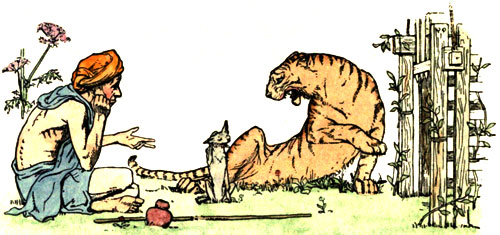
One further reason why I chose to post the Jacobs version is, once again in Indian Fairy Tales he has John D. Batten's illustrations. The two worked together on almost all of the Jacobs' folktale anthologies. Batten's work always adds to the enjoyment and understanding. Bryant lets stories stand on their own merits without illustrations. I do have one complaint with Batten's illustration, the jackal is not easy to picture. Neither Jacobs nor Bryant tell anything about jackals, keeping his words and actions the focus.

The Tiger, the Brahman, and the Jackal

O

nce upon a time, a tiger was caught in a trap. He tried in vain to get out through the bars, and rolled and bit with rage and grief when he failed.

By chance a poor Brahman came by. "Let me out of this cage, oh pious one!" cried the tiger.

"Nay, my friend," replied the Brahman mildly, "you would probably eat me if I did."

"Not at all!" swore the tiger with many oaths; "on the contrary, I should be for ever grateful, and serve you as a slave!"

Now when the tiger sobbed and sighed and wept and swore, the pious Brahman's heart softened, and at last he consented to open the door of the cage. Out popped the tiger, and, seizing the poor man, cried, "What a fool you[67] are! What is to prevent my eating you now, for after being cooped up so long I am just terribly hungry!"

In vain the Brahman pleaded for his life; the most he could gain was a promise to abide by the decision of the first three things he chose to question as to the justice of the tiger's action.

So the Brahman first asked a pipal tree what it thought of the matter, but the pipal tree replied coldly, "What have you to complain about? Don't I give shade and shelter to every one who passes by, and don't they in return tear down my branches to feed their cattle? Don't whimper—be a man!"

Then the Brahman, sad at heart, went further afield till he saw a buffalo turning a well-wheel; but he fared no better from it, for it answered, "You are a fool to expect gratitude! Look at me! Whilst I gave milk they fed me on cotton-seed and oil-cake, but now I am dry they yoke me here, and give me refuse as fodder!"

The Brahman, still more sad, asked the road to give him its opinion.

"My dear sir," said the road, "how foolish you are to expect anything else! Here am I, useful to everybody, yet all, rich and poor, great and small, trample on me as they go past, giving me nothing but the ashes of their pipes and the husks of their grain!"

On this the Brahman turned back sorrowfully, and on the way he met a jackal, who called out, "Why, what's the matter, Mr. Brahman? You look as miserable as a fish out of water!"

The Brahman told him all that had occurred. "How very confusing!" said the jackal, when the recital[68] was ended; "would you mind telling me over again, for everything has got so mixed up?"

The Brahman told it all over again, but the jackal shook his head in a distracted sort of way, and still could not understand.

"It's very odd," said he, sadly, "but it all seems to go in at one ear and out at the other! I will go to the place where it all happened, and then perhaps I shall be able to give a judgment."

So they returned to the cage, by which the tiger was waiting for the Brahman, and sharpening his teeth and claws.

"You've been away a long time!" growled the savage beast, "but now let us begin our dinner."

"Our dinner!" thought the wretched Brahman, as his knees knocked together with fright; "what a remarkably delicate way of putting it!"

"Give me five minutes, my lord!" he pleaded, "in order that I may explain matters to the jackal here, who is somewhat slow in his wits."

The tiger consented, and the Brahman began the whole story over again, not missing a single detail, and spinning as long a yarn as possible.

"Oh, my poor brain! oh, my poor brain!" cried the jackal, wringing its paws. "Let me see! how did it all begin? You were in the cage, and the tiger came walking by——"

"Pooh!" interrupted the tiger, "what a fool you are! I was in the cage."

"Of course!" cried the jackal, pretending to tremble with fright; "yes! I was in the cage—no I wasn't—dear![69] dear! where are my wits? Let me see—the tiger was in the Brahman, and the cage came walking by——no, that's not it, either! Well, don't mind me, but begin your dinner, for I shall never understand!"

"Yes, you shall!" returned the tiger, in a rage at the jackal's stupidity; "I'll make you understand! Look here—I am the tiger——"

"Yes, my lord!"

"And that is the Brahman——"

"Yes, my lord!"

"And that is the cage——"

"Yes, my lord!"

"And I was in the cage—do you understand?"

"Yes—no—— Please, my lord——"

"Well?" cried the tiger impatiently.

"Please, my lord!—how did you get in?"

"How!—why in the usual way, of course!"

"Oh, dear me!—my head is beginning to whirl again! Please don't be angry, my lord, but what is the usual way?"

At this the tiger lost patience, and, jumping into the cage, cried, "This way! Now do you understand how it was?"

"Perfectly!" grinned the jackal, as he dexterously shut the door, "and if you will permit me to say so, I think matters will remain as they were!"

***

The endangered status of Tigers is part of the quiz mentioned at the start. Here are several World Wildlife Fund articles about them. I particularly want to recommend their Teaching Tools About Wildlife and Forests.

**********************************

This is part of a series of postings of stories under the category, “Keeping the Public in Public Domain.” The idea behind Public Domain was to preserve our cultural heritage after the authors and their immediate heirs were compensated. I feel strongly current copyright law delays this intent on works of the 20th century. My own library of folklore includes so many books within the Public Domain I decided to share stories from them. I hope you enjoy discovering them.

At the same time, my own involvement in storytelling regularly creates projects requiring research as part of my sharing stories with an audience.  Whenever that research needs to be shown here, the publishing of Public Domain stories will not occur that week.  This is a return to my regular posting of a research project here.  (Don't worry, this isn't dry research, my research is always geared towards future storytelling to an audience.)  Response has convinced me that "Keeping the Public in Public Domain" should continue along with my other postings as often as I can manage it.
See the sidebar for other Public Domain story resources I recommend on the page “Public Domain Story Resources."

Friday, May 8, 2026

Jacobs - The Tail - Keeping the Public in Public Domain

This brief story is simply a wee bit of chuckling. Joseph Jacobs ends his More Celtic Fairy Tales with the following story. 

The Tail.

T
here was a shepherd once who went out to the hill to look after his sheep. It was misty and cold, and he had much trouble to find them. At last he had them all but one; and after much searching he found that one too in a peat hag, half drowned; so he took off his plaid, and bent down and took hold of the sheep's tail, and he pulled! The sheep was heavy with water, and he could not lift her, so he took off his coat and he pulled!! but it was too much for him, so he spit on his hands, and took a good hold of the tail and he pulled!! and the tail broke! and if it had not been for that this tale would have been a great deal longer.


Jacobs always gave thorough notes about each story, but only after the following warning:

XLVI. THE TAIL.

Source.—Campbell, No. lvii.

Parallels.—Most story-tellers have some formula of this kind to conclude their narrations. Prof. Crane gives some examples in his Italian Popular Tales, pp. 155-7. The English have: "I'll tell you a story of Jack a Nory," and "The Three Wise Men of Gotham" who went to Sea in a Bowl:

"If the bowl had been stronger, My song would have been longer."

 ***********

This is part of a series of postings of stories under the category, “Keeping the Public in Public Domain.” The idea behind Public Domain was to preserve our cultural heritage after the authors and their immediate heirs were compensated. I feel strongly current copyright law delays this intent on works of the 20th century. My own library of folklore includes so many books within the Public Domain I decided to share stories from them. I hope you enjoy discovering them.

At the same time, my own involvement in storytelling regularly creates projects requiring research as part of my sharing stories with an audience.  Whenever that research needs to be shown here, the publishing of Public Domain stories will not occur that week.  This is a return to my regular posting of a research project here.  (Don't worry, this isn't dry research, my research is always geared towards future storytelling to an audience.)  Response has convinced me that "Keeping the Public in Public Domain" should continue along with my other postings as often as I can manage it.
See the sidebar for other Public Domain story resources I recommend on the page “Public Domain Story Resources."

************


Friday, December 19, 2025

Aesop and Joseph Jacobs - Four fables on Peace - Keeping the Public in Public Domain

Photo  by Disha Sheta of India on Pexels

Sometimes the news goes against everything that seems right. 

Before giving a story and wishing holiday greetings, I want to extend condolences to my friends and readers in Australia. I celebrate Christmas, but dozens of my friends celebrate Hanukkah and Kwanza and I wish only the best for all of them.

If ever there seemed to be a time when Peace is needed, but missing, it seems to be now. 

Perhaps it is time we look at some of the world's attempts at wisdom concerning Peace since we so desperately need it. Many of these efforts can be found in fables.  

Joseph Jacobs, in his book, The Fables of Aesop, admits that many attribute fables to "Aesop", but  as a result he "felt at liberty to retell the fables in such a way as would interest children, and have adopted from the various versions that which seemed most suitable in each case, telling the fable anew in my own way." 

We are in good hands with his efforts, so I went there for a few brief stories on Peace. His versions follow the older, more traditional idea of including the moral after the story.  Fables nowadays usually take the view of letting the audience form their own conclusion. How you tell it is up to you as a storyteller or teacher. As a reader you may feel free to skip to the next fable or read what Jacobs says is the lesson the story tells.

The Dog and the Shadow

It happened that a Dog had got a piece of meat and was carrying it home in his mouth to eat it in peace. Now on his way home he had to cross a plank lying across a running brook. As he crossed, he looked down and saw his own shadow reflected in the water beneath. Thinking it was another dog with another piece of meat, he made up his mind to have that also. So he made a snap at the shadow in the water, but as he opened his mouth the piece of meat fell out, dropped into the water and was never seen more.

Beware lest you lose the substance by grasping at the shadow.  

The Town Mouse and the Country Mouse

Now you must know that a Town Mouse once upon a time went on a visit to his cousin in the country. He was rough and ready, this cousin, but he loved his town friend and made him heartily welcome. Beans and bacon, cheese and bread, were all he had to offer, but he offered them freely. The Town Mouse rather turned up his long nose at this country fare, and said: “I cannot understand, Cousin, how you can put up with such poor food as this, but of course you cannot expect anything better in the country; come you with me and I will show you how to live. When you have been in town a week you will wonder how you could ever have stood a country life.” No sooner said than done: the two mice set off for the town and arrived at the Town Mouse’s residence late at night. “You will want some refreshment after our long journey,” said the polite Town Mouse, and took his friend into the grand dining-room. There they found the remains of a fine feast, and soon the two mice were eating up jellies and cakes and all that was nice. Suddenly they heard growling and barking. “What is that?” said the Country Mouse. “It is only the dogs of the house,” answered the other. “Only!” said the Country Mouse. “I do not like that music at my dinner.” Just at that moment the door flew open, in came two huge mastiffs, and the two mice had to scamper down and run off. “Good-bye, Cousin,” said the Country Mouse. “What! going so soon?” said the other. “Yes,” he replied;

“Better beans and bacon in peace than cakes and ale in fear.”  

The Bat, the Birds, and the Beasts

A great conflict was about to come off between the Birds and the Beasts. When the two armies were collected together the Bat hesitated which to join. The Birds that passed his perch said: “Come with us”; but he said: “I am a Beast.” Later on, some Beasts who were passing underneath him looked up and said: “Come with us”; but he said: “I am a Bird.” Luckily at the last moment peace was made, and no battle took place, so the Bat came to the Birds and wished to join in the rejoicings, but they all turned against him and he had to fly away. He then went to the Beasts, but soon had to beat a retreat, or else they would have torn him to pieces. “Ah,” said the Bat, “I see now,

“He that is neither one thing nor the other has no friends.” 

The Fox, the Cock, and the Dog

One moonlight night a Fox was prowling about a farmer’s hen-coop, and saw a Cock roosting high up beyond his reach. “Good news, good news!” he cried.

“Why, what is that?” said the Cock.

“King Lion has declared a universal truce. No beast may hurt a bird henceforth, but all shall dwell together in brotherly friendship.”

“Why, that is good news,” said the Cock; “and there I see some one coming, with whom we can share the good tidings.” And so saying he craned his neck forward and looked afar off.

“What is it you see?” said the Fox.

“It is only my master’s Dog that is coming towards us. What, going so soon?” he continued, as the Fox began to turn away as soon as he had heard the news. “Will you not stop and congratulate the Dog on the reign of universal peace?”

“I would gladly do so,” said the Fox, “but I fear he may not have heard of King Lion’s decree.”

Cunning often outwits itself. 

***

Personally I look to the book of John, chapter 14, verse 27 when Jesus said,“Peace I leave with you, my peace I give unto you: not as the world giveth, give I unto you. Let not your heart be troubled, neither let it be afraid.

However you celebrate, may you enjoy the season and have a good rest of 2025 and may 2026 be the best yet. 

******** 

This is part of a series of postings of stories under the category, “Keeping the Public in Public Domain.” The idea behind Public Domain was to preserve our cultural heritage after the authors and their immediate heirs were compensated. I feel strongly current copyright law delays this intent on works of the 20th century. My own library of folklore includes so many books within the Public Domain I decided to share stories from them. I hope you enjoy discovering them.

At the same time, my own involvement in storytelling regularly creates projects requiring research as part of my sharing stories with an audience.  Whenever that research needs to be shown here, the publishing of Public Domain stories will not occur that week.  This is a return to my regular posting of a research project here.  (Don't worry, this isn't dry research, my research is always geared towards future storytelling to an audience.)  Response has convinced me that "Keeping the Public in Public Domain" should continue along with my other postings as often as I can manage it.
See the sidebar for other Public Domain story resources I recommend on the page “Public Domain Story Resources."

Friday, July 11, 2025

Jacobs - Reynard and Bruin - Keeping the Public in Public Domain

July truly is a month for nations celebrating, starting with Canada Day on the first, then our own 4th of July, and it's almost time for France to celebrate Bastille Day on the 14th. I went looking for something appropriately French and think Reynard the trickster fox deserves a storytelling visit. While the crafty fox stories did travel around Europe, the French liked him so well their word for "fox" became "Renard."

Joseph Jacobs was clearly taken with him and did an entire book, The Most Delectable History of Reynard the Fox .  Unlike much of Jacobs' work, it's too flowery and I don't find it tells well, although the adventures can be simplified and retold.  The year Jacobs died (1916) his final book, Europa's Fairy Book  -- sometimes called European Folk and Fairy Tales came out with a few easily retold adventures where the fox outwits the bear. It does, however, let this unrepentant trickster be appropriately punished. Jacobs long-time collaboration continued with illustrations by John D. Batten. I'll say a bit more about the sources after Reynard has his tale (or perhaps I should say "tail").

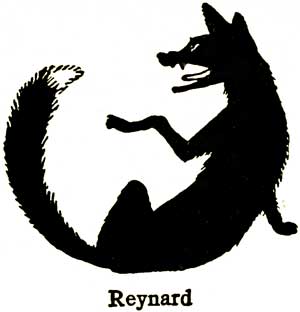
Reynard

REYNARD AND BRUIN

You must know that once upon a time Reynard the Fox and Bruin the Bear went into partnership and kept house together. Would you like to know the reason? Well, Reynard knew that Bruin had a beehive full of honeycomb, and that was what he wanted; but Bruin kept so close a guard upon his honey that Master Reynard didn't know how to get away from him and get hold of the honey. So one day he said to Bruin, "Pardner, I have to go and be gossip—that means god-father, you know—to one of my old friends." "Why, certainly," said Bruin. So off Reynard goes into the woods, and after a time he crept back and uncovered the beehive and had such a feast of honey. Then he went back to Bruin, who asked him what name had been given to the child. Reynard had forgotten all about the christening and could only say, "Just-begun." "What a funny name," said Master Bruin.

A little while after Reynard thought he would like another feast of honey. So he told Bruin that he had to go to another christening; and off he went. And when he came back and Bruin asked him what was the name given to the child Reynard said, "Half-eaten." The third time the same thing occurred, and this time the name given by Reynard to the child that didn't exist was "All-gone,"—you can guess why.

A short time afterwards Master Bruin thought he would like to eat up some of his honey and asked Reynard to come and join him in the feast. When they got to the beehive Bruin was so surprised to find that there was no honey left; and he turned round to Reynard and said, "Just-begun, Half-eaten, All-gone—so that is what you meant; you have eaten my honey." "Why no," said Reynard, "how could that be? I have never stirred from your side except when I went a-gossiping, and then I was far away from here. You must have eaten the honey yourself, perhaps when you were asleep; at any rate we can easily tell; let us lie down here in the sunshine, and if either of us has eaten the honey, the sun will soon sweat it out of us." No sooner said than done, and the two lay side by side in the sunshine. Soon Master Bruin commenced to doze, and Mr. Reynard took some honey from the hive and smeared it round Bruin's snout; then he woke him up and said, "See, the honey is oozing out of your snout; you must have eaten it when you were asleep."

Some time after this Reynard saw a man driving a cart full of fish, which made his mouth water. So he ran and he ran and he ran till he got far away in front of the cart and lay down in the road as still as if he were dead. When the man came up to him and saw him lying there dead, as he thought, he said to himself, "Why, that will make a beautiful red fox scarf and muff for my wife Ann." And he got down and seized hold of Reynard and threw him into the cart all along with the fish, and then he went driving on as before. Reynard began to throw the fish out till there were none left, and then he jumped out himself without the man noticing it, who drove up to his door and called out, "Ann, Ann, see what I have brought you." And when his wife came to the door she looked into the cart and said, "Why, there is nothing there."

Reynard in the meantime had brought all his fish together and began eating some when up comes Bruin and asked for a share. "No, no," said Reynard, "we only share food when we have shared work. I fished for these, you go and fish for others."

"Why, how could you fish for these? the water is all frozen over," said Bruin.

"I'll soon show you," said Reynard, and brought him down to the bank of the river, and pointed to a hole in the ice and said, "I put my tail in that, and the fish were so hungry I couldn't draw them up quick enough. Why do you not do the same?"

So Bruin put his tail down and waited and waited but no fish came. "Have patience, man," said Reynard; "as soon as one fish comes the rest will follow."

"Ah, I feel a bite," said Bruin, as the water commenced to freeze round his tail and caught it in the ice.

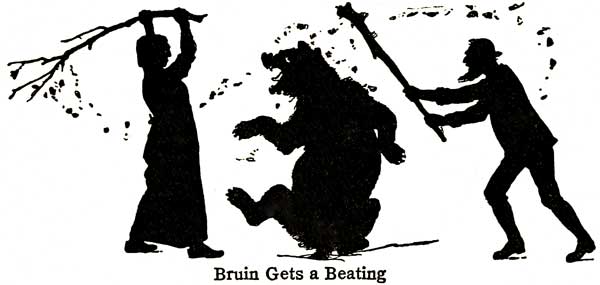
Bruin Gets a Beating

"Better wait till two or three have been caught and then you can catch three at a time. I'll go back and finish my lunch."

And with that Master Reynard trotted up to the man's wife and said to her, "Ma'am, there's a big black bear caught by the tail in the ice; you can do what you like with him." So the woman called her husband and they took big sticks and went down to the river and commenced whacking Bruin who, by this time, was fast in the ice. He pulled and he pulled and he pulled, till at last he got away leaving three quarters of his tail in the ice, and that is why bears have such short tails up to the present day.

Meanwhile Master Reynard was having a great time in the man's house, golloping everything he could find till the man and his wife came back and found him with his nose in the cream jug. As soon as he heard them come in he tried to get away, but not before the man had seized hold of the cream jug and thrown it at him, just catching him on the tail, and that is the reason why the tips of foxes' tails are cream white to this very day.

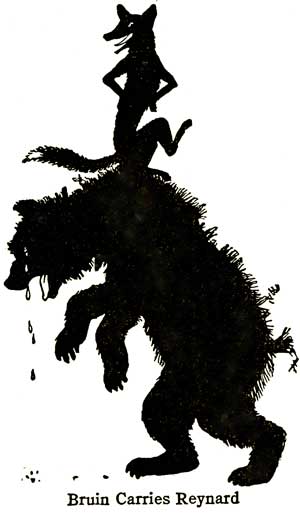
Bruin Carries Reynard

Well, Reynard crept home and found Bruin in such a state, who commenced to grumble and complain that it was all Reynard's fault that he had lost his tail. So Reynard pointed to his own tail and said, "Why, that's nothing; see my tail; they hit me so hard upon the head my brains fell out upon my tail. Oh, how bad I feel; won't you carry me to my little bed." So Bruin, who was a good-hearted soul, took him upon his back and rolled with him towards the house. And as he went on Reynard kept saying, "The sick carries the sound, the sick carries the sound."

"What's that you are saying?" asked Bruin.

"Oh, I have no brains left, I do not know what I am saying," said Reynard but kept on singing, "The sick carries the sound, ha, ha, the sick carries the sound."

Then Bruin knew that he had been done and threw Reynard down upon the ground, and would have eaten him up but that the fox slunk away and rushed into a briar bush. Bruin followed him closely into the briar bush and caught Reynard's hind leg in his mouth. Then Reynard called out, "That's right, you fool, bite the briar root, bite the briar root."

Bruin thinking that he was biting the briar root, let go Reynard's foot and snapped at the nearest briar root. "That's right, now you've got me,

don't hurt me too much,"

called out Reynard, and slunk away.

"Don't hurt me too much, don't hurt me too much."

When Bruin heard Reynard's voice dying away in the distance he knew that he had been done again, and that was the end of their partnership.

Some time after this a man was plowing in the field with his two oxen, who were very lazy that day. So the man called out at them, "Get a move on or I'll give you to the Bear"; and when they didn't quicken their pace he tried to frighten them by calling out, "Bear, Bear, come and take these lazy oxen." Sure enough, Bruin heard him and came out of the woods and said, "Here I am, give me the oxen, or else it'll be worse for you." The man was in despair but said, "Yes, yes, of course they are yours, but please let me finish my morning's plowing so I may finish this acre." Bruin could not say "No" to that, and sat down licking his chops and waiting for the oxen. The man went on plowing, thinking what he should do, when just at the corner of the field Reynard came up to him and said, "If you will give me two geese, I'll help you out of this fix and deliver the Bear into your hands." The man agreed and he told him what to do and went away into the woods. Soon after, the Bear and the man heard a noise like "Bow-wow, Bow-wow"; and the Bear came to the man and said, "What's that?" "Oh, that must be the lord's hounds out hunting for bears." "Hide me, hide me," said Bruin, "and I will let you off the oxen." Then Reynard called out from the wood, "What's that black thing you've got there?" And the Bear said, "Say it's the stump of a tree." So when the man had called this out to the Fox, Reynard called out, "Put it in the cart; fix it with the chain; cut off the boughs, and drive your axe into the stump." Then the Bear said to the man, "Pretend to do what he bids you; heave me into the cart; bind me with the chain; pretend to cut off the boughs, and drive the axe into the stump." So the man lifted Bruin into the cart, bound him with the chain, then cut off his limbs and buried the axe in his head.

Then Reynard came forward and asked for his reward, and the man went back to his house to get the pair of geese that he had promised.

"Wife, wife," he called out, as he neared the house, "get me a pair of geese, which I have promised the Fox for ridding me of the Bear."

"I can do better than that," said his wife Ann, and brought him out a bag with two struggling animals in it.

"Give these to Master Reynard," said she; "they will be geese enough for him." So the man took the bag and went down to the field and gave the bag to Reynard; but when he opened it out sprang two hounds, and he had great trouble in running away from them to his den.

When he got to his den the Fox asked each of his limbs, how they had helped him in his flight. His nose said, "I smelt the hounds"; his eyes said, "We looked for the shortest way"; his ears said, "We listened for the breathing of the hounds"; and his legs said, "We ran away with you." Then he asked his tail what it had done, and it said, "Why, I got caught in the bushes or made your leg stumble; that is all I could do." So, as a punishment, the Fox stuck his tail out of his den, and the hounds saw it and caught hold of it, and dragged the Fox out of his den by it and ate him all up. So that was the end of Master Reynard, and well he deserved it. Don't you think so?


Several familiar folktales were transformed into Reynard tales. The first is the Grimm collected tale of "The Cat and Mouse Who Shared a House." The story of why the bear is stumpy-tailed is a Norse tale that also traveled to Canada. Scholars have used it to show the Vikings did indeed land there because it is told by their First Nations. I don't know if Jacobs knew the story of "Br'er Rabbit in the Briar Patch", but it certainly fits Bear trying to get Reynard in the briar patch. As for the wife putting two dogs in a bag for Reynard, there probably are other stories using that, but it reminds me of the ending of "The Hobyahs."

************************

This is part of a series of postings of stories under the category, “Keeping the Public in Public Domain.” The idea behind Public Domain was to preserve our cultural heritage after the authors and their immediate heirs were compensated. I feel strongly current copyright law delays this intent on works of the 20th century. My own library of folklore includes so many books within the Public Domain I decided to share stories from them. I hope you enjoy discovering them.

At the same time, my own involvement in storytelling regularly creates projects requiring research as part of my sharing stories with an audience.  Whenever that research needs to be shown here, the publishing of Public Domain stories will not occur that week.  This is a return to my regular posting of a research project here.  (Don't worry, this isn't dry research, my research is always geared towards future storytelling to an audience.)  Response has convinced me that "Keeping the Public in Public Domain" should continue along with my other postings as often as I can manage it.

See the sidebar for other Public Domain story resources I recommend on the page “Public Domain Story Resources."


Friday, January 17, 2025

Jacobs - Hereafterthis - Keeping the Public in Public Domain

The fires of Los Angeles rightfully have been THE news item in a week still loaded with major events. Locally Mitch Albom, who supports a Haitian orphanage, has compared this to what happened after the earthquake in Haiti. I certainly hope L.A. doesn't evolve into the lawlessness and further destruction of Haiti, but agree the problems will outlast the attention currently trying to help after this disaster. For my own part I want to give to organizations who won't give now and then move on. To look at a recent U.S. event, this can be seen in the battle for support after the devastation from Hurricane Helene with its own "1,000 Year Flood."

I searched in Public Domain stories trying to find an appropriate story. Other than the unhelpful tale of Pandora opening the box bringing misery, I was dissatisfied with what I found. I did find the Joseph Jacobs tale of "Hereafterthis" in More English Fairy Tales. Yes, it's a "fairy tale" with all the implied simplification. The people affected by the fires have far more serious problems, but it does show how things can progress until disaster can wipe out everything. (I heard one woman "fortunate" to find a rental property say its monthly rent equals the amount she still must pay on her ruined home's mortgage.) So, yes, this story has a "fairy tale ending", but comes with the hope better days still come to all devastated by a 21st Century disaster comparable to the devastation of the 1906 San Francisco Earthquake.

Hereafterthis

Hereafterthis


Once upon a time there was a farmer called Jan, and he lived all alone by himself in a little farmhouse.

By-and-by he thought that he would like to have a wife to keep it all vitty for him.

So he went a-courting a fine maid, and he said to her: "Will you marry me?"

"That I will, to be sure," said she.

So they went to church, and were wed. After the wedding was over, she got up on his horse behind him, and he brought her home. And they lived as happy as the day was long.

One day, Jan said to his wife, "Wife can you milk-y?"

"Oh, yes, Jan, I can milk-y. Mother used to milk-y, when I lived home."

So he went to market and bought her ten red cows. All went well till one day when she had driven them to the pond to drink, she thought they did not drink fast enough. So she drove them right into the pond to make them drink faster, and they were all drowned.

When Jan came home, she up and told him what she had done, and he said, "Oh, well, there, never mind, my dear, better luck next time."

So they went on for a bit, and then, one day, Jan said to his wife, "Wife can you serve pigs?"

"Oh, yes, Jan, I can serve pigs. Mother used to serve pigs when I lived home."

So Jan went to market and bought her some pigs. All went well till one day, when she had put their food into the trough she thought they did not eat fast enough, and she pushed their heads into the trough to make them eat faster, and they were all choked.

When Jan came home, she up and told him what she had done, and he said, "Oh, well, there, never mind, my dear, better luck next time."

So they went on for a bit, and then, one day, Jan said to his wife, "Wife can you bake-y?"

"Oh, yes, Jan, I can bake-y. Mother used to bake-y when I lived home."

So he bought everything for his wife so that she could bake bread. All went well for a bit, till one day, she thought she would bake white bread for a treat for Jan. So she carried her meal to the top of a high hill, and let the wind blow on it, for she thought to herself that the wind would blow out all the bran. But the wind blew away meal and bran and all—so there was an end of it.

When Jan came home, she up and told him what she had done, and he said, "Oh, well, there, never mind, my dear, better luck next time."

So they went on for a bit, and then, one day, Jan said to his wife, "Wife can you brew-y?"

"Oh, yes, Jan, I can brew-y. Mother used to brew-y when I lived home."

So he bought everything proper for his wife to brew ale with. All went well for a bit, till one day when she had brewed her ale and put it in the barrel, a big black dog came in and looked up in her face. She drove him out of the house, but he stayed outside the door and still looked up in her face. And she got so angry that she pulled out the plug of the barrel, threw it at the dog, and said, "What dost look at me for? I be Jan's wife." Then the dog ran down the road, and she ran after him to chase him right away. When she came back again, she found that the ale had all run out of the barrel, and so there was an end of it.

When Jan came home, she up and told him what she had done, and he said, "Oh well, there, never mind, my dear, better luck next time."

So they went on for a bit, and then, one day, she thought to herself, "'T is time to clean up my house." When she was taking down her big bed she found a bag of groats on the tester. So when Jan came home, she up and said to him, "Jan, what is that bag of groats on the tester for?"

"That is for Hereafterthis, my dear."

Now, there was a robber outside the window, and he heard what Jan said. Next day, he waited till Jan had gone to market, and then he came and knocked at the door. "What do you please to want?" said Mally.

"I am Hereafterthis," said the robber, "I have come for the bag of groats."

Now the robber was dressed like a fine gentleman, so she thought to herself it was very kind of so fine a man to come for the bag of groats, so she ran upstairs and fetched the bag of groats, and gave it to the robber and he went away with it.

When Jan came home, she said to him, "Jan, Hereafterthis has been for the bag of groats."

"What do you mean, wife?" said Jan.

So she up and told him, and he said, "Then I'm a ruined man, for that money was to pay our rent with. The only thing we can do is to roam the world over till we find the bag of groats." Then Jan took the house-door off its hinges, "That's all we shall have to lie on," he said. So Jan put the door on his back, and they both set out to look for Hereafterthis. Many a long day they went, and in the night Jan used to put the door on the branches of a tree, and they would sleep on it. One night they came to a big hill, and there was a high tree at the foot. So Jan put the door up in it, and they got up in the tree and went to sleep. By-and-by Jan's wife heard a noise, and she looked to see what it was. It was an opening of a door in the side of the hill. Out came two gentlemen with a long table, and behind them fine ladies and gentlemen, each carrying a bag, and one of them was Hereafterthis with the bag of groats. They sat round the table, and began to drink and talk and count up all the money in the bags. So then Jan's wife woke him up, and asked what they should do.

"Now's our time," said Jan, and he pushed the door off the branches, and it fell right in the very middle of the table, and frightened the robbers so that they all ran away. Then Jan and his wife got down from the tree, took as many money-bags as they could carry on the door, and went straight home. And Jan bought his wife more cows, and more pigs, and they lived happy ever after.

***

May the people having to start over find a way, once again, to find reasons to continue and even to find happiness.  

For the rest of us, let us not forget the need to continue helping. 

***************

This is part of a series of postings of stories under the category, “Keeping the Public in Public Domain.” The idea behind Public Domain was to preserve our cultural heritage after the authors and their immediate heirs were compensated. I feel strongly current copyright law delays this intent on works of the 20th century. My own library of folklore includes so many books within the Public Domain I decided to share stories from them. I hope you enjoy discovering them.

At the same time, my own involvement in storytelling regularly creates projects requiring research as part of my sharing stories with an audience.  Whenever that research needs to be shown here, the publishing of Public Domain stories will not occur that week.  This is a return to my regular posting of a research project here.  (Don't worry, this isn't dry research, my research is always geared towards future storytelling to an audience.)  Response has convinced me that "Keeping the Public in Public Domain" should continue along with my other postings as often as I can manage it.

See the sidebar for other Public Domain story resources I recommend on the page “PublicDomain Story Resources."


Friday, July 29, 2022

The Highland Games + Johnny Gloke - Joseph Jacobs - Keeping the Public in Public Domain


The Wee Bairns area of the 173rd Highland Games of the St. Andrews Society of Detroit is returning!  It was missing at the 2020 and 2021 Highland Games due to Covid concerns.  It's always in a big open area at Greenmead Historical Village in Livonia so its elimination was surprising.  The intent behind the Wee Bairns area is bringing an understanding of Scottish heritage to children with fun events tailored to them.  

While North Oakland County Storytellers no longer hold meetings, some of us treasure our Scottish heritage and have told stories in the Wee Bairns area for a great many years.  Once again from 10 to 3 on Saturday, August 6, N.O.C.S. will bring it to listeners.  Ten of those stories can be found here under the heading of Scottish Folklore.  That reflects only some of the long history of participation there.  It goes back even further than is shown here.

Today's story comes from Joseph Jacobs, More English Fairy Tales, but don't let that title fool you as Jacobs definitely includes Scottish material.  You may jump down to the story, but if that English connection troubles you, read his discussion of this as part of his Preface to the book: 

Then as to using tales in Lowland Scotch, whereat a Saturday Reviewer, whose identity and fatherland were not difficult to guess, was so shocked. Scots a dialect of English! Scots tales the same as English! Horror and Philistinism! was the Reviewer's outcry. Matter of fact is my reply, which will only confirm him, I fear, in his convictions. Yet I appeal to him, why make a difference between tales told on different sides of the Border? A tale told in Durham or Cumberland in a dialect which only Dr. Murray could distinguish from Lowland Scotch, would on all hands be allowed to be "English." The same tale told a few miles farther North, why should we refuse it the same qualification? A tale in Henderson is English: why not a tale in Chambers, the majority of whose tales are to be found also south of the Tweed?

The truth is, my folk-lore friends and my Saturday Reviewer differ with me on the important problem of the origin of folk-tales. They think that a tale probably originated where it was found. They therefore attribute more importance than I to the exact form in which it is found and restrict it to the locality of birth. I consider the probability to lie in an origin elsewhere: I think it more likely than not that any tale found in a place was rather brought there than born there. I have discussed this matter elsewhere[1] with all the solemnity its importance deserves, and cannot attempt further to defend my position here. But even the reader innocent of folk-lore can see that, holding these views, I do not attribute much anthropological value to tales whose origin is probably foreign, and am certainly not likely to make a hard-and-fast division between tales of the North Countrie and those told across the Border.

[1] See "The Science of Folk Tales and the Problem of Diffusion" in Transactions of the International Folk-Lore Congress, 1891.

Don't know if you bothered to read all of that, but here's "Johnny Gloke" which will start out sounding rather familiar.  I'll give Jacobs' brief Notes and References after it.

Johnny Gloke

Johnny Gloke was a tailor by trade, but like a man of spirit he grew tired of his tailoring, and wished to follow some other path that would lead to honour and fame. But he did not know what to do at first to gain fame and fortune, so for a time he was fonder of basking idly in the sun than in plying the needle and scissors. One warm day as he was enjoying his ease, he was annoyed by the flies alighting on his bare ankles. He brought his hand down on them with force and killed a goodly number of them. On counting the victims of his valour, he was overjoyed at his success; his heart rose to the doing of great deeds, and he gave vent to his feelings in the saying:—

"Well done! Johnny Gloke,
Kilt fifty flies at one stroke."

His resolution was now taken to cut out his path to fortune and honour. So he took down from its resting-place a rusty old sword that had belonged to some of his forebears, and set out in search of adventures. After travelling a long way, he came to a country that was much troubled by two giants, whom no one was bold enough to meet, and strong enough to overcome. He was soon told of the giants, and learned that the King of the country had offered a great reward and the hand of his daughter in marriage to the man who should rid his land of this scourge. John's heart rose to the deed, and he offered himself for the service. The great haunt of the giants was a wood, and John set out with his old sword to perform his task. When he reached the wood, he laid himself down to think what course he would follow, for he knew how weak he was compared to those he had undertaken to kill. He had not waited long, when he saw them coming with a waggon to fetch wood for fuel. My! they were big ones, with huge heads and long tusks for teeth. Johnny hid himself in the hollow of a tree, thinking only of his own safety. Feeling himself safe, he peeped out of his hiding-place, and watched the two at work. Thus watching he formed his plan of action. He picked up a pebble, threw it with force at one of them, and struck him a sharp blow on the head. The giant in his pain turned at once on his companion, and blamed him in strong words for hitting him. The other denied in anger that he had thrown the pebble. John now saw himself on the high way to gain his reward and the hand of the King's daughter. He kept still, and carefully watched for an opportunity of striking another blow. He soon found it, and right against the giant's head went another pebble. The injured giant fell on his companion in fury, and the two belaboured each other till they were utterly tired out. They sat down on a log to breathe, rest, and recover themselves.

"...the two belaboured each other till they were utterly tired out."

While sitting, one of them said, "Well, all the King's army was not able to take us, but I fear an old woman with a rope's end would be too much for us now."

"If that be so," said Johnny Gloke, as he sprang, bold as a lion, from his hiding-place, "What do you say to Johnny Gloke with his old roosty sword?" So saying he fell upon them, cut off their heads, and returned in triumph. He received the King's daughter in marriage and for a time lived in peace and happiness. He never told the mode he followed in his dealing with the giants.

Some time after a rebellion broke out among the subjects of his father-in-law. John, on the strength of his former valiant deed, was chosen to quell the rebellion. His heart sank within him, but he could not refuse, and so lose his great name. He was mounted on the fiercest horse that ever saw sun or wind, and set out on his desperate task. He was not accustomed to ride on horseback, and he soon lost all control of his steed. It galloped off at full speed, in the direction of the rebel army. In its wild career it passed under the gallows that stood by the wayside. The gallows was somewhat old and frail, and down it fell on the horse's neck. Still the horse made no stop, but always forward at furious speed towards the rebels. On seeing this strange sight approaching towards them at such a speed they were seized with terror, and cried out to one another, "There comes Johnny Gloke that killed the two giants with the gallows on his horse's neck to hang us all." They broke their ranks, fled in dismay, and never stopped till they reached their homes. Thus was Johnny Gloke a second time victorious. So in due time he came to the throne and lived a long, happy, and good life as king.

***

I'm sure you recognized that story under a different name.  Jacobs addresses that: 

  JOHNNY GLOKE

Source.—Contributed by Mr. W. Gregor to Folk-Lore Journal, vii. I have rechristened "Johnny Glaik" for the sake of the rhyme, and anglicised the few Scotticisms.

Parallels.—This is clearly The Valiant Tailor of the Grimms: "x at a blow" has been bibliographised. (See my List of Incidents in Trans. Folk-Lore Congress, 1892, sub voce.)

Remarks.—How The Valiant Tailor got to Aberdeen one cannot tell, though the resemblance is close enough to suggest a direct "lifting" from some English version of Grimm's Goblins. At the same time it must be remembered that Jack the Giant Killer (see Notes on No. xix.) contains some of the incidents of The Valiant Tailor.

 Hope to see you and Nessie at the Highland Games next week on August 6.


 ****************

This is part of a series of postings of stories under the category, "Keeping the Public in Public Domain."  The idea behind Public Domain was to preserve our cultural heritage after the authors and their immediate heirs were compensated.  I feel strongly current copyright law delays this intent on works of the 20th century.  My own library of folklore includes so many books within the Public Domain I decided to share stories from them.  I hope you enjoy discovering new stories.  


At the same time, my own involvement in storytelling regularly creates projects requiring research as part of my sharing stories with an audience.  Whenever that research needs to be shown here, the publishing of Public Domain stories will not occur that week.  This is a return to my regular posting of a research project here.  (Don't worry, this isn't dry research, my research is always geared towards future storytelling to an audience.)  Response has convinced me that "Keeping the Public in Public Domain" should continue along with my other postings as often as I can manage it.

Other Public Domain story resources I recommend-

  • There are many online resources for Public Domain stories, maybe none for folklore is as ambitious as fellow storyteller, Yoel Perez's database, Yashpeh, the International Folktales Collection.  I have long recommended it and continue to do so.  He has loaded Stith Thompson's Motif Index into his server as a database so you can search the whole 6 volumes for whatever word or expression you like by pressing one key. http://folkmasa.org/motiv/motif.htm

  • You may have noticed I'm no longer certain Dr. Perez has the largest database, although his offering the Motif Index certainly qualifies for those of us seeking specific types of stories.  There's another site, FairyTalez claiming to be the largest, with "over 2000 fairy tales, folktales, and fables" and they are "fully optimized for phones, tablets, and PCs", free and presented without ads.
    Between those two sites, there is much for story-lovers, but as they say in infomercials, "Wait, there's more!"

The email list for storytellers, Storytell, discussed Online Story Sources and came up with these additional suggestions:        

         - David K. Brown - http://people.ucalgary.ca/~dkbrown/stories.html

         - Richard Martin - http://www.tellatale.eu/tales_page.html

         - Spirit of Trees - http://spiritoftrees.org/featured-folktales

         - Story-Lovers - http://www.story-lovers.com/ is now only accessible through the Wayback Machine, described below, but the late Jackie Baldwin's wonderful site lives on there, fully searchable manually (the Google search doesn't work), at https://archive.org/ .  It's not easy, but go to Story-lovers.com snapshot for October 22 2016  and you can click on SOS: Searching Out Stories to scroll down through the many story topics and click on the story topic that interests you.

       - World of Tales - http://www.worldoftales.com/ 

 
           - Zalka Csenge Virag - http://multicoloreddiary.blogspot.com doesn't give the actual stories, but her recommendations, working her way through each country on a continent, give excellent ideas for finding new books and stories to love and tell.

     
You're going to find many of the links on these sites have gone down, BUT go to the Internet Archive Wayback Machine to find some of these old links.  Tim's site, for example, is so huge probably updating it would be a full-time job.  In the case of Story-Lovers, it's great that Jackie Baldwin set it up to stay online as long as it did after she could no longer maintain it.  Possibly searches maintained it.  Unfortunately Storytell list member, Papa Joe is on both Tim Sheppard's site and Story-Lovers, but he no longer maintains his old Papa Joe's Traveling Storytelling Show website and his Library (something you want to see!) is now only on the Wayback Machine.  It took some patience working back through claims of snapshots but finally in December of 2006 it appears!

    Somebody as of this writing whose stories can still be found by his website is the late Chuck Larkin - http://chucklarkin.com/stories.html.  I prefer to list these sites by their complete address so they can be found by the Wayback Machine, a.k.a. Archive.org, when that becomes the only way to find them.

You can see why I recommend these to you. 

Have fun discovering even more stories

Friday, October 15, 2021

Mr. Fox - Steel - Keeping the Public in Public Domain

One of my long-time favorite spooky tales to tell mature audiences is Mister Fox.  It's as current as any modern day news item of a serial killer.  The type goes back at least to the story of Bluebeard with its variations.  For years I've told the version collected by Joseph Jacobs.  Surprisingly enough, although I've had 15 articles here with Jacobs as a label, I've never posted the story here.  Earlier this year I found the version by Flora Annie Steel.  The two tellings are very similar, including the haunting message carved over the doors at the castle of Mr. Fox.  I suggest, however, comparing her version with the link given above to that recorded by Joseph Jacobs.  

If it were legible enough, I'd post the two copies alongside each other, but recommend you do that for yourself before telling it.  

From the title page of English Fairy Tales retold by Flora Annie Steel

MR. FOX

Lady Mary was young and Lady Mary was fair, and she had more lovers than she could count on the fingers of both hands.

She lived with her two brothers, who were very proud and very fond of their beautiful sister, and very anxious that she should choose well amongst her many suitors.

Now amongst them there was a certain Mr. Fox, handsome and young and rich; and though nobody quite knew who he was, he was so gallant and so gay that every one liked him. And he wooed Lady Mary so well that at last she promised to marry him. But though he talked much of the beautiful home to which he would take her, and described the castle and all the wonderful things that furnished it, he never offered to show it to her, neither did he invite Lady Mary's brothers to see it.

Now this seemed to her very strange indeed; and, being a lass of spirit, she made up her mind to see the castle if she could.

So one day, just before the wedding, when she knew Mr. Fox would be away seeing the lawyers with her brothers, she just kilted up her skirts and set out unbeknownst—for, see you, the whole household was busy preparing for the marriage feastings—to see for herself what Mr. Fox's beautiful castle was like.

After many searchings, and much travelling, she found it at last; and a fine strong building it was, with high walls and a deep moat to it. A bit frowning and gloomy, but when she came up to the wide gateway she saw these words carven over the arch:

BE BOLD—BE BOLD.

So she plucked up courage, and the gate being open, went through it and found herself in a wide, empty, open courtyard. At the end of this was a smaller door, and over this was carven:

BE BOLD, BE BOLD; BUT NOT TOO BOLD.

So she went through it to a wide, empty hall, and up the wide, empty staircase. Now at the top of the staircase there was a wide, empty gallery at one end of which were wide windows with the sunlight streaming through them from a beautiful garden, and at the other end a narrow door, over the archway of which was carven:

BE BOLD, BE BOLD; BUT NOT TOO BOLD,
LEST THAT YOUR HEART'S BLOOD SHOULD RUN COLD
.

Now Lady Mary was a lass of spirit, and so, of course, she turned her back on the sunshine, and opened the narrow, dark door. And there she was in a narrow, dark passage. But at the end there was a chink of light. So she went forward and put her eye to the chink—and what do you think she saw?

Why! a wide saloon lit with many candles, and all round it, some hanging by their necks, some seated on chairs, some lying on the floor, were the skeletons and bodies of numbers of beautiful young maidens in their wedding-dresses that were all stained with blood.

Now Lady Mary, for all she was a lass of spirit, and brave as brave, could not look for long on such a horrid sight, so she turned and fled. Down the dark narrow passage, through the dark narrow door (which she did not forget to close behind her), and along the wide gallery she fled like a hare, and was just going down the wide stairs into the wide hall when, what did she see, through the window, but Mr. Fox dragging a beautiful young lady across the wide courtyard! There was nothing for it, Lady Mary decided, but to hide herself as quickly and as best she might; so she fled faster down the wide stairs, and hid herself behind a big wine-butt that stood in a corner of the wide hall. She was only just in time, for there at the wide door was Mr. Fox dragging the poor young maiden along by the hair; and he dragged her across the wide hall and up the wide stairs. And when she clutched at the bannisters to stop herself, Mr. Fox cursed and swore dreadfully; and at last he drew his sword and brought it down so hard on the poor young lady's wrist that the hand, cut off, jumped up into the air so that the diamond ring on the finger flashed in the sunlight as it fell, of all places in the world, into Lady Mary's very lap as she crouched behind the wine-butt!

Then she was fair frightened, thinking Mr. Fox would be sure to find her; but after looking about a little while in vain (for, of course, he coveted the diamond ring), he continued his dreadful task of dragging the poor, beautiful young maiden upstairs to the horrid chamber, intending, doubtless, to return when he had finished his loathly work, and seek for the hand.

But by that time Lady Mary had fled; for no sooner did she hear the awful, dragging noise pass into the gallery, than she upped and ran for dear life—through the wide door with

BE BOLD, BE BOLD; BUT NOT TOO BOLD

engraven over the arch, across the wide courtyard past the wide gate with

BE BOLD—BE BOLD

engraven over it, never stopping, never thinking till she reached her own chamber. And all the while the hand with the diamond ring lay in her kilted lap.

Now the very next day, when Mr. Fox and Lady Mary's brothers returned from the lawyers, the marriage-contract had to be signed. And all the neighbourhood was asked to witness it and partake of a splendid breakfast. And there was Lady Mary in bridal array, and there was Mr. Fox, looking so gay and so gallant. He was seated at the table just opposite Lady Mary, and he looked at her and said:

"How pale you are this morning, dear heart."

Then Lady Mary looked at him quietly and said, "Yes, dear sir! I had a bad night's rest, for I had horrible dreams."

Then Mr. Fox smiled and said, "Dreams go by contraries, dear heart; but tell me your dream, and your sweet voice will speed the time till I can call you mine."

"I dreamed," said Lady Mary, with a quiet smile, and her eyes were clear, "that I went yesterday to seek the castle that is to be my home, and I found it in the woods with high walls and a deep dark moat. And over the gateway were carven these words:

BE BOLD—BE BOLD."

Then Mr. Fox spoke in a hurry. "But it is not so—nor it was not so."

"Then I crossed the wide courtyard and went through a wide door over which was carven:

BE BOLD, BE BOLD; BUT NOT TOO BOLD,"

went on Lady Mary, still smiling, and her voice was cold; "but, of course, it is not so, and it was not so."

And Mr. Fox said nothing; he sate like a stone.

"Then I dreamed," continued Lady Mary, still smiling, though her eyes were stern, "that I passed through a wide hall and up a wide stair and along a wide gallery until I came to a dark narrow door, and over it was carven:

BE BOLD, BE BOLD; BUT NOT TOO BOLD,
LEST THAT YOUR HEART'S BLOOD SHOULD RUN COLD
.

"But it is not so, of course, and it was not so."

And Mr. Fox said nothing; he sate frozen.

"Then I dreamed that I opened the door and went down a dark narrow passage," said Lady Mary, still smiling, though her voice was ice. "And at the end of the passage there was a door, and the door had a chink in it. And through the chink I saw a wide saloon lit with many candles, and all round it were the bones and bodies of poor dead maidens, their clothes all stained with blood; but of course it is not so, and it was not so."

By this time all the neighbours were looking Mr. Fox-ways with all their eyes, while he sate silent.

But Lady Mary went on, and her smiling lips were set:

"Then I dreamed that I ran downstairs and had just time to hide myself when you, Mr. Fox, came in dragging a young lady by the hair. And the sunlight glittered on her diamond ring as she clutched the stair-rail, and you out with your sword and cut off the poor lady's hand."

Then Mr. Fox rose in his seat stonily and glared about him as if to escape, and his eye-teeth showed like a fox beset by the dogs, and he grew pale.

And he said, trying to smile, though his whispering voice could scarcely be heard:

"But it is not so, dear heart, and it was not so, and God forbid it should be so!"

Then Lady Mary rose in her seat also, and the smile left her face, and her voice rang as she cried:

"But it is so, and it was so;
Here's hand and ring I have to show."

And with that she pulled out the poor dead hand with the glittering ring from her bosom and pointed it straight at Mr. Fox.

At this all the company rose, and drawing their swords cut Mr. Fox to pieces.

*******

I find Steel's version a bit more complete and definitely prefer her Lady Mary, who Steel stressed as "a lass of spirit."  Perhaps you will prefer Jacobs, possibly considering it more streamlined.  It's interesting that his "Mr. Fox" is found in a book also titled English Fairy Tales.  His book was published in 1898, while Steel's was 1918 and she herself says she retold the stories.  

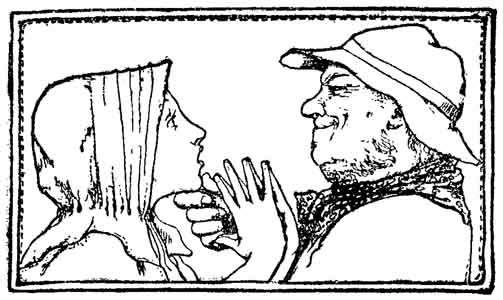
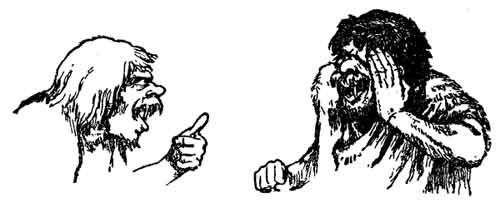
Jacobs is diligent in giving his sources in his volumes and regularly cautions younger readers not to read further.  I'm particularly fond of this drawing by his regular illustrator, John D. Batten, found in Jacobs' More Celtic Fairy Tales.

(My maternal roots include the name Batten.  Genealogy puts me to sleep, but would love there to be a personal link somewhere to John D.)

Jacobs research goes back to Shakespeare.  At the risk of putting you to sleep, he notes:

Source.—Contributed by Blakeway to Malone's Variorum Shakespeare, to illustrate Benedick's remark in Much Ado about Nothing (I. i. 146): “Like the old tale, my Lord, 'It is not so, nor 'twas not so, but, indeed, God forbid it should be so;'” which clearly refers to the tale of Mr. Fox. “The Forbidden Chamber” has been studied by Mr. Hartland, Folk-Lore Journal, iii. 193, seq.

Parallels.—Halliwell, p. 166, gives a similar tale of “An Oxford Student,” whose sweetheart saw him digging her grave. “Mr. Fox” is clearly a variant of the theme of “The Robber Bridegroom” (Grimm, No. 40, Mrs. Hunt's translation, i. 389, 395; and Cosquin, i. 180-1).

The folk process of telling means the story, along with those previously mentioned Bluebeard variations, will have slight differences from storyteller to storyteller.  The creepy nature of this story, however, remains in each.

*****************  

This is part of a series of postings of stories under the category, "Keeping the Public in Public Domain."  The idea behind Public Domain was to preserve our cultural heritage after the authors and their immediate heirs were compensated.  I feel strongly current copyright law delays this intent on works of the 20th century.  My own library of folklore includes so many books within the Public Domain I decided to share stories from them.  I hope you enjoy discovering new stories.  


At the same time, my own involvement in storytelling regularly creates projects requiring research as part of my sharing stories with an audience.  Whenever that research needs to be shown here, the publishing of Public Domain stories will not occur that week.  This is a return to my regular posting of a research project here.  (Don't worry, this isn't dry research, my research is always geared towards future storytelling to an audience.)  Response has convinced me that "Keeping the Public in Public Domain" should continue along with my other postings as often as I can manage it.
Other Public Domain story resources I recommend-
  • There are many online resources for Public Domain stories, maybe none for folklore is as ambitious as fellow storyteller, Yoel Perez's database, Yashpeh, the International Folktales Collection.  I have long recommended it and continue to do so.  He has loaded Stith Thompson's Motif Index into his server as a database so you can search the whole 6 volumes for whatever word or expression you like by pressing one key. http://folkmasa.org/motiv/motif.htm
  • You may have noticed I'm no longer certain Dr. Perez has the largest database, although his offering the Motif Index certainly qualifies for those of us seeking specific types of stories.  There's another site, FairyTalez claiming to be the largest, with "over 2000 fairy tales, folktales, and fables" and they are "fully optimized for phones, tablets, and PCs", free and presented without ads.

    Between those two sites, there is much for story-lovers, but as they say in infomercials, "Wait, there's more!"
The email list for storytellers, Storytell, discussed Online Story Sources and came up with these additional suggestions:            
         - David K. Brown - http://people.ucalgary.ca/~dkbrown/stories.html
         - Richard Martin - http://www.tellatale.eu/tales_page.html
         - Spirit of Trees - http://spiritoftrees.org/featured-folktales
         - Story-Lovers - http://www.story-lovers.com/ is now only accessible through the Wayback Machine, described below, but the late Jackie Baldwin's wonderful site lives on there, fully searchable manually (the Google search doesn't work), at https://archive.org/ .  It's not easy, but go to Story-lovers.com snapshot for October 22 2016  and you can click on SOS: Searching Out Stories to scroll down through the many story topics and click on the story topic that interests you.
       - World of Tales - http://www.worldoftales.com/ 
           - Zalka Csenge Virag - http://multicoloreddiary.blogspot.com doesn't give the actual stories, but her recommendations, working her way through each country on a continent, give excellent ideas for finding new books and stories to love and tell.
     
You're going to find many of the links on these sites have gone down, BUT go to the Internet Archive Wayback Machine to find some of these old links.  Tim's site, for example, is so huge probably updating it would be a full-time job.  In the case of Story-Lovers, it's great that Jackie Baldwin set it up to stay online as long as it did after she could no longer maintain it.  Possibly searches maintained it.  Unfortunately Storytell list member, Papa Joe is on both Tim Sheppard's site and Story-Lovers, but he no longer maintains his old Papa Joe's Traveling Storytelling Show website and his Library (something you want to see!) is now only on the Wayback Machine.  It took some patience working back through claims of snapshots but finally in December of 2006 it appears!
    Somebody as of this writing whose stories can still be found by his website is the late Chuck Larkin - http://chucklarkin.com/stories.html.  I prefer to list these sites by their complete address so they can be found by the Wayback Machine, a.k.a. Archive.org, when that becomes the only way to find them.
You can see why I recommend these to you. Have fun discovering even more stories!