Tell me if you have a topic you'd like to see. (Contact: LoiS-sez@LoiS-sez.com .)
Please also let others know about this site.
Showing posts with label Henry Rowe Schoolcraft. Show all posts

Friday, December 6, 2024

Cowles - Why the Wind Wails - Keeping the Public in Public Domain

The only rule for weather predictions for most locations is that it will change. . . and it definitely has!

We may not have received the nation's worst, but Michigan, especially the west and north, is bad enough. Erie Pennsylvania, your residents must love winter. Since winter and cold are my least favorite time of year, anybody there who doesn't love winter has my sympathy.

We had been having above normal weather and I was foolish enough to think that was a trend!

Julia Darrow Cowles and her book Indian Nature Myths hasn't been here in years -- their posting here spans from 2013 - 2017. That first story back in 2013 was before I found ways to reproduce pages better than a simple scan of my own books. That first story was her retelling of the Schoolcraft tale, "How the Seasons Came to Be." Definitely appropriate now. I suggest going to the book listed above at Project Gutenberg as the entire book is a treat for nature lovers.

Cowles notes the nations responsible for her stories, often the Anishinaabe (listing as Ojibwa or Chippewa) but several, including today's story, are merely attributed to the Algonquian. Our area's native people are part of that larger group and stories do travel. For more about the Algonquian peoples go to that link to understand this most populous and widespread North American indigenous North American group. Cowles briefly mentioned such story traveling in her Preface.

Wind chills have made the weather transition particularly brutal, so this Algonquin story is on my mind as the wind howls or it invisibly tries to beat me.

WHY THE WIND WAILS

(Algonquin)

WHEN the pale moon looks down from the sky, and when the wind cries mournfully around the wigwam, this is the story that the old man of the tribe tells to the Indian children:

Many, many moons ago the great chief of our tribe had a very beautiful daughter.

“She shall marry a great warrior,” said the Chief, “and a mighty hunter. Then she will be well cared for, and I shall be happy.”

So the great Chief kept watch of the young men of the tribe, to see which one would prove worthy of his daughter.

One day, as the Chief sat in the door of his lodge, there came a sudden rushing sound, and a young man stood before him. It was the Wind, who had made himself visible that he might talk with the Chief.

When he had saluted, he said, “Great Chief, I love your daughter. May I carry her away to my lodge, and make her my wife?”

The Chief looked at the Wind, and he answered, “No. My daughter is not for such as you. You are no warrior. You are no hunter. You love to play pranks. You cannot marry my daughter.”

So the Wind went away sorrowing, for he loved the Indian maiden.

The next day the maiden came to her father and said, “Father, I love the Wind better than any young warrior of our tribe. May I go to his lodge, and be his wife?”

The Chief looked at his daughter and said, “No. The Wind is no mate for you. He is no warrior. He is no hunter. He loves only to play pranks. You cannot marry him.”

The maiden went away sorrowing, for she loved the Wind.

The next day when the maiden went out to gather sweet marsh grass for her basket weaving, she heard a sudden rushing sound above her head. She looked up, and as she looked the Wind swept down and carried her in his arms far away to his lodge.

There they lived happily together, for the maiden became his wife. But the great Chief was full of wrath. He hunted through all the land for the lodge of the Wind, but he could not find it for many moons. Still he would not give up the search, for his heart was hot with wrath.

One day the Wind heard a great crashing sound among the trees near his lodge, and his heart stood still.

“It is your father,” he cried, and he hid the Chief’s daughter in a thicket, while he made himself invisible, that he might stay close beside her.

The great Chief looked inside the lodge of the Wind, but he found it empty. Then he went through the brush, striking to right and left with his heavy club, and calling, “My daughter: my daughter!”

And when the Wind’s wife heard her father’s voice, she answered, “Oh, my father, strike not! We are here.”

But before her words could reach him, the Chief swung his great club once more, and it fell upon the head of the invisible Wind, who, without a sound, dropped unconscious upon the ground. And because he was invisible, neither the Chief nor his daughter knew what had happened.

Then the Chief took his daughter in his arms and hastened back to his tribe. But each day she grew more and more sorrowful, and longed for her husband, the Wind.

For many hours the Wind lay unconscious beside his lodge. When he awakened, the Chief and his daughter had gone. Sorrowfully he set out in search of his wife. He traveled to her father’s tribe, and there at last he found her. But she was in a canoe with her father, far out upon the lake.

Then the Wind cried, “Come to me, my loved one,” and his voice swept out over the water.

The Chief said, “The winds are blowing,” but his daughter knew her husband’s voice. She could not see him, for he was still invisible, but she lifted herself up in the canoe and stretched out her hands toward the shore. As she did so a breeze stirred the water, and the canoe overturned.

The Chief’s daughter threw up her arms, and the Wind tried to catch her in his embrace, but he was too late. The Great Spirit bore her far up into the sky, and there he gave her a home where she would live
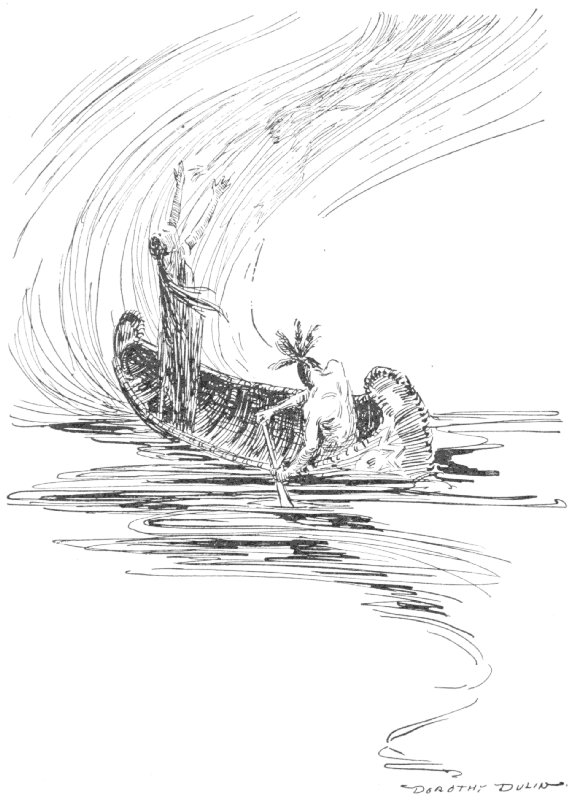


“THE WIND TRIED TO CATCH HER IN HIS EMBRACE”

The great Chief was drowned in the waters of the lake.

Night after night his daughter looks down upon the earth, hoping for a sight of her lost lover. But though the Wind still roams about the earth in search of his bride, he has never, since the Chief’s blow fell upon his head, had the power to become visible to men.

And now you will understand why the voice of the Wind is so mournful as it wails about the wigwam; and why the Moon Maiden’s pale face is always turned downward toward the earth.

***

The book ends with another Algonquin wind tale, "Keepers of the Winds", but it's best saved for a warmer time. 

For my fellow storytellers I want to repeat Cowles' note that appeared right before the stories: 

Before reading or telling the Indian Nature Myths to the children, it is best to explain that just as they love to wonder and imagine about the new and strange sights and sounds of the world, so the early races of men, the children of time, loved to wonder and imagine. And so these stories of nature grew out of their imaginings; and some of the stories are so beautiful, and some of them are so odd, that men have repeated them from one generation to another, ever since,—for even when they no longer believed them to be true, they loved them.

Other anthologies title this story "Bride of the Wind." Florence Holbrook's The Book of Nature Myths and Mary F. Nixon-Roulet's Indian Folk Tales  are two Public Domain books with that title.

 ******************

This is part of a series of postings of stories under the category, “Keeping the Public in Public Domain.” The idea behind Public Domain was to preserve our cultural heritage after the authors and their immediate heirs were compensated. I feel strongly current copyright law delays this intent on works of the 20th century. My own library of folklore includes so many books within the Public Domain I decided to share stories from them. I hope you enjoy discovering them.

At the same time, my own involvement in storytelling regularly creates projects requiring research as part of my sharing stories with an audience.  Whenever that research needs to be shown here, the publishing of Public Domain stories will not occur that week.  This is a return to my regular posting of a research project here.  (Don't worry, this isn't dry research, my research is always geared towards future storytelling to an audience.)  Response has convinced me that "Keeping the Public in Public Domain" should continue along with my other postings as often as I can manage it.

See the sidebar for other Public Domain story resources I recommend on the page “PublicDomain Story Resources."

Friday, November 5, 2021

Schoolcraft - Shingebiss - Keeping the Public in Public Domain

November is a month to focus on Native Americans.  It can't begin to cover enough, but I propose to take the four directions -- a sacred concept that probably spans the many Native American nations -- and give a story for each.  

Of course my love of the Anishinaabe means I must open with the north and our Great Lakes people.  Commonly called the People of the 3 Fires, they are composed of the Ojibwa (also called Chippewa), the Odawa (or Ottawa), and the Pottawatomi.  The third group, the Pottawatomi is mainly on the west side of Michigan and I've never had any opportunity to know anybody there.  They also are in Canada and called the First Nations (the Canadian name for the first people; here in the U.S. we say Native American).  I'm uncertain how their First Nations sisters and brothers might differ as again I'm limited to only what I find online and in print.  I've been taught by both Odawa and Ojibwa elders who have now gone on the Long Walk and I miss them immensely.  I have a fellow storytelling friend, Robyn Henry from the Saginaw Chippewa Band, who used to be in the Flint area.  Since she moved away it's been harder to stay in touch, but she's the one I'd always turn to for verification.  I know she resents the way many of the legends belonging to her people are supposedly now unavailable because outside writers tell and copyright them.  

Robyn also is aware of the way stories in the few anthologies available are either incomplete or contain errors.  Certainly Henry Rowe Schoolcraft  reveals his 19th century roots, but we are blessed with the knowledge that his wife, Jane Johnston Schoolcraft (whose name translates as The Sound the Stars Make Rushing Through the Sky), told him Anishinaabe stories she knew.  By the way, that hotlink for her name is also the title of a 2008 book edited by Robert Dale Parker of  all her writings, including poetry.  I believe this story reveals her poetic nature.  Project Gutenberg includes it in the book attributed to H.R. Schoolcraft, with the unattractive title of The Myth of Hiawatha, and Other Oral Legends, Mythologic and Allegoric, of the North American Indians.

Photograph by Scott Suriano
Don't let any of that stop you for many have found this to be a story worth knowing.  Sometimes it's about a duck living alone in the winter, but I've also heard of people telling it as if Shingebiss was a woman.  Some people debate which type of our ducks who winter here it could be.  Again, don't let that stop you.  You can also substitute Northwest Wind for Kabebonicca. I'll say more after the story, but for now let it speak to you.  I'm confident you will be glad you did. 

 SHINGEBISS.

AN ALLEGORY OF SELF-RELIANCE.

FROM THE ODJIBWA.

There was once a Shingebiss, the name of the fall duck living alone, in a solitary lodge, on the shores of the deep bay of a lake, in the coldest winter weather. The ice had formed on the water, and he had but four logs of wood to keep his fire. Each of these would, however, burn a month, and as there were but four cold winter months, they were sufficient to carry him through till spring.

Shingebiss was hardy and fearless, and cared for no one. He would go out during the coldest day, and seek for places where flags and rushes grew through the ice, and plucking them up with his bill, would dive through the openings, in quest of fish. In this way he found plenty of food, while others were starving, and he went home daily to his lodge, dragging strings of fish after him, on the ice.

Kabebonicca observed him, and felt a little piqued at his perseverance and good luck in defiance of the severest blasts of wind he could send from the northwest. "Why! this is a wonderful man," said he; "he does not mind the cold, and appears as happy and contented as if it were the month of June. I will try whether he cannot be mastered." He poured forth tenfold colder blasts, and drifts of snow, so that it was next to impossible to live in the open air. Still, the fire of Shingebiss did not go out: he wore but a single strip of leather around his body, and he was seen, in the worst weather, searching the shores for rushes, and carrying home fish.

"I shall go and visit him," said Kabebonicca, one day, as he saw Shingebiss dragging along a quantity of fish. And, accordingly, that very night, he went to the door of his lodge. Meantime Shingebiss had cooked his fish, and finished his meal, and was lying, partly on his side, before the fire, singing his songs. After Kabebonicca had come to the door, and stood listening there, he sang as follows:—

Ka Neej Ka Neej
Be In Be In
Bon In Bon In
Oc Ee. Oc Ee.
Ca We-ya! Ca We-ya!

The number of words, in this song, are few and simple, but they are made up from compounds which carry the whole of their original meanings, and are rather suggestive of the ideas floating in the mind than actual expressions of those ideas. Literally, he sings:—

Spirit of the Northwest—you are but my fellow man.

By being broken into syllables, to correspond with a simple chant, and by the power of intonation and repetition, with a chorus, these words are expanded into melodious utterance, if we may be allowed the term, and may be thus rendered:—

Windy god, I know your plan,

You are but my fellow man;

Blow you may your coldest breeze,

Shingebiss you cannot freeze.

Sweep the strongest wind you can,

Shingebiss is still your man;

Heigh! for life—and ho! for bliss,

Who so free as Shingebiss?

The hunter knew that Kabebonicca was at his door, for he felt his cold and strong breath; but he kept on singing his songs, and affected utter indifference. At length Kabebonicca entered, and took his seat on the opposite side of the lodge. But Shingebiss did not regard, or notice him. He got up, as if nobody were present, and taking his poker, pushed the log, which made his fire burn brighter, repeating, as he sat down again:—

You are but my fellow man.

Very soon the tears began to flow down Kabebonicca's cheeks, which increased so fast, that, presently, he said to himself: "I cannot stand this—I must go out." He did so, and left Shingebiss to his songs; but resolved to freeze up all the flag orifices, and make the ice thick, so that he could not get any more fish. Still, Shingebiss, by dint of great diligence, found means to pull up new roots, and dive under for fish. At last, Kabebonicca was compelled to give up the contest. "He must be aided by some Monedo," said he. "I can neither freeze him nor starve him; he is a very singular being—I will let him alone."

**** 

Do a search for Shingebiss and you will see, among other things, a picture book retelling the story by Nancy Van Laan.  You can use this to judge how close to its origins it is, but don't believe the story is locked up under copyright and can't be retold.  It's too important for that.

Friend and fellow storyteller, Fran Stallings is a member of National Storytelling Network's  Special Interest Group, Healing Story Alliance.  When I went looking for more about Shingebiss the search led me to the Wayback Machine and her very thorough telling and teller's notes about the story dating back to early in this century.  I strongly recommend it.  It even includes her version of the music in the tale.

Back in 2011 Canadian songwriter and recording/audiovisual artist, Ellsie Kay, wrote a song for Shingebiss.  She's not a member of the First Nations, but her song and brief form of telling the story on YouTube is definitely worth viewing and seems to capture the spirit of this story.  I've too little knowledge of pronunciation of  the language to guarantee it's correct, but love her translation:

North Wind, North Wind, fierce in feature

You are but my fellow creature;

Blow your worst, you can't freeze me;

I fear you not, and so I'm FREE!

Whether you feel like telling the story & trying to sing what either she or Fran offer for the song, or just as appropriately, chant the words Kay offers, I believe you and your audiences will remember that last line and maybe even join you in it: 

I fear you not, and so I'm FREE!

By the time you read this, I will have been able to tell this story twice as part of the Jackson Storyfest.  What a privilege to bring Shingebiss and other Anishinaabe tales.  I wish they were being told by Anishinaabeg tellers, but will do my best to represent them as faithfully as possible.  

Let your love of the wisdom found in our Native American stories keep you reading and telling them.  As Shingebiss would remind you, "I fear you not, and so I'm FREE!"  At the same time do it with respect and honor the original tellers and their intent to keep their wisdom for all of us.


Saturday, March 21, 2020

Parker - The Coming of Spring - Keeping the Public in Public Domain

The vernal equinox started in the U.S. Thursday, March 19 making it official, spring has arrived in the Northern Hemisphere with day and night roughly equal in length.  The Old Farmer's Almanac's website tells us the last time spring appeared this early was 1896, but don't get too excited, it's always either March 19, 20, or 21.  Three options, but it's also interesting that it won't happen again on March 21 until 2101.

Different people have different ways of feeling that spring has arrived in their area.

Alexas_Fotos / 21121 on Pixabay
This week I saw one in front of me.  I live near a golf course, but am not a golfer.  That course has been great for walking with my dog while winter closed it to golfers and days have been short.  Looks like I won't be able to walk it much longer as the lawns were looking green, flags were out at the holes, and the grounds crew had obviously been busy.  I guess you could switch the quote from The Field of Dreams to "If you groom it, they will come!"  Since a foursome is under the current suggested maximum of ten for social distancing, I suspect golf fanatics, known for even risking being struck by lightning, will take to the course.  Can't say for sure, but there's a snow and/or rainstorm working its way across the country.

Robins are often pointed to as a sign of spring.  Since they arrive even while snow still returns to Michigan, they're not a very reliable sign.  Michigan's first people, the Anishinaabe, also eagerly awaited spring's return to our mitten-shaped state.  Henry Rowe Schoolcraft  recorded some of those stories and the link to him here takes you to some, including one about our official state bird, the robin.

Stories travel.  The Anishinaabe tale of "Peboan and Seegwun" is such a favorite I've given it here twice!  Did our area's First People over on the western end of the Great Lakes influence the Seneca,  who were the farthest west of the eastern First People of the Iroquois Confederation.  The Seneca were located south of Lake Ontario, at the opposite, eastern end of the Great Lakes.  Did the Seneca influence our own "People of the Three Fires?"  I know the two nations weren't always friendly, but there's obvious similarity to our area's story in the tale recorded by Arthur C. Parker from Aurelia Miller one probably chilly January day in 1905 and published in his Seneca Myths & Folk Tales.  Whether you compare it to "Peboan and Seegwun" or not, I believe the imagery of the Seneca characters will stick with you because we all hope winter is ending and we are seeing "The Coming of Spring."

If you're looking for educational value, comparing the Seneca tale to "Peboan and Seegwun" is great for kids, but really that sounds like school.  Why spoil it?  Let's go back to that Old Farmer's Almanac article which asks "How Do YOU Celebrate the Vernal Equinox?" then answers it with Observe nature around you! and comes up with seven ideas to do it.

Their ideas aren't incompatible with "social distancing" and even work if you are in quarantine.  Then when spring showers (or late snows) start, come back inside and read as March is Reading Month!
******************
This is part of a series of postings of stories under the category, "Keeping the Public in Public Domain."  The idea behind Public Domain was to preserve our cultural heritage after the authors and their immediate heirs were compensated.  I feel strongly current copyright law delays this intent on works of the 20th century.  My own library of folklore includes so many books within the Public Domain I decided to share stories from them.  I hope you enjoy discovering new stories.  


At the same time, my own involvement in storytelling regularly creates projects requiring research as part of my sharing stories with an audience.  Whenever that research needs to be shown here, the publishing of Public Domain stories will not occur that week.  This is a return to my regular posting of a research project here.  (Don't worry, this isn't dry research, my research is always geared towards future storytelling to an audience.)  Response has convinced me that "Keeping the Public in Public Domain" should continue along with my other postings as often as I can manage it.
Other Public Domain story resources I recommend-
  • There are many online resources for Public Domain stories, maybe none for folklore is as ambitious as fellow storyteller, Yoel Perez's database, Yashpeh, the International Folktales Collection.  I have long recommended it and continue to do so.  He has loaded Stith Thompson's Motif Index into his server as a database so you can search the whole 6 volumes for whatever word or expression you like by pressing one key. http://folkmasa.org/motiv/motif.htm
  • You may have noticed I'm no longer certain Dr. Perez has the largest database, although his offering the Motif Index certainly qualifies for those of us seeking specific types of stories.  There's another site, FairyTalez claiming to be the largest, with "over 2000 fairy tales, folktales, and fables" and they are "fully optimized for phones, tablets, and PCs", free and presented without ads.

    Between those two sites, there is much for story-lovers, but as they say in infomercials, "Wait, there's more!"
The email list for storytellers, Storytell, discussed Online Story Sources and came up with these additional suggestions:            
         - David K. Brown - http://people.ucalgary.ca/~dkbrown/stories.html
         - Richard Martin - http://www.tellatale.eu/tales_page.html
         - Spirit of Trees - http://spiritoftrees.org/featured-folktales
         - Story-Lovers - http://www.story-lovers.com/ is now only accessible through the Wayback Machine, described below, but Jackie Baldwin's wonderful site lives on there, fully searchable manually (the Google search doesn't work), at https://archive.org/ .  It's not easy, but go to Story-lovers.com snapshot for October 22 2016  and you can click on SOS: Searching Out Stories to scroll down through the many story topics and click on the story topic that interests you.
       - World of Tales - http://www.worldoftales.com/ 
           - Zalka Csenge Virag - http://multicoloreddiary.blogspot.com doesn't give the actual stories, but her recommendations, working her way through each country on a continent, give excellent ideas for finding new books and stories to love and tell.
     
You're going to find many of the links on these sites have gone down, BUT go to the Internet Archive Wayback Machine to find some of these old links.  Tim's site, for example, is so huge probably updating it would be a full-time job.  In the case of Story-Lovers, it's great that Jackie Baldwin set it up to stay online as long as it did after she could no longer maintain it.  Possibly searches maintained it.  Unfortunately Storytell list member, Papa Joe is on both Tim Sheppard's site and Story-Lovers, but he no longer maintains his old Papa Joe's Traveling Storytelling Show website and his Library (something you want to see!) is now only on the Wayback Machine.  It took some patience working back through claims of snapshots but finally in December of 2006 it appears!
    Somebody as of this writing whose stories can still be found by his website is the late Chuck Larkin - http://chucklarkin.com/stories.html.  I prefer to list these sites by their complete address so they can be found by the Wayback Machine, a.k.a. Archive.org, when that becomes the only way to find them.
You can see why I recommend these to you. Have fun discovering even more stories!

Saturday, April 7, 2018

Schoolcraft (Judd) - Opeechee the Robin Redbreast

The calendar officially says the first day of summer is 75 days from now (April 7)!  I would appreciate spring coming, too, thank you.
Photo by Joshua Little http://littlebirder.blogspot.com/2014/03
Every year I always see a few robins sitting in the snow.  They always look like southern gentlemen with their chests stuck out proudly with an orange vest.


April is a fickle month.  I've seen some doozies of snow storms in April, even as the days lengthen, early spring flowers start to pop up  and grass begins to turn green.

As long as there is food available, American Robins may stay north in cold climates. Photo by Chuck Porter via Birdshare.
Cornell Lab of Ornithology's blog, All About Birds, says many robins may not migrate.  Take a look at the article, "Is it unusual to see American Robins in the middle of winter?"  According to them, the non-migrating robins change their behavior to find food, but in spring revert back to the worm-catching we see all over our lawns.

Michigan's state bird is officially the robin -- although I'd say the mosquito would be more accurate.  I've heard and read many versions of the Anishinaabe pourquois tale of how robins came to be.  Mary Catherine Judd in Wigwam Stories only calls herself the book's compiler and says she has "gone directly to the works of Schoolcraft", but I prefer her retelling to the one Schoolcraft published and also find its conclusion is closer to the telling I have heard from Anishinaabe elders and friends.


Stay warm, if you have a bird feeder, fill it, and lets hope spring comes SOON!
********************
This is part of a series of postings of stories under the category, "Keeping the Public in Public Domain."  The idea behind Public Domain was to preserve our cultural heritage after the authors and their immediate heirs were compensated.  I feel strongly current copyright law delays this intent on works of the 20th century.  My own library of folklore includes so many books within the Public Domain I decided to share stories from them.  I hope you enjoy discovering new stories.  


At the same time, my own involvement in storytelling regularly creates projects requiring research as part of my sharing stories with an audience.  Whenever that research needs to be shown here, the publishing of Public Domain stories will not occur that week.  This is a return to my regular posting of a research project here.  (Don't worry, this isn't dry research, my research is always geared towards future storytelling to an audience.)  Response has convinced me that "Keeping the Public in Public Domain" should continue along with my other postings as often as I can manage it.
Other Public Domain story resources I recommend-
  • There are many online resources for Public Domain stories, maybe none for folklore is as ambitious as fellow storyteller, Yoel Perez's database, Yashpeh, the International Folktales Collection.  I have long recommended it and continue to do so.  He has loaded Stith Thompson's Motif Index into his server as a database so you can search the whole 6 volumes for whatever word or expression you like by pressing one key. http://folkmasa.org/motiv/motif.htm
  • You may have noticed I'm no longer certain Dr. Perez has the largest database, although his offering the Motif Index certainly qualifies for those of us seeking specific types of stories.  There's another site, FairyTalez claiming to be the largest, with "over 2000 fairy tales, folktales, and fables" and they are "fully optimized for phones, tablets, and PCs", free and presented without ads.

    Between those two sites, there is much for story-lovers, but as they say in infomercials, "Wait, there's more!"
The email list for storytellers, Storytell, discussed Online Story Sources and came up with these additional suggestions:            
         - David K. Brown - http://people.ucalgary.ca/~dkbrown/stories.html
         - Richard Martin - http://www.tellatale.eu/tales_page.html
         - Spirit of Trees - http://spiritoftrees.org/featured-folktales
         - Story-Lovers - http://www.story-lovers.com/ is now only accessible through the Wayback Machine, described below, but Jackie Baldwin's wonderful site lives on there, fully searchable manually (the Google search doesn't work), at https://archive.org/ .  It's not easy, but go to Story-lovers.com snapshot for October 22 2016  and you can click on SOS: Searching Out Stories to scroll down through the many story topics and click on the story topic that interests you.
       - World of Tales - http://www.worldoftales.com/ 
     
You're going to find many of the links on these sites have gone down, BUT go to the Internet Archive Wayback Machine to find some of these old links.  Tim's site, for example, is so huge probably updating it would be a full-time job.  In the case of Story-Lovers, it's great that Jackie Baldwin set it up to stay online as long as it did after she could no longer maintain it.  Possibly searches maintained it.  Unfortunately Storytell list member, Papa Joe is on both Tim Sheppard's site and Story-Lovers, but he no longer maintains his old Papa Joe's Traveling Storytelling Show website and his Library (something you want to see!) is now only on the Wayback Machine.  It took some patience working back through claims of snapshots but finally in December of 2006 it appears!
    Somebody as of this writing whose stories can still be found by his website is the late Chuck Larkin - http://chucklarkin.com/stories.html.  I prefer to list these sites by their complete address so they can be found by the Wayback Machine, a.k.a. Archive.org, when that becomes the only way to find them.
You can see why I recommend these to you. Have fun discovering even more stories!

Saturday, March 24, 2018

Schoolcraft - Peboan and Seegwun (take 2 & call me in the morning) - Keeping the Public in Public Domain

Have you ever felt so awful you didn't think you could fight your way out of a paper bag...

Germs are so sneaky.  I ate some leftovers from my husband and then the next day he came down with a cold.  Guess what?  Yup, I have it now, too.  It started to tease me Wednesday night and then began getting more obvious on Thursday.  Now? 

Can't begin to do justice to posting anything, but have a story I was able to croak out on Thursday and did a search here.  Yep, posted it here March 28, 2015.  Wasn't going to repeat it, but I felt better then.  Some people advise re-posting some of your better or more important posts.  Don't plan to do that after all the years I've been doing this, but today it seems like a good idea.

Here are a few reasons why besides the way I feel:
  • It's a great story and I realized after telling it and giving the names in Anishinaabe and saying my pronunciation might be off, I should have told the story and then asked the class if they knew who Peboan and Seegwun were.  (The names mean Winter and Spring.)  Here's a quick beginner Anishinaabe dictionary, complete with pronunciation guide.  You will notice a difference in spelling as the language varies with local dialects because no standard writing system represents all and none is primary.  I could say more, but right now doubt it would interest you unless you're really into linguistics.  I have one friend who is into linguistics, so I would gladly give her other resources.  I have friends here in Michigan who are People of the Three Fires and they love their native language and are far better at it than I will ever be as a "Long knife."  Suffice it to say the language's complexity rivals Russian and I remember an elder working on her doctorate grumbling about having to learn yet another language.
  • The end of this posting includes reasons why it deserves attention in Women's History month.
  • Don't remember what else...I told you I wasn't functioning normally.  Just know that much of the country is still experiencing winter no matter what the foolish Groundhog predicted and the calendar claims we entered spring this past week.  Saw robins twice this past week, but then every year I see a few sitting in the snow.  Soon sneezes and sniffles and congestion will be due to spring allergens.
LoiS(pring...what a concept!)

It's been a busy week here at Lake Wobegon -- Woops! that's Garrison Keillor's great introduction to the news from his fictional town.  Still it has been a busy week of storytelling and beyond, so I thought I'd just give a very short Anishinaabe tale about how the weather is here in Michigan at this time.  I will, but typical of Storytelling + Research = LoiS it led to some interesting research after the story.  (Wish I'd known those symbols couldn't become part of the website address when I titled this blog!)

For a family literacy event completing March Reading Month I included this story.


That comes from the 1856 book originally published in 1839 under the authorship of Henry Rowe Schoolcraft as The Myth of Hiawatha, and Other Oral Legends, Mythologic and Allegoric, of the North American Indians and easily found on Project Gutenberg.  Also there is the bit more approachable title of "The Winter Spirit and His Visitor" in his 1916 The Indian Fairy Book , which has revisions and new colored illustrations.  In that revised and republished book I found it interesting the Foreword claims, "Mr. Schoolcraft listened and wrote the stories down, just as he heard them."  By then his first wife, Jane Johnston Schoolcraft, had died back in 1842.  Searching for more on the story Henry isn't listed at all, but her portrait came up on the Homestead.org site,
as well as the statement "In this case the storyteller Schoolcraft is translating is her mother Ozhaguscodaywayquay."  Homestead also gives a picture of a winter lodge, which looks rather like a tipi made of small logs and branches, and the flower H.R.S. identifies as the Miskodeed or Claytonia Virginica, commonly called Spring Beauty.

So did the man whose name is honored here in Michigan in both an Upper Peninsula county and a metro Detroit college provide enough to the stories to be called the author of the books?  Surely his wife's contribution is obvious, but a 2008 book edited by Robert Dale Parker published all her writings, including poetry.

The title, by the way, The Sound the Stars Make Rushing Through the Sky, is her Anishinaabe name.  I've also seen her Anglicized name as Susan.


A beautiful 1993 picture book of the story by illustrator, Charles Larry, was reviewed by both Kirkus and Publishers Weekly as a riddle/myth.  It's definitely a myth, but the identification of Winter and Spring doesn't have to wait until the end.  (Even H.R. Schoolcraft identifies it in the title as an allegory of the two.)  In a Goodreads review by Kristin the story is faulted for it's lack of action.  Universally the illustrations are praised even by Kristin, but as Publishers Weekly notes, there's certainly "vivid language."


Those of us experiencing this time of seasonal transition can certainly appreciate the way Winter tries to stay, but we trust Spring will eventually take over.

Too often this area's Native contribution is overlooked when considering Native Americans. As a result I was delighted to find the Charles Larry book included in Karri Smith's Mini-Unit on Native Americans aimed at First Graders.

As the Farmer’s Almanac says: it’s easy to understand the draw of the Ojibwe’s more poetic explanation. After all, even today, we still talk about 'Old Man Winter.'

I would add that the information on Jane Johnston Schoolcraft is also appropriate as we come to the end of Women's History Month.
********************
This is part of a series of postings of stories under the category, "Keeping the Public in Public Domain."  The idea behind Public Domain was to preserve our cultural heritage after the authors and their immediate heirs were compensated.  I feel strongly current copyright law delays this intent on works of the 20th century.  My own library of folklore includes so many books within the Public Domain I decided to share stories from them.  I hope you enjoy discovering new stories.  


At the same time, my own involvement in storytelling regularly creates projects requiring research as part of my sharing stories with an audience.  Whenever that research needs to be shown here, the publishing of Public Domain stories will not occur that week.  This is a return to my regular posting of a research project here.  (Don't worry, this isn't dry research, my research is always geared towards future storytelling to an audience.)  Response has convinced me that "Keeping the Public in Public Domain" should continue along with my other postings as often as I can manage it.
Other Public Domain story resources I recommend-
  • There are many online resources for Public Domain stories, maybe none for folklore is as ambitious as fellow storyteller, Yoel Perez's database, Yashpeh, the International Folktales Collection.  I have long recommended it and continue to do so.  He has loaded Stith Thompson's Motif Index into his server as a database so you can search the whole 6 volumes for whatever word or expression you like by pressing one key. http://folkmasa.org/motiv/motif.htm
  • You may have noticed I'm no longer certain Dr. Perez has the largest database, although his offering the Motif Index certainly qualifies for those of us seeking specific types of stories.  There's another site, FairyTalez claiming to be the largest, with "over 2000 fairy tales, folktales, and fables" and they are "fully optimized for phones, tablets, and PCs", free and presented without ads.

    Between those two sites, there is much for story-lovers, but as they say in infomercials, "Wait, there's more!"
The email list for storytellers, Storytell, discussed Online Story Sources and came up with these additional suggestions:            
         - David K. Brown - http://people.ucalgary.ca/~dkbrown/stories.html
         - Richard Martin - http://www.tellatale.eu/tales_page.html
         - Spirit of Trees - http://spiritoftrees.org/featured-folktales
         - Story-Lovers - http://www.story-lovers.com/ is now only accessible through the Wayback Machine, described below, but Jackie Baldwin's wonderful site lives on there, fully searchable manually (the Google search doesn't work), at https://archive.org/ .  It's not easy, but go to Story-lovers.com snapshot for October 22 2016  and you can click on SOS: Searching Out Stories to scroll down through the many story topics and click on the story topic that interests you.
       - World of Tales - http://www.worldoftales.com/ 
     
You're going to find many of the links on these sites have gone down, BUT go to the Internet Archive Wayback Machine to find some of these old links.  Tim's site, for example, is so huge probably updating it would be a full-time job.  In the case of Story-Lovers, it's great that Jackie Baldwin set it up to stay online as long as it did after she could no longer maintain it.  Possibly searches maintained it.  Unfortunately Storytell list member, Papa Joe is on both Tim Sheppard's site and Story-Lovers, but he no longer maintains his old Papa Joe's Traveling Storytelling Show website and his Library (something you want to see!) is now only on the Wayback Machine.  It took some patience working back through claims of snapshots but finally in December of 2006 it appears!
    Somebody as of this writing whose stories can still be found by his website is the late Chuck Larkin - http://chucklarkin.com/stories.html.  I prefer to list these sites by their complete address so they can be found by the Wayback Machine, a.k.a. Archive.org, when that becomes the only way to find them.
You can see why I recommend these to you. Have fun discovering even more stories!