Tell me if you have a topic you'd like to see. (Contact: LoiS-sez@LoiS-sez.com .)
Please also let others know about this site.
Showing posts with label Hodja. Show all posts

Friday, July 3, 2026

Borrow - "Cogia Efendi one day went into a garden" - Keeping the Public in Public Domain


17th-century miniature of Nasruddin
Even as we celebrate our own 4th of July, I can't help noting an international celebration at the same time. Current online references to the Annual 67th International Nasreddin Hodja Festival are in Turkish, so AI explains it this way:

The 2026 International Nasreddin Hodja Culture and Art Festival in Sivrihisar, Eskişehir, takes place from June 29 to July 5, with the main events and concerts running from July 3 to 5. This annual celebration features the iconic "göle maya çalma" (making the lake ferment) ceremony, folk dances, art exhibitions, and free nightly concerts. [1, 2, 3, 4]

Key Festival Highlights

  • Core Event Dates: June 29 – July 5
  • Main Concerts: July 3 – 5 at the Open-Air Sculpture Museum (Açık Hava Heykel Bahçesi)
  • Göl’e Maya Çalma (Yeast in the Lake): Traditionally held on July 1 in Nasreddin Hodja Neighborhood to kick off the cultural celebrations.
  • Free Nightly Performances: Artists taking the stage include Resul Dindar, Uğur Işılak, Derya Bedavacı, and Ebru Yaşar. [1, 2, 3, 4]

I'm surprised that the last time I featured the Hodja wasn't at last year's festival time, but earlier back in March of that year looking ahead to April Fool's Day. The Hodja is often called a "wise fool." At that time I mentioned two Public Domain books found at Project Gutenberg:   Allan Ramsay's Tales from Turkey , which only has a few Hodja tales and George Borrow, trans. [1884]. The Turkish Jester or, The Pleasantries of Cogia Nasr Eddin Effendi . 

At that time I complained "Borrow's text is formatted poorly, but the brief stories are in paragraphs that often begins 'One day the Cogia...' "  I still regret the way he handles the stories, but know it has a wealth of stories. 

Since gardens are now beginning to have the first signs of produce, I enjoyed this story translated by Borrow of the Hodja in a garden. 

Cogia Efendi one day went into a garden, pulled up some carrots and turnips and other kinds of vegetables, which he found, putting some into a sack and some into his bosom; suddenly the gardener coming up, laid hold of him, and said, ‘What are you seeking here?’  The Cogia, being in great consternation, not finding any other reply, answered, ‘For some days past a great wind has been blowing, and that wind blew me hither.’  ‘But who pulled up these vegetables?’ said the gardener.  ‘As the wind blew very violently,’ replied the Cogia, ‘it cast me here and there, and whatever I laid hold of in the hope of saving myself remained in my hands.’  ‘Ah,’ said the gardener, ‘but who filled the sack with them?’  ‘Well,’ said the Cogia, ‘that is the very question I was about to ask myself when you came up.’ 

Of course a Wikipedia article about Nasreddin Hodja is available. I also recommend an excellent overview from last year's "800 years on, Türkiye celebrates the wit and wisdom of its own Nasreddin Hodja." 

The Hodja's name is given in many ways and his location spreads through many countries in the Middle East, but surely the central Anatolian town called Akşehir or Eskişehir, in the country nowadays being called Türkiye, is THE place where he most notably lives on. His tales are enjoyable no matter what your language.

***************

This is part of a series of postings of stories under the category, “Keeping the Public in Public Domain.” The idea behind Public Domain was to preserve our cultural heritage after the authors and their immediate heirs were compensated. I feel strongly current copyright law delays this intent on works of the 20th century. My own library of folklore includes so many books within the Public Domain I decided to share stories from them. I hope you enjoy discovering them.

At the same time, my own involvement in storytelling regularly creates projects requiring research as part of my sharing stories with an audience.  Whenever that research needs to be shown here, the publishing of Public Domain stories will not occur that week.  This is a return to my regular posting of a research project here.  (Don't worry, this isn't dry research, my research is always geared towards future storytelling to an audience.)  Response has convinced me that "Keeping the Public in Public Domain" should continue along with my other postings as often as I can manage it.

See the sidebar for other Public Domain story resources I recommend on the page “Public Domain Story Resources."


Friday, March 21, 2025

Borrow - My favorite Hodja story - Keeping the Public in Public Domain

This is the book where I first discovered the Hodja

Nasreddin is a "wise fool" enjoyed throughout the Muslim world, which I've earlier noted has many names. One of my favorite stories is offered here. I confess I've told it some times even changing the Hodja (here given as the Cogia) to other preachers. I'm sure having a constantly new sermon is a problem that happens in religions everywhere. It seems an appropriate ending to this month's Ramadan.

The story goes, one of the stories of a hundred, that Cogia Nasr Eddin Efendi one day ascending into the pulpit to preach, said, ‘O believers, do ye not know what I am going to say to you?’  

The congregation answered, ‘Dear Cogia Efendi, we do not know.’  

Then said the Cogia, ‘What shall I say to you until you do know?’  

One day the Cogia ascending again into the pulpit, said, ‘O Mussulmen, do ye not know what I am going to say to you?’  

‘We do know,’ they replied.  

Then said the Cogia, ‘Some of ye do know already, what should I have to say to you?’  Then descending from the chair he went out.  

The assembly separated quite astonished, and, when they were out, continued to say, ‘Which are those of us who know?  Which are those who do not know?’  

The Cogia one day again mounting the chair in the same manner, said, ‘O brothers, when I said to ye, “Do you know what I shall say?” There were some who said, “We know,” others said, “We do not.”  It were now well that those among ye who knew what the Cogia said should teach those that did not." 

George Borrow, trans. [1884]. The Turkish Jester or, The Pleasantries of Cogia Nasr Eddin Effendi (in English) at Project Gutenberg. The summary there correctly says:

Through his comical misunderstandings and sharp observations, the Cogia addresses broader themes of wisdom, foolishness, and societal norms. The stories serve not only as entertainment but also as reflections on life, often concluding with a profound yet humorous twist that leaves readers both amused and contemplative.

Borrow's text is formatted poorly, but the brief stories are in paragraphs that often begins "One day the Cogia..." I took this story and separated the conversation between him and his congregation into individual paragraphs.

There's yet another public domain version of this story at  Allan Ramsay's Tales from Turkey as well as in many books still under copyright.

For my own part, I feel foolish, too. (Doubt I can say I'm a wise fool.) I accidentally clicked this to be published last week! Blogger only lets me Update it now. <SIGH!> I hope you catch it on March 29 when I intended to publish it. In the meantime I guess this is Blogger shouting APRIL FOOL!

**************

This is part of a series of postings of stories under the category, “Keeping the Public in Public Domain.” The idea behind Public Domain was to preserve our cultural heritage after the authors and their immediate heirs were compensated. I feel strongly current copyright law delays this intent on works of the 20th century. My own library of folklore includes so many books within the Public Domain I decided to share stories from them. I hope you enjoy discovering them.

At the same time, my own involvement in storytelling regularly creates projects requiring research as part of my sharing stories with an audience.  Whenever that research needs to be shown here, the publishing of Public Domain stories will not occur that week.  This is a return to my regular posting of a research project here.  (Don't worry, this isn't dry research, my research is always geared towards future storytelling to an audience.)  Response has convinced me that "Keeping the Public in Public Domain" should continue along with my other postings as often as I can manage it.

See the sidebar for other Public Domain story resources I recommend on the page “Public Domain Story Resources."

Friday, July 1, 2022

Priscilla Howe - Nasruddin Hodja Is Warmed by Moonbeams


Today's story is NOT Public Domain.  It's graciously been shared by friend and storytelling colleague, Priscilla Howe and her publisher, Parkhurst Brothers.  

It's no secret I'm a HUGE fan of Hodja stories, publishing about him seven times before this.  Sometimes he may have another name, like Goha in Egypt or the Mullah in Iran, but this trickster or "wise fool" is popular throughout the Middle East and beyond.  Priscilla had the wonderful experience of spending five months in Bulgaria on a Fulbright Scholarship collecting their folklore, which is little known in English-language folklore resources.  I asked if there was any way to share something from her book, Clever, Kind, Tricky & Sly.  This story is the result.  I'll say more after it.  We'll leave the bragging to the Hodja.

Nasruddin Hodja Is Warmed by Moonbeams

One day in the village square, Nasruddin Hodja was bragging about how easily he could stand the cold. “I’m so tough, I could sleep in that tree tonight with no blanket, no fire, nothing to warm me but the clothes I’m wearing now.”

The villagers laughed. “We bet you can’t, Hodja, you’re just talking.”

A bet? You’re on. Tonight, I’ll sleep in the tree.”

He climbed the tree that evening and slept all night on a wide branch. In the morning, the villagers were surprised.

How did you manage?”

Easy, I just watched the full moon.”

Ha! You lose the bet! You had the warmth of moonbeams!”

The next week, the Hodja invited all of those who had bet against him to dinner at his house. This was a rare occasion, as the Hodja was usually reluctant to feed so many friends. Everyone came, crowding into the Hodja’s house. They waited and waited for the meal to be served, but they couldn’t even smell food cooking.

After an hour, one spoke up, “Hodja, did you invite us for a meal? Will there be food?”

Oh, yes, I’m cooking the rice now. Let us check on it.” They went to the kitchen, where there was an enormous iron pot of water, with maybe twenty rice grains in the bottom, hung over a small candle.

Hodja! That candle will never heat the water!”

Right. And moonbeams never warmed a man in a tree on a cold winter’s night.”

Storyteller's Note: I know this story best as a tale from Ethiopia called Fire on the Mountain, in which a poor man watches a fire on a distant mountain to keep himself warm all night.

From Clever, Kind, Tricky, and Sly: A Bulgarian Folktale Sampler by Priscilla Howe. Parkhurst Brothers Publishers, 2021. Available at bookshop.org, Amazon and by special order from your favorite independent bookstore (bookshop.org supports indie shops).

Oh, Priscilla!  Here in the extreme heat of this summer it's great to enjoy that look back at the difficulty of getting warm in winter.

Like Priscilla, I remember the Ethiopian version, but also recall this popular story idea in the book, Once the Hodja, by Alice Geer Kelsey.  From start to finish Kelsey has the flame of a candle keep him going, making this Bulgarian moonbeam version slightly different.  Stories travel and those differences are delightful!

I was going to tell more about Priscilla, but her website (I'll repeat the link, https://www.priscillahowe.com/) does such a great job of it.  Let me just say, if ever I wanted a mentor, I'd try to catch her when she's away from her home in Kansas, possibly before going out to tell internationally in one of fourteen countries.  Aside from being talented and an unstoppable bundle of fun, she's great with puppets, too.  Her blog comes close to feeling like a bit of time to chat together about such things over coffee at the kitchen table.  Her workshops are even more filled with her experience and that fun.

It's worth noting that the second half of Clever, Kind, Tricky, and Sly: A Bulgarian Folktale Sampler has tales about the Bulgarian trickster, "Clever Peter."  He's unique to Bulgarian folklore, poking his wit against the rich and self-important.  That misleading peasant is not as foolish as he wants to appear.  He's also not to be confused with the BBC show of the same name.  The book even includes a Bulgarian version of Cinderella, lots of source notes with ideas for your own storytelling, and that favorite author, "Minnie Moore."  (Aaargh!  pun alert!)  Take a look at the book's reviews to tempt you even further.

I also want to promote Priscilla's publisher, Parkhurst Brothers.  The company has a wide catalog, but I especially appreciate its large Storytelling section filled with stories and insight into storytelling.  It's president, Ted Parkhurst, has returned to his roots right here in Marion, Michigan.  While storytelling is not all he publishes, his support of the storytelling world is long and thorough.  As he said in his LinkedIn profile: We believe the storytelling community will grow in size and influence over the next generation, and we are doing our part to make that happen. 

With storytellers like Priscilla and supporters like Ted, it can't be otherwise.

Friday, September 10, 2021

Cemetery Walks and Ewing - "The Khoja Peeps Into Futurity" - Keeping the Public in Public Domain

Cemeteries can be interesting places to walk and it's even more so when you know something about the people buried there.  This Saturday I will again serve as a guide at Pontiac's historic Oak Hill Cemetery and then next month will be involved with Clarkston's first ever cemetery walk at Lakeview Cemetery.  Both are fundraisers for cemetery improvements.  You might think it's a case of plant the body and forget it, but there's much more needed than a simple lawn mowing as time goes on.

Next month I'll say more about the Lakeview renovation going on (especially tombstone cleaning on the second Saturday of the month in the morning from 10 to noon!).  Oak Hill this year will focus on the Great Migration, which transformed our region as thousands of families came to Pontiac, Detroit, Flint and beyond for booming automotive job opportunities.  I hope you can come see how Pontiac was once a magnet for people to come for jobs.

While thinking about cemeteries, my thoughts turned to a book I recently acquired, Tales of Nasr-Ed-Din Khoja by Henry D. Barnham.  There are five stories about the Hodja (that name is transliterated from the Turkish in several ways) that might work BUT the book is an old, 1923, paperback that wouldn't be treated well by pressing it down against a copier and some pages have very little space in the "gutter", the center area between two pages.  You may have noticed some of my reproductions are more professionally done and it's because I can find the book online at either Project Gutenberg or Archive.org.  This saves my books and also gives additional stories from its original volume.  Unfortunately Tales of Nasr-Ed-Din Khoja doesn't yet appear online except to buy.  Barnham published it in Britain and even with the U.K.'s switch to copyright coverage of 70 years after the death of the author, the book is now Public Domain.  According to the British Library catalogue Henry Dudley Barnham was born in 1854.  Tracking him down genealogically at MyHeritage, he died in 1936.

<SIGH!>  WorldCat shows the book is owned by six U.S. academic libraries near me and a total of 82 worldwide, even in Australia.  I would love to have this book online to save my own copy.

I was able to find two Hodja books at Project Gutenberg.  Using "hodja" I found a book I've long known, Told in the Coffee House: Turkish Tales by Cyrus Adler and Allan Ramsay.  Unfortunately, while it does include many Hodja tales, I didn't find anything related to cemeteries.  Using "khoja", however, I discovered a new-to-me book, Miscellanea by Juliana Horatia Ewing, which contains indeed a "miscellanea" including 52 brief tales about the Hodja, who she explains as "A Khoja is a religious teacher, and sometimes a school-master also."  Another name for his title people might recognize is "Imam."  The tales might benefit from modern editing, but one Hodja tale that fits today's topic and is fairly well known is #25, "The Khoja Peeps Into Futurity."  Most are illustrated, but credit to the illustrator is almost buried in the preface to this book, which combines several of her books, saying "written after Mrs. Ewing's marriage, with the help of her husband; he supplied the facts and descriptions from things which he had seen during his long residence abroad. Colonel Ewing also helped my sister in translating the Tales of the Khoja from the Turkish. The illustrations now reproduced were drawn by our brother, Alfred Scott-Gatty."

Tale 25.—The Khoja Peeps Into Futurity.

Having need of a stout piece of wood, the Khoja one day decided to cut off a certain branch from a tree that belonged to him, as he perceived that it would serve his purpose.

Taking, therefore, his axe in his hand, and tucking his skirts into his girdle, he climbed the tree, and the branch he desired being firm and convenient, he seated himself upon it, and then began to hack and hew.

As he sat and chopped a man passed by below him, who called out and said, "O stupid man! What are you doing? When the branch is cut through you will certainly fall to the ground."

"Are the decrees of the future less veiled from this man than from me, who am a Khoja?" said Nasr-ed-Deen Effendi to himself, and he made the man no reply, but chopped on.

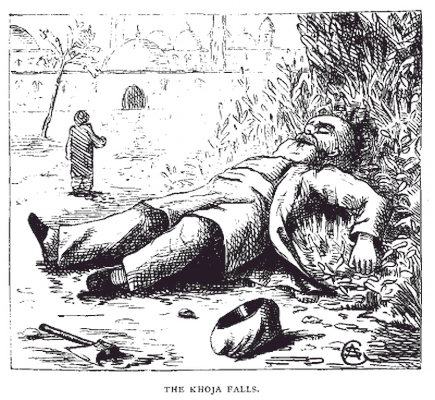
In a few moments the branch gave way, and the Khoja fell to the ground.

When he recovered himself he jumped up, and ran after the man who had warned him.

(THE KHOJA FALLS)

"O you fellow!" cried he. "It has happened to me even as you foretold. At the moment when the branch was cut through I fell to the ground. Now, therefore, since the future is open to thee, I beseech thee to tell me the day of my death."

"This madness is greater than the other," replied the man. "The day of death is among the hidden counsels of the Most High."

But the Khoja held him by the gown and continued to urge him, saying, "You told me when I should fall from the tree, and it came to pass to the moment. Tell me now how long I have to live." And as he would not release him, but kept crying, "How much time have I left?" the man lost patience, and said, "O fool! there is no more time left to thee. The days of the years of thy life are numbered."

"Then I am dead, lo I am dead!" said the Khoja, and he lay down, and stiffened himself, and did not move.

By and by his neighbours came and stood at his head, and having observed him, they brought a bier and laid him on it, saying, "Let us take him to his own house."

Now in the way thither there was in the road a boggy place, which it was difficult to pass, and the bearers of the bier stood still and consulted, saying, "Which way shall we go?"

And they hesitated so long that the Khoja, becoming impatient, raised his head from the bier, and said, "That's the way I used to go myself, when I was alive."

*******

I don't expect any of the residents of Oak Hill Cemetery to correct us on what they did while alive nor where they expected to be buried.  Come on out if you can.  If you can't, at least the Hodja gave you a smile once again.

******************
This is part of a series of postings of stories under the category, "Keeping the Public in Public Domain."  The idea behind Public Domain was to preserve our cultural heritage after the authors and their immediate heirs were compensated.  I feel strongly current copyright law delays this intent on works of the 20th century.  My own library of folklore includes so many books within the Public Domain I decided to share stories from them.  I hope you enjoy discovering new stories.  


At the same time, my own involvement in storytelling regularly creates projects requiring research as part of my sharing stories with an audience.  Whenever that research needs to be shown here, the publishing of Public Domain stories will not occur that week.  This is a return to my regular posting of a research project here.  (Don't worry, this isn't dry research, my research is always geared towards future storytelling to an audience.)  Response has convinced me that "Keeping the Public in Public Domain" should continue along with my other postings as often as I can manage it.
Other Public Domain story resources I recommend-
  • There are many online resources for Public Domain stories, maybe none for folklore is as ambitious as fellow storyteller, Yoel Perez's database, Yashpeh, the International Folktales Collection.  I have long recommended it and continue to do so.  He has loaded Stith Thompson's Motif Index into his server as a database so you can search the whole 6 volumes for whatever word or expression you like by pressing one key. http://folkmasa.org/motiv/motif.htm
  • You may have noticed I'm no longer certain Dr. Perez has the largest database, although his offering the Motif Index certainly qualifies for those of us seeking specific types of stories.  There's another site, FairyTalez claiming to be the largest, with "over 2000 fairy tales, folktales, and fables" and they are "fully optimized for phones, tablets, and PCs", free and presented without ads.

    Between those two sites, there is much for story-lovers, but as they say in infomercials, "Wait, there's more!"
The email list for storytellers, Storytell, discussed Online Story Sources and came up with these additional suggestions:            
         - David K. Brown - http://people.ucalgary.ca/~dkbrown/stories.html
         - Richard Martin - http://www.tellatale.eu/tales_page.html
         - Spirit of Trees - http://spiritoftrees.org/featured-folktales
         - Story-Lovers - http://www.story-lovers.com/ is now only accessible through the Wayback Machine, described below, but the late Jackie Baldwin's wonderful site lives on there, fully searchable manually (the Google search doesn't work), at https://archive.org/ .  It's not easy, but go to Story-lovers.com snapshot for October 22 2016  and you can click on SOS: Searching Out Stories to scroll down through the many story topics and click on the story topic that interests you.
       - World of Tales - http://www.worldoftales.com/ 
           - Zalka Csenge Virag - http://multicoloreddiary.blogspot.com doesn't give the actual stories, but her recommendations, working her way through each country on a continent, give excellent ideas for finding new books and stories to love and tell.
     
You're going to find many of the links on these sites have gone down, BUT go to the Internet Archive Wayback Machine to find some of these old links.  Tim's site, for example, is so huge probably updating it would be a full-time job.  In the case of Story-Lovers, it's great that Jackie Baldwin set it up to stay online as long as it did after she could no longer maintain it.  Possibly searches maintained it.  Unfortunately Storytell list member, Papa Joe is on both Tim Sheppard's site and Story-Lovers, but he no longer maintains his old Papa Joe's Traveling Storytelling Show website and his Library (something you want to see!) is now only on the Wayback Machine.  It took some patience working back through claims of snapshots but finally in December of 2006 it appears!
    Somebody as of this writing whose stories can still be found by his website is the late Chuck Larkin - http://chucklarkin.com/stories.html.  I prefer to list these sites by their complete address so they can be found by the Wayback Machine, a.k.a. Archive.org, when that becomes the only way to find them.
You can see why I recommend these to you. Have fun discovering even more stories!

Saturday, August 29, 2020

An "Original" Story


I call my husky/malamute my Exercise Machine, getting him out roughly every other day for at least a 45 minute hike.  Fortunately we live near several parks with wooded trails.  Ideas for this blog often come while on these outings.  It's a great time to observe nature and think about storytelling possibilities.   Summer clearly isn't ready to leave Michigan, but lately I've seen scattered signs of autumn as leaf color changes on a few vines and an occasional bush or tree exposed to colder damp air. 

Most interesting, the wild grape vines. which until now were only good for chewing a bit on the tendrils, are starting to ripen. 
That picture came from an article on making "Wild grape wine"  from a blog called PA Wild Edibles.  The author has apparently kept the blog online, but it only ran from 2011-2014, offering ideas from his foraging in Pennsylvania.  I confess that foraging has long interested me.  Maybe my love of wildflowers and wild plants  is because I'm a terrrrrrible gardener.  For those of us interested in wild plants his blog is worth prowling.  I'm also impressed that anyone might be able to find enough wild grapes to make wine.  I love grabbing a cluster and nibbling one at a time.  It's guaranteed to have a seed to spit, possibly spreading more vines along the trail.

Besides spreading wild grapes, I want to spread this story the wild grapes made me decide to share.  Any fellow lovers of the "wise fool", the Hodja, will recognize its inspiration.  I set it in a tiny hamlet called Grape found in Monroe County alongside the River Raisin.  It's a Michigan area that welcomed French pioneers with plentiful wild grapes.

***********
Back when Grape was a flourishing community and not a mere spot in the road between Monroe and Dundee, a preacher was having an impossible time figuring out what to say in his weekly sermon.  He wracked his brain, but nothing seemed to work.  At last he decided what he would say.

That Sunday he stepped into his usual spot to deliver his sermon to his small congregation.  He looked at them all carefully, taking his time to be sure each person felt his gaze.  At last he spoke up.  "Good people of Grape, do you know what I have to tell you?"  He waited.  The people shifted in their seats uncomfortably.  "Well do you?" he repeated in a demanding tone.  They began to look at each other and shake their heads No.  "Well then, how can I speak to you?" he said defiantly, turned and went on with the church service.

The next week he again had no idea what to say in his sermon.  Again he stepped into his usual spot to deliver his sermon.  Again he called out, "Good people of Grape, do you know what I have to tell you?"  He waited.  The people shifted in their seats uncomfortably, but this time they shook their heads Yes.  "Good," he said, "then I have no need to say any more to you."  He turned and went on with the church service.

For yet a third week he again had no idea what to say in his sermon.  Again he stepped into his usual spot to deliver his sermon.  Again he called out, "Good people of Grape, do you know what I have to tell you?"  He waited.  The people shifted in their seats uncomfortably, but this time some shook their heads Yes and some shook their heads No.  "Excellent," he said, "then those of you who know should tell those of you who don't."  He turned and went on with the church service, but knew he really had to figure what to say in his next weekly sermon.
***********
As that story shows, it's rather like my storytelling friend, Laura Vitek, likes to say at the end of her emails, "There's always a story.  It'd be a shame not to tell it."

Similarly while prowling that PA Wild Edibles blog I found a recipe for sumac cider.  I've known staghorn sumac supposedly made a lemonade ever since I read it in the late Euell Gibbons' ground-breaking book on foraging, Stalking the Wild Asparagus, but lemonade didn't need my experimentation.  Cider?  Maybe.  It's certainly a year when orchards aren't opening for their usual autumn treat.

That leads me, good people on the internet, to ask you if you agree with my husband or me.  Should it always be Cider and Doughnuts or not?  Those of you who think you know, please be sure to say.  You can let me know either in my email or on Facebook where each week I also post these articles.

Saturday, July 21, 2018

The Hodja Still Lives! - Part 3

This is one of my favorite Hodja books


(Also try Kelsey's Once the Mullah as many of those stories are just the Hodja in a different setting.  Did you notice Once the Hodja is in the links below? )
Today's information about the Hodja will be great if you want to find more stories on your own, but otherwise you won't find any stories here.  I do however give you the means to get to some and they even are categorized into six topics.

In my "The Hodja Still Lives! - Part 2" I said today's information would come from Erol Beyman's site, which now can only be found on the Wayback Machine (part of Archive.org).  That link takes you back to July 6, 2004.  I am omitting the PREFACE, INTRODUCTION, GRAPHICS, and LIFE STORY you will find there as I think it's information I've already covered or, in the case of the Graphics, it's difficult to download.  TRAINING has Reading Exercises with 6 stories (Nasreddin and the Pot; Nasreddin Goes Shopping; Nasreddin and the Beggar; Nasreddin and the Smell of Soup; Nasreddin the Ferry Man; Nasreddin's Visitiors). Each checks for Reading Comprehension; Recreating the Story; and Summarizing the Story: Gap-fill Exercise. There's also a section on Learning Exercises with the the story of Nasreddin and the Candles, but I'm told the Java Applets tend to crash browsers, so I didn't try that section.  Instead I bring you Beyman's SOURCES and LINKS.  If you click on STORIES there's a 6-pronged graphic grouping the stories into categories of Family Troubles; Neighborhood; Town Conversations; Animal; Business Life; World Questions.
SOURCES  ( I know these are not all the books, but it gives you an excellent assortment of 20th century publications, including foreign language versions.)
Tales of Nasr-Ed-Din Khoja
Sir Valentine Chirol, Translated by Henry D. Barnham, C.M.G.
Nisbet & Co. Ltd. (London, 1923)

Once the Hodja
Alice Geer Kelsey. Illustrated by Frank Dobias (New York, 1943)

Tales of the Hodja
Charles Downing. Illustated by Willliam Papas (New York, 1965)

The exploits of the incomparable Mulla Nasrudin
Idries Shah. Drawn by Richard Williams (1966)

The pleasentries of the incredible Mulla Nasrudin
Idries Shah. Drawn by Richard Williams (1977)

The Example of the journal Molla Nasreddin in Azarbaijan
H. B. Paksoy, Prof. Dr. Erling von Mende & Baymirza Hayit Festschrift. (Koln, 1988)

Nasr Eddin Hodja, un drôle d'idiot
Auteur/Author: Maunoury Jean-Louis

Sublimes paroles et idioties de Nasr Eddin Hodja
Auteur/Author: Maunoury Jean-Louis, Editeur/Publisher: Phebus (1990)

Tales Alive in Turkey
Dr. Warren S. Walker & Dr. Ahmet E. Uysal (Lubbock, Texas, 1990)

Classic Tales of Mulla Masreddin
MHouman Farzad (Published 1990)

Watermelons, Walnuts and The Wisdom Of Allah, And The Other Tales Of Hodja
Barbara K. Walker. Illustrated by Harold Berson (Published 1991)

The Tales of Nasreddin Hodja
Compiled by: Raymond C.Clark, Illustrated by: Robert MacLean
Pro Lingua Associates Brattleboro, VT USA 800-366-4775 (Published 1991)

More Tales Alive in Turkey
Dr. Warren S. Walker & Dr. Ahmet E. Uysal. (Lubbock, Texas, 1992)

Nasreddin Hodja
Alpay Kabacali, Illustrations by Fatih M. Durmus
Net Bookstores, ISBN 975-479-123-6 (Istanbul, 1992)

Sublimi parole e facezie di Nasr Eddin Hodja, Luni
Auteur/Author: Maunoury Jean-Louis (1994)

202 Jokes of Nasreddin Hodja
Tuncay Yurtsever
Minyatür Bookstores, 87.34.Y.0044.21 (Istanbul)

A Research on Nasreddin Hodja
Metin Hakverdioglu (Published 1996)

The Best Anecdotes of Nasreddin Hoca
Kemal Yorenc, Aksit Bookstores (Istanbul, 1996)

Nasreddin Hoca (Turkish)
Abdulbaki Golpinarli, Illustrated by Abidin Dino
ISBN 975-101-087-X, Inkilap Kitapevi (Istanbul, 1996)

Nasreddin Hoca´nin Dünyasi (Turkish)
Dr. Irfan Nasrattinoglu, ISBN 975-458-077-4
Türkiye Is Bankasi Yayinlari (Istanbul, 1996)

Nasreddin Hoca´ya Armagan (Turkish)
M. Sabri Koz, ISBN 975-329-090-4
Oglak Yayinlari (Istanbul, 1996)

600 Mulla Nasreddin Tales
Muhammad Ramazani (Published 1997, 1998)

The Obstinate Hodja
Kemal Esref Sakarya

The sayings and doings of Nasrudin the Wise
Michael Flanders

The tales of Nasrettin Hoca
Aziz Nesin

Tales of Nasreddin Khoja : 181 Mulla Nasreddin Stories
Henry D. Barnham (Publishing 2000)


MAIN HODJA LINKS  (No, I did not check these. you now should feel a bit more comfortable with using the Wayback Machine for sites no longer up and running.)
Nasreddin Hoca Person of The Millennium by Erol Abit
Nasreddin Hodja im Orienternet (German) by Ömer Faruk Gözelel Mirror
Hoca The Great by Learning Practical Turkish Web Site
Nasreddin Hodja stories by Turgut Durduran & Amy Alexieff
This Remainds Me Of A Story... by Ioan Tenner
Focus Kids (Mediterranean) by Focus Multimedia
600 years old jokes! by Shop 1000 (Istanbul)
Nasreddin Hodja by Stuart Alexander Rockefeller
Nasreddin Hodja by Tara Mulder
Molla Nasreddin - Comic Sage of the Ages by Azerbaijan International (4.3) Autumn 1996
Hodja Brand by Jeremy Schiff
Once the Hodja by Alice Geer Kelsey
Nasreddin Hodja by Alpay Karacali
Nasreddin Hodja, Tales of the Turkish Trickster retold by D. L. Ashliman
Google Web Directory
DMOZ Open Directory Project
Fool's Paradise by Peter Michaels


Enjoy!


Next week I promise you will bring a devil of a story .