Tell me if you have a topic you'd like to see. (Contact: LoiS-sez@LoiS-sez.com .)
Please also let others know about this site.
Showing posts with label Andrew Lang. Show all posts

Friday, February 28, 2025

Lang - The Maiden with the Wooden Helmet - Keeping the Public in Public Domain

Illustration by Urokogataya

If you're looking for an unusual, but beautiful story for Women's History Month, there's a lovely tale from Japanese folklore. As might be expected when something is translated, it's sometimes called by various names. Wikipedia gives a reasonable summary of "Hachikazuki." The story dates back in print to the 14th to 16th century and is probably even older. In approximately 1735 to 1745 it was published as a children's booklet of mainly drawings by Urokogataya. 

The story is translated as "The Black Bowl" by Grace James in her Green willow and other Japanese fairy tales
and Lafcadio Hearn used her version in his anthology, Japanese fairy tales. 

Frankly that title never would have caught my attention. It was while prowling The Violet Fairy Book this title caught my eye. The Project Gutenberg eBook for some reason omits the illustration by Henry Justice Ford! Ford's illustrations were a vital part of the Langs' Fairy Book series. Ford's illustration, of any I found for the story, fit my vision of the Maiden's Helmet where others with a Bowl did not. 
Since this is the start of Women's History Month it's worth repeating this from the Wikipedia article on "The Langs' Fairy Books:
The authorship and translation of the Coloured Fairy Books is often and incorrectly attributed to Andrew Lang alone. Nora is not named on the front cover or spines of any of the Coloured Fairy Books, which all tout Andrew as their editor. However, as Andrew acknowledges in a preface to The Lilac Fairy Book (1910), "The fairy books have been almost wholly the work of Mrs. Lang, who has translated and adapted them from the French, German, Portuguese, Italian, Spanish, Catalan, and other languages." 

Every Women's History year has a theme and this year it is “Moving Forward Together,” which celebrates "Women Educating and Inspiring Generations." For centuries this story has educated young girls to be more than mere beauty, but be strong in carrying out their resolutions.

Here's Leonora Lang's translation from the German of "The Maiden with the Wooden Helmet."

by Henry Justice Ford for The Violet Fairy Book (1906)  

In a little village in the country of Japan there lived long, long ago a man and his wife. For many years they were happy and prosperous, but bad times came, and at last nothing was left them but their daughter, who was as beautiful as the morning. The neighbours were very kind, and would have done anything they could to help their poor friends, but the old couple felt that since everything had changed they would rather go elsewhere, so one day they set off to bury themselves in the country, taking their daughter with them.

Now the mother and daughter had plenty to do in keeping the house clean and looking after the garden, but the man would sit for hours together gazing straight in front of him, and thinking of the riches that once were his. Each day he grew more and more wretched, till at length he took to his bed and never got up again.

His wife and daughter wept bitterly for his loss, and it was many months before they could take pleasure in anything. Then one morning the mother suddenly looked at the girl, and found that she had grown still more lovely than before. Once her heart would have been glad at the sight, but now that they two were alone in the world she feared some harm might come of it. So, like a good mother, she tried to teach her daughter all she knew, and to bring her up to be always busy, so that she would never have time to think about herself. And the girl was a good girl, and listened to all her mother’s lessons, and so the years passed away.

At last one wet spring the mother caught cold, and though in the beginning she did not pay much attention to it, she gradually grew more and more ill, and knew that she had not long to live. Then she called her daughter and told her that very soon she would be alone in the world; that she must take care of herself, as there would be no one to take care of her. And because it was more difficult for beautiful women to pass unheeded than for others, she bade her fetch a wooden helmet out of the next room, and put it on her head, and pull it low down over her brows, so that nearly the whole of her face should lie in its shadow. The girl did as she was bid, and her beauty was so hidden beneath the wooden cap, which covered up all her hair, that she might have gone through any crowd, and no one would have looked twice at her. And when she saw this the heart of the mother was at rest, and she lay back in her bed and died.

The girl wept for many days, but by-and-by she felt that, being alone in the world, she must go and get work, for she had only herself to depend upon. There was none to be got by staying where she was, so she made her clothes into a bundle, and walked over the hills till she reached the house of the man who owned the fields in that part of the country. And she took service with him and laboured for him early and late, and every night when she went to bed she was at peace, for she had not forgotten one thing that she had promised her mother; and, however hot the sun might be, she always kept the wooden helmet on her head, and the people gave her the nickname of Hatschihime.

In spite, however, of all her care the fame of her beauty spread abroad: many of the impudent young men that are always to be found in the world stole softly up behind her while she was at work, and tried to lift off the wooden helmet. But the girl would have nothing to say to them, and only bade them be off; then they began to talk to her, but she never answered them, and went on with what she was doing, though her wages were low and food not very plentiful. Still she could manage to live, and that was enough.

One day her master happened to pass through the field where she was working, and was struck by her industry and stopped to watch her. After a while he put one or two questions to her, and then led her into his house, and told her that henceforward her only duty should be to tend his sick wife. From this time the girl felt as if all her troubles were ended, but the worst of them was yet to come.

Not very long after Hatschihime had become maid to the sick woman, the eldest son of the house returned home from Kioto, where he had been studying all sorts of things. He was tired of the splendours of the town and its pleasures, and was glad enough to be back in the green country, among the peach-blossoms and sweet flowers. Strolling about in the early morning, he caught sight of the girl with the odd wooden helmet on her head, and immediately he went to his mother to ask who she was, and where she came from, and why she wore that strange thing over her face.

His mother answered that it was a whim, and nobody could persuade her to lay it aside; whereat the young man laughed, but kept his thoughts to himself.

One hot day, however, he happened to be going towards home when he caught sight of his mother’s waiting maid kneeling by a little stream that flowed through the garden, splashing some water over her face. The helmet was pushed on one side, and as the youth stood watching from behind a tree he had a glimpse of the girl’s great beauty; and he determined that no one else should be his wife. But when he told his family of his resolve to marry her they were very angry, and made up all sorts of wicked stories about her. However, they might have spared themselves the trouble, as he knew it was only idle talk. ‘I have merely to remain firm,’ thought he, ‘and they will have to give in.’ It was such a good match for the girl that it never occurred to anyone that she would refuse the young man, but so it was. It would not be right, she felt, to make a quarrel in the house, and though in secret she wept bitterly, for a long while, nothing would make her change her mind. At length one night her mother appeared to her in a dream, and bade her marry the young man. So the next time he asked her—as he did nearly every day—to his surprise and joy she consented. The parents then saw they had better make the best of a bad business, and set about making the grand preparations suitable to the occasion. Of course the neighbours said a great many ill-natured things about the wooden helmet, but the bridegroom was too happy to care, and only laughed at them.

When everything was ready for the feast, and the bride was dressed in the most beautiful embroidered dress to be found in Japan, the maids took hold of the helmet to lift it off her head, so that they might do her hair in the latest fashion. But the helmet would not come, and the harder they pulled, the faster it seemed to be, till the poor girl yelled with pain. Hearing her cries the bridegroom ran in and soothed her, and declared that she should be married in the helmet, as she could not be married without. Then the ceremonies began, and the bridal pair sat together, and the cup of wine was brought them, out of which they had to drink. And when they had drunk it all, and the cup was empty, a wonderful thing happened. The helmet suddenly burst with a loud noise, and fell in pieces on the ground; and as they all turned to look they found the floor covered with precious stones which had fallen out of it. But the guests were less astonished at the brilliancy of the diamonds than at the beauty of the bride, which was beyond anything they had ever seen or heard of. The night was passed in singing and dancing, and then the bride and bridegroom went to their own house, where they lived till they died, and had many children, who were famous throughout Japan for their goodness and beauty.

(Japanische Marchen.)


*********

This is part of a series of postings of stories under the category, “Keeping the Public in Public Domain.” The idea behind Public Domain was to preserve our cultural heritage after the authors and their immediate heirs were compensated. I feel strongly current copyright law delays this intent on works of the 20th century. My own library of folklore includes so many books within the Public Domain I decided to share stories from them. I hope you enjoy discovering them.

At the same time, my own involvement in storytelling regularly creates projects requiring research as part of my sharing stories with an audience.  Whenever that research needs to be shown here, the publishing of Public Domain stories will not occur that week.  This is a return to my regular posting of a research project here.  (Don't worry, this isn't dry research, my research is always geared towards future storytelling to an audience.)  Response has convinced me that "Keeping the Public in Public Domain" should continue along with my other postings as often as I can manage it.

See the sidebar for other Public Domain story resources I recommend on the page “Public Domain Story Resources."

Friday, August 30, 2024

Lang - The Death of Abu Nowas and of His Wife - Keeping the Public in Public Domain

This coming week on Saturday, September 7 I will once again tell as if I was an actual person briefly back from the dead. In this case I'm early Clarkston resident, Sarah (Sally) Jackson Merrill. I also have the privilege of being with her husband, Caleb Barton Merrill, portrayed by James Pabst. At their grave marking we bring these two together again,telling of their time in the American Revolution and eventually settling here in Michigan in its early years of statehood. Even if it's only what we can deduce from existing research, they led interesting lives! It has been surprising how much fun it has been letting them become the married couple they once were as we tell their stories. . . if Sarah lets Caleb talk uninterrupted! Sarah, commonly known as Sally, out-lived Caleb by nearly a quarter of a century, finally dying at age 94 after raising children, grandchildren, great-grandchildren, and even three great-great grandchildren.

From Sally's Massachusetts childhood in revolutionary times, to her marriage and family-raising in New York, and finally coming to Michigan, she saw a LOT! . . . and wasn't shy about passing on what she knew.

Of course the life of Sally and Caleb had me thinking about more than I can tell next week. Thoughts of this very real couple now in what I call "the City of the Dead" led me to an unusual story of a couple claiming to be dead. It comes from Andrew Lang's Crimson Fairy Book.

The Death Of Abu Nowas And Of His Wife

Once upon a time there lived a man whose name was Abu Nowas, and he was a great favourite with the Sultan of the country, who had a palace in the same town where Abu Nowas dwelt.

One day Abu Nowas came weeping into the hall of the palace where the Sultan was sitting, and said to him: “Oh, mighty Sultan, my wife is dead.”

“That is bad news,” replied the Sultan; “I must get you another wife.” And he bade his Grand Vizir send for the Sultana.

“This poor Abu Nowas has lost his wife,” said he, when she entered the hall.

“Oh, then we must get him another,” answered the Sultana; “I have a girl that will suit him exactly,” and clapped her hands loudly. At this signal a maiden appeared and stood before her.

“I have got a husband for you,” said the Sultana.

“Who is he?” asked the girl.

“Abu Nowas, the jester,” replied the Sultana.

“I will take him,” answered the maiden; and as Abu Nowas made no objection, it was all arranged. The Sultana had the most beautiful clothes made for the bride, and the Sultan gave the bridegroom his wedding suit, and a thousand gold pieces into the bargain, and soft carpets for the house.

So Abu Nowas took his wife home, and for some time they were very happy, and spent the money freely which the Sultan had given them, never thinking what they should do for more when that was gone. But come to an end it did, and they had to sell their fine things one by one, till at length nothing was left but a cloak apiece, and one blanket to cover them. “We have run through our fortune,” said Abu Nowas, “what are we to do now? I am afraid to go back to the Sultan, for he will command his servants to turn me from the door. But you shall return to your mistress, and throw yourself at her feet and weep, and perhaps she will help us.”

“Oh, you had much better go,” said the wife. “I shall not know what to say.”

“Well, then, stay at home, if you like,” answered Abu Nowas, “and I will ask to be admitted to the Sultan’s presence, and will tell him, with sobs, that my wife is dead, and that I have no money for her burial. When he hears that perhaps he will give us something.”

“Yes, that is a good plan,” said the wife; and Abu Nowas set out.

The Sultan was sitting in the hall of justice when Abu Nowas entered, his eyes streaming with tears, for he had rubbed some pepper into them. They smarted dreadfully, and he could hardly see to walk straight, and everyone wondered what was the matter with him.

“Abu Nowas! What has happened?” cried the Sultan.

“Oh, noble Sultan, my wife is dead,” wept he.

“We must all die,” answered the Sultan; but this was not the reply for which Abu Nowas had hoped.

“True, O Sultan, but I have neither shroud to wrap her in, nor money to bury her with,” went on Abu Nowas, in no wise abashed by the way the Sultan had received his news.

“Well, give him a hundred pieces of gold,” said the Sultan, turning to the Grand Vizir. And when the money was counted out Abu Nowas bowed low, and left the hall, his tears still flowing, but with joy in his heart.

“Have you got anything?” cried his wife, who was waiting for him anxiously.

“Yes, a hundred gold pieces,” said he, throwing down the bag, “but that will not last us any time. Now you must go to the Sultana, clothed in sackcloth and robes of mourning, and tell her that your husband, Abu Nowas, is dead, and you have no money for his burial. When she hears that, she will be sure to ask you what has become of the money and the fine clothes she gave us on our marriage, and you will answer, ‘before he died he sold everything.’”

The wife did as she was told, and wrapping herself in sackcloth went up to the Sultana’s own palace, and as she was known to have been one of Subida’s favourite attendants, she was taken without difficulty into the private apartments.

“What is the matter?” inquired the Sultana, at the sight of the dismal figure.

“My husband lies dead at home, and he has spent all our money, and sold everything, and I have nothing left to bury him with,” sobbed the wife.

Then Subida took up a purse containing two hundred gold pieces, and said: “Your husband served us long and faithfully. You must see that he has a fine funeral.”

The wife took the money, and, kissing the feet of the Sultana, she joyfully hastened home. They spent some happy hours planning how they should spend it, and thinking how clever they had been. “When the Sultan goes this evening to Subida’s palace,” said Abu Nowas, “she will be sure to tell him that Abu Nowas is dead. ‘Not Abu Nowas, it is his wife,’ he will reply, and they will quarrel over it, and all the time we shall be sitting here enjoying ourselves. Oh, if they only knew, how angry they would be!”

As Abu Nowas had foreseen, the Sultan went, in the evening after his business was over, to pay his usual visit to the Sultana.

“Poor Abu Nowas is dead!” said Subida when he entered the room.

“It is not Abu Nowas, but his wife who is dead,” answered the Sultan.

“No; really you are quite wrong. She came to tell me herself only a couple of hours ago,” replied Subida, “and as he had spent all their money, I gave her something to bury him with.”

“You must be dreaming,” exclaimed the Sultan. “Soon after midday Abu Nowas came into the hall, his eyes streaming with tears, and when I asked him the reason he answered that his wife was dead, and they had sold everything they had, and he had nothing left, not so much as would buy her a shroud, far less for her burial.”

For a long time they talked, and neither would listen to the other, till the Sultan sent for the door-keeper and bade him go instantly to the house of Abu Nowas and see if it was the man or his wife who was dead. But Abu Nowas happened to be sitting with his wife behind the latticed window, which looked on the street, and he saw the man coming, and sprang up at once. “There is the Sultan’s door-keeper! They have sent him here to find out the truth. Quick! throw yourself on the bed and pretend that you are dead.” And in a moment the wife was stretched out stiffly, with a linen sheet spread across her, like a corpse.

She was only just in time, for the sheet was hardly drawn across her when the door opened and the porter came in. “Has anything happened?” asked he.

“My poor wife is dead,” replied Abu Nowas. “Look! she is laid out here.” And the porter approached the bed, which was in a corner of the room, and saw the stiff form lying underneath.

“We must all die,” said he, and went back to the Sultan.

“Well, have you found out which of them is dead?” asked the Sultan.

“Yes, noble Sultan; it is the wife,” replied the porter.

“He only says that to please you,” cried Subida in a rage; and calling to her chamberlain, she ordered him to go at once to the dwelling of Abu Nowas and see which of the two was dead. “And be sure you tell the truth about it,” added she, “or it will be the worse for you.”

As her chamberlain drew near the house, Abu Nowas caught sight of him. “There is the Sultana’s chamberlain,” he exclaimed in a fright. “Now it is my turn to die. Be quick and spread the sheet over me.” And he laid himself on the bed, and held his breath when the chamberlain came in. “What are you weeping for?” asked the man, finding the wife in tears.

“My husband is dead,” answered she, pointing to the bed; and the chamberlain drew back the sheet and beheld Abu Nowas lying stiff and motionless. Then he gently replaced the sheet and returned to the palace.

“Well, have you found out this time?” asked the Sultan.

“My lord, it is the husband who is dead.”

“But I tell you he was with me only a few hours ago,” cried the Sultan angrily. “I must get to the bottom of this before I sleep! Let my golden coach be brought round at once.”

The coach was before the door in another five minutes, and the Sultan and Sultana both got in. Abu Nowas had ceased being a dead man, and was looking into the street when he saw the coach coming. “Quick! quick!” he called to his wife. “The Sultan will be here directly, and we must both be dead to receive him.” So they laid themselves down, and spread the sheet over them, and held their breath. At that instant the Sultan entered, followed by the Sultana and the chamberlain, and he went up to the bed and found the corpses stiff and motionless. “I would give a thousand gold pieces to anyone who would tell me the truth about this,” cried he, and at the words Abu Nowas sat up. “Give them to me, then,” said he, holding out his hand. “You cannot give them to anyone who needs them more.”

“Oh, Abu Nowas, you impudent dog!” exclaimed the Sultan, bursting into a laugh, in which the Sultana joined. “I might have known it was one of your tricks!” But he sent Abu Nowas the gold he had promised, and let us hope that it did not fly so fast as the last had done.

[From Tunische Mährchen.]

*******

Well they did say Abu Nowas was a jester. He may not have been good with money, but he certainly was quick-witted.

The Merrills had their ups and downs, both during the American Revolution and beyond, but I'm willing to bet this story would have amused them!

If you're able to come, I think you'll find they, too, led interesting lives.

******************

This is part of a series of postings of stories under the category, "Keeping the Public in Public Domain."  The idea behind Public Domain was to preserve our cultural heritage after the authors and their immediate heirs were compensated.  I feel strongly current copyright law delays this intent on works of the 20th century.  My own library of folklore includes so many books within the Public Domain I decided to share stories from them.  I hope you enjoy discovering new stories.  


At the same time, my own involvement in storytelling regularly creates projects requiring research as part of my sharing stories with an audience.  Whenever that research needs to be shown here, the publishing of Public Domain stories will not occur that week.  This is a return to my regular posting of a research project here.  (Don't worry, this isn't dry research, my research is always geared towards future storytelling to an audience.)  Response has convinced me that "Keeping the Public in Public Domain" should continue along with my other postings as often as I can manage it.

Other Public Domain story resources I recommend-

  • There are many online resources for Public Domain stories, maybe none for folklore is as ambitious as fellow storyteller, Yoel Perez's database, Yashpeh, the International Folktales Collection.  I have long recommended it and continue to do so.  He has loaded Stith Thompson's Motif Index into his server as a database so you can search the whole 6 volumes for whatever word or expression you like by pressing one key. http://folkmasa.org/motiv/motif.htm

  • You may have noticed I'm no longer certain Dr. Perez has the largest database, although his offering the Motif Index certainly qualifies for those of us seeking specific types of stories.  There's another site, FairyTalez claiming to be the largest, with "over 2000 fairy tales, folktales, and fables" and they are "fully optimized for phones, tablets, and PCs", free and presented without ads.
    Between those two sites, there is much for story-lovers, but as they say in infomercials, "Wait, there's more!"

The email list for storytellers, Storytell, discussed Online Story Sources and came up with these additional suggestions:        

         - David K. Brown - http://people.ucalgary.ca/~dkbrown/stories.html

         - Richard Martin - http://www.tellatale.eu/tales_page.html

         - Spirit of Trees - http://spiritoftrees.org/featured-folktales

         - Story-Lovers - http://www.story-lovers.com/ is now only accessible through the Wayback Machine, described below, but the late Jackie Baldwin's wonderful site lives on there, fully searchable manually (the Google search doesn't work), at https://archive.org/ .  It's not easy, but go to Story-lovers.com snapshot for December 22 2016  and you can click on SOS: Searching Out Stories to scroll down through the many story topics and click on the story topic that interests you.

       - World of Tales - http://www.worldoftales.com/ 

 
           - Zalka Csenge Virag - http://multicoloreddiary.blogspot.com doesn't give the actual stories, but her recommendations, working her way through each country on a continent, give excellent ideas for finding new books and stories to love and tell.

     
You're going to find many of the links on these sites have gone down, BUT go to the Internet Archive Wayback Machine to find some of these old links.  Tim's site, for example, is so huge probably updating it would be a full-time job.  In the case of Story-Lovers, it's great that Jackie Baldwin set it up to stay online as long as it did after she could no longer maintain it.  Possibly searches maintained it.  Unfortunately Storytell list member, Papa Joe is on both Tim Sheppard's site and Story-Lovers, but he no longer maintains his old Papa Joe's Traveling Storytelling Show website and his Library (something you want to see!) is now only on the Wayback Machine.  It took some patience working back through claims of snapshots but finally in December of 2006 it appears!

    Somebody as of this writing whose stories can still be found by his website is the late Chuck Larkin - http://chucklarkin.com/stories.html.  I prefer to list these sites by their complete address so they can be found by the Wayback Machine, a.k.a. Archive.org, when that becomes the only way to find them.

You can see why I recommend these to you. 

Have fun discovering even more stories


Friday, August 16, 2024

Lang - The Cat's Elopement - Keeping the Public in Public Domain

by Maja Lindberg
The illustration of the cat sleeping on a stack of books was something I saw and loved. It's by Swedish artist Maja Lindberg. I'm repeating the link to her site and would recommend prowling it. Let's applaud https://translate.google.com as my Swedish is nonexistent, but was able to ask permission to post it and it was generously given. That was last week and International Cat Day was Thursday, August 8. By that time I was knee deep in last week's story of "The Dancing Dog", but promised this Saturday would be CATURDAY as I was already looking forward to posting Lindberg's picture.

I love cats, but have learned I'm healthier no longer having a cat. Fortunately my allergies aren't severe enough to prevent me visiting homes with cats. 

Looking ahead I knew there are a great many stories about cats. Many are fables, but I wanted something else. I also found many stories showing the tricky nature of cats. My favorite was posted last year, the Grimm story of "Cat and Mouse in Partnership." This year I wanted to post something more for all who love cats. "The Cat's Elopement" fits that and opens Andrew Lang's The Pink Fairy Book.

There's a bit of a problem with retelling this story. I believe the names of the two cats would be distracting telling it. Lang offers a Japanese story found in a German book, so I'm hesitant to believe the cat names would be the correct names. Add to that when telling the story in English the male cat's name of Gon sounds like Gone, while the female cat's name of Koma sounds like Coma. If you search online for Japanese cat names there are many sites. Four hundred cat names and their meanings are alphabetically listed at Munchiecat.com. I found it interesting there was no Gom or Koma. Lost in translation? Personally I suggest enjoying the story and then choosing your own name for the two cats. 

The Cat’s Elopement

[From the Japanische Marchen und Sagen, von David Brauns (Leipzig: Wilhelm Friedrich).]

Once upon a time there lived a cat of marvellous beauty, with a skin as soft and shining as silk, and wise green eyes, that could see even in the dark. His name was Gon, and he belonged to a music teacher, who was so fond and proud of him that he would not have parted with him for anything in the world.

Now not far from the music master’s house there dwelt a lady who possessed a most lovely little pussy cat called Koma. She was such a little dear altogether, and blinked her eyes so daintily, and ate her supper so tidily, and when she had finished she licked her pink nose so delicately with her little tongue, that her mistress was never tired of saying, ‘Koma, Koma, what should I do without you?’

Well, it happened one day that these two, when out for an evening stroll, met under a cherry tree, and in one moment fell madly in love with each other. Gon had long felt that it was time for him to find a wife, for all the ladies in the neighbourhood paid him so much attention that it made him quite shy; but he was not easy to please, and did not care about any of them. Now, before he had time to think, Cupid had entangled him in his net, and he was filled with love towards Koma. She fully returned his passion, but, like a woman, she saw the difficulties in the way, and consulted sadly with Gon as to the means of overcoming them. Gon entreated his master to set matters right by buying Koma, but her mistress would not part from her. Then the music master was asked to sell Gon to the lady, but he declined to listen to any such suggestion, so everything remained as before.

At length the love of the couple grew to such a pitch that they determined to please themselves, and to seek their fortunes together. So one moonlight night they stole away, and ventured out into an unknown world. All day long they marched bravely on through the sunshine, till they had left their homes far behind them, and towards evening they found themselves in a large park. The wanderers by this time were very hot and tired, and the grass looked very soft and inviting, and the trees cast cool deep shadows, when suddenly an ogre appeared in this Paradise, in the shape of a big, big dog! He came springing towards them showing all his teeth, and Koma shrieked, and rushed up a cherry tree. Gon, however, stood his ground boldly, and prepared to give battle, for he felt that Koma’s eyes were upon him, and that he must not run away. But, alas! his courage would have availed him nothing had his enemy once touched him, for he was large and powerful, and very fierce. From her perch in the tree Koma saw it all, and screamed with all her might, hoping that some one would hear, and come to help. Luckily a servant of the princess to whom the park belonged was walking by, and he drove off the dog, and picking up the trembling Gon in his arms, carried him to his mistress.

So poor little Koma was left alone, while Gon was borne away full of trouble, not in the least knowing what to do. Even the attention paid him by the princess, who was delighted with his beauty and pretty ways, did not console him, but there was no use in fighting against fate, and he could only wait and see what would turn up.

The princess, Gon’s new mistress, was so good and kind that everybody loved her, and she would have led a happy life, had it not been for a serpent who had fallen in love with her, and was constantly annoying her by his presence. Her servants had orders to drive him away as often as he appeared; but as they were careless, and the serpent very sly, it sometimes happened that he was able to slip past them, and to frighten the princess by appearing before her. One day she was seated in her room, playing on her favourite musical instrument, when she felt something gliding up her sash, and saw her enemy making his way to kiss her cheek. She shrieked and threw herself backwards, and Gon, who had been curled up on a stool at her feet, understood her terror, and with one bound seized the snake by his neck. He gave him one bite and one shake, and flung him on the ground, where he lay, never to worry the princess any more. Then she took Gon in her arms, and praised and caressed him, and saw that he had the nicest bits to eat, and the softest mats to lie on; and he would have had nothing in the world to wish for if only he could have seen Koma again.

Time passed on, and one morning Gon lay before the house door, basking in the sun. He looked lazily at the world stretched out before him, and saw in the distance a big ruffian of a cat teasing and ill-treating quite a little one. He jumped up, full of rage, and chased away the big cat, and then he turned to comfort the little one, when his heart nearly burst with joy to find that it was Koma. At first Koma did not know him again, he had grown so large and stately; but when it dawned upon her who it was, her happiness knew no bounds. And they rubbed their heads and their noses again and again, while their purring might have been heard a mile off.

Paw in paw they appeared before the princess, and told her the story of their life and its sorrows. The princess wept for sympathy, and promised that they should never more be parted, but should live with her to the end of their days. By-and-bye the princess herself got married, and brought a prince to dwell in the palace in the park. And she told him all about her two cats, and how brave Gon had been, and how he had delivered her from her enemy the serpent.

And when the prince heard, he swore they should never leave them, but should go with the princess wherever she went. So it all fell out as the princess wished; and Gon and Koma had many children, and so had the princess, and they all played together, and were friends to the end of their lives.

***

For those able to live with cats, may you, too, play together and be friends to the end of your lives. I sometimes console myself and others who lose their pets with the thought that it lets us know and love so many. I've learned that people who have large birds have the opposite problem, needing to find another home for their birds when the shorter-lived human dies first.

 ***************************

This is part of a series of postings of stories under the category, "Keeping the Public in Public Domain."  The idea behind Public Domain was to preserve our cultural heritage after the authors and their immediate heirs were compensated.  I feel strongly current copyright law delays this intent on works of the 20th century.  My own library of folklore includes so many books within the Public Domain I decided to share stories from them.  I hope you enjoy discovering new stories.  


At the same time, my own involvement in storytelling regularly creates projects requiring research as part of my sharing stories with an audience.  Whenever that research needs to be shown here, the publishing of Public Domain stories will not occur that week.  This is a return to my regular posting of a research project here.  (Don't worry, this isn't dry research, my research is always geared towards future storytelling to an audience.)  Response has convinced me that "Keeping the Public in Public Domain" should continue along with my other postings as often as I can manage it.

Other Public Domain story resources I recommend-

  • There are many online resources for Public Domain stories, maybe none for folklore is as ambitious as fellow storyteller, Yoel Perez's database, Yashpeh, the International Folktales Collection.  I have long recommended it and continue to do so.  He has loaded Stith Thompson's Motif Index into his server as a database so you can search the whole 6 volumes for whatever word or expression you like by pressing one key. http://folkmasa.org/motiv/motif.htm

  • You may have noticed I'm no longer certain Dr. Perez has the largest database, although his offering the Motif Index certainly qualifies for those of us seeking specific types of stories.  There's another site, FairyTalez claiming to be the largest, with "over 2000 fairy tales, folktales, and fables" and they are "fully optimized for phones, tablets, and PCs", free and presented without ads.
    Between those two sites, there is much for story-lovers, but as they say in infomercials, "Wait, there's more!"

The email list for storytellers, Storytell, discussed Online Story Sources and came up with these additional suggestions:        

         - David K. Brown - http://people.ucalgary.ca/~dkbrown/stories.html

         - Richard Martin - http://www.tellatale.eu/tales_page.html

         - Spirit of Trees - http://spiritoftrees.org/featured-folktales

         - Story-Lovers - http://www.story-lovers.com/ is now only accessible through the Wayback Machine, described below, but the late Jackie Baldwin's wonderful site lives on there, fully searchable manually (the Google search doesn't work), at https://archive.org/ .  It's not easy, but go to Story-lovers.com snapshot for December 22 2016  and you can click on SOS: Searching Out Stories to scroll down through the many story topics and click on the story topic that interests you.

       - World of Tales - http://www.worldoftales.com/ 

 
           - Zalka Csenge Virag - http://multicoloreddiary.blogspot.com doesn't give the actual stories, but her recommendations, working her way through each country on a continent, give excellent ideas for finding new books and stories to love and tell.

     
You're going to find many of the links on these sites have gone down, BUT go to the Internet Archive Wayback Machine to find some of these old links.  Tim's site, for example, is so huge probably updating it would be a full-time job.  In the case of Story-Lovers, it's great that Jackie Baldwin set it up to stay online as long as it did after she could no longer maintain it.  Possibly searches maintained it.  Unfortunately Storytell list member, Papa Joe is on both Tim Sheppard's site and Story-Lovers, but he no longer maintains his old Papa Joe's Traveling Storytelling Show website and his Library (something you want to see!) is now only on the Wayback Machine.  It took some patience working back through claims of snapshots but finally in December of 2006 it appears!

    Somebody as of this writing whose stories can still be found by his website is the late Chuck Larkin - http://chucklarkin.com/stories.html.  I prefer to list these sites by their complete address so they can be found by the Wayback Machine, a.k.a. Archive.org, when that becomes the only way to find them.

You can see why I recommend these to you. 

Have fun discovering even more stories


Friday, August 9, 2024

Lang - The Dancing Dog - Keeping the Public in Public Domain

Officially the "Dog Days of Summer" are considered in that link from the Old Farmer's Almanac to be July 3 - August 11. They point out it has variations, but always is tied to summer's Sirius, the Dog Star. It's an interesting article. I also have a love of dogs, so I was eager to once again present a story about them. I recall attending a storytelling conference that wisely put in its schedule a time to tell stories about pets. It was scheduled for one of those times when attendees would probably be running out of steam. It definitely perked up everybody in the group I attended as we all had stories about our pets and loved to tell about them!

Today's story is in two books, Lang's The Animal Story Book and a slightly edited version by Carolyn Sherwin Bailey in her In the Animal World. To be honest I prefer Bailey's version and recommend comparing it with Lang. He doesn't give his source unless it was from a French work, Ménagerie Intime, noted after the title. I chose it both because it's the original and Bailey's book has no illustrations while Lang's has illustrations by H.J. Ford. Beyond that, I'm on the road a lot this week and forced to use a laptop. It was far easier to copy the Project Gutenberg version than to take screenshots and edit Bailey's book which was only at the Internet Archive.

I strongly support both Project Gutenberg and the Internet Archive. If you haven't heard about (and lent your own support to) their fight in the lawsuit by four publishers, I urge you to read the latest in What Happened Last Friday in Hachette v. Internet Archive. The digital rights for libraries and online are at stake and even authors support the archive. That link is just the latest news presuming most readers understand what the case means for internet and library access.

The French setting doesn't hurt this story appearing in a week when the Olympics have taken us to Paris.  Bailey only calls the story "The Dancing Dog" and I've kept that shorter title for today's posting. Beyond all of that, here's a story of a most unusual dog -- but then aren't they all?!?

STILL WATERS RUN DEEP; OR THE DANCING DOG

Ménagerie Intime.

When Little Théophile became Big Théophile, he was as fond as ever of dogs and cats, and he knew more about them than anybody else. After the death of a large white spaniel called Luther, he filled the vacant place on his rug by another of the same breed, to whom he gave the name of Zamore. Zamore was a little dog, as black as ink, except for two yellow patches over his eyes, and a stray patch on his chest. He was not in the least handsome, and no stranger would ever have given him a second thought. But when you came to know him, you found Zamore was not a common dog at all. He despised all women, and absolutely refused to obey them or to follow them, and neither Théophile’s mother nor his sisters could get the smallest sign of friendship from him. If they offered him cakes or sugar, he would accept them in a dignified manner, but never dreamed of saying ‘thank you,’ still less of wagging his tail on the floor, or giving little yaps of delight and gratitude, as well-brought-up dogs should do. Even to Théophile’s father, whom he liked better than anyone else, he was cold and respectful, though he followed him everywhere, and never left his master’s heels when they took a walk. And when they were fishing together, Zamore would sit silent on the bank for hours together, and only allowed himself one bark when the fish was safely hooked.

Now no one could possibly have guessed that a dog of such very quiet and reserved manners was at heart as gay and cheerful as the silliest kitten that ever was born, but so he was, and this was how his family found it out.

One day he was walking as seriously as usual through a broad square in the outskirts of Paris, when he was surprised at meeting a large grey donkey, with two panniers on its back, and in the panniers a troop of dogs, some dressed as Swiss shepherdesses, some as Turks, some in full court costume. The owner of the animals stopped the donkey close to where Zamore was standing, and bade the dogs jump down. Then he cracked his whip; the fife and drum struck up a merry tune, the dogs steadied themselves on their hind legs, and the dance began.

Zamore looked on as if he had been turned into stone. The sight of these dogs, dressed in bright colours, this one with his head covered by a feathered hat, and that one by a turban, but all moving about in time to the music, and making pirouettes and little bows; were they really dogs he was watching or some new kind of men? Anyway he had never seen anything so enchanting or so beautiful, and if it was true that they were only dogs—well, he was a dog too!

With that thought, all that had lain hidden in Zamore’s soul burst forth, and when the dancers filed gracefully before him, he raised himself on his hind legs, and in spite of staggering a little, prepared to join the ring, to the great amusement of the spectators.

The dog-owner, however, whose name was Monsieur Corri, did not see matters in the same light. He raised his whip a second time, and brought it down with a crack on the sides of Zamore, who ran out of the ring, and with his tail between his legs and an air of deep thought, he returned home.

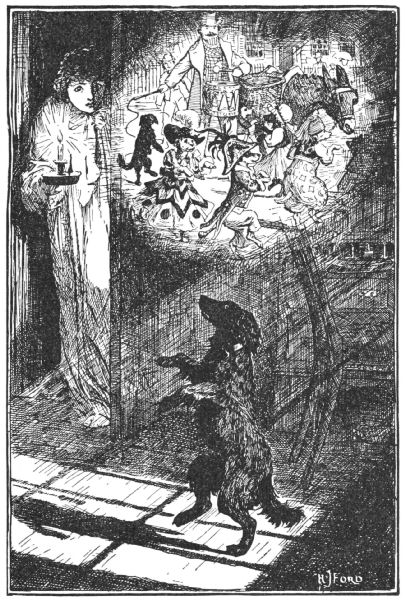
The girl finds Zamore practising his dancing

All that day Zamore was more serious and more gloomy than ever. Nothing would tempt him out, hardly even his favourite dinner, and it was quite plain that he was turning over something in his mind. But during the night his two young mistresses were awakened by a strange noise that seemed to come from an empty room next theirs, where Zamore usually slept. They both lay awake and listened, and thought it was like a measured stamping, and that the mice might be giving a ball. But could little mice feet tread so heavily as that? Supposing a thief had got in? So the bravest of the two girls got up, and stealing to the door softly opened it and looked into the room. And what do you think she saw? Why, Zamore, on his hind legs, his paws in the air, practising carefully the steps that he had been watching that morning!

This was not, as one might have expected, a mere fancy of the moment, which would be quite forgotten the next day. Zamore was too serious a dog for that, and by dint of hard study he became in time a beautiful dancer. As often as the fife and drum were heard in the streets, Zamore rushed out of the house, glided softly between the spectators, and watched with absorbed attention the dancing dogs who were doing their steps: but remembering the blow he had had from the whip, he took care not to join them. He noted their positions, the figures, and the way they held their bodies, and in the night he copied them, though by day he was just as solemn as ever. Soon he was not contented with merely copying what he saw, he invented for himself, and it is only just to say that, in stateliness of step, few dogs could come up to him. Often his dances were witnessed (unknown to himself) by Théophile and his sisters, who watched him through the crack of the door; and so earnest was he, that at length, worn out by dancing, he would drink up the whole of a large basin of water, which stood in the corner of the room.

When Zamore felt himself the equal of the best of the dancing dogs, he began to wish that like them he might have an audience.

Now in France the houses are not always built in a row as they are in England, but sometimes have a square court-yard in front, and in the house where Zamore lived, this court was shut in on one side by an iron railing, which was wide enough to let dogs of a slim figure squeeze through.

One fine morning there met in this court-yard fifteen or twenty dogs, friends of Zamore, to whom the night before he had sent letters of invitation. The object of the party was to see Zamore make his début in dancing, and the ball-room was to be the court-yard, which Zamore had carefully swept with his tail. The dance began, and the spectators were so delighted, that they could not wait for the end to applaud, as people ought always to do, but uttered loud cries of ‘Ouah, ouah,’ that reminded you of the noises you hear at a theatre. Except one old water spaniel who was filled with envy at Zamore’s talents, and declared that no decent dog would ever make an exhibition of himself like that, they all vowed that Zamore was the king of dancers, and that nothing had ever been seen to equal his minuet, jig, and waltz for grace and beauty.

It was only during his dancing moments that Zamore unbent. At all other times he was as gloomy as ever, and never cared to stir from the rug unless he saw his old master take up his hat and stick for a walk. Of course, if he had chosen, he might have joined Monsieur Corri’s troupe, of which he would have made the brightest ornament; but the love of his master proved greater than his love of his art, and he remained unknown, except of his family. In the end he fell a victim to his passion for dancing, and he died of brain fever, which is supposed to have been caused by the fatigue of learning the schottische, the fashionable dance of the day.

***********

As I said earlier I recommend Bailey's lightly edited version and recommend going to https://archive.org/details/inanimalworld00bail/page/136/mode/2up -- it will only take a few minutes for three and a fraction pages.

Because my time on the road required working a bit ahead, I'm writing this on Thursday, August 8. I just learned today is International Cat Day! I find there are even more stories about cats, so I will start prowling for next week's story and make it Caturday!

*********************

This is part of a series of postings of stories under the category, "Keeping the Public in Public Domain."  The idea behind Public Domain was to preserve our cultural heritage after the authors and their immediate heirs were compensated.  I feel strongly current copyright law delays this intent on works of the 20th century.  My own library of folklore includes so many books within the Public Domain I decided to share stories from them.  I hope you enjoy discovering new stories.  


At the same time, my own involvement in storytelling regularly creates projects requiring research as part of my sharing stories with an audience.  Whenever that research needs to be shown here, the publishing of Public Domain stories will not occur that week.  This is a return to my regular posting of a research project here.  (Don't worry, this isn't dry research, my research is always geared towards future storytelling to an audience.)  Response has convinced me that "Keeping the Public in Public Domain" should continue along with my other postings as often as I can manage it.

Other Public Domain story resources I recommend-

  • There are many online resources for Public Domain stories, maybe none for folklore is as ambitious as fellow storyteller, Yoel Perez's database, Yashpeh, the International Folktales Collection.  I have long recommended it and continue to do so.  He has loaded Stith Thompson's Motif Index into his server as a database so you can search the whole 6 volumes for whatever word or expression you like by pressing one key. http://folkmasa.org/motiv/motif.htm

  • You may have noticed I'm no longer certain Dr. Perez has the largest database, although his offering the Motif Index certainly qualifies for those of us seeking specific types of stories.  There's another site, FairyTalez claiming to be the largest, with "over 2000 fairy tales, folktales, and fables" and they are "fully optimized for phones, tablets, and PCs", free and presented without ads.
    Between those two sites, there is much for story-lovers, but as they say in infomercials, "Wait, there's more!"

The email list for storytellers, Storytell, discussed Online Story Sources and came up with these additional suggestions:        

         - David K. Brown - http://people.ucalgary.ca/~dkbrown/stories.html

         - Richard Martin - http://www.tellatale.eu/tales_page.html

         - Spirit of Trees - http://spiritoftrees.org/featured-folktales

         - Story-Lovers - http://www.story-lovers.com/ is now only accessible through the Wayback Machine, described below, but the late Jackie Baldwin's wonderful site lives on there, fully searchable manually (the Google search doesn't work), at https://archive.org/ .  It's not easy, but go to Story-lovers.com snapshot for December 22 2016  and you can click on SOS: Searching Out Stories to scroll down through the many story topics and click on the story topic that interests you.

       - World of Tales - http://www.worldoftales.com/ 

 
           - Zalka Csenge Virag - http://multicoloreddiary.blogspot.com doesn't give the actual stories, but her recommendations, working her way through each country on a continent, give excellent ideas for finding new books and stories to love and tell.

     
You're going to find many of the links on these sites have gone down, BUT go to the Internet Archive Wayback Machine to find some of these old links.  Tim's site, for example, is so huge probably updating it would be a full-time job.  In the case of Story-Lovers, it's great that Jackie Baldwin set it up to stay online as long as it did after she could no longer maintain it.  Possibly searches maintained it.  Unfortunately Storytell list member, Papa Joe is on both Tim Sheppard's site and Story-Lovers, but he no longer maintains his old Papa Joe's Traveling Storytelling Show website and his Library (something you want to see!) is now only on the Wayback Machine.  It took some patience working back through claims of snapshots but finally in December of 2006 it appears!

    Somebody as of this writing whose stories can still be found by his website is the late Chuck Larkin - http://chucklarkin.com/stories.html.  I prefer to list these sites by their complete address so they can be found by the Wayback Machine, a.k.a. Archive.org, when that becomes the only way to find them.

You can see why I recommend these to you. 

Have fun discovering even more stories


Friday, July 19, 2024

Lang - The Voice of Death - Keeping the Public in Public Domain

Storytellers don't get sick days. Last week, while I knew my voice sounded "rusty" thanks to a viral infection, it worked out because it was a room with good acoustics. That evening's Dinner Detective and maybe this week, too, works out as part of the fun of improvisation.  We'll see.  Have a ton of prescriptions and at least it's not Covid.

In the meantime I went story hunting and found Andrew Lang in his The Red Fairy Book had something to say about voices in this Romanian story of "The Voice of Death." Project Gutenberg gives the story,  but misses a fine illustration.  My book's copy only says "With numerous illustrations by H.J. Ford and Lancelot Speed."  Don't know which artist did this.

THE VOICE OF DEATH

Once upon a time there lived a man whose one wish and prayer was to get rich. Day and night he thought of nothing else, and at last his prayers were granted, and he became very wealthy. Now being so rich, and having so much to lose, he felt that it would be a terrible thing to die and leave all his possessions behind; so he made up his mind to set out in search of a land where there was no death. He got ready for his journey, took leave of his wife, and started. Whenever he came to a new country the first question that he asked was whether people died in that land, and when he heard that they did, he set out again on his quest. At last he reached a country where he was told that the people did not even know the meaning of the word death. Our traveller was delighted when he heard this, and said:

‘But surely there are great numbers of people in your land, if no one ever dies?’

‘No,’ they replied, ‘there are not great numbers, for you see from time to time a voice is heard calling first one and then another, and whoever hears that voice gets up and goes away, and never comes back.’

‘And do they see the person who calls them,’ he asked, ‘or do they only hear his voice?’

‘They both see and hear him,’ was the answer.

Well, the man was amazed when he heard that the people were stupid enough to follow the voice, though they knew that if they went when it called them they would never return. And he went back to his own home and got all his possessions together, and, taking his wife and family, he set out resolved to go and live in that country where the people did not die, but where instead they heard a voice calling them, which they followed into a land from which they never returned. For he had made up his own mind that when he or any of his family heard that voice they would pay no heed to it, however loudly it called.

After he had settled down in his new home, and had got everything in order about him, he warned his wife and family that, unless they wanted to die, they must on no account listen to a voice which they might some day hear calling them.

For some years everything went well with them, and they lived happily in their new home. But one day, while they were all sitting together round the table, his wife suddenly started up, exclaiming in a loud voice:

‘I am coming! I am coming!’

And she began to look round the room for her fur coat, but her husband jumped up, and taking firm hold of her by the hand, held her fast, and reproached her, saying:

‘Don’t you remember what I told you? Stay where you are unless you wish to die.’

‘But don’t you hear that voice calling me?’ she answered. ‘I am merely going to see why I am wanted. I shall come back directly.’

So she fought and struggled to get away from her husband, and to go where the voice summoned. But he would not let her go, and had all the doors of the house shut and bolted. When she saw that he had done this, she said:

‘Very well, dear husband, I shall do what you wish, and remain where I am.’

So her husband believed that it was all right, and that she had thought better of it, and had got over her mad impulse to obey the voice. But a few minutes later she made a sudden dash for one of the doors, opened it and darted out, followed by her husband. He caught her by the fur coat, and begged and implored her not to go, for if she did she would certainly never return. She said nothing, but let her arms fall backwards, and suddenly bending herself forward, she slipped out of the coat, leaving it in her husband’s hands. He, poor man, seemed turned to stone as he gazed after her hurrying away from him, and calling at the top of her voice, as she ran:

‘I am coming! I am coming!’

When she was quite out of sight her husband recovered his wits and went back into his house, murmuring:

‘If she is so foolish as to wish to die, I can’t help it. I warned and implored her to pay no heed to that voice, however loudly it might call.’

Well, days and weeks and months and years passed, and nothing happened to disturb the peace of the household. But one day the man was at the barber’s as usual, being shaved. The shop was full of people, and his chin had just been covered with a lather of soap, when, suddenly starting up from the chair, he called out in a loud voice:

‘I won’t come, do you hear? I won’t come!’

The barber and the other people in the shop listened to him with amazement. But again looking towards the door, he exclaimed:

‘I tell you, once and for all, I do not mean to come, so go away.’

And a few minutes later he called out again:

‘Go away, I tell you, or it will be the worse for you. You may call as much as you like but you will never get me to come.’

And he got so angry that you might have thought that some one was actually standing at the door, tormenting him. At last he jumped up, and caught the razor out of the barber’s hand, exclaiming:

‘Give me that razor, and I’ll teach him to let people alone for the future.’

And he rushed out of the house as if he were running after some one, whom no one else saw. The barber, determined not to lose his razor, pursued the man, and they both continued running at full speed till they had got well out of the town, when all of a sudden the man fell head foremost down a precipice, and never was seen again. So he too, like the others, had been forced against his will to follow the voice that called him.

The barber, who went home whistling and congratulating himself on the escape he had made, described what had happened, and it was noised abroad in the country that the people who had gone away, and had never returned, had all fallen into that pit; for till then they had never known what had happened to those who had heard the voice and obeyed its call.

But when crowds of people went out from the town to examine the ill-fated pit that had swallowed up such numbers, and yet never seemed to be full, they could discover nothing. All that they could see was a vast plain, that looked as if it had been there since the beginning of the world. And from that time the people of the country began to die like ordinary mortals all the world over.[13]

[13] Roumanian Tales from the German of Mite Thremnitz. 

****

I always tell people if you go to The Dinner Detective and it's a night when you can see me, keep it to yourself as a clue to who is maybe the murderer or the victim.  This week I will be thinking about "The Voice of Death."

***************

This is part of a series of postings of stories under the category, "Keeping the Public in Public Domain."  The idea behind Public Domain was to preserve our cultural heritage after the authors and their immediate heirs were compensated.  I feel strongly current copyright law delays this intent on works of the 20th century.  My own library of folklore includes so many books within the Public Domain I decided to share stories from them.  I hope you enjoy discovering new stories.  


At the same time, my own involvement in storytelling regularly creates projects requiring research as part of my sharing stories with an audience.  Whenever that research needs to be shown here, the publishing of Public Domain stories will not occur that week.  This is a return to my regular posting of a research project here.  (Don't worry, this isn't dry research, my research is always geared towards future storytelling to an audience.)  Response has convinced me that "Keeping the Public in Public Domain" should continue along with my other postings as often as I can manage it.

Other Public Domain story resources I recommend-

  • There are many online resources for Public Domain stories, maybe none for folklore is as ambitious as fellow storyteller, Yoel Perez's database, Yashpeh, the International Folktales Collection.  I have long recommended it and continue to do so.  He has loaded Stith Thompson's Motif Index into his server as a database so you can search the whole 6 volumes for whatever word or expression you like by pressing one key. http://folkmasa.org/motiv/motif.htm

  • You may have noticed I'm no longer certain Dr. Perez has the largest database, although his offering the Motif Index certainly qualifies for those of us seeking specific types of stories.  There's another site, FairyTalez claiming to be the largest, with "over 2000 fairy tales, folktales, and fables" and they are "fully optimized for phones, tablets, and PCs", free and presented without ads.
    Between those two sites, there is much for story-lovers, but as they say in infomercials, "Wait, there's more!"

The email list for storytellers, Storytell, discussed Online Story Sources and came up with these additional suggestions:        

         - David K. Brown - http://people.ucalgary.ca/~dkbrown/stories.html

         - Richard Martin - http://www.tellatale.eu/tales_page.html

         - Spirit of Trees - http://spiritoftrees.org/featured-folktales

         - Story-Lovers - http://www.story-lovers.com/ is now only accessible through the Wayback Machine, described below, but the late Jackie Baldwin's wonderful site lives on there, fully searchable manually (the Google search doesn't work), at https://archive.org/ .  It's not easy, but go to Story-lovers.com snapshot for December 22 2016  and you can click on SOS: Searching Out Stories to scroll down through the many story topics and click on the story topic that interests you.

       - World of Tales - http://www.worldoftales.com/ 

 
           - Zalka Csenge Virag - http://multicoloreddiary.blogspot.com doesn't give the actual stories, but her recommendations, working her way through each country on a continent, give excellent ideas for finding new books and stories to love and tell.

     
You're going to find many of the links on these sites have gone down, BUT go to the Internet Archive Wayback Machine to find some of these old links.  Tim's site, for example, is so huge probably updating it would be a full-time job.  In the case of Story-Lovers, it's great that Jackie Baldwin set it up to stay online as long as it did after she could no longer maintain it.  Possibly searches maintained it.  Unfortunately Storytell list member, Papa Joe is on both Tim Sheppard's site and Story-Lovers, but he no longer maintains his old Papa Joe's Traveling Storytelling Show website and his Library (something you want to see!) is now only on the Wayback Machine.  It took some patience working back through claims of snapshots but finally in December of 2006 it appears!

    Somebody as of this writing whose stories can still be found by his website is the late Chuck Larkin - http://chucklarkin.com/stories.html.  I prefer to list these sites by their complete address so they can be found by the Wayback Machine, a.k.a. Archive.org, when that becomes the only way to find them.

You can see why I recommend these to you. 

Have fun discovering even more stories