Tell me if you have a topic you'd like to see. (Contact: LoiS-sez@LoiS-sez.com .)
Please also let others know about this site.
Showing posts with label dogs. Show all posts

Friday, August 28, 2026

Pitman - The Strange Tale of Doctor Dog - Keeping the Public in Public Domain

There have been a variety of medical matters affecting my family so that is on my mind while looking for stories. It led me to a most unusual tale dating back to old imperial China, when the emperor was called "The Son of Heaven."

The story comes from The Chinese Wonder Book, a wonderful look back at Chinese folklore by Norman Hinsdale Pitman. Surprisingly he was a Michigander, born in Lamont, Michigan, but his career was entirely based in China starting by teaching at Chihli Province College in China from 1909-1912 before becoming a professor of English at Peking Teachers College. Project Gutenberg calls the stories "enchanting tales" and they certainly have a magical style not likely to be found in modern Chinese stories. The book has many illustrations by Li Chu-T'ang. 


THE STRANGE TALE OF DOCTOR DOG

THE STRANGE TALE OF DOCTOR DOG


F

ar up in the mountains of the Province of Hunan in the central part of China, there once lived in a small village a rich gentleman who had only one child. This girl, like the daughter of Kwan-yu in the story of the Great Bell, was the very joy of her father's life.

Now Mr. Min, for that was this gentleman's name, was famous throughout the whole district for his learning, and, as he was also the owner of much property, he spared no effort to teach Honeysuckle the wisdom of the sages, and to give her everything she craved. Of course this was enough to spoil most children, but Honeysuckle was not at all like other children. As sweet as the flower from which she took her name, she listened to her father's slightest command, and obeyed without ever waiting to be told a second time.

Her father often bought kites for her, of every kind and shape. There were fish, birds, butterflies, lizards and huge dragons, one of which had a tail more than thirty feet long. Mr. Min was very skilful in flying these kites for little Honeysuckle, and so naturally did his birds and butterflies circle round and hover about in the air that almost any little western boy would have been deceived and said, "Why, there is a real bird, and not a kite at all!" Then again, he would fasten a queer little instrument to the string, which made a kind of humming noise, as he waved his hand from side to side. "It is the wind singing, Daddy," cried Honeysuckle, clapping her hands with joy; "singing a kite-song to both of us." Sometimes, to teach his little darling a lesson if she had been the least naughty, Mr. Min would fasten queerly twisted scraps of paper, on which were written many Chinese words, to the string of her favourite kite.

"What are you doing, Daddy?" Honeysuckle would ask. "What can those queer-looking papers be?"

"On every piece is written a sin that we have done."

 "What is a sin, Daddy?"

"Oh, when Honeysuckle has been naughty; that is a sin!" he answered gently. "Your old nurse is afraid to scold you, and if you are to grow up to be a good woman, Daddy must teach you what is right."

Then Mr. Min would send the kite up high—high over the house-tops, even higher than the tall Pagoda on the hillside. When all his cord was let out, he would pick up two sharp stones, and, handing them to Honeysuckle, would say, "Now, daughter, cut the string, and the wind will carry away the sins that are written down on the scraps of paper."

"But, Daddy, the kite is so pretty. Mayn't we keep our sins a little longer?" she would innocently ask.

"No, child; it is dangerous to hold on to one's sins. Virtue is the foundation of happiness," he would reply sternly, choking back his laughter at her question. "Make haste and cut the cord."

So Honeysuckle, always obedient—at least with her father—would saw the string in two between the sharp stones, and with a childish cry of despair would watch her favourite kite, blown by the wind, sail farther and farther away, until at last, straining her eyes, she could see it sink slowly to the earth in some far-distant meadow.

"Now laugh and be happy," Mr. Min would say, "for your sins are all gone. See that you don't get a new supply of them."

Honeysuckle was also fond of seeing the Punch and Judy show, for, you must know, this old-fashioned amusement for children was enjoyed by little folks in China, perhaps three thousand years before your great-grandfather was born. It is even said that the great Emperor, Mu, when he saw these little dancing images for the first time, was greatly enraged at seeing one of them making eyes at his favourite wife. He ordered the showman to be put to death, and it was with difficulty the poor fellow persuaded his Majesty that the dancing puppets were not really alive at all, but only images of cloth and clay.

No wonder then Honeysuckle liked to see Punch and Judy if the Son of Heaven himself had been deceived by their queer antics into thinking them real people of flesh and blood.

But we must hurry on with our story, or some of our readers will be asking, "But where is Dr. Dog? Are you never coming to the hero of this tale?" One day when Honeysuckle was sitting inside a shady pavilion that overlooked a tiny fish-pond, she was suddenly seized with a violent attack of colic. Frantic with pain, she told a servant to summon her father, and then without further ado, she fell over in a faint upon the ground.

When Mr. Min reached his daughter's side, she was still unconscious. After sending for the family physician to come post haste, he got his daughter to bed, but although she recovered from her fainting fit, the extreme pain continued until the poor girl was almost dead from exhaustion.

Now, when the learned doctor arrived and peered at her from under his gigantic spectacles, he could not discover the cause of her trouble. However, like some of our western medical men, he did not confess his ignorance, but proceeded to prescribe a huge dose of boiling water, to be followed a little later by a compound of pulverized deer's horn and dried toadskin.

Poor Honeysuckle lay in agony for three days, all the time growing weaker and weaker from loss of sleep. Every great doctor in the district had been summoned for consultation; two had come from Changsha, the chief city of the province, but all to no avail. It was one of those cases that seem to be beyond the power of even the most learned physicians. In the hope of receiving the great reward offered by the desperate father, these wise men searched from cover to cover in the great Chinese Cyclopedia of Medicine, trying in vain to find a method of treating the unhappy maiden. There was even thought of calling in a certain foreign physician from England, who was in a distant city, and was supposed, on account of some marvellous cures he had brought to pass, to be in direct league with the devil. However, the city magistrate would not allow Mr. Min to call in this outsider, for fear trouble might be stirred up among the people.

Mr. Min sent out a proclamation in every direction, describing his daughter's illness, and offering to bestow on her a handsome dowry and give her in marriage to whoever should be the means of bringing her back to health and happiness. He then sat at her bedside and waited, feeling that he had done all that was in his power. There were many answers to his invitation. Physicians, old and young, came from every part of the Empire to try their skill, and when they had seen poor Honeysuckle and also the huge pile of silver shoes her father offered as a wedding gift, they all fought with might and main for her life; some having been attracted by her great beauty and excellent reputation, others by the tremendous reward.

But, alas for poor Honeysuckle! Not one of all those wise men could cure her! One day, when she was feeling a slight change for the better, she called her father, and, clasping his hand with her tiny one said, "Were it not for your love I would give up this hard fight and pass over into the dark wood; or, as my old grandmother says, fly up into the Western Heavens. For your sake, because I am your only child, and especially because you have no son, I have struggled hard to live, but now I feel that the next attack of that dreadful pain will carry me away. And oh, I do not want to die!"

Here Honeysuckle wept as if her heart would break, and her old father wept too, for the more she suffered the more he loved her.

Just then her face began to turn pale. "It is coming! The pain is coming, father! Very soon I shall be no more. Good-bye, father! Good-bye; good——." Here her voice broke and a great sob almost broke her father's heart. He turned away from her bedside; he could not bear to see her suffer. He walked outside and sat down on a rustic bench; his head fell upon his bosom, and the great salt tears trickled down his long grey beard.

As Mr. Min sat thus overcome with grief, he was startled at hearing a low whine. Looking up he saw, to his astonishment, a shaggy mountain dog about the size of a Newfoundland. The huge beast looked into the old man's eyes with so intelligent and human an expression, with such a sad and wistful gaze, that the greybeard addressed him, saying, "Why have you come? To cure my daughter?"

The dog replied with three short barks, wagging his tail vigorously and turning toward the half-opened door that led into the room where the girl lay.

By this time, willing to try any chance whatever of reviving his daughter, Mr. Min bade the animal follow him into Honeysuckle's apartment. Placing his forepaws upon the side of her bed, the dog looked long and steadily at the wasted form before him and held his ear intently for a moment over the maiden's heart. Then, with a slight cough he deposited from his mouth into her outstretched hand, a tiny stone. Touching her wrist with his right paw, he motioned to her to swallow the stone.

"Yes, my dear, obey him," counselled her father, as she turned to him inquiringly, "for good Dr. Dog has been sent to your bedside by the mountain fairies, who have heard of your illness and who wish to invite you back to life again."

Without further delay the sick girl, who was by this time almost burned away by the fever, raised her hand to her lips and swallowed the tiny charm. Wonder of wonders! No sooner had it passed her lips than a miracle occurred. The red flush passed away from her face, the pulse resumed its normal beat, the pains departed from her body, and she arose from the bed well and smiling.

Flinging her arms about her father's neck, she cried out in joy, "Oh, I am well again; well and happy; thanks to the medicine of the good physician."

The noble dog barked three times, wild with delight at hearing these tearful words of gratitude, bowed low, and put his nose in Honeysuckle's outstretched hand.

Mr. Min, greatly moved by his daughter's magical recovery, turned to the strange physician, saying, "Noble Sir, were it not for the form you have taken, for some unknown reason, I would willingly give four times the sum in silver that I promised for the cure of the girl, into your possession. As it is, I suppose you have no use for silver, but remember that so long as we live, whatever we have is yours for the asking, and I beg of you to prolong your visit, to make this the home of your old age—in short, remain here for ever as my guest—nay, as a member of my family."

The dog barked thrice, as if in assent. From that day he was treated as an equal by father and daughter. The many servants were commanded to obey his slightest whim, to serve him with the most expensive food on the market, to spare no expense in making him the happiest and best-fed dog in all the world. Day after day he ran at Honeysuckle's side as she gathered flowers in her garden, lay down before her door when she was resting, guarded her Sedan chair when she was carried by servants into the city. In short, they were constant companions; a stranger would have thought they had been friends from childhood.

One day, however, just as they were returning from a journey outside her father's compound, at the very instant when Honeysuckle was alighting from her chair, without a moment's warning, the huge animal dashed past the attendants, seized his beautiful mistress in his mouth, and before anyone could stop him, bore her off to the mountains. By the time the alarm was sounded, darkness had fallen over the valley and as the night was cloudy no trace could be found of the dog and his fair burden.

Once more the frantic father left no stone unturned to save his daughter. Huge rewards were offered, bands of woodmen scoured the mountains high and low, but, alas, no sign of the girl could be found! The unfortunate father gave up the search and began to prepare himself for the grave. There was nothing now left in life that he cared for—nothing but thoughts of his departed daughter. Honeysuckle was gone for ever.

"Alas!" said he, quoting the lines of a famous poet who had fallen into despair:

"My whiting hair would make an endless rope,

Yet would not measure all my depth of woe."

Several long years passed by; years of sorrow for the ageing man, pining for his departed daughter. One beautiful October day he was sitting in the very same pavilion where he had so often sat with his darling. His head was bowed forward on his breast, his forehead was lined with grief. A rustling of leaves attracted his attention. He looked up. Standing directly in front of him was Dr. Dog, and lo, riding on his back, clinging to the animal's shaggy hair, was Honeysuckle, his long-lost daughter; while standing near by were three of the handsomest boys he had ever set eyes upon!

"Ah, my daughter! My darling daughter, where have you been all these years?" cried the delighted father, pressing the girl to his aching breast. "Have you suffered many a cruel pain since you were snatched away so suddenly? Has your life been filled with sorrow?"

"Only at the thought of your grief," she replied, tenderly, stroking his forehead with her slender fingers; "only at the thought of your suffering; only at the thought of how I should like to see you every day and tell you that my husband was kind and good to me.  For you must know, dear father, this is no mere animal that stands beside you. This Dr. Dog, who cured me and claimed me as his bride because of your promise, is a great magician. He can change himself at will into a thousand shapes. He chooses to come here in the form of a mountain beast so that no one may penetrate the secret of his distant palace."

"Then he is your husband?" faltered the old man, gazing at the animal with a new expression on his wrinkled face.

"Yes; my kind and noble husband, the father of my three sons, your grandchildren, whom we have brought to pay you a visit."

"And where do you live?"

"In a wonderful cave in the heart of the great mountains; a beautiful cave whose walls and floors are covered with crystals, and encrusted with sparkling gems. The chairs and tables are set with jewels; the rooms are lighted by a thousand glittering diamonds. Oh, it is lovelier than the palace of the Son of Heaven himself! We feed of the flesh of wild deer and mountain goats, and fish from the clearest mountain stream. We drink cold water out of golden goblets, without first boiling it, for it is purity itself. We breathe fragrant air that blows through forests of pine and hemlock. We live only to love each other and our children, and oh, we are so happy! And you, father, you must come back with us to the great mountains and live there with us the rest of your days, which, the gods grant, may be very many."
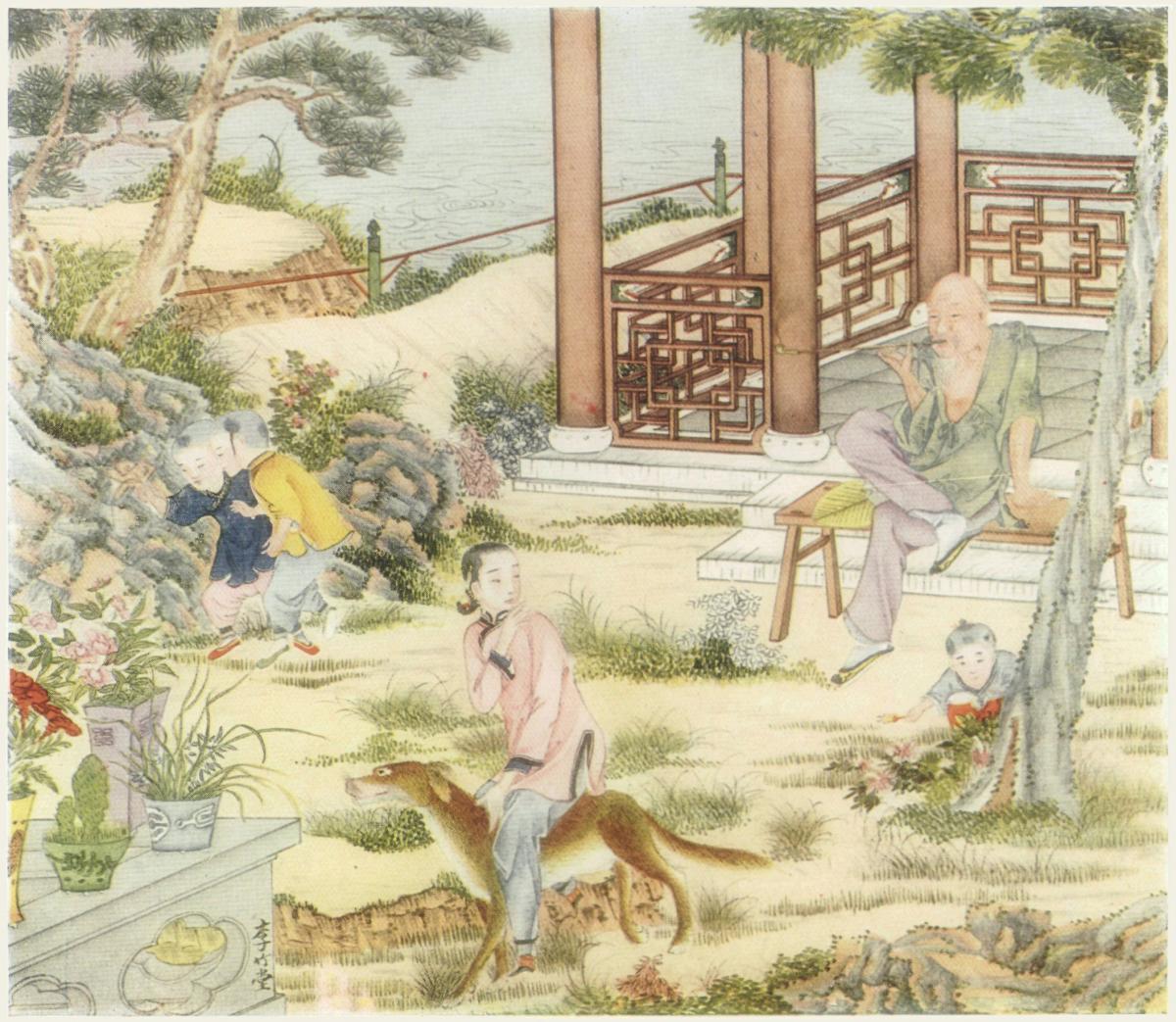
'CLINGING TO THE ANIMAL'S SHAGGY HAIR WAS HONEYSUCKLE'

The old man pressed his daughter once more to his breast and fondled the children, who clambered over him rejoicing at the discovery of a grandfather they had never seen before.

From Dr. Dog and his fair Honeysuckle are sprung, it is said, the well-known race of people called the Yus, who even now inhabit the mountainous regions of the Canton and Hunan provinces. It is not for this reason, however, that we have told the story here, but because we felt sure every reader would like to learn the secret of the dog that cured a sick girl and won her for his bride.

*************

While having a dog is supposed to be good for our health, somehow I doubt they are able to match Doctor Dog!

******************************* 

This is part of a series of postings of stories under the category, “Keeping the Public in Public Domain.” The idea behind Public Domain was to preserve our cultural heritage after the authors and their immediate heirs were compensated. I feel strongly current copyright law delays this intent on works of the 20th century. My own library of folklore includes so many books within the Public Domain I decided to share stories from them. I hope you enjoy discovering them.

At the same time, my own involvement in storytelling regularly creates projects requiring research as part of my sharing stories with an audience.  Whenever that research needs to be shown here, the publishing of Public Domain stories will not occur that week.  This is a return to my regular posting of a research project here.  (Don't worry, this isn't dry research, my research is always geared towards future storytelling to an audience.)  Response has convinced me that "Keeping the Public in Public Domain" should continue along with my other postings as often as I can manage it.

See the sidebar for other Public Domain story resources I recommend on the page “Public Domain Story Resources."


Thursday, October 30, 2025

O'Donnell - How the Ghost of a Dog Saved Life - Keeping the Public in Public Domain

With Halloween this year being on a Friday, it seems everybody is extending Halloween through the weekend. I wasn't about to do that until the title of a book began to haunt me. Clearly I needed to take a look at Elliott O'Donnell's Animal Ghosts or Animal Hauntings and the Hereafter , a title I found while searching at Project Gutenberg. 

O'Donnell, Wikipedia tells us was "known primarily for his books about ghosts." He started by writing a psychic thriller in his spare time, "but specialised in what were claimed as true stories of ghosts and hauntings. These were immensely popular, but his flamboyant style and amazing stories suggest that he combined fact with fiction." In Animal Ghosts he certainly spent a lot of time citing sources telling of spectral animals. I prowled the Cat section first and felt much of the stories spent too much time setting up background on his tellers to make the actual story tellable. Then I went to the Dogs. (Okay, that sounds like the truth about this "source.") The story I felt needed telling is about a Newfoundland.  

I've had Huskies and Malamutes all my adult life, but then there was Fred, a Newfoundland/Chow mix. We were going to just foster him, but he stayed. I confess the Newfoundland in him was a sweet, appealing "Drool Monster." Unfortunately there was also the Chow which made him smaller than a true Newfoundland. (Think about the size of a Saint Bernard if you've never met a Newf.) I'm sure somebody thought the mix would be more manageable. Trust me, the personality of a Chow may appeal to some, but it can't be because they are "manageable" -- they are excitable and in charge. Looking back at Fred, I can see the Newf in him fitting this story.

How the Ghost of a Dog saved Life

When I was a boy, an elderly friend of mine, Miss Lefanu, narrated to me an anecdote which impressed me much. It was to this effect.

Miss Lefanu was walking one day along a very lonely country lane, when she suddenly observed an enormous Newfoundland dog following in her wake a few yards behind. Being very fond of dogs, she called out to it in a caressing voice and endeavoured to stroke it. To her disappointment, however, it dodged aside, and repeated the manoeuvre every time she tried to touch it. At length, losing patience, she desisted, and resumed her walk, the dog still following her. In this fashion they went on, until they came to a particularly dark part of the road, where the branches of the trees almost met overhead, and there was a pool of stagnant, slimy water, suggestive of great depth. On the one side the hedge was high, but on the other there was a slight gap leading into a thick spinney. Miss Lefanu never visited the spot alone after dusk, and had been warned against it even in the daytime. As she drew near to it, everything that she had ever heard about it flashed across her mind, and she was more than once on the verge of turning back, when the sight of the big, friendly-looking dog plodding behind, reassuring her, she pressed on. Just as she came to the gap, there was a loud snapping of twigs, and, to her horror, two tramps, with singularly sinister faces, sprang out, and were about to strike her with their bludgeons, when the dog, uttering a low, ominous growl, dashed at them. In an instant the expression of murderous joy in their eyes died out, one of abject terror took its place, and, dropping their weapons, they fled, as if the very salvation of their souls depended on it. As may be imagined, Miss Lefanu lost no time in getting home, and the first thing she did on arriving there was to go into the kitchen and order the cook to prepare, at once, a thoroughly good meal for her gallant rescuer—the Newfoundland dog, which she had shut up securely in the back yard, with the laughing remark, "There—you can't escape me now." Judge of her astonishment, however, when, on her return, the dog had gone. As the walls of the back yard were twelve feet high, and the doors had been shut all the while—no one having passed through them—it was impossible for the animal to have escaped, and the only interpretation that could possibly be put on the matter was that the dog was superphysical—a conclusion that was subsequently confirmed by the experiences of various other people. As the result of exhaustive enquiries Miss Lefanu eventually learned that many years before, on the very spot where the tramps had leaped out on her, a pedlar and his Newfoundland dog had been discovered murdered.

This story being true, then, there is one more link in the chain of evidence to show that dogs, as well as men, have spirits, and spirits that can, on occasion, at least, perform deeds of practical service.

***

Other animals in Animal Ghosts are horses, bulls, cows, pigs, sheep, wild animals, inhabitants of the jungle, and birds. Ghosts a plenty!

O'Donnell in his Preface says: If human beings, with all their vices, have a future life, assuredly animals, who in character so often equal, nay, excel human beings, have a future life also. 

I definitely agree. Without them heaven wouldn't be heavenly. 

******************************* 

This is part of a series of postings of stories under the category, “Keeping the Public in Public Domain.” The idea behind Public Domain was to preserve our cultural heritage after the authors and their immediate heirs were compensated. I feel strongly current copyright law delays this intent on works of the 20th century. My own library of folklore includes so many books within the Public Domain I decided to share stories from them. I hope you enjoy discovering them.

At the same time, my own involvement in storytelling regularly creates projects requiring research as part of my sharing stories with an audience.  Whenever that research needs to be shown here, the publishing of Public Domain stories will not occur that week.  This is a return to my regular posting of a research project here.  (Don't worry, this isn't dry research, my research is always geared towards future storytelling to an audience.)  Response has convinced me that "Keeping the Public in Public Domain" should continue along with my other postings as often as I can manage it.

See the sidebar for other Public Domain story resources I recommend on the page “Public Domain Story Resources."


Friday, February 7, 2025

Bailey - Four-Legged Saint Valentine - Keeping the Public in Public Domain


It's coming . . . Valentine's Day! As always, you can start finding more than you probably want to know at Wikipedia.  In addition to all the legends and folk traditions I found the section on "Modern Times", which starts at 1797 of interest. It also goes on to talk of specific worldwide celebration, saying "On the United States mainland, about 190 million Valentine's Day cards are sent each year, not including the hundreds of millions of cards school children exchange." Aside from all the types of candy and e-cards, it's good to know it is still an activity in the schools. 

When I went looking for a story, I knew Caroline Sherwin Bailey could be counted on to have at least one. It was interesting to find a story that might take children back to their great grandparents' childhood during World War II. My copy of Merry Tales for Children is the 1943 edition with the earlier 1921 version included. While Bailey gives an editorial note of stories by other authors, this seems to be pure Bailey storytelling. Fortunately Platt & Munk didn't renew the copyright, so both versions are now Public Domain. I love turning to the back jacket flap of my hard cover book where "all the boys and girls of America" are urged to "buy U.S. War Bonds or Stamps. Start now to save for the future and you will be helping your country to win the war." That's definitely worth a bit of discussion along with such things as fountain pens and typewriters in a day when even cursive writing is becoming a relic of the past. Whenever I do my One-Room Schoolteacher program I always have grandparents in the audience talk about having to teach their grandchildren cursive or, at least, how to write a signature. I see it's a skill in demand for genealogy. I also note the way the United States Postal Service has changed. Back then it was twice a day. Today it's still necessary to point out why it should even continue to be week days. 

Save for the end talking about the  "Four-legged Saint Valentine" trained to deliver letters in red envelopes. What an idea! Service dogs continue to exist, but doubt we have the pleasure of having teeth marks on our mail. Hmmm! Wonder if robot dogs of the future will be in schools and libraries to encourage children to practice their reading. Personally I prefer the reactions of an actual dog.

Also after the story I give some dog-related crafts as well as a way to celebrate with your own dog if you are so blessed as to have these Four-Legged Valentines.

***

BestFriends.org has 9 ways to celebrate Valentine's Day with your pets -- they also have information about how they are "on the ground helping Los Angeles pets" after the L.A. wildfires.

Easy puppy paper bag Valentine card holder

or use a Dog Valentine box with printable template 

and a puppy as a Valentine craft 

Whether a dog, cat, or other pet, they are family and deserve our love.

Friday, September 20, 2024

National Dog Week


The last full week in September is National Dog Week in the United States. I'm definitely a lifelong fan of dogs. Sled dogs, Huskies and Malamutes, are my favorite breeds because they are the closest to their wolf origins. I checked and found 20 posts have been made here with the label "dogs" including one from last year on March 24th when I said goodbye to "the best dog ever." Our new boy is quite the character, now six years old, but going on six months in his activity level. He came to us last year with quite a story already. He had lost his original person when the man died. I can understand why this dog proved too much for the man's widow. In fairness to our present hyperactive husky, I try to remember any problems we had with his predecessor.

Twenty posts about dogs! I was all set to give yet another story here. The only problem is I wanted something originating in Native American storytelling about the origins of dogs and their longtime friendship with people. I even found one I thought was pretty obscure, "Why the Dog Hangs Out His Tongue." DRAT! June 6, 2020 as the Covid "Shelter in Place" was coming to an end I posted that very story I planned for today.

I encourage you to go to that search label of "dogs" for lots of stories including June 6, 2020 which ends with the following picture and I repeat its concluding paragraph.

Illustration by R. Emmett Owen


The story, "Why the Dog Hangs Out His Tongue" ends with
When our dog is on the trail with me I sometimes wonder about him "not being able to run as fast" while alternating between trying to control him or just keep up. I also remind my husband when our dog is barking (especially if I can tell coyotes are nearby) he's just doing his job. Unfortunately for a pair of possums, that includes protecting us from them. Hmmm maybe I should hunt up some possum stories.


A storytelling conference where I once presented, the Northeast Storytelling's annual conference, Sharing the-Fire, had a wonderful session to let people unwind with Telling Pet Stories. Anybody with a pet, even if it's not a dog, has stories. I'm always happy to encourage storytelling, so if you have or had a pet, I hope you will start or continue telling stories about them. That's all I'm going to tell for now -- I need to hurry away because we've a dog leaping at our back door wanting inside!

Friday, August 9, 2024

Lang - The Dancing Dog - Keeping the Public in Public Domain

Officially the "Dog Days of Summer" are considered in that link from the Old Farmer's Almanac to be July 3 - August 11. They point out it has variations, but always is tied to summer's Sirius, the Dog Star. It's an interesting article. I also have a love of dogs, so I was eager to once again present a story about them. I recall attending a storytelling conference that wisely put in its schedule a time to tell stories about pets. It was scheduled for one of those times when attendees would probably be running out of steam. It definitely perked up everybody in the group I attended as we all had stories about our pets and loved to tell about them!

Today's story is in two books, Lang's The Animal Story Book and a slightly edited version by Carolyn Sherwin Bailey in her In the Animal World. To be honest I prefer Bailey's version and recommend comparing it with Lang. He doesn't give his source unless it was from a French work, Ménagerie Intime, noted after the title. I chose it both because it's the original and Bailey's book has no illustrations while Lang's has illustrations by H.J. Ford. Beyond that, I'm on the road a lot this week and forced to use a laptop. It was far easier to copy the Project Gutenberg version than to take screenshots and edit Bailey's book which was only at the Internet Archive.

I strongly support both Project Gutenberg and the Internet Archive. If you haven't heard about (and lent your own support to) their fight in the lawsuit by four publishers, I urge you to read the latest in What Happened Last Friday in Hachette v. Internet Archive. The digital rights for libraries and online are at stake and even authors support the archive. That link is just the latest news presuming most readers understand what the case means for internet and library access.

The French setting doesn't hurt this story appearing in a week when the Olympics have taken us to Paris.  Bailey only calls the story "The Dancing Dog" and I've kept that shorter title for today's posting. Beyond all of that, here's a story of a most unusual dog -- but then aren't they all?!?

STILL WATERS RUN DEEP; OR THE DANCING DOG

Ménagerie Intime.

When Little Théophile became Big Théophile, he was as fond as ever of dogs and cats, and he knew more about them than anybody else. After the death of a large white spaniel called Luther, he filled the vacant place on his rug by another of the same breed, to whom he gave the name of Zamore. Zamore was a little dog, as black as ink, except for two yellow patches over his eyes, and a stray patch on his chest. He was not in the least handsome, and no stranger would ever have given him a second thought. But when you came to know him, you found Zamore was not a common dog at all. He despised all women, and absolutely refused to obey them or to follow them, and neither Théophile’s mother nor his sisters could get the smallest sign of friendship from him. If they offered him cakes or sugar, he would accept them in a dignified manner, but never dreamed of saying ‘thank you,’ still less of wagging his tail on the floor, or giving little yaps of delight and gratitude, as well-brought-up dogs should do. Even to Théophile’s father, whom he liked better than anyone else, he was cold and respectful, though he followed him everywhere, and never left his master’s heels when they took a walk. And when they were fishing together, Zamore would sit silent on the bank for hours together, and only allowed himself one bark when the fish was safely hooked.

Now no one could possibly have guessed that a dog of such very quiet and reserved manners was at heart as gay and cheerful as the silliest kitten that ever was born, but so he was, and this was how his family found it out.

One day he was walking as seriously as usual through a broad square in the outskirts of Paris, when he was surprised at meeting a large grey donkey, with two panniers on its back, and in the panniers a troop of dogs, some dressed as Swiss shepherdesses, some as Turks, some in full court costume. The owner of the animals stopped the donkey close to where Zamore was standing, and bade the dogs jump down. Then he cracked his whip; the fife and drum struck up a merry tune, the dogs steadied themselves on their hind legs, and the dance began.

Zamore looked on as if he had been turned into stone. The sight of these dogs, dressed in bright colours, this one with his head covered by a feathered hat, and that one by a turban, but all moving about in time to the music, and making pirouettes and little bows; were they really dogs he was watching or some new kind of men? Anyway he had never seen anything so enchanting or so beautiful, and if it was true that they were only dogs—well, he was a dog too!

With that thought, all that had lain hidden in Zamore’s soul burst forth, and when the dancers filed gracefully before him, he raised himself on his hind legs, and in spite of staggering a little, prepared to join the ring, to the great amusement of the spectators.

The dog-owner, however, whose name was Monsieur Corri, did not see matters in the same light. He raised his whip a second time, and brought it down with a crack on the sides of Zamore, who ran out of the ring, and with his tail between his legs and an air of deep thought, he returned home.

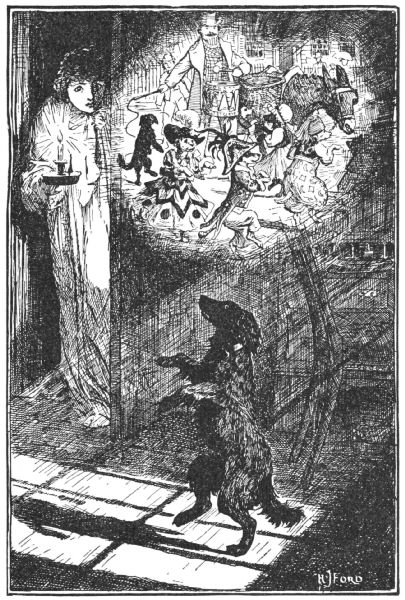
The girl finds Zamore practising his dancing

All that day Zamore was more serious and more gloomy than ever. Nothing would tempt him out, hardly even his favourite dinner, and it was quite plain that he was turning over something in his mind. But during the night his two young mistresses were awakened by a strange noise that seemed to come from an empty room next theirs, where Zamore usually slept. They both lay awake and listened, and thought it was like a measured stamping, and that the mice might be giving a ball. But could little mice feet tread so heavily as that? Supposing a thief had got in? So the bravest of the two girls got up, and stealing to the door softly opened it and looked into the room. And what do you think she saw? Why, Zamore, on his hind legs, his paws in the air, practising carefully the steps that he had been watching that morning!

This was not, as one might have expected, a mere fancy of the moment, which would be quite forgotten the next day. Zamore was too serious a dog for that, and by dint of hard study he became in time a beautiful dancer. As often as the fife and drum were heard in the streets, Zamore rushed out of the house, glided softly between the spectators, and watched with absorbed attention the dancing dogs who were doing their steps: but remembering the blow he had had from the whip, he took care not to join them. He noted their positions, the figures, and the way they held their bodies, and in the night he copied them, though by day he was just as solemn as ever. Soon he was not contented with merely copying what he saw, he invented for himself, and it is only just to say that, in stateliness of step, few dogs could come up to him. Often his dances were witnessed (unknown to himself) by Théophile and his sisters, who watched him through the crack of the door; and so earnest was he, that at length, worn out by dancing, he would drink up the whole of a large basin of water, which stood in the corner of the room.

When Zamore felt himself the equal of the best of the dancing dogs, he began to wish that like them he might have an audience.

Now in France the houses are not always built in a row as they are in England, but sometimes have a square court-yard in front, and in the house where Zamore lived, this court was shut in on one side by an iron railing, which was wide enough to let dogs of a slim figure squeeze through.

One fine morning there met in this court-yard fifteen or twenty dogs, friends of Zamore, to whom the night before he had sent letters of invitation. The object of the party was to see Zamore make his début in dancing, and the ball-room was to be the court-yard, which Zamore had carefully swept with his tail. The dance began, and the spectators were so delighted, that they could not wait for the end to applaud, as people ought always to do, but uttered loud cries of ‘Ouah, ouah,’ that reminded you of the noises you hear at a theatre. Except one old water spaniel who was filled with envy at Zamore’s talents, and declared that no decent dog would ever make an exhibition of himself like that, they all vowed that Zamore was the king of dancers, and that nothing had ever been seen to equal his minuet, jig, and waltz for grace and beauty.

It was only during his dancing moments that Zamore unbent. At all other times he was as gloomy as ever, and never cared to stir from the rug unless he saw his old master take up his hat and stick for a walk. Of course, if he had chosen, he might have joined Monsieur Corri’s troupe, of which he would have made the brightest ornament; but the love of his master proved greater than his love of his art, and he remained unknown, except of his family. In the end he fell a victim to his passion for dancing, and he died of brain fever, which is supposed to have been caused by the fatigue of learning the schottische, the fashionable dance of the day.

***********

As I said earlier I recommend Bailey's lightly edited version and recommend going to https://archive.org/details/inanimalworld00bail/page/136/mode/2up -- it will only take a few minutes for three and a fraction pages.

Because my time on the road required working a bit ahead, I'm writing this on Thursday, August 8. I just learned today is International Cat Day! I find there are even more stories about cats, so I will start prowling for next week's story and make it Caturday!

*********************

This is part of a series of postings of stories under the category, "Keeping the Public in Public Domain."  The idea behind Public Domain was to preserve our cultural heritage after the authors and their immediate heirs were compensated.  I feel strongly current copyright law delays this intent on works of the 20th century.  My own library of folklore includes so many books within the Public Domain I decided to share stories from them.  I hope you enjoy discovering new stories.  


At the same time, my own involvement in storytelling regularly creates projects requiring research as part of my sharing stories with an audience.  Whenever that research needs to be shown here, the publishing of Public Domain stories will not occur that week.  This is a return to my regular posting of a research project here.  (Don't worry, this isn't dry research, my research is always geared towards future storytelling to an audience.)  Response has convinced me that "Keeping the Public in Public Domain" should continue along with my other postings as often as I can manage it.

Other Public Domain story resources I recommend-

  • There are many online resources for Public Domain stories, maybe none for folklore is as ambitious as fellow storyteller, Yoel Perez's database, Yashpeh, the International Folktales Collection.  I have long recommended it and continue to do so.  He has loaded Stith Thompson's Motif Index into his server as a database so you can search the whole 6 volumes for whatever word or expression you like by pressing one key. http://folkmasa.org/motiv/motif.htm

  • You may have noticed I'm no longer certain Dr. Perez has the largest database, although his offering the Motif Index certainly qualifies for those of us seeking specific types of stories.  There's another site, FairyTalez claiming to be the largest, with "over 2000 fairy tales, folktales, and fables" and they are "fully optimized for phones, tablets, and PCs", free and presented without ads.
    Between those two sites, there is much for story-lovers, but as they say in infomercials, "Wait, there's more!"

The email list for storytellers, Storytell, discussed Online Story Sources and came up with these additional suggestions:        

         - David K. Brown - http://people.ucalgary.ca/~dkbrown/stories.html

         - Richard Martin - http://www.tellatale.eu/tales_page.html

         - Spirit of Trees - http://spiritoftrees.org/featured-folktales

         - Story-Lovers - http://www.story-lovers.com/ is now only accessible through the Wayback Machine, described below, but the late Jackie Baldwin's wonderful site lives on there, fully searchable manually (the Google search doesn't work), at https://archive.org/ .  It's not easy, but go to Story-lovers.com snapshot for December 22 2016  and you can click on SOS: Searching Out Stories to scroll down through the many story topics and click on the story topic that interests you.

       - World of Tales - http://www.worldoftales.com/ 

 
           - Zalka Csenge Virag - http://multicoloreddiary.blogspot.com doesn't give the actual stories, but her recommendations, working her way through each country on a continent, give excellent ideas for finding new books and stories to love and tell.

     
You're going to find many of the links on these sites have gone down, BUT go to the Internet Archive Wayback Machine to find some of these old links.  Tim's site, for example, is so huge probably updating it would be a full-time job.  In the case of Story-Lovers, it's great that Jackie Baldwin set it up to stay online as long as it did after she could no longer maintain it.  Possibly searches maintained it.  Unfortunately Storytell list member, Papa Joe is on both Tim Sheppard's site and Story-Lovers, but he no longer maintains his old Papa Joe's Traveling Storytelling Show website and his Library (something you want to see!) is now only on the Wayback Machine.  It took some patience working back through claims of snapshots but finally in December of 2006 it appears!

    Somebody as of this writing whose stories can still be found by his website is the late Chuck Larkin - http://chucklarkin.com/stories.html.  I prefer to list these sites by their complete address so they can be found by the Wayback Machine, a.k.a. Archive.org, when that becomes the only way to find them.

You can see why I recommend these to you. 

Have fun discovering even more stories


Friday, June 14, 2024

Skinner - Why Roses Have Thorns - Keeping the Public Domain

Years ago I tried to outsmart a dog who liked to dig next to the foundation of my house. A nearby garden center suggested "carpet roses." The thorns were predicted to stop him.  They didn't, but a fence around the roses did.  He's no longer alive, but a memory of many wonderful years.  I still have the roses to enjoy and remind me that while he was indeed a wonderful dog, he wasn't perfect.  (That helps keep the comparison fair next to our present dog.)

Today's story is about roses and their thorns from the summer anthology The Turquoise Story Book : Stories and Legends of Summer and Nature and was adapted by Eleanor Skinner from Algonquin Indian Tales, by Egerton R. Young.

by Micah Tindell on Unsplash

WHY ROSES HAVE THORNS
 
(ALGONQUIN LEGEND)

In the far-off days of long ago roses had no thorns. The branches of the bushes and the flower stems were smooth and delicate and made delicious food for the animals. They greedily ate the leaves, stems, and lovely blossoms; sometimes, indeed, they devoured the entire plant.

With grief the roses saw that each year the number of bushes was growing fewer and they feared the time would come when there would be none of their blossoms left to gladden the summer days. At last they held a council to see if anything could be done to prevent the animals from destroying the bushes. But no one could think of a way out of the difficulty.

"We must go to Manabozho, the Great 328Chief," said one of them. "He will advise us what to do."

Accordingly, it was decided that several messengers, chosen from the council, should seek the Great Chief and tell him how the animals were fast destroying the roses.

It was no easy matter to find Manabozho, for while he lived on earth among the Red Men he took many disguises. They who sought him were carried by the swiftest wind through valleys and meadows and far over the hilltops. All along the path of their journey, whenever they asked the question, "Where shall we find Manabozho?" they received the same answer, "Travel on toward the sunrise. There you will find the Great Chief. He is tending a wonderful garden."

At last one morning they saw the sun shining on a marvellous garden where vegetables grew in abundance. There were beds of cucumbers and squash, rows of corn and beans, and many other plants, whose names the messengers did not know. And what surprised them most was the beautiful hedge of rose-bushes which surrounded the garden. They 329looked anxiously for the Great Gardener Chief but he was nowhere to be seen. Silently the messengers hid themselves in a forest which grew near, for they believed Manabozho would soon return. The thought of talking to him filled them with awe, but they were determined to be brave and tell him their mission.

"He values roses or he would not have chosen them for his garden hedge," they whispered, looking with pride at the beauty of the flowering bushes.

While they were waiting a surprising thing happened. In the forest they heard quiet, stealthy steps approaching. Soon they saw a procession of animals from the woods. There were field mice, squirrels, rabbits, foxes, coyotes, elks, and bears, all making their way to Manabozho's garden. They were sniffing the air as if they scented something delicious. On they came until they reached the rose-hedge where they stopped to taste the dainty, fragrant leaves. Various cries of satisfaction were uttered and immediately they began feasting on the delicate bushes. Leaves, flowers, 330and stems were all devoured and in a short time not one bit of the rose-hedge around the Great Chief's garden was left. It could not have disappeared more completely if Manabozho himself had cut it down. The dainty morsel of the rose-hedge, however, was not enough to satisfy the hunger of the animals from the woods. They turned their attention to the vegetables and were devouring the very choicest of them when suddenly the smaller animals pricked up their ears and listened. The next moment they scuttled away as fast as they could into the forest. The larger animals took this for a sign of danger and hurried after them.

In a little while the messengers of the Rose Council heard a loud voice singing. Manabozho was returning from his adventure. As he drew near his song ceased for he saw that destruction had come to his precious garden. His rage was terrible! In a voice which shook the neighboring hillsides he declared he would punish the intruders. He was particularly grieved at the destruction of his rose-hedge which he valued not only for its beauty 331but because he believed it was a means of protection to his garden.

When the messengers saw this they came forward and stated the object of their journey. Manabozho listened with eager interest while one of them told the story of the rapidly decreasing number of rose-bushes.

"Great Manabozho," said the speaker, "the animals of the woods find rose-bushes such delicious food that they eat blossoms, leaves, and stems. Our number is decreasing so rapidly that in a little while there will be none left to gladden the earth. The destruction of your hedge proves how ruthlessly the animals destroy us. Help us, O Chief! Devise some plan to protect us."

"You shall, indeed, have my help," said Manabozho, thoughtfully.

For some time the chief was silent. Then he said, "I'll give you weapons and you shall protect yourselves. Sharp thorns shall grow on your branches and needle-like prickles shall cover the stems which hold your lovely blossoms. While you are armed with these, 332the cruel animals will not venture to touch you."

The messengers thanked Manabozho with all their hearts. Delighted with his gift, they hastened back to tell the Council how the Great Chief had saved the roses of the world. Ever since that day roses have had thorns.

Adapted from Algonquin Indian Tales, by Egerton R. Young. Copyright, 1903, by Egerton R. Young. Reprinted by permission of the Abingdon Press, Publishers.

**************

If you are looking to find seasonal material in the Public Domain, Duffield and Company in the early Twentieth Century produced a series of books known as the Jewel Series.  Many of them are anthologies specifically about the seasons by Ada M. Skinner and Eleanor L. Skinner with three not about the seasons by Penrhyn W. Coussens. 

The Jewel Series:

THE DIAMOND STORY BOOK. Compiled by Penrhyn W. Coussens. Illustrations in color by Ethel Green.

THE EMERALD STORY BOOK. Stories of Spring, Nature, and Easter. By Ada and Eleanor Skinner. Frontispiece in color by Maxfield Parrish.

THE RUBY STORY BOOK. Tales of Courage and Heroism. Retold by Penrhyn W. Coussens. Frontispiece in color by Maxfield Parrish.

THE SAPPHIRE STORY BOOK. Tales of the Sea. Collected and retold by Penrhyn W. Coussens. Frontispiece in color by Maxfield Parrish.

THE TOPAZ STORY BOOK. Stories and Legends of Autumn, Hallowe’en, and Thanksgiving. Compiled by Ada M. and Eleanor L. Skinner. Frontispiece in color by Maxfield Parrish.

THE TURQUOISE STORY BOOK. Stories and Legends of Summer and Nature. By Ada M. and Eleanor L. Skinner. Frontispiece in color by Maxfield Parrish.

THE PEARL STORY BOOK. Stories and Legends of Winter, Christmas and New Year’s Day. Compiled by Ada M. and Eleanor L. Skinner. Frontispiece in color by Maxfield Parrish.

THE GARNET STORY BOOK. Tales of Cheer both Old and New. Compiled by Ada M. and Eleanor L. Skinner. Frontispiece in color by Dugald S. Walker.

THE JADE STORY BOOK. Stories from the Orient. Compiled by Penrhyn W. Coussens. Frontispiece in color by Dugald Stewart Walker.


Friday, March 24, 2023

Woodson - How the Dog Became the Friend of Man - Keeping the Public in Public Domain

This week I said a final goodbye to the best dog ever!


He had been a family member since the autumn of 2011.  For now I can only say I'm sure our pets must go to heaven or it wouldn't be heavenly there without them!

Do I have stories about him?  You bet I do, but for now I'm not ready to share them.  I also am not ready again to become a "fur-ever" home, but plan to foster senior malamutes.  If I can't resist going further, it will become obvious, but for now this wonderful dog is truly the best dog I've ever had the blessing to know.


I wanted to find a story to memorialize him and thought instantly of Simon Otto's "Dog Legend" in his book, We Walk in Peace.  I tried unsuccessfully to find it again in other Anishinaabe anthologies from the Public Domain.  Simon didn't choose stories to share that are well-known.  He did choose to share them with me.  Since he,too, has gone on the Long Walk (probably with a dog or dogs by his side) I have tried unsuccessfully to contact his heirs (his wife, Mary?) for permission to reprint his works.  Perhaps this is a call to try further.  All of his books are now out-of-print, but can probably be found by searching.  I have them all, complete with his encouragement to share them.  If you go looking, all his books are stories of the Anishinaabek except for Aube Na Bing; A Pictorial History of Michigan Indians and even there he slips in three legends.  "Aube na bing" means "looking back" and I look back on the ways he helped me and others appreciate this part of our state's too often missed culture, a culture that reached across the border to nearby members of Canada's First Nations.  I also remember he was criticized for sharing some stories considered "sacred."  Eventually that criticism died down, possibly recognizing the value of his sharing, but I never notice his name in the listing of important Ojibway.  I did, however, discover an excellent article in the "Petoskey News-Review" where he had a column for several years called "Talking Leaves."  The pair of interviews it contains show much about this storyteller who ended his stories with the message of "Walk in Peace."


Since I was unable to find a way to include the Anishinaabe legend of how the dog came to live with people, I wound up further away with Carter Woodson's African Myths and Proverbs.  Doctor Carter Godwin Woodson, deserves recognition for his own cultural work.  Woodson became the second African American, after W. E. B. Du Bois, to obtain a PhD degree from Harvard University. Woodson is the only person whose parents were enslaved in the United States to obtain a PhD in history.  An American historian, author, journalist, he was one of the first scholars to study the history of the African diaspora, including African-American history.  In 1926, Woodson pioneered the celebration of "Negro History Week, which of course is now Black History Month.  He split his attention between the U.S. and its African origins.  Here is his story of "How the Dog Became the Friend of Man", but there is no identification of its source beyond saying in the anthology's subtitle "Folk Tales from Various Parts of Africa."  

***

No doubt the story was repeated again and again throughout earliest history all over the world.  Dogs truly are "Man's best friend."

*******************

This is part of a series of postings of stories under the category, "Keeping the Public in Public Domain."  The idea behind Public Domain was to preserve our cultural heritage after the authors and their immediate heirs were compensated.  I feel strongly current copyright law delays this intent on works of the 20th century.  My own library of folklore includes so many books within the Public Domain I decided to share stories from them.  I hope you enjoy discovering new stories.  


At the same time, my own involvement in storytelling regularly creates projects requiring research as part of my sharing stories with an audience.  Whenever that research needs to be shown here, the publishing of Public Domain stories will not occur that week.  This is a return to my regular posting of a research project here.  (Don't worry, this isn't dry research, my research is always geared towards future storytelling to an audience.)  Response has convinced me that "Keeping the Public in Public Domain" should continue along with my other postings as often as I can manage it.

Other Public Domain story resources I recommend-

  • There are many online resources for Public Domain stories, maybe none for folklore is as ambitious as fellow storyteller, Yoel Perez's database, Yashpeh, the International Folktales Collection.  I have long recommended it and continue to do so.  He has loaded Stith Thompson's Motif Index into his server as a database so you can search the whole 6 volumes for whatever word or expression you like by pressing one key. http://folkmasa.org/motiv/motif.htm

  • You may have noticed I'm no longer certain Dr. Perez has the largest database, although his offering the Motif Index certainly qualifies for those of us seeking specific types of stories.  There's another site, FairyTalez claiming to be the largest, with "over 2000 fairy tales, folktales, and fables" and they are "fully optimized for phones, tablets, and PCs", free and presented without ads.
    Between those two sites, there is much for story-lovers, but as they say in infomercials, "Wait, there's more!"

The email list for storytellers, Storytell, discussed Online Story Sources and came up with these additional suggestions:        

         - David K. Brown - http://people.ucalgary.ca/~dkbrown/stories.html

         - Richard Martin - http://www.tellatale.eu/tales_page.html

         - Spirit of Trees - http://spiritoftrees.org/featured-folktales

         - Story-Lovers - http://www.story-lovers.com/ is now only accessible through the Wayback Machine, described below, but the late Jackie Baldwin's wonderful site lives on there, fully searchable manually (the Google search doesn't work), at https://archive.org/ .  It's not easy, but go to Story-lovers.com snapshot for October 22 2016  and you can click on SOS: Searching Out Stories to scroll down through the many story topics and click on the story topic that interests you.

       - World of Tales - http://www.worldoftales.com/ 

 
           - Zalka Csenge Virag - http://multicoloreddiary.blogspot.com doesn't give the actual stories, but her recommendations, working her way through each country on a continent, give excellent ideas for finding new books and stories to love and tell.

     
You're going to find many of the links on these sites have gone down, BUT go to the Internet Archive Wayback Machine to find some of these old links.  Tim's site, for example, is so huge probably updating it would be a full-time job.  In the case of Story-Lovers, it's great that Jackie Baldwin set it up to stay online as long as it did after she could no longer maintain it.  Possibly searches maintained it.  Unfortunately Storytell list member, Papa Joe is on both Tim Sheppard's site and Story-Lovers, but he no longer maintains his old Papa Joe's Traveling Storytelling Show website and his Library (something you want to see!) is now only on the Wayback Machine.  It took some patience working back through claims of snapshots but finally in December of 2006 it appears!

    Somebody as of this writing whose stories can still be found by his website is the late Chuck Larkin - http://chucklarkin.com/stories.html.  I prefer to list these sites by their complete address so they can be found by the Wayback Machine, a.k.a. Archive.org, when that becomes the only way to find them.

You can see why I recommend these to you. 

Have fun discovering even more stories

Friday, November 18, 2022

Bailey - Why the Dog Sits by the Fire - Keeping the Public in Public Domain


The metro Detroit area is in better shape than much of Michigan.  For proof of that, the Buffalo Bills and Cleveland Browns game has been moved here this Sunday because of the epic snowstorm headed to Buffalo.  Even with that, we're still getting a winter headstart.

As the saying of " 'tain't a fit night for man nor beast" proves true, a story by the fire or other way of warming up seems appropriate.  The 1924 book In the Animal World by Carolyn Sherwin Bailey has the perfect story.  Her Table of Contents says it and a story following it are "Adapted from an Iroquois legend", but neither her Foreword nor Editorial Notes give her source of Iroquois folklore.  Knowing how she tailors her work to be easily enjoyed by young readers and listeners, I'm going to trust her work. Nowadays it would be documented and with more time I would hunt various major resources.  For now, let us enjoy the story.


My own elderly husky/malamute mix has often been mistaken for a wolf.  He definitely has no interest in laying by the fire . . . Too Hot!  We allow his old bones to come in and out as much as he wants, but this is what he was doing in the most recent snow squall.

That's a drowsy dog and he's not even curled up in what is called a "Siberian Swirl" where he curls up in a ball with his tail for protection over his nose and face. 

Next week our temperatures in this area will bounce back up by 20 degrees after the 30 degree drop we currently have.  Stay warm and enjoy stories as you join me in Keeping the Public in Public Domain!

*****************

This is part of a series of postings of stories under the category, "Keeping the Public in Public Domain."  The idea behind Public Domain was to preserve our cultural heritage after the authors and their immediate heirs were compensated.  I feel strongly current copyright law delays this intent on works of the 20th century.  My own library of folklore includes so many books within the Public Domain I decided to share stories from them.  I hope you enjoy discovering new stories.  


At the same time, my own involvement in storytelling regularly creates projects requiring research as part of my sharing stories with an audience.  Whenever that research needs to be shown here, the publishing of Public Domain stories will not occur that week.  This is a return to my regular posting of a research project here.  (Don't worry, this isn't dry research, my research is always geared towards future storytelling to an audience.)  Response has convinced me that "Keeping the Public in Public Domain" should continue along with my other postings as often as I can manage it.

Other Public Domain story resources I recommend-

  • There are many online resources for Public Domain stories, maybe none for folklore is as ambitious as fellow storyteller, Yoel Perez's database, Yashpeh, the International Folktales Collection.  I have long recommended it and continue to do so.  He has loaded Stith Thompson's Motif Index into his server as a database so you can search the whole 6 volumes for whatever word or expression you like by pressing one key. http://folkmasa.org/motiv/motif.htm

  • You may have noticed I'm no longer certain Dr. Perez has the largest database, although his offering the Motif Index certainly qualifies for those of us seeking specific types of stories.  There's another site, FairyTalez claiming to be the largest, with "over 2000 fairy tales, folktales, and fables" and they are "fully optimized for phones, tablets, and PCs", free and presented without ads.
    Between those two sites, there is much for story-lovers, but as they say in infomercials, "Wait, there's more!"

The email list for storytellers, Storytell, discussed Online Story Sources and came up with these additional suggestions:        

         - David K. Brown - http://people.ucalgary.ca/~dkbrown/stories.html

         - Richard Martin - http://www.tellatale.eu/tales_page.html

         - Spirit of Trees - http://spiritoftrees.org/featured-folktales

         - Story-Lovers - http://www.story-lovers.com/ is now only accessible through the Wayback Machine, described below, but the late Jackie Baldwin's wonderful site lives on there, fully searchable manually (the Google search doesn't work), at https://archive.org/ .  It's not easy, but go to Story-lovers.com snapshot for October 22 2016  and you can click on SOS: Searching Out Stories to scroll down through the many story topics and click on the story topic that interests you.

       - World of Tales - http://www.worldoftales.com/ 

 
           - Zalka Csenge Virag - http://multicoloreddiary.blogspot.com doesn't give the actual stories, but her recommendations, working her way through each country on a continent, give excellent ideas for finding new books and stories to love and tell.

     
You're going to find many of the links on these sites have gone down, BUT go to the Internet Archive Wayback Machine to find some of these old links.  Tim's site, for example, is so huge probably updating it would be a full-time job.  In the case of Story-Lovers, it's great that Jackie Baldwin set it up to stay online as long as it did after she could no longer maintain it.  Possibly searches maintained it.  Unfortunately Storytell list member, Papa Joe is on both Tim Sheppard's site and Story-Lovers, but he no longer maintains his old Papa Joe's Traveling Storytelling Show website and his Library (something you want to see!) is now only on the Wayback Machine.  It took some patience working back through claims of snapshots but finally in December of 2006 it appears!

    Somebody as of this writing whose stories can still be found by his website is the late Chuck Larkin - http://chucklarkin.com/stories.html.  I prefer to list these sites by their complete address so they can be found by the Wayback Machine, a.k.a. Archive.org, when that becomes the only way to find them.

You can see why I recommend these to you. 

Have fun discovering even more stories