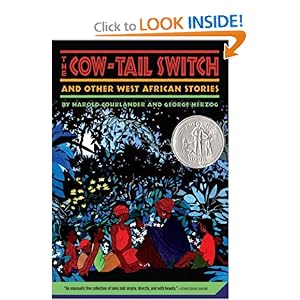
We all hope our lives make a difference. I've been privileged to do oral histories and at other times help young people do it, too. Additionally my reenactment of Liberetta Lerich Green started with her oral history telling about growing up on a Michigan Underground Railroad Station and her family's Civil War experiences. The title story in Harold Courlander's The Cow-Tail
Switch and Other West African Stories shows the value of remembering
people's lives.
Never overlook the value of putting something in a format available to
future readers or listeners. Whether they are the descendants of the person
interviewed or not, the interview becomes precious beyond any time or
expense involved. Two easily overlooked groups who can especially value
doing this are people with no children and those diagnosed with Alzheimer's
disease in the early stages. It's their way to stay alive!
I'm always indebted to my fellow storytellers for their ideas. Great storytelling resources come from a very active international email list, Storytell, and the online network, Professional Storyteller , (where I'm an assistant administrator to nearly 1900 members from around the world). I hope these suggestions from my storytelling friends help you do an oral history project. The ideas were so plentiful this topic will have three more parts.
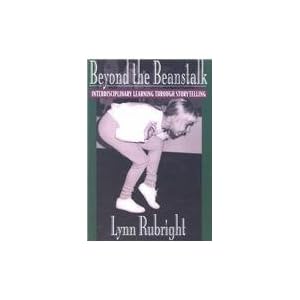
- Lynn Rubright's excellent book, Beyond the Beanstalk: Interdisciplinary Learning Through Storytelling, (published byHeinemann, 1996) will be discussed in the final part of this four part series of blogs.
- Jo Radner, who teaches oral history workshops in the northeast, adds: My favorite intergenerational storytelling program is Judy
Klevins' Swapping Stories. She trains groups of students and elders separately in interviewing and public speaking, then puts them
together in pairs -- one elder, one student. They interview each
other, swap stories, and then perform each other's stories to an
audience. So it's not just students collecting stories from
elders. As I often put it, old people are a foreign country to the
young -- but the young are also a foreign country to the old. They
need to tell each other their stories to make the connections. (Note by LoiS: Their approach sounds very similar to some of the ideas in Lynn Rubright's book mentioned above and in Part 4.)
- Renee Englot offers a three-part look at the interview: Framing Questions, Tips for Shaping and Conducting the Interview, and finally After the Interview. Each is a complete document, so her contributions will be a separate post, Staying Alive with Oral Histories - Part 3.
- Here in the Ann Arbor area, storyteller and former media specialist, Judy Schmidt, added both a basic "Ten Tips for Taping" and other recommendations in Part 2 of Staying Alive with Oral Histories.
 It's almost guaranteed my research will include Jackie Baldwin's Story-Lovers
site. She's done an award winning job of compiling
information from the Storytell list. For this topic go to the Oral Histories
section of the "S.O.S." there. (While you're there, be sure to check
her home page and scroll down to her lovely stationery, cards, prints,
and so much more.)
It's almost guaranteed my research will include Jackie Baldwin's Story-Lovers
site. She's done an award winning job of compiling
information from the Storytell list. For this topic go to the Oral Histories
section of the "S.O.S." there. (While you're there, be sure to check
her home page and scroll down to her lovely stationery, cards, prints,
and so much more.) 
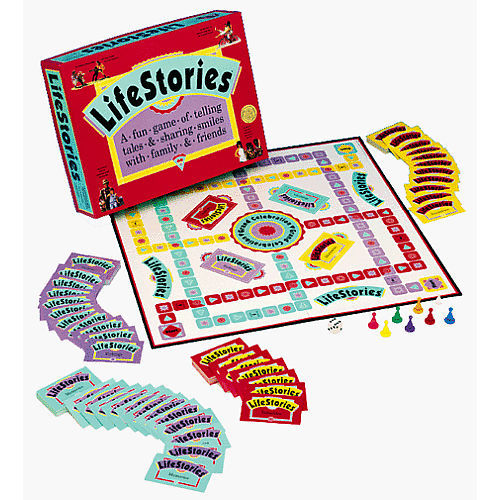
- Something I first heard about years ago on the Storytell list was this playful way to bring back memories, the game, Life Stories. It's available and thoroughly reviewed on Amazon (in the Toys and Games section).
If you can't do an oral history project, I suggest you at least create an interview document
for people to use in self-recording. That's not as "magical" as what pops up in a live interview, but at least it's not dependent
on grant funding.
LoiS(econd interview with someone wasn't nearly as lively as the time
the tape recorder didn't work! -- shades of those Ten Tips for Taping)
This is the end of Part 1 - Staying Alive with Oral Histories. See Parts 2 and 3 with guest authors, Judy Schmidt and Renee Englot and then the bibliography in Part 4 of Staying Alive with Oral Histories featuring Lynn Rubright.