Tell me if you have a topic you'd like to see. (Contact: LoiS-sez@LoiS-sez.com .)
Please also let others know about this site.
Showing posts with label tricksters. Show all posts

Friday, July 11, 2025

Jacobs - Reynard and Bruin - Keeping the Public in Public Domain

July truly is a month for nations celebrating, starting with Canada Day on the first, then our own 4th of July, and it's almost time for France to celebrate Bastille Day on the 14th. I went looking for something appropriately French and think Reynard the trickster fox deserves a storytelling visit. While the crafty fox stories did travel around Europe, the French liked him so well their word for "fox" became "Renard."

Joseph Jacobs was clearly taken with him and did an entire book, The Most Delectable History of Reynard the Fox .  Unlike much of Jacobs' work, it's too flowery and I don't find it tells well, although the adventures can be simplified and retold.  The year Jacobs died (1916) his final book, Europa's Fairy Book  -- sometimes called European Folk and Fairy Tales came out with a few easily retold adventures where the fox outwits the bear. It does, however, let this unrepentant trickster be appropriately punished. Jacobs long-time collaboration continued with illustrations by John D. Batten. I'll say a bit more about the sources after Reynard has his tale (or perhaps I should say "tail").
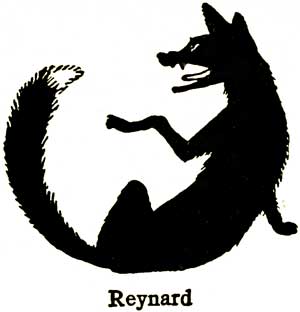
Reynard

REYNARD AND BRUIN

You must know that once upon a time Reynard the Fox and Bruin the Bear went into partnership and kept house together. Would you like to know the reason? Well, Reynard knew that Bruin had a beehive full of honeycomb, and that was what he wanted; but Bruin kept so close a guard upon his honey that Master Reynard didn't know how to get away from him and get hold of the honey. So one day he said to Bruin, "Pardner, I have to go and be gossip—that means god-father, you know—to one of my old friends." "Why, certainly," said Bruin. So off Reynard goes into the woods, and after a time he crept back and uncovered the beehive and had such a feast of honey. Then he went back to Bruin, who asked him what name had been given to the child. Reynard had forgotten all about the christening and could only say, "Just-begun." "What a funny name," said Master Bruin.

A little while after Reynard thought he would like another feast of honey. So he told Bruin that he had to go to another christening; and off he went. And when he came back and Bruin asked him what was the name given to the child Reynard said, "Half-eaten." The third time the same thing occurred, and this time the name given by Reynard to the child that didn't exist was "All-gone,"—you can guess why.

A short time afterwards Master Bruin thought he would like to eat up some of his honey and asked Reynard to come and join him in the feast. When they got to the beehive Bruin was so surprised to find that there was no honey left; and he turned round to Reynard and said, "Just-begun, Half-eaten, All-gone—so that is what you meant; you have eaten my honey." "Why no," said Reynard, "how could that be? I have never stirred from your side except when I went a-gossiping, and then I was far away from here. You must have eaten the honey yourself, perhaps when you were asleep; at any rate we can easily tell; let us lie down here in the sunshine, and if either of us has eaten the honey, the sun will soon sweat it out of us." No sooner said than done, and the two lay side by side in the sunshine. Soon Master Bruin commenced to doze, and Mr. Reynard took some honey from the hive and smeared it round Bruin's snout; then he woke him up and said, "See, the honey is oozing out of your snout; you must have eaten it when you were asleep."

Some time after this Reynard saw a man driving a cart full of fish, which made his mouth water. So he ran and he ran and he ran till he got far away in front of the cart and lay down in the road as still as if he were dead. When the man came up to him and saw him lying there dead, as he thought, he said to himself, "Why, that will make a beautiful red fox scarf and muff for my wife Ann." And he got down and seized hold of Reynard and threw him into the cart all along with the fish, and then he went driving on as before. Reynard began to throw the fish out till there were none left, and then he jumped out himself without the man noticing it, who drove up to his door and called out, "Ann, Ann, see what I have brought you." And when his wife came to the door she looked into the cart and said, "Why, there is nothing there."

Reynard in the meantime had brought all his fish together and began eating some when up comes Bruin and asked for a share. "No, no," said Reynard, "we only share food when we have shared work. I fished for these, you go and fish for others."

"Why, how could you fish for these? the water is all frozen over," said Bruin.

"I'll soon show you," said Reynard, and brought him down to the bank of the river, and pointed to a hole in the ice and said, "I put my tail in that, and the fish were so hungry I couldn't draw them up quick enough. Why do you not do the same?"

So Bruin put his tail down and waited and waited but no fish came. "Have patience, man," said Reynard; "as soon as one fish comes the rest will follow."

"Ah, I feel a bite," said Bruin, as the water commenced to freeze round his tail and caught it in the ice.
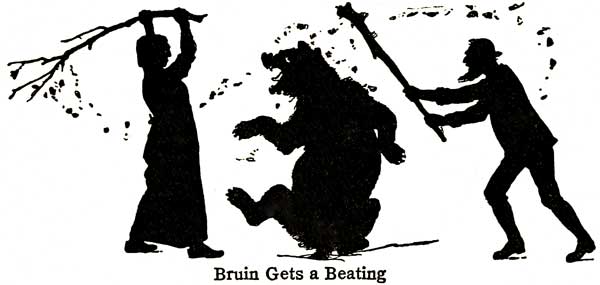
Bruin Gets a Beating

"Better wait till two or three have been caught and then you can catch three at a time. I'll go back and finish my lunch."

And with that Master Reynard trotted up to the man's wife and said to her, "Ma'am, there's a big black bear caught by the tail in the ice; you can do what you like with him." So the woman called her husband and they took big sticks and went down to the river and commenced whacking Bruin who, by this time, was fast in the ice. He pulled and he pulled and he pulled, till at last he got away leaving three quarters of his tail in the ice, and that is why bears have such short tails up to the present day.

Meanwhile Master Reynard was having a great time in the man's house, golloping everything he could find till the man and his wife came back and found him with his nose in the cream jug. As soon as he heard them come in he tried to get away, but not before the man had seized hold of the cream jug and thrown it at him, just catching him on the tail, and that is the reason why the tips of foxes' tails are cream white to this very day.
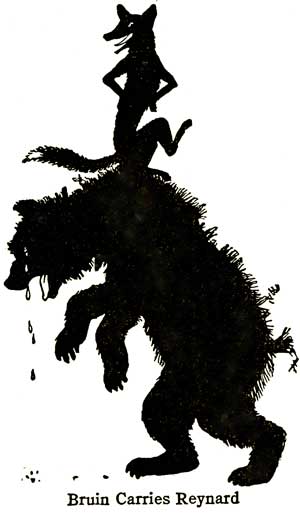
Bruin Carries Reynard

Well, Reynard crept home and found Bruin in such a state, who commenced to grumble and complain that it was all Reynard's fault that he had lost his tail. So Reynard pointed to his own tail and said, "Why, that's nothing; see my tail; they hit me so hard upon the head my brains fell out upon my tail. Oh, how bad I feel; won't you carry me to my little bed." So Bruin, who was a good-hearted soul, took him upon his back and rolled with him towards the house. And as he went on Reynard kept saying, "The sick carries the sound, the sick carries the sound."

"What's that you are saying?" asked Bruin.

"Oh, I have no brains left, I do not know what I am saying," said Reynard but kept on singing, "The sick carries the sound, ha, ha, the sick carries the sound."

Then Bruin knew that he had been done and threw Reynard down upon the ground, and would have eaten him up but that the fox slunk away and rushed into a briar bush. Bruin followed him closely into the briar bush and caught Reynard's hind leg in his mouth. Then Reynard called out, "That's right, you fool, bite the briar root, bite the briar root."

Bruin thinking that he was biting the briar root, let go Reynard's foot and snapped at the nearest briar root. "That's right, now you've got me,

don't hurt me too much,"

called out Reynard, and slunk away.

"Don't hurt me too much, don't hurt me too much."

When Bruin heard Reynard's voice dying away in the distance he knew that he had been done again, and that was the end of their partnership.

Some time after this a man was plowing in the field with his two oxen, who were very lazy that day. So the man called out at them, "Get a move on or I'll give you to the Bear"; and when they didn't quicken their pace he tried to frighten them by calling out, "Bear, Bear, come and take these lazy oxen." Sure enough, Bruin heard him and came out of the woods and said, "Here I am, give me the oxen, or else it'll be worse for you." The man was in despair but said, "Yes, yes, of course they are yours, but please let me finish my morning's plowing so I may finish this acre." Bruin could not say "No" to that, and sat down licking his chops and waiting for the oxen. The man went on plowing, thinking what he should do, when just at the corner of the field Reynard came up to him and said, "If you will give me two geese, I'll help you out of this fix and deliver the Bear into your hands." The man agreed and he told him what to do and went away into the woods. Soon after, the Bear and the man heard a noise like "Bow-wow, Bow-wow"; and the Bear came to the man and said, "What's that?" "Oh, that must be the lord's hounds out hunting for bears." "Hide me, hide me," said Bruin, "and I will let you off the oxen." Then Reynard called out from the wood, "What's that black thing you've got there?" And the Bear said, "Say it's the stump of a tree." So when the man had called this out to the Fox, Reynard called out, "Put it in the cart; fix it with the chain; cut off the boughs, and drive your axe into the stump." Then the Bear said to the man, "Pretend to do what he bids you; heave me into the cart; bind me with the chain; pretend to cut off the boughs, and drive the axe into the stump." So the man lifted Bruin into the cart, bound him with the chain, then cut off his limbs and buried the axe in his head.

Then Reynard came forward and asked for his reward, and the man went back to his house to get the pair of geese that he had promised.

"Wife, wife," he called out, as he neared the house, "get me a pair of geese, which I have promised the Fox for ridding me of the Bear."

"I can do better than that," said his wife Ann, and brought him out a bag with two struggling animals in it.

"Give these to Master Reynard," said she; "they will be geese enough for him." So the man took the bag and went down to the field and gave the bag to Reynard; but when he opened it out sprang two hounds, and he had great trouble in running away from them to his den.

When he got to his den the Fox asked each of his limbs, how they had helped him in his flight. His nose said, "I smelt the hounds"; his eyes said, "We looked for the shortest way"; his ears said, "We listened for the breathing of the hounds"; and his legs said, "We ran away with you." Then he asked his tail what it had done, and it said, "Why, I got caught in the bushes or made your leg stumble; that is all I could do." So, as a punishment, the Fox stuck his tail out of his den, and the hounds saw it and caught hold of it, and dragged the Fox out of his den by it and ate him all up. So that was the end of Master Reynard, and well he deserved it. Don't you think so?


Several familiar folktales were transformed into Reynard tales. The first is the Grimm collected tale of "The Cat and Mouse Who Shared a House." The story of why the bear is stumpy-tailed is a Norse tale that also traveled to Canada. Scholars have used it to show the Vikings did indeed land there because it is told by their First Nations. I don't know if Jacobs knew the story of "Br'er Rabbit in the Briar Patch", but it certainly fits Bear trying to get Reynard in the briar patch. As for the wife putting two dogs in a bag for Reynard, there probably are other stories using that, but it reminds me of the ending of "The Hobyahs."

************************

This is part of a series of postings of stories under the category, “Keeping the Public in Public Domain.” The idea behind Public Domain was to preserve our cultural heritage after the authors and their immediate heirs were compensated. I feel strongly current copyright law delays this intent on works of the 20th century. My own library of folklore includes so many books within the Public Domain I decided to share stories from them. I hope you enjoy discovering them.

At the same time, my own involvement in storytelling regularly creates projects requiring research as part of my sharing stories with an audience.  Whenever that research needs to be shown here, the publishing of Public Domain stories will not occur that week.  This is a return to my regular posting of a research project here.  (Don't worry, this isn't dry research, my research is always geared towards future storytelling to an audience.)  Response has convinced me that "Keeping the Public in Public Domain" should continue along with my other postings as often as I can manage it.

See the sidebar for other Public Domain story resources I recommend on the page “Public Domain Story Resources."


Friday, March 8, 2024

Judson -The Bringing of the Light by Raven - Keeping the Public in Public Domain

This weekend the time shifts to Daylight Saving Time.  Neither Standard time nor DST are perfect year round and so the debate about the time shift returns every year.  This coming week has abnormally higher death and accident rates.  Personally I'm NOT a Morning Person either way and will take a long time to adjust.  Added to those problems, this autumn when the time again changes, people with pets inclined to wake them will find the shift back in time doesn't let them adjust to "fall back" after "springing forward."  

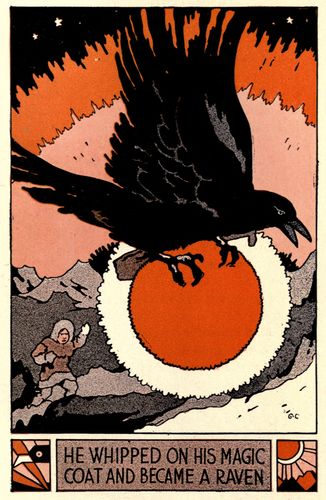
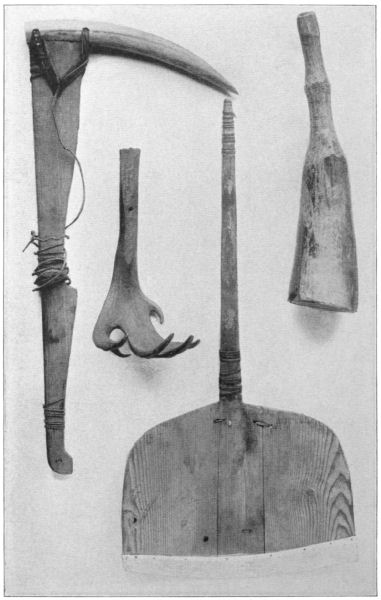
The traditional tales from Alaska all tend to tell the same story, whether the many anthologies where Katherine Berry Judson includes it or the version by Clara K. Bayliss, calling the story "Chunks of Daylight" in her A Treasury of Eskimo Tales   Judson shows the traditional tools from the holdings of the Smithsonian as an illustration.  I'm going to include the illustration by George Carlson from the Bayliss book, but I prefer the extra bit of an ending Judson includes.  Judson has several anthologies with the story, but this can be found at Project Gutenberg in  The Myths and Legends of Alaska.   Both Bayliss and Judson have this Raven be an orphan with a magic coat able to turn him into a Raven.  I'm used to stories where Raven is a trickster and a bird and this story stays true to the trickster even if he doesn't start out as a Raven.

HE WHIPPED ON HIS MAGIC COAT AND BECAME A RAVEN 

THE BRINGING OF THE LIGHT BY RAVEN

Eskimo (Lower Yukon)

IN the first days, the sun and moon were in the sky. Then the sun and moon were taken away and people had only the light of the stars. Even the magic of the shamans failed to bring back the light.

Now there was an orphan boy in the village who sat with the humble people over the entrance way of the kashim. He was despised by every one. When the magic of the shamans failed to bring back the sun and moon into the sky the boy mocked them. He said, “What fine shamans you must be. You cannot bring back the light, but I can.” Then the shamans were angry and beat that boy and drove him out of the kashim. Now this boy was like any other boy until he put on a raven coat he had. Then he became Raven.

Now the boy went to his aunt’s house. He told her the shamans had failed to bring back the light, and they had beaten him when he mocked them. The boy said, “Where are the sun and moon?”

The aunt said, “I do not know.”

The boy said, “I am sure you know. Look what a  finely sewed coat you wear. You could not sew it that way if you did not know where the light is.”

Thus they argued.

Then the aunt said, “If you wish to find the light, go far to the south. Go on snowshoes. You will know the place when you get there.”

The boy put on his snowshoes and set off toward the south. Many days he travelled and the darkness was always the same. When he had gone a very long way he saw far in front of him a ray of light. Then the boy hurried on. As he went farther the light showed again, plainer than before. Then it vanished for a time. Thus it kept appearing and vanishing.

At last the boy came to a large hill. One side was brightly lighted; the other side was black as night. Close to the hill was a hut. A man was shovelling snow from in front of it. The man tossed the snow high in the air; then the light could not be seen until the snow fell. Then the man tossed the snow again. So the light kept appearing and disappearing. Close to the house was a large ball of fire.

The boy stopped and began to plan how to steal the ball of light.

Then the boy walked up to the man. He said, “Why do you throw up the snow? It hides the light from our village.”

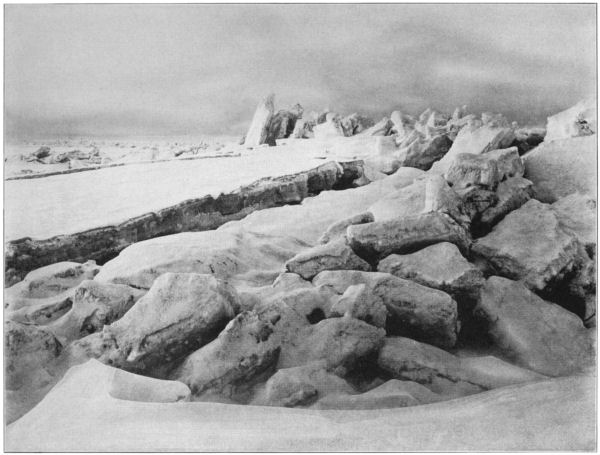
Photograph by B. B. Dobbs
Ice Hummocks on Bering Sea
From photograph loaned by the Smithsonian Institution
Snow Shovel, Pick, Rake, and Maul

The man said, “I am not hiding the light. I am cleaning away the snow. Who are you? Where did you come from?”

The boy said, “It is so dark at our village I do not want to stay there. I came here to live with you.”

“All the time?” asked the man.

“Yes,” said the boy.

The man said, “All right. Come into the house with me.” Then he dropped his shovel on the ground. He stooped down to lead the way through the underground passage into the house. He let the curtain fall in front of the door as he passed, because he thought the boy was close beside him.

Then the boy caught up the ball of light. He put it in the turned-up flap of his fur coat. Then he picked up the shovel and ran away toward the north. He ran until his feet were tired. Then he put on his raven coat and flew away. He flew rapidly to the north. Raven could hear the man shriek behind him. The man was pursuing him. But Raven flew faster. Then the man cried, “Keep the light; but give me my shovel.”

Raven said, “No, you cannot have your shovel. You made our village dark.” So Raven flew faster.

Now as Raven flew, he broke off a little piece of the light. This made day. Then he went on a long time in darkness, until he broke off another piece of light.  Thus it was day again. So as Raven flew to the village he broke off the pieces of light. When Raven reached the kashim of his own village he threw away the last piece. He went into the kashim and said to the shamans, “I have brought back the light. It will be light and then dark, so as to make day and night.”

After this Raven went out upon the ice because his home was on the seacoast. Then a great wind arose, and the ice drifted with him across the sea to the land on the other side.

Thus Raven brought back the light. It is night and day, as he said it would be. But sometimes the nights are very long because Raven travelled a long way without throwing away a piece of the light.

**** I'm also a fan of the way Caldecott award winning artist, Gerald McDermott, handles the story in his book, Raven; A Trickster Tale from the Pacific Northwest.

****  May our chunks of daylight be longer and longer for the coming months.

****************

This is part of a series of postings of stories under the category, "Keeping the Public in Public Domain."  The idea behind Public Domain was to preserve our cultural heritage after the authors and their immediate heirs were compensated.  I feel strongly current copyright law delays this intent on works of the 20th century.  My own library of folklore includes so many books within the Public Domain I decided to share stories from them.  I hope you enjoy discovering new stories.  


At the same time, my own involvement in storytelling regularly creates projects requiring research as part of my sharing stories with an audience.  Whenever that research needs to be shown here, the publishing of Public Domain stories will not occur that week.  This is a return to my regular posting of a research project here.  (Don't worry, this isn't dry research, my research is always geared towards future storytelling to an audience.)  Response has convinced me that "Keeping the Public in Public Domain" should continue along with my other postings as often as I can manage it.

Other Public Domain story resources I recommend-

  • There are many online resources for Public Domain stories, maybe none for folklore is as ambitious as fellow storyteller, Yoel Perez's database, Yashpeh, the International Folktales Collection.  I have long recommended it and continue to do so.  He has loaded Stith Thompson's Motif Index into his server as a database so you can search the whole 6 volumes for whatever word or expression you like by pressing one key. http://folkmasa.org/motiv/motif.htm

  • You may have noticed I'm no longer certain Dr. Perez has the largest database, although his offering the Motif Index certainly qualifies for those of us seeking specific types of stories.  There's another site, FairyTalez claiming to be the largest, with "over 2000 fairy tales, folktales, and fables" and they are "fully optimized for phones, tablets, and PCs", free and presented without ads.
    Between those two sites, there is much for story-lovers, but as they say in infomercials, "Wait, there's more!"

The email list for storytellers, Storytell, discussed Online Story Sources and came up with these additional suggestions:        

         - David K. Brown - http://people.ucalgary.ca/~dkbrown/stories.html

         - Richard Martin - http://www.tellatale.eu/tales_page.html

         - Spirit of Trees - http://spiritoftrees.org/featured-folktales

         - Story-Lovers - http://www.story-lovers.com/ is now only accessible through the Wayback Machine, described below, but the late Jackie Baldwin's wonderful site lives on there, fully searchable manually (the Google search doesn't work), at https://archive.org/ .  It's not easy, but go to Story-lovers.com snapshot for December 22 2016  and you can click on SOS: Searching Out Stories to scroll down through the many story topics and click on the story topic that interests you.

       - World of Tales - http://www.worldoftales.com/ 

 
           - Zalka Csenge Virag - http://multicoloreddiary.blogspot.com doesn't give the actual stories, but her recommendations, working her way through each country on a continent, give excellent ideas for finding new books and stories to love and tell.

     
You're going to find many of the links on these sites have gone down, BUT go to the Internet Archive Wayback Machine to find some of these old links.  Tim's site, for example, is so huge probably updating it would be a full-time job.  In the case of Story-Lovers, it's great that Jackie Baldwin set it up to stay online as long as it did after she could no longer maintain it.  Possibly searches maintained it.  Unfortunately Storytell list member, Papa Joe is on both Tim Sheppard's site and Story-Lovers, but he no longer maintains his old Papa Joe's Traveling Storytelling Show website and his Library (something you want to see!) is now only on the Wayback Machine.  It took some patience working back through claims of snapshots but finally in December of 2006 it appears!

    Somebody as of this writing whose stories can still be found by his website is the late Chuck Larkin - http://chucklarkin.com/stories.html.  I prefer to list these sites by their complete address so they can be found by the Wayback Machine, a.k.a. Archive.org, when that becomes the only way to find them.

You can see why I recommend these to you. 

Have fun discovering even more stories

Friday, July 1, 2022

Priscilla Howe - Nasruddin Hodja Is Warmed by Moonbeams


Today's story is NOT Public Domain.  It's graciously been shared by friend and storytelling colleague, Priscilla Howe and her publisher, Parkhurst Brothers.  

It's no secret I'm a HUGE fan of Hodja stories, publishing about him seven times before this.  Sometimes he may have another name, like Goha in Egypt or the Mullah in Iran, but this trickster or "wise fool" is popular throughout the Middle East and beyond.  Priscilla had the wonderful experience of spending five months in Bulgaria on a Fulbright Scholarship collecting their folklore, which is little known in English-language folklore resources.  I asked if there was any way to share something from her book, Clever, Kind, Tricky & Sly.  This story is the result.  I'll say more after it.  We'll leave the bragging to the Hodja.

Nasruddin Hodja Is Warmed by Moonbeams

One day in the village square, Nasruddin Hodja was bragging about how easily he could stand the cold. “I’m so tough, I could sleep in that tree tonight with no blanket, no fire, nothing to warm me but the clothes I’m wearing now.”

The villagers laughed. “We bet you can’t, Hodja, you’re just talking.”

A bet? You’re on. Tonight, I’ll sleep in the tree.”

He climbed the tree that evening and slept all night on a wide branch. In the morning, the villagers were surprised.

How did you manage?”

Easy, I just watched the full moon.”

Ha! You lose the bet! You had the warmth of moonbeams!”

The next week, the Hodja invited all of those who had bet against him to dinner at his house. This was a rare occasion, as the Hodja was usually reluctant to feed so many friends. Everyone came, crowding into the Hodja’s house. They waited and waited for the meal to be served, but they couldn’t even smell food cooking.

After an hour, one spoke up, “Hodja, did you invite us for a meal? Will there be food?”

Oh, yes, I’m cooking the rice now. Let us check on it.” They went to the kitchen, where there was an enormous iron pot of water, with maybe twenty rice grains in the bottom, hung over a small candle.

Hodja! That candle will never heat the water!”

Right. And moonbeams never warmed a man in a tree on a cold winter’s night.”

Storyteller's Note: I know this story best as a tale from Ethiopia called Fire on the Mountain, in which a poor man watches a fire on a distant mountain to keep himself warm all night.

From Clever, Kind, Tricky, and Sly: A Bulgarian Folktale Sampler by Priscilla Howe. Parkhurst Brothers Publishers, 2021. Available at bookshop.org, Amazon and by special order from your favorite independent bookstore (bookshop.org supports indie shops).

Oh, Priscilla!  Here in the extreme heat of this summer it's great to enjoy that look back at the difficulty of getting warm in winter.

Like Priscilla, I remember the Ethiopian version, but also recall this popular story idea in the book, Once the Hodja, by Alice Geer Kelsey.  From start to finish Kelsey has the flame of a candle keep him going, making this Bulgarian moonbeam version slightly different.  Stories travel and those differences are delightful!

I was going to tell more about Priscilla, but her website (I'll repeat the link, https://www.priscillahowe.com/) does such a great job of it.  Let me just say, if ever I wanted a mentor, I'd try to catch her when she's away from her home in Kansas, possibly before going out to tell internationally in one of fourteen countries.  Aside from being talented and an unstoppable bundle of fun, she's great with puppets, too.  Her blog comes close to feeling like a bit of time to chat together about such things over coffee at the kitchen table.  Her workshops are even more filled with her experience and that fun.

It's worth noting that the second half of Clever, Kind, Tricky, and Sly: A Bulgarian Folktale Sampler has tales about the Bulgarian trickster, "Clever Peter."  He's unique to Bulgarian folklore, poking his wit against the rich and self-important.  That misleading peasant is not as foolish as he wants to appear.  He's also not to be confused with the BBC show of the same name.  The book even includes a Bulgarian version of Cinderella, lots of source notes with ideas for your own storytelling, and that favorite author, "Minnie Moore."  (Aaargh!  pun alert!)  Take a look at the book's reviews to tempt you even further.

I also want to promote Priscilla's publisher, Parkhurst Brothers.  The company has a wide catalog, but I especially appreciate its large Storytelling section filled with stories and insight into storytelling.  It's president, Ted Parkhurst, has returned to his roots right here in Marion, Michigan.  While storytelling is not all he publishes, his support of the storytelling world is long and thorough.  As he said in his LinkedIn profile: We believe the storytelling community will grow in size and influence over the next generation, and we are doing our part to make that happen. 

With storytellers like Priscilla and supporters like Ted, it can't be otherwise.

Friday, December 31, 2021

Call it "Character", "Values", "New Year's Resolutions"...WHATEVER!

J.P.Morgan's quote from Country Living's 62 Best New Year Quotes 2022

 The change of year is a time for other changes.  New Year's resolutions are all about changing for the better.  Storytelling can offer a way of noticing needed changes.

Whether you are a parent, teacher, or storyteller asked to tell about a particular behavioral topic, using stories to teach and change is an old, old, very old technique.  Whoever Aesop may have been, his fables, or the Jataka tales about Buddha, or the parables of Jesus, all used story to teach and encourage change.  Only over-familiarity or efforts to keep religion out of teaching might make some avoid the Bible or other long-standing cultural resources.  Folklore tends to be a resource more likely to help when those resources can't be used.

Does that mean folktales are never "preachy"?

Dunberidiculous!

Delivery of a story can "telegraph" intent, leading the listener to reject the storyteller's purpose.  Let the story stand on its own merit, following along with the characters as they try different options.

If a story is believable within the limits of its world with lively characters and an interesting plot, it may resonate, coming back to the listener as needed.  Reading a story may work, but the direct delivery of a story to a listener makes it personal. 

What about analyzing the story?

Too often this can feel like tearing off the wings of a butterfly to understand it better.  If it must happen to satisfy curriculum needs or other purposes, at least let it happen after the story has ended.

It's perfectly reasonable after the story, if you must analyze it to wait until later and ask "Why?", letting the listener explain what happened.

Stepping back a bit to Aesop, some believe the moral of a tale should never be stated.  An obviously well-known moral, "Slow and steady wins the race" for the story of the "Tortoise and the Hare" is a perfect example.  First of all the translation may word it differently, but more importantly asking "What is the story trying to teach us?" might give a different answer that is also valid.  Not asking might let the tale ferment within the listener to produce what needs to be learned

Let the story sit and work its results over time.  It may come during the telling, but it may not happen until later when the storyteller is gone.  

What about tricksters or bad behavior?

Trickster characters often exist to show what not to do and may receive appropriate punishment.  Think of Coyote when he's only looking out for himself.  Does he succeed?  It's extremely rare for a folktale to let bad behavior go unpunished or, at the very least, not serve as a warning.  That's why "Little Red Riding Hood" was called a "Cautionary Tale."

What about resources to find the story fitting the needed change?

Near the end of the Twentieth Century this need for "Character education" using stories was once again starting to be noticed.  I say "once again" as it's funny to realize this discovery comes around periodically.  When storytelling began being noticed in schools and libraries at the start of the Twentieth Century and on through the days of the one-room school, this resource was popular.  

For example you can find on Internet Archive from the Oregon Office of Superintendent of Public Instruction, Julius Alonzo Churchill produced a 15 page booklet, "Moral instruction in the public schools through the story", recommending:

The following books will be found helpful to the teacher:
83 Bailey. For the story teller.
85 Bryant. How to tell stories to children.
87 Gather. Educating by story telling.
104 Brownlee. Character building in school.
105 Cabot. A course in citizenship.
106 Cabot. Ethics for children. 110 Dewey. Lessons on morals.
1693 Engleman. Moral education in school and home. Bryant. Moral and religious education. Haviland. Character training in childhood. Sneath & Hodges. Moral training in the school and home.

The numbering or lack of it was based on their state library collection.  I have given any online links, preferring Project Gutenberg when available. Churchill omits some some possibly helpful subtitles: for Cabot's Ethics for Children,  add "A Guide for Teachers and Parents"; for Dewey's Lessons on morals add "Arranged for Grammar Schools, High Schools and Academies"; for Sneath & Hodges' "Moral training in the school and home" add "A Manual for Teachers and Parents."  With homeschooling parents this can help identify resources not overly academic.

Since all but one of those books is available online, they are a quick guide to Public Domain material that need not be purchased.

The little Oregon booklet is mainly a bibliography listing stories, with grade level suggestions, of topics that were of concern to teachers.  Beyond the educational books already listed, the titles, with their authors, are usually fairly standard Public Domain works like the Gelett Burgess book about Goops and How to Be Them or the sequel, More Goops -- they may be old fashioned, but there's lots of humor and gold in them leading the Goops to be favorite memories with people looking back to when they might have needed "A Manual of Manners for Impolite Infants" as the sequel's subtitle adds.  Another Burgess, Thornton, is sometimes listed with his Mother West Wind stories.  An elderly woman once told me all she knew about animals and nature she learned from them, but this shows they also include teaching good character traits. James Baldwin was another listed whose retelling of well-known stories kept standard cultural tales alive.  Other authors named in the bibliography often are found in this blog's sidebar.  

Last week I mentioned the work of  William J. Bennett, who included a slightly adapted version of "Why the Chimes Rang" in The Moral Compass: Stories for a Life's Journey, the sequel to his popular The Book of Virtues.  His editing of Public Domain stories show Character Education matching those early "virtues."

What about more recent resources?

Internet Archive lets you "borrow" more recent books, but only for an hour (to avoid publisher complaints about copyright infringement).  It gives you a chance to thoroughly preview a book, but after that you should either buy or borrow the book through your local library.  Inter-library loans let you borrow beyond what may actually be owned by your library, so don't give up.

Bobby & Sherry Norfolk did an excellent job with Moral of the story; folktales for character development.  It came out in 1999 and includes sources & bibliographies from the '80s and '90s for specific character education issues, making them easy to either borrow or buy.  There are stories grouped by theme on values in the book.  Added stories on the topics are in the bibliography of stories recommended by educators and storytellers.  A few of those stories may be older, but are definitely standard material to find.  There's even an abridged one hour audio version of six of the stories with the lively telling by the Norfolks, showing "that character education, using storytelling and folktales from cultures around the world, can be fun, enjoyable, non-didactic, and remarkable effective."

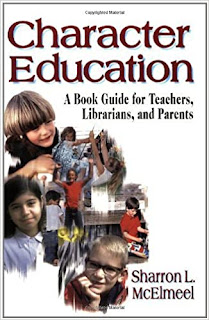
A similar book is Character education : a book guide for teachers, librarians, and parents

by Sharron L. McElmeel written in 2002 and available as either an eBook or paperback.  School Library Journal's review states: 

This useful tool is organized in 17 chapters with each one focusing on different character traits such as flexibility, initiative, humility, and patience. Each chapter begins with a definition of the term and lists several books that range in age appropriateness. A brief summary of the book is followed by discussion/activity notes, a list of related traits/curricular themes, and suggested collaborative readings. Relevant quotes from a variety of well-known authors and others are interspersed throughout. This book stands out from others of its type because of its excellent introduction that talks about character education in general, specifics related to the home and classroom, as well as a consideration of various formats and genres; its brevity that makes it a useful planning resource without being overwhelming; and its thorough index of titles, authors, and concepts. A boon for librarians as well as for parents who are homeschooling or organizing group projects.

Both those books are given with Amazon links, but are available beyond that omnipresent source, too.

Searching further

Something more likely to be found only in a library are Storytellers Sourcebook: A Subject, Title, and Motif Index to Folklore Collections for Children and its sequel, Storyteller's Sourcebook, 1983-1999  by Margaret Read MacDonald.  She worked on the sequel with Brian W. Sturm.  I asked her if there would be a 21st century version and she said it wasn't economically worthwhile with internet searching the way it is.  <SIGH!>  The subjects indexed go waaaaay beyond character education, but certainly includes the various topics.  If your local library doesn't have the books, ask the librarian to locate the nearest library which owns them.

Another library resource would be the various volumes of the many years of Index to Fairy Tales.  The indexers vary over the years and the title may change slightly.  That link is to the HathiTrust online versions up through 1952. The original 1915 volume is separate.  There's also limited, search only, versions of the later volumes: 1949-1972; 1973-1977; 1978-1986; 1987-1992 with significant pre-1987 titles not previous indexed.  Initial indexing didn't go beyond listing story titles so you may need to be creative in your hunting.  The series didn't begin to check subjects until the 1949-1972 edition, but the earlier volumes are good for Public Domain material.  The ability to search these online may save a trip to a library.  

Even more online resources

A resource for members of the National Storytelling Network is GREENWOOD’S WORLD FOLKLORE AND FOLKLIFE RESOURCE & DATABASE GUIDE -- Only available through institutions, such as libraries or schools…AND NSN!  It's updated monthly, covering "holidays, festivals, language, stories, and fairy tales, proverbs, food ways, and folk remedies that define our society and our place within it."  All content is fully-indexed and cross-searchable.

Internet Archive also offers the Wayback Machine to locate websites no longer "live" on the internet.  For many years on the storytellers email list, Storytell, storytellers could ask a question and have the answers saved at Story-Lovers - http://www.story-lovers.com/, but it is now only accessible through the Wayback Machine.  The late Jackie Baldwin's wonderful site lives on there, fully searchable manually (the Google search doesn't work), at https://archive.org/ .  It's not easy, but go to Story-lovers.com snapshot for October 22 2016  and you can click on SOS: Searching Out Stories to scroll down through the many story topics and click on the story topic that interests you. 

Storytell, is now hosted by the National Storytelling Network.  Unlike the Greenwood database, which is only available to members, anyone may join that email list via the link.  Once subscribed you not only receive the emails, but can sign in and access the archive which currently runs from the end of January 2016 through the present.  The archive isn't as easy to use as SOS: Searching Out Stories, but online searching is a skill worth developing if you need to find stories.  As a list member you can also add to the discussions including asking for other members' suggestions.

(Here on this blog you may find a lot using its sidebar.)

What about making a recording or reprinting?

Use caution in reprinting or recording a story beyond the current guaranteed year. . . for 2022 on January 1 Public Domain will be available 1926 and earlier for U.S. works.  Beyond that you need to be certain if a work was renewed.  Stanford's online database of renewals lets you check up through 1963. After that renewal was automatic.  Beyond 2022 the years will continue to have Public Domain Days of free access.  All of this is U.S. copyright & varies around the world, but that Public Domain Review link mentions a bit of how to deal with other countries.  

I'm not a lawyer (although I have played one in an Agatha Christie mystery and was murdered!), but know of other copyright resources if you need them.  Don't get me started on my rant about the need for Public Domain and how copyright has gone beyond what it should be!!!

Final thoughts

Let's return to the Oregon resource's discussion of this topic: 

The method which it is designed should be followed in carrying out this work is the indirect method. The teacher should read or tell the story to the children without any direct attempt to enforce the moral. Let the child do his own moralizing. He is perfectly capable of it, and that which he does for himself is far more effective than that which the teacher does for him. Of course, it is vital that he should grasp the point of the story. If he fails to do so at first, tactful questioning will bring the moral lesson out, but by all means "preaching" should be avoided. It is best that the child should not know that the story is being presented to him for any ulterior purpose. Psychologists have formulated the law that the power of normal suggestion varies inversely with the extent to which its purpose is definitely revealed. Someone has said: "The mother who says to her child, 'Why don't you go out on the lawn and see how many dandelions you can pick?' is likely to secure a period of privacy, but if she adds, 'so that I can be alone for a little while,' the result will not be the same."

Happy telling . . . try change through storytelling, it can be fun!

Friday, December 17, 2021

Compton - The Coyote or Prairie Wolf - Keeping the Public in Public Domain

If ever there was a time for stories of Light, Hope, and Working Together it is now.  School shootings and threats, tornadoes upending whole lives, the pandemic are only some of the reasons, but they're big ones.

The terrible events of the shootings at nearby Oxford knocked off any possible Hanukkah stories for this year.  Yet if that celebration is called a "Festival of Light", certainly light is needed at this time.  Looking for stories about light took me to tales of how fire was given to people.  Our long ago ancestors recognized the hope fire brought.

There are many stories about this, but the one I found came from a book I had dismissed because of its title which seemed to have little authenticity: American Indian Fairy Tales by Margaret Compton.  The failure to note the tribal background made me even more hesitant.  Then I noticed in the introductory pages Compton's "Author's Note" to her 1895 book:

Through the courtesy of the librarian of the Smithsonian Institute, the author has had access to government reports of Indian life.  Upon these and the folk-lore contained in the standard works of Schoolcraft, Copway, and Catlin these stories are founded. 

As for Compton, via library cataloging notes, I learned she lived from 1852-1903, but nothing more.  There probably exists genealogical information, but her literary information hasn't made it to the internet.  I'll give more background to the story after letting it stand on its own.  I particularly appreciate that, while it is yet one more trickster tale about the mythical Coyote, in this version it requires a group willing to risk their lives.  (Compton also tacks on two very brief Coyote anecdotes, showing his less benevolent nature.) 


To save my own copy, I made use of Internet Archive, and needed to use two copies of the book.  The one with the anonymous botanical illustrations matches my own.  Internet Archive is currently offering a 2-to-1 Matching Gift Campaign, tripling the impact of every donation.  I am donating and hope you do, too.

It reminded me of a 1997 picture book version called Fire Race.   Only when I looked further into the "reteller", Jonathan London, did I realize what a different work this was for him.  He is best known for the series of over 30 books about the best-selling Froggy, which started as a tale told to his young sons.  But a look at the over 120 books he has written shows, once he began writing, his love of nature has often taken him way beyond the lovable Froggy.  Fire Race is indeed his version, with action packed illustrations by Sylvia Long.  The book does a great job of showing how this effort to get fire would never have happened if dependent on only one thief.  (I also enjoy the Raven version where Raven does it alone, but the teamwork and action in this story make it a special version.)

At least London corrected the name to Karuk, but it certainly isn't the first time a name's spelling changes and becomes standardized over time.  That led me to look for further background information.

The Klamath River is discussed fully in Wikipedia including this discussion of the five main Klamath River Basin Tribes Today, especially the Karuk who are surely the Cahrocs of the story:

Karuk

The Karuk tribe recognized self-governance in 1994 and gained federal recognition in 1979. As the California legislature rejected treaties to create federal designated land, the Karuk peoples do not have a reservation. The Klamath Forest Reserve was created by the U.S. government in 1905 and claimed Karuk land as public land. Members have been working to reclaim parcels of their original land and place them in trusts.
The concept of World Renewal plays heavily into both Karuk and Yurok culture. Although the term "world renewal" was coined by anthropologist Kroeber and Gifford, the Karuk tribe has adopted the phrase to refer to their annual ceremony that they view as essential to maintaining the reciprocal and stewarding relationship they have with the environment. The ceremony is meant to renew and sustain this relationship.[84] Many aspects of the larger ceremony involve being near or on the Klamath river, such as boat dances that take place in canoes and involve giving thanks and gratitude to the river.[85] Salmon are an integral aspect of Karuk identity, culture, and subsistence. Karuk fisherman continue to sustainably fish for Salmon despite their decreasing numbers, drought and myriad other ecological issues. Ishi Pishi falls, located near the town of Somes Bar, remains the traditional location for Karuk men to fish.[86] Karuk fishermen use a traditional dip-net fishing technique using long poles with nets on the end. This style of fishing works to naturally limit the amount of fish caught in a fishing session, thus ensuring that many salmon are able to spawn upstream and resupply the fishery.[87]
The Karuk language also revolves around the Klamath River, and the word "karuk" means "upriver". To indicate uphill, the word maruk is used, meaning away from the river. Conversely, the word saruk, meaning towards the river, is used to indicate downhill.[88]

The Wikipedia article specifically on the Karuk people has an interesting note about back in the mid-1870s there were two different types of shamans "There are two classes of shamans—the root doctors and the barking doctors ... It is the province of the barking-doctor to diagnose the case, which she (most doctors are women) does by squatting down ... before the patient, and barking at him ... for hours together. After her comes the root-doctor, and with numerous potions, poultices, etc., seeks to medicate the part where the other has discovered the ailment resides."  

(Comment by LoiS) Coyote would surely have been pleased.

That description of the two types of shamans comes from the work of Stephen Powers, and much of the retelling of this story of Coyote comes from his third chapter, "Karok Fables" in 1877 Tribes of California.  His work was also in that Smithsonian Institute collection and surely was checked by Compton.  Powers, before entering the American Civil War as a newspaper correspondent in the Union Army, was a graduate of the University of Michigan.  U. of M. offers a free download of the book.  Powers wrote many articles and re-worked other notes to create his Tribes of California.  The book was the product of his walking and horseback riding thousands of miles studying the various tribes.  Fifty years later it was still considered "the best introduction to the subject" by Alfred Kroeber, then dean of Native California ethnologists.

How much of the Karuk tale is authentically retold by Compton, London or others?  I'm not an ethnologist.  I'm a storyteller who recognizes the value of this tale and believe in “Keeping the Public in the Public Domain."

*********************** 

This is part of a series of postings of stories under the category, "Keeping the Public in Public Domain."  The idea behind Public Domain was to preserve our cultural heritage after the authors and their immediate heirs were compensated.  I feel strongly current copyright law delays this intent on works of the 20th century.  My own library of folklore includes so many books within the Public Domain I decided to share stories from them.  I hope you enjoy discovering new stories.  


At the same time, my own involvement in storytelling regularly creates projects requiring research as part of my sharing stories with an audience.  Whenever that research needs to be shown here, the publishing of Public Domain stories will not occur that week.  This is a return to my regular posting of a research project here.  (Don't worry, this isn't dry research, my research is always geared towards future storytelling to an audience.)  Response has convinced me that "Keeping the Public in Public Domain" should continue along with my other postings as often as I can manage it.
Other Public Domain story resources I recommend-
  • There are many online resources for Public Domain stories, maybe none for folklore is as ambitious as fellow storyteller, Yoel Perez's database, Yashpeh, the International Folktales Collection.  I have long recommended it and continue to do so.  He has loaded Stith Thompson's Motif Index into his server as a database so you can search the whole 6 volumes for whatever word or expression you like by pressing one key. http://folkmasa.org/motiv/motif.htm
  • You may have noticed I'm no longer certain Dr. Perez has the largest database, although his offering the Motif Index certainly qualifies for those of us seeking specific types of stories.  There's another site, FairyTalez claiming to be the largest, with "over 2000 fairy tales, folktales, and fables" and they are "fully optimized for phones, tablets, and PCs", free and presented without ads.

    Between those two sites, there is much for story-lovers, but as they say in infomercials, "Wait, there's more!"
The email list for storytellers, Storytell, discussed Online Story Sources and came up with these additional suggestions:            
         - David K. Brown - http://people.ucalgary.ca/~dkbrown/stories.html
         - Richard Martin - http://www.tellatale.eu/tales_page.html
         - Spirit of Trees - http://spiritoftrees.org/featured-folktales
         - Story-Lovers - http://www.story-lovers.com/ is now only accessible through the Wayback Machine, described below, but the late Jackie Baldwin's wonderful site lives on there, fully searchable manually (the Google search doesn't work), at https://archive.org/ .  It's not easy, but go to Story-lovers.com snapshot for October 22 2016  and you can click on SOS: Searching Out Stories to scroll down through the many story topics and click on the story topic that interests you.
       - World of Tales - http://www.worldoftales.com/ 
           - Zalka Csenge Virag - http://multicoloreddiary.blogspot.com doesn't give the actual stories, but her recommendations, working her way through each country on a continent, give excellent ideas for finding new books and stories to love and tell.
     
You're going to find many of the links on these sites have gone down, BUT go to the Internet Archive Wayback Machine to find some of these old links.  Tim's site, for example, is so huge probably updating it would be a full-time job.  In the case of Story-Lovers, it's great that Jackie Baldwin set it up to stay online as long as it did after she could no longer maintain it.  Possibly searches maintained it.  Unfortunately Storytell list member, Papa Joe is on both Tim Sheppard's site and Story-Lovers, but he no longer maintains his old Papa Joe's Traveling Storytelling Show website and his Library (something you want to see!) is now only on the Wayback Machine.  It took some patience working back through claims of snapshots but finally in December of 2006 it appears!
    Somebody as of this writing whose stories can still be found by his website is the late Chuck Larkin - http://chucklarkin.com/stories.html.  I prefer to list these sites by their complete address so they can be found by the Wayback Machine, a.k.a. Archive.org, when that becomes the only way to find them.
You can see why I recommend these to you. Have fun discovering even more stories!

Friday, September 3, 2021

Folk Stories from Afghanistan

For a variety of reasons stories from Afghanistan may need telling.  I don't have any Public Domain resources, but that doesn't prevent telling those stories as long as they aren't electronically published.  I do have four books with twice as many stories that I should be able to give here the "bones" of their stories.  The books should be available either as used books or by interlibrary loan as they are in fairly standard anthologies.

This photo by EJ Wolfson on Unsplash gives a good view of Afghanistan beyond the cities.


Before opening the four books, it never hurts to get an overview.  Here's a slightly compressed version of the introductory paragraphs in the Wikipedia article on Afghanistan.

Afghanistan is a landlocked country at the crossroads of Central and South Asia. It is bordered by Pakistan to the east and south, Iran to the west, Turkmenistan and Uzbekistan to the north, and Tajikistan and China to the northeast. The country is predominately mountainous with plains in the north and southwest. It is inhabited by mostly of ethnic Pashtuns, Tajiks, Hazaras, and Uzbeks. Kabul serves as its capital and largest city.

Human habitation in Afghanistan dates back to the Middle Paleolithic Era, and the country's strategic location along the Silk Road connected it to the cultures of the Middle East and other parts of Asia. The land has historically been home to various peoples and has witnessed numerous military campaigns, including those by Alexander the Great, Mauryas, Muslim Arabs, Mongols, British, Soviets, and in 2001 by the United States with NATO-allied countries. It has been called "unconquerable"[13][14] and nicknamed the "graveyard of empires",[15] though it has been occupied during several different periods of its history. 

These are the four books I recommend: 

  1. Bulatkin, I.F. - Eurasian Folk and Fairy Tales
  2. Carpenter, Frances - The Elephant's Bathtub; Wonder Tales from the Far East
  3. Dorson, Richard M. - Folktales Told Around the World
  4. Protter, Eric and Nancy - Folk and Fairy Tales of Far-Off Lands

It's interesting that the stories tend towards Trickster tales.  Bulatkin's "The Hare and the Tiger" has an aging tiger forcing the forest creatures to sacrifice one of themselves daily until hare avoids his day to become the tiger's meal.  The next day he claims to have been captured by another tiger even more powerful.  The enraged old tiger wants to be shown the braggart.  Hare says he lives in a nearby well.  Takes the tiger there.  Tiger is fooled when he sees himself reflected in the well.  Jumps in and drowns.

Protter has a common theme of two brothers, with the older one accepting a job with the promise he will do all the hiring farmer requires without losing his temper or he will be penalized.  The farmer in turn promises he will pay the penalty if the worker makes him lose his temper.  The older one becomes trapped by this, but the younger brother rescues him by an even stricter agreement that ends in the farmer losing his temper and learning to treat his workers fairly.  As I said, the theme isn't new, but it is extremely well done.

Professor Dorson was noted for his work in folklore and his use of standard storytelling motifs makes it possible to summarize each of his tales in that way.  

  • "The Romance of Mongol Girl and Arab Boy" combines many: "love at first sight" sharing the separation of the sexes with "communication of lovers through hole in wall" along with "princess so lovely every one falls in love with her."  There's also "task performed with help of old woman", "bride purchased for her weight in gold" and much more as the tale is long and complex.
  • "The Decapitation of Sufi Islam" is much shorter and simpler with motifs of "severed head moves from place to place" and "saint unharmed by fire.  It's a legend usually told by devotees of the Karukh Sufi order as Sufi Islam was their founder.
  • "The Two Thieves with the Same Wife" combines that Indian tale type with another found in Russia, Lithuania, and India of "one party relates the situation in the form of a tale, to the gentleman who is being robbed."  Added motifs include "identification by matching parts of divided token" and "the stolen and re-stolen ham (or in this case money)."
  • "Khastakhumar and Bibinagar" uses something best known in the tale of Cupid and Psyche, the motif of "the search for the lost husband." Because of Afghan religious commitments, the wife drops her ring in a jug of water instead of a glass of wine.  Other changes have the the enchanted husband and his wife boil the ogre co-wife (instead of a servant) in boiling water to escape, because of their negative view of polygamy.  There are magical objects aplenty as well as the punishment of wandering till iron shoes are worn out.
  • "The Seventy-Year-Old Corpse" combines the "supplanted bride" (a sub-type of the Cupid and Psyche type) with "prediction by bird that girl will have a dead husband", "disenchantment by removal of enchanting thorn", "false bride finishes true bride's task and supplants her", with "recognition by overheard conversation with objects."

The story by Carpenter, "One Mean Trick Deserves Another" is a good ending piece somewhat similar to Protter, but where the foolish son is tricked out of selling the family's nanny goat by a family of six brothers.  The boy's father is so clever that he is called Assad the Wise and manages to trick each of the brothers in turn into paying him a lot of money and ultimately getting a judge to give Assad all they own and kick them forever out of town. 

UPDATE -- UPDATE -- UPDATE -- 

Fellow storyteller from Canada, Norman Perrin, added to these books with this additional information:

A list of Afghan story collections, , not as easy to access, my apologies,
for those up to the challenge of finding them.
From oldest to most recent.

Tales of Afghanistan  Amina Shah   Octagon 1982
18 traditional tales by a storyteller who grew up in Afghanistan.
https://en.wikipedia.org/wiki/Amina_Shah
No notes.

Folktales of Afghanistan   Asha Dhar  Sterling Publishers  1982
17 tales, the last story has six tales of Afghan trickster Abu Khan
No notes, with a brief introduction on the stories and Afghan culture and
history.

A Key to the Heart Laura Simms Chocolate Sauce Publishing
Dual language English and Arabic script.
With notes and bibliography that include more sources of Afghan tales.
Requests for permissions should go to Permissions Dept., Chocolate sauce
Publishing Inc., The Storytelling Suite 814 Broadway, NY NY, 10003

Afghan Folktales from Herat : Persian texts in transcription and
translation Youli Ioannesyan  Cambria Press 2009
These 11 stories are translated into English From the Herati dialect were
collected from informants in the city of Herat.
There are extensive notes and a bibliography.

Afghan Village Voices: Stories from a Tribal Community Compiled and edited
by Richard Tapper   I. B. Tauris  2020
From back cover: "The book comprises a collection of remarkable stories.
folktales and conversations and provides unprecedented insight into the
depth and colour of these people's lives.... with memories of strife,
ethnic  feuds, falling in love elopements...the world of spirits,,, "

With glossary, extensive notes, indexes of people, places and subjects.
Norman Perrin
Four Winds Storytellers' Library

When Norman mentions Four Winds Storytellers Library, it's a 6,000 volume collection of folktales from around the world, as a free research resource that has aided storytellers, authors and other researchers since 1990.

That leads me to this photo by Firoz Sidiqy on Unsplash showing a "goodbye" from Afghanistan's youth, especially girls, from earlier in this century.

******************


This is part of a series of postings of stories under the category, "Keeping the Public in Public Domain."  The idea behind Public Domain was to preserve our cultural heritage after the authors and their immediate heirs were compensated.  I feel strongly current copyright law delays this intent on works of the 20th century.  My own library of folklore includes so many books within the Public Domain I decided to share stories from them.  I hope you enjoy discovering new stories.  


At the same time, my own involvement in storytelling regularly creates projects requiring research as part of my sharing stories with an audience.  Whenever that research needs to be shown here, the publishing of Public Domain stories will not occur that week.  This is a return to my regular posting of a research project here.  (Don't worry, this isn't dry research, my research is always geared towards future storytelling to an audience.)  Response has convinced me that "Keeping the Public in Public Domain" should continue along with my other postings as often as I can manage it.
Other Public Domain story resources I recommend-
  • There are many online resources for Public Domain stories, maybe none for folklore is as ambitious as fellow storyteller, Yoel Perez's database, Yashpeh, the International Folktales Collection.  I have long recommended it and continue to do so.  He has loaded Stith Thompson's Motif Index into his server as a database so you can search the whole 6 volumes for whatever word or expression you like by pressing one key. http://folkmasa.org/motiv/motif.htm
  • You may have noticed I'm no longer certain Dr. Perez has the largest database, although his offering the Motif Index certainly qualifies for those of us seeking specific types of stories.  There's another site, FairyTalez claiming to be the largest, with "over 2000 fairy tales, folktales, and fables" and they are "fully optimized for phones, tablets, and PCs", free and presented without ads.

    Between those two sites, there is much for story-lovers, but as they say in infomercials, "Wait, there's more!"
The email list for storytellers, Storytell, discussed Online Story Sources and came up with these additional suggestions:            
         - David K. Brown - http://people.ucalgary.ca/~dkbrown/stories.html
         - Richard Martin - http://www.tellatale.eu/tales_page.html
         - Spirit of Trees - http://spiritoftrees.org/featured-folktales
         - Story-Lovers - http://www.story-lovers.com/ is now only accessible through the Wayback Machine, described below, but the late Jackie Baldwin's wonderful site lives on there, fully searchable manually (the Google search doesn't work), at https://archive.org/ .  It's not easy, but go to Story-lovers.com snapshot for October 22 2016  and you can click on SOS: Searching Out Stories to scroll down through the many story topics and click on the story topic that interests you.
       - World of Tales - http://www.worldoftales.com/ 
           - Zalka Csenge Virag - http://multicoloreddiary.blogspot.com doesn't give the actual stories, but her recommendations, working her way through each country on a continent, give excellent ideas for finding new books and stories to love and tell.
     
You're going to find many of the links on these sites have gone down, BUT go to the Internet Archive Wayback Machine to find some of these old links.  Tim's site, for example, is so huge probably updating it would be a full-time job.  In the case of Story-Lovers, it's great that Jackie Baldwin set it up to stay online as long as it did after she could no longer maintain it.  Possibly searches maintained it.  Unfortunately Storytell list member, Papa Joe is on both Tim Sheppard's site and Story-Lovers, but he no longer maintains his old Papa Joe's Traveling Storytelling Show website and his Library (something you want to see!) is now only on the Wayback Machine.  It took some patience working back through claims of snapshots but finally in December of 2006 it appears!
    Somebody as of this writing whose stories can still be found by his website is the late Chuck Larkin - http://chucklarkin.com/stories.html.  I prefer to list these sites by their complete address so they can be found by the Wayback Machine, a.k.a. Archive.org, when that becomes the only way to find them.
You can see why I recommend these to you. Have fun discovering even more stories!