Tell me if you have a topic you'd like to see. (Contact: LoiS-sez@LoiS-sez.com .)
Please also let others know about this site.
Showing posts with label Summer Reading. Show all posts

Friday, November 15, 2024

Otto - Rainbow Legend / Summer Reading "Rainbow of Stories"

This is Native American Heritage Month, with the official day of observance as November 15th. At the same time I've been building my plans for the Collaborative Summer Library Program theme of "Color Our World."

I've prepared A Rainbow of Stories, including songs, an Anansi tale from Africa (told with an Anansi puppet), a Puerto Rican tale of Juan Bobo, the Haitian audience participation tale of Tippingee, as well as a tale the audience will create, and...

a Native American tale from Michigan's own Odawa/Ottawa (People of the the Three Fires known as the Anishinaabe) as recorded by Simon Otto. Nanaboozhoo is the legendary Anishinaabe hero and prankster with magical powers (other spellings and pronunciations exist) and Mukawgee is his dog. Together in the early days when Mother Earth was still growing, they set many things in motion that still exist today.

Simon has gone on The Long Walk, but I'm grateful for his friendship and permission to share the stories he recorded of the Anishinabek. I know his life's mission was to help us all appreciate them. As the title of the book with this story says: Walk in Peace!

I found it interesting that Native American Heritage Month celebrates this rich cultural traditions through the theme of "Rock Your Mocs." The heart of the celebration is taking place from November 10th to 16th, but I will gladly wear my moccasins not only this month, but this summer as a powerful symbol of unity and respect for the ancestors and the diverse cultures that enrich our communities.

Walk in Peace!

Friday, April 19, 2024

Parker - The Gwineeboos The Redbreasts - Keeping The Public in Public Domain

Monday is Earth Day and while I have tons of Creation or Pourquois tales, none of them seemed to call out to me until I went to K. Langloh Parker's Australian Legendary TalesI've included Parker's book from colonial Australia retelling Australian aboriginal tales twice before here and strongly recommend going to them for background material on her and to understand more about the stories.

Today's story is about sharing, for Earth Day is indeed about learning how to share the earth.  It's also a tale about the robin, but the Australian robin is not the same as the robin most of us, living outside Australasia, know.  There are 51 species of Australasian robins, but like the robins of the rest of the world, today's story is about the red breasted ones that led colonizers to call them robins, but Parker preserved their original name of Gwineeboo.  Gwineeboo's friend, Goomai, is a water rat.  The other characters named in the story, Quarrian and Gidgereegah, are only described as hunters, but the book's glossary tells us they are parrots for that's what they became.

Aside from this being a story pitting two females (plus their noisy hungry baby) against two hunters, it's a great story for audience participation.  Teach the audience to chant like the baby, "Gwineeboo, Gwineeboo. I want kangaroo. I want kangaroo. Gwineeboo. Gwineeboo." They will have a blast, but be sure to teach them to silence when you hold up your hand!  Beyond that I suggest putting the later chant that causes the storm on a card as it's more difficult to remember.  "Moogaray, Moogaray, May, May, Eehu, Eehu, Doongarah."  Then give the translation.  You can say that fortunately the audience aren't birds, so - you hope -the chant only works in the story.

The only other needed explanation, again from the glossary, is that a dardurr is a type of hut.

The scarlet robin, an Australasian robin

THE GWINEEBOOS THE REDBREASTS

Gwineeboo and Goomai, the water rat, were down at the creek one day, getting mussels for food, when, to their astonishment, a kangaroo hopped right into the water beside them. Well they knew that he must be escaping from hunters, who were probably pressing him close. So Gwineeboo quickly seized her yam stick, and knocked the kangaroo on the head; he was caught fast in the weeds in the creek, so could not escape. When the two old women had killed the kangaroo they hid its body under the weeds in the creek, fearing to take it out and cook it straight away, lest the hunters should come up and claim it. The little son of Gwineeboo watched them from the bank. After having hidden the kangaroo, the women picked up their mussels and started for their camp, when up came the hunters, Quarrian and Gidgereegah, who had tracked the kangaroo right to the creek.

Seeing the women they said: "Did you see a kangaroo?"

The women answered: "No. We saw no kangaroo."

"That is strange, for we have tracked it right up to here."

"We have seen no kangaroo. See, we have been digging out mussels for food. Come to our camp, and we will give you some when they are cooked."

The young men, puzzled in their minds, followed the women to their camp, and when the mussels were cooked the hunters joined the old women at their dinner. The little boy would not eat the mussels; he kept crying to his mother, "Gwineeboo, Gwineeboo. I want kangaroo. I want kangaroo. Gwineeboo. Gwineeboo."

"There," said Quarrian. "Your little boy has seen the kangaroo, and wants some; it must be here somewhere."

"Oh, no. He cries for anything he thinks of, some days for kangaroo; he is only a little boy, and does not know what he wants," said old Gwineeboo. But still the child kept saying, "Gwineeboo. Gwineeboo. I want kangaroo. I want kangaroo." Goomai was so angry with little Gwineeboo for keeping on asking for kangaroo, and thereby making the young men suspicious, that she hit him so hard on the mouth to keep him quiet, that the blood came, and trickled down his breast, staining it red. When she saw this, old Gwineeboo grew angry in her turn, and hit old Goomai, who returned the blow, and so a fight began, more words than blows, so the noise was great, the women fighting, little Gwineeboo crying, not quite knowing whether he was crying because Goomai had hit him, because his mother was fighting, or because he still wanted kangaroo.

Quarrian said to Gidgereegah. "They have the kangaroo somewhere hidden; let us slip away now in the confusion. We will only hide, then come back in a little while, and surprise them."

They went quietly away, and as soon as the two women noticed they had gone, they ceased fighting, and determined to cook the kangaroo. They watched the two young men out of sight, and waited some time so as to be sure that they were safe. Then down they hurried to get the kangaroo. They dragged it out, and were just making a big fire on which to cook it, when up came Quarrian and Gidgereegah, saying:

"Ah! we thought so. You had our kangaroo all the time; little Gwineeboo was right."

"But we killed it," said the women.

"But we hunted it here," said the men, and so saying caught hold of the kangaroo and dragged it away to some distance, where they made a fire and cooked it. Goomai, Gwineeboo, and her little boy went over to Quarrian and Gidgereegah, and begged for some of the meat, but the young men would give them none, though little Gwineeboo cried piteously for some. But no; they said they would rather throw what they did not want to the hawks than give it to the women or child. At last, seeing that there was no hope of their getting any, the women went away. They built a big dardurr for themselves, shutting themselves and the little boy up in it. Then they began singing a song which was to invoke a storm to destroy their enemies, for so now they considered Quarrian and Gidgereegah. For some time they chanted:

"Moogaray, Moogaray, May, May, Eehu, Eehu, Doongarah."

First they would begin very slowly and softly, gradually getting quicker and louder, until at length they almost shrieked it out. The words they said meant, "Come hailstones; come wind; come rain; come lightning."

While they were chanting, little Gwineeboo kept crying, and would not be comforted. Soon came a few big drops of rain, then a big wind, and as that lulled, more rain. Then came thunder and lightning, the air grew bitterly cold, and there came a pitiless hailstorm, hailstones bigger than a duck's egg fell, cutting the leaves from the trees and bruising their bark. Gidgereegah and Quarrian came running over to the dardurr and begged the women to let them in.

"No," shrieked Gwineeboo above the storm, "there was no kangaroo meat for us: there is no dardurr shelter for you. Ask shelter of the hawks whom ye fed." The men begged to be let in, said they would hunt again and get kangaroo for the women, not one but many. "No," again shrieked the women. "You would not even listen to the crying of a little child; it is better such as you should perish." And fiercer raged the storm and louder sang the women:

"Moogaray, Moogaray, May, May,
Eehu, Eehu, Doongarah."

So long and so fierce was the storm that the young men must have perished had they not been changed into birds. First they were changed into birds and afterwards into stars in the sky, where they now are, Gidgereegah and Ouarrian with the kangaroo between them, still bearing the names that they bore on the earth. 

***

This story convinced me to add it to my "Storytelling Cruise Around the World."  The "cruise" is one my most popular programs and fits well with this year's Summer Reading theme of "Adventure Begins at Your Library." Stories sometimes just have a way of calling out to be told. . . sort of like that baby calling "Gwineeboo, Gwineeboo. I want kangaroo. I want kangaroo. Gwineeboo. Gwineeboo."

*****************

This is part of a series of postings of stories under the category, "Keeping the Public in Public Domain."  The idea behind Public Domain was to preserve our cultural heritage after the authors and their immediate heirs were compensated.  I feel strongly current copyright law delays this intent on works of the 20th century.  My own library of folklore includes so many books within the Public Domain I decided to share stories from them.  I hope you enjoy discovering new stories.  


At the same time, my own involvement in storytelling regularly creates projects requiring research as part of my sharing stories with an audience.  Whenever that research needs to be shown here, the publishing of Public Domain stories will not occur that week.  This is a return to my regular posting of a research project here.  (Don't worry, this isn't dry research, my research is always geared towards future storytelling to an audience.)  Response has convinced me that "Keeping the Public in Public Domain" should continue along with my other postings as often as I can manage it.

Other Public Domain story resources I recommend-

  • There are many online resources for Public Domain stories, maybe none for folklore is as ambitious as fellow storyteller, Yoel Perez's database, Yashpeh, the International Folktales Collection.  I have long recommended it and continue to do so.  He has loaded Stith Thompson's Motif Index into his server as a database so you can search the whole 6 volumes for whatever word or expression you like by pressing one key. http://folkmasa.org/motiv/motif.htm

  • You may have noticed I'm no longer certain Dr. Perez has the largest database, although his offering the Motif Index certainly qualifies for those of us seeking specific types of stories.  There's another site, FairyTalez claiming to be the largest, with "over 2000 fairy tales, folktales, and fables" and they are "fully optimized for phones, tablets, and PCs", free and presented without ads.
    Between those two sites, there is much for story-lovers, but as they say in infomercials, "Wait, there's more!"

The email list for storytellers, Storytell, discussed Online Story Sources and came up with these additional suggestions:        

         - David K. Brown - http://people.ucalgary.ca/~dkbrown/stories.html

         - Richard Martin - http://www.tellatale.eu/tales_page.html

         - Spirit of Trees - http://spiritoftrees.org/featured-folktales

         - Story-Lovers - http://www.story-lovers.com/ is now only accessible through the Wayback Machine, described below, but the late Jackie Baldwin's wonderful site lives on there, fully searchable manually (the Google search doesn't work), at https://archive.org/ .  It's not easy, but go to Story-lovers.com snapshot for December 22 2016  and you can click on SOS: Searching Out Stories to scroll down through the many story topics and click on the story topic that interests you.

       - World of Tales - http://www.worldoftales.com/ 

 
           - Zalka Csenge Virag - http://multicoloreddiary.blogspot.com doesn't give the actual stories, but her recommendations, working her way through each country on a continent, give excellent ideas for finding new books and stories to love and tell.

     
You're going to find many of the links on these sites have gone down, BUT go to the Internet Archive Wayback Machine to find some of these old links.  Tim's site, for example, is so huge probably updating it would be a full-time job.  In the case of Story-Lovers, it's great that Jackie Baldwin set it up to stay online as long as it did after she could no longer maintain it.  Possibly searches maintained it.  Unfortunately Storytell list member, Papa Joe is on both Tim Sheppard's site and Story-Lovers, but he no longer maintains his old Papa Joe's Traveling Storytelling Show website and his Library (something you want to see!) is now only on the Wayback Machine.  It took some patience working back through claims of snapshots but finally in December of 2006 it appears!

    Somebody as of this writing whose stories can still be found by his website is the late Chuck Larkin - http://chucklarkin.com/stories.html.  I prefer to list these sites by their complete address so they can be found by the Wayback Machine, a.k.a. Archive.org, when that becomes the only way to find them.

You can see why I recommend these to you. 

Have fun discovering even more stories

Friday, July 21, 2023

Holbrook - The First Ants - Keeping the Public Domain

I had such fun with all of the audience participation and storytelling this past week for Summer Reading programs in the Thumb.  (Non-Michiganders, this mitten-shaped state has an area shaped like a thumb!)  Brown City, in addition to a room full of children, parents, and grandparents, had North Branch Township Library's own storyteller!  Regina Thomas and her friend asked if I had time before heading home to join with her over a cold drink, her treat!  We wound up at the historic former stagecoach stop formerly Harrington Inn, now Teardrop Junction.  It's a fascinating place with stories that deserve telling about it and its new owner, Sara McPherson.  Wound up hearing from Ms McPherson some stories and then having first some soup like she made during the current war over in the Ukraine and then a delicious meal.  Much more than just the planned ice tea...YUM!  

Over the table I talked further with Regina about her idea to add an additional sense, the sense of smell to some of the stories.  With a stewpot packed with 39 stories on the topic of Friendship, selected at random by my young audience members, it would be hard to know which stories would be able to use a scent.  At the same time it has me thinking when planning future programs how it might introduce, be part of the tale, or end one.  Obviously with 39 stories it would be too much to fit all of them.  The sense of smell along with music is one of the strongest triggers of memories.  

It got me looking for stories specifically about smells.  Today's story is indeed about that sense, BUT it's also about an insect bothering people in summer...especially on picnics.  This pourquois tale is about the first ants.  It's found in a book I highly recommend by Florence Holbrook, The Book of Nature Myths for Children.  Two of her stories from that anthology have been given here earlier.


THE STORY OF THE FIRST ANTS.

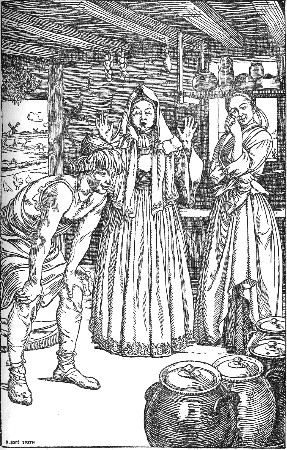
"This jar is full of smoked flesh," said one voice.

"This has fish, this is full of honey, and that one is almost running over with oil," said another voice. "We shall have all that we need to eat for many days to come."

These are the words that a villager coming home from his work heard his mother and his sister say.

"They have often played tricks on me," he said to himself, "and now I will play one on them." So he went into the house and said, "Mother, I have found that I have a wonderful sense of smell, and by its help I can find whatever is hidden away."

"That is a marvelous story," cried the sister.

"If you can tell me what is in these jars," said his mother, "I shall think you are really a magician. What is it now?"

"This is flesh, this fish, this honey, and this jar is full of oil," said the man.

"I never heard of such a marvel in all my life," cried the mother; and in the morning she called her friends and said, "Only think what a wonderful sense of smell my son has! He told me what was in these jars when they were closed."

It was not long before the people all through the country heard of the wonderful man, and one day word came that the king wished to see him at once.

The man was afraid, for he did not know what would happen to him, and he was still more afraid when the king said, "A pearl is lost that I had in my hand last night. They say you can find things that are lost. Find my pearl, or your head will he lost."

The poor man went out into the forest. "Oh, how I wish I had not tried to play tricks," he wailed. "Then this sharp sorrow, this dire trouble, would not have come upon me."

"Please, please do not tell the king," said two voices in the shadow of the trees.

"Who are you?" asked the man.

"Oh, you must know us well," said a man coming out into the light. "My name is Sharp, and that man behind the tree is named Dire, but please do not tell the king. We will give you the pearl; here it is. You called our names, and we saw that you knew us. Oh, I wish I had not been a thief!"

The man gave the pearl to the king, and went home wishing that no one would ever talk to him again of his sense of smell.

In three days word came from the queen that he must come to her at once. She thought his power was only a trick, and to catch him she had put a cat into a bag and the bag into a box.

When the man came, she asked sharply, "What is in this box? Tell me the truth, or off will go your head."

A WONDERFUL SENSE OF SMELL A WONDERFUL SENSE OF SMELL

"What shall I do?" thought the man, "Dire death is upon me." He did not remember that he was before the queen, and he repeated half aloud an old saying, "The bagged cat soon dies."

"What is that?" cried the queen.

"The bagged cat soon dies," repeated the man in great terror.

"You are a marvelous man," said the queen. "There is really a bag in the box and a cat in the bag, but no one besides myself knew it."

"He is not a man; he is a god," cried the people, "and he must be in the sky and live among the gods;" so they threw him up to the sky. His hand was full of earth, and when the earth fell back, it was no longer earth, but a handful of ants. Ants have a wonderful sense of smell, and it is because they fell from the hand of this man who was thrown up into the sky to live among the gods.

***************

This is part of a series of postings of stories under the category, "Keeping the Public in Public Domain."  The idea behind Public Domain was to preserve our cultural heritage after the authors and their immediate heirs were compensated.  I feel strongly current copyright law delays this intent on works of the 20th century.  My own library of folklore includes so many books within the Public Domain I decided to share stories from them.  I hope you enjoy discovering new stories.  


At the same time, my own involvement in storytelling regularly creates projects requiring research as part of my sharing stories with an audience.  Whenever that research needs to be shown here, the publishing of Public Domain stories will not occur that week.  This is a return to my regular posting of a research project here.  (Don't worry, this isn't dry research, my research is always geared towards future storytelling to an audience.)  Response has convinced me that "Keeping the Public in Public Domain" should continue along with my other postings as often as I can manage it.

Other Public Domain story resources I recommend-

  • There are many online resources for Public Domain stories, maybe none for folklore is as ambitious as fellow storyteller, Yoel Perez's database, Yashpeh, the International Folktales Collection.  I have long recommended it and continue to do so.  He has loaded Stith Thompson's Motif Index into his server as a database so you can search the whole 6 volumes for whatever word or expression you like by pressing one key. http://folkmasa.org/motiv/motif.htm

  • You may have noticed I'm no longer certain Dr. Perez has the largest database, although his offering the Motif Index certainly qualifies for those of us seeking specific types of stories.  There's another site, FairyTalez claiming to be the largest, with "over 2000 fairy tales, folktales, and fables" and they are "fully optimized for phones, tablets, and PCs", free and presented without ads.
    Between those two sites, there is much for story-lovers, but as they say in infomercials, "Wait, there's more!"

The email list for storytellers, Storytell, discussed Online Story Sources and came up with these additional suggestions:        

         - David K. Brown - http://people.ucalgary.ca/~dkbrown/stories.html

         - Richard Martin - http://www.tellatale.eu/tales_page.html

         - Spirit of Trees - http://spiritoftrees.org/featured-folktales

         - Story-Lovers - http://www.story-lovers.com/ is now only accessible through the Wayback Machine, described below, but the late Jackie Baldwin's wonderful site lives on there, fully searchable manually (the Google search doesn't work), at https://archive.org/ .  It's not easy, but go to Story-lovers.com snapshot for December 22 2016  and you can click on SOS: Searching Out Stories to scroll down through the many story topics and click on the story topic that interests you.

       - World of Tales - http://www.worldoftales.com/ 

 
           - Zalka Csenge Virag - http://multicoloreddiary.blogspot.com doesn't give the actual stories, but her recommendations, working her way through each country on a continent, give excellent ideas for finding new books and stories to love and tell.

     
You're going to find many of the links on these sites have gone down, BUT go to the Internet Archive Wayback Machine to find some of these old links.  Tim's site, for example, is so huge probably updating it would be a full-time job.  In the case of Story-Lovers, it's great that Jackie Baldwin set it up to stay online as long as it did after she could no longer maintain it.  Possibly searches maintained it.  Unfortunately Storytell list member, Papa Joe is on both Tim Sheppard's site and Story-Lovers, but he no longer maintains his old Papa Joe's Traveling Storytelling Show website and his Library (something you want to see!) is now only on the Wayback Machine.  It took some patience working back through claims of snapshots but finally in December of 2006 it appears!

    Somebody as of this writing whose stories can still be found by his website is the late Chuck Larkin - http://chucklarkin.com/stories.html.  I prefer to list these sites by their complete address so they can be found by the Wayback Machine, a.k.a. Archive.org, when that becomes the only way to find them.

You can see why I recommend these to you. 

Have fun discovering even more stories


Friday, June 23, 2023

Damon and Pythias - Keeping the Public in Public Domain

Summer Reading Programs are beginning, including my


The stewpot is loaded with 37 stories from all over the globe and ethnic groups.  It will be up to the audience to select the stories.  (The titles are on colorful strips of paper, but nobody -- including me -- can tell what the story is until it is selected.)

Today's story of the friendship of Damon and Pythias is legendary.  Wikipedia gives a bit of background to this tale placing its telling firmly in the hands of such classical authors as Cicero and happening at the time when Dionysius I (r. 405–367 BC) ruled Syracuse.  While the story, if told with sufficient suspense, will interest them, children will not care about the principles of the Pythagorean ideal of friendship.  Some say a test of that ideal was the reason this story actually happened.  Similarly I may have been told in school that Geometry owed many of its principles to Pythagoras.  I had enough problems with Geometry and certainly couldn't have told you about his philosophy.  As for Damon & Pythias, I'd heard the names, but never really heard the story.  It's time to correct at least knowledge of the story -- we'll continue muddling along on mathematics.  The fact that this is a story said to have actually happened may be why it continues to fascinate people over the many centuries.

DAMON AND PYTHIAS

Once a young man who had done something that displeased the King, was dragged to prison, and the day set for his death. His home was far away. “Let me go and bid good-bye to my father and mother and friends,” he said to the King, “and I will return and die.” The King laughed and said, “Ah! ah! he wishes to save himself! He would never return!” A young man stepped forward from the crowd, and said: “O King, put me in prison until he returns. I know he will do as he has promised, for he is a man who has never broken his word. If he does not return, I will die for him.”

The King, surprised at such an offer of friendship, agreed. So Pythias went to bid his friends good-bye, and Damon was put in prison. Many days passed. By and by the day arrived for the death of Pythias, and he had not returned. Damon said, “I know something has prevented, or he would be here to keep his word. I am ready to die for him!” The jailer led him out, and was just about to put him to death, when suddenly, far away on the distant road, a cloud of dust was seen growing larger and larger.

undefined  

It was Pythias running, swift as the wind, to keep his promise. He told them how he had been hindered by storm and shipwreck. He thanked his friend again and again for his faith in him. And then giving himself for death into the hands of the jailer, he was led out for execution. “Stop! Stop!” cried the King, “such friends must not suffer unjustly. Pythias shall be free! And I could give all that I possess to have one such true friend!”

Still from Universal's film Damon and Pythias (1914)

That particular version came from the General Historical Stories section of World Stories Retold by William James Sly.  While we may look at the 1914 copyright and scoff at how the inside title continues as "For Modern Boys and Girls",  the editor's explanation of why Historical Stories should be told is still true.

10. HISTORICAL STORIES

Idealistic stories—fairy tales, folk-lore, myths, legends, fables, and allegories—have their place. They add to the poetry, imagery, enjoyment, spirituality, and enrichment of a life that would often be wholly prosaic without them. But after all, the growing boy and girl who pleads “Tell me a true story,” at approximately the age of six, reveals the truth that the mind cannot be satisfied without the solid, hard, real ground of historical and scientific fact. For this reason by far the larger number of stories that must be told, and that are demanded by advancing childhood and youth, are realistic stories. These are stories from national or world history, biography, personal reminiscences and adventures, true stories of animals, and all others that recount actual happenings. “These have a special value because, besides suggesting a principle, they also indicate how it may receive specific application in life. The deeds of the Christian martyrs and of the modest heroes of every-day life have a certain power which is beyond that of the most beautiful myth. The story of what Jesus did means more than all the visions of all the prophets.”[4]

[Pg 32]Stories of national history impress the mind of the young with patriotism. Historical world stories inspire the heart of the young with a broader human sympathy for all the nations of the earth. The hunger for the heroic, which is native to the imagination and emotion of every growing boy and girl, may be fed by these classic stories of heroic action, endurance, decision, courage, faith, and self-sacrifice.

I'm often asked by young audience members "Is that story true?"  There is plenty of truth in this legend.

Friday, April 14, 2023

Grimm (Lang) - The Cat and the Mouse in Partnership - Keeping the Public in Public Domain

I've been gathering stories about friendship for this summer's program of Friendship Stew.  There will be stories from all over the world with the titles printed on colorful strips of paper in my story stewpot.  My audience members will also have their names on colorful strips in a saucepan.  Once a first person in the audience is chosen, we will keep involving the group more and more, both as a group and with individual members chosen.

Stories of friendship include "the good, the bad and the ugly."  The Brothers Grimm present a pair of examples with "The Bremen Town Musicians" as an example of good friendship, but today's story, "The Cat and the Mouse in Partnership" is at the opposite end of the friendship spectrum.  Andrew Lang placed it as the first story in his Yellow Fairy Book and there are many picture book versions of it.  I first discovered the story in The Cat and Mouse Who Shared a House as retold with pictures by Ruth Hurlimann as translated from the German by Anthea Bell.

It's an old, now out-of-print book, but the retelling and illustrations are delightful and worth hunting up a library copy.  At the same time there are also other picture books with the title originally used by Lang.  Here's the story as he told it.

THE CAT AND THE MOUSE IN PARTNERSHIP

A cat had made acquaintance with a mouse, and had spoken so much of the great love and friendship she felt for her, that at last the Mouse consented to live in the same house with her, and to go shares in the housekeeping. ‘But we must provide for the winter or else we shall suffer hunger,’ said the Cat. ‘You, little Mouse, cannot venture everywhere in case you run at last into a trap.’ This good counsel was followed, and a little pot of fat was bought. But they did not know where to put it. At length, after long consultation, the Cat said, ‘I know of no place where it could be better put than in the church. No one will trouble to take it away from there. We will hide it in a corner, and we won’t touch it till we are in want.’ So the little pot was placed in safety; but it was not long before the Cat had a great longing for it, and said to the Mouse, ‘I wanted to tell you, little Mouse, that my cousin has a little son, white with brown spots, and she wants me to be godmother to it. Let me go out to-day, and do you take care of the house alone.’

‘Yes, go certainly,’ replied the Mouse, ‘and when you eat anything good, think of me; I should very much like a drop of the red christening wine.’

But it was all untrue. The Cat had no cousin, and had not been asked to be godmother. She went straight to the church, slunk to the little pot of fat, began to lick it, and licked the top off. Then she took a walk on the roofs of the town, looked at the view, stretched herself out in the sun, and licked her lips whenever she thought of the little pot of fat. As soon as it was evening she went home again.

‘Ah, here you are again!’ said the Mouse; ‘you must certainly have had an enjoyable day.’

‘It went off very well,’ answered the Cat.

‘What was the child’s name?’ asked the Mouse.

‘Top Off,’ said the Cat drily.

‘Topoff!’ echoed the Mouse, ‘it is indeed a wonderful and curious name. Is it in your family?’

‘What is there odd about it?’ said the Cat. ‘It is not worse than Breadthief, as your godchild is called.’

Not long after this another great longing came over the Cat. She said to the Mouse, ‘You must again be kind enough to look after the house alone, for I have been asked a second time to stand godmother, and as this child has a white ring round its neck, I cannot refuse.’

The kind Mouse agreed, but the Cat slunk under the town wall to the church, and ate up half of the pot of fat. ‘Nothing tastes better,’ said she, ‘than what one eats by oneself,’ and she was very much pleased with her day’s work. When she came home the Mouse asked, ‘What was this child called?’

‘Half Gone,’ answered the Cat.

‘Halfgone! what a name! I have never heard it in my life. I don’t believe it is in the calendar.’

Soon the Cat’s mouth began to water once more after her licking business. ‘All good things in threes,’ she said to the Mouse; ‘I have again to stand godmother. The child is quite black, and has very white paws, but not a single white hair on its body. This only happens once in two years, so you will let me go out?’

‘Topoff! Halfgone!’ repeated the Mouse, ‘they are such curious names; they make me very thoughtful.’

‘Oh, you sit at home in your dark grey coat and your long tail,’ said the Cat, ‘and you get fanciful. That comes of not going out in the day.’

The Mouse had a good cleaning out while the Cat was gone, and made the house tidy; but the greedy Cat ate the fat every bit up.

‘When it is all gone one can be at rest,’ she said to herself, and at night she came home sleek and satisfied. The Mouse asked at once after the third child’s name.

‘It won’t please you any better,’ said the Cat, ‘he was called Clean Gone.’

‘Cleangone!’ repeated the Mouse. ‘I do not believe that name has been printed any more than the others. Cleangone! What can it mean?’ She shook her head, curled herself up, and went to sleep.

From this time on no one asked the Cat to stand godmother; but when the winter came and there was nothing to be got outside, the Mouse remembered their provision and said, ‘Come, Cat, we will go to our pot of fat which we have stored away; it will taste very good.’

‘Yes, indeed,’ answered the Cat; ‘it will taste as good to you as if you stretched your thin tongue out of the window.’

They started off, and when they reached it they found the pot in its place, but quite empty!

‘Ah,’ said the Mouse,’ ‘now I know what has happened! It has all come out! You are a true friend to me! You have eaten it all when you stood godmother; first the top off, then half of it gone, then——’

‘Will you be quiet!’ screamed the Cat. ‘Another word and I will eat you up.’

‘Clean-gone’ was already on the poor Mouse’s tongue, and scarcely was it out than the Cat made a spring at her, seized and swallowed her.

You see that is the way of the world. 

***

Watch out for friends like that cat!

**************** 

This is part of a series of postings of stories under the category, "Keeping the Public in Public Domain."  The idea behind Public Domain was to preserve our cultural heritage after the authors and their immediate heirs were compensated.  I feel strongly current copyright law delays this intent on works of the 20th century.  My own library of folklore includes so many books within the Public Domain I decided to share stories from them.  I hope you enjoy discovering new stories.  


At the same time, my own involvement in storytelling regularly creates projects requiring research as part of my sharing stories with an audience.  Whenever that research needs to be shown here, the publishing of Public Domain stories will not occur that week.  This is a return to my regular posting of a research project here.  (Don't worry, this isn't dry research, my research is always geared towards future storytelling to an audience.)  Response has convinced me that "Keeping the Public in Public Domain" should continue along with my other postings as often as I can manage it.

Other Public Domain story resources I recommend-

  • There are many online resources for Public Domain stories, maybe none for folklore is as ambitious as fellow storyteller, Yoel Perez's database, Yashpeh, the International Folktales Collection.  I have long recommended it and continue to do so.  He has loaded Stith Thompson's Motif Index into his server as a database so you can search the whole 6 volumes for whatever word or expression you like by pressing one key. http://folkmasa.org/motiv/motif.htm

  • You may have noticed I'm no longer certain Dr. Perez has the largest database, although his offering the Motif Index certainly qualifies for those of us seeking specific types of stories.  There's another site, FairyTalez claiming to be the largest, with "over 2000 fairy tales, folktales, and fables" and they are "fully optimized for phones, tablets, and PCs", free and presented without ads.
    Between those two sites, there is much for story-lovers, but as they say in infomercials, "Wait, there's more!"

The email list for storytellers, Storytell, discussed Online Story Sources and came up with these additional suggestions:        

         - David K. Brown - http://people.ucalgary.ca/~dkbrown/stories.html

         - Richard Martin - http://www.tellatale.eu/tales_page.html

         - Spirit of Trees - http://spiritoftrees.org/featured-folktales

         - Story-Lovers - http://www.story-lovers.com/ is now only accessible through the Wayback Machine, described below, but the late Jackie Baldwin's wonderful site lives on there, fully searchable manually (the Google search doesn't work), at https://archive.org/ .  It's not easy, but go to Story-lovers.com snapshot for December 22 2016  and you can click on SOS: Searching Out Stories to scroll down through the many story topics and click on the story topic that interests you.

       - World of Tales - http://www.worldoftales.com/ 

 
           - Zalka Csenge Virag - http://multicoloreddiary.blogspot.com doesn't give the actual stories, but her recommendations, working her way through each country on a continent, give excellent ideas for finding new books and stories to love and tell.

     
You're going to find many of the links on these sites have gone down, BUT go to the Internet Archive Wayback Machine to find some of these old links.  Tim's site, for example, is so huge probably updating it would be a full-time job.  In the case of Story-Lovers, it's great that Jackie Baldwin set it up to stay online as long as it did after she could no longer maintain it.  Possibly searches maintained it.  Unfortunately Storytell list member, Papa Joe is on both Tim Sheppard's site and Story-Lovers, but he no longer maintains his old Papa Joe's Traveling Storytelling Show website and his Library (something you want to see!) is now only on the Wayback Machine.  It took some patience working back through claims of snapshots but finally in December of 2006 it appears!

    Somebody as of this writing whose stories can still be found by his website is the late Chuck Larkin - http://chucklarkin.com/stories.html.  I prefer to list these sites by their complete address so they can be found by the Wayback Machine, a.k.a. Archive.org, when that becomes the only way to find them.

You can see why I recommend these to you. 

Have fun discovering even more stories

Friday, March 17, 2023

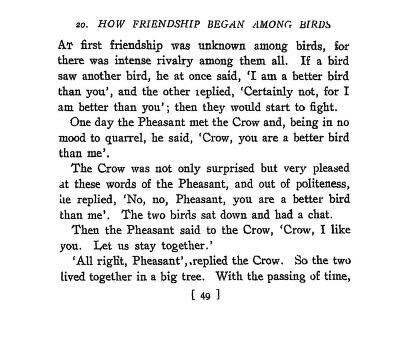
Aung - How Friendship Began Among the Birds - Keeping the Public in Public Domain

This summer many libraries will use the Collaborative Summer Library Program theme of "All Together Now."  When thinking about programs, one librarian's response gave me an idea on how to fit it into storytelling.  She asked, "What do we do after Friendship Bracelets?!?"  Another librarian in a small city said they were going to focus on the world, including international stories.  

This is when I came up with Friendship Stew

It is indeed "free from discrimination based on race, ethnicity, national origin, gender identity" as the CSLP theme proposes and will have a stewpot filled with the names of stories about friendship from all over the world.  Additionally all attendees will have their name in a saucepan to be able to draw out the next story name.  The topic of friendship must cover both the good and the bad examples -- what child hasn't had a problem with someone they thought was a friend?  As much as possible, those stories will also include audience participation.  

Me playing dulcimer in my One-Room School program

In between stories, that saucepan of attendees will again be involved.  Many songs let a child choose an action everybody does.  For example the old favorite of "If you're happy and you know it" can become "If you're friendly and you know it", letting the chosen child name the group's next action.  I plan to use my Mountain Dulcimer, one of many folk instruments I enjoy playing and deserves to be better known.  (I always find great interest in this instrument that has three names: Mountain Dulcimer; Appalachian Mountain Dulcimer; and Lap Dulcimer -- as it's played sitting down and totally unlike the Hammered Dulcimer.  I don't want to get Hammered!)

There are stories from every continent and major ethnic group in that stewpot.  Here's a short tale from Burmese Folk Tales by Maung Htin Aung that can be found at the Internet Archive.  (After the story I want to say more about the Internet Archive.)  Burma is now called Myanmar, but the language is still called Burmese.


The Internet Archive is a non-profit digital library offering millions of free books, movies, & audio files, plus billions of saved web pages in the Wayback Machine.  Along with Project Gutenberg, and Wikipedia, I annually donate and suggest you do, too.  These three resources are so important to this blog and to me as a reader.  I hope you donate, too, and want you to be aware of how they are fighting for the right of libraries to continue lending, including digitally.  Four major publishers are suing the Internet Archive trying to shut down the digital lending program.  Digital books are not owned by the libraries, although the cost is substantial, and don't stay available indefinitely, unlike a printed book.  There is much information available on the lawsuit which is now beginning oral arguments on March 20.  This is a brief overview of the situation

I also hope you go to their Battle for Libraries website and sign their petition.

These digital resources are volunteer-driven and deserve our Friendship!

***************

This is part of a series of postings of stories under the category, "Keeping the Public in Public Domain."  The idea behind Public Domain was to preserve our cultural heritage after the authors and their immediate heirs were compensated.  I feel strongly current copyright law delays this intent on works of the 20th century.  My own library of folklore includes so many books within the Public Domain I decided to share stories from them.  I hope you enjoy discovering new stories.  


At the same time, my own involvement in storytelling regularly creates projects requiring research as part of my sharing stories with an audience.  Whenever that research needs to be shown here, the publishing of Public Domain stories will not occur that week.  This is a return to my regular posting of a research project here.  (Don't worry, this isn't dry research, my research is always geared towards future storytelling to an audience.)  Response has convinced me that "Keeping the Public in Public Domain" should continue along with my other postings as often as I can manage it.

Other Public Domain story resources I recommend-

  • There are many online resources for Public Domain stories, maybe none for folklore is as ambitious as fellow storyteller, Yoel Perez's database, Yashpeh, the International Folktales Collection.  I have long recommended it and continue to do so.  He has loaded Stith Thompson's Motif Index into his server as a database so you can search the whole 6 volumes for whatever word or expression you like by pressing one key. http://folkmasa.org/motiv/motif.htm

  • You may have noticed I'm no longer certain Dr. Perez has the largest database, although his offering the Motif Index certainly qualifies for those of us seeking specific types of stories.  There's another site, FairyTalez claiming to be the largest, with "over 2000 fairy tales, folktales, and fables" and they are "fully optimized for phones, tablets, and PCs", free and presented without ads.
    Between those two sites, there is much for story-lovers, but as they say in infomercials, "Wait, there's more!"

The email list for storytellers, Storytell, discussed Online Story Sources and came up with these additional suggestions:        

         - David K. Brown - http://people.ucalgary.ca/~dkbrown/stories.html

         - Richard Martin - http://www.tellatale.eu/tales_page.html

         - Spirit of Trees - http://spiritoftrees.org/featured-folktales

         - Story-Lovers - http://www.story-lovers.com/ is now only accessible through the Wayback Machine, described below, but the late Jackie Baldwin's wonderful site lives on there, fully searchable manually (the Google search doesn't work), at https://archive.org/ .  It's not easy, but go to Story-lovers.com snapshot for October 22 2016  and you can click on SOS: Searching Out Stories to scroll down through the many story topics and click on the story topic that interests you.

       - World of Tales - http://www.worldoftales.com/ 

 
           - Zalka Csenge Virag - http://multicoloreddiary.blogspot.com doesn't give the actual stories, but her recommendations, working her way through each country on a continent, give excellent ideas for finding new books and stories to love and tell.

     
You're going to find many of the links on these sites have gone down, BUT go to the Internet Archive Wayback Machine to find some of these old links.  Tim's site, for example, is so huge probably updating it would be a full-time job.  In the case of Story-Lovers, it's great that Jackie Baldwin set it up to stay online as long as it did after she could no longer maintain it.  Possibly searches maintained it.  Unfortunately Storytell list member, Papa Joe is on both Tim Sheppard's site and Story-Lovers, but he no longer maintains his old Papa Joe's Traveling Storytelling Show website and his Library (something you want to see!) is now only on the Wayback Machine.  It took some patience working back through claims of snapshots but finally in December of 2006 it appears!

    Somebody as of this writing whose stories can still be found by his website is the late Chuck Larkin - http://chucklarkin.com/stories.html.  I prefer to list these sites by their complete address so they can be found by the Wayback Machine, a.k.a. Archive.org, when that becomes the only way to find them.

You can see why I recommend these to you. 

Have fun discovering even more stories


Friday, February 3, 2023

 Ashley Bryan and Two Public Domain Sources

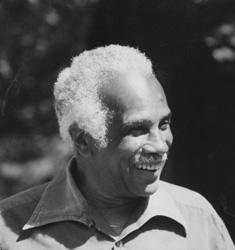
This will appear on the anniversary of the death of Ashley Bryan on February 4, 2022 at slightly over 98 1/2.  In his life he received many awards and even created this autobiography

Book photographs by Bill McGuinness with  Author Photo (jpg): Ashley Bryan

published by Simon and Schuster.  That link not only describes the book, but includes pages from it and links to YouTube videos of him showing his wonderful spirit.

His official Simon and Schuster author's page shows all 28 of his books they published, including the book where I first discovered him...The Dancing Granny.  I love Anansi stories and dancing and this book combined both elements in a storytelling style that made me want to dance while watching the trickster get what he deserved.  Each listing of Bryan's books also include another link to a curriculum guide.  Among those 28 books is his book, Ashley Bryan's Puppets showing his two-foot tall African-style hand puppets made with "beach junk" (a.k.a. found objects) plus "glue and thread and paint and a sprinkling of African folklore."

When specific stories were used, he gave their sources.  Today I'm going to post the original source of the title story from his The Ox of the Wonderful Horns and Other African Folktales.  I strongly recommend you compare this original from Kaffir Folk Tales with the way Ashley Bryan fleshes it out to make it even better.


An excellent anthology by Bryan is Ashley Bryan's African Tales, Uh-Huh which includes 14 tales from his Ox..., Lion and the Ostrich Chicks, and this story from In the Shadow of the Bush by Percy Amaury Talbot and retold in Bryan's Beat the Story Drum, Pum-Pum.

This summer I plan to tell stories of Friendship and that story will be one of many included in "Friendship Stew."  Next week I plan to say more about my Summer Reading Program on the Collaborative Summer Library Program theme of "All Together Now."
 
In the meantime I hope you read the many books by Ashley Bryan and also go to the Ashley Bryan Center website for even further information.  There were many tributes upon his death.  School Library Journal used this quote from NPR by Jason Reynolds, “But we throw ‘National Treasure’ around so cavalierly that when you get to know one, you realize how rare they are, and you want the world to dance jubilee in their honor. He deserved it. My god, Ashley, have you earned your rest.”

I believe Ashley Bryan's advice, "Wake up every morning and find the child in you" deserves to be his own parting words.

**************

This is part of a series of postings of stories under the category, "Keeping the Public in Public Domain."  The idea behind Public Domain was to preserve our cultural heritage after the authors and their immediate heirs were compensated.  I feel strongly current copyright law delays this intent on works of the 20th century.  My own library of folklore includes so many books within the Public Domain I decided to share stories from them.  I hope you enjoy discovering new stories.  


At the same time, my own involvement in storytelling regularly creates projects requiring research as part of my sharing stories with an audience.  Whenever that research needs to be shown here, the publishing of Public Domain stories will not occur that week.  This is a return to my regular posting of a research project here.  (Don't worry, this isn't dry research, my research is always geared towards future storytelling to an audience.)  Response has convinced me that "Keeping the Public in Public Domain" should continue along with my other postings as often as I can manage it.

Other Public Domain story resources I recommend-

  • There are many online resources for Public Domain stories, maybe none for folklore is as ambitious as fellow storyteller, Yoel Perez's database, Yashpeh, the International Folktales Collection.  I have long recommended it and continue to do so.  He has loaded Stith Thompson's Motif Index into his server as a database so you can search the whole 6 volumes for whatever word or expression you like by pressing one key. http://folkmasa.org/motiv/motif.htm

  • You may have noticed I'm no longer certain Dr. Perez has the largest database, although his offering the Motif Index certainly qualifies for those of us seeking specific types of stories.  There's another site, FairyTalez claiming to be the largest, with "over 2000 fairy tales, folktales, and fables" and they are "fully optimized for phones, tablets, and PCs", free and presented without ads.
    Between those two sites, there is much for story-lovers, but as they say in infomercials, "Wait, there's more!"

The email list for storytellers, Storytell, discussed Online Story Sources and came up with these additional suggestions:        

         - David K. Brown - http://people.ucalgary.ca/~dkbrown/stories.html

         - Richard Martin - http://www.tellatale.eu/tales_page.html

         - Spirit of Trees - http://spiritoftrees.org/featured-folktales

         - Story-Lovers - http://www.story-lovers.com/ is now only accessible through the Wayback Machine, described below, but the late Jackie Baldwin's wonderful site lives on there, fully searchable manually (the Google search doesn't work), at https://archive.org/ .  It's not easy, but go to Story-lovers.com snapshot for October 22 2016  and you can click on SOS: Searching Out Stories to scroll down through the many story topics and click on the story topic that interests you.

       - World of Tales - http://www.worldoftales.com/ 

 
           - Zalka Csenge Virag - http://multicoloreddiary.blogspot.com doesn't give the actual stories, but her recommendations, working her way through each country on a continent, give excellent ideas for finding new books and stories to love and tell.

     
You're going to find many of the links on these sites have gone down, BUT go to the Internet Archive Wayback Machine to find some of these old links.  Tim's site, for example, is so huge probably updating it would be a full-time job.  In the case of Story-Lovers, it's great that Jackie Baldwin set it up to stay online as long as it did after she could no longer maintain it.  Possibly searches maintained it.  Unfortunately Storytell list member, Papa Joe is on both Tim Sheppard's site and Story-Lovers, but he no longer maintains his old Papa Joe's Traveling Storytelling Show website and his Library (something you want to see!) is now only on the Wayback Machine.  It took some patience working back through claims of snapshots but finally in December of 2006 it appears!

    Somebody as of this writing whose stories can still be found by his website is the late Chuck Larkin - http://chucklarkin.com/stories.html.  I prefer to list these sites by their complete address so they can be found by the Wayback Machine, a.k.a. Archive.org, when that becomes the only way to find them.

You can see why I recommend these to you. 

Have fun discovering even more stories