Tell me if you have a topic you'd like to see. (Contact: LoiS-sez@LoiS-sez.com .)
Please also let others know about this site.
Showing posts with label holidays. Show all posts

Friday, June 26, 2026

Happy Treason Day?

Here's an Update I'm now adding: 

If we open a quarrel between past and present, we shall find that we have lost the future.
– Winston Churchill –

That is so appropriate for what today's post considers that I'm putting it at the very beginning!

I really don't want any post about the Fourth of July to get political. I'm well aware that current public  polling about the holiday is gloomy:

According to a Reuters/Ipsos poll out this month, a plurality of Democrats – 42 percent – say that Independence Day is about “friends and family time,” compared to only 24 percent who say that the holiday is about “celebrating America.” Among Republicans, meanwhile, 65 percent say the holiday is about celebrating America, while 23 percent say it’s about friends and family.

The same poll also asked whether respondents would display an American Flag this July 4. Just 27 percent of Democrats said yes, compared to 64 percent of Republicans. When that same question was asked in July 2001, 68 percent of Republicans and 65 percent of Democrats said they would display the flag.

But perhaps the most astonishing finding on the left’s patriotic collapse is that more than half of Democrats don’t even want to live in America.

 or to put it another way:

or as Homework.Study.com explains: 

"Happy Treason Day" is a hilarious, tongue-in-cheek nod to U.S. Independence Day! It’s all about playfully reminding our British friends that the Founding Fathers technically committed treason when they signed the Declaration of Independence.  

That got me thinking back to the Bicentennial in 1976. History.com looked back to see how it differs from today. I especially enjoyed this section: 

 International Recognition

Two official state visits took place during the Bicentennial celebrations, according to the Ford Presidential Museum. French President Valéry Giscard d’Estaing and his wife, Anne-Aymone, visited in May. In July, Great Britain’s Queen Elizabeth II toured several states, including attending a formal state dinner in Philadelphia.

“We are deeply grateful for having been invited to visit the United States in the main week of your bicentennial,” the queen said during the event. “After all, nobody can say that what happened on the Fourth of July 1776 was not very much a bilateral affair between us.”

During the visit, she presented the country with the Bicentennial Bell on behalf of Britain.

While I have seen tee shirts with Queen Elizabeth and the "Happy Treason Day" meme, this updating will probably soon appear on a shirt.

Made by AlexBrodsky 3 years ago

For a look further back to 1912, Project Gutenberg has preserved several of the books in the series by Robert Haven Schauffler called Our American Holidays.  At the start of the anthology, Independence Day; its celebration, spirit and significance as related in prose and verse readers are presented with a preface that emphasizes the importance of Independence Day as America's national holiday and critiques how it has been traditionally celebrated with meaningless noise and injury. Schauffler advocates for a more meaningful observance that honors the holiday's true historical significance. While no source other than the author's name is given, I appreciate the book's opening by Viscount James Bryce to the section called "Spirit and Significance."  (He was the British ambassador to the United States from 1907 to 1913. Wikipedia notes he "was very efficient in strengthening Anglo-American ties and friendship.")


ENGLAND AND AMERICA

BY JAMES BRYCE

This is a memorable day to Englishmen as well as to Americans. It is to us a day both of regret and of rejoicing: of regret at the severance of the political connection which bound the two branches of our race together, and of regret even more for the unhappy errors which brought that severance about, and the unhappy strife by which the memory of it was embittered. But it is also a day of rejoicing, for it is the birthday of the eldest daughter of England—the day when a new nation, sprung from our own, first took its independent place in the world. And now with the progress of time, rejoicing has prevailed over regret, and we in England can at length join heartily with you in celebrating the beginning of your national life. All sense of bitterness has passed away, and been replaced by sympathy with all which this anniversary means to an American heart.

England and America now understand one another far better than they ever did before. In 1776 there was on one side a monarch and a small ruling caste, on the other side a people. Now our government can no longer misrepresent the nation, and across the ocean a people speaks to a people. We have both come, and that most notably within recent months, to perceive that all over the world the interests of America and of England are substantially the same.

The sense of our underlying unity over against the other races and forms of civilization has been a potent force in drawing us together. It is said that the Fourth of July is a day of happy augury for mankind. This is true because on that day America entered on a course and proclaimed principles of government which have been of profound significance for mankind. Many nations have had a career of conquest and of civilizing dominion: but to make an immense people prosperous, happy, and free is a nobler and grander achievement than the most brilliant conquests and the widest dominion.

***

I'm sure that both Schauffler and Bryce would be appalled with the present opinions found in the Reuters/Ipsos poll opening today's look at the Fourth of July during America 250.


Friday, June 19, 2026

The Royal Fireworks by Handel and Beyond

Even before the Fourth of July, fireworks are beginning. Here in the Detroit metro area there will be many including on the Detroit riverfront on Monday the 22d. To find even more, the local Oakland County Moms newsletter has listed still more places where they will appear.

I'm a lover of classical music, so I expect to hear Music for the Royal Fireworks played on local classical music stations. I knew George Frideric Handel had composed it for a celebration for England's king George II, but I had no idea there was much more to the story

Hand colored etching of the fireworks and illuminations at his Grace, the Duke of Richmond's, at Whitehall and on the River Thames on Monday 15 May 1749. The occasion for which George Frideric Handel composed his Music for the Royal Fireworks.  

The actual story is a tale of difficulty satisfying the king's musical taste and fireworks that seem almost cursed. 

The firework display was for the benefit of King George II of Great Britain to celebrate the signing of the treaty at Aix la Chapelle in 1748 marking the end of the War of Austrian Succession. 

During the preparations, Handel and Duke John Montagu, the Master-General of the Ordnance and the officer responsible for the Royal Fireworks, had an argument about adding violins. The duke made clear to Handel that King George had a preference for only martial instruments (winds and percussion), and hoped there would be "no fiddles." Handel omitted the string instruments against his will. 

Also, against Handel's will, there was a full rehearsal of the music in Vauxhall Gardens and not in Green Park, where he wanted it. On April 21, 1749 an audience estimated to be over twelve thousand people, each paying two shillings and six pence (half a crown), rushed to attend the rehearsal, causing a three-hour traffic jam of carriages on London Bridge, the only vehicular route to the area south of the river.

The fireworks themselves were devised and controlled by Gaetano Ruggieri and Giuseppe Sarti, both from Bologna. The Ruggieri family was one of the longest surviving dynasties in the pyrotechnical trade, later firing the celebrations for the French Revolution and were still around to supervise the display in New York harbor when the Statue of Liberty was rededicated in 1986. Charles Frederick was the controller, captain Thomas Desaguliers was the chief fire master. Unfortunately the display was not as successful as the music itself. The weather was rainy, causing many misfires, and in the middle of the show one of the fireworks landed on the pavilion of the Temple of Peace, igniting the several thousand fireworks inside, killing three spectators. Also, a woman's clothes were set on fire by a stray rocket and other fireworks burned two soldiers and blinded a third. (Even before the performance another soldier, at an earlier rehearsal for the 101 cannon used during the event, had his hand blown off.)

Certainly the official fireworks part of the performance for the king seems ill-fated, but Handel re-scored the suite for full orchestra for a performance on May 27 in the Foundling Hospital. From the very first in both the original and later full orchestral version, the music has always proven very popular. . . just don't add actual fireworks!


Friday, February 13, 2026

Bailey - The Coach in the Forest - Keeping the Public in Public Domain

As https://www.history.com/ so aptly put it, "For being the year’s shortest month, February sure comes chock-full of holidays and major events. Between Valentine’s Day, Presidents’ Day, Groundhog Day, Black History Month, the Super Bowl, and sometimes Lunar New Year and Ramadan, there’s plenty to celebrate." That quote also gives a variety of their coverage to explore. As if that wasn't enough they also have The Surprising History of February.

I was all prepared, since this will be the Lunar Year of the Horse, to tell a horse story, but several of these holiday happen right now, including February 17 is also the day for a "Rare ‘Ring of Fire’ Solar Eclipse to Ignite Skies on Feb. 17 as Moon Falls Short of Covering the Sun. Astronomers refer to this phenomenon as an annular eclipse, a name derived from the Latin word annulus, meaning ring.   Because the path of annularity lies almost entirely over Antarctica and the Southern Ocean, opportunities to see the full ring in person will be extremely limited. Only Antarctic researchers and extreme travelers are likely to witness it firsthand while millions in South America and southern Africa will see a partial eclipse, and even livestream coverage may be difficult due to the region’s harsh conditions.

Since so few will be able to see that Solar Eclipse I decided to hunt for a story that combined two holidays since there's no way to cover everything this February. 

With the America 250 celebration begun, I decided to go to this story of George Washington traveling to the temporary capital in Philadelphia. The role of the horse in the story is relatively minor. 

Washington by John Trumbull - 1790

The story is from Carolyn Sherwin Bailey. I'm not surprised as she was a great storyteller with many books, some of which include holidays. I haven't ever included any from Friendly Tales before. Bailey talks about the stories in this book as being for a new developmental stage. "At first he is ego-centric, interested in himself alone, but there comes a stage in the development of every child when it is necessary to help him to find a community ideal, to sacrifice the infant personality and merge himself in a social whole. Children should be led as soon as possible to feel that they live, not alone, but in the lives of others. Each child needs to feel that he has a friend, a neighbor, a social group in school, a town, a country." This certainly manages that.


 I tried to find facts about the coach being given by the King of France, but was unsuccessful. I did find  "Did George Washington ever meet the King Louis XVI of France".

So whatever holiday you feel like celebrating, this is a story that can be used beyond February 16, 2026.

************* 

This is part of a series of postings of stories under the category, “Keeping the Public in Public Domain.” The idea behind Public Domain was to preserve our cultural heritage after the authors and their immediate heirs were compensated. I feel strongly current copyright law delays this intent on works of the 20th century. My own library of folklore includes so many books within the Public Domain I decided to share stories from them. I hope you enjoy discovering them.

At the same time, my own involvement in storytelling regularly creates projects requiring research as part of my sharing stories with an audience.  Whenever that research needs to be shown here, the publishing of Public Domain stories will not occur that week.  This is a return to my regular posting of a research project here.  (Don't worry, this isn't dry research, my research is always geared towards future storytelling to an audience.)  Response has convinced me that "Keeping the Public in Public Domain" should continue along with my other postings as often as I can manage it.

See the sidebar for other Public Domain story resources I recommend on the page “Public Domain Story Resources."


Friday, December 27, 2024

2 Hanukkah Stories by 6th Graders


This year Hanukkah begins the evening of Wednesday, December 25, and ends the evening of Thursday, January 2, 2025. Although the dates change annually, this year marks a particularly late observance of the holiday, with the beginning corresponding with Christmas and the ending spilling into the new year. This won't happen again until 2035 and then not until 2054! (In some past years, it's been early enough to overlap Thanksgiving.) It is a Festival of Lights and always occurs during the Winter Solstice, symbolizing the bringing of light into the darkest of times. 

I wanted to find a Hanukkah story to share. It wasn't easy, but while searching I found an unusual resource: http://www.zuzu.org/contents.html is a site dedicated to the writing and art of New York City school children. It resurrected a print newspaper named ZuZu. I'm uncertain if additions are being made to the website, but its Happy Holidays section presents "Holiday celebrations and traditions from around the world" including Chanukah Stories

You may notice and be puzzled by how to spell the holiday. AI does a good job of explaining how transliterating from Hebrew to Latin letters creates more than one way to do it. Zuzu chooses "Chanukah." Growing up in University City, Missouri hearing Yiddish and bits of Hebrew from my Jewish neighbors, I can appreciate the sound of "Ch", but personally have chosen the more common "Hanukkah" which is "The most widely used spelling, which is easier for English speakers to pronounce."

Two (or maybe three) of the stories I believe do the best job of telling simply why Hanukkah is historically important and how it continues to be important. Zuzu presents it through the eyes of children who, at the time, were 6th graders at Ramaz Lower School in New York City. I've no idea how to request permission to reprint them here. It was back in that 1994 printed newspaper the stories appeared. I hope my presenting them with full credit both to the students and Zuzu.org is acceptable. They were 10 then and now 40. I hope they enjoy others seeing their work from 30 years ago!

Marta Herschkopf, writes why Hanukkah is important:

The Story of Chanukah
by Marta Herschkopf, age 10

    A long time ago the Greeks led by Alexander the Great, their king, were trying to take over the world. They were very good fighters and were succeeding so far. They defeated Persia, who was ruling the land of Israel and then marched off to the Jews' holy land.

    When they reached Jerusalem, they put it under Grecian rule. The Jews weren't sure if they wanted to become Greek. So the Greeks put up an idol and commanded the Jews to bow to it. Then a man named Matityaho spoke up and cried, "All Jews who wish to obey Hashim follow me!"

    He was joined by his sons and other Jews. They gathered weapons and fled for the mountains. There they kept the Sabbath and all of the Torah's commandments.

    Meanwhile the Greeks had taken over Israel. They had gone to the Holy Temple and placed a huge idol inside. Then they overturned tables and altars and knocked down the golden Menorah. Indeed, the temple was destroyed.

    Then they descended upon the Jews in the hills. They were led by Matitayo's oldes son Judah. These Jews got the name Maccabbees, which means "hammers," in Hebrew because they fought with the power of hammers.

    The real miracle of Chanukah was that even though there were so many Greeks, and so few Maccabees, the Maccabees won and chased the Greeks out of Jerusalem.

    The first thing they did was they went to the temple and lit the Menorah. But they found only enough oil for one day. But the oil lasted for eight days which is the best known miracle of Chanukah.

Stepping out of nearly 2200 years ago, a 10 year-old boy only named as Jonathan, tells "What Chanukah Means to Me." If I was to re-tell about Hanukkah's meaning today, I would prefer both the story and illustration by another 10 year-old, Sarah Edelsburg:

My Family Chanukah Party
by Sarah Edelsburg, age 10

    Every year, my mom, dad, brother and I have a big party in the middle of Chanukah. But this is not an ordinary party. It's a Chanukah party with Chanukah decorations, latkes, jelly donuts and presents for everyone. We only invite relatives. This party is so much fun!! It's usually at night. I get to make the invitations by hand. That's a lot of fun too. Two hours before the party will start, my mom starts setting up. We usually buy Chanukah tablecloths, plates, cups, napkins, and signs. My Mom pulls out the table so there is more space to put the food. The food is set up like a buffet. You're supposed to take what you want to eat. Mom puts the tablecloth on and starts taking out plates, cups, silverware and napkins. While she does that, my brother and I get dressed for the party. When we come out there are more chairs in the living room and little bowls with potato chips, M&Ms, and nuts in them. The decorations are up. Our cameras are out. Soon the guest will arrive.

    The guest arrive!!! The party starts. First we light the menorah as everyone gathers around and we sing a Chanukah song or two with everybody. Then mom takes out the food. Everyone piles around the table to get food. We all sit together talking as we eat. We all walk around and talk to every single person. I usually have so much to say. We eat for a long time. Many get up for seconds of latkes and apple sauce. After that mom brings out a delicious chocolate cake. It always tastes great!! After that we open presents. Everyone gives something to each other. My brother and I usually make our presents by hand. There would always be a smile on everybody's face because we all give great presents. After that we eat some more dessert and everybody for while looks at their gifts. My brother and I start playing with our presents. Soon people have to leave Soon everyone is gone. We pile all our presents in our rooms, then we quickly go to bed. My Chanukah party is my favorite party of the year. It's so much fun!!!

illustration by Sarah Edelsburg, age 10

- originally submitted for the Holiday 1994 issue of ZuZu

Three typos were corrected, including Sarah's first name ending with an "h", as seen in her illustration.

Happy Hanukkah!


Friday, December 20, 2024

Rydingsvard - The Christmas Spruce Tree - Keeping the Public in Public Domain

Old reader textbooks are a view into the childhood of our grandparents and those however many "great" grandparents. Some of it is too dated to tell now, but The Wide Awake Third Reader  by Clara Murray in 1912 has a story worth remembering, "The Christmas Spruce Tree" by Anna von Rydingsvard. The "a" in Rydingsvard has an umlaut over it, but I'm not using a keyboard able to give it.

I sometimes feel sad seeing trees cut down for Christmas, but maybe I should remember this little tale. Yes, it's anthropomorphic, giving human characteristics to a tree, but science has proven even trees have feelings and thoughts of a sort, so maybe this could happen.

THE CHRISTMAS SPRUCE TREE

Among the tall trees in the forest grew a little spruce tree. It was no taller than a man, and that is very short for a tree.

The other trees near it grew so tall and had such large branches that the poor little tree could not grow at all.

She liked to listen when the other trees were talking, but it often made her sad.

“I am king of the forest,” said the oak. “Look at my huge trunk and my branches. How they reach up toward heaven! I furnish planks for men from which they build their ships. Then I defy the storm on the ocean as I did the thunder in the forest.”

“And I go with you over the foaming waves,” said the tall straight pine. “I hold up the flapping sails when the ships fly over the ocean.”

“And we warm the houses when winter comes and the cold north wind drives the snow before him,” said the birches.

“We have the same work to do,” said a tall fir tree, and she bowed gracefully, drooping her branches toward the ground.

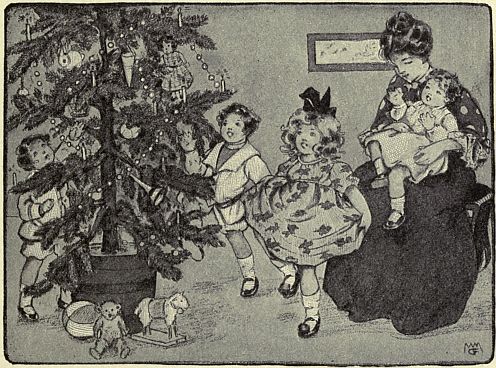
mother and children around the Christmas tree

The little spruce tree heard the other trees talking about their work in the world. This made her sad, and she thought, “What work can I do? What will become of me?”

But she could not think of any way in which she could be useful. She decided to ask the other trees in the forest.

So she asked the oak, the pine and the fir, but they were so proud and stately they did not even hear her.

Then she asked the beautiful white birch that stood near by. “You have no work to do,” said the birch, “because you can never grow large enough. Perhaps you might be a Christmas tree, but that is all.”

“What is a Christmas tree?” asked the little spruce.

“I do not know exactly,” replied the birch. “Sometimes when the days are short and cold, and the ground is covered with snow, men come out here into the forest. They look at all the little spruce trees and choose the prettiest, saying, ‘This will do for a Christmas tree.’

“Then they chop it down and carry it away. What they do with it I cannot tell.”

The little spruce asked the rabbit that hopped over the snow, the owls that slept in the pines, and the squirrels that came to find nuts and acorns.

But no one knew more than the birch tree. No one could tell what men did with the Christmas trees.

Then the little spruce tree wept because she had no work to do and could not be of any use in the world.

The tears hardened into clear, round drops, which we call gum.

At last a boy came into the forest with an axe in his hand. He looked the little tree all over. “Perhaps this will do for a Christmas tree,” he said. So he chopped it down, laid it on a sled, and dragged it home.

The next day the boy sold the tree, and it was taken into a large room and dressed up with pop corn and gilded nuts and candles. Packages of all sizes and shapes, and tiny bags filled with candy, were tied on its branches.

The tree was trembling with the excitement, but she stood as still as she could. “What if I should drop some of this fruit,” she thought.

When it began to grow dark, every one left the room and the tree was alone. It began to feel lonely and to think sad thoughts.

Soon the door opened and a lady came in. She lighted all the candles.

How light and glowing it was then!

The tree had never even dreamed of anything so beautiful!

Then the children came and danced about the tree, singing a Christmas song. The father played on his violin, and the baby sat in her mother’s arms, smiling and cooing.

“Now I know what I was made for,” thought the spruce tree; “I was intended to give joy to the little ones, because I, myself, am so small and humble.”

******

Whether you choose a live tree or an artificial one, I hope your holiday is able to give the joy this story describes and whatever you may need from it.

***

This is part of a series of postings of stories under the category, “Keeping the Public in Public Domain.” The idea behind Public Domain was to preserve our cultural heritage after the authors and their immediate heirs were compensated. I feel strongly current copyright law delays this intent on works of the 20th century. My own library of folklore includes so many books within the Public Domain I decided to share stories from them. I hope you enjoy discovering them.

At the same time, my own involvement in storytelling regularly creates projects requiring research as part of my sharing stories with an audience.  Whenever that research needs to be shown here, the publishing of Public Domain stories will not occur that week.  This is a return to my regular posting of a research project here.  (Don't worry, this isn't dry research, my research is always geared towards future storytelling to an audience.)  Response has convinced me that "Keeping the Public in Public Domain" should continue along with my other postings as often as I can manage it.

See the sidebar for other Public Domain story resources I recommend on the page “PublicDomain Story Resources."


Thursday, December 12, 2024

Pratt - The Dying Baldur - Keeping the Public in Public Domain

I'm posting today's story early as Saturday I will be telling stories of Holidays Around the World at Pere Marquette District Library in Clare at the time I usually publicize my blog.

There are so many holidays and stories within those holidays I must give their stories fairly briefly. One of those stories is how we came to associate mistletoe with this time of year.

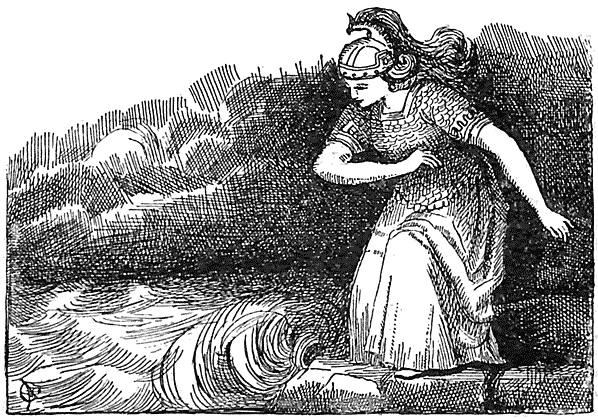
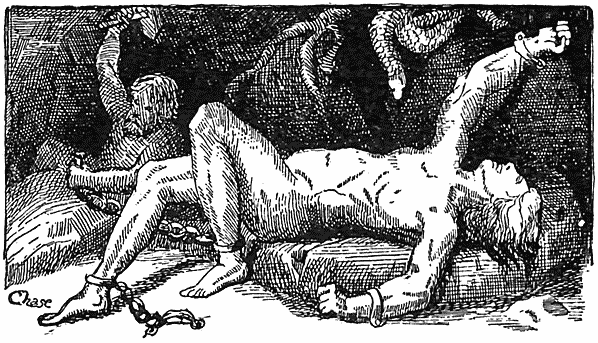
Many books tell this Norse mythological tale. I've tried to find one that stays fairly concise. Mara L. Pratt came very close to that in her Legends of Norseland , which is liberally illustrated by A. Chase. Even at that I must add a brief bit at the end to tie the mistletoe legend together with an explanation about kissing under the mistletoe. 

One quick note on names in the story, most people write Loki instead of Loke. Baldur is sometimes written Balder, but that might be mistaken for a head without hair! Also female names often have an "a" on the end.

THE DYING BALDUR.

Ages upon ages had rolled away. And now the day of sorrow, which always Odin had known must come, drew near.

Already the god of song had gone with his beautiful wife Idun down into the dark valley of death; and there was a new strange rustle among the leaves of Ygdrasil, like the rustling of leaves that were dead.

Odin’s face grew sad; and, try as he would, he could not join with the happy gods about him in their joys and festal games.

“Odin,” said Frigg one day, “tell me what grieves thee; what weighs thee down and puts such sadness into thine eyes and heart.”

“Baldur himself shall tell you all,” answered Odin sadly.

Then Baldur seated himself in the midst of the gods and said: “Always, since Odin drank at the Well of Wisdom, and learned the secrets of the past and of the future, has he known that a time would come when the light must go out from Baldur’s eyes; and he, although a god, must go down into the dark valley. Now that time draws near. Already have Brage and Idun gone from us; and with them have gone song and youth. Soon will Baldur go, and with him must go the light and warmth he has always been so glad to bring to Asgard and to Midgard both.”

“O Baldur! Baldur! Baldur! My Child! my child! my child!” cried Frigg. “This cannot be! this shall not be! I will go down from Asgard. I will go up and down the earth, and every rock and tree and plant shall pledge themselves to do no harm to thee.”

“Dear mother Frigg,” sighed Baldur, “you cannot change what is foretold. From the beginning of time this was decreed, that one day the light should go out from heaven and the twilight of the gods should fall.”

There was a long silence in the hall of Asgard. No god had courage to speak. Their hearts were heavy, and they had no wish to speak.

The sun sank behind the western hills. Its rich sunset glow spread over the golden city and over the beautiful earth below. Then darkness followed slowly, slowly creeping, creeping on, up the mountain side, across the summit, until even the shining city stood dark and shadowy beneath the gathering twilight.

“Like this, some day, the twilight will fall upon our city,” said Odin; “and it will never, never rise again.”

The mother heart of Frigg would not accept even Odin’s word. And when the sun’s first rays shot up above the far-off hills, Frigg stole forth from Asgard down the rainbow bridge to Midgard.

To every lake, and river, and sea, she hurried, and said: “Promise me, O waters, that Baldur’s light shall never go out because of you.”

“We promise,” the waters answered. And Frigg hurried on to the metals. “Promise me, O metals, that Baldur’s light shall never go out because of you.” 

“We promise,” answered the metals. And Frigg hurried on to the minerals. “Promise me, O minerals,” she said, “that Baldur’s light shall never go out because of you.”

“We promise,” answered the minerals. And Frigg hurried on to the fire, the earth, the stones, the trees, the shrubs, the grasses, the birds, the beasts, the reptiles; and even to the abode of pale disease she went. Of each she asked the same earnest, anxious question; and from each she received the same kind, honest answer.

As the sun sank behind the high peaks of the Frost giants’ homes, Frigg, radiant and happy, her eyes bright and her heart alive with hope, sped up the rainbow bridge. Triumphant, she hurried into the great hall to Odin and Baldur.

“Be happy again, O Odin! Be happy again, O Baldur! There is no danger, no sorrow to come to us from anything in the earth or under the earth. For every tree has promised me; and every rock and every metal; every animal and every bird. Even the waters and the fire have promised that never harm through them shall come to Baldur.”

But, alas, for poor Frigg. One little weed, a wee little weed, hidden beneath a rock, she had overlooked. Loke, who had followed closely upon her in all her wanderings through the day, had not failed to notice this oversight of Frigg’s. His wicked face shone with glee. His eyes gleamed; and as the radiant Frigg sped up the rainbow bridge, he hurried away to his home among the Frost giants to tell them of the little weed which, by and by, should work such harm to Baldur, in shutting out his life and light from Asgard and the earth.

The ages rolled on. Every one in Asgard, save Odin, had long ago thrown off the shadow of fear. “No harm can come to Baldur,” they would say; and all save Odin believed it.

But a day came when Odin, looking down into the home of the dead, saw there the [spirits moving about, hastening hither and thither.

“Something is happening there in the pale valley,” said Odin. “They are preparing for the coming of another shade. And it must be some great one who is to come. See how great the preparation is they make.”

“We prepare for the coming of Baldur,” answered the shades as Odin came upon them, busy in their work. “We prepare a throne for Baldur. We prepare a throne for Baldur.”

“For Baldur?” asked Odin, his heart sinking. “For Baldur!” chanted the shades. “For Baldur! Baldur cometh! Baldur cometh!”

And Odin, his godlike heart faint and sick at the thought, turned away and went slowly up the rainbow bridge.

There, in the great garden of the gods, he found Thor and Baldur and their brother 

Hodor playing at tests of strength. Behind Hodor, invisible, stood Loke. In his hand he held a spear.

“Shame upon you, Hodor,” whispered Loke, “that you, the strong and mighty Hodor, cannot overcome Baldur in a test of strength. Baldur may be beautiful and sunny, and he is a great joy to the world; that we know. But what is he compared with Hodor for strength?”

“But the spears will not touch him. See how they glance away. Indeed it is true: Light cannot be pierced.” answered Hodor, good-naturedly.

“Take this spear,” said Loke, quietly. “It is less clumsy than those you throw.”

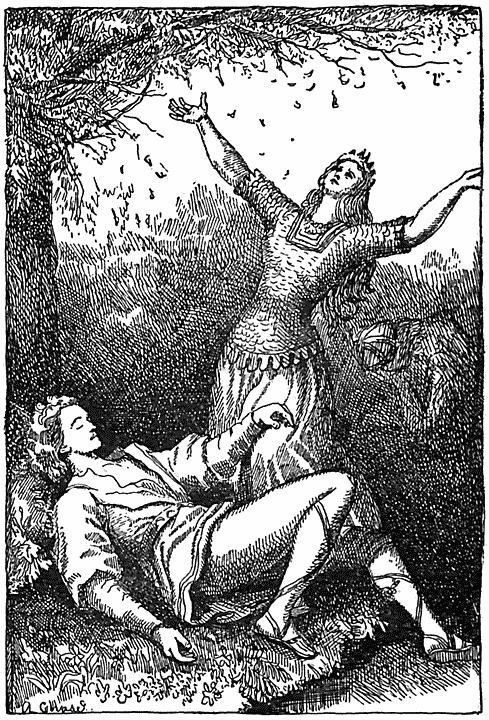
BALDUR, THE BEAUTIFUL, IS DEAD.

BALDUR, THE BEAUTIFUL, IS DEAD.

Hodor took it, never thinking of any harm. Alas for Baldur and Asgard and all the happy smiling Earth! It was a spear tipped with the mistletoe—the one plant that Frigg had failed to find. The one plant that had not promised to do no harm to Baldur.

Quickly the spear flew through the air. One second, and Baldur the Summer Spirit, Baldur the Light of the Earth fell—dead.

“O, Asgard! Baldur is dead!” groaned Odin. “O Asgard, Asgard! Baldur is dead!”

Hodor, Thor, the gods, one and all, stood pale and white. A terrible fear settled over their faces. They shook with terror.

And even as they stood there, speechless in their grief, a twilight dimness began to fall lightly, lightly over all. The shining pavements grew less bright; the blue of the great arch overhead deepened; and in the valleys of Midgard there were long black shadows. Baldur was dead. The light had failed. The golden age was at an end. Now, even the gods must die. 

***

The shortest explanation of mistletoe and kissing is given in this "AI Overview"

Mistletoe is featured in many mythologies and has been associated with a variety of meanings, including fertility, love, and peace: Norse mythology

  • In this myth, the god Loki tricked the god Hodur into killing Baldur, the god's twin brother, with an arrow made from mistletoe. Frigga, the mother of Baldur and Hodur, wept tears that turned into mistletoe berries. Mistletoe became a symbol of love and peace in Scandinavia, and the custom of calling a truce under mistletoe may have originated from this myth. 

Remember not to eat the berries as they are poisonous! So keep them away from children -- another good reason to hang them high and out of reach. May you stay around mistletoe, kissing or not, with plenty of love and peace for the holidays.

***** 

This is part of a series of postings of stories under the category, “Keeping the Public in Public Domain.” The idea behind Public Domain was to preserve our cultural heritage after the authors and their immediate heirs were compensated. I feel strongly current copyright law delays this intent on works of the 20th century. My own library of folklore includes so many books within the Public Domain I decided to share stories from them. I hope you enjoy discovering them.

At the same time, my own involvement in storytelling regularly creates projects requiring research as part of my sharing stories with an audience.  Whenever that research needs to be shown here, the publishing of Public Domain stories will not occur that week.  This is a return to my regular posting of a research project here.  (Don't worry, this isn't dry research, my research is always geared towards future storytelling to an audience.)  Response has convinced me that "Keeping the Public in Public Domain" should continue along with my other postings as often as I can manage it.

See the sidebar for other Public Domain story resources I recommend on the page “PublicDomain Story Resources."

Friday, May 24, 2024

Bailey - The Soldier Who Lived in the Drum - Keeping the Public in Public Domain

According to Wikipedia, this weekend's Memorial Day holiday evolved in the years after the United States' Civil War.  Starting with the common practice of cemetery gravesite decorating, Confederate graves seem to be its origin, rapidly spreading to Union graves, then followed by the two World Wars.  Beyond flags and flowers, the day frequently includes parades, speeches, the Indianapolis race, and it was eventually moved from May 30 to the final Monday in May, creating a three day holiday considered the unofficial start of summer.

Original caption: "You bet I'm goin' to be a soldier, too, like my Uncle David, when I grow up."

"On Decoration Day" by John T. McCutcheon, Public domain between 1900 -1905, via Wikimedia Commons.  

I remember my mother calling Memorial Day by its older name of Decoration Day.  Such traditions exist in other countries.  I present a program about World War I from the viewpoint of a Michigan woman, Oleda Joure Christides, who was a bilingual phone operator at General Pershing's headquarters in World War I France.  

I think it's important to people all over the world to remember those who fought and died protecting their homeland and its values, whether an official day or not.  The stories of those battles deserve to be remembered.  It may be a time of community togetherness, but it should be more than just partying and sports.  The men and women who gave their lives or returned with the visible and invisible scars of war deserve this.  

My own family includes an uncle who survived the landing on D-Day in World War II.  As his older sister, my mother saw the difficulties he experienced readjusting to civilian life.  I'm not sure how much he shared with his wife and children.  Surely that was up to him.  For my own part I ought to see how much, if at all, "Unca Bill" told them.  The men and women of those years are fast disappearing.  History needs to save as much of their story as they are willing to tell.  It's called oral history and if you don't feel ready to ask about these experiences, go to your local library catalog and put in the subject of "oral history"  for a few suggestions.

While war is always something we hope will not return, it is worthwhile to know about the past and be prepared to defend ourselves and what we value.  I found an interesting tale aimed at children from that storyteller extraordinaire, Carolyn Sherwin Bailey.  It was originally printed in Stories for Sunday Telling and while she says the stores have all been used in a Sunday School setting, the headings show their general usefulness: Sunday Fairy Stories; Stories of Play (source of today's story); Holiday Stories (not including Memorial nor Decoration Day); and Stories of Everyday.  


(Orff Percussion Instrument Children's Toy Two-sided Snare Drum available at Walmart)

Obviously this story opening the "Stories of Play" is not limited to Memorial Day.  Similarly remembering our veterans should not be limited to any single day.

If you would like to see how schools in the early Twentieth Century celebrated Decoration Day, pages 346-350 of Common School Education and Teachers World, Volume 3 gives a look back.  Until time machines are perfected, Public Domain works are our best way to travel to the past.

Friday, February 11, 2022

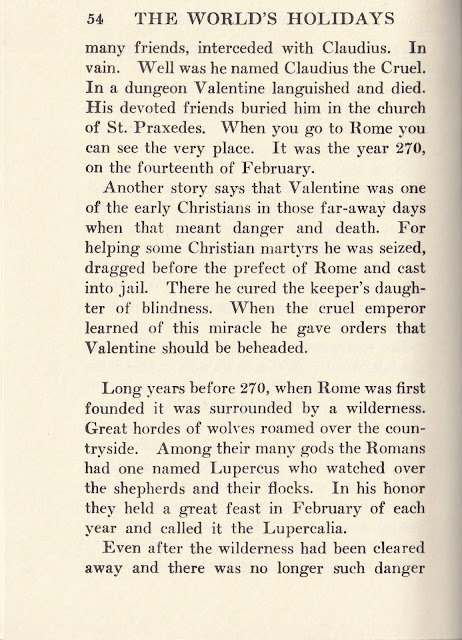
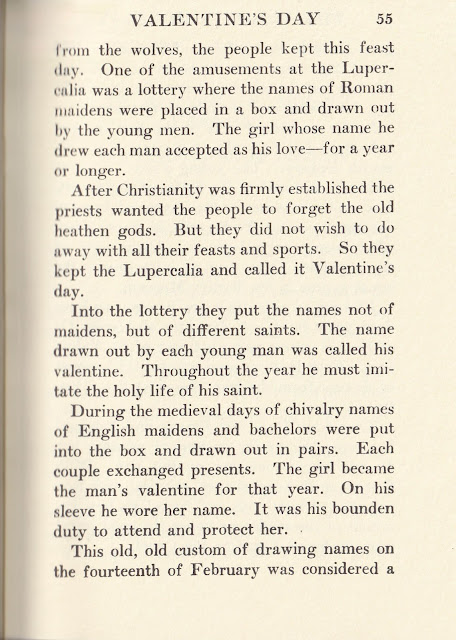
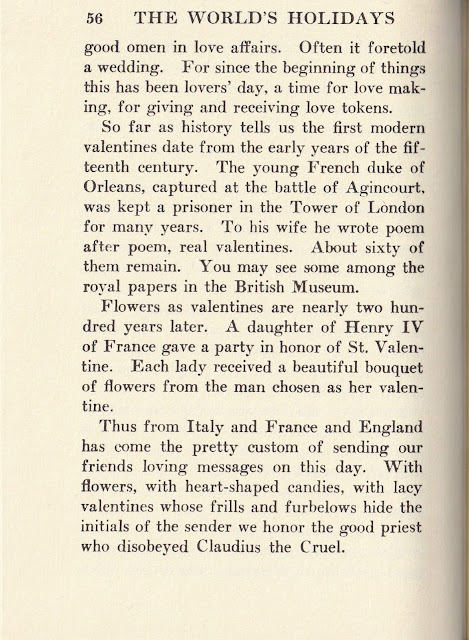
Humphrey - The Good Saint Valentine - Keeping the Public in Public Domain

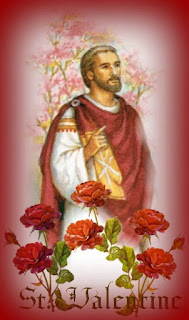
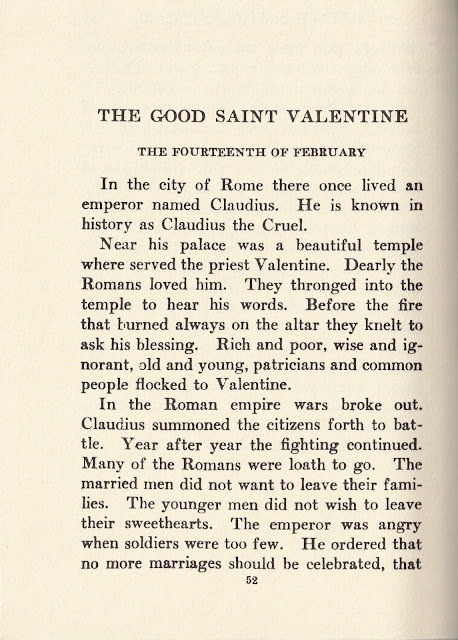
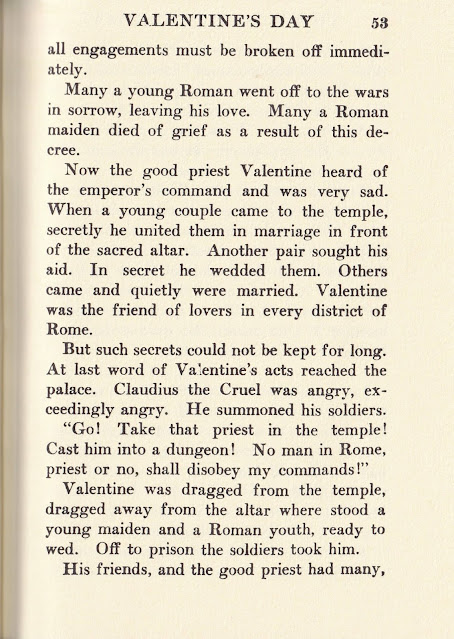
Legendary tales of saints in early Christian times are plentiful, but what is known about both Saint Valentine and the development of the holiday are fairly consistent.  Much less is known about today's author, Grace Humphrey, who published many books in the early 20th century.  Let's look at what she wrote first, plus a drawing of the youthful saint.  (No illustrations from early days exist.  Religious or stained glass versions make him look way older than I picture this man who valued love.  I chose another that's common, but also by the prolific "A. Nony Mous.")


Whether you like poems, flowers, or modern day cards and "sweets for the sweet", this gives you a bit of legendary background on a holiday that is certainly commercialized, but also would be popular even without buying a thing.

I mentioned at the beginning little is known about the author, Grace Humphrey.  Perhaps genealogical information could be found, but that lets us know only a facts view of a woman whose many works tried to present both what facts could be found AND some of the spirit of her subjects.  Her list of works at Goodreads lets me guess she was from Illinois with possibly eastern European roots.  In a day when book covers didn't carry author photos, she seems to have preferred to let her work speak for itself.

Speaking of her works, Stories of the World's Holidays, is on my shelf in a sturdy brown reprint from Gale Research.  They reprinted many early books of interest to storytellers, so if you see them, don't let the boring appearance stop you.

At one time while freelancing I worked for the local publisher, Gale, back then called Gale Research.  Like many publishers they've become part of a larger publisher, in this case Cengage.  Mergers happen and tax laws on a publisher's "backlist" all led to dropping their republishing old classics like today's book, Stories of the World's Holidays.  The Public Domain was enriched by those backlist classics.

***********************


This is part of a series of postings of stories under the category, "Keeping the Public in Public Domain."  The idea behind Public Domain was to preserve our cultural heritage after the authors and their immediate heirs were compensated.  I feel strongly current copyright law delays this intent on works of the 20th century.  My own library of folklore includes so many books within the Public Domain I decided to share stories from them.  I hope you enjoy discovering new stories.  


At the same time, my own involvement in storytelling regularly creates projects requiring research as part of my sharing stories with an audience.  Whenever that research needs to be shown here, the publishing of Public Domain stories will not occur that week.  This is a return to my regular posting of a research project here.  (Don't worry, this isn't dry research, my research is always geared towards future storytelling to an audience.)  Response has convinced me that "Keeping the Public in Public Domain" should continue along with my other postings as often as I can manage it.
Other Public Domain story resources I recommend-
  • There are many online resources for Public Domain stories, maybe none for folklore is as ambitious as fellow storyteller, Yoel Perez's database, Yashpeh, the International Folktales Collection.  I have long recommended it and continue to do so.  He has loaded Stith Thompson's Motif Index into his server as a database so you can search the whole 6 volumes for whatever word or expression you like by pressing one key. http://folkmasa.org/motiv/motif.htm
  • You may have noticed I'm no longer certain Dr. Perez has the largest database, although his offering the Motif Index certainly qualifies for those of us seeking specific types of stories.  There's another site, FairyTalez claiming to be the largest, with "over 2000 fairy tales, folktales, and fables" and they are "fully optimized for phones, tablets, and PCs", free and presented without ads.

    Between those two sites, there is much for story-lovers, but as they say in infomercials, "Wait, there's more!"
The email list for storytellers, Storytell, discussed Online Story Sources and came up with these additional suggestions:            
         - David K. Brown - http://people.ucalgary.ca/~dkbrown/stories.html
         - Richard Martin - http://www.tellatale.eu/tales_page.html
         - Spirit of Trees - http://spiritoftrees.org/featured-folktales
         - Story-Lovers - http://www.story-lovers.com/ is now only accessible through the Wayback Machine, described below, but the late Jackie Baldwin's wonderful site lives on there, fully searchable manually (the Google search doesn't work), at https://archive.org/ .  It's not easy, but go to Story-lovers.com snapshot for October 22 2016  and you can click on SOS: Searching Out Stories to scroll down through the many story topics and click on the story topic that interests you.
       - World of Tales - http://www.worldoftales.com/ 
           - Zalka Csenge Virag - http://multicoloreddiary.blogspot.com doesn't give the actual stories, but her recommendations, working her way through each country on a continent, give excellent ideas for finding new books and stories to love and tell.
     
You're going to find many of the links on these sites have gone down, BUT go to the Internet Archive Wayback Machine to find some of these old links.  Tim's site, for example, is so huge probably updating it would be a full-time job.  In the case of Story-Lovers, it's great that Jackie Baldwin set it up to stay online as long as it did after she could no longer maintain it.  Possibly searches maintained it.  Unfortunately Storytell list member, Papa Joe is on both Tim Sheppard's site and Story-Lovers, but he no longer maintains his old Papa Joe's Traveling Storytelling Show website and his Library (something you want to see!) is now only on the Wayback Machine.  It took some patience working back through claims of snapshots but finally in December of 2006 it appears!
    Somebody as of this writing whose stories can still be found by his website is the late Chuck Larkin - http://chucklarkin.com/stories.html.  I prefer to list these sites by their complete address so they can be found by the Wayback Machine, a.k.a. Archive.org, when that becomes the only way to find them.
You can see why I recommend these to you. Have fun discovering even more stories!

Friday, December 25, 2020

Deihl - The Three Bells - Keeping the Public in Public Domain

Stating something obvious, but unsaid is called "mentioning the elephant in the room."  This New Year's elephant, leaving 2020 for 2021, deserves considering.  Artists have a way of putting things in many ways, including t-shirts and posters.  An artist calling himself MoTasS on Redbubble.com created this poster and it's also on t-shirts there.

https://www.redbubble.com/i/poster/FUNNY-SAYING-ABOUT-THE-NEW-YEAR-2021-GIFT-FOR-CHRISTMAS-by-MoTasS/63381562.LVTDI?utm_source=google&utm_medium=cpc&utm_campaign=g.pla+notset&country_code=US
Poster & tees on Redbubble.com by MoTasS

I found a New Year's story also related to coping with seeing either the positives or negatives in life.  It's called "The Three Bells" and I found an illustration that led me to more information I'll give later.  The story matches my long-time wondering how people living near churches ringing bells feel about it.


That "The End" is for the entire book, Holiday-Time Stories by Edna Groff Deihl.  While Deihl wrote several books for children, the only online information I could find was her Harrisburg, Pennsylvania grave and she lived from 1881-1935.  She also isn't remembered in print biographical reference works on children's authors. This book never had its 1930 copyright renewed.  It's rather like the bell that stopped ringing as it entered the Thirties, a decade those of us leaving 2020 should remember.  

This past year has had so many leave us forever, it has been hard to remember them all.  I know churches have gotten creative in continuing their services, many can be found online at YouTube and some continue in-person in parking lots.  I don't know if church bells continue to ring at their usual times or possibly extra as a memorial.  The three bells shown at the beginning of today's post came from a Chicago Tribune article on how churches in that area rang a memorial back in April.  Remember April was when the current pandemic was looking its worst while we tried to "flatten the curve."  Now winter has brought both the hope of starting vaccine shots and the despair of far larger spikes in deaths.  May the end of one year and the start of another bring remembrance and reflection in many ways.

********************

This is part of a series of postings of stories under the category, "Keeping the Public in Public Domain."  The idea behind Public Domain was to preserve our cultural heritage after the authors and their immediate heirs were compensated.  I feel strongly current copyright law delays this intent on works of the 20th century.  My own library of folklore includes so many books within the Public Domain I decided to share stories from them.  I hope you enjoy discovering new stories.  


At the same time, my own involvement in storytelling regularly creates projects requiring research as part of my sharing stories with an audience.  Whenever that research needs to be shown here, the publishing of Public Domain stories will not occur that week.  This is a return to my regular posting of a research project here.  (Don't worry, this isn't dry research, my research is always geared towards future storytelling to an audience.)  Response has convinced me that "Keeping the Public in Public Domain" should continue along with my other postings as often as I can manage it.
Other Public Domain story resources I recommend-
  • There are many online resources for Public Domain stories, maybe none for folklore is as ambitious as fellow storyteller, Yoel Perez's database, Yashpeh, the International Folktales Collection.  I have long recommended it and continue to do so.  He has loaded Stith Thompson's Motif Index into his server as a database so you can search the whole 6 volumes for whatever word or expression you like by pressing one key. http://folkmasa.org/motiv/motif.htm
  • You may have noticed I'm no longer certain Dr. Perez has the largest database, although his offering the Motif Index certainly qualifies for those of us seeking specific types of stories.  There's another site, FairyTalez claiming to be the largest, with "over 2000 fairy tales, folktales, and fables" and they are "fully optimized for phones, tablets, and PCs", free and presented without ads.

    Between those two sites, there is much for story-lovers, but as they say in infomercials, "Wait, there's more!"
The email list for storytellers, Storytell, discussed Online Story Sources and came up with these additional suggestions:            
         - David K. Brown - http://people.ucalgary.ca/~dkbrown/stories.html
         - Richard Martin - http://www.tellatale.eu/tales_page.html
         - Spirit of Trees - http://spiritoftrees.org/featured-folktales
         - Story-Lovers - http://www.story-lovers.com/ is now only accessible through the Wayback Machine, described below, but the late Jackie Baldwin's wonderful site lives on there, fully searchable manually (the Google search doesn't work), at https://archive.org/ .  It's not easy, but go to Story-lovers.com snapshot for October 22 2016  and you can click on SOS: Searching Out Stories to scroll down through the many story topics and click on the story topic that interests you.
       - World of Tales - http://www.worldoftales.com/ 
           - Zalka Csenge Virag - http://multicoloreddiary.blogspot.com doesn't give the actual stories, but her recommendations, working her way through each country on a continent, give excellent ideas for finding new books and stories to love and tell.
     
You're going to find many of the links on these sites have gone down, BUT go to the Internet Archive Wayback Machine to find some of these old links.  Tim's site, for example, is so huge probably updating it would be a full-time job.  In the case of Story-Lovers, it's great that Jackie Baldwin set it up to stay online as long as it did after she could no longer maintain it.  Possibly searches maintained it.  Unfortunately Storytell list member, Papa Joe is on both Tim Sheppard's site and Story-Lovers, but he no longer maintains his old Papa Joe's Traveling Storytelling Show website and his Library (something you want to see!) is now only on the Wayback Machine.  It took some patience working back through claims of snapshots but finally in December of 2006 it appears!
    Somebody as of this writing whose stories can still be found by his website is the late Chuck Larkin - http://chucklarkin.com/stories.html.  I prefer to list these sites by their complete address so they can be found by the Wayback Machine, a.k.a. Archive.org, when that becomes the only way to find them.
You can see why I recommend these to you. Have fun discovering even more stories!