Tell me if you have a topic you'd like to see. (Contact: LoiS-sez@LoiS-sez.com .)
Please also let others know about this site.
Showing posts with label spring. Show all posts

Friday, April 25, 2025

Holbrook - The Story of the Bees and the Flies - Keeping the Public in Public Domain

Spring is actually starting to warm things up! Of course in addition to plants and animals waking up, insects are, too. While I know fear of bees is a problem for many, I value not only their honey, but also the work they do with pollination. Without them our agriculture would have serious problems. The U.S. Department of Agriculture quotes some scientists as estimating one in every three bites you eat is dependent on pollinators. American honeybees are clearly declining. Commercial beekeepers estimate a loss of 62% this year. Greenmatters.com quoted not only that worrisome fact, but a 2025 study, Project Apis m which gives not only the problem, but possible ways to help bee populations.

At the same time the fly is considered one of the world's most annoying insects. Fly Insect Facts gives a fair appraisal: 

Although they so often share an antagonistic relationship with humans as an annoyance or a potential carrier of diseases, these insects also serve many important ecological roles.

They are the second most common pollinators, behind only bees. They help to keep the environment free of decomposing animal flesh. And as a common subject of genetic research, they also help to advance the frontiers of human knowledge.

I recall the Ogden Nash verse stating "In His wisdom God created the fly; And then forgot to tell us why." I once asked Anishinaabe medicine woman and ethnobotanist, Keewaydinoquay Peschel about this. She disagreed with the Nash verse, pointing out their role in removing decomposing flesh. 

As you see both bees and flies, perhaps you will also think back to this story from Florence Holbrook's The Book of Nature Myths for a tale that seems to have Algonquian origin. Unfortunately back in 1902 giving the source of such stories wasn't common. I notice the Creator is called "the manito" and Wikipedia points out "Gitche Manitou (Gitchi Manitou, Kitchi Manitou, etc.) means "Great Spirit" in several Algonquian languages."

THE STORY OF THE BEES AND THE FLIES.

There were once two tribes of little people who lived near together. They were not at all alike, for one of the tribes looked for food and carried it away to put it up safely for winter, while the other played and sang and danced all day long.

"Come and play with us," said the lazy people, but the busy workers answered, "No, come and work with us. Winter will soon be here. Snow and ice will be everywhere, and if we do not put up food now we shall have none for the cold, stormy days."

So the busy people brought honey from the flowers, but the lazy people kept on playing. They laughed together and whispered to one another, "See those busy workers! They will have food for two tribes, and they will give us some. Let us go and dance."

While the summer lasted, one tribe worked and the other played. When winter came, the busy workers were sorry for their friends and said, "Let us give them some of our honey." So the people who played had as much food as if they, too, had brought honey from the flowers.

Another summer was coming, and the workers said, "If we should make our home near the lilies that give us honey, it would be easier to get our food." So the workers flew away, but the lazy people played and danced as they had done before while their friends were near, for they thought, "Oh, they will come back and bring us some honey."

By and by the cold came, but the lazy people had nothing to eat, and the workers did not come with food. The manito had said to them, "Dear little workers, you shall no longer walk from flower to flower. I will give you wings, and you shall be bees. Whenever men hear a gentle humming, they will say, 'Those are the busy bees, and their wings were given them because they were wise and good.'"

To the other tribe the manito said, "You shall be flies, and you, too, shall have wings; but while the workers fly from flower to flower and eat the yellow honey, you shall have for your food only what has been thrown away. When men hear your buzzing, they will say, 'It is good that the flies have wings, because we can drive them away from us the more quickly.'"

****************

This is part of a series of postings of stories under the category, “Keeping the Public in Public Domain.” The idea behind Public Domain was to preserve our cultural heritage after the authors and their immediate heirs were compensated. I feel strongly current copyright law delays this intent on works of the 20th century. My own library of folklore includes so many books within the Public Domain I decided to share stories from them. I hope you enjoy discovering them.

At the same time, my own involvement in storytelling regularly creates projects requiring research as part of my sharing stories with an audience.  Whenever that research needs to be shown here, the publishing of Public Domain stories will not occur that week.  This is a return to my regular posting of a research project here.  (Don't worry, this isn't dry research, my research is always geared towards future storytelling to an audience.)  Response has convinced me that "Keeping the Public in Public Domain" should continue along with my other postings as often as I can manage it.

See the sidebar for other Public Domain story resources I recommend on the page “Public Domain Story Resources."


Friday, March 21, 2025

Walker - Jack the Preacher - Keeping the Public in Public Domain

Offiffiffic'ally Spring started this past week when: The vernal equinox arrives on Thursday, marking the start of the spring season for the Northern Hemisphere and the fall in the Southern Hemisphere. On the equator, the sun will be directly overhead at noon. Equinoxes are the only time when both the north and south poles are lit by sunshine at the same time.(AP News.com ) Even earlier, "meteorological spring" began on March 1 as that AP article continues: While astronomical seasons depend on how the Earth moves around the sun, meteorological seasons are defined by the weather. They break down the year into three-month seasons based on annual temperature cycles. By that calendar, spring starts on March 1, summer on June 1, fall on Sept. 1 and winter on Dec. 1.

As a result spring seems firmly entrenched in March. Looking at the past week, southeastern Michigan hit 70s only to let the next day's vernal equinox bring flakes of snow! I know spring will come here even if the present temperatures "roller coaster." Is it any wonder fairy tales enjoy this hopeful sign of Spring? Many exist, but as I look out at the evergreens swaying in the wind, I can appreciate this story poking fun at the pride of the trees thinking they announce spring to the woodland flowers.

(I'll tell a bit more about the book where this story is found after the tale.)

JACK THE PREACHER

Jack the Preacher

Jack the Preacher

One morning in very early springtime the big Evergreen Trees began to talk about the part they took in telling all the woodland flowers that it was spring.

"Why, if we were not here," said one Evergreen Tree, "who would awake these sleepy springtime flowers to their duty? I should like you to tell me!"

"You speak truly, brother," said another tree. "We are ever green and need no awakening to our duty; but for us the woods would be a sorry-looking place in the summer. Those lazy crocuses would sleep right on and on!"

"Yes, and the little violets never would dare show their timid little heads," said another Evergreen Tree, "when the soft winds begin to run through the woods. It is then we call forth to all sleeping flowers and shrubs and bushes: 'Awake! It is time to get up!'"

"And who would tell the Bee summer was on its way?" said another Tree. "He would never get his work started at all if it were not for us. How lucky the flowers and all the woodland things are that we are here to tell them when to get up!"

So the Evergreens talked and bragged about how they preached Springtime to the woodland folk, and as they talked all the spring flowers awoke and the insects began lazily to stretch their wings, but it was not because of what the big Evergreen Trees were saying; no, it was because they had heard the voice of the little woodland preacher.

And who was he, do you think? Why, no other than Jack-in-the-pulpit, who gives a talk every spring to all the woodland dwellers on just how to bloom and how to buzz and when to do it.

Every night for ever so long before it is time for the crocus or the violet or any early spring flower to bloom, when it is the magic hour the Fairies come running through the woods and touch Jack on his nodding little head under the dry leaves and up he pops and begins to preach.

So when the flowers and bees and things heard the big Evergreen Trees talking they nodded to each other and laughed. "Isn't it funny to hear them?" said a beautiful yellow crocus. "Those tall trees know nothing about the real truth of things, do they?"

"Fancy thinking they awaken us!" said another flower. "Why, they themselves are asleep. They get so used to winter they stand still all the time, but who is to tell them the truth about our Preacher Jack? The Evergreen Trees never bend or sway to one side or the other far enough to see the beauties of our woodland spring. They only know what the winds tell them."

"Let them think what they like," said a little bush of pretty blossoms. "It does not hurt Jack-in-the-pulpit if the Evergreens think they are the preachers of the woods, for all the spring and summer flowers know that Jack has always been our preacher and the Evergreens haven't any pulpit to preach from. Only they do not know it."

And so the sleepy old Evergreens thought they were the ones who awakened the flowers and preached to them about their duty, and no one ever told them about little Jack-in-the-pulpit, who always has and always will preach about the spring and summer to all the woodland dwellers. 

***

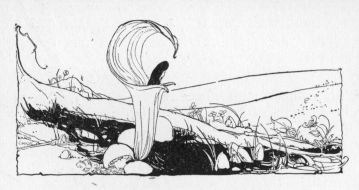
That story is from Sandman's Goodnight Stories by Abbie Phillips Walker and the illustration was by Rhoda C. Chase. I find it interesting that Chase has a Wikipedia page, but the only thing I could find about Walker was essentially a list of her several "Sandman" books and at Find-A-Grave. For the first two decades of the Twentieth Century her "Sandman" books were quite popular. Currently Project Gutenberg has three of them and Archive.org has several more.

In case that illustration of a Jack in the Pulpit isn't enough, here's a photo of one sprouting up on the forest floor. May you soon find one!


***************

This is part of a series of postings of stories under the category, “Keeping the Public in Public Domain.” The idea behind Public Domain was to preserve our cultural heritage after the authors and their immediate heirs were compensated. I feel strongly current copyright law delays this intent on works of the 20th century. My own library of folklore includes so many books within the Public Domain I decided to share stories from them. I hope you enjoy discovering them.

At the same time, my own involvement in storytelling regularly creates projects requiring research as part of my sharing stories with an audience.  Whenever that research needs to be shown here, the publishing of Public Domain stories will not occur that week.  This is a return to my regular posting of a research project here.  (Don't worry, this isn't dry research, my research is always geared towards future storytelling to an audience.)  Response has convinced me that "Keeping the Public in Public Domain" should continue along with my other postings as often as I can manage it.

See the sidebar for other Public Domain story resources I recommend on the page “Public Domain Story Resources."
 

Friday, May 13, 2022

Hartwell/Pyle - The Little Tadpole - Keeping the Public in Public Domain

This month is so busy I decided to do three inter-related stories early and schedule their publishing for the next three weeks.  One of my programs is as the One-Room School Teacher.  Along the way I show some of the books used as enrichment in those classrooms.  E.C. Hartwell or Ernest Clark Hartwell produced the Story Hour Readings, from fourth year through eighth.  He also wrote a teaching manual for the series and one other book, The Teaching of History.  Beyond that, since he was primarily the editor and not the author, the only information I could find on him was he was born in 1883 and died in 1964 long after the popularity of One-Room Schools.  

Because this year's cooperative Summer Reading Program's theme is water-related, I decided to choose stories that might be useful.  Starting with the Fourth Year I found a non-oceanic story, but appropriate to this springtime when frogs are singing.  It also helped that the story's written by Katherine Pyle.  She's less well-known than her brother, Howard Pyle, who has appeared here in five postings before.  Her art and writing, however, deserve to be better known and she certainly was acclaimed in her lifetime.

She's a perfect introduction to this Story Hour Readings trilogy and fits the purpose of "Keeping the Public in Public Domain."   It opens with a simple illustration not as complex as some of her artwork, but conveys the whimsy she often revealed.  It may even have been by one of the miscellany of illustrators used in the series as it's unsigned.


May the story stick with you when you hear everything from the Spring Peepers all the way to a deep bass bullfrog.  They all started out as Tadpoles!

That simple story was an introduction to the next two weeks when stories of sharks and swordfish bring high adventure to the older students.

*******************

This is part of a series of postings of stories under the category, "Keeping the Public in Public Domain."  The idea behind Public Domain was to preserve our cultural heritage after the authors and their immediate heirs were compensated.  I feel strongly current copyright law delays this intent on works of the 20th century.  My own library of folklore includes so many books within the Public Domain I decided to share stories from them.  I hope you enjoy discovering new stories.  


At the same time, my own involvement in storytelling regularly creates projects requiring research as part of my sharing stories with an audience.  Whenever that research needs to be shown here, the publishing of Public Domain stories will not occur that week.  This is a return to my regular posting of a research project here.  (Don't worry, this isn't dry research, my research is always geared towards future storytelling to an audience.)  Response has convinced me that "Keeping the Public in Public Domain" should continue along with my other postings as often as I can manage it.
Other Public Domain story resources I recommend-
  • There are many online resources for Public Domain stories, maybe none for folklore is as ambitious as fellow storyteller, Yoel Perez's database, Yashpeh, the International Folktales Collection.  I have long recommended it and continue to do so.  He has loaded Stith Thompson's Motif Index into his server as a database so you can search the whole 6 volumes for whatever word or expression you like by pressing one key. http://folkmasa.org/motiv/motif.htm
  • You may have noticed I'm no longer certain Dr. Perez has the largest database, although his offering the Motif Index certainly qualifies for those of us seeking specific types of stories.  There's another site, FairyTalez claiming to be the largest, with "over 2000 fairy tales, folktales, and fables" and they are "fully optimized for phones, tablets, and PCs", free and presented without ads.

    Between those two sites, there is much for story-lovers, but as they say in infomercials, "Wait, there's more!"
The email list for storytellers, Storytell, discussed Online Story Sources and came up with these additional suggestions:            
         - David K. Brown - http://people.ucalgary.ca/~dkbrown/stories.html
         - Richard Martin - http://www.tellatale.eu/tales_page.html
         - Spirit of Trees - http://spiritoftrees.org/featured-folktales
         - Story-Lovers - http://www.story-lovers.com/ is now only accessible through the Wayback Machine, described below, but the late Jackie Baldwin's wonderful site lives on there, fully searchable manually (the Google search doesn't work), at https://archive.org/ .  It's not easy, but go to Story-lovers.com snapshot for October 22 2016  and you can click on SOS: Searching Out Stories to scroll down through the many story topics and click on the story topic that interests you.
       - World of Tales - http://www.worldoftales.com/ 
           - Zalka Csenge Virag - http://multicoloreddiary.blogspot.com doesn't give the actual stories, but her recommendations, working her way through each country on a continent, give excellent ideas for finding new books and stories to love and tell.
     
You're going to find many of the links on these sites have gone down, BUT go to the Internet Archive Wayback Machine to find some of these old links.  Tim's site, for example, is so huge probably updating it would be a full-time job.  In the case of Story-Lovers, it's great that Jackie Baldwin set it up to stay online as long as it did after she could no longer maintain it.  Possibly searches maintained it.  Unfortunately Storytell list member, Papa Joe is on both Tim Sheppard's site and Story-Lovers, but he no longer maintains his old Papa Joe's Traveling Storytelling Show website and his Library (something you want to see!) is now only on the Wayback Machine.  It took some patience working back through claims of snapshots but finally in December of 2006 it appears!
    Somebody as of this writing whose stories can still be found by his website is the late Chuck Larkin - http://chucklarkin.com/stories.html.  I prefer to list these sites by their complete address so they can be found by the Wayback Machine, a.k.a. Archive.org, when that becomes the only way to find them.
You can see why I recommend these to you. Have fun discovering even more stories!

Friday, March 18, 2022

Bain - The Origin of the Mole - Keeping the Public in Public Domain

https://upload.wikimedia.org/wikipedia/commons/4/44/Kret_mole.jpg 
This Sunday is the offiffiffic'al start of Spring.  It's even starting to feel a bit like Spring in the metro Detroit area!  I like to say Spring is the time of year when a little hard work pays off in a lot of hard work later.  Living in an area where we sit on acreage, I'm not inclined to get overly worked up about having a beautiful lawn.  It's probably just as well for the sake of our area wildlife.  Our tractor is larger than a garden tractor, as those weren't up to the job of mowing the sections we mow.  When mowing it's common to find dirt tunnels made by moles.  If this was suburbia maybe that would bother me, but I'm able to have a "live and let live" attitude enjoying the rare sighting of their soft furry bodies.  (My dog has other ideas!)

Recently I introduced the Ukrainian folktales found in R. Nisbet Bain's Cossack Fairy Tales and Folk Tales, the only English language collection of Ukrainian folklore in Public Domain.  The story is small, like a mole, and I'm sure we could personify the "rich man" and the "poor man" having the "field in common" with current events.  I have more about moles after the story.

THE ORIGIN OF THE MOLE

Once upon a time a rich man and a poor man had a field in common, and they sowed it with the same seed at the same time. But God prospered the poor man’s labour and made his seed to grow, but the rich man’s seed did not grow. Then the rich man claimed that part of the field where the grain had sprung up, and said to the poor man, “Look now! ’tis my seed that has prospered, and not thine!” The poor man protested, but the rich man would not listen, but said to him, “If thou wilt not believe me, then, poor man, come into the field quite early to-morrow morning, before dawn, and God shall judge betwixt us.”

Then the poor man went home. But the rich man dug a deep trench in the poor man’s part of the field and placed his son in it, and said to him, “Look now, my son; when I come hither to-morrow morning and ask whose field this is, say that it is not the poor man’s, but the rich man’s.”

Then he well covered up his son with straw, and departed to his own house.

In the morning all the people assembled together and went to the field, and the rich man cried, “Speak, O God! whose field is this, the rich man’s or the poor man’s?”

“The rich man’s, the rich man’s,” cried a voice from the midst of the field.

But the Lord Himself was among the people gathered together there, and He said, “Listen not to that voice, for the field is verily the poor man’s.”

Then the Lord told all the people how the matter went, and then He said to the son of the rich man,

“Stay where thou art, and sit beneath the earth all thy days, so long as the sun is in the sky.”

So the rich man’s son became a mole on the spot, and that is why the mole always flies the light of day.

*********

That reminds me of the two New Testament stories of the sower and the other about weeds.  Beyond that I found two sites about moles that might help to know more about them.  Live Science tells facts about them I find more interesting than the standard Wikipedia reference given at the start of today's blog.  For those considering them pests, MyMove.com's pest control section offers "How to Get Rid of Moles and Keep Them Away for Good."  I especially applaud their recommendations as being both non-poisonous and using household items.  Remember neighborhood cats, dogs, and other animals might eat a poisoned mole and also be affected.  


Now for something completely different (shades of Monty Python!) here's a site that's fun for drawing.  https://www.wedrawanimals.com/how-to-draw-a-cute-mole/ gives more moles than just this mole and is also worth prowling for even more easy drawing.

That site might give you other animals to draw and include when you tell stories.  I hope you feel ready to Spring into action.  It's certainly the time when animals are coming back into our neighborhoods.  Let's enjoy the transition and hope Spring really is here with all the welcome changes from Winter.

*****************

This is part of a series of postings of stories under the category, "Keeping the Public in Public Domain."  The idea behind Public Domain was to preserve our cultural heritage after the authors and their immediate heirs were compensated.  I feel strongly current copyright law delays this intent on works of the 20th century.  My own library of folklore includes so many books within the Public Domain I decided to share stories from them.  I hope you enjoy discovering new stories.  


At the same time, my own involvement in storytelling regularly creates projects requiring research as part of my sharing stories with an audience.  Whenever that research needs to be shown here, the publishing of Public Domain stories will not occur that week.  This is a return to my regular posting of a research project here.  (Don't worry, this isn't dry research, my research is always geared towards future storytelling to an audience.)  Response has convinced me that "Keeping the Public in Public Domain" should continue along with my other postings as often as I can manage it.
Other Public Domain story resources I recommend-
  • There are many online resources for Public Domain stories, maybe none for folklore is as ambitious as fellow storyteller, Yoel Perez's database, Yashpeh, the International Folktales Collection.  I have long recommended it and continue to do so.  He has loaded Stith Thompson's Motif Index into his server as a database so you can search the whole 6 volumes for whatever word or expression you like by pressing one key. http://folkmasa.org/motiv/motif.htm
  • You may have noticed I'm no longer certain Dr. Perez has the largest database, although his offering the Motif Index certainly qualifies for those of us seeking specific types of stories.  There's another site, FairyTalez claiming to be the largest, with "over 2000 fairy tales, folktales, and fables" and they are "fully optimized for phones, tablets, and PCs", free and presented without ads.

    Between those two sites, there is much for story-lovers, but as they say in infomercials, "Wait, there's more!"
The email list for storytellers, Storytell, discussed Online Story Sources and came up with these additional suggestions:            
         - David K. Brown - http://people.ucalgary.ca/~dkbrown/stories.html
         - Richard Martin - http://www.tellatale.eu/tales_page.html
         - Spirit of Trees - http://spiritoftrees.org/featured-folktales
         - Story-Lovers - http://www.story-lovers.com/ is now only accessible through the Wayback Machine, described below, but the late Jackie Baldwin's wonderful site lives on there, fully searchable manually (the Google search doesn't work), at https://archive.org/ .  It's not easy, but go to Story-lovers.com snapshot for October 22 2016  and you can click on SOS: Searching Out Stories to scroll down through the many story topics and click on the story topic that interests you.
       - World of Tales - http://www.worldoftales.com/ 
           - Zalka Csenge Virag - http://multicoloreddiary.blogspot.com doesn't give the actual stories, but her recommendations, working her way through each country on a continent, give excellent ideas for finding new books and stories to love and tell.
     
You're going to find many of the links on these sites have gone down, BUT go to the Internet Archive Wayback Machine to find some of these old links.  Tim's site, for example, is so huge probably updating it would be a full-time job.  In the case of Story-Lovers, it's great that Jackie Baldwin set it up to stay online as long as it did after she could no longer maintain it.  Possibly searches maintained it.  Unfortunately Storytell list member, Papa Joe is on both Tim Sheppard's site and Story-Lovers, but he no longer maintains his old Papa Joe's Traveling Storytelling Show website and his Library (something you want to see!) is now only on the Wayback Machine.  It took some patience working back through claims of snapshots but finally in December of 2006 it appears!
    Somebody as of this writing whose stories can still be found by his website is the late Chuck Larkin - http://chucklarkin.com/stories.html.  I prefer to list these sites by their complete address so they can be found by the Wayback Machine, a.k.a. Archive.org, when that becomes the only way to find them.
You can see why I recommend these to you. Have fun discovering even more stories!


Friday, April 23, 2021

Olcott - Old-Man-Who-Made-the-Trees-to-Blossom - Keeping the Public in Public Domain

This past week was Earth Day and also here in the mitten-shaped state of Michigan we had some hard freezes after above normal temperatures for most of the month.  Spring, especially the month of April can be so fickle.  Here in southeastern Michigan I've enjoyed the many blooming trees I see on my hiking in our area.  This has me watching to be sure the freezing hasn't hurt the blooms.  Since spring blooming is normally in a chilly time, I'm hopeful they are hardy.  

This is especially true for our state because our cherries are a major part of both our agriculture and tourism.  Recently in 2012 those blossoms suffered record damage.  As the PBS News Hour noted it was A Sour Season for Michigan's Cherry Farmers and also included the blossoms on peaches and apples.  Prior to 2012 we had a slightly lesser, but similarly devastating, early warmth followed by cold in 2002.  The area affected was around Traverse City in the opposite northwestern corner of the state.  PBS's Science reporter, Saskia de Melker, noted that area 

is considered by many an ideal place for growing fruit.  Located on the 45th parallel, halfway between the equator and the North Pole, the surrounding Great Lakes and rolling hills help create a temperate climate.
Traverse City Festivals Events page

I also mentioned tourism and Traverse City has not just one, but two festivals related to all of this.  Blossom Day is scheduled for the third weekend in May followed by the Blessing of the Blossoms.  In July there's planned their eight-day National Cherry Festival, which is both one of their oldest festivals and one of the nation's largest.  That title is easily confused with the National Cherry Blossom Festival in Washington, D.C.

It's understandable that Traverse City separates its blossom celebration from the later big summer harvest festival.  Most people are familiar with Washington D.C.'s cherry trees.  They are part of a larger Wikipedia article on the Cherry Blossom, but this section on our capitol's trees is related to today's story:

Japan gave 3,020 cherry blossom trees as a gift to the United States in 1912 to celebrate the nations' growing friendship, replacing an earlier gift of 2,000 trees that had to be destroyed due to disease in 1910. These trees were planted in Sakura Park in Manhattan and lined the shore of the Tidal Basin and the roadway in East Potomac Park in Washington, D.C. The first two original trees were planted by first lady Helen Taft and Viscountess Chinda on the bank of the Tidal Basin. The gift was renewed with another 3,800 trees in 1965.[105][106] In Washington, D.C. the cherry blossom trees continue to be a popular tourist attraction (and the subject of the annual National Cherry Blossom Festival) when they reach full bloom in early spring.

Their festival this year was March 20 to April 11 as their area is further south with an earlier spring.

Yachounomori Garden, Tatebayashi-shi(city) Gunma-ken(Prefecture), Japan

Mentioning the Japanese origin of those trees leads to today's story which anthologist Frances Jenkins Olcott just describes as a Japanese folktale with no mention of the source where she found it nor how she may have retold it.  Her Acknowledgements section simply says that Japanese tales (she mentions a few, but not this story) "are from Davis, Myths and Legends of Japan and Gordon Smith, Ancient Tales and Folk-Lore of Japan."  I don't have either, but would try to find them before telling this story.  At its end I want to give a storytelling note. 

 I might use a slightly different way to tell this story which has the Tale Type of "The Envious Neighbor."  It's a tale type often found in Asian folktales.


O.k. maybe Japanese folklore ends the story this way.  Maybe I'm also cynical about this "happily ever after" ending of the tale with kindness, not only on the part of the good old couple, since they have consistently been trusting, but also by their greedy old neighbors.  It seems the story should be stopped prior to the final paragraph.  Ask your audience what they think the ending should be.  At that point either congratulate them for sharing the view of the Japanese storytellers OR that their view differs from Japanese tradition.

There are more possibilities for using this to teach kindness, especially in view of recent news stories about Hate Crimes, including those directed at Asian Americans.  There's a reason stories throughout the ages have been used to teach values.

********************

This is part of a series of postings of stories under the category, "Keeping the Public in Public Domain."  The idea behind Public Domain was to preserve our cultural heritage after the authors and their immediate heirs were compensated.  I feel strongly current copyright law delays this intent on works of the 20th century.  My own library of folklore includes so many books within the Public Domain I decided to share stories from them.  I hope you enjoy discovering new stories.  


At the same time, my own involvement in storytelling regularly creates projects requiring research as part of my sharing stories with an audience.  Whenever that research needs to be shown here, the publishing of Public Domain stories will not occur that week.  This is a return to my regular posting of a research project here.  (Don't worry, this isn't dry research, my research is always geared towards future storytelling to an audience.)  Response has convinced me that "Keeping the Public in Public Domain" should continue along with my other postings as often as I can manage it.
Other Public Domain story resources I recommend-
  • There are many online resources for Public Domain stories, maybe none for folklore is as ambitious as fellow storyteller, Yoel Perez's database, Yashpeh, the International Folktales Collection.  I have long recommended it and continue to do so.  He has loaded Stith Thompson's Motif Index into his server as a database so you can search the whole 6 volumes for whatever word or expression you like by pressing one key. http://folkmasa.org/motiv/motif.htm
  • You may have noticed I'm no longer certain Dr. Perez has the largest database, although his offering the Motif Index certainly qualifies for those of us seeking specific types of stories.  There's another site, FairyTalez claiming to be the largest, with "over 2000 fairy tales, folktales, and fables" and they are "fully optimized for phones, tablets, and PCs", free and presented without ads.

    Between those two sites, there is much for story-lovers, but as they say in infomercials, "Wait, there's more!"
The email list for storytellers, Storytell, discussed Online Story Sources and came up with these additional suggestions:            
         - David K. Brown - http://people.ucalgary.ca/~dkbrown/stories.html
         - Richard Martin - http://www.tellatale.eu/tales_page.html
         - Spirit of Trees - http://spiritoftrees.org/featured-folktales
         - Story-Lovers - http://www.story-lovers.com/ is now only accessible through the Wayback Machine, described below, but the late Jackie Baldwin's wonderful site lives on there, fully searchable manually (the Google search doesn't work), at https://archive.org/ .  It's not easy, but go to Story-lovers.com snapshot for October 22 2016  and you can click on SOS: Searching Out Stories to scroll down through the many story topics and click on the story topic that interests you.
       - World of Tales - http://www.worldoftales.com/ 
           - Zalka Csenge Virag - http://multicoloreddiary.blogspot.com doesn't give the actual stories, but her recommendations, working her way through each country on a continent, give excellent ideas for finding new books and stories to love and tell.
     
You're going to find many of the links on these sites have gone down, BUT go to the Internet Archive Wayback Machine to find some of these old links.  Tim's site, for example, is so huge probably updating it would be a full-time job.  In the case of Story-Lovers, it's great that Jackie Baldwin set it up to stay online as long as it did after she could no longer maintain it.  Possibly searches maintained it.  Unfortunately Storytell list member, Papa Joe is on both Tim Sheppard's site and Story-Lovers, but he no longer maintains his old Papa Joe's Traveling Storytelling Show website and his Library (something you want to see!) is now only on the Wayback Machine.  It took some patience working back through claims of snapshots but finally in December of 2006 it appears!
    Somebody as of this writing whose stories can still be found by his website is the late Chuck Larkin - http://chucklarkin.com/stories.html.  I prefer to list these sites by their complete address so they can be found by the Wayback Machine, a.k.a. Archive.org, when that becomes the only way to find them.
You can see why I recommend these to you. Have fun discovering even more stories!

Thursday, April 11, 2019

Lindsay - - Keeping the Public in Public Domain

Today, April 11, is National Pet Day.  That coupled with something happening this Saturday leads me to an earlier than usual publishing for this week.

Go to this link for 10 ideas to celebrate national pet day (good for pets any time). My other reason is this Saturday in Mount Clemens I will be part of, and would love to see you at, this celebration.
The Detroit Puppeteers Guild alternate their annual Day of Puppetry between adults and, this year, children.  Friend and colleague, Rob Papineau, always gives delightful shows, so his "Bunny Business" is guaranteed to be fun for the audience.

That show and the coming of Easter made me prowl my collection of books for today's Public Domain tale.  I found it in the ever reliable work by Kindergarten pioneer, Maud Lindsay, from her Story Garden for Little Children. 

Many of her books can be found online.  The Story Garden for Little Children can be found at Archive.org , complete with charming black and white illustrations by Florence Liley Young.  My own copy misses the illustration on the right, which was probably the book cover.  I also disagree a bit with the publisher's placement of the story's main illustration.  Publishers have to decide based on many things, but I want the illustration to occur as close to when it happens in the story and moved it slightly.

It tells well, complete with a child "detective."


Realistically rabbits eating your garden may not be what you want, but that story certainly tells well for spring or Easter.  I hope you enjoy making it your own, while remembering the storytellers who are part of our heritage, just as the Public Domain tries to keep our literary heritage alive.
********************
This is part of a series of postings of stories under the category, "Keeping the Public in Public Domain."  The idea behind Public Domain was to preserve our cultural heritage after the authors and their immediate heirs were compensated.  I feel strongly current copyright law delays this intent on works of the 20th century.  My own library of folklore includes so many books within the Public Domain I decided to share stories from them.  I hope you enjoy discovering new stories.  


At the same time, my own involvement in storytelling regularly creates projects requiring research as part of my sharing stories with an audience.  Whenever that research needs to be shown here, the publishing of Public Domain stories will not occur that week.  This is a return to my regular posting of a research project here.  (Don't worry, this isn't dry research, my research is always geared towards future storytelling to an audience.)  Response has convinced me that "Keeping the Public in Public Domain" should continue along with my other postings as often as I can manage it.
Other Public Domain story resources I recommend-
  • There are many online resources for Public Domain stories, maybe none for folklore is as ambitious as fellow storyteller, Yoel Perez's database, Yashpeh, the International Folktales Collection.  I have long recommended it and continue to do so.  He has loaded Stith Thompson's Motif Index into his server as a database so you can search the whole 6 volumes for whatever word or expression you like by pressing one key. http://folkmasa.org/motiv/motif.htm
  • You may have noticed I'm no longer certain Dr. Perez has the largest database, although his offering the Motif Index certainly qualifies for those of us seeking specific types of stories.  There's another site, FairyTalez claiming to be the largest, with "over 2000 fairy tales, folktales, and fables" and they are "fully optimized for phones, tablets, and PCs", free and presented without ads.

    Between those two sites, there is much for story-lovers, but as they say in infomercials, "Wait, there's more!"
The email list for storytellers, Storytell, discussed Online Story Sources and came up with these additional suggestions:            
         - David K. Brown - http://people.ucalgary.ca/~dkbrown/stories.html
         - Richard Martin - http://www.tellatale.eu/tales_page.html
         - Spirit of Trees - http://spiritoftrees.org/featured-folktales
         - Story-Lovers - http://www.story-lovers.com/ is now only accessible through the Wayback Machine, described below, but Jackie Baldwin's wonderful site lives on there, fully searchable manually (the Google search doesn't work), at https://archive.org/ .  It's not easy, but go to Story-lovers.com snapshot for October 22 2016  and you can click on SOS: Searching Out Stories to scroll down through the many story topics and click on the story topic that interests you.
       - World of Tales - http://www.worldoftales.com/ 
           - Zalka Csenge Virag - http://multicoloreddiary.blogspot.com doesn't give the actual stories, but her recommendations, working her way through each country on a continent, give excellent ideas for finding new books and stories to love and tell.
     
You're going to find many of the links on these sites have gone down, BUT go to the Internet Archive Wayback Machine to find some of these old links.  Tim's site, for example, is so huge probably updating it would be a full-time job.  In the case of Story-Lovers, it's great that Jackie Baldwin set it up to stay online as long as it did after she could no longer maintain it.  Possibly searches maintained it.  Unfortunately Storytell list member, Papa Joe is on both Tim Sheppard's site and Story-Lovers, but he no longer maintains his old Papa Joe's Traveling Storytelling Show website and his Library (something you want to see!) is now only on the Wayback Machine.  It took some patience working back through claims of snapshots but finally in December of 2006 it appears!
    Somebody as of this writing whose stories can still be found by his website is the late Chuck Larkin - http://chucklarkin.com/stories.html.  I prefer to list these sites by their complete address so they can be found by the Wayback Machine, a.k.a. Archive.org, when that becomes the only way to find them.
You can see why I recommend these to you. Have fun discovering even more stories!

Saturday, April 7, 2018

Schoolcraft (Judd) - Opeechee the Robin Redbreast

The calendar officially says the first day of summer is 75 days from now (April 7)!  I would appreciate spring coming, too, thank you.
Photo by Joshua Little http://littlebirder.blogspot.com/2014/03
Every year I always see a few robins sitting in the snow.  They always look like southern gentlemen with their chests stuck out proudly with an orange vest.


April is a fickle month.  I've seen some doozies of snow storms in April, even as the days lengthen, early spring flowers start to pop up  and grass begins to turn green.

As long as there is food available, American Robins may stay north in cold climates. Photo by Chuck Porter via Birdshare.
Cornell Lab of Ornithology's blog, All About Birds, says many robins may not migrate.  Take a look at the article, "Is it unusual to see American Robins in the middle of winter?"  According to them, the non-migrating robins change their behavior to find food, but in spring revert back to the worm-catching we see all over our lawns.

Michigan's state bird is officially the robin -- although I'd say the mosquito would be more accurate.  I've heard and read many versions of the Anishinaabe pourquois tale of how robins came to be.  Mary Catherine Judd in Wigwam Stories only calls herself the book's compiler and says she has "gone directly to the works of Schoolcraft", but I prefer her retelling to the one Schoolcraft published and also find its conclusion is closer to the telling I have heard from Anishinaabe elders and friends.


Stay warm, if you have a bird feeder, fill it, and lets hope spring comes SOON!
********************
This is part of a series of postings of stories under the category, "Keeping the Public in Public Domain."  The idea behind Public Domain was to preserve our cultural heritage after the authors and their immediate heirs were compensated.  I feel strongly current copyright law delays this intent on works of the 20th century.  My own library of folklore includes so many books within the Public Domain I decided to share stories from them.  I hope you enjoy discovering new stories.  


At the same time, my own involvement in storytelling regularly creates projects requiring research as part of my sharing stories with an audience.  Whenever that research needs to be shown here, the publishing of Public Domain stories will not occur that week.  This is a return to my regular posting of a research project here.  (Don't worry, this isn't dry research, my research is always geared towards future storytelling to an audience.)  Response has convinced me that "Keeping the Public in Public Domain" should continue along with my other postings as often as I can manage it.
Other Public Domain story resources I recommend-
  • There are many online resources for Public Domain stories, maybe none for folklore is as ambitious as fellow storyteller, Yoel Perez's database, Yashpeh, the International Folktales Collection.  I have long recommended it and continue to do so.  He has loaded Stith Thompson's Motif Index into his server as a database so you can search the whole 6 volumes for whatever word or expression you like by pressing one key. http://folkmasa.org/motiv/motif.htm
  • You may have noticed I'm no longer certain Dr. Perez has the largest database, although his offering the Motif Index certainly qualifies for those of us seeking specific types of stories.  There's another site, FairyTalez claiming to be the largest, with "over 2000 fairy tales, folktales, and fables" and they are "fully optimized for phones, tablets, and PCs", free and presented without ads.

    Between those two sites, there is much for story-lovers, but as they say in infomercials, "Wait, there's more!"
The email list for storytellers, Storytell, discussed Online Story Sources and came up with these additional suggestions:            
         - David K. Brown - http://people.ucalgary.ca/~dkbrown/stories.html
         - Richard Martin - http://www.tellatale.eu/tales_page.html
         - Spirit of Trees - http://spiritoftrees.org/featured-folktales
         - Story-Lovers - http://www.story-lovers.com/ is now only accessible through the Wayback Machine, described below, but Jackie Baldwin's wonderful site lives on there, fully searchable manually (the Google search doesn't work), at https://archive.org/ .  It's not easy, but go to Story-lovers.com snapshot for October 22 2016  and you can click on SOS: Searching Out Stories to scroll down through the many story topics and click on the story topic that interests you.
       - World of Tales - http://www.worldoftales.com/ 
     
You're going to find many of the links on these sites have gone down, BUT go to the Internet Archive Wayback Machine to find some of these old links.  Tim's site, for example, is so huge probably updating it would be a full-time job.  In the case of Story-Lovers, it's great that Jackie Baldwin set it up to stay online as long as it did after she could no longer maintain it.  Possibly searches maintained it.  Unfortunately Storytell list member, Papa Joe is on both Tim Sheppard's site and Story-Lovers, but he no longer maintains his old Papa Joe's Traveling Storytelling Show website and his Library (something you want to see!) is now only on the Wayback Machine.  It took some patience working back through claims of snapshots but finally in December of 2006 it appears!
    Somebody as of this writing whose stories can still be found by his website is the late Chuck Larkin - http://chucklarkin.com/stories.html.  I prefer to list these sites by their complete address so they can be found by the Wayback Machine, a.k.a. Archive.org, when that becomes the only way to find them.
You can see why I recommend these to you. Have fun discovering even more stories!