Tell me if you have a topic you'd like to see. (Contact: LoiS-sez@LoiS-sez.com .)
Please also let others know about this site.
Showing posts with label Storytell. Show all posts

Friday, December 12, 2025

Santa Visits the Moes

Clifton Johnson's The Oak-Tree Fairy Book is described in Google Books as " culturally important" with both familiar American tales forming roughly one-third of the book and the other two-thirds unusual stories that my Dover edition says are "drawn from a wide variety of sources. All 54 stories are told in terms that retains the charm and the interest fairy tales should have, but that avoid savagery and excessive pathos." 

I'm not sure that 1968 description of this 1905 book would be true today, but this past  week I had a last minute Christmas program booked and needed several stories FAST!

Over on  the sidebar you will find Public Domain Story Resources

One of the best resource is the late Jackie Baldwin's Story-Lovers site with suggestions from fellow storytellers on the email listserv, Storytell. There were several quick ideas including taking a well-known story, "The Twist-mouth Family" and having Santa Claus be the one who solves their problem of blowing out the candle. Of course when I tell it I like to have my audience blow like each character does.

This is how I changed it to "Santa Visits the Moes."

There once was a family named Moe who had their mouths twisted out of the usual shape. When Santa Claus came to visit, he found their candle burning and they were wide awake. 

"You need to got to sleep so I can deliver your presents", said Santa."Mr. Moe, blow that candle out so you can all go to sleep."

"Yes, I will," was his reply. 

"Well, I wish you would," said Santa. 

"Well, I will," he said. 

So he blew and blew, but his mouth was twisted and he blew upward, this way ---- and he couldn't blow out the light.

Then he said, "Mother will you blow out the light?" 

"Yes, I will," was her reply. 

"Well, I wish you would," said Santa. 

"Well, I will," she said. 

So Mrs. Moe blew and blew, but her mouth was twisted and she blew downward, this way ---- and she couldn't blow out the light.

Then Santa spoke to the daughter and said, "Young Miss Moe, will you blow out the light?"  

"Yes, I will," was her reply. 

"Well, I wish you would," said Santa. 

"Well, I will," she said. 

So she blew and blew, but her mouth was twisted to the right and she blew out of the right corner of her mouth, this way ---- and she couldn't blow out the light.

Then Santa spoke to the son and said, "Young Master Moe, will you blow out the light?"  

"Yes, I will," was his reply. 

"Well, I wish you would," said Santa. 

"Well, I will," he said. 

So  he blew and blew, but his mouth was twisted to the left and he blew out of the leftt corner of his mouth, this way ---- and he couldn't blow out the light.

"Then I guess I better blow out that light", Santa said . . and he did!

The light was out and all the Moe family went to bed and to sleep.

So Santa was able to deliver their presents and go on to other houses like yours! 

*****

As it turned out, a snow storm blew out the program after all my preparation. They plan to have me come in January instead for a program on Winter. We'll see if Winter lets me do it! You never know in Michigan. 

In the meantime, let this and other stories fit in your pocket to tell wherever you may be this holiday season! 

******************

This retelling is part of a series of postings of stories under the category, “Keeping the Public in Public Domain.” The idea behind Public Domain was to preserve our cultural heritage after the authors and their immediate heirs were compensated. I feel strongly current copyright law delays this intent on works of the 20th century. My own library of folklore includes so many books within the Public Domain I decided to share stories from them. I hope you enjoy discovering them.

At the same time, my own involvement in storytelling regularly creates projects requiring research as part of my sharing stories with an audience.  Whenever that research needs to be shown here, the publishing of Public Domain stories will not occur that week.  This is a return to my regular posting of a research project here.  (Don't worry, this isn't dry research, my research is always geared towards future storytelling to an audience.)  Response has convinced me that "Keeping the Public in Public Domain" should continue along with my other postings as often as I can manage it.

See the sidebar for other Public Domain story resources I recommend on the page “Public Domain Story Resources."


Friday, October 20, 2023

"The Shortest Scary Stories in the World"

Photo by Sabina Music Rich on Unsplash

As a storyteller I regularly tell stories in the Public Domain.  It's also why a large segment of this blog is in the category of Keeping the Public in Public Domain.  Whether you are a professional storyteller or not, it's my way of helping keep alive stories that should not fade away.  Certain the last two weeks did this as the story of The Pumpkin Giant deserves to be kept alive.  

Recently I had a program where the audience wanted spooky, but not too scary stories.  I told the group coordinator I used material that fit the requirement, BUT if she heard about any nightmares to remember when we sleep we use the events of the day to work out our problems.  I told her about a mother once telling me her child had a nightmare about crocodiles after a story in Preschool Storytime.  The story was about Bernard Waber's Lyle the Crocodile.  There are many books in the series, one of which is titled Lovable Lyle and gives a clue to just how the character goes out of his way to be anything but frightening.

With that "spooky, but not too scary" requirement, I offered a small cauldron of jokes and riddles and a large black cast iron pot with yellow paper strips for the titles of song parodies related to the topic and orange strips with the titles of appropriate stories.  Everybody in the group was on still another group of strips letting me choose the next person to decide what we heard.  They were allowed to choose a joke or riddle, a song, a story, or to pass.  This left the program to be shaped by the group as there was just enough time to call on all 17 attendees.

Among the stories was a strip called "The Shortest Scary Stories in the World."  There were so many stories available, it was never chosen.  If it had, I would have said there are Three! that claim to be "The Shortest Scary Stories in the World"  plus another of "All the Scary Stories in the World in Six Seconds."  Which would they choose: 1,2,3, or "All the Scary Stories in the World in Six Seconds?"  

Unfortunately for my recognition of authorship and possibly copyright, I am completely unable to find the source of "The Shortest Scary Stories in the World."  I suspected it was on Jackie Baldwin's site, Story-Lover's World.  Jackie tried to be the public archive for the email list, Storytell.  The list originally was sponsored by Texas Woman's University.  Eventually the university no longer was able to support it, so Jackie's "SOS:Searching Out Stories" section of her business site is as close as we can come to archiving those earlier suggestions.  Sadly her site ended in December of 2016 with https://web.archive.org/web/20161204114224/http://www.story-lovers.com/listsofstories.html .  I strongly recommend using it as a first stop bibliography when putting a storytelling program together on a theme.  I know the late Jackie Baldwin appreciated knowing it was still used even after she could no longer maintain it.  

The National Storytelling Network now hosts the Storytell list at https://storynet.org/groups/storytell/storytell-listserv/.  Membership in NSN is not a requirement to subscribe, but the archives are only available to subscribers to the list.

Trying all manner of searches never did turn up the source of "The Shortest Scary Stories in the World."  If someone can lead me to it, I'll gladly acknowledge their work and, if permitted, keep it posted here.  


 Next week I plan to take a second look at two versions of my favorite scary tale.
Steve Talkowski on Behance.net


Friday, August 11, 2023

An Email Conversation on Memorization and Storytelling


Fellow storyteller, Priscilla Howe, has a blog called More Storytelling Notes and her article "On Storytelling and Memorization" sparked an online conversation between the two of us.  First go to that link and then think a bit about it.  This is what I emailed her: 

Oh I definitely agree!  I've seen some of those who memorize get hopelessly stuck.  At the same time, my years of storytelling this way has caused me HUGE difficulties when I started to return to my background of theatre.  I'm doing it as a mental discipline while pampering my inner ham. I also prefer supporting roles to avoid letting my fellow actors down if I can't regurgitate it 100%.  (My theatre training said you should listen to your colleagues, but I find some -- if they were storytellers they'd definitely memorize! -- expect that 100%.)

I believe in storytelling.  It's alive and adapts to its audience.  At the same time I know there were some societies, like the Druids, who believed in memorization to guarantee passing a story unchanged through the ages.

At the same time I'm finding some of historical storytelling needs me cheating a bit to guarantee (a) getting all the topic into the presentation and (b) getting facts presented accurately.

I'd love a way for you to "guest" on my blog on this topic, Priscilla. 

I was never paid for my memorization (maybe I'd have grown to love it), but my mom, too, loved to spout bits from her own memory including that RLS couplet.  I'm still trying to figure out what in her youth prompted her to exclaim with delight "the old man spilled his bag of gold!" upon seeing a lawn scattered with dandelions.  I'm attaching a poem from Annette Wynne's For Days and Days; A Year-Round Treasury of Child Verse.  It was published in 1919, so it would have been a recent book when she was in grade school.  Still that ending couplet of "Miser, miser, here's God's gold, Gather some before you're old!" seems to have problems with being both memorable enough AND it's about gathering, not spilling.
LoiS(earching & wishing I'd asked her to say more)

This was that poem (with a bonus poem on the same first page):

To which she responded:

Thanks for the comments, and for the poem. My mother had vast quantities of poetry floating around in her brain, but it was not always accurate.

On a totally different note, she would sing "Wilberforce, get off your horse, and bring him in to lunch!" but no other verses. Do you know that song? There are SO many things I wish I could ask my mother now.

I've been doing a presentation for Humanities Kansas that is about 3/4 storytelling and 1/4 lecture. For that, I do use notes. Facts don't stick in my head as well as stories do. I think that's why I don't do many historical pieces. When I tell a story I wrote about the Siege of Leningrad, I always have to go over and over the specific facts, and still wonder if I've bungled them.

I'd be happy to be a guest blogger. Do you want to use this Substack post, or something new?

Be well!
Priscilla

Learn about my programs, recordings and calendar on my website. You can also read my blog and sign up for my Substack newsletter there. You'll find lots of videos on my youtube channel.

Our conversation continued 

Oh, Priscilla, I know exactly what you mean about wishing you could talk to your mother yet again.  Where's a true time machine that would permit that?  As storytellers we do the best we can, but always know it's imperfect.

I definitely agree that I, too, need ways to see notes relating to facts.  I've found ways to do it as a reporter in my Prohibition program and as a school teacher in my One Room School program.  My WWI Hello Girl program, because I have the audience hold up photos (also in the Prohibition program) has me look at notes.  My Underground Railroad/Civil War program has me study beforehand like a spy learning a cover story!  I'm getting my plans together for a woman who led a Minute Women's group and can't think of a way to "cheat."  Spy style learning will probably have to return & that's so tough.  I think it's on a par with what you say about your Siege of Leningrad story.

I've been thinking about how we can do this.  My blog has stayed print rather than podcast, but it can always take a link and embed it.  That's how we could use your Substack post, by printing the article, mentioning it's followed by the minute-long Jabberwocky and giving a plug to your Substack blog.  Beyond that I guess it's my comments and yours from these emails.  I'd love to find a way to break them up more like a conversation, but I guess calling it An Email Conversation On Storytelling and Memorization is the best we can do.  Brief intro to your post then our emailed reactions.

Your further thoughts on this?  You ask about "something new" and admit I'm open to it, but this is where my head sees it currently.
LoiS<MILE> & well wishes your way, too
Oh, Priscilla, I know exactly what you mean about wishing you could talk to your mother yet again.  Where's a true time machine that would permit that?  As storytellers we do the best we can, but always know it's imperfect.

I definitely agree that I, too, need ways to see notes relating to facts.  I've found ways to do it as a reporter in my Prohibition program and as a school teacher in my One Room School program.  My WWI Hello Girl program, because I have the audience hold up photos (also in the Prohibition program) has me look at notes.  My Underground Railroad/Civil War program has me study beforehand like a spy learning a cover story!  I'm getting my plans together for a woman who led a Minute Women's group and can't think of a way to "cheat."  Spy style learning will probably have to return & that's so tough.  I think it's on a par with what you say about your Siege of Leningrad story.

Your further thoughts on this?  You ask about "something new" and admit I'm open to it, but this is where my head sees it currently.
LoiS<MILE> & well wishes your way, too

Priscilla:

Oh, yes, the spy cover story! In fact, my uncle wrote backstories for German spies who had been "turned" by the Americans, and who were being sent back into Germany. He wrote a novel about his experiences, Call it treason, which was made into the movie Decision before dawn. I've been thinking about telling his story, and the story of a cousin on the other side of the family who was in the French resistance in WWII (caught, almost hanged, saved at the last moment!), and my great-aunt and great-uncle who were in WWI (one a nurse and the other a pilot). One of these days...And of course, the pressure to keep to facts is intense. 
Here are a few more points:

Though I don't memorize, when I've told the same story hundreds of times, it tends to come out almost the same every time.

One of the benefits of not memorizing is that I can personalize it to the audience or location. For example I mention the local co-op when I tell The ghost with the one black eye (a story I heard from my good friend Mike Rundle, who worked at said co-op for decades).

Maybe we could ask readers if they memorize, and if they do, what they prefer about that way.

Just mullling.

Priscilla

Lois: 

Some great history lurking in your past!

Talking about expanding the conversation, telling often on a story (as opposed to those factual tales) I find tends to simplification a la the great story synthesizer, Pleasant DeSpain.

As for personalizing (singing:) Aaaa-men, AMEN! AMEN.  I dearly love it's freedom to match the audience and also incorporate things happening which would be a distraction if using memorization.

The audience response is worthwhile, giving another viewpoint.  I confess it's no longer for me after finding the benefits of telling.  To my mind it's a straitjacket or a support that can't be trusted.
LoiS(melling the mulled thoughts & like mulled cider, I like it)

********

So this is where we ask for reactions.  Do you memorize?  Why do you prefer memorization?

This blog offers some limited options to reply here.  I also mention it each week on Facebook and will be posting about it on Storytell, the email list for storytellers.


Friday, March 31, 2023

Perseverance Wins - Anonymous - Keeping the Public in Public Domain


Today may be April Fools' Day, but it's no joke that unfortunately the court case of Hachette v. Internet Archive about online access to digital books went in favor of the four major publishers suing the Internet Archive.  This is only the beginning of the battle.  Appeals were to be expected no matter who won as the principle of borrowing through libraries is involved.  As the Internet Archive blog article, "The Fight Continues" stated:

This decision impacts libraries across the US who rely on controlled digital lending to connect their patrons with books online. It hurts authors by saying that unfair licensing models are the only way their books can be read online. And it holds back access to information in the digital age, harming all readers, everywhere.

For a non-library look at the case, Time Magazine's online article is worth seeing for an overview of the case from beyond the views of either parties.  It does a fair assessment of the principles involved. 

Personally I consider it dangerous that digital e-books are not owned by libraries in the same way a physical book is owned.  

I found, yes, at Internet Archive, a story showing not only the importance of books and reading, but also the importance of libraries which obviously were unavailable at the time of the story.  It's in a 1914 book with the dull sounding title of A Course in Citizenship edited by Ella Lyman Cabot.  In the footnotes we are told the story, "Perseverance Wins" is abridged  from Fanny E. Coe's 1908 textbook, A School Reader, Fourth Grade.  I wasn't able to track down that book online, but know I have some of her readers downstairs in my basket of books for my "One-Room School Teacher" program.

One other quick bit of information about the story, there are two parts to it.  The second part takes place many years after the first.  It begins with the words "Last year I went to Europe" and is a necessary conclusion to this story told by "Judge Preston."


Even though libraries are the major buyers of books, publishers have long worked against library lending.  The current case involving digital rights will have far reaching consequences.  The four publishers' legal departments have no problem affording the fight on this case all the way up to the Supreme Court.  The Internet Archive is a non-profit with limited resources (best put to their continuing work instead of legal bills). On their home page at https://archive.org/ they point out:

The Internet Archive is a crucial resource, but fewer than 1 in 1000 of our patrons donate; we're powered by contributions averaging $25.51. If you find our library useful, please pitch in.

I do support them financially and hope you do, too.  This valuable resource also hosts The Wayback Machine, which archives websites.  The Wayback Machine includes this blog, my own website, https://www.lois-sez.com/, and a great many more.  I always follow a "Keeping the Public in Public Domain" segment with a list of further online storytelling resources.  One of those, Jackie Baldwin's site, Story-Lovers.com, was a cumulative site crammed with story suggestions from storytellers on the email list, Storytell.  That email list is now hosted by the National Storytelling Network and their archive picks up shortly before Jackie's site ended.  She also edited her listing of resources, so it is not the same as prowling the listserv's archive.  Jackie has gone to storytelling in the Great Beyond, but the Wayback Machine gives the last chance to view her wonderful resource on December 22, 2016 (search it internally, not via an external search engine like Google).  

I similarly have been able to view sites no longer online through the Wayback Machine.  I would dread the loss of this way to access online resources.  Books and letters on paper have their own danger of disappearing, but online digital preservation is also critical, whether saving old books or websites.  Just as Public Domain preserves our culture, the Internet Archive is preserving it digitally . . . the ramifications of Hachette v. Internet Archive are not an April Fools' Joke the future can afford.

****************  

This is part of a series of postings of stories under the category, "Keeping the Public in Public Domain."  The idea behind Public Domain was to preserve our cultural heritage after the authors and their immediate heirs were compensated.  I feel strongly current copyright law delays this intent on works of the 20th century.  My own library of folklore includes so many books within the Public Domain I decided to share stories from them.  I hope you enjoy discovering new stories.  


At the same time, my own involvement in storytelling regularly creates projects requiring research as part of my sharing stories with an audience.  Whenever that research needs to be shown here, the publishing of Public Domain stories will not occur that week.  This is a return to my regular posting of a research project here.  (Don't worry, this isn't dry research, my research is always geared towards future storytelling to an audience.)  Response has convinced me that "Keeping the Public in Public Domain" should continue along with my other postings as often as I can manage it.

Other Public Domain story resources I recommend-

  • There are many online resources for Public Domain stories, maybe none for folklore is as ambitious as fellow storyteller, Yoel Perez's database, Yashpeh, the International Folktales Collection.  I have long recommended it and continue to do so.  He has loaded Stith Thompson's Motif Index into his server as a database so you can search the whole 6 volumes for whatever word or expression you like by pressing one key. http://folkmasa.org/motiv/motif.htm

  • You may have noticed I'm no longer certain Dr. Perez has the largest database, although his offering the Motif Index certainly qualifies for those of us seeking specific types of stories.  There's another site, FairyTalez claiming to be the largest, with "over 2000 fairy tales, folktales, and fables" and they are "fully optimized for phones, tablets, and PCs", free and presented without ads.
    Between those two sites, there is much for story-lovers, but as they say in infomercials, "Wait, there's more!"

The email list for storytellers, Storytell, discussed Online Story Sources and came up with these additional suggestions:        

         - David K. Brown - http://people.ucalgary.ca/~dkbrown/stories.html

         - Richard Martin - http://www.tellatale.eu/tales_page.html

         - Spirit of Trees - http://spiritoftrees.org/featured-folktales

         - Story-Lovers - http://www.story-lovers.com/ is now only accessible through the Wayback Machine, described below, but the late Jackie Baldwin's wonderful site lives on there, fully searchable manually (the Google search doesn't work), at https://archive.org/ .  It's not easy, but go to Story-lovers.com snapshot for December 22 2016  and you can click on SOS: Searching Out Stories to scroll down through the many story topics and click on the story topic that interests you.

       - World of Tales - http://www.worldoftales.com/ 

 
           - Zalka Csenge Virag - http://multicoloreddiary.blogspot.com doesn't give the actual stories, but her recommendations, working her way through each country on a continent, give excellent ideas for finding new books and stories to love and tell.

     
You're going to find many of the links on these sites have gone down, BUT go to the Internet Archive Wayback Machine to find some of these old links.  Tim's site, for example, is so huge probably updating it would be a full-time job.  In the case of Story-Lovers, it's great that Jackie Baldwin set it up to stay online as long as it did after she could no longer maintain it.  Possibly searches maintained it.  Unfortunately Storytell list member, Papa Joe is on both Tim Sheppard's site and Story-Lovers, but he no longer maintains his old Papa Joe's Traveling Storytelling Show website and his Library (something you want to see!) is now only on the Wayback Machine.  It took some patience working back through claims of snapshots but finally in December of 2006 it appears!

    Somebody as of this writing whose stories can still be found by his website is the late Chuck Larkin - http://chucklarkin.com/stories.html.  I prefer to list these sites by their complete address so they can be found by the Wayback Machine, a.k.a. Archive.org, when that becomes the only way to find them.

You can see why I recommend these to you. 

Have fun discovering even more stories

Friday, April 1, 2022

Mermaid Song for Summer

This summer many libraries will be using the ocean-related Collaborative Summer Library Program theme.  This lets me use a program that has long been popular, the Storytelling Cruise Around the World.  My puppy puppet, Buzz, is already practicing his part . . . you guessed it, the Dog Paddle!

GRRRrrrr!

O.k. he does do a bit more because I like to include the audience in my program.  Each child receives a raffle-style ticket and I let Buzz draw out a ticket between stories for a chance to choose a water-related joke or riddle.  When it's a riddle, the ticket holder can try to answer it and, if unsuccessful, choose someone else to try before letting the whole audience guess.  

I'm happy with the stories I use as they have been popular with such varied audiences from the Jackson StoryFest to the Detroit Institute of Arts and at libraries and schools.  Because they are mainly stories using audience participation, it keeps the program interactive even without the raffle tickets.  Now bringing the program out after not telling it for a while, I re-evaluated everything.  Yes, I was happy with it until I realized it had no music!  Oh well, I told myself it wasn't necessary until . . . 

Earlier this week on Storytell, the email discussion list I've often mentioned, storyteller Pat Nease offered a mermaid song parody.  She graciously consented to let me post it here for all to sing.  Pat said it was inspired by 

"a book by Lucille Colandro titled 'There was an Old Mermaid Who Swallowed a Shark!' I thought it such a clever idea, but the book goes from large to small and I prefer the small to large arrangement, plus I needed an ending.  So I wrote my own (I'll do a brief food chain with my listeners so they'll know what krill is.)"  

 
I worried about posting it here, but even Colandro's series admits it and each of her other beginning readers in the series use the traditional song, "There was an old lady who swallowed a fly."  That series is good silly fun that sometimes uses the original song idea of an "old lady", but some others have an old pirate, an old astronaut, or an old scientist, as well as great variety in the objects swallowed.  The fun of the series is increased even more with illustrations by Jared Lee, which also help reading beginners figure out the objects swallowed.

Here's Pat's parody and then at the end, for those like me who want to play an instrument while singing, I'll give the chords rather than interrupt her lyrics.

There Was an Old Mermaid


There was an old Mermaid who swallowed some Krill.

Oh, what a thrill, to swallow that krill.  She might be ill.


There was an old Mermaid who swallowed some shrimp.

She looked like a blimp, she ate so much shrimp!

She swallowed the shrimp to play with the krill,

Oh, what a thrill, to swallow that krill.  She might be ill.


There was an old Mermaid who swallowed a sea star.

She had to swim far, to swallow that star.

She swallowed the star to light up the shrimp,

She swallowed the shrimp to play with the krill,

Oh, what a thrill, to swallow that krill.  She might be ill.


There was an old Mermaid who swallowed a crab.

It was real tough to grab, but she swallowed that crab.

She swallowed the crab to pinch the star,

She swallowed the star to light up the shrimp,

She swallowed the shrimp to play with the krill,

Oh, what a thrill, to swallow that krill.  She might be ill.


There was an old Mermaid who swallowed a fish.

A tropical fish, that was her wish.

She swallowed the fish to tease the crab,

She swallowed the crab to pinch the star,

She swallowed the star to light up the shrimp,

She swallowed the shrimp to play with the krill,

Oh, what a thrill, to swallow that krill.  She might be ill.


There was an old Mermaid who swallowed an eel

She let out a squeal when she swallowed that eel.

She swallowed the eel to dance with the fish,

She swallowed the fish to tease the crab,

She swallowed the crab to pinch the star,

She swallowed the star to light up the shrimp,

She swallowed the shrimp to play with the krill,

Oh, what a thrill, to swallow that krill.  She might be ill.


There was an old Mermaid who swallowed a squid.

That’s what she did, she swallowed a squid.

She swallowed the squid to tickle the eel,

She swallowed the eel to dance with the fish,

She swallowed the fish to tease the crab,

She swallowed the crab to pinch the star,

She swallowed the star to light up the shrimp,

She swallowed the shrimp to play with the krill,

Oh, what a thrill, to swallow that krill.  She might be ill.


There was an old Mermaid who swallowed a shark.

Well, it was dark when she swallowed that shark.

She swallowed the shark to catch the squid,

She swallowed the squid to tickle the eel,

She swallowed the eel to dance with the fish,

She swallowed the fish to tease the crab,

She swallowed the crab to pinch the star,

She swallowed the star to light up the shrimp,

She swallowed the shrimp to play with the krill,

Oh, what a thrill, to swallow that krill.  She might be ill.


There was an old Mermaid who swallowed a whale.

And that, my friends, is the end of this tale.

The whale prevails.


For those of you playing chords, the first line is always a G; the second line is A for the first phrase and D for the second phrase.  From there on for each ending it's D for "she might be", ending with G for "ill." As repetition starts in the following verses, just keep playing a G chord as the mermaid swallows more and more, each time ending in (A) Oh what a thrill, (D) To swallow that krill. (D) She might be (G) ill.


It's worth suggesting to your audiences they should join in as much as they can manage to remember.  It can be a great challenge for you and them!


May you and your audiences swallow up this bit of silliness, some stories, and a lot of summer reading!


Friday, March 4, 2022

"Unhinged ruler" stories

A wonderful online resource for storytelling and storytellers is hosted by the National Storytelling Network, the email list, Storytell.  I'll give more information about it after this list.

One of the great things on Storytell is the ability to ask a question and get replies from members ranging from beginner through professional.  One of our professionals, Richard Martin in Germany asked: 

Recent events have made me look for folk tales of rulers who become sufficiently divorced from the reality perceived by others that they end up doing terrible things to their land - perhaps even the lands of others. So far I have only thought of the Ovid tale of King Erysichthon whose insatiable greed led him to prostitute his daughter and eventually to consume himself.

O Founts of Wisdom, which tales can you suggest?

Rachel Hedman replied:


I would actually approach it to folktales where people unified together for good. Where a group may be small but their heart and goodness overcome. Bring about the unifying spirit that sometimes must fight to keep the peace for all.
 
Richard clarified:
I appreciate that, but it is the tragic story of the person heading for doom which I find interesting. Sometimes we need to look at such things.
From there the topic began producing these replies:
*(Suzanne Whitby) 

I tend to resonate with Richard, here. Using folktales to explore possible outcomes - good or bad - can provoke conversation and thought, in my world anyway :) Admittedly, I do love a trickster and a good ending, though, so Richard, some thoughts below which might only partially help. Also, a few ideas that are based in history, but have a somewhat mythical quality about them - again, take what you find useful and ignore the rest.

The one that popped into my head was the story of the "battle in sign language"  - the Spanish inquisitor, wanting to evict the Jews, the "debate" etc. I know you know this story. From the perspective of today, perhaps there is the feeling of the inquisitor heading for doom.

The other is about the witch prickers - here is one historical example of a woman in the role (https://www.bbc.com/news/uk-scotland-20315106), but a bit of Googling might be of interest.

I wonder if Loki and his involvement in the death of Baldur might be interesting - as a reader or listener, we know it's going to go badly on every level, and it does.

Thinking of the Greeks, I think you might also want to look to Minos in Crete - paying to Poseidon for a sign of the god's favour, then refusing to sacrifice it, resulting in the gods (unfairly) visiting a punishment on him in the form of Pasiphae falling in love with a bull, and so on. Again, as soon as you know that Minos tries to trick Poseidon, well... Not a particularly hopeful story, unless you follow it through to Minos' death at the hands of the daughters of King Cocalus in Sicily, but perhaps that's just me being a bit too interested in retribution!!

Going back a bit earlier, I think the whole story of Prometheus stealing fire, the gods creating the "girl with all the gifts" etc. also has seeds of doom.

Gengis Khan popped into my head, too, as I thought there were some doom-filled stories about him that were unproven, but I haven't been able to find anything.

The Ethiopian tale of the fire on the mountain - felt a bit ominous, although all works out in the end.

Maybe the tale of King Midas - happy ending in the end, but there is that idea of "doom" at the outset.

*(Cassandra Wye)

Hi Richard,

I am with you on the doom ending - because it is less told in story-world 
And I always love telling the untold stories 

There is of course - A drop of Honey - from MRM book of earth tales 
and all things are linked - African tale collected by H Courtalder ? I think 

But for me the tale that is never told = ending of King Solomon 

There are loads of tales about his wisdom and his wealth 

But apparently he squandered it all, his palaces and temples fell down and he died a pauper 

I am sure there are many on the list that know more about this than I do 

My favourite of course is what happened to Hao Ai - The greatest archer of them alli (other spellings are available) 
who saved the world from 10 suns 
Became a hero 
Was rewarded for his heroism with immortality 
And promptly started to abuse his power 

This is my favourite one to tell 
There are loads of written versions of this tale online

I learned mine from UK Chinese community about 30 years ago 

Hope this helps

* (Marilyn McPhie)                                                                                                                             Here's a story that might fit the theme: 

Long ago, lived a king named Reggis. In his kingdom, there was a carpenter, who made beautiful wooden chests. The king declared him as the royal carpenter. King Reggis served his country well. No one went hungry. The people under his rule were happy. One day, he overheard the cook saying, Ours is the best king we ever had! and the king silently agreed. The next day the king overheard the gardener talking to his assistant, King Reggis is amazing, he could do anything! and the king silently agreed. These thoughts filled the king's mind. He became displeased with anything ordinary. Each day he had to find another way to show that he was the best and he could do anything. He paced restlessly in the moonlight. The moon was so bright and silvery, the king wondered what it would be like to touch it. So he called his carpenter and said I wish to touch the moon. So, what is the fastest way to build a tall tower? The carpenter answered, If you stack up all the chests in the kingdom, that would make a tall tower. The king agreed and asked him to begin work. The carpenter knew this was not possible, but he had to do as the king ordered. He went to work. Every chest in the kingdom was brought to the garden and stacked up. The king's purple and gold one was first. Then all the others went on top. When all the chests were stacked, it was not high enough to reach the moon, so the king ordered the carpenter to make more chests. The carpenter used every scrap of wood left in the kingdom, and all the new chests were added. The king announced he would climb the tower that night and touch the moon. Everyone watched in wonder. When the king stretched up his hand as he stood on the last chest on top of the tower, the moon was still out of reach. So the king demanded that one more chest be sent up. But there are no more chests , the carpenter shouted up to the king. Then take one from the bottom and send it up! the king commanded. The carpenter knew the king's pride had finally made him blind to even the most obvious facts. There was nothing to be done but do as the king commanded. So the carpenter pulled out the purple and gold chest and then ran out of the garden. The tower toppled over with a huge crash, filling the garden with chests. When every chest had fallen, the carpenter was afraid to look for the king. But the king was thankfully not badly injured. The king returned to his royal duties with a very different attitude. One day he overheard the cook say to the gardener, Our good king is foolish, but he is no longer full of pride and the king silently and strongly agreed. Source: Adapted from a Caribbean folktale

This was in my files.  Sadly, I apparently didn't record the source.  If anyone else has it, please let me know.

There's also the Chinese legend of Wan Hu who decided in the 16th century to launch himself into space.  Supposedly, he has a chair built and attached forty-seven rockets to it.  When the fuses were lit, there was a huge explosion.  When the smoke cleared, there was no evidence of Wan Hu or the chair.

* (Allison Galbraith)

Hi Richard,

The one where a king only has a bath once in a blue moon, and when he does his feet get dirty on the way out of the river.

So he makes ridiculous demands to have the land washed (flooded) and brushed (too dusty) and finally covered in an enormous quilt of patchwork leather (nothing can grow)

A wise soul puts him right by suggesting they cut the leather carpet neatly around the king’s feet, then tie it onto his feet with straps.

Hence the rest of the land can be freed of carpet, and the king’s feet are kept clean in the first pair of shoes ever made 😊

I can’t remember where I first saw/heard this tale or where it originates – hopefully someone else can help with that!

* (Elinor Benjamin) 

There is always the Wicked Prince

https://andersen.sdu.dk/vaerk/hersholt/TheWickedPrince_e.html

* (Rona Leventhal)

Probably not exactly what you want, but The Fisherman and His Wife has some of the similar motifs and stories mentioned in this thread.  Been meaning to work on that one myself for quite a while!

Here's To The Stories!
 
* (Mary Garrett)
I recall one in which the emperor commanded that the worms eating the mulberry trees be exterminated not realizing they were silkworms.
There’s another in which complaints of noisy frogs lead to filling all the little puddles and ponds, and then there were no frogs to eat insects.
Do I have details, nope . . . it’s been too long since I heard or read them, but I’ll bet someone knows.

Oh, and “Drop of Honey” which dealt with inaction instead of foolish action.  Life is complicated.  

* (Nicola-Jane le Breton)
And there is 'The King of the Moles' from Somerset:


About a Lord of the Manor who decides he wants everything to be neat & tidy, regardless of the environmental impact.

Nature responds with devastating consequences for him.

I have a PDF of this one, from a book of Somerset Tales I borrowed from the library.

* (Tim Jennings)
Leanne and I recorded a version of a tale from India, we called it “The King And The Thrush.” I believe it could serve you well. It’s on the album of the same name, with the subtitle “Tales of Goodness and Greed.”  One of our best, and you are welcome to as much as you want of the original elements that we added, or you could go back to the source, which I think is called “The talking Thrush.” On the same album, the well-known Danish tale “The Wonderful Pot,” always a winner. I think we fixed it in a couple of places, but the original, again, very good, added to American library story times about the same time as 3 little pigs. “Jackal’s Pond” would also work, he’s not a king, but he declares himself a god, and makes the other animals bow down and worship him before he lets them drink. Nobody else tells it, Leanne discovered it, I think we made it much better. 

Always like a hat-tip when somebody makes use of our work, but that’s just my vanity at this point, the tales want to spread, and I’ve certainly copped licks from other folks w/o acknowledgement in my time.

* (Olive Shaughnessy)
Rum Pum Pum: A Folktale from India.
  I just told it yesterday. It delights the children and all the adults in the room knew I was honoring Ukraine.
 
* (Kiran Shah)
Rum Pum Pum sounds very much like The Rooster's Diamond Button by Margaret Read MacDonald.
LSK: That's "The Little Rooster and the Turkish Sultan" in Margaret Read MacDonald's Twenty Tellable Tales.
 
* (Kiran again responding to the earlier suggestion by Cassandra)
Hi Cassandra,
Yes, A drop of Honey is one of my favourites.
Hou Yi - (different spelling) is one I hadn't thought of. 
I do not know about King Solomon so would love to hear more.
 
* (Cassandra)
Hi Kiran

King Solomon is a really interesting “character”

He is one of the few “wise “ men that is revered in Jewish, Muslim and Christian faiths 
You find his stories around the world - as they have travelled extensively as each faith spread around the globe 
He was said to be so wise - that he knew all the languages of all animals 
And incredibly rich 
And his judgements have gone down in history 

My favourite king Solomon tale - I developed for my vision project 
And included on We Share the Same Moon science as storytelling resource - https://www.wesharethesamemoon.org/?p=562

But I first fell in love with his stories via Bertolt Brecht - "The Caucasian Chalk Circle”
My all time favourite play. One day I will play Azdak. 

And of course if memory serves King Solomon’s wall is still a holy site in Jerusalem 

BUT - when I did some research on to what might be the “real” story - not so noble

According to Wikipedia, he squandered his immense wealth and died a pauper 

If I were Richard - and aren’t we all glad I am not ;) 
I would love to weave together the fact and the fiction 
And it is such a beautiful and terrible tale 

* (LSK: my own reply about Solomon)
Cassandra, I agree with your calling Solomon "a really interesting 'character'...one of the few “wise “ men that is revered in Jewish, Muslim and Christian faiths."
I applaud your "research on to what might be the 'real' story - not so noble
According to Wikipedia, he squandered his immense wealth and died a pauper."
and also second your wish, "I would love to weave together the fact and the fiction
And it is such a beautiful and terrible tale."

This reminds me of a teacher saying something like "aren't we glad the Bible isn't still being written?"  (Actually in God's view it is, but I continue...) The only "character" not shown making a mistake is Joseph, unless you count his pride in showing he was the favorite among his brothers.

I remember once proposing Solomon in that perfect category only to be told how ruthlessly he taxed his people to support his flagrantly extravagant lifestyle.  It would indeed be worthwhile to have a tale weaving together his wise and very unwise sides.
LoiS(ure his choice in foreign female companions was a step toward this) 
 
* (Cassandra)
YES !

This are the stories l love to tell!

Like Hoa Ai (other spellings are available) - who is both a hero and a
monster

I love telling them with teens and getting them to discuss the concept of
“hero” and ‘wise”

Why can’t we all be wise and unwise?
Such a better concept to live with rather than up to
Cassandra 
 
Those are the four days of discussion and you will notice it also gives suggestions on usage such as the discussion of "hero" and "wise and unwise."
 
AFTER I created this compilation I received this additional story suggestion of a very moving story I remember well.  If you read it, I'm sure it will stay with you.
(Barry Stewart Mann)
I saw some of the Storytell chat about unhinged rulers but was too busy to zero in.  Now it's Saturday and I saw your post - hope I'm not too late to offer this one, "Kaddo's Wall," a story from West Africa (as best I can tell, from Togo or Burkina Faso) about a rich man (not technically a leader, but in practice very much so) who will not share his corn, but instead hires the peasants to use it to build a wall around him ("Build that wall!").  It's from the collection The Cow-Tail Switch and Other West African Stories, by Harold Courlander and George Herzog. 

If you wish to join this international email discussion list, you don't have to be a member of  National Storytelling Network -- although it's certainly worth supporting and their archiving it goes back to April of 2016.  Prior to that Texas Woman's University hosted it.  We lost those archives but some entries were saved by Jackie Baldwin on her Story-Lovers.com site which can be found via the Wayback Machine.  (To learn how to access that, see the standard webliography at the end of "Keeping the Public in Public Domain" segments on this blog.)  On the N.S.N. site go to https://storynet.org/groups/storytell/storytell-listserv/ and follow the instructions.

Friday, December 31, 2021

Call it "Character", "Values", "New Year's Resolutions"...WHATEVER!

J.P.Morgan's quote from Country Living's 62 Best New Year Quotes 2022

 The change of year is a time for other changes.  New Year's resolutions are all about changing for the better.  Storytelling can offer a way of noticing needed changes.

Whether you are a parent, teacher, or storyteller asked to tell about a particular behavioral topic, using stories to teach and change is an old, old, very old technique.  Whoever Aesop may have been, his fables, or the Jataka tales about Buddha, or the parables of Jesus, all used story to teach and encourage change.  Only over-familiarity or efforts to keep religion out of teaching might make some avoid the Bible or other long-standing cultural resources.  Folklore tends to be a resource more likely to help when those resources can't be used.

Does that mean folktales are never "preachy"?

Dunberidiculous!

Delivery of a story can "telegraph" intent, leading the listener to reject the storyteller's purpose.  Let the story stand on its own merit, following along with the characters as they try different options.

If a story is believable within the limits of its world with lively characters and an interesting plot, it may resonate, coming back to the listener as needed.  Reading a story may work, but the direct delivery of a story to a listener makes it personal. 

What about analyzing the story?

Too often this can feel like tearing off the wings of a butterfly to understand it better.  If it must happen to satisfy curriculum needs or other purposes, at least let it happen after the story has ended.

It's perfectly reasonable after the story, if you must analyze it to wait until later and ask "Why?", letting the listener explain what happened.

Stepping back a bit to Aesop, some believe the moral of a tale should never be stated.  An obviously well-known moral, "Slow and steady wins the race" for the story of the "Tortoise and the Hare" is a perfect example.  First of all the translation may word it differently, but more importantly asking "What is the story trying to teach us?" might give a different answer that is also valid.  Not asking might let the tale ferment within the listener to produce what needs to be learned

Let the story sit and work its results over time.  It may come during the telling, but it may not happen until later when the storyteller is gone.  

What about tricksters or bad behavior?

Trickster characters often exist to show what not to do and may receive appropriate punishment.  Think of Coyote when he's only looking out for himself.  Does he succeed?  It's extremely rare for a folktale to let bad behavior go unpunished or, at the very least, not serve as a warning.  That's why "Little Red Riding Hood" was called a "Cautionary Tale."

What about resources to find the story fitting the needed change?

Near the end of the Twentieth Century this need for "Character education" using stories was once again starting to be noticed.  I say "once again" as it's funny to realize this discovery comes around periodically.  When storytelling began being noticed in schools and libraries at the start of the Twentieth Century and on through the days of the one-room school, this resource was popular.  

For example you can find on Internet Archive from the Oregon Office of Superintendent of Public Instruction, Julius Alonzo Churchill produced a 15 page booklet, "Moral instruction in the public schools through the story", recommending:

The following books will be found helpful to the teacher:
83 Bailey. For the story teller.
85 Bryant. How to tell stories to children.
87 Gather. Educating by story telling.
104 Brownlee. Character building in school.
105 Cabot. A course in citizenship.
106 Cabot. Ethics for children. 110 Dewey. Lessons on morals.
1693 Engleman. Moral education in school and home. Bryant. Moral and religious education. Haviland. Character training in childhood. Sneath & Hodges. Moral training in the school and home.

The numbering or lack of it was based on their state library collection.  I have given any online links, preferring Project Gutenberg when available. Churchill omits some some possibly helpful subtitles: for Cabot's Ethics for Children,  add "A Guide for Teachers and Parents"; for Dewey's Lessons on morals add "Arranged for Grammar Schools, High Schools and Academies"; for Sneath & Hodges' "Moral training in the school and home" add "A Manual for Teachers and Parents."  With homeschooling parents this can help identify resources not overly academic.

Since all but one of those books is available online, they are a quick guide to Public Domain material that need not be purchased.

The little Oregon booklet is mainly a bibliography listing stories, with grade level suggestions, of topics that were of concern to teachers.  Beyond the educational books already listed, the titles, with their authors, are usually fairly standard Public Domain works like the Gelett Burgess book about Goops and How to Be Them or the sequel, More Goops -- they may be old fashioned, but there's lots of humor and gold in them leading the Goops to be favorite memories with people looking back to when they might have needed "A Manual of Manners for Impolite Infants" as the sequel's subtitle adds.  Another Burgess, Thornton, is sometimes listed with his Mother West Wind stories.  An elderly woman once told me all she knew about animals and nature she learned from them, but this shows they also include teaching good character traits. James Baldwin was another listed whose retelling of well-known stories kept standard cultural tales alive.  Other authors named in the bibliography often are found in this blog's sidebar.  

Last week I mentioned the work of  William J. Bennett, who included a slightly adapted version of "Why the Chimes Rang" in The Moral Compass: Stories for a Life's Journey, the sequel to his popular The Book of Virtues.  His editing of Public Domain stories show Character Education matching those early "virtues."

What about more recent resources?

Internet Archive lets you "borrow" more recent books, but only for an hour (to avoid publisher complaints about copyright infringement).  It gives you a chance to thoroughly preview a book, but after that you should either buy or borrow the book through your local library.  Inter-library loans let you borrow beyond what may actually be owned by your library, so don't give up.

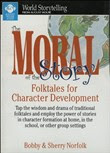
Bobby & Sherry Norfolk did an excellent job with Moral of the story; folktales for character development.  It came out in 1999 and includes sources & bibliographies from the '80s and '90s for specific character education issues, making them easy to either borrow or buy.  There are stories grouped by theme on values in the book.  Added stories on the topics are in the bibliography of stories recommended by educators and storytellers.  A few of those stories may be older, but are definitely standard material to find.  There's even an abridged one hour audio version of six of the stories with the lively telling by the Norfolks, showing "that character education, using storytelling and folktales from cultures around the world, can be fun, enjoyable, non-didactic, and remarkable effective."

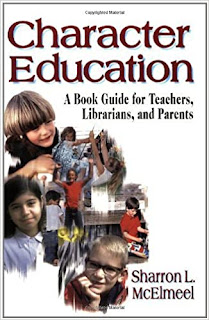
A similar book is Character education : a book guide for teachers, librarians, and parents

by Sharron L. McElmeel written in 2002 and available as either an eBook or paperback.  School Library Journal's review states: 

This useful tool is organized in 17 chapters with each one focusing on different character traits such as flexibility, initiative, humility, and patience. Each chapter begins with a definition of the term and lists several books that range in age appropriateness. A brief summary of the book is followed by discussion/activity notes, a list of related traits/curricular themes, and suggested collaborative readings. Relevant quotes from a variety of well-known authors and others are interspersed throughout. This book stands out from others of its type because of its excellent introduction that talks about character education in general, specifics related to the home and classroom, as well as a consideration of various formats and genres; its brevity that makes it a useful planning resource without being overwhelming; and its thorough index of titles, authors, and concepts. A boon for librarians as well as for parents who are homeschooling or organizing group projects.

Both those books are given with Amazon links, but are available beyond that omnipresent source, too.

Searching further

Something more likely to be found only in a library are Storytellers Sourcebook: A Subject, Title, and Motif Index to Folklore Collections for Children and its sequel, Storyteller's Sourcebook, 1983-1999  by Margaret Read MacDonald.  She worked on the sequel with Brian W. Sturm.  I asked her if there would be a 21st century version and she said it wasn't economically worthwhile with internet searching the way it is.  <SIGH!>  The subjects indexed go waaaaay beyond character education, but certainly includes the various topics.  If your local library doesn't have the books, ask the librarian to locate the nearest library which owns them.

Another library resource would be the various volumes of the many years of Index to Fairy Tales.  The indexers vary over the years and the title may change slightly.  That link is to the HathiTrust online versions up through 1952. The original 1915 volume is separate.  There's also limited, search only, versions of the later volumes: 1949-1972; 1973-1977; 1978-1986; 1987-1992 with significant pre-1987 titles not previous indexed.  Initial indexing didn't go beyond listing story titles so you may need to be creative in your hunting.  The series didn't begin to check subjects until the 1949-1972 edition, but the earlier volumes are good for Public Domain material.  The ability to search these online may save a trip to a library.  

Even more online resources

A resource for members of the National Storytelling Network is GREENWOOD’S WORLD FOLKLORE AND FOLKLIFE RESOURCE & DATABASE GUIDE -- Only available through institutions, such as libraries or schools…AND NSN!  It's updated monthly, covering "holidays, festivals, language, stories, and fairy tales, proverbs, food ways, and folk remedies that define our society and our place within it."  All content is fully-indexed and cross-searchable.

Internet Archive also offers the Wayback Machine to locate websites no longer "live" on the internet.  For many years on the storytellers email list, Storytell, storytellers could ask a question and have the answers saved at Story-Lovers - http://www.story-lovers.com/, but it is now only accessible through the Wayback Machine.  The late Jackie Baldwin's wonderful site lives on there, fully searchable manually (the Google search doesn't work), at https://archive.org/ .  It's not easy, but go to Story-lovers.com snapshot for October 22 2016  and you can click on SOS: Searching Out Stories to scroll down through the many story topics and click on the story topic that interests you. 

Storytell, is now hosted by the National Storytelling Network.  Unlike the Greenwood database, which is only available to members, anyone may join that email list via the link.  Once subscribed you not only receive the emails, but can sign in and access the archive which currently runs from the end of January 2016 through the present.  The archive isn't as easy to use as SOS: Searching Out Stories, but online searching is a skill worth developing if you need to find stories.  As a list member you can also add to the discussions including asking for other members' suggestions.

(Here on this blog you may find a lot using its sidebar.)

What about making a recording or reprinting?

Use caution in reprinting or recording a story beyond the current guaranteed year. . . for 2022 on January 1 Public Domain will be available 1926 and earlier for U.S. works.  Beyond that you need to be certain if a work was renewed.  Stanford's online database of renewals lets you check up through 1963. After that renewal was automatic.  Beyond 2022 the years will continue to have Public Domain Days of free access.  All of this is U.S. copyright & varies around the world, but that Public Domain Review link mentions a bit of how to deal with other countries.  

I'm not a lawyer (although I have played one in an Agatha Christie mystery and was murdered!), but know of other copyright resources if you need them.  Don't get me started on my rant about the need for Public Domain and how copyright has gone beyond what it should be!!!

Final thoughts

Let's return to the Oregon resource's discussion of this topic: 

The method which it is designed should be followed in carrying out this work is the indirect method. The teacher should read or tell the story to the children without any direct attempt to enforce the moral. Let the child do his own moralizing. He is perfectly capable of it, and that which he does for himself is far more effective than that which the teacher does for him. Of course, it is vital that he should grasp the point of the story. If he fails to do so at first, tactful questioning will bring the moral lesson out, but by all means "preaching" should be avoided. It is best that the child should not know that the story is being presented to him for any ulterior purpose. Psychologists have formulated the law that the power of normal suggestion varies inversely with the extent to which its purpose is definitely revealed. Someone has said: "The mother who says to her child, 'Why don't you go out on the lawn and see how many dandelions you can pick?' is likely to secure a period of privacy, but if she adds, 'so that I can be alone for a little while,' the result will not be the same."

Happy telling . . . try change through storytelling, it can be fun!