Tell me if you have a topic you'd like to see. (Contact: LoiS-sez@LoiS-sez.com .)
Please also let others know about this site.
Showing posts with label monkeys. Show all posts

Friday, September 5, 2025

Babbitt - The Penny-Wise Monkey - Keeping the Public in Public Domaihn

Like many with a bit of change in my pocket, I've been thinking about the coming demise of the penny. Then I found this 


kenr2155
To give credit to the artist I tried to find a bit more about The Unknown Punster. It looks as if he (Ken R 2155) hangs out on Pinterest

I sometimes change the common saying that puns are the lowest form of humor. Puns are the LoiS form of humor!

Possibly I should join The Unknown Punster's 1,500 followers.  

So many sayings about pennies have been part of our culture. Looking through folk literature I found a very appropriate (and timely!) story that fits the "penny wise/pound foolish" idea. Will future translations from the Sanskrit need to change the title?

THE PENNY-WISE MONKEY

Once upon a time the king of a large and rich country gathered together his army to take a faraway little country. The king and his soldiers marched all morning long and then went into camp in the forest.

When they fed the horses they gave them some peas to eat. One of the Monkeys living in the forest saw the peas and jumped down to get some of them. He filled his mouth and hands with them, and up into the tree he went again, and sat down to eat the peas.

As he sat there eating the peas, one pea fell from his hand to the ground. At once the greedy Monkey dropped all the peas he had in his hands, and ran down to hunt for the lost pea. But he could not find that one pea. He climbed up into his tree again, and sat still looking very glum. "To get more, I threw away what I had," he said to himself.

The king had watched the Monkey, and he said to himself: "I will not be like this foolish Monkey, who lost much to gain a little. I will go back to my own country and enjoy what I now have."

So he and his men marched back home. 

***

Ellen C. Babbitt's More Jataka Tales was the source of that and her first book of Jataka Tales with her translation from the Sanskrit of early Buddhist fables is equally good. 

Her Foreword to the second book gives even more background: The Jataka tales, regarded as historic in the Third Century B. C., are the oldest collection of folk-lore extant. They come down to us from that dim far-off time when our forebears told tales around the same hearth fire on the roof of the world. Professor Rhys Davids speaks of them as "a priceless record of the childhood of our race. The same stories are found in Greek, Latin, Arabic, Persian, and in most European languages. The Greek versions of the Jataka tales were adapted and ascribed to the famous storyteller, Aesop, and under his name handed down as a continual feast for the children in the West,--tales first invented to please and instruct our far-off cousins in the East." Here East, though East, meets West!  

Whether it's a penny or inflated to a nickel for your thoughts, it's a story with wisdom worth sharing. 

******************

This is part of a series of postings of stories under the category, “Keeping the Public in Public Domain.” The idea behind Public Domain was to preserve our cultural heritage after the authors and their immediate heirs were compensated. I feel strongly current copyright law delays this intent on works of the 20th century. My own library of folklore includes so many books within the Public Domain I decided to share stories from them. I hope you enjoy discovering them.

At the same time, my own involvement in storytelling regularly creates projects requiring research as part of my sharing stories with an audience.  Whenever that research needs to be shown here, the publishing of Public Domain stories will not occur that week.  This is a return to my regular posting of a research project here.  (Don't worry, this isn't dry research, my research is always geared towards future storytelling to an audience.)  Response has convinced me that "Keeping the Public in Public Domain" should continue along with my other postings as often as I can manage it.

See the sidebar for other Public Domain story resources I recommend on the page “Public Domain Story Resources."


Saturday, February 13, 2016

Hearn/Chamberlain - The Silly Jelly-Fish - Keeping the Public in Public Domain


2016 Chinese Monkey YearThe Chinese New Year started February 8 for 2016 with the Year of the Monkey. 

Went looking for an appropriate story and was surprised to find Lafcadio Hearn wrote one complete with not only a monkey, but dragons, and a pourquois tale of how the jellyfish became the way it is.  Went looking for it and the Internet Archive had the story as written in English by Basil Hall Chamberlain in Kobunsha's Japanese fairy tale series -- no. 13.  If you go to Google Books, however, you will see the exact same text in Hearn's Japanese Fairy Tales, pp. 36-41. Who wrote it?  My bet is on Hearn.

Leave it to a tricky monkey to fool everyone.  This is essentially the story told in India as The Monkey's Heart where a monkey fools a crocodile.  


The classic Index to Fairy Tales by Mary Huse Eastman puts the story in many Public Domain volumes by many authors of the late 19th and early 20th century starting with Hearn, but does not mention Chamberlain.  I've many of them, but they and the Google book by Hearn miss the lovely illustrations found on the Internet Archive edition attributed to Chamberlain, which is also Public Domain, so it would be as silly as a jelly-fish to omit them.  The MARC record doesn't tell who did the illustrations, possibly Chamberlain?  It only says they are hand-colored and "Printed on one side of double leaves of crepe paper, folded in the traditional Japanese style."  It does claim "told in English by B. H. Chamberlain." To make the illustrations look right, I tried to put two side by side, but the software for this blog isn't permitting it even when I keep them smaller.  At least this makes the text and illustrations more legible since I can reproduce them larger for you. 


So Monkey had his fun with the jelly-fish and us, keeping us guessing if Lafcadio Hearn did indeed write "The Silly Jelly-Fish" or Chamberlain.  The story was quite popular so you may enjoy tracking down more than one version.  Here are some other Public Domain versions of the tale: Griffis - "Jellyfish Takes a Journey" in Green Willow; Lang - "The Monkey and the Jelly-Fish" in both his Violet Fairy Book and another less common book called Twelve Huntsmen and Other Stories; Ozaki - "Jelly Fish and the Monkey" in Japanese Fairy Book; Singleton - "Silly Jelly Fish" in Wild Flower Fairy Book; Wiggin and Smith - "Silly Jelly Fish" in Tales of Laughter.  To find the Indian versions about the crocodile, there are fewer, but my favorite is Babbitt's "Monkey and the Crocodile" in Jataka Tales.

Here are a few illustrations from some of those versions:  the first three are in Yei Theodora Ozaki's Japanese Fairy Book and fit the story above


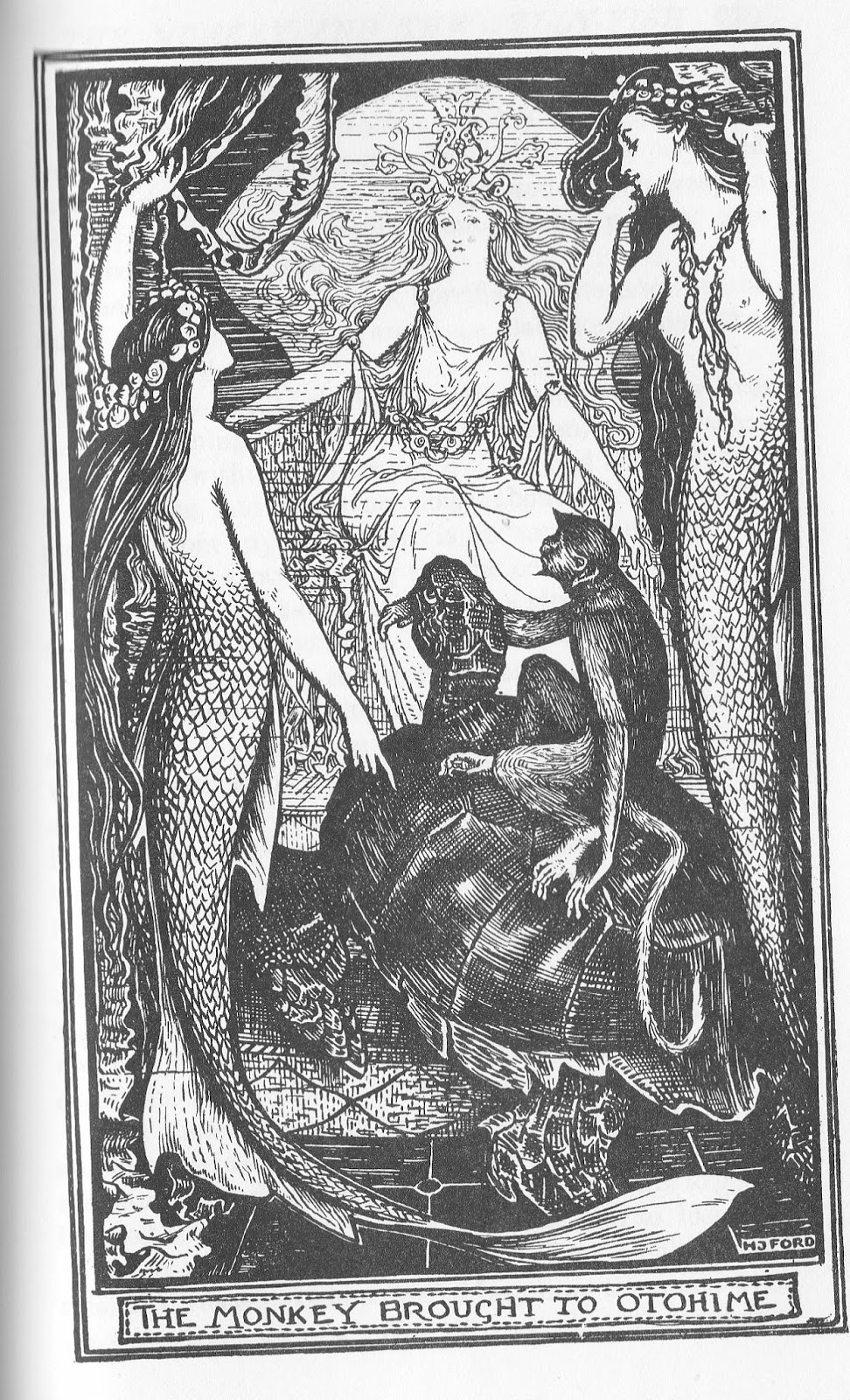
the last is from Andrew Lang's Violet Fairy Book and is by H.J.Ford -- notice the story is clearly very different, for example there are no dragons, so you might want to compare his "The Monkey and the Jelly-Fish."
So Happy New Year, either the Chinese Year of the Monkey or 2016.
******************
This is part of a series of postings of stories under the category, "Keeping the Public in Public Domain."  The idea behind Public Domain was to preserve our cultural heritage after the authors and their immediate heirs were compensated.  I feel strongly current copyright law delays this intent on works of the 20th century.  My own library of folklore includes so many books within the Public Domain I decided to share stories from them.  I hope you enjoy discovering new stories.  


At the same time, my own involvement in storytelling regularly creates projects requiring research as part of my sharing stories with an audience.  Whenever that research needs to be shown here, the publishing of Public Domain stories will not occur that week.  This is a return to my regular posting of a research project here.  (Don't worry, this isn't dry research, my research is always geared towards future storytelling to an audience.)  Response has convinced me that "Keeping the Public in Public Domain" should continue along with my other postings as often as I can manage it.  


There are many online resources for Public Domain stories, none for folklore is as ambitious as fellow storyteller, Yoel Perez's database, Yashpeh, the International Folktales Collection.  I recommended it earlier and want to continue to do so.  He has just loaded Stith Thompson's Motif Index into his server as a database so one can search the whole 6 volumes for whatever word or expression he likes by pressing one key. http://folkmasa.org/motiv/motif.htm

He also loaded to his server the doctorate thesis of Prof. Dov Noy (Neunan) "Motif-index of Talmudic-Midrahic literature" Indiana University, 1954, as a PDF file.
in the hope that some of you would make use of it.

You can see why that is a site I recommend to you.

Have fun discovering even more stories!