Tell me if you have a topic you'd like to see. (Contact: LoiS-sez@LoiS-sez.com .)
Please also let others know about this site.
Showing posts with label Scottish folklore. Show all posts

Friday, August 8, 2025

Retelling the Legend of the Thistle Saving Scotland from Viking Attack

https://img.freepik.com

While at the 176th annual St. Andrews Society of Detroit Highland Games I heard a Scottish legend I'm told is quite well-known. It came because I was talking about the fact that the thistle is Scotland's national flower and emblem. 

Here's a very brief form of the story:

In the mid‑13th century (1263), Vikings under King Haakon IV attempted a nighttime surprise attack near Largs, Ayrshire. They removed their boots to move more quietly. One barefoot Norseman accidentally stepped on a Scottish thistle—its sharp spikes caused him to cry out. The Scots woke, rallied, and defeated the Vikings. 

The version I heard said the Scots intentionally settled in a place where the Vikings would have to pass.

There are many versions of the story and especially about the Battle of Largs, including a narrative poem by John Galt and also The Norwegian Account of Haco's Expedition Against Scotland, A.D. MCCLXIII by Rev. James Johnstone, a historical account translated from Old Icelandic texts and often reprinted or compiled in 19th‑century books.There's even The Order of the Thistle, whose own roots are full of the labyrinth of legend.

There are two sources I like the best:

  1.  Wikipedia article on the Thistle, drop down to Culture and it's all about Symbolism and the Scottish Thistle
  2. Scotclans.org article on The Scottish Thistle which is well-fleshed out without being too much for re-telling. 

While strolling the vendors I saw a men's t-shirt about the "services" a Viking provides. I prowled online and couldn't find it, but did find these two that are fun and possibly worth considering in view of the legend of the thistle.


There's a lo-o-o-omg link for that on Etsy.com, but just go to Etsy and search Viking World Tour. What I like about it is that, while its first countries are England, Wales, France, and Ireland, I notice Scotland is NOT there!


This second shirt is also fun although the script isn't always easy.

Temu.com has it as Men's Viking Laws & Rules Graphic T-Shirt.


 Have fun with the legend and remember the reason why the Thistle is so important to Scotland.

Thursday, August 3, 2023

Douglas - The Mermaid Wife - Keeping the Public in Public Domain

While the title of today's story sounds as if it's about a mermaid, it's actually about a selkie, a creature the Scots tell us are able to turn from seal into human by removing their seal skin.  Many believe the mermaid legend came from viewing seals at a distance.  There are many forms of today's story, but Sir George Douglas gives it probably with just the essentials.  Some editions of his book, Scottish Folk & Fairy Tales, have illustrations, but none for this story.  I've found a pair online that seem to match the story well.

From https://www.bytheway.scot/the-selkie/


from https://www.fanpop.com/clubs/magical-creatures/images/39743633/title/selkie-photo

There are three earlier stories given here for Sir George Douglas and the July 28th, 2015 has the companion story Seal-Catcher's Adventure.  Both are stories I plan to be telling at this year's 174th St. Andrew's Highland Games.  (For that reason this week's blog appears a wee bit early in the hope of seeing you there this Saturday when my blog is normally published.)

************

This is part of a series of postings of stories under the category, "Keeping the Public in Public Domain."  The idea behind Public Domain was to preserve our cultural heritage after the authors and their immediate heirs were compensated.  I feel strongly current copyright law delays this intent on works of the 20th century.  My own library of folklore includes so many books within the Public Domain I decided to share stories from them.  I hope you enjoy discovering new stories.  


At the same time, my own involvement in storytelling regularly creates projects requiring research as part of my sharing stories with an audience.  Whenever that research needs to be shown here, the publishing of Public Domain stories will not occur that week.  This is a return to my regular posting of a research project here.  (Don't worry, this isn't dry research, my research is always geared towards future storytelling to an audience.)  Response has convinced me that "Keeping the Public in Public Domain" should continue along with my other postings as often as I can manage it.

Other Public Domain story resources I recommend-

  • There are many online resources for Public Domain stories, maybe none for folklore is as ambitious as fellow storyteller, Yoel Perez's database, Yashpeh, the International Folktales Collection.  I have long recommended it and continue to do so.  He has loaded Stith Thompson's Motif Index into his server as a database so you can search the whole 6 volumes for whatever word or expression you like by pressing one key. http://folkmasa.org/motiv/motif.htm

  • You may have noticed I'm no longer certain Dr. Perez has the largest database, although his offering the Motif Index certainly qualifies for those of us seeking specific types of stories.  There's another site, FairyTalez claiming to be the largest, with "over 2000 fairy tales, folktales, and fables" and they are "fully optimized for phones, tablets, and PCs", free and presented without ads.
    Between those two sites, there is much for story-lovers, but as they say in infomercials, "Wait, there's more!"

The email list for storytellers, Storytell, discussed Online Story Sources and came up with these additional suggestions:        

         - David K. Brown - http://people.ucalgary.ca/~dkbrown/stories.html

         - Richard Martin - http://www.tellatale.eu/tales_page.html

         - Spirit of Trees - http://spiritoftrees.org/featured-folktales

         - Story-Lovers - http://www.story-lovers.com/ is now only accessible through the Wayback Machine, described below, but the late Jackie Baldwin's wonderful site lives on there, fully searchable manually (the Google search doesn't work), at https://archive.org/ .  It's not easy, but go to Story-lovers.com snapshot for December 22 2016  and you can click on SOS: Searching Out Stories to scroll down through the many story topics and click on the story topic that interests you.

       - World of Tales - http://www.worldoftales.com/ 

 
           - Zalka Csenge Virag - http://multicoloreddiary.blogspot.com doesn't give the actual stories, but her recommendations, working her way through each country on a continent, give excellent ideas for finding new books and stories to love and tell.

     
You're going to find many of the links on these sites have gone down, BUT go to the Internet Archive Wayback Machine to find some of these old links.  Tim's site, for example, is so huge probably updating it would be a full-time job.  In the case of Story-Lovers, it's great that Jackie Baldwin set it up to stay online as long as it did after she could no longer maintain it.  Possibly searches maintained it.  Unfortunately Storytell list member, Papa Joe is on both Tim Sheppard's site and Story-Lovers, but he no longer maintains his old Papa Joe's Traveling Storytelling Show website and his Library (something you want to see!) is now only on the Wayback Machine.  It took some patience working back through claims of snapshots but finally in December of 2006 it appears!

    Somebody as of this writing whose stories can still be found by his website is the late Chuck Larkin - http://chucklarkin.com/stories.html.  I prefer to list these sites by their complete address so they can be found by the Wayback Machine, a.k.a. Archive.org, when that becomes the only way to find them.

You can see why I recommend these to you. 

Have fun discovering even more stories

Friday, July 28, 2023

Grierson - Wee Bannock - Keeping the Public in Public Domain

The Wee Bairns area will re-open next week on August 5 at the 174th St. Andrew's Society of Detroit  Highland Games.  Their stated purpose is

St. Andrew’s Society of Detroit recognizes that children are our future.  To help bring our heritage to them, our Highland Games created an area specially designed for them, Wee Bairns.

Wee Bairns events allow children to gain an understanding of our heritage while having fun.

This is their listing on Michigan Storytelling, the monthly website I manage listing Michigan's storytelling activities.

August 5, 11:00 a.m.-3:00 p.m. EDT (Live Event)
St. Andrew's Society of Detroit and North Oakland County Storytellers (NOCS)  welcome children to the Wee Bairns area of the 174th annual Highland Games for stories of Scottish heritage. Contact the Society at (248) 526-1849 for more information or go to the Wee Bairns section of the Highland Games information at < https://highlandgames.com/wee-bairns/> . The event is at 20501 Newburgh Rd. at Greenmead Historical Park in Livonia. Advance Games tickets are available online. Online and tickets purchased at the gate for the day are $20. Children 12 and under are admitted free. 

I'm pleased that once again I can be one of the storytellers providing "a wee tour of Scotland."

One of those traditional tales I do not intend to tell is the origin of our well-known Gingerbread Boy.  It's a type of tale called a "Chain Story" because of the way it is structured.  Following that link there are activities using this structure to teach predictability and storytelling.

Why wouldn't I tell this story?

There are so many words and professions needing explanation it would slow the story down, starting with "What is a bannock in Scotland?" which Wikipedia explains.  I sometimes say I treat my family like gods...Burnt Offerings.  I don't feel ready to serve my attempts at making a bannock, but could have handouts with recipes.  There are many online.  https://www.cookingnook.com/recipe/bannock/ promises an easy version.  As you might expect, there are probably as many variations as there are those who bake or fry a bannock.

No, what stops me is the very intent of the Wee Bairns as there are all manner of occupations, done in traditional ways each deserving explanation.  Even the author uses footnotes for two of the terms, sending the reader to a glossary.  That means the author gives you the option of going to the Glossary.  I'm going to give the same option to online explanations by adding links to four words I believe need explanations.  As links they are a different color easily giving the option.

Why not offer handouts and explanations?  They slow down the story at an event meant to emphasize entertainment and is for children of all ages.  I'm giving it here both to announce the coming event and for the reader to decide how they want to pursue the story.  (By the way a board book exists -- by its nature meant for the youngest children.  The visual offers the option to understand much better than mere words, but, of course, is not Public Domain.)

Cover by Nour Salem for board book by Elizabeth W. Grierson

This is the story from Elizabeth Grierson's 1910 book of THE SCOTTISH FAIRY BOOK found on Project Gutenberg.  (I recommend her Preface and many of the well-known tales in the book.)

THE WEE BANNOCK

"Some tell about their sweethearts, How they tirled them to the winnock, But I'll tell you a bonnie tale About a guid oatmeal bannock."

There was once an old man and his wife, who lived in a dear little cottage by the side of a burn. They were a very canty and contented couple, for they had enough to live on, and enough to do. Indeed, they considered themselves quite rich, for, besides their cottage and their garden, they possessed two sleek cows, five hens and a cock, an old cat, and two kittens.

The old man spent his time looking after the cows, and the hens, and the garden; while the old woman kept herself busy spinning.

One day, just after breakfast, the old woman thought that she would like an oatmeal bannock for her supper that evening, so she took down her bakeboard, and put on her girdle, and baked a couple of fine cakes, and when they were ready she put them down before the fire to harden.

While they were toasting, her husband came in from the byre, and sat down to take a rest in his great arm-chair. Presently his eyes fell on the bannocks, and, as they looked very good, he broke one through the middle and began to eat it.

When the other bannock saw this it determined that it should not have the same fate, so it ran across the kitchen and out of the door as fast as it could. And when the old woman saw it disappearing, she ran after it as fast as her legs would carry her, holding her spindle in one hand and her distaff in the other.

But she was old, and the bannock was young, and it ran faster than she did, and escaped over the hill behind the house. It ran, and it ran, and it ran, until it came to a large newly thatched cottage, and, as the door was open, it took refuge inside, and ran right across the floor to a blazing fire, which was burning in the first room that it came to.

Now, it chanced that this house belonged to a tailor, and he and his two apprentices were sitting cross-legged on the top of a big table by the window, sewing away with all their might, while the tailor's wife was sitting beside the fire carding lint.

When the wee bannock came trundling across the floor, all three tailors got such a fright that they jumped down from the table and hid behind the Master Tailor's wife.

"Hoot," she said, "what a set of cowards ye be! 'Tis but a nice wee bannock. Get hold of it and divide it between you, and I'll fetch you all a drink of milk."

So she jumped up with her lint and her lint cards, and the tailor jumped up with his great shears, and one apprentice grasped the line measure, while another took up the saucer full of pins; and they all tried to catch the wee bannock. But it dodged them round and round the fire, and at last it got safely out of the door and ran down the road, with one of the apprentices after it, who tried to snip it in two with his shears.

It ran too quickly for him, however, and at last he stopped and went back to the house, while the wee bannock ran on until it came to a tiny cottage by the roadside. It trundled in at the door, and there was a weaver sitting at his loom, with his wife beside him, winding a clue of yarn.

"What's that, Tibby?" said the weaver, with a start as the little cake flew past him.

"Oh!" cried she in delight, jumping to her feet, "'tis a wee bannock. I wonder where it came from?"

"Dinna bother your head about that, Tibby," said her man, "but grip it, my woman, grip it."

But it was not so easy to get hold of the wee bannock. It was in vain that the Goodwife threw her clue at it, and that the Goodman tried to chase it into a corner and knock it down with his shuttle. It dodged, and turned, and twisted, like a thing bewitched, till at last it flew out at the door again, and vanished down the hill, "for all the world," as the old woman said, "like a new tarred sheep, or a daft cow."

In the next house that it came to it found the Goodwife in the kitchen, kirning. She had just filled her kirn, and there was still some cream standing in the bottom of her cream jar.

"Come away, little bannock," she cried when she saw it. "Thou art come in just the nick of time, for I am beginning to feel hungry, and I'll have cakes and cream for my dinner."

But the wee bannock hopped round to the other side of the kirn, and the Goodwife after it. And she was in such a hurry that she nearly upset the kirn; and by the time that she had put it right again, the wee bannock was out at the door and half-way down the brae to the mill.

The miller was sifting meal in the trough, but he straightened himself up when he saw the little cake.

"It's a sign of plenty when bannocks are running about with no one to look after them," he said; "but I like bannocks and cheese, so just come in, and I will give thee a night's lodging."

But the little bannock had no wish to be eaten up by the miller, so it turned and ran out of the mill, and the miller was so busy that he did not trouble himself to run after it.

After this it ran on, and on, and on, till it came to the smithy, and it popped in there to see what it could see.

The smith was busy at the anvil making horse-shoe nails, but he looked up as the wee bannock entered.

"If there be one thing I am fond of, it is a glass of ale and a well-toasted cake," he cried. "So come inbye here, and welcome to ye."

But as soon as the little bannock heard of the ale, it turned and ran out of the smithy as fast as it could, and the disappointed smith picked up his hammer and ran after it. And when he saw that he could not catch it, he flung his heavy hammer at it, in the hope of knocking it down, but, luckily for the little cake, he missed his aim.

After this the bannock came to a farmhouse, with a great stack of peats standing at the back of it. In it went, and ran to the fireside. In this house the master had all the lint spread out on the floor, and was cloving[1] it with an iron rod, while the mistress was heckling[2] what he had already cloven.

"Oh, Janet," cried the Goodman in surprise, "here comes in a little bannock. It looks rare and good to eat. I'll have one half of it."

"And I'll have the other half," cried the Goodwife. "Hit it over the back with your cloving-stick, Sandy, and knock it down. Quick, or it will be out at the door again."

But the bannock played "jook-about," and dodged behind a chair. "Hoot!" cried Janet contemptuously, for she thought that her husband might easily have hit it, and she threw her heckle at it.

But the heckle missed it, just as her husband's cloving-rod had done, for it played "jook-about" again, and flew out of the house.

This time it ran up a burnside till it came to a little cottage standing among the heather.

Here the Goodwife was making porridge for the supper in a pot over the fire, and her husband was sitting in a corner plaiting ropes of straw with which to tie up the cow.

"Oh, Jock! come here, come here," cried the Goodwife. "Thou art aye crying for a little bannock for thy supper; come here, histie, quick, and help me to catch it."

"Ay, ay," assented Jock, jumping to his feet and hurrying across the little room. "But where is it? I cannot see it."

"There, man, there," cried his wife, "under that chair. Run thou to that side; I will keep to this."

So Jock ran into the dark corner behind the chair; but, in his hurry, he tripped and fell, and the wee bannock jumped over him and flew laughing out at the door.

Through the whins and up the hillside it ran, and over the top of the hill, to a shepherd's cottage on the other side.

The inmates were just sitting down to their porridge, and the Goodwife was scraping the pan.

"Save us and help us," she exclaimed, stopping with the spoon half-way to her mouth. "There's a wee bannock come in to warm itself at our fireside."

"Sneck the door," cried the husband, "and we'll try to catch it. It would come in handy after the porridge."

But the bannock did not wait until the door was sneckit. It turned and ran as fast as it could, and the shepherd and his wife and all the bairns ran after it, with their spoons in their hands, in hopes of catching it.

And when the shepherd saw that it could run faster than they could, he threw his bonnet at it, and almost struck it; but it escaped all these dangers, and soon it came to another house, where the folk were just going to bed.

The Goodman was half undressed, and the Goodwife was raking the cinders carefully out of the fire.

"What's that?" said he, "for the bowl of brose that I had at supper-time wasna' very big."

"Catch it, then," answered his wife, "and I'll have a bit, too. Quick! quick! Throw your coat over it or it will be away."

So the Goodman threw his coat right on the top of the little bannock, and almost managed to smother it; but it struggled bravely, and got out, breathless and hot, from under it. Then it ran out into the grey light again, for night was beginning to fall, and the Goodman ran out after it, without his coat. He chased it and chased it through the stackyard and across a field, and in amongst a fine patch of whins. Then he lost it; and, as he was feeling cold without his coat, he went home.

As for the poor little bannock, it thought that it would creep under a whin bush and lie there till morning, but it was so dark that it never saw that there was a fox's hole there. So it fell down the fox's hole, and the fox was very glad to see it, for he had had no food for two days.

"Oh, welcome, welcome," he cried; and he snapped it through the middle with his teeth, and that was the end of the poor wee bannock.

And if a moral be wanted for this tale, here it is: That people should never be too uplifted or too cast down over anything, for all the good folk in the story thought that they were going to get the bannock, and, lo and behold! the fox got it after all.

Footnotes to the glossary

1 - Cloving  separating lint from its stalk

2 - Heckle   to comb

***

Our Gingerbread Boy versions clearly descends from this Scottish story.  There have been an even dozen stories before this with the label of Scottish folklore.  This makes the 13th with my own decision and rationale as to why I won't tell it. . . with the possible exception of in a classroom seeking in-depth look into Scottish folklore and occupations of the past.

***************************

This is part of a series of postings of stories under the category, "Keeping the Public in Public Domain."  The idea behind Public Domain was to preserve our cultural heritage after the authors and their immediate heirs were compensated.  I feel strongly current copyright law delays this intent on works of the 20th century.  My own library of folklore includes so many books within the Public Domain I decided to share stories from them.  I hope you enjoy discovering new stories.  


At the same time, my own involvement in storytelling regularly creates projects requiring research as part of my sharing stories with an audience.  Whenever that research needs to be shown here, the publishing of Public Domain stories will not occur that week.  This is a return to my regular posting of a research project here.  (Don't worry, this isn't dry research, my research is always geared towards future storytelling to an audience.)  Response has convinced me that "Keeping the Public in Public Domain" should continue along with my other postings as often as I can manage it.

Other Public Domain story resources I recommend-

  • There are many online resources for Public Domain stories, maybe none for folklore is as ambitious as fellow storyteller, Yoel Perez's database, Yashpeh, the International Folktales Collection.  I have long recommended it and continue to do so.  He has loaded Stith Thompson's Motif Index into his server as a database so you can search the whole 6 volumes for whatever word or expression you like by pressing one key. http://folkmasa.org/motiv/motif.htm

  • You may have noticed I'm no longer certain Dr. Perez has the largest database, although his offering the Motif Index certainly qualifies for those of us seeking specific types of stories.  There's another site, FairyTalez claiming to be the largest, with "over 2000 fairy tales, folktales, and fables" and they are "fully optimized for phones, tablets, and PCs", free and presented without ads.
    Between those two sites, there is much for story-lovers, but as they say in infomercials, "Wait, there's more!"

The email list for storytellers, Storytell, discussed Online Story Sources and came up with these additional suggestions:        

         - David K. Brown - http://people.ucalgary.ca/~dkbrown/stories.html

         - Richard Martin - http://www.tellatale.eu/tales_page.html

         - Spirit of Trees - http://spiritoftrees.org/featured-folktales

         - Story-Lovers - http://www.story-lovers.com/ is now only accessible through the Wayback Machine, described below, but the late Jackie Baldwin's wonderful site lives on there, fully searchable manually (the Google search doesn't work), at https://archive.org/ .  It's not easy, but go to Story-lovers.com snapshot for December 22 2016  and you can click on SOS: Searching Out Stories to scroll down through the many story topics and click on the story topic that interests you.

       - World of Tales - http://www.worldoftales.com/ 

 
           - Zalka Csenge Virag - http://multicoloreddiary.blogspot.com doesn't give the actual stories, but her recommendations, working her way through each country on a continent, give excellent ideas for finding new books and stories to love and tell.

     
You're going to find many of the links on these sites have gone down, BUT go to the Internet Archive Wayback Machine to find some of these old links.  Tim's site, for example, is so huge probably updating it would be a full-time job.  In the case of Story-Lovers, it's great that Jackie Baldwin set it up to stay online as long as it did after she could no longer maintain it.  Possibly searches maintained it.  Unfortunately Storytell list member, Papa Joe is on both Tim Sheppard's site and Story-Lovers, but he no longer maintains his old Papa Joe's Traveling Storytelling Show website and his Library (something you want to see!) is now only on the Wayback Machine.  It took some patience working back through claims of snapshots but finally in December of 2006 it appears!

    Somebody as of this writing whose stories can still be found by his website is the late Chuck Larkin - http://chucklarkin.com/stories.html.  I prefer to list these sites by their complete address so they can be found by the Wayback Machine, a.k.a. Archive.org, when that becomes the only way to find them.

You can see why I recommend these to you. 

Have fun discovering even more stories

Friday, December 30, 2022

O'Donnell - The Inextinguishable Candle of the Old White House - Keeping the Public in Public Domain


2022 is nearly over, but will, of course continue to haunt us.  I went looking for stories to celebrate the Scottish celebration of Hogmanay since it will be a long time until this Scottish New Year's Eve celebration returns on my Saturday schedule of posting here.  That link can give you a brief Wikipedia overview of it.  Couldn't find stories specifically about it, but the above banner is from  Spirithalloween.com's blog which gives two quick New Year's Eve ghost stories and links to even more.  

Neither are specifically Scottish and I really wanted that for Hogmanay.  Their second ghost story, however, is about a ghostly Lady in White.  There are many ghost stories featuring a Lady in White, including a Scottish one in Elliott O'Donnell's Scottish Ghost Stories and he said "Like most European countries, Scotland claims its share of phantasms in the form of 'White Ladies.' " O'Donnell also mentions "Sir Walter Scott's 'White Lady of Avenel,' and there are endless others, both in reality and fiction."  I was tempted to post O'Donnell's fifteenth case -- he calls each story a Case -- "The White Lady of Rownam Avenue, Near Stirling", especially with my own Stirling family roots.  Tempted, yes, but preferred the book's opening story or case, as it occurs around party time.  The story's opening and closing has long unbroken text, setting up and later concluding the story.  O'Donnell's opening case is actually two in one, but for partying let's skip to 

THE INEXTINGUISHABLE CANDLE OF THE OLD WHITE HOUSE

There was once a house, known as "The Old White House," that used to stand by the side of the road, close to where you say the horse first took fright. Some people of the name of Holkitt, relations of dear old Sir Arthur Holkitt, and great friends of ours, used to live there. The house, it was popularly believed, had been built on the site of an ancient burial-ground. Every one used to say it was haunted, and the Holkitts had great trouble in getting servants. The appearance of the haunted house did not belie its reputation, for its grey walls, sombre garden, gloomy hall, dark passages and staircase, and sinister-looking attics could not have been more thoroughly suggestive of all kinds of ghostly phenomena. Moreover, the whole atmosphere of the place, no matter how hot and bright the sun, was cold and dreary, and it was a constant source of wonder to every one how Lady Holkitt could live there. She was, however, always cheerful, and used to tell me that nothing would induce her to leave a spot dear to so many generations of her family, and associated with the happiest recollections in her life. She was very fond of company, and there was scarcely a week in the year in which she had not some one staying with her. I can only remember her as widow, her husband, a major in the Gordon Highlanders, having died in India before I was born. She had two daughters, Margaret and Alice, both considered very handsome, but some years older than I. This difference in age, however, did not prevent our being on very friendly terms, and I was constantly invited to their house—in the summer to croquet and archery, in the winter to balls. Like most elderly ladies of that period, Lady Holkitt was very fond of cards, and she and my mother used frequently to play bezique and cribbage, whilst the girls and I indulged in something rather more frivolous. On those occasions the carriage always came for us at ten, since my mother, for some reason or other—I had a shrewd suspicion it was on account of the alleged haunting—would never return home after that time. When she accepted an invitation to a ball, it was always conditionally that Lady Holkitt would put us both up for the night, and the carriage used, then, to come for us the following day, after one o'clock luncheon. I shall never forget the last time I went to a dance at "The Old White House," though it is now rather more than fifty years ago. My mother had not been very well for some weeks, having, so she thought, taken cold internally. She had not had a doctor, partly because she did not feel ill enough, and partly because the only medical man near us was an apothecary, of whose skill she had a very poor opinion. My mother had quite made up her mind to accompany me to the ball, but at the last moment, the weather being appalling, she yielded to advice, and my aunt Norah, who happened to be staying with us at the time, chaperoned me instead. It was snowing when we set out, and as it snowed all through the night and most of the next day, the roads were completely blocked, and we had to remain at "The Old White House" from Monday evening till the following Thursday. Aunt Norah and I occupied separate bedrooms, and mine was at the end of a long passage away from everybody else's. Prior to this my mother and I had always shared a room—the only really pleasant one, so I thought, in the house—overlooking the front lawn. But on this occasion there being a number of visitors, belated like ourselves, we had to squeeze in wherever we could; and as my aunt and I were to have separate rooms (my aunt liking a room to herself), it was natural that she should be allotted the largest and most comfortable. Consequently, she was domiciled in the wing where all the other visitors slept, whilst I was forced to retreat to a passage on the other side of the house, where, with the exception of my apartment, there were none other but lumber-rooms. All went smoothly and happily, and nothing interrupted the harmony of our visit, till the night before we returned home. We had had supper—our meals were differently arranged in those days—and Margaret and I were ascending the staircase on our way to bed, when Alice, who had run upstairs ahead of us, met us with a scared face.

"Oh, do come to my room!" she cried. "Something has happened to Mary." (Mary was one of the housemaids.)

We both accompanied her, and, on entering her room, found Mary seated on a chair, sobbing hysterically. One only had to glance at the girl to see that she was suffering from some very severe shock. Though normally red-cheeked and placid, in short, a very healthy, stolid creature, and the last person to be easily perturbed, she was now without a vestige of colour, whilst the pupils of her eyes were dilated with terror, and her entire body, from the crown of her head to the soles of her feet, shook as if with ague. I was immeasurably shocked to see her.

"Why, Mary," Margaret exclaimed, "whatever is the matter? What has happened?"

"It's the candle, miss," the girl gasped, "the candle in Miss Trevor's room. I can't put it out."

"You can't put it out, why, what nonsense!" Margaret said. "Are you mad?"

"It is as true as I sit here, miss," Mary panted. "I put the candle on the mantelpiece while I set the room to rights, and when I had finished and came to blow it out, I couldn't. I blew, and blew, and blew, but it hadn't any effect, and then I grew afraid, miss, horribly afraid," and here she buried her face in her hands, and shuddered. "I've never been frightened like this before, miss," she returned slowly, "and I've come away and left the candle burning."

"How absurd of you," Margaret scolded. "We must go and put it out at once. I have a good mind to make you come with us, Mary—but there! Stay where you are, and for goodness' sake stop crying, or every one in the house will hear you."

So saying, Margaret hurried off,—Alice and I accompanying her,—and on arriving outside my room, the door of which was wide open, we perceived the lighted candle standing in the position Mary had described. I looked at the girls, and perceived, in spite of my endeavours not to perceive it, the unmistakable signs of a great fear—fear of something they suspected but dared not name—lurking in the corners of their eyes.

"Who will go first?" Margaret demanded. No one spoke.

"Well then," she continued, "I will," and, suiting the action to the word, she stepped over the threshold. The moment she did so, the door began to close. "This is curious!" she cried. "Push!"

We did; we all three pushed; but, despite our efforts, the door came resolutely to, and we were shut out. Then before we had time to recover from our astonishment, it flew open; but before we could cross the threshold, it came violently to in the same manner as before. Some unseen force held it against us.

"Let us make one more effort," Margaret said, "and if we don't succeed, we will call for help."

Obeying her instructions, we once again pushed. I was nearest the handle, and in some manner,—how, none of us could ever explain,—just as the door opened of its own accord, I slipped and fell inside. The door then closed immediately with a bang, and, to my unmitigated horror, I found myself alone in the room. For some seconds I was spellbound, and could not even collect my thoughts sufficiently to frame a reply to the piteous entreaties of the Holkitts, who kept banging on the door, and imploring me to tell them what was happening. Never in the hideous excitement of nightmare had I experienced such a terror as the terror that room conveyed to my mind. Though nothing was to be seen, nothing but the candle, the light of which was peculiarly white and vibrating, I felt the presence of something inexpressibly menacing and horrible. It was in the light, the atmosphere, the furniture, everywhere. On all sides it surrounded me, on all sides I was threatened—threatened in a manner that was strange and deadly. Something suggesting to me that the source of evil originated in the candle, and that if I could succeed in extinguishing the light I should free myself from the ghostly presence, I advanced towards the mantelpiece, and, drawing in a deep breath, blew—blew with the energy born of desperation. It had no effect. I repeated my efforts; I blew frantically, madly, but all to no purpose; the candle still burned—burned softly and mockingly. Then a fearful terror seized me, and, flying to the opposite side of the room, I buried my face against the wall, and waited for what the sickly beatings of my heart warned me was coming. Constrained to look, I slightly, only very, very slightly, moved round, and there, there, floating stealthily towards me through the air, came the candle, the vibrating, glowing, baleful candle. I hid my face again, and prayed God to let me faint. Nearer and nearer drew the light; wilder and wilder the wrenches at the door. Closer and closer I pressed myself to the wall. And then, then when the final throes of agony were more than human heart and brain could stand, there came the suspicion, the suggestion of a touch—of a touch so horrid that my prayers were at last answered, and I fainted. When I recovered, I was in Margaret's room, and half a dozen well-known forms were gathered round me. It appears that with the collapse of my body on the floor, the door, that had so effectually resisted every effort to turn the handle, immediately flew open, and I was discovered lying on the ground with the candle—still alight—on the ground beside me. My aunt experienced no difficulty in blowing out the refractory candle, and I was carried with the greatest tenderness into the other wing of the house, where I slept that night. Little was said about the incident next day, but all who knew of it expressed in their faces the utmost anxiety—an anxiety which, now that I had recovered, greatly puzzled me. On our return home, another shock awaited me; we found to our dismay that my mother was seriously ill, and that the doctor, who had been sent for from Perth the previous evening, just about the time of my adventure with the candle, had stated that she might not survive the day. His warning was fulfilled—she died at sunset. Her death, of course, may have had nothing at all to do with the candle episode, yet it struck me then as an odd coincidence, and seems all the more strange to me after hearing your account of the bogle that touched your dear father in the road, so near the spot where the Holkitts' house once stood. I could never discover whether Lady Holkitt or her daughters ever saw anything of a superphysical nature in their house; after my experience they were always very reticent on that subject, and naturally I did not like to press it. On Lady Holkitt's death, Margaret and Alice sold the house, which was eventually pulled down, as no one would live in it, and I believe the ground on which it stood is now a turnip field. That, my dear, is all I can tell you.


Let's hear it for electricity!

If you read that Wikipedia link I gave to Elliott O'Donnell, you will find he died at the ripe old age of 93 after a varied career where initially "he travelled in the United States instead, working on a cattle range in Oregon and becoming a policeman during the Chicago Railway Strike of 1894. Returning to England on the SS Elbe, he worked there as a schoolmaster and trained for theatre in London..."  It was his spare time writing occult fantasies that led to his specializing in "what were claimed as true stories of ghosts and hauntings. These were immensely popular, but his flamboyant style and amazing stories suggest that he combined fact with fiction."  While publishing heavily on such matters he became a lecturer and authority on  supernatural affairs and often was asked to solve alleged ghost problems.

If your electrical power goes out, you can always light a candle, but I also hope you can extinguish it.

Happy New Year (and Hogmanay)!

Friday, July 29, 2022

The Highland Games + Johnny Gloke - Joseph Jacobs - Keeping the Public in Public Domain


The Wee Bairns area of the 173rd Highland Games of the St. Andrews Society of Detroit is returning!  It was missing at the 2020 and 2021 Highland Games due to Covid concerns.  It's always in a big open area at Greenmead Historical Village in Livonia so its elimination was surprising.  The intent behind the Wee Bairns area is bringing an understanding of Scottish heritage to children with fun events tailored to them.  

While North Oakland County Storytellers no longer hold meetings, some of us treasure our Scottish heritage and have told stories in the Wee Bairns area for a great many years.  Once again from 10 to 3 on Saturday, August 6, N.O.C.S. will bring it to listeners.  Ten of those stories can be found here under the heading of Scottish Folklore.  That reflects only some of the long history of participation there.  It goes back even further than is shown here.

Today's story comes from Joseph Jacobs, More English Fairy Tales, but don't let that title fool you as Jacobs definitely includes Scottish material.  You may jump down to the story, but if that English connection troubles you, read his discussion of this as part of his Preface to the book: 

Then as to using tales in Lowland Scotch, whereat a Saturday Reviewer, whose identity and fatherland were not difficult to guess, was so shocked. Scots a dialect of English! Scots tales the same as English! Horror and Philistinism! was the Reviewer's outcry. Matter of fact is my reply, which will only confirm him, I fear, in his convictions. Yet I appeal to him, why make a difference between tales told on different sides of the Border? A tale told in Durham or Cumberland in a dialect which only Dr. Murray could distinguish from Lowland Scotch, would on all hands be allowed to be "English." The same tale told a few miles farther North, why should we refuse it the same qualification? A tale in Henderson is English: why not a tale in Chambers, the majority of whose tales are to be found also south of the Tweed?

The truth is, my folk-lore friends and my Saturday Reviewer differ with me on the important problem of the origin of folk-tales. They think that a tale probably originated where it was found. They therefore attribute more importance than I to the exact form in which it is found and restrict it to the locality of birth. I consider the probability to lie in an origin elsewhere: I think it more likely than not that any tale found in a place was rather brought there than born there. I have discussed this matter elsewhere[1] with all the solemnity its importance deserves, and cannot attempt further to defend my position here. But even the reader innocent of folk-lore can see that, holding these views, I do not attribute much anthropological value to tales whose origin is probably foreign, and am certainly not likely to make a hard-and-fast division between tales of the North Countrie and those told across the Border.

[1] See "The Science of Folk Tales and the Problem of Diffusion" in Transactions of the International Folk-Lore Congress, 1891.

Don't know if you bothered to read all of that, but here's "Johnny Gloke" which will start out sounding rather familiar.  I'll give Jacobs' brief Notes and References after it.

Johnny Gloke

Johnny Gloke was a tailor by trade, but like a man of spirit he grew tired of his tailoring, and wished to follow some other path that would lead to honour and fame. But he did not know what to do at first to gain fame and fortune, so for a time he was fonder of basking idly in the sun than in plying the needle and scissors. One warm day as he was enjoying his ease, he was annoyed by the flies alighting on his bare ankles. He brought his hand down on them with force and killed a goodly number of them. On counting the victims of his valour, he was overjoyed at his success; his heart rose to the doing of great deeds, and he gave vent to his feelings in the saying:—

"Well done! Johnny Gloke,
Kilt fifty flies at one stroke."

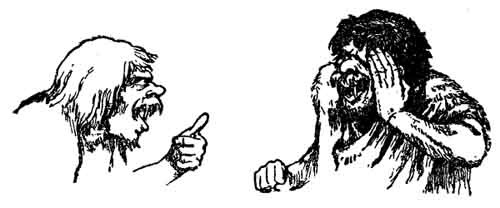
His resolution was now taken to cut out his path to fortune and honour. So he took down from its resting-place a rusty old sword that had belonged to some of his forebears, and set out in search of adventures. After travelling a long way, he came to a country that was much troubled by two giants, whom no one was bold enough to meet, and strong enough to overcome. He was soon told of the giants, and learned that the King of the country had offered a great reward and the hand of his daughter in marriage to the man who should rid his land of this scourge. John's heart rose to the deed, and he offered himself for the service. The great haunt of the giants was a wood, and John set out with his old sword to perform his task. When he reached the wood, he laid himself down to think what course he would follow, for he knew how weak he was compared to those he had undertaken to kill. He had not waited long, when he saw them coming with a waggon to fetch wood for fuel. My! they were big ones, with huge heads and long tusks for teeth. Johnny hid himself in the hollow of a tree, thinking only of his own safety. Feeling himself safe, he peeped out of his hiding-place, and watched the two at work. Thus watching he formed his plan of action. He picked up a pebble, threw it with force at one of them, and struck him a sharp blow on the head. The giant in his pain turned at once on his companion, and blamed him in strong words for hitting him. The other denied in anger that he had thrown the pebble. John now saw himself on the high way to gain his reward and the hand of the King's daughter. He kept still, and carefully watched for an opportunity of striking another blow. He soon found it, and right against the giant's head went another pebble. The injured giant fell on his companion in fury, and the two belaboured each other till they were utterly tired out. They sat down on a log to breathe, rest, and recover themselves.

"...the two belaboured each other till they were utterly tired out."

While sitting, one of them said, "Well, all the King's army was not able to take us, but I fear an old woman with a rope's end would be too much for us now."

"If that be so," said Johnny Gloke, as he sprang, bold as a lion, from his hiding-place, "What do you say to Johnny Gloke with his old roosty sword?" So saying he fell upon them, cut off their heads, and returned in triumph. He received the King's daughter in marriage and for a time lived in peace and happiness. He never told the mode he followed in his dealing with the giants.

Some time after a rebellion broke out among the subjects of his father-in-law. John, on the strength of his former valiant deed, was chosen to quell the rebellion. His heart sank within him, but he could not refuse, and so lose his great name. He was mounted on the fiercest horse that ever saw sun or wind, and set out on his desperate task. He was not accustomed to ride on horseback, and he soon lost all control of his steed. It galloped off at full speed, in the direction of the rebel army. In its wild career it passed under the gallows that stood by the wayside. The gallows was somewhat old and frail, and down it fell on the horse's neck. Still the horse made no stop, but always forward at furious speed towards the rebels. On seeing this strange sight approaching towards them at such a speed they were seized with terror, and cried out to one another, "There comes Johnny Gloke that killed the two giants with the gallows on his horse's neck to hang us all." They broke their ranks, fled in dismay, and never stopped till they reached their homes. Thus was Johnny Gloke a second time victorious. So in due time he came to the throne and lived a long, happy, and good life as king.

***

I'm sure you recognized that story under a different name.  Jacobs addresses that: 

  JOHNNY GLOKE

Source.—Contributed by Mr. W. Gregor to Folk-Lore Journal, vii. I have rechristened "Johnny Glaik" for the sake of the rhyme, and anglicised the few Scotticisms.

Parallels.—This is clearly The Valiant Tailor of the Grimms: "x at a blow" has been bibliographised. (See my List of Incidents in Trans. Folk-Lore Congress, 1892, sub voce.)

Remarks.—How The Valiant Tailor got to Aberdeen one cannot tell, though the resemblance is close enough to suggest a direct "lifting" from some English version of Grimm's Goblins. At the same time it must be remembered that Jack the Giant Killer (see Notes on No. xix.) contains some of the incidents of The Valiant Tailor.

 Hope to see you and Nessie at the Highland Games next week on August 6.


 ****************

This is part of a series of postings of stories under the category, "Keeping the Public in Public Domain."  The idea behind Public Domain was to preserve our cultural heritage after the authors and their immediate heirs were compensated.  I feel strongly current copyright law delays this intent on works of the 20th century.  My own library of folklore includes so many books within the Public Domain I decided to share stories from them.  I hope you enjoy discovering new stories.  


At the same time, my own involvement in storytelling regularly creates projects requiring research as part of my sharing stories with an audience.  Whenever that research needs to be shown here, the publishing of Public Domain stories will not occur that week.  This is a return to my regular posting of a research project here.  (Don't worry, this isn't dry research, my research is always geared towards future storytelling to an audience.)  Response has convinced me that "Keeping the Public in Public Domain" should continue along with my other postings as often as I can manage it.

Other Public Domain story resources I recommend-

  • There are many online resources for Public Domain stories, maybe none for folklore is as ambitious as fellow storyteller, Yoel Perez's database, Yashpeh, the International Folktales Collection.  I have long recommended it and continue to do so.  He has loaded Stith Thompson's Motif Index into his server as a database so you can search the whole 6 volumes for whatever word or expression you like by pressing one key. http://folkmasa.org/motiv/motif.htm

  • You may have noticed I'm no longer certain Dr. Perez has the largest database, although his offering the Motif Index certainly qualifies for those of us seeking specific types of stories.  There's another site, FairyTalez claiming to be the largest, with "over 2000 fairy tales, folktales, and fables" and they are "fully optimized for phones, tablets, and PCs", free and presented without ads.
    Between those two sites, there is much for story-lovers, but as they say in infomercials, "Wait, there's more!"

The email list for storytellers, Storytell, discussed Online Story Sources and came up with these additional suggestions:        

         - David K. Brown - http://people.ucalgary.ca/~dkbrown/stories.html

         - Richard Martin - http://www.tellatale.eu/tales_page.html

         - Spirit of Trees - http://spiritoftrees.org/featured-folktales

         - Story-Lovers - http://www.story-lovers.com/ is now only accessible through the Wayback Machine, described below, but the late Jackie Baldwin's wonderful site lives on there, fully searchable manually (the Google search doesn't work), at https://archive.org/ .  It's not easy, but go to Story-lovers.com snapshot for October 22 2016  and you can click on SOS: Searching Out Stories to scroll down through the many story topics and click on the story topic that interests you.

       - World of Tales - http://www.worldoftales.com/ 

 
           - Zalka Csenge Virag - http://multicoloreddiary.blogspot.com doesn't give the actual stories, but her recommendations, working her way through each country on a continent, give excellent ideas for finding new books and stories to love and tell.

     
You're going to find many of the links on these sites have gone down, BUT go to the Internet Archive Wayback Machine to find some of these old links.  Tim's site, for example, is so huge probably updating it would be a full-time job.  In the case of Story-Lovers, it's great that Jackie Baldwin set it up to stay online as long as it did after she could no longer maintain it.  Possibly searches maintained it.  Unfortunately Storytell list member, Papa Joe is on both Tim Sheppard's site and Story-Lovers, but he no longer maintains his old Papa Joe's Traveling Storytelling Show website and his Library (something you want to see!) is now only on the Wayback Machine.  It took some patience working back through claims of snapshots but finally in December of 2006 it appears!

    Somebody as of this writing whose stories can still be found by his website is the late Chuck Larkin - http://chucklarkin.com/stories.html.  I prefer to list these sites by their complete address so they can be found by the Wayback Machine, a.k.a. Archive.org, when that becomes the only way to find them.

You can see why I recommend these to you. 

Have fun discovering even more stories

Saturday, April 18, 2020

Shelter in Place - week 4 / Miller - Trapping the Plague - Keeping the Public in Public Domain

Plagues and pestilences have happened throughout history.  The quote “Those who forget history are condemned to repeat it” is attributed to the American philosopher George Santayana and it can be accurately quoted as “Those who cannot remember the past are condemned to repeat it” as stated in his work, The Life of Reason: Reason in Common Sense.  I went looking for stories and, other than the very dark "Masque of the Red Death" by Edgar Allen Poe, it was interesting how little I could find and, of course, even less that was Public Domain.

I was able to find an interesting story from an area that fits the title of the Undiscovered Scotland website.  Cromarty has a landlocked harbor that had industrial factories for brewing, iron, lace, cloth, and rope until road and rail routes passed it by, leaving a conservation site and what Encyclopedia Britannica describes as "perhaps the best preserved 18th-century town in the Highlands."  Cromarty remembers its most famous citizen, Hugh Miller, with two buildings.  The National Trust for Scotland operates his birthplace, the only thatched cottage in the town, as a museum and there's also the Hugh Miller Institute which Undiscovered Scotland calls "a grand, if a little out of place, library presented to the town by the Carnegie Institute in 1903."

Hugh Miller is described by Wikipedia as "a self-taught Scottish geologist and writer, folklorist[1] and an evangelical Christian.[2]"   Let's leave his geological writings to the scientist and look at the first book he ever wrote, Scenes and Legends of the North of Scotland, or The Traditional History of Cromarty.  It's easy to picture his tale of the central part of the church-yard of the little Scottish Highland town of Nigg (current population said to be 156).  The town is small, but the Wikipedia article about it opens with:
Nigg (from the Scottish Gaelic: An Neag meaning "the notch", referring to a feature of the hills above the parish church) is a village and parish in Easter Ross, administered by The Highland Council. It lies on the north shore of the entrance to the Cromarty Firth.
This is 2d attempt at posting Wikimedia Commons photo
Nigg Old Church and churchyard.
Rosskmaxwell - Own work

 Nigg Old Church

The present parish church is an 18th-century building on an early Christian site dating back to at least the 8th century. The Nigg Stone, one of the most elaborate stone monuments of early medieval western Europe,[1] is preserved in a room at the west end of the church. This late 8th century Pictish cross-slab formerly stood in the churchyard, but was moved indoors for preservation in recent years.
The nearby manse is one of the oldest to survive in Scotland, dating back to the first half of the 17th century. It is now privately owned and no longer used as the parish minister's residence.
Nigg Old has its odd and curious features. In the churchyard is the Cholera Stone, dating from the cholera epidemic of 1832. One of the elders, on coming out of the church, saw a cloud of vapour hovering above the ground. He believed it to be a cloud of cholera, threw a blanket or cloth over it and placed this large stone on top to keep it from escaping. And inside the church, according to one tradition, the beadle (church officer) allowed an illicit still to be kept in the space under the pulpit.[2]
Aye, that's the Scottish tradition or folklore for you.  But Nigg is right across the bay from Miller's larger hometown of Cromarty (population 719 to 730 depending on your source) on an area called "the Black Isle."   Wikipedia's Nigg article also says:
The Nigg to Cromarty ferry route is often called The King’s Ferry – the route taken by King James IV of Scotland when on pilgrimage to the shrine of St Duthac at Tain, doing so at least 18 times in the years between 1493 to 1513.[3]
It is the only ferry service from the Black Isle. The ferry crosses the entrance to the Cromarty Firth, one of the finest natural harbours in Europe and also an area rich in wildlife and world-famous for its dolphin population.[4]
Hugh Miller was both interested in science and folklore so his book gives you a larger picture of how the protected harbor played a role in the early 19th century Cholera epidemic from quarantine to its spread, with that interesting tale of its capture in Nigg on the third page.  There's more, though and it provides some interesting incidents -- especially if you "read between the lines", so don't just skim to that third page.


It's interesting that Persia, now called Iran, and Russia are mentioned.  This time Iran was heavily hit early because a trader apparently carried Coronavirus, Covid-19 back from China, while Russia has sealed its country off as best it could.

Would that we could somehow trap the current plague in a bag.  Until then I hope you take this bit of advice from the authors site, promo.authorsxp.com :

Readers...Self-Quarantining Since 750 B.C.

******************
This is part of a series of postings of stories under the category, "Keeping the Public in Public Domain."  The idea behind Public Domain was to preserve our cultural heritage after the authors and their immediate heirs were compensated.  I feel strongly current copyright law delays this intent on works of the 20th century.  My own library of folklore includes so many books within the Public Domain I decided to share stories from them.  I hope you enjoy discovering new stories.  


At the same time, my own involvement in storytelling regularly creates projects requiring research as part of my sharing stories with an audience.  Whenever that research needs to be shown here, the publishing of Public Domain stories will not occur that week.  This is a return to my regular posting of a research project here.  (Don't worry, this isn't dry research, my research is always geared towards future storytelling to an audience.)  Response has convinced me that "Keeping the Public in Public Domain" should continue along with my other postings as often as I can manage it.
Other Public Domain story resources I recommend-
  • There are many online resources for Public Domain stories, maybe none for folklore is as ambitious as fellow storyteller, Yoel Perez's database, Yashpeh, the International Folktales Collection.  I have long recommended it and continue to do so.  He has loaded Stith Thompson's Motif Index into his server as a database so you can search the whole 6 volumes for whatever word or expression you like by pressing one key. http://folkmasa.org/motiv/motif.htm
  • You may have noticed I'm no longer certain Dr. Perez has the largest database, although his offering the Motif Index certainly qualifies for those of us seeking specific types of stories.  There's another site, FairyTalez claiming to be the largest, with "over 2000 fairy tales, folktales, and fables" and they are "fully optimized for phones, tablets, and PCs", free and presented without ads.

    Between those two sites, there is much for story-lovers, but as they say in infomercials, "Wait, there's more!"
The email list for storytellers, Storytell, discussed Online Story Sources and came up with these additional suggestions:            
         - David K. Brown - http://people.ucalgary.ca/~dkbrown/stories.html
         - Richard Martin - http://www.tellatale.eu/tales_page.html
         - Spirit of Trees - http://spiritoftrees.org/featured-folktales
         - Story-Lovers - http://www.story-lovers.com/ is now only accessible through the Wayback Machine, described below, but Jackie Baldwin's wonderful site lives on there, fully searchable manually (the Google search doesn't work), at https://archive.org/ .  It's not easy, but go to Story-lovers.com snapshot for October 22 2016  and you can click on SOS: Searching Out Stories to scroll down through the many story topics and click on the story topic that interests you.
       - World of Tales - http://www.worldoftales.com/ 
           - Zalka Csenge Virag - http://multicoloreddiary.blogspot.com doesn't give the actual stories, but her recommendations, working her way through each country on a continent, give excellent ideas for finding new books and stories to love and tell.
     
You're going to find many of the links on these sites have gone down, BUT go to the Internet Archive Wayback Machine to find some of these old links.  Tim's site, for example, is so huge probably updating it would be a full-time job.  In the case of Story-Lovers, it's great that Jackie Baldwin set it up to stay online as long as it did after she could no longer maintain it.  Possibly searches maintained it.  Unfortunately Storytell list member, Papa Joe is on both Tim Sheppard's site and Story-Lovers, but he no longer maintains his old Papa Joe's Traveling Storytelling Show website and his Library (something you want to see!) is now only on the Wayback Machine.  It took some patience working back through claims of snapshots but finally in December of 2006 it appears!