Tell me if you have a topic you'd like to see. (Contact: LoiS-sez@LoiS-sez.com .)
Please also let others know about this site.
Showing posts with label insects. Show all posts

Friday, April 25, 2025

Holbrook - The Story of the Bees and the Flies - Keeping the Public in Public Domain

Spring is actually starting to warm things up! Of course in addition to plants and animals waking up, insects are, too. While I know fear of bees is a problem for many, I value not only their honey, but also the work they do with pollination. Without them our agriculture would have serious problems. The U.S. Department of Agriculture quotes some scientists as estimating one in every three bites you eat is dependent on pollinators. American honeybees are clearly declining. Commercial beekeepers estimate a loss of 62% this year. Greenmatters.com quoted not only that worrisome fact, but a 2025 study, Project Apis m which gives not only the problem, but possible ways to help bee populations.

At the same time the fly is considered one of the world's most annoying insects. Fly Insect Facts gives a fair appraisal: 

Although they so often share an antagonistic relationship with humans as an annoyance or a potential carrier of diseases, these insects also serve many important ecological roles.

They are the second most common pollinators, behind only bees. They help to keep the environment free of decomposing animal flesh. And as a common subject of genetic research, they also help to advance the frontiers of human knowledge.

I recall the Ogden Nash verse stating "In His wisdom God created the fly; And then forgot to tell us why." I once asked Anishinaabe medicine woman and ethnobotanist, Keewaydinoquay Peschel about this. She disagreed with the Nash verse, pointing out their role in removing decomposing flesh. 

As you see both bees and flies, perhaps you will also think back to this story from Florence Holbrook's The Book of Nature Myths for a tale that seems to have Algonquian origin. Unfortunately back in 1902 giving the source of such stories wasn't common. I notice the Creator is called "the manito" and Wikipedia points out "Gitche Manitou (Gitchi Manitou, Kitchi Manitou, etc.) means "Great Spirit" in several Algonquian languages."

THE STORY OF THE BEES AND THE FLIES.

There were once two tribes of little people who lived near together. They were not at all alike, for one of the tribes looked for food and carried it away to put it up safely for winter, while the other played and sang and danced all day long.

"Come and play with us," said the lazy people, but the busy workers answered, "No, come and work with us. Winter will soon be here. Snow and ice will be everywhere, and if we do not put up food now we shall have none for the cold, stormy days."

So the busy people brought honey from the flowers, but the lazy people kept on playing. They laughed together and whispered to one another, "See those busy workers! They will have food for two tribes, and they will give us some. Let us go and dance."

While the summer lasted, one tribe worked and the other played. When winter came, the busy workers were sorry for their friends and said, "Let us give them some of our honey." So the people who played had as much food as if they, too, had brought honey from the flowers.

Another summer was coming, and the workers said, "If we should make our home near the lilies that give us honey, it would be easier to get our food." So the workers flew away, but the lazy people played and danced as they had done before while their friends were near, for they thought, "Oh, they will come back and bring us some honey."

By and by the cold came, but the lazy people had nothing to eat, and the workers did not come with food. The manito had said to them, "Dear little workers, you shall no longer walk from flower to flower. I will give you wings, and you shall be bees. Whenever men hear a gentle humming, they will say, 'Those are the busy bees, and their wings were given them because they were wise and good.'"

To the other tribe the manito said, "You shall be flies, and you, too, shall have wings; but while the workers fly from flower to flower and eat the yellow honey, you shall have for your food only what has been thrown away. When men hear your buzzing, they will say, 'It is good that the flies have wings, because we can drive them away from us the more quickly.'"

****************

This is part of a series of postings of stories under the category, “Keeping the Public in Public Domain.” The idea behind Public Domain was to preserve our cultural heritage after the authors and their immediate heirs were compensated. I feel strongly current copyright law delays this intent on works of the 20th century. My own library of folklore includes so many books within the Public Domain I decided to share stories from them. I hope you enjoy discovering them.

At the same time, my own involvement in storytelling regularly creates projects requiring research as part of my sharing stories with an audience.  Whenever that research needs to be shown here, the publishing of Public Domain stories will not occur that week.  This is a return to my regular posting of a research project here.  (Don't worry, this isn't dry research, my research is always geared towards future storytelling to an audience.)  Response has convinced me that "Keeping the Public in Public Domain" should continue along with my other postings as often as I can manage it.

See the sidebar for other Public Domain story resources I recommend on the page “Public Domain Story Resources."


Friday, July 21, 2023

Holbrook - The First Ants - Keeping the Public Domain

I had such fun with all of the audience participation and storytelling this past week for Summer Reading programs in the Thumb.  (Non-Michiganders, this mitten-shaped state has an area shaped like a thumb!)  Brown City, in addition to a room full of children, parents, and grandparents, had North Branch Township Library's own storyteller!  Regina Thomas and her friend asked if I had time before heading home to join with her over a cold drink, her treat!  We wound up at the historic former stagecoach stop formerly Harrington Inn, now Teardrop Junction.  It's a fascinating place with stories that deserve telling about it and its new owner, Sara McPherson.  Wound up hearing from Ms McPherson some stories and then having first some soup like she made during the current war over in the Ukraine and then a delicious meal.  Much more than just the planned ice tea...YUM!  

Over the table I talked further with Regina about her idea to add an additional sense, the sense of smell to some of the stories.  With a stewpot packed with 39 stories on the topic of Friendship, selected at random by my young audience members, it would be hard to know which stories would be able to use a scent.  At the same time it has me thinking when planning future programs how it might introduce, be part of the tale, or end one.  Obviously with 39 stories it would be too much to fit all of them.  The sense of smell along with music is one of the strongest triggers of memories.  

It got me looking for stories specifically about smells.  Today's story is indeed about that sense, BUT it's also about an insect bothering people in summer...especially on picnics.  This pourquois tale is about the first ants.  It's found in a book I highly recommend by Florence Holbrook, The Book of Nature Myths for Children.  Two of her stories from that anthology have been given here earlier.


THE STORY OF THE FIRST ANTS.

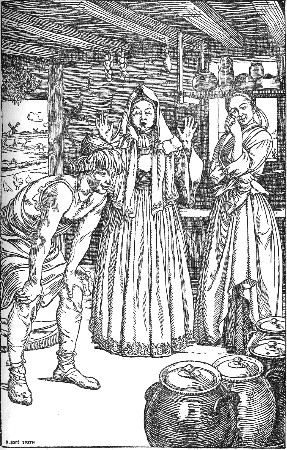
"This jar is full of smoked flesh," said one voice.

"This has fish, this is full of honey, and that one is almost running over with oil," said another voice. "We shall have all that we need to eat for many days to come."

These are the words that a villager coming home from his work heard his mother and his sister say.

"They have often played tricks on me," he said to himself, "and now I will play one on them." So he went into the house and said, "Mother, I have found that I have a wonderful sense of smell, and by its help I can find whatever is hidden away."

"That is a marvelous story," cried the sister.

"If you can tell me what is in these jars," said his mother, "I shall think you are really a magician. What is it now?"

"This is flesh, this fish, this honey, and this jar is full of oil," said the man.

"I never heard of such a marvel in all my life," cried the mother; and in the morning she called her friends and said, "Only think what a wonderful sense of smell my son has! He told me what was in these jars when they were closed."

It was not long before the people all through the country heard of the wonderful man, and one day word came that the king wished to see him at once.

The man was afraid, for he did not know what would happen to him, and he was still more afraid when the king said, "A pearl is lost that I had in my hand last night. They say you can find things that are lost. Find my pearl, or your head will he lost."

The poor man went out into the forest. "Oh, how I wish I had not tried to play tricks," he wailed. "Then this sharp sorrow, this dire trouble, would not have come upon me."

"Please, please do not tell the king," said two voices in the shadow of the trees.

"Who are you?" asked the man.

"Oh, you must know us well," said a man coming out into the light. "My name is Sharp, and that man behind the tree is named Dire, but please do not tell the king. We will give you the pearl; here it is. You called our names, and we saw that you knew us. Oh, I wish I had not been a thief!"

The man gave the pearl to the king, and went home wishing that no one would ever talk to him again of his sense of smell.

In three days word came from the queen that he must come to her at once. She thought his power was only a trick, and to catch him she had put a cat into a bag and the bag into a box.

When the man came, she asked sharply, "What is in this box? Tell me the truth, or off will go your head."

A WONDERFUL SENSE OF SMELL A WONDERFUL SENSE OF SMELL

"What shall I do?" thought the man, "Dire death is upon me." He did not remember that he was before the queen, and he repeated half aloud an old saying, "The bagged cat soon dies."

"What is that?" cried the queen.

"The bagged cat soon dies," repeated the man in great terror.

"You are a marvelous man," said the queen. "There is really a bag in the box and a cat in the bag, but no one besides myself knew it."

"He is not a man; he is a god," cried the people, "and he must be in the sky and live among the gods;" so they threw him up to the sky. His hand was full of earth, and when the earth fell back, it was no longer earth, but a handful of ants. Ants have a wonderful sense of smell, and it is because they fell from the hand of this man who was thrown up into the sky to live among the gods.

***************

This is part of a series of postings of stories under the category, "Keeping the Public in Public Domain."  The idea behind Public Domain was to preserve our cultural heritage after the authors and their immediate heirs were compensated.  I feel strongly current copyright law delays this intent on works of the 20th century.  My own library of folklore includes so many books within the Public Domain I decided to share stories from them.  I hope you enjoy discovering new stories.  


At the same time, my own involvement in storytelling regularly creates projects requiring research as part of my sharing stories with an audience.  Whenever that research needs to be shown here, the publishing of Public Domain stories will not occur that week.  This is a return to my regular posting of a research project here.  (Don't worry, this isn't dry research, my research is always geared towards future storytelling to an audience.)  Response has convinced me that "Keeping the Public in Public Domain" should continue along with my other postings as often as I can manage it.

Other Public Domain story resources I recommend-

  • There are many online resources for Public Domain stories, maybe none for folklore is as ambitious as fellow storyteller, Yoel Perez's database, Yashpeh, the International Folktales Collection.  I have long recommended it and continue to do so.  He has loaded Stith Thompson's Motif Index into his server as a database so you can search the whole 6 volumes for whatever word or expression you like by pressing one key. http://folkmasa.org/motiv/motif.htm

  • You may have noticed I'm no longer certain Dr. Perez has the largest database, although his offering the Motif Index certainly qualifies for those of us seeking specific types of stories.  There's another site, FairyTalez claiming to be the largest, with "over 2000 fairy tales, folktales, and fables" and they are "fully optimized for phones, tablets, and PCs", free and presented without ads.
    Between those two sites, there is much for story-lovers, but as they say in infomercials, "Wait, there's more!"

The email list for storytellers, Storytell, discussed Online Story Sources and came up with these additional suggestions:        

         - David K. Brown - http://people.ucalgary.ca/~dkbrown/stories.html

         - Richard Martin - http://www.tellatale.eu/tales_page.html

         - Spirit of Trees - http://spiritoftrees.org/featured-folktales

         - Story-Lovers - http://www.story-lovers.com/ is now only accessible through the Wayback Machine, described below, but the late Jackie Baldwin's wonderful site lives on there, fully searchable manually (the Google search doesn't work), at https://archive.org/ .  It's not easy, but go to Story-lovers.com snapshot for December 22 2016  and you can click on SOS: Searching Out Stories to scroll down through the many story topics and click on the story topic that interests you.

       - World of Tales - http://www.worldoftales.com/ 

 
           - Zalka Csenge Virag - http://multicoloreddiary.blogspot.com doesn't give the actual stories, but her recommendations, working her way through each country on a continent, give excellent ideas for finding new books and stories to love and tell.

     
You're going to find many of the links on these sites have gone down, BUT go to the Internet Archive Wayback Machine to find some of these old links.  Tim's site, for example, is so huge probably updating it would be a full-time job.  In the case of Story-Lovers, it's great that Jackie Baldwin set it up to stay online as long as it did after she could no longer maintain it.  Possibly searches maintained it.  Unfortunately Storytell list member, Papa Joe is on both Tim Sheppard's site and Story-Lovers, but he no longer maintains his old Papa Joe's Traveling Storytelling Show website and his Library (something you want to see!) is now only on the Wayback Machine.  It took some patience working back through claims of snapshots but finally in December of 2006 it appears!

    Somebody as of this writing whose stories can still be found by his website is the late Chuck Larkin - http://chucklarkin.com/stories.html.  I prefer to list these sites by their complete address so they can be found by the Wayback Machine, a.k.a. Archive.org, when that becomes the only way to find them.

You can see why I recommend these to you. 

Have fun discovering even more stories


Friday, June 30, 2023

Princess Fire-Fly - Frank Rinder - Keeping the Public in Public Domain

Firefly Catching, by Mizuno Toshikata, 1891

This weekend is the start of a prolonged Fourth of July celebration.  In some places fireworks are returning.   At the same time dry conditions and smoke from the widespread Canadian wildfires make fireworks unwise in many other locations.  Either way, nature is trying to bring us the unpredictable fireworks of the firefly.  Look outside when it's dark and enjoy the display of Lightning Bugs or Fireflies.  They are believed to be declining.  At one point their gathering for scientific study and also pesticide spraying made me believe it, too, but I live in a semi-rural area and now think they may be returning.  Over the centuries fireflies have fascinated people.  The Japanese legend has been translated many times.  I found four stories of the same legend in early Twentieth Century anthologies, but my favorite retelling was in The Turquoise Story Book, an anthology of summer stories by the Skinner sisters, Ada and Eleanor, which I've credited here before.  In their table of contents they credit the retelling to Frank Rinder.  A bit of further searching finds he was both an artist and a writer with his longer, but still poetic version of the story in his anthology, Old-World Japan; Legends of the Land of the Gods.  Surprisingly he chose artist T.H. Robinson to illustrate the book, but Rinder was also "art critic of the Glasgow Herald, and a writer on and collector of primarily early 20th Century prints", so that may explain his choice.  I think the story stands well enough on its own, but it does show the style of "Old-World Japan."

My only additional comment is I had to look up what a cockchafer is.  Wikipedia says it is "colloquially called the Maybug, Maybeetle, or doodlebug, is a species of scarab beetle."

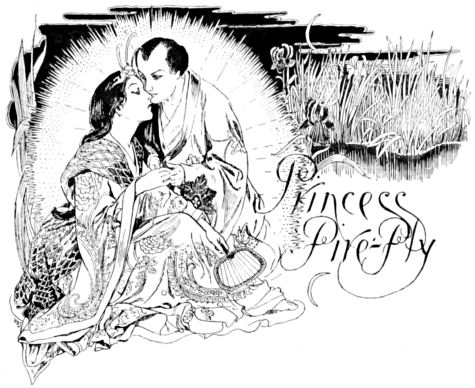
Princess Fire-Fly


Decorative title - Princess Fire-Fly

DEEP in the pinky petals of a lotus bloom that grew in the castle moats of Fukui, in Echizen, lived Hi-O, the King of the Fire-Flies. In this beautiful flower his daughter, the Princess Hotaru, passed her childhood exploring every shady nook and fragrant corner of the bell-like palace, listening to the buzz of life around, and peeping over the edge of the petals at the wonderful world which lay mysteriously beyond. Hotaru-Himé had few youthful companions, but, as she daily bade her father farewell, she dreamed of the time when she, too, would fly abroad, and her brilliant light would attract universal admiration.

Gradually, a beautiful sheen o’erspread her body; night by night it became brighter, until at last her home, in the hours of darkness, was as a globe of coral wherein shone a lamp of gold. So glorious was her light that the stars paled before it, and the bright sickle moon withdrew behind a cloud from jealousy.

Himé was now allowed to fly from her home, to loiter among the pleasant rice fields, and to explore the indigo meadows which lay far off on the horizon. She had no lack of friends and would-be lovers; thousands of insects, attracted by her magic light, came and offered their homage, but Himé never forgot that she was of royal blood, and, while she haughtily thanked her many suitors, none found a way into her heart.

But the Princess whispered to herself, “Only he who loves me more than life shall call me bride.”

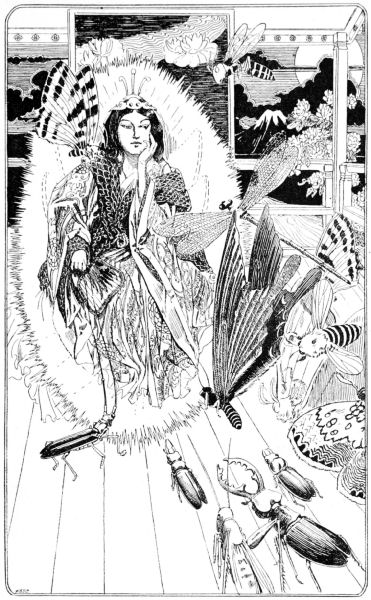
One evening the Princess, seated on a throne formed by the heart of the lotus, held her court. Soon the faint roseate petals of the flower were thronged with a host of ardent lovers. But the Princess whispered to herself, “Only he who loves me more than life shall call me bride.”

The golden beetle laid his fortunes at her feet, the cockchafer wooed her in passionate words, the dragon-fly proudly proffered his hand, and the hawk-moth humbly, yet persistently, addressed her. Countless other insects gained audience, but her answer was ever the same, “Go, and bring me fire, and I will be your bride.”

One by one they took wing, enraptured by the hope of success, and unconscious that they were all bent on the self-same errand. The hawk-moth entered the Buddhist Temple and circled round and round the tall wax lights, until, in an ecstasy of love, he flew into the flame, exclaiming, “Now to win the Princess or meet my death!” His poor singed body fell heavily to the ground. The beetle watched intently, for a moment or two,  the log fire crackling on the hearth, and then, regardless of his fate, boldly caught at a tongue of flame he hoped to carry to Himé—but his end was that of the hawk-moth. The dragon-fly, notwithstanding his sunlit splendours, could not fulfil the bidding of the Lady of the Lotus Bloom; he also fell a prey to her imperious command. Other lovers there were who tried to steal from the diamond his heart of fire, who winged their way to the summit of Fukui, or sped to the depths of the valleys in search of the talisman that was to make Himé their bride. The sun rose in morning splendour over untold numbers of dead bodies, which alone remained to tell of the great devotion that had inspired the lovers of Princess Hotaru.

Now tidings came to Hi-Maro, a Prince of the Fire-Flies living hard by, that the Princess Hotaru was exceedingly beautiful; whereupon he flew swiftly to her home among the lotus flowers. Even as, with a flood of golden light, he entered, the charms of Himé were not dimmed. One look passed between the youth and the maiden, and then each felt that a great love filled their hearts. Hi-Maro wooed and wed, and for many years lived happily with Hotaru-Himé in the castle moats of Fukui.

Centuries have passed since Hi-Maro won his bride, and still the dazzling fire-fly Princesses send their insect lovers in search of fire.

****

As other insects fly into your fires or lights and you see the fireflies winking on and off, I hope you will remember this legend...and also watch out for the demands of beautiful princesses.

**************************

This is part of a series of postings of stories under the category, "Keeping the Public in Public Domain."  The idea behind Public Domain was to preserve our cultural heritage after the authors and their immediate heirs were compensated.  I feel strongly current copyright law delays this intent on works of the 20th century.  My own library of folklore includes so many books within the Public Domain I decided to share stories from them.  I hope you enjoy discovering new stories.  


At the same time, my own involvement in storytelling regularly creates projects requiring research as part of my sharing stories with an audience.  Whenever that research needs to be shown here, the publishing of Public Domain stories will not occur that week.  This is a return to my regular posting of a research project here.  (Don't worry, this isn't dry research, my research is always geared towards future storytelling to an audience.)  Response has convinced me that "Keeping the Public in Public Domain" should continue along with my other postings as often as I can manage it.

Other Public Domain story resources I recommend-

  • There are many online resources for Public Domain stories, maybe none for folklore is as ambitious as fellow storyteller, Yoel Perez's database, Yashpeh, the International Folktales Collection.  I have long recommended it and continue to do so.  He has loaded Stith Thompson's Motif Index into his server as a database so you can search the whole 6 volumes for whatever word or expression you like by pressing one key. http://folkmasa.org/motiv/motif.htm

  • You may have noticed I'm no longer certain Dr. Perez has the largest database, although his offering the Motif Index certainly qualifies for those of us seeking specific types of stories.  There's another site, FairyTalez claiming to be the largest, with "over 2000 fairy tales, folktales, and fables" and they are "fully optimized for phones, tablets, and PCs", free and presented without ads.
    Between those two sites, there is much for story-lovers, but as they say in infomercials, "Wait, there's more!"

The email list for storytellers, Storytell, discussed Online Story Sources and came up with these additional suggestions:        

         - David K. Brown - http://people.ucalgary.ca/~dkbrown/stories.html

         - Richard Martin - http://www.tellatale.eu/tales_page.html

         - Spirit of Trees - http://spiritoftrees.org/featured-folktales

         - Story-Lovers - http://www.story-lovers.com/ is now only accessible through the Wayback Machine, described below, but the late Jackie Baldwin's wonderful site lives on there, fully searchable manually (the Google search doesn't work), at https://archive.org/ .  It's not easy, but go to Story-lovers.com snapshot for December 22 2016  and you can click on SOS: Searching Out Stories to scroll down through the many story topics and click on the story topic that interests you.

       - World of Tales - http://www.worldoftales.com/ 

 
           - Zalka Csenge Virag - http://multicoloreddiary.blogspot.com doesn't give the actual stories, but her recommendations, working her way through each country on a continent, give excellent ideas for finding new books and stories to love and tell.

     
You're going to find many of the links on these sites have gone down, BUT go to the Internet Archive Wayback Machine to find some of these old links.  Tim's site, for example, is so huge probably updating it would be a full-time job.  In the case of Story-Lovers, it's great that Jackie Baldwin set it up to stay online as long as it did after she could no longer maintain it.  Possibly searches maintained it.  Unfortunately Storytell list member, Papa Joe is on both Tim Sheppard's site and Story-Lovers, but he no longer maintains his old Papa Joe's Traveling Storytelling Show website and his Library (something you want to see!) is now only on the Wayback Machine.  It took some patience working back through claims of snapshots but finally in December of 2006 it appears!

    Somebody as of this writing whose stories can still be found by his website is the late Chuck Larkin - http://chucklarkin.com/stories.html.  I prefer to list these sites by their complete address so they can be found by the Wayback Machine, a.k.a. Archive.org, when that becomes the only way to find them.

You can see why I recommend these to you. 

Have fun discovering even more stories

Saturday, November 16, 2019

This and that

This is what I have to remind myself
This week started out fooling our local weather forecasters as it looked like we would get an early, but relatively light blast of three inches.  Nope, try three times that!

My boy snoozing on his snow throne (yes, he has a den & is also welcome in & out of the house)
For lovers of this weather like my dog it's fine, but living high atop a "bunny slope" of a hill we finally got this week's mail on Thursday.  Monday was Veteran's Day so there was no mail, but the little that made it through today made me wonder what happened to that "Neither snow nor rain nor heat nor gloom of night stays these couriers from the swift completion of their appointed rounds"?

Wikipedia assures us  it's not the official creed of the U.S.Post Office.  For even more information, an article at Mental Floss goes into more than just the basics of how an observation by Herodotus became mixed up with our own expectations.  Watching a mail vehicle backing down my neighbor's hill after only getting half way up, it's definitely not reasonable to expect it.


For my own part I'm so relieved it came this week and not last week when we had the opening week of Clarkston Village Players' production of "The Great Gatsby."  We had a Benefit performance, plus the regularly scheduled evening performances on Friday and Saturday, plus a matinee.  All in all we'll do a dozen performances, (Good Lord Willing and the Snow Don't Rise).  Performances run until the final week of this month and we'd hate to have to miss any.

Woolly Bear Caterpillar. Photo by SillyPuttyEnemies/Wikimedia Commons.
We're more than a month away from the official start of winter, so I hope this doesn't mean it's the start of a long, hard winter.  I remember seeing a Wooly Bear Caterpillar that had a long brown stretch between its two black ends.  Wondering what, if anything, it may have predicted about the yet-to-come season, I went to "The Old Farmer's Almanac" online site for the definitive word on "Woolly Bear Caterpillars and Weather Prediction; Do Woolly Worms Really Predict Winter Weather?"

For What It's Worth, my Wooly Bear had a much longer brown area than the one in the Wikimedia photo.  I found the conclusion about what that said interesting.

Finally today I was able to get out with my dog for an overdue hour-long walk. 

Flint Public Library's classic book, Ring A Ring O'Roses has something warmer for those around young children.

Walking in the Snow

Let's go walking in the snow; Walk.
Walking, walking, on tiptoe. Tiptoe.
Lift your one foot way up high, Hop on one foot.
Then the other to keep it dry. Hop on the other foot.
All around the yard we skip; Skip.
Watch your step, or you might slip. Pretend to fall.

We definitely didn't skip through the woods and around the river walk at Independence Oaks Park, but we did hurry as the daylight rapidly faded.  We left the park one minute after its official closing time of six p.m.  Truly we were "the last dog home" and thanked the park employee who waited that extra minute in the below freezing "autumn" cold.

Saturday, May 26, 2018

Flanders Fields, Poppies, and Pollinators for Memorial Day

For the U.S. this weekend we have Memorial Day to recognize all our armed forces who died serving our country.

For Canadian neighbors and the rest of the British Commonwealth it's Remembrance Day, but they wait until November 11, the day of the Armistice ending World War I on the eleventh day of the eleventh month at the eleventh hour.  (That timing also creates the saying, when something is done at the last minute, that it was done "at the eleventh hour.")

There is some confusion here in the U.S. as November 11 is our Veterans Day, honoring all who have served in our military.  Memorial Day was strictly intended to remember those who gave their lives in the military, not our current military, nor its veterans.

For both the U.S., the British Commonwealth, and even many non-Commonwealth nations, poppies are a visual symbol pointing back to a poem, "In Flanders Fields", by Canadian doctor, Lieutenant Colonel John McCrae, in the spring of 1915, shortly after attending the funeral of a friend in Ypres and seeing poppies growing in battle-scarred fields where the soldiers had been buried.

When I do my World War I program I use a black and white photo (although it started with the hint of
the red that so impressed Dr. McCrae) because that's the photo a veteran, like Oleda Joure Christides, would have.  She also knew about the poem:
In Flanders fields the poppies blow
Between the crosses, row on row,
That mark our place; and in the sky
The larks, still bravely singing, fly
Scarce heard amid the guns below.

We are the Dead.
Short days ago
We lived, felt dawn, saw sunset glow,
Loved and were loved, and now we lie
In Flanders fields.

Take up our quarrel with the foe:
To you from failing hands we throw
The torch; be yours to hold it high.
If ye break faith with us who die
We shall not sleep, though poppies grow
In Flanders fields.

After the First World War, the poppy was adopted as a symbol of Remembrance and their bright red color reminds people of all the blood shed.  I was told at the time of the poem it was one of the only things able to bloom in the cemetery there.  The flower is a perfect example of why wildflowers should never be called weeds.  Wikipedia, in an article about it under its scientific name of Papaver rhoeas says, "Due to the extent of ground disturbance in warfare during World War I, corn poppies bloomed in between the trench lines and no man's lands on the Western front."  I was even told lime was used for those graves, so that further eliminated most things from growing there.  In that same article about the flower, Wikipedia states, "Before the advent of herbicides, P. rhoeas sometimes was abundant in agricultural fields."

The picture at the opening of today's article shows the cemetery has changed from the days of preliminary crosses and wildflowers finding their way onto the grounds where so much blood was shed.  The flowers and tombstones look too cultivated to be what was seen in the early Twentieth Century.  I am encouraged that the European Union has banned the use of neonicotinoid pesticides because they have proven it has killed bees, butterflies and, more recently, declining bird populations also are being linked to the pesticides.  Pollinators like these are crucial to our own survival because they are needed for our agriculture and food production.  Here's a link to a petition to our own Environmental Protection Agency asking that they, too, ban this war on our own pollinators. The  underlining of the word "Protection" is my own, since that is supposed to be what the agency does.

Both Memorial Day and flowers remind me of that song about "Where Have All the Flowers Gone" and how it ends with the repeated phrase "When will they ever learn?"  Personally I wish Memorial Day, wonderful as it always is to have a three day holiday, had stayed on May 30 because moving it to the last Monday in May has changed it to what people now call "the unofficial start of summer."  It was meant to be more than that.

Speaking of summer starting unoffically, here in Michigan's version of the Great Lakes' version of Lake Woebegone we barely gave a nod to springtime before summer arrived with 90 degrees!

As for World War I itself, I keep remembering the commonly used statement "Those who don't remember history are doomed to repeat it."  My program with me portraying Oleda tries to honor her, our veterans, and Women's History.  I sincerely hope it continues after November 11, 2018 as its message is not just about that "eleventh hour" or even Flanders Field.

Saturday, August 19, 2017

"Crockett" - Colonel Crockett and the Honey Bees + "his" Almanacs about Eclipses - Keeping the Public in Public Domain

from The Crockett Almanac 1841
I've posted about bees and hornets recently (and even honey if you count the World War I recipes).  Old time "Crockett Almanacs" give us yet another story of these insects and also a 19th century look at eclipses.  August 21 we'll have the first total solar eclipse across the entire contiguous United States since June 8, 1918, so eclipses are something everybody seems to be talking about now.

Talking about folk heroes seems to make them last forever.  As for politicians, maybe they just seem to never die.  Davy Crockett was both a folk hero and a politician.  He officially died at the Alamo on March 6, 1836, but "his" almanacs (1835 to 1856) were filled with Crockett tall tales supposedly written down by the publisher, Ben Hardin, who also is given in some tall tales as a friend and companion in some adventures.

Reproductions occasionally do not perfectly show a letter.  Might the type face have been just as bad in the original?  I don't know, but the language is certainly the original.  The almanacs attempt to sound and be mis-spelled as the public expected the frontier hero, soldier, and politician might have told the stories.  It is an interesting visual way to attempt hearing the backwoods language of that day.  When it puzzles you (and it will), try saying it out loud to see if you understand what is said.

Eclipses - 1840

Eclipses -1841

and then the story, but first a quick note.  Because the story is supposedly about a trick Crockett played on Teddy O'Rourke it opens with a description of the differences between Yankees and the Irish.  Don't let it "get your Irish up", I know mine was under control and I always, or way too often, "speak before I think."

This was the picture at the end of the 1841 almanac.
Even though the story's title is "Colonel Crockett and the Honey Bees, he's in the background watching the trick he played with Jimmy Flatfoot on Teddy O'Rourke to stop his bragging (not that Davy would ever brag)


Before leaving the idea of almanacs and eclipses, let's have some facts and a bit of fun.  You may want to check the almanac that is probably the most accepted since its founding in 1792, the Old Farmer's Almanac.  Here is their look at Total Solar Eclipses in the U.S.  Notice that they say "Accurate observations of solar eclipses in the 19th century were sparse until the solar eclipse of July 18, 1860."

Anybody who knows me knows I can never resist a pun, so I'll close with this lunar or loony riddle.  How does the Man in the Moon gets his hair cut? . . . E-clipse it. 

O.k. stop that groaning and enjoy the astronomical mania currently happening.  Can't find truly safe solar glasses?  Here's a video on how to make your own solar eclipse viewer.

************ 
This is part of a series of postings of stories under the category, "Keeping the Public in Public Domain."  The idea behind Public Domain was to preserve our cultural heritage after the authors and their immediate heirs were compensated.  I feel strongly current copyright law delays this intent on works of the 20th century.  My own library of folklore includes so many books within the Public Domain I decided to share stories from them.  I hope you enjoy discovering new stories.  


At the same time, my own involvement in storytelling regularly creates projects requiring research as part of my sharing stories with an audience.  Whenever that research needs to be shown here, the publishing of Public Domain stories will not occur that week.  This is a return to my regular posting of a research project here.  (Don't worry, this isn't dry research, my research is always geared towards future storytelling to an audience.)  Response has convinced me that "Keeping the Public in Public Domain" should continue along with my other postings as often as I can manage it.
 
Other Public Domain story resources I recommend-
  • There are many online resources for Public Domain stories, maybe none for folklore is as ambitious as fellow storyteller, Yoel Perez's database, Yashpeh, the International Folktales Collection.  I have long recommended it and continue to do so.  He has loaded Stith Thompson's Motif Index into his server as a database so you can search the whole 6 volumes for whatever word or expression you like by pressing one key. http://folkmasa.org/motiv/motif.htm
  • You may have noticed I'm no longer certain Dr. Perez has the largest database, although his offering the Motif Index certainly qualifies for those of us seeking specific types of stories.  There's another site, FairyTalez claiming to be the largest, with "over 2000 fairy tales, folktales, and fables" and they are "fully optimized for phones, tablets, and PCs", free and presented without ads.

    Between those two sites, there is much for story-lovers, but as they say in infomercials, "Wait, there's more!"
The email list for storytellers, Storytell, discussed Online Story Sources and came up with these additional suggestions:            
         - David K. Brown - http://people.ucalgary.ca/~dkbrown/stories.html
         - Richard Martin - http://www.tellatale.eu/tales_page.html
         - Spirit of Trees - http://spiritoftrees.org/featured-folktales
         - Story-Lovers - http://www.story-lovers.com/ is now only accessible through the Wayback Machine, described below, but Jackie Baldwin's wonderful site lives on there, fully searchable manually (the Google search doesn't work), at https://archive.org/ and put in http://www.story-lovers.com/ in the search box.  I recommend using the latest "snapshot" on November 2016
       - World of Tales - http://www.worldoftales.com/ 
   
    You're going to find many of the links on these sites have gone down, BUT go to the Internet Archive Wayback Machine to find some of these old links.  Tim's site, for example, is so huge probably updating it would be a full-time job.  In the case of Story-Lovers, it's great that Jackie Baldwin set it up to stay online as long as it did after she could no longer maintain it.  For an example of using the "Wayback Machine", list member, Papa Joe is on both Tim Sheppard's site and Story-Lovers, but he no longer maintains his old Papa Joe's Traveling Storytelling Show website and his Library (something you want to see!) is gone, but using the Wayback Machine you can still see it.  At the Wayback Machine I put in his site's address, then chose 2006 since it was a later year and clicked until I reached the Library at http://www.pjtss.net/library/.  
    Somebody as of this writing whose stories can still be found by his website is the late Chuck Larkin - http://chucklarkin.com/stories.html.  I prefer to list these sites by their complete address so they can be found by the Wayback Machine, a.k.a. Archive.org, when that becomes the only way to find them.
You can see why I recommend these to you. Have fun discovering even more stories!

Saturday, August 5, 2017

Bailey - Cuffy ... part 2 - Keeping the Public in Public Domain

Fear of bees or bee stings is a common phobia.

Isn't it a good thing bear cubs can swim? Last week we saw Cuffy running for the river to stop the stinging after his attempt to raid a honey tree.  First let us see how he manages.

Afterwards I'll give a brief Anishinaabe tale from our Great Lakes Native American wisdom.  Along the way including some factual information and a source or two for other Native American lore.

Yellow Jacket or hornet

As I mention on my website's page about nature programs I offer,  I and my puppy puppet, Buzz,  especially want to help children with one of their biggest fears... BEES, while learning their vital role in our food supply.

When the Going Buggy in the Garden program was being prepared, various Nature links were selected.  The Storytelling Resources section of my website includes them in the page of Specialized Resources under Nature.   They mainly focus on insects, especially bees, but my years as a librarian let me find similar resources for your program.  The same page also includes tools to let me or you make puzzles and other handouts on your topic.

I promised a brief Anishinaabe tale related to bees and hornets.  


Bee (collected by a scientist) -- note its fuzzy hairs, unlike a hornet
Back in the early days after Gitchee Manitou (the Great Spirit) made the world, Nanabazhoo (also spelled and pronounced in many ways including Manabozho) was able to help with some of the early problems.  One of those problems was brought by bees, who said their honey and their own safety was endangered as they had no defense.   Nanabazhoo needed time to think of a solution and told them to come back later and he would help.  When the time came, the generous bees brought their cousins, the hornets with them.  Nanabazhoo had created stingers as a weapon for the bees, but the hornets took them, too.  While bees agreed to use the stingers only once and then only to defend themselves or their honey, the hornets made no such promise.  Hornets have awful tempers and will sting repeatedly.  So often people mistake the Yellow Jacket for the Bee and too often blame the bee.  

While there aren't many Native American legends about the bee, you can find a few at Native American Language Net and there's also this Cherokee tale of "How the Honey Bee Got Their Stinger " which shows some similarity and comes from First People - The Legends.  The late author and folktale collector, Louise Jean Walker, grew up in Michigan, so of course she did what she could to gather the old stories then in danger of being forgotten.  This story can be found in her Legends of Green Sky Hill.  She also created a companion book, Woodland Wigwams.  

All of this talk about insects reminds me of the time I quoted Ogden Nash, saying:
In His wisdom God created the Fly
and then forgot to tell us why.
Since so many Native American tales are Pourquois tales -- tales telling us why something is the way it is, I asked a Medicine Woman about the fly.  She pointed out their role in decomposition of dead animals, food, et cetera.  She knew many stories, but she never gave me one for the fly.  Maybe you can create one?  

In the meantime be thankful to the bee and keep it safe, for it is vital to our agriculture.  Next week I think we may yet have another adventure by Cuffy since this is a busy time for me.
*********

This is part of a series of postings of stories under the category, "Keeping the Public in Public Domain."  The idea behind Public Domain was to preserve our cultural heritage after the authors and their immediate heirs were compensated.  I feel strongly current copyright law delays this intent on works of the 20th century.  My own library of folklore includes so many books within the Public Domain I decided to share stories from them.  I hope you enjoy discovering new stories.  


At the same time, my own involvement in storytelling regularly creates projects requiring research as part of my sharing stories with an audience.  Whenever that research needs to be shown here, the publishing of Public Domain stories will not occur that week.  This is a return to my regular posting of a research project here.  (Don't worry, this isn't dry research, my research is always geared towards future storytelling to an audience.)  Response has convinced me that "Keeping the Public in Public Domain" should continue along with my other postings as often as I can manage it.
 
Other Public Domain story resources I recommend-
  • There are many online resources for Public Domain stories, maybe none for folklore is as ambitious as fellow storyteller, Yoel Perez's database, Yashpeh, the International Folktales Collection.  I have long recommended it and continue to do so.  He has loaded Stith Thompson's Motif Index into his server as a database so you can search the whole 6 volumes for whatever word or expression you like by pressing one key. http://folkmasa.org/motiv/motif.htm
  • You may have noticed I'm no longer certain Dr. Perez has the largest database, although his offering the Motif Index certainly qualifies for those of us seeking specific types of stories.  There's another site, FairyTalez claiming to be the largest, with "over 2000 fairy tales, folktales, and fables" and they are "fully optimized for phones, tablets, and PCs", free and presented without ads.

    Between those two sites, there is much for story-lovers, but as they say in infomercials, "Wait, there's more!"
The email list for storytellers, Storytell, discussed Online Story Sources and came up with these additional suggestions:            
         - David K. Brown - http://people.ucalgary.ca/~dkbrown/stories.html
         - Richard Martin - http://www.tellatale.eu/tales_page.html
         - Spirit of Trees - http://spiritoftrees.org/featured-folktales
         - Story-Lovers - http://www.story-lovers.com/ is now only accessible through the Wayback Machine, described below, but Jackie Baldwin's wonderful site lives on there, fully searchable manually (the Google search doesn't work), at https://archive.org/ and put in http://www.story-lovers.com/ in the search box.  I recommend using the latest "snapshot" on November 2016
       - World of Tales - http://www.worldoftales.com/ 
   
    You're going to find many of the links on these sites have gone down, BUT go to the Internet Archive Wayback Machine to find some of these old links.  Tim's site, for example, is so huge probably updating it would be a full-time job.  In the case of Story-Lovers, it's great that Jackie Baldwin set it up to stay online as long as it did after she could no longer maintain it.  For an example of using the "Wayback Machine", list member, Papa Joe is on both Tim Sheppard's site and Story-Lovers, but he no longer maintains his old Papa Joe's Traveling Storytelling Show website and his Library (something you want to see!) is gone, but using the Wayback Machine you can still see it.  At the Wayback Machine I put in his site's address, then chose 2006 since it was a later year and clicked until I reached the Library at http://www.pjtss.net/library/.  
    Somebody as of this writing whose stories can still be found by his website is the late Chuck Larkin - http://chucklarkin.com/stories.html.  I prefer to list these sites by their complete address so they can be found by the Wayback Machine, a.k.a. Archive.org, when that becomes the only way to find them.
You can see why I recommend these to you. Have fun discovering even more stories!