Tell me if you have a topic you'd like to see. (Contact: LoiS-sez@LoiS-sez.com .)
Please also let others know about this site.
Showing posts with label videos. Show all posts

Thursday, January 17, 2013

History as seen by the "average" person

Storytelling is both my passion and my profession, but there are subgroups within storytelling.  Sean Buvala, acting as my coach, asked me, "If money was no problem, what type of storytelling would you most like to do?"  HISTORY! I said, but not history as viewed by somebody famous...history as seen by the "average" person.

Books, television, and often movies, when looking at history focus on either someone famous or on many people without seeing life as it appeared to the "average" person.  This type of program takes similar research, so it doesn't come quickly.  That makes it hard for historical societies and museums, schools, and libraries to produce their own programs.  Added to that, coming in the persona of an individual from back in time does something movies, television, books, and even the authors of those books can't do, present a living, talking person who can react to the audience and its interests.

Liberetta Lerich Green was a very real woman who grew up here in Michigan on an Underground Railroad Station and later helped her parents in their abolition efforts.  She was here on the homefront when her brothers fought with the "Fighting Fifth" Infantry.  (I must mention here my separate blog, Michigan's "Fighting Fifth" Civil War Infantry.  Local newspaper articles on that regiment appear at the pace they appeared 150 years ago, just as the families and friends of that regiment tried to follow what was happening to the boys they loved.)  I also have copies of letters her brothers sent home and a few by her parents trying to see if their sons and others they knew might be in a military hospital needing help. Liberetta's parents, Sarah and Peter Lerich, came here as pioneers before statehood.  Teachers and elders taught Liberetta about pioneer life and even the War of 1812.  Additionally Liberetta was a Macomb County farmer's wife and later widow, and she raised three boys and three girls, including one, Loa, who was a pioneering educator. As Liberetta I've had the joy of telling about her family's contributions and what life was like for them and what she learned from others.

Beyond Liberetta there have been what I call "generic" characters.  The Michigan Arts and Humanities Touring Program posted a video of my One-Room Schoolteacher.  I also have a character I call The Hired Girl, a position common to many women of all ages.  ("Girl" is how she might be called back then.)  It was a way for women to work beyond their own homes.  The Hired Girl can let me also include folktales she might have heard in addition to talking about her work.  The Hired Girl is able to explain how a Victorian Christmas was celebrated, too.  My researching One-Room Schools and their Teachers as well as Victorian Christmas led to posts here.  (Check the sidebar to find the many posts here that have come from Liberetta and these various historical programs.) While still working as a librarian in Mount Clemens, which has a history going back to the Bath House Era, I even took the Hired Girl and worked as a "Rubber", a person involved in the baths and massages of these long ago spas.

Just for fun, I also have a program that, like Liberetta telling about the War of 1812, was developed for the Lorenzo Cultural Center's series of historical programs.  Why do I say "just for fun"?  It looks at my own childhood growing up and "Skipping Through the Halls of Fifties Memories", both the things I noticed and things going on all around me that I was too young to notice until grown-ups told me about them later.  It's a great way to get an audience recalling their own childhoods for oral history programs.

Where in time will I go next?  I don't know.  Right now I'm beginning work on the story of a Polish woman's emigration to the U.S. 

I'm in the state's Touring Directory, so my programs qualify for state grants.  It's hard to guess what might be requested next, but it will be fun using my Storytelling + Research skills to bring to new audiences "History as seen by the 'average' person."  

Thursday, March 22, 2012

Project Grimm @ the Grimm Brothers Bicentennial

Federation for European Storytelling (FEST), which represents many European countries and many storytelling traditions, consider the Grimm fairy tales a part of our common cultural heritage.  FEST specifically calls for their celebration, especially since Kinder und Hausmärchen (KHM) was first published two hundred years ago.
December 20, 1812

To celebrate both the well-known and less well-known Grimm tales and all their distant cousins in other European storytelling traditions, participants of Project Grimm created a game producing online video using the KHM numbering of their 211 tales collected. 

The videos are gradually being put online. Already you may browse the videos by language, name and country of the teller, KHM number, and tale title.  Some give the entire tale while others are only a performance excerpt.  Sixty-five participated from these countries:
  • Austria
  • England
  • Germany
  • Hungary
  • Ireland
  • Italy
  • Netherlands
  • Norway
  • Scotland
  • Spain with storytelling in both Catalan and Basque
  • Switzerland
  • Wales
  • There's even a video with an interpreter for Austrian Sign Language...see how many "natural" signs you understand! Our family uses American Sign Language and enjoys learning the sign differences for other countries.
In mentioning Austrian Sign Language, I imagine the fun coming from the many languages used to tell these tales.  Watch Rapunzel in a language you don't know and see if the teller still helps you follow it.  Catch a story in a European language you are studying.  The Project is international entertainment.

So far, the most popular stories are: Rapunzel, The Three Spinners, Mother Hulda, Rumpelstiltskin, and Cinderella but that may change in the course of the project.  Also each participant is assigned two tales beyond the two chosen by the storyteller.

There now is also an official Facebook page at http://www.facebook.com/projectgrimm with more videos uploaded all the time.

Wikipedia on the Grimms' Fairy Tales puts some of this in perspective as it notes:
The first volumes were much criticized because, although they were called "Children's Tales", they were not regarded as suitable for children, both for the scholarly information included and the subject matter. Many changes through the editions – such as turning the wicked mother of the first edition in Snow White and Hansel and Gretel to a stepmother, were probably made with an eye to such suitability. They removed sexual references—such as Rapunzel's innocently asking why her dress was getting tight around her belly, and thus naïvely revealing her pregnancy and the prince's visits to her stepmother—but, in many respects, violence, particularly when punishing villains, was increased.

In 1825 the Brothers published their Kleine Ausgabe or "small edition," a selection of 50 tales designed for child readers. This children's version went through ten editions between 1825 and 1858.   

The Wikipedia article lists the KHM number and title of all tales, plus listing those omitted from the final edition. Titles may differ from what you recognize as translations vary.  British storyteller in Germany, Richard Martin, helped me learn what 50 tales were considered appropriate for 19th century children.  Here are the KHM numbers and you can check them with Wikipedia: KHM 1, 3, 4, 5, 6, 7, 9, 10, 11, 13, 14, 15, 19, 21, 24, 25, 26, 27, 34, 37,  45, 46, 47, 50, 51, 52, 53, 55, 58, 59,  65, 69, 80, 83, 87, 89, 94, 98, 102, 104a, 105,106, 110, 114, 124, 129, 130, 135, 151, 153.  It's interesting to see what famous stories are included and what are omitted.  For example, Hansel and Gretel are in, also Rumpelstiltskin.  Rapunzel is out, but also The Elves and the Shoemaker are missing.  It includes many unfamiliar tales, which is exactly why the Project Grimm exists.

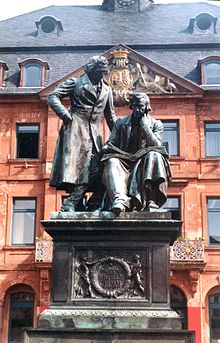
Statue of Jakob and Wilhelm Grimm in the Hanau marketplace (Hessen, Germany)

The Wikipedia article's added features include a tab labelled Talk for added views of the topic. To research folklore use an external link to Aarne-Thompson Tale Types on D.L. Ashliman's excellent website, matching Grimm stories to familiar themes. Another Wikipedia article is also referenced about the German Fairy Tale Route -- a German tourism project of various locations important to their work, established in 1975, in case you visit Germany.

With all the current attention on fairy tales in movies and television, I side with both the Fairy Tale Lobby and FEST in seeking to promote fairy tales for all ages, yes, including adults since these tales were never solely intended for children.  Jakob and Wilhelm knew this and so do you.