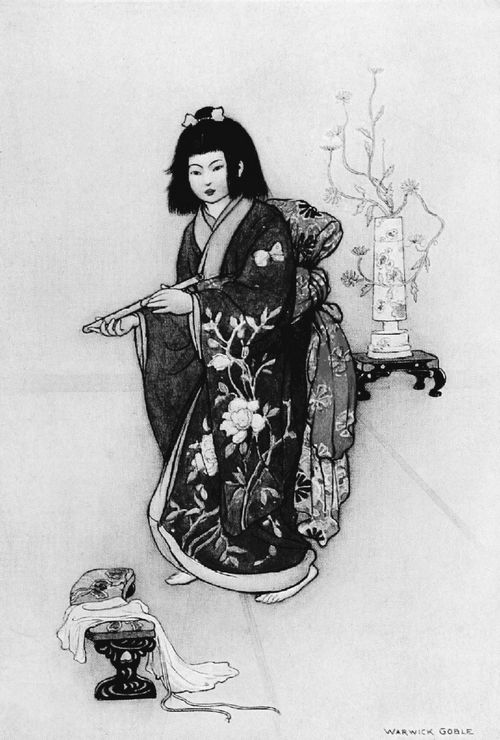
Here in lower Michigan leaves are changing in yards, on roadsides, and along the many lakes, BUT deep in the woods all is still green. Before it's too late I am enjoying that green and bring a story to salute it. The first green of spring is always the willow and many willows are still green. The Japanese tale of Green Willow starts out romantically, but takes a haunting turn. Both Lafcadio Hearn and Grace James tell the tale, but I'll save my paperbacks by copying it from the Project Gutenberg eBook of Japanese Fairy Tales by Grace James. (Hearn's version is called "The Story of Aoyagi" in Kwaidan: Stories and Studies of Strange Things.) The story opens her book and some versions of the James book have the following illustration by Warwick Goble.
GREEN WILLOW
Tomodata, the young samurai, owed allegiance to
the Lord of Noto. He was a soldier, a courtier, and
a poet. He had a sweet voice and a beautiful face,
a noble form and a very winning address. He was
a graceful dancer, and excelled in every manly
sport. He was wealthy and generous and kind.
He was beloved by rich and by poor.
Now his daimyo, the Lord of Noto, wanted a
man to undertake a mission of trust. He chose
Tomodata, and called him to his presence.
“Are you loyal?” said the daimyo.
“My lord, you know it,” answered Tomodata.
“Do you love me, then?” asked the daimyo.
“Ay, my good lord,” said Tomodata, kneeling
before him.
“Then carry my message,” said the daimyo.
“Ride and do not spare your beast. Ride straight,
and fear not the mountains nor the enemies’ country.
Stay not for storm nor any other thing. Lose
your life; but betray not your trust. Above all, do
not look any maid between the eyes. Ride, and
bring me word again quickly.”
Thus spoke the Lord of Noto.
So Tomodata got him to horse, and away he
rode upon his quest. Obedient to his lord’s
commands, he spared not his good beast. He rode
straight, and was not afraid of the steep mountain
passes nor of the enemies’ country. Ere he had
been three days upon the road the autumn tempest
burst, for it was the ninth month. Down poured
the rain in a torrent. Tomodata bowed his head
and rode on. The wind howled in the pine-tree
branches. It blew a typhoon. The good horse
trembled and could scarcely keep its feet, but
Tomodata spoke to it and urged it on. His own
cloak he drew close about him and held it so
that it might not blow away, and in this wise he
rode on.
The fierce storm swept away many a familiar
landmark of the road, and buffeted the samurai so
that he became weary almost to fainting. Noontide
was as dark as twilight, twilight was as dark
as night, and when night fell it was as black as the
night of Yomi, where lost souls wander and cry.
By this time Tomodata had lost his way in a wild,
lonely place, where, as it seemed to him, no human
soul inhabited. His horse could carry him no
longer, and he wandered on foot through bogs and
marshes, through rocky and thorny tracks, until he
fell into deep despair.
“Alack!” he cried, “must I die in this wilderness
and the quest of the Lord of Noto be unfulfilled?”
At this moment the great winds blew away the
clouds of the sky, so that the moon shone very
brightly forth, and by the sudden light Tomodata
saw a little hill on his right hand. Upon the hill
was a small thatched cottage, and before the cottage
grew three green weeping-willow trees.
“Now, indeed, the gods be thanked!” said
Tomodata, and he climbed the hill in no time.
Light shone from the chinks of the cottage door,
and smoke curled out of a hole in the roof. The
three willow trees swayed and flung out their green
streamers in the wind. Tomodata threw his horse’s
rein over a branch of one of them, and called for
admittance to the longed-for shelter.
At once the cottage door was opened by an old
woman, very poorly but neatly clad.
“Who rides abroad upon such a night?” she
asked, “and what wills he here?”
“I am a weary traveller, lost and benighted
upon your lonely moor. My name is Tomodata.
I am a samurai in the service of the Lord of Noto,
upon whose business I ride. Show me hospitality
for the love of the gods. I crave food and shelter
for myself and my horse.”
As the young man stood speaking the water
streamed from his garments. He reeled a little,
and put out a hand to hold on by the side-post of
the door.
“Come in, come in, young sir!” cried the old
woman, full of pity. “Come in to the warm
fire. You are very welcome. We have but coarse
fare to offer, but it shall be set before you with
great good-will. As to your horse, I see you have
delivered him to my daughter; he is in good
hands.”
At this Tomodata turned sharply round. Just
behind him, in the dim light, stood a very young
girl with the horse’s rein thrown over her arm.
Her garments were blown about and her long
loose hair streamed out upon the wind. The
samurai wondered how she had come there. Then
the old woman drew him into the cottage and
shut the door. Before the fire sat the good
man of the house, and the two old people did
the very best they could for Tomodata. They
gave him dry garments, comforted him with hot
rice wine, and quickly prepared a good supper
for him.
Presently the daughter of the house came in,
and retired behind a screen to comb her hair and
to dress afresh. Then she came forth to wait upon
him. She wore a blue robe of homespun cotton.
Her feet were bare. Her hair was not tied nor
confined in any way, but lay along her smooth
cheeks, and hung, straight and long and black, to
her very knees. She was slender and graceful.
Tomodata judged her to be about fifteen years old,
and knew well that she was the fairest maiden he
had ever seen.
At length she knelt at his side to pour wine
into his cup. She held the wine-bottle in two
hands and bent her head. Tomodata turned to
look at her. When she had made an end of
pouring the wine and had set down the bottle,
their glances met, and Tomodata looked at her full
between the eyes, for he forgot altogether the
warning of his daimyo, the Lord of Noto.
“Maiden,” he said, “what is your name?”
She answered: “They call me the Green
Willow.”
“The dearest name on earth,” he said, and
again he looked her between the eyes. And
because he looked so long her face grew rosy red,
from chin to forehead, and though she smiled her
eyes filled with tears.
Ah me, for the Lord of Noto’s quest!
Then Tomodata made this little song:
“Long-haired maiden, do you know
That with the red dawn I must go?
Do you wish me far away?
Cruel long-haired maiden, say—
Long-haired maiden, if you know
That with the red dawn I must go,
Why, oh why, do you blush so?”
And the maiden, the Green Willow, answered:
“The dawn comes if I will or no;
Never leave me, never go.
My sleeve shall hide the blush away.
The dawn comes if I will or no;
Never leave me, never go.
Lord, I lift my long sleeve so....”
“Oh, Green Willow, Green Willow ...”
sighed Tomodata.
That night he lay before the fire—still, but
with wide eyes, for no sleep came to him though
he was weary. He was sick for love of the Green
Willow. Yet by the rules of his service he was
bound in honour to think of no such thing. Moreover,
he had the quest of the Lord of Noto that
lay heavy on his heart, and he longed to keep truth
and loyalty.
At the first peep of day he rose up. He looked
upon the kind old man who had been his host, and
left a purse of gold at his side as he slept. The
maiden and her mother lay behind the screen.
Tomodata saddled and bridled his horse, and
mounting, rode slowly away through the mist of
the early morning. The storm was quite over
and it was as still as Paradise. The green grass
and the leaves shone with the wet. The sky
was clear, and the path very bright with autumn
flowers; but Tomodata was sad.
When the sunlight streamed across his saddlebow,
“Ah, Green Willow, Green Willow,” he
sighed; and at noontide it was “Green Willow,
Green Willow”; and “Green Willow, Green
Willow,” when the twilight fell. That night
he lay in a deserted shrine, and the place was so
holy that in spite of all he slept from midnight till
the dawn. Then he rose, having it in his mind to
wash himself in a cold stream that flowed near by,
so as to go refreshed upon his journey; but he was
stopped upon the shrine’s threshold. There lay
the Green Willow, prone upon the ground. A
slender thing she lay, face downwards, with her
black hair flung about her. She lifted a hand and
held Tomodata by the sleeve. “My lord, my
lord,” she said, and fell to sobbing piteously.
He took her in his arms without a word, and
soon he set her on his horse before him, and
together they rode the livelong day. It was little
they recked of the road they went, for all the
while they looked into each other’s eyes. The
heat and the cold were nothing to them. They
felt not the sun nor the rain; of truth or falsehood
they thought nothing at all; nor of filial piety, nor
of the Lord of Noto’s quest, nor of honour nor
plighted word. They knew but the one thing.
Alas, for the ways of love!
At last they came to an unknown city, where
they stayed. Tomodata carried gold and jewels
in his girdle, so they found a house built of white
wood, spread with sweet white mats. In every dim
room there could be heard the sound of the garden
waterfall, whilst the swallow flitted across and
across the paper lattice. Here they dwelt, knowing
but the one thing. Here they dwelt three years of
happy days, and for Tomodata and the Green Willow
the years were like garlands of sweet flowers.
In the autumn of the third year it chanced that
the two of them went forth into the garden at
dusk, for they had a wish to see the round moon
rise; and as they watched, the Green Willow began
to shake and shiver.
“My dear,” said Tomodata, “you shake and
shiver; and it is no wonder, the night wind is
chill. Come in.” And he put his arm around her.
At this she gave a long and pitiful cry, very
loud and full of agony, and when she had uttered
the cry she failed, and dropped her head upon her
love’s breast.
“Tomodata,” she whispered, “say a prayer for
me; I die.”
“Oh, say not so, my sweet, my sweet! You
are but weary; you are faint.”
He carried her to the stream’s side, where the
iris grew like swords, and the lotus-leaves like
shields, and laved her forehead with water. He
said: “What is it, my dear? Look up and live.”
“The tree,” she moaned, “the tree ... they
have cut down my tree. Remember the Green
Willow.”
With that she slipped, as it seemed, from his
arms to his feet; and he, casting himself upon the
ground, found only silken garments, bright coloured,
warm and sweet, and straw sandals, scarlet-thonged.
In after years, when Tomodata was a holy
man, he travelled from shrine to shrine, painfully
upon his feet, and acquired much merit.
Once, at nightfall, he found himself upon a
lonely moor. On his right hand he beheld a little
hill, and on it the sad ruins of a poor thatched
cottage. The door swung to and fro with broken
latch and creaking hinge. Before it stood three
old stumps of willow trees that had long since
been cut down. Tomodata stood for a long time
still and silent. Then he sang gently to himself:
“Long-haired maiden, do you know
That with the red dawn I must go? Do you wish me far away?
Cruel long-haired maiden, say—
Long-haired maiden, if you know
That with the red dawn I must go,
Why, oh why, do you blush so?”
“Ah, foolish song! The gods forgive me....
I should have recited the Holy Sutra for the
Dead,” said Tomodata.
***
Because the James version has the English name of Green Willow, as opposed to Aoyagi, I chose her story, but advise comparing it with Hearn's. An online study guide of Kwaidan at Gradesaver.com has these comments by Elmina Jazvin:
Nature is the main motif in most of the stories and shows the price
that comes with disturbing the nature. . . .
The meaning of the word Kwaidan translates to "a ghost story" and this collection is mostly made out of those.
It's not the spookiest of tales, but might be worth keeping for some Halloween audiences. The songs could use the teller singing them to an appropriate sounding melody. My own silly mind keeps having Kermit the Frog singing, "It's not easy being green!"
*************
This
is part of a series of postings of stories under the category,
"Keeping the Public in Public Domain." The idea
behind Public Domain was to preserve our cultural heritage after the
authors and their immediate heirs were compensated. I feel
strongly current copyright law delays this intent on works of the
20th century. My
own library of folklore includes so many books within the Public
Domain I decided to share stories from them. I hope you enjoy
discovering new stories.

At
the same time, my own involvement in storytelling regularly creates
projects requiring research as part of my sharing stories with an
audience. Whenever that research needs to be shown here, the publishing
of Public Domain stories will not occur that week. This is a return to
my regular posting of a research project here. (Don't worry, this
isn't dry research, my research is always geared towards future
storytelling to an audience.) Response has convinced me that "Keeping
the Public in Public Domain" should continue along with my other
postings as often as I can manage it.
Other
Public Domain story resources I recommend-
There
are many online resources for Public Domain stories, maybe none for
folklore is as ambitious as fellow storyteller, Yoel Perez's
database, Yashpeh,
the International Folktales Collection. I have long
recommended it and continue to do so. He has loaded
Stith Thompson's Motif Index into his server as a database so
you can search the whole 6 volumes for whatever word or expression
you like by pressing one key. http://folkmasa.org/motiv/motif.htm
- You may have noticed I'm no
longer certain Dr. Perez has the largest database, although his
offering the Motif Index certainly qualifies for those of us seeking
specific types of stories. There's another site, FairyTalez
claiming to be the largest, with "over 2000 fairy tales,
folktales, and fables" and they are "fully optimized for
phones, tablets, and PCs", free and presented without ads.
Between those two sites, there
is much for story-lovers, but as they say in infomercials, "Wait,
there's more!"
The
email list for storytellers, Storytell,
discussed Online Story Sources and came up with these additional
suggestions:
-
Story-Lovers - http://www.story-lovers.com/ is now only accessible
through the Wayback Machine, described below, but the late Jackie Baldwin's
wonderful site lives on there, fully searchable manually (the Google
search doesn't work), at https://archive.org/ . It's not easy, but go to Story-lovers.com snapshot for October 22 2016 and you can click on SOS: Searching Out Stories to scroll down through the many story topics and click on the story topic that interests you.
You're
going to find many of the links on these sites have gone down, BUT
go to the Internet Archive
Wayback Machine to find some of these old links. Tim's
site, for example, is so huge probably updating it would be a
full-time job. In the case of Story-Lovers, it's great that
Jackie Baldwin set it up to stay online as long as it did after she
could no longer maintain it. Possibly searches maintained it.
Unfortunately Storytell list member, Papa Joe is on both Tim
Sheppard's site and Story-Lovers, but he no longer maintains his old
Papa Joe's Traveling Storytelling Show website and his Library
(something you want to see!) is now only on the Wayback Machine. It
took some patience working back through claims of snapshots but finally
in December of 2006 it appears!
Somebody
as of this writing whose stories can still be found by his website
is the late Chuck Larkin - http://chucklarkin.com/stories.html.
I prefer to list these sites by their complete address so they can
be found by the Wayback Machine, a.k.a. Archive.org, when that
becomes the only way to find them.
You
can see why I recommend these to you. Have fun
discovering even more stories!
 My Prohibition program was just hitting the level I wanted when Covid shut it down!




 Now is the time for thinking ahead to 2017 with new projects and room for self-improvement.
 from Good Enough to Better and even Best.