Tell me if you have a topic you'd like to see. (Contact: LoiS-sez@LoiS-sez.com .)
Please also let others know about this site.
Showing posts with label rabbits. Show all posts

Friday, June 20, 2025

Chandler - Why the Sun Travels Regularly - Keeping the Public in Public Domain

It's offiffiffica'ly SUMMER! While weather with the current nation's heat wave and things like Memorial Day or the end of school may seem to have already brought Summer, the summer solstice in 2025 occurred on June 20 at 10:42 p.m. ET, marking the longest day of the year in the Northern Hemisphere and the official start of summer. It has been great to see the days become longer, but surely few in a northern part of the United States mind trading the days getting shorter while we leave winter's cold behind. 

I went looking for a story about this change and found one in Katherine Chandler's In the Reign of Coyote. Chandler tells us she found it in The Pacific Northwest Oregon and Washington, 2 vols., compiled and published by the Northwest Pacific History Company, Portland, Oregon, 1889, II. Aside from the frame characters used to present the stories, I strongly suspect she is correct when she says "While the essentials of the stories have been retained, the narratives have been elaborated and modified." We are not told by Chandler which of the Native Americans started this tale and there are many in the Pacific Northwest. The drawings for each story by J.W. Ferguson Kennedy add to that elaboration. If looking just for that story, it's at https://archive.org/details/inreignofcoyote0000kath/page/104/mode/2up


We're looking at an extra hot start to the days of summer, but even at that it's not enough to scorch a rabbit to pieces! At least the regularity of the length of those days can be counted on to happen.

*************** 

This is part of a series of postings of stories under the category, “Keeping the Public in Public Domain.” The idea behind Public Domain was to preserve our cultural heritage after the authors and their immediate heirs were compensated. I feel strongly current copyright law delays this intent on works of the 20th century. My own library of folklore includes so many books within the Public Domain I decided to share stories from them. I hope you enjoy discovering them.

At the same time, my own involvement in storytelling regularly creates projects requiring research as part of my sharing stories with an audience.  Whenever that research needs to be shown here, the publishing of Public Domain stories will not occur that week.  This is a return to my regular posting of a research project here.  (Don't worry, this isn't dry research, my research is always geared towards future storytelling to an audience.)  Response has convinced me that "Keeping the Public in Public Domain" should continue along with my other postings as often as I can manage it.

See the sidebar for other Public Domain story resources I recommend on the page “Public Domain Story Resources."


Friday, January 7, 2022

Seton - A Rabbit's Story of His Life, Written by Himself - Keeping the Public in Public Domain

Have you gone for a hike lately?  For many of us right now that means bundling up!  Wind chills and snow have much of the northern hemisphere very much in the grip of winter!  

More about that in today's story, but first a look back at last week.  Public Domain Day was a week ago on January 1st with many 1926 U.S. works and international works by authors, composers, and more also being added.  That latter is worth noting:

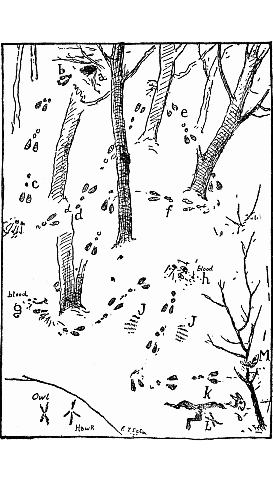
I went through my personal collection and found my 1926 edition of Ernest Thompson Seton's Woodland Tales, not realizing an earlier 1922 edition was already at Project Gutenberg.  In Seton's "Things to See in Wintertime" section he has a "Tale" he called "Tracks and the Stories They Tell" with the most common tracks of Dog, Cat, Sparrow, Chicken, and Robin.  He called it a "Tale", but it's really the following #56 that is actually a Tale.  He found a story  discovered by following the tracks of a rabbit all the way through to some final  feathers to solve a Woodland murder mystery.  His illustration is small and a bit hard to follow.  I was able to enlarge it a bit to make it slightly easier to follow.  I would recommend, if you wanted to re-tell the story, getting an artist to make a larger version.  (There's a limit  as to how large a picture may be enlarged before it becomes unreadable.)

One other quick note, Seton in the Preface called his stories "Mother Carey Tales."  Mother Carey is usually a personification of the sea, but he used it as a Mother Nature figure, complete with all the favoring of the strong over the weak.

TALE 56
A Rabbit's Story of His Life, Written by Himself

Yes, the Rabbit wrote it himself and about himself in the oldest writing on earth, that is the tracks of his feet.
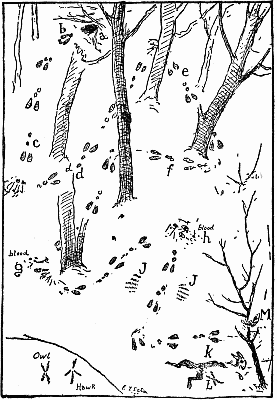
A WOODCRAFT TRAGEDY As shown by the Tracks and Signs in the Snow A WOODCRAFT TRAGEDY
As shown by the Tracks and Signs in the Snow

In February of 1885, one morning after a light snowfall, I went tramping through the woods north of Toronto, when I came on something that always makes me stop and look—the fresh tracks of an animal. This was the track of a Cottontail Rabbit and I followed its windings with thrills of interest. There it began under a little brush pile (a); the bed of brown leaves showing that he settled there, before the snow-fall began. Now here (b) he leaped out after the snow ceased, for the tracks are sharp, and sat looking around. See the two long marks of his hind feet and in front the two smaller prints of his front feet; behind is the mark made by his tail, showing that he was sitting on it.

Then he had taken alarm at something and dashed off at speed (c), for now his hind feet are tracking ahead of the front feet, as in most bounding forefoots, and the faster he goes, the farther ahead those hind feet get.

See now how he dodged about here and there, this way and that, among the trees, as though trying to escape some dreaded enemy (c, d, e, f).

But what enemy? There are no other tracks, and still the wild jumping went on.

I began to think that the Rabbit was crazy, flying from an imaginary foe; possibly that I was on the track of a March Hare. But at "g" I found on the trail for the first time a few drops of blood. That told me that the Rabbit was in real danger but gave no clue to its source.

At "h" I found more blood and at "j" I got a new thrill, for there, plain enough on each side of the Rabbit track, were finger-like marks, and the truth dawned on me that these were the prints of great wings. The Rabbit was fleeing from an eagle, a hawk, or an owl. Some twenty yards farther "k" I found in the snow the remains of the luckless Rabbit partly devoured. Then I knew that the eagle had not done it, for he would have taken the Rabbit's body away, not eaten him up there. So it must have been a hawk or an owl. I looked for something to tell me which, and I got it. Right by the Rabbit's remains was the large twin-toed track (l) that told me that an owl had been there, and that therefore he was the criminal. Had it been a hawk the mark would have been as shown in the left lower corner, three toes forward and one back, whereas the owl usually sets his foot with two toes forward and two backward, as in the sketch. This, then, I felt sure was the work of an owl. But which owl? There were two, maybe three kinds in that valley. I wished to know exactly and, looking for further evidence, I found on a sapling near by a big soft, downy, owlish feather (m) with three brown bars across it; which told me plainly that a Barred Owl or Hoot Owl had been there recently, and that he was almost certainly the killer of the Cottontail.

This may sound like a story of Sherlock Holmes among the animals—a flimsy tale of circumstantial evidence. But while I was making my notes, what should come flying through the woods but the Owl himself, back to make another meal, no doubt. He alighted on a branch just above my head, barely ten feet up, and there gave me the best of proof, next to eye witness of the deed, that all I had gathered from the tracks and signs in the snow was quite true.

I had no camera in those days, but had my sketch book, and as he sat, I made a drawing which hangs to-day among my pictures that are beyond price.

Here, then, is a chapter of wild life which no man saw, which man could not have seen, for the presence of a man would have prevented it. And yet we know it was true, for it was written by the Rabbit himself.

If you have the seeing eye, you will be able to read many strange and thrilling happenings written for you thus in the snow, the mud, and even the sand and the dust.

*******

Seton in this story and the study of animal tracks in "Tale 55" encourages us to see nature's stories.  I try to observe those stories on my snowy hikes, but confess snow depths make it hard to get a clear view.  They're sometimes as difficult to decipher as in Seton's own small illustrations.

*****************

Now for the "fine print" about Keeping the Stories in Public Domain.  (You can always enlarge it on your computer.)

This is part of a series of postings of stories under the category, "Keeping the Public in Public Domain."  The idea behind Public Domain was to preserve our cultural heritage after the authors and their immediate heirs were compensated.  I feel strongly current copyright law delays this intent on works of the 20th century.  My own library of folklore includes so many books within the Public Domain I decided to share stories from them.  I hope you enjoy discovering new stories.  


At the same time, my own involvement in storytelling regularly creates projects requiring research as part of my sharing stories with an audience.  Whenever that research needs to be shown here, the publishing of Public Domain stories will not occur that week.  This is a return to my regular posting of a research project here.  (Don't worry, this isn't dry research, my research is always geared towards future storytelling to an audience.)  Response has convinced me that "Keeping the Public in Public Domain" should continue along with my other postings as often as I can manage it.
Other Public Domain story resources I recommend-
  • There are many online resources for Public Domain stories, maybe none for folklore is as ambitious as fellow storyteller, Yoel Perez's database, Yashpeh, the International Folktales Collection.  I have long recommended it and continue to do so.  He has loaded Stith Thompson's Motif Index into his server as a database so you can search the whole 6 volumes for whatever word or expression you like by pressing one key. http://folkmasa.org/motiv/motif.htm
  • You may have noticed I'm no longer certain Dr. Perez has the largest database, although his offering the Motif Index certainly qualifies for those of us seeking specific types of stories.  There's another site, FairyTalez claiming to be the largest, with "over 2000 fairy tales, folktales, and fables" and they are "fully optimized for phones, tablets, and PCs", free and presented without ads.

    Between those two sites, there is much for story-lovers, but as they say in infomercials, "Wait, there's more!"
The email list for storytellers, Storytell, discussed Online Story Sources and came up with these additional suggestions:            
         - David K. Brown - http://people.ucalgary.ca/~dkbrown/stories.html
         - Richard Martin - http://www.tellatale.eu/tales_page.html
         - Spirit of Trees - http://spiritoftrees.org/featured-folktales
         - Story-Lovers - http://www.story-lovers.com/ is now only accessible through the Wayback Machine, described below, but the late Jackie Baldwin's wonderful site lives on there, fully searchable manually (the Google search doesn't work), at https://archive.org/ .  It's not easy, but go to Story-lovers.com snapshot for October 22 2016  and you can click on SOS: Searching Out Stories to scroll down through the many story topics and click on the story topic that interests you.
       - World of Tales - http://www.worldoftales.com/ 
           - Zalka Csenge Virag - http://multicoloreddiary.blogspot.com doesn't give the actual stories, but her recommendations, working her way through each country on a continent, give excellent ideas for finding new books and stories to love and tell.
     
You're going to find many of the links on these sites have gone down, BUT go to the Internet Archive Wayback Machine to find some of these old links.  Tim's site, for example, is so huge probably updating it would be a full-time job.  In the case of Story-Lovers, it's great that Jackie Baldwin set it up to stay online as long as it did after she could no longer maintain it.  Possibly searches maintained it.  Unfortunately Storytell list member, Papa Joe is on both Tim Sheppard's site and Story-Lovers, but he no longer maintains his old Papa Joe's Traveling Storytelling Show website and his Library (something you want to see!) is now only on the Wayback Machine.  It took some patience working back through claims of snapshots but finally in December of 2006 it appears!
    Somebody as of this writing whose stories can still be found by his website is the late Chuck Larkin - http://chucklarkin.com/stories.html.  I prefer to list these sites by their complete address so they can be found by the Wayback Machine, a.k.a. Archive.org, when that becomes the only way to find them.
You can see why I recommend these to you. Have fun discovering even more stories!

Saturday, May 16, 2020

Shelter in Place - Week 8 / Judson - Rabbit Goes Duck Hunting - Keeping the Public in Public Domain

There's a saying going around that seems to fit right now.  "My ducks are absolutely not in a row.  At this point I have no idea where my ducks even are."

Our area has so many inland lakes in addition to the Great Lakes that it's easy to see ducklings, goslings, cygnets with feathered parents standing guard.  I wanted a short funny story to fit the saying about not knowing where my ducks even are.  In the early Twentieth Century Katherine Berry Judson created half a dozen anthologies of Native American folktales, each title beginning with Myths and Legends of and this Cherokee tale is in Myths and Legends of the Mississippi Valley and the Great Lakes.  

Let's open with a photo of the leading characters even though they act very differently in the story.

 I can just hear the duck quack-laughing and the same for the anonymous Cherokee teller.  While talking about anonymous sources, I like to give credit and get permission for graphics I use, but was unable to do that with these as the site is anonymous, but if you need a laugh, try https://coolfunnyanimals.blogspot.com and scroll the sidebar for your choices of animals.  It's like snacking, it's hard to just have one.

Now back to that idea of getting your ducks in a row, this duck farmer in Vietnam reminds me of the classic picture book by Marjorie Flack, The Story About Ping where a little duck hated to be the last in line because that duck received a smack on the back.
Joss Woodhead at Unsplash.com
Talk about getting your ducks in a row!
***********************
This is part of a series of postings of stories under the category, "Keeping the Public in Public Domain."  The idea behind Public Domain was to preserve our cultural heritage after the authors and their immediate heirs were compensated.  I feel strongly current copyright law delays this intent on works of the 20th century.  My own library of folklore includes so many books within the Public Domain I decided to share stories from them.  I hope you enjoy discovering new stories.  


At the same time, my own involvement in storytelling regularly creates projects requiring research as part of my sharing stories with an audience.  Whenever that research needs to be shown here, the publishing of Public Domain stories will not occur that week.  This is a return to my regular posting of a research project here.  (Don't worry, this isn't dry research, my research is always geared towards future storytelling to an audience.)  Response has convinced me that "Keeping the Public in Public Domain" should continue along with my other postings as often as I can manage it.
Other Public Domain story resources I recommend-
  • There are many online resources for Public Domain stories, maybe none for folklore is as ambitious as fellow storyteller, Yoel Perez's database, Yashpeh, the International Folktales Collection.  I have long recommended it and continue to do so.  He has loaded Stith Thompson's Motif Index into his server as a database so you can search the whole 6 volumes for whatever word or expression you like by pressing one key. http://folkmasa.org/motiv/motif.htm
  • You may have noticed I'm no longer certain Dr. Perez has the largest database, although his offering the Motif Index certainly qualifies for those of us seeking specific types of stories.  There's another site, FairyTalez claiming to be the largest, with "over 2000 fairy tales, folktales, and fables" and they are "fully optimized for phones, tablets, and PCs", free and presented without ads.

    Between those two sites, there is much for story-lovers, but as they say in infomercials, "Wait, there's more!"
The email list for storytellers, Storytell, discussed Online Story Sources and came up with these additional suggestions:            
         - David K. Brown - http://people.ucalgary.ca/~dkbrown/stories.html
         - Richard Martin - http://www.tellatale.eu/tales_page.html
         - Spirit of Trees - http://spiritoftrees.org/featured-folktales
         - Story-Lovers - http://www.story-lovers.com/ is now only accessible through the Wayback Machine, described below, but Jackie Baldwin's wonderful site lives on there, fully searchable manually (the Google search doesn't work), at https://archive.org/ .  It's not easy, but go to Story-lovers.com snapshot for October 22 2016  and you can click on SOS: Searching Out Stories to scroll down through the many story topics and click on the story topic that interests you.
       - World of Tales - http://www.worldoftales.com/ 
           - Zalka Csenge Virag - http://multicoloreddiary.blogspot.com doesn't give the actual stories, but her recommendations, working her way through each country on a continent, give excellent ideas for finding new books and stories to love and tell.
     
You're going to find many of the links on these sites have gone down, BUT go to the Internet Archive Wayback Machine to find some of these old links.  Tim's site, for example, is so huge probably updating it would be a full-time job.  In the case of Story-Lovers, it's great that Jackie Baldwin set it up to stay online as long as it did after she could no longer maintain it.  Possibly searches maintained it.  Unfortunately Storytell list member, Papa Joe is on both Tim Sheppard's site and Story-Lovers, but he no longer maintains his old Papa Joe's Traveling Storytelling Show website and his Library (something you want to see!) is now only on the Wayback Machine.  It took some patience working back through claims of snapshots but finally in December of 2006 it appears!
    Somebody as of this writing whose stories can still be found by his website is the late Chuck Larkin - http://chucklarkin.com/stories.html.  I prefer to list these sites by their complete address so they can be found by the Wayback Machine, a.k.a. Archive.org, when that becomes the only way to find them.
You can see why I recommend these to you. Have fun discovering even more stories!

Thursday, April 11, 2019

Lindsay - - Keeping the Public in Public Domain

Today, April 11, is National Pet Day.  That coupled with something happening this Saturday leads me to an earlier than usual publishing for this week.

Go to this link for 10 ideas to celebrate national pet day (good for pets any time). My other reason is this Saturday in Mount Clemens I will be part of, and would love to see you at, this celebration.
The Detroit Puppeteers Guild alternate their annual Day of Puppetry between adults and, this year, children.  Friend and colleague, Rob Papineau, always gives delightful shows, so his "Bunny Business" is guaranteed to be fun for the audience.

That show and the coming of Easter made me prowl my collection of books for today's Public Domain tale.  I found it in the ever reliable work by Kindergarten pioneer, Maud Lindsay, from her Story Garden for Little Children. 

Many of her books can be found online.  The Story Garden for Little Children can be found at Archive.org , complete with charming black and white illustrations by Florence Liley Young.  My own copy misses the illustration on the right, which was probably the book cover.  I also disagree a bit with the publisher's placement of the story's main illustration.  Publishers have to decide based on many things, but I want the illustration to occur as close to when it happens in the story and moved it slightly.

It tells well, complete with a child "detective."


Realistically rabbits eating your garden may not be what you want, but that story certainly tells well for spring or Easter.  I hope you enjoy making it your own, while remembering the storytellers who are part of our heritage, just as the Public Domain tries to keep our literary heritage alive.
********************
This is part of a series of postings of stories under the category, "Keeping the Public in Public Domain."  The idea behind Public Domain was to preserve our cultural heritage after the authors and their immediate heirs were compensated.  I feel strongly current copyright law delays this intent on works of the 20th century.  My own library of folklore includes so many books within the Public Domain I decided to share stories from them.  I hope you enjoy discovering new stories.  


At the same time, my own involvement in storytelling regularly creates projects requiring research as part of my sharing stories with an audience.  Whenever that research needs to be shown here, the publishing of Public Domain stories will not occur that week.  This is a return to my regular posting of a research project here.  (Don't worry, this isn't dry research, my research is always geared towards future storytelling to an audience.)  Response has convinced me that "Keeping the Public in Public Domain" should continue along with my other postings as often as I can manage it.
Other Public Domain story resources I recommend-
  • There are many online resources for Public Domain stories, maybe none for folklore is as ambitious as fellow storyteller, Yoel Perez's database, Yashpeh, the International Folktales Collection.  I have long recommended it and continue to do so.  He has loaded Stith Thompson's Motif Index into his server as a database so you can search the whole 6 volumes for whatever word or expression you like by pressing one key. http://folkmasa.org/motiv/motif.htm
  • You may have noticed I'm no longer certain Dr. Perez has the largest database, although his offering the Motif Index certainly qualifies for those of us seeking specific types of stories.  There's another site, FairyTalez claiming to be the largest, with "over 2000 fairy tales, folktales, and fables" and they are "fully optimized for phones, tablets, and PCs", free and presented without ads.

    Between those two sites, there is much for story-lovers, but as they say in infomercials, "Wait, there's more!"
The email list for storytellers, Storytell, discussed Online Story Sources and came up with these additional suggestions:            
         - David K. Brown - http://people.ucalgary.ca/~dkbrown/stories.html
         - Richard Martin - http://www.tellatale.eu/tales_page.html
         - Spirit of Trees - http://spiritoftrees.org/featured-folktales
         - Story-Lovers - http://www.story-lovers.com/ is now only accessible through the Wayback Machine, described below, but Jackie Baldwin's wonderful site lives on there, fully searchable manually (the Google search doesn't work), at https://archive.org/ .  It's not easy, but go to Story-lovers.com snapshot for October 22 2016  and you can click on SOS: Searching Out Stories to scroll down through the many story topics and click on the story topic that interests you.
       - World of Tales - http://www.worldoftales.com/ 
           - Zalka Csenge Virag - http://multicoloreddiary.blogspot.com doesn't give the actual stories, but her recommendations, working her way through each country on a continent, give excellent ideas for finding new books and stories to love and tell.
     
You're going to find many of the links on these sites have gone down, BUT go to the Internet Archive Wayback Machine to find some of these old links.  Tim's site, for example, is so huge probably updating it would be a full-time job.  In the case of Story-Lovers, it's great that Jackie Baldwin set it up to stay online as long as it did after she could no longer maintain it.  Possibly searches maintained it.  Unfortunately Storytell list member, Papa Joe is on both Tim Sheppard's site and Story-Lovers, but he no longer maintains his old Papa Joe's Traveling Storytelling Show website and his Library (something you want to see!) is now only on the Wayback Machine.  It took some patience working back through claims of snapshots but finally in December of 2006 it appears!
    Somebody as of this writing whose stories can still be found by his website is the late Chuck Larkin - http://chucklarkin.com/stories.html.  I prefer to list these sites by their complete address so they can be found by the Wayback Machine, a.k.a. Archive.org, when that becomes the only way to find them.
You can see why I recommend these to you. Have fun discovering even more stories!

Saturday, January 31, 2015

Bailey - Why the Bear Sleeps All Winter - Keeping the Public in Public Domain

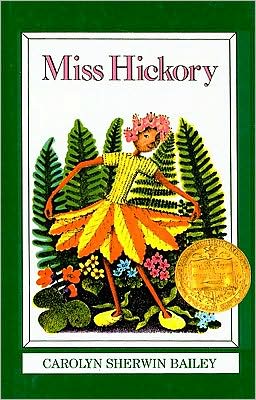
There is still another two or three months of winter left in North America and I'm sure many of us would love to run away to someplace warm or, failing that, hibernate.  Carolyn Sherwin Bailey's background as a teacher, principal, and life-long writer resulted in her dependably telling stories in a way that works with an audience.  Her version of "Why the Bear Sleeps All Winter" in  Firelight Stories published in 1907 is no exception.  (By the way, the publisher was Milton Bradley who now is known for board games.)  By that time she had already published four books including the first of her For the Children's Hour books.

While older anthologies don't document sources the way most do today, in her Introduction she groups the story with some other tales "The southern negroes have given us the stories...still told in Georgia and the Carolinas."  At the same time she omits the difficult dialect that almost becomes a foreign language so commonly used then in such tales.  The hero of the story is "little Brother Rabbit" oppressed by an "old Bear."  All the other animals are called Brother.  The name Br'er is a contraction of Brother and tales of Br'er Rabbit by Joel Chandler Harris don't include this story.  It would be fun to assign the animal parts to audience members to mime while the story is told. 


While it's not hibernation, curling up with a good book is always welcome.  Ms. Bauer has many books online:


******************
This is part of a series of postings of stories under the category, "Keeping the Public in Public Domain."  The idea behind Public Domain was to preserve our cultural heritage after the authors and their immediate heirs were compensated.  I feel strongly current copyright law delays this intent on works of the 20th century.  My own library of folklore includes so many books within the Public Domain I decided to share stories from them.  I hope you enjoy discovering new stories. 

At the same time, my own involvement in storytelling regularly creates projects requiring research as part of my sharing stories with an audience.  Whenever that research needs to be shown here, the publishing of Public Domain stories will not occur that week.  This is a return to my normal monthly posting of a research project here.  Response has convinced me that "Keeping the Public in Public Domain" should continue along with my monthly postings as often as I can manage it.    


There are many online resources for Public Domain stories, none for folklore is as ambitious as fellow storyteller, Yoel Perez's database, Yashpeh, the International Folktales Collection.  I recommended it earlier and want to continue to do so.  Have fun discovering even more stories!