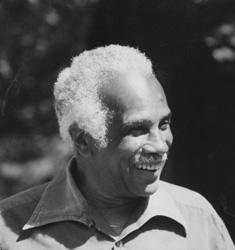
It seems incredible, but I've actually seen leaves saying the change to autumn is near! John Barton Gruelle or Johnny Gruelle, is best known as the creator of Raggedy Ann and Andy, even though his career as a syndicated cartoonist and author/illustrator included much more. I mention this because his story of "A Change of Coats" came up when I went looking into the subject of change. It's in his 1919 book, Friendly Fairies.
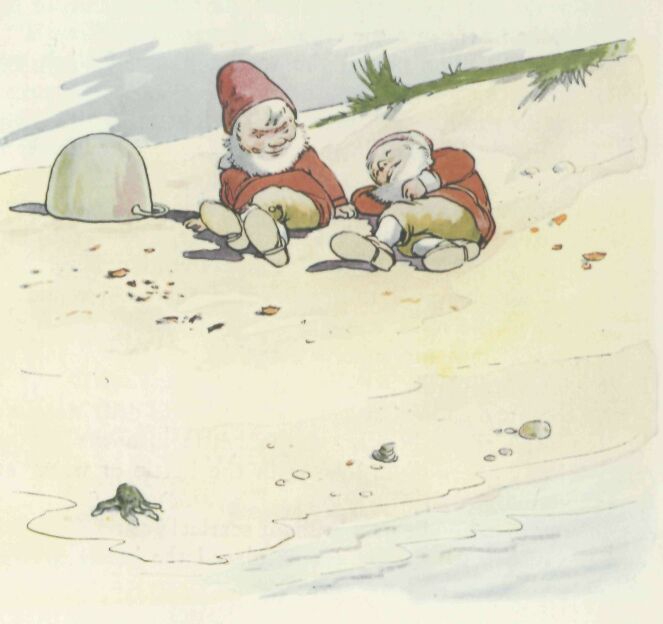
Of course it can be told as is -- although I'd hope you would show his delightful gnomes afterwards. Another way I could see telling it is with the Crab and Lobster as stick puppets, a kettle (real or otherwise) with different colors of fabric. You might also talk a bit afterwards about Gruelle's famous Raggedy Ann and Andy.
A CHANGE OF COATS
Two mischievous little gnomes were walking along the beach one
day and as they came to a pile of rocks they heard voices. One of
the little gnomes put his finger to his lips for silence and
peeped cautiously around the largest stone. There he saw a crab
and a lobster sitting upon a bunch of sea-weed in the
sunshine.
The other little gnome tip-toed up and joined his brother and
when they had listened a while they winked at each other and
quietly walked back to the beach. After whispering together a
moment one of the little gnomes ran up the beach and over a sand
dune.
The other gnome again crept up behind the large stone and
listened to the lobster and the crab.
"Yes," said the crab, "I agree with you, Mr. Lobster! While
our coats are just a plain green they are still quite
beautiful!"
"Ah! You speak the truth, Friend Crab," the lobster replied,
"Green is a lovely color and I am very glad that we are not
purple!"
"I am very glad that we are green, too." the crab said, "Just
suppose we were colored blue! I know I should not be able to
stand it! Would you, Friend Lobster?'
"No indeed!" the lobster cried, "Nor would I care to change to
any other color, would you, Friend Crab!" "It is nice to be
satisfied! Isn't it, Friend Lobster?"
"Yes! Especially when we are as satisfied as we are!" The
lobster answered.
The little gnome listening behind the large stone winked at
himself and smiled. He knew the lobster and the crab would give
anything if they were of a different color, for he could tell by
their conversation they were dissatisfied with their green
coats.
Soon the other little gnome appeared over the sand dunes
carrying a large kettle, and when he got to a spot on the beach
where the crab and the lobster could see and hear him he began
shouting in a sing-song manner: "Old clothes changed to new! Old
clothes changed to new! Old clothes changed to new!"
"Pooh!" said the lobster. "Who is foolish enough to wish to
change their natural coats?"
"Hmm!" said the crab as he sidled towards the beach. "Let's go
over and talk with him, anyway, and ask him if anyone ever
changes the color of their clothes. Not that I wish to change my
lovely green coat, you understand, but—"
"It would be interesting to hear about it, anyway!" the
lobster replied, as he crawled after the crab.
The little gnome with the large kettle sat upon the beach and
pretended he did not see the crab and lobster, but continued
crying: "Old coats changed to new! Green ones changed to red! Old
coat changed to new! Old coats changed to new!"
When the crab and the lobster came up quite near the little
gnome pulled a number of pieces of colored cloth from his pocket
and placed them upon the sand.
"How pretty!" said the crab.
"Very lovely!" said the lobster.
"Do you wish your coats changed in color?" asked the little
gnome.
"Ah, no, thank you!" the two hypocrites said. "We were just
looking around a bit!"
"Well, I am glad to have your company," said the little gnome
as he took a piece of scarlet cloth and laid it over the
lobster's back.
"How do you like that?" he asked of the crab.
"It looks fine!" said the crab. "Try it on me!"
The little gnome placed the scarlet piece of cloth over the
crab's back.
"How do you like it?" he asked the lobster.
"Did I look that well in that color?" asked the lobster by way
of reply.
"I think both of you will look far better if you let me change
you to scarlet. It's in far better taste, too!" the little gnome
added, pinching himself to keep from laughing.
"Shall we change?" the crab asked the lobster and the lobster
asked the crab.
"You will find the color a great deal warmer," said the little
gnome. "Green is decidedly cold, you know!"
So the little gnome gathered an armful of drift-wood and built
a fire. Then he dipped the kettle into the sea and placed the
crab and the lobster in the kettle of water and put the lid
on.
"Be sure and make us a brilliant scarlet!" cried the lobster
and the crab, as the little gnome placed the kettle over the
fire. An hour later the two little gnomes lay upon their backs
upon the sand and yawned contentedly, their little round stomachs
almost bursting their belts. Near them was the upturned kettle,
and scattered all about them on the sand were lovely pieces of
scarlet lobster and crab shells.
"It's funny," one little gnome said drowsily, "how one
sometimes will become dissatisfied with the way he was made by
Mother Nature and try to improve upon her work! It usually leads
to misfortune."
"Yes, that is true," the other little gnome replied, "We
should be satisfied and contented just as we are!"
"Well, I for one am satisfied!" the little gnome said,
stroking his fat stomach.
"So am I!" his brother laughed.
**************************
This is part of a
series of postings of stories under the category, “Keeping the
Public in Public Domain.” The idea behind Public Domain was to
preserve our cultural heritage after the authors and their immediate
heirs were compensated. I feel strongly current copyright law delays
this intent on works of the 20th century. My own library
of folklore includes so many books within the Public Domain I decided
to share stories from them. I hope you enjoy discovering them.
At
the same time, my own involvement in storytelling regularly creates
projects requiring research as part of my sharing stories with an
audience. Whenever that research needs to be shown here, the
publishing of Public Domain stories will not occur that week.
This is a return to my regular posting of a research project here.
(Don't worry, this isn't dry research, my research is always geared
towards future storytelling to an audience.) Response has
convinced me that "Keeping the Public in Public Domain"
should continue along with my other postings as often as I can manage
it.
See the sidebar for other Public
Domain story resources I recommend on the page “Public Domain Story Resources."




.jpg)
.jpg)
.jpg)
.png)