Tell me if you have a topic you'd like to see. (Contact: LoiS-sez@LoiS-sez.com .)
Please also let others know about this site.
Showing posts with label Frederic Taber Cooper. Show all posts

Friday, July 30, 2021

Cooper - A Quartet of Tree Fables from The Argosy of Fables - Keeping the Public in Public Domain

White Lake Township in Michigan is right next to my own township.  I often substitute at their library and there is the huge Pontiac Lake State Recreation Area and the Indian Springs metropark as two major places where I take my malamutt (malamute/husky) for some of our roughly every other day hikes.

Photo by Lukasz Szmigiel on Unsplash

That township is currently trying to get disaster recognition after this past weekend's tornado.  Yes, our area had trees toppled and branches torn off, but it's painful in White Lake.  Traveling through the township through the middle of this past week was an obstacle course as some roads were closed (some still are) and everywhere tried to cope with the damage.  Trees overnight have gone from something that looked like this 

Instead to something a bit closer to these two photos, except both are more orderly.

Photo by Ca Ku on Unsplash


Photo by Annie Spratt on Unsplash


Those photos may eventually look like the area with a semblance of order, but right now trees are uprooted, laying all over.  

Right now it just hurts to see the randomness of damage that was done with a heavy blow.  It's not like the horrible fires decimating the western U.S. in the sense that it seems so very random.  Scientists have been discussing the consciousness and possible communication of trees in recent years.  A good example is the March 2018 Smithsonian article "Do Trees Talk to Each Other?" I would hate to hear them shouting and crying out right now.  It all seems rather like J.R.R. Tolkien's the Ents.  (If you don't recognize who they are, I strongly recommend learning.  Trees may never seem the same to you.)

From ancient times trees have been with us, so it's no wonder they even are in fables.  I found four in An Argosy of Fable selected and edited by Frederic Taber Cooper.  The book starts with Classical Fables and the ones I've selected are in that section by Aesop and Phaedrus.  Aesop opens and closes this group of four.


Argosy has other less prolific classical fabulists, then continues with "Oriental Fables" (Hindoo [sic], Persian, Chinese, Armenian and Turkish), then goes on to "Modern Fables" (English, French, Spanish, Russian, German, Polish) and finally a section called "Kraal and Wigwam Fables" (African and American Indian).  Some of those have been given here in earlier blogs.  Obviously Cooper not only selected but edited a work that attempts to cover the teachings of a great many cultures.  It's interesting that the Wikipedia article says so little about him personally (although his Latin and Sanskrit professorship gives a hint) and somehow doesn't even list the Argosy.

If the trees have any wisdom or thoughts I suspect these four fables give a hint of their thoughts at this time.  Anthropomorphic?  Perhaps, but it hurts to see their present condition.

I believe the Jewish fable of the old man planting trees he'll never see grow is appropriate here.  His answer is that he's planting them for the next generation.  I've long talked about Arbor Day and the Arbor Day Foundation.  I don't know if baby trees can save the western part of our country, but I certainly hope, here in the middle and beyond, trees continue to provide shade, be useful, and beautiful while adding their necessary oxygen to our planet.

******************

This is part of a series of postings of stories under the category, "Keeping the Public in Public Domain."  The idea behind Public Domain was to preserve our cultural heritage after the authors and their immediate heirs were compensated.  I feel strongly current copyright law delays this intent on works of the 20th century.  My own library of folklore includes so many books within the Public Domain I decided to share stories from them.  I hope you enjoy discovering new stories.  


At the same time, my own involvement in storytelling regularly creates projects requiring research as part of my sharing stories with an audience.  Whenever that research needs to be shown here, the publishing of Public Domain stories will not occur that week.  This is a return to my regular posting of a research project here.  (Don't worry, this isn't dry research, my research is always geared towards future storytelling to an audience.)  Response has convinced me that "Keeping the Public in Public Domain" should continue along with my other postings as often as I can manage it.
Other Public Domain story resources I recommend-
  • There are many online resources for Public Domain stories, maybe none for folklore is as ambitious as fellow storyteller, Yoel Perez's database, Yashpeh, the International Folktales Collection.  I have long recommended it and continue to do so.  He has loaded Stith Thompson's Motif Index into his server as a database so you can search the whole 6 volumes for whatever word or expression you like by pressing one key. http://folkmasa.org/motiv/motif.htm
  • You may have noticed I'm no longer certain Dr. Perez has the largest database, although his offering the Motif Index certainly qualifies for those of us seeking specific types of stories.  There's another site, FairyTalez claiming to be the largest, with "over 2000 fairy tales, folktales, and fables" and they are "fully optimized for phones, tablets, and PCs", free and presented without ads.

    Between those two sites, there is much for story-lovers, but as they say in infomercials, "Wait, there's more!"
The email list for storytellers, Storytell, discussed Online Story Sources and came up with these additional suggestions:            
         - David K. Brown - http://people.ucalgary.ca/~dkbrown/stories.html
         - Richard Martin - http://www.tellatale.eu/tales_page.html
         - Spirit of Trees - http://spiritoftrees.org/featured-folktales
         - Story-Lovers - http://www.story-lovers.com/ is now only accessible through the Wayback Machine, described below, but the late Jackie Baldwin's wonderful site lives on there, fully searchable manually (the Google search doesn't work), at https://archive.org/ .  It's not easy, but go to Story-lovers.com snapshot for October 22 2016  and you can click on SOS: Searching Out Stories to scroll down through the many story topics and click on the story topic that interests you.
       - World of Tales - http://www.worldoftales.com/ 
           - Zalka Csenge Virag - http://multicoloreddiary.blogspot.com doesn't give the actual stories, but her recommendations, working her way through each country on a continent, give excellent ideas for finding new books and stories to love and tell.
     
You're going to find many of the links on these sites have gone down, BUT go to the Internet Archive Wayback Machine to find some of these old links.  Tim's site, for example, is so huge probably updating it would be a full-time job.  In the case of Story-Lovers, it's great that Jackie Baldwin set it up to stay online as long as it did after she could no longer maintain it.  Possibly searches maintained it.  Unfortunately Storytell list member, Papa Joe is on both Tim Sheppard's site and Story-Lovers, but he no longer maintains his old Papa Joe's Traveling Storytelling Show website and his Library (something you want to see!) is now only on the Wayback Machine.  It took some patience working back through claims of snapshots but finally in December of 2006 it appears!
    Somebody as of this writing whose stories can still be found by his website is the late Chuck Larkin - http://chucklarkin.com/stories.html.  I prefer to list these sites by their complete address so they can be found by the Wayback Machine, a.k.a. Archive.org, when that becomes the only way to find them.
You can see why I recommend these to you. Have fun discovering even more stories!

Saturday, July 4, 2015

100th Post of Keeping the Public in Public Domain

 100-fireworks
The fireworks here is not just for the 4th of July.

It's hard to believe, but there have been 100 stories in this series of Public Domain stories.  To celebrate I looked for a story with 100 in it and found a goodie.  Because it comes from another language, not every version of the title is translated  the same.  This comes from Frederic Taber Cooper's An Argosy of Fables which had 5 posts in September of 2013.  That book is huge and it was hard to limit myself to a representative of the main categories.  Today's story comes from the segment Cooper called "Hindoo Fables".  When that was mentioned earlier, I explained that was his early 20th century oversimplification of Indian culture since their majority religion is Hinduism.  This comes from the ancient Panchatantra tales.  Noted Sanskrit scholar, Arthur Ryder, has another version of the story he titles "Hundred-Wit, Thousand-Wit, and Single-Wit (pp 444-446)."  I prefer his title, but possibly Ryder's translation was too academic.  Cooper's version tells in more accessible style. 

While your at it, the first two weeks in June's discussion on fables used two Jataka tales for a discussion of whether to tell the moral or not.

A great way to spark a story is to take a proverb and create a story to illustrate it.  Fables do just that, but it's up to the teller to decide if telling the moral helps or hurts the story.

Either way, may our next 100 public domain stories help Keep the Public in Public Domain.
************************
This is part of a series of postings of stories under the category, "Keeping the Public in Public Domain."  The idea behind Public Domain was to preserve our cultural heritage after the authors and their immediate heirs were compensated.  I feel strongly current copyright law delays this intent on works of the 20th century.  My own library of folklore includes so many books within the Public Domain I decided to share stories from them.  I hope you enjoy discovering new stories.  


At the same time, my own involvement in storytelling regularly creates projects requiring research as part of my sharing stories with an audience.  Whenever that research needs to be shown here, the publishing of Public Domain stories will not occur that week.  This is a return to my regular posting of a research project here.  (Don't worry, this isn't dry research, my research is always geared towards future storytelling to an audience.)  Response has convinced me that "Keeping the Public in Public Domain" should continue along with my other postings as often as I can manage it.  


There are many online resources for Public Domain stories, none for folklore is as ambitious as fellow storyteller, Yoel Perez's database, Yashpeh, the International Folktales Collection.  I recommended it earlier and want to continue to do so.  Have fun discovering even more stories!


Saturday, November 2, 2013

Cory - Billy Bunny Series - Keeping the Public in Public Domain

Today's Keeping the Public in Public Domain has an idea for storytellers or puppeteers looking for a way to build a program wrapped around one character.  I've escaped from fables (see end of this post for more information) and this year's look Victorian Christmas that took the second half of October.

When I was still creating storytelling programs at one library I found it was easy to do a continuing story where each week I told a new adventure about one character -- I would have a puppet for the character, but that's optional.  Books that offer episodic stories where each chapter has a stand-alone adventure about one character were perfect for this.  The era covered by Public Domain had many such books and even series following characters.  I should have included Cuffy Bear when I came to Arthur Scott Bailey on my shelves as that was the first of a series about Cuffy and also the first of such books I have. 

David Cory had many series because he syndicated children's stories for the daily WZJ radio show in Newark, New Jersey.  A collection of his correspondence, some manuscripts, and memorabilia is housed at the Special Collections Research Center at Syracuse University Libraries.  Their description of his work says, "He came to writing after a twenty-year career as a stockbroker, beginning with stories invented for his children."  Project Gutenberg currently has 14 of his books including four series:

 Three of the Puss-In-Boots, Jr. series
Three of the Little Jack Rabbit series
and
 
 one from the Little Indian series.
Project Gutenberg has three from the series LITTLE JOURNEYS TO HAPPY LAND (no cover given)  and 
The Jumble Book,  a book that doesn't seem to be a series book, but has a variety of animal stories.

My own series book is from the Billy Bunny Books of the 1920s.  Project Gutenberg currently has two.  Mine is yet a third book:

(Notice some of those other titles in the series) 


The leaves are still enough on the trees, as I write this, giving some of Michigan's autumn beauty.  As a result I'm choosing these two stories that include Jack Frost and the second tale includes a bit of nature facts.

You will notice the mention at the beginning and end of each story tying it to the story just told or about to be told.  The song includes a word guaranteed to make today's children snicker, "gay."  It would be reasonable to avoid the distraction by changing the wording from "and gay" to "today" unless you want to spend time before the story discussing the term.  The vocabulary of older works sometimes requires you to make such decisions. 


Actually we're jumping to another story.  By the way, talking about changes and decisions, I might decide to remove some of the personification of those who aren't animals.  Examples of this are the character, Mr. Happy Sun, changing it to "the happy sun" and "his" to "its" and similarly handle Willy Wind if I don't think it hurts Cory's work.  Mother Nature is there, too.  Shades of Thornton Burgess and Old Mother West Wind!  Puppeteers especially need to consider the number of characters used.


If you're curious about that Luckymobile Uncle Lucky drove, go to this article from March 26, 2009 in the blog, Lady, That's My Skull to see it.
The blog's author, who writes under the name of Sleestak, was able to find several volumes of the series.  Sleestak seems to enjoy the art of Hugh Spencer more than the stories and shows several more illustrations from Billy Bunny and Daddy Fox, (available from Project Gutenberg) including a Billy Bunny doll worth watching for at antique stores. 

*****
At the beginning of today's article I mentioned Frederic Taber Cooper's An Argosy of Fables.  Prior to spending the second half of October looking at Victorian Christmas celebrations, starting on September 21, 2013, I made several posts from Argosy's Book One, Classical Fables, and Book Two, Oriental Fables, although I stopped in that section without including Armenian and Turkish Fables.  I'm a big fan of Turkish folktales about Nasreddin Hodja, so those fables could provide short additional material to balance out a program.  Book Three is called Modern Fables (remember the book was published in 1921) and covers English, French, Spanish, Russian (all by Krilov except one from that prolific author, Anonymous), German, and Polish (all by Krasicki) fables.  Book Four is titled "Kraal and Wigwam Fables" looking at fables from various areas of Africa and various Native American tales Cooper calls fables.  The good news is the sources of the Native American material is better identified than in many Public Domain books.  Unfortunately many of the other sources may be difficult to track down, especially when Cooper was referring to sources in another language or in something other than a book.  His work as editor, however, produces generally tellable stories.

If you consider that fables are the wisdom of the past and other cultures, the book is an excellent overview of a major type of story.  The same organization that brings us the Wikipedia does us a great service with its Wikisource placing the book online.
******************
This is my slightly revised series statement of purpose:
This is part of a series of weekly posting of stories under the category, "Keeping the Public in Public Domain."  The idea behind Public Domain was to preserve our cultural heritage after the authors and their immediate heirs were compensated.  I feel strongly current copyright law delays this intent on works of the 20th century.  I hope you enjoy discovering new stories. 

At the same time, I'm returning to involvement in projects requiring research as part of my sharing stories with an audience.  Whenever that research needs to be shown here, the publishing of Public Domain stories will not occur that week.  This is a return to my normal monthly posting of a research project here.  Response has convinced me that "Keeping the Public in Public Domain" should continue along with my monthly postings as often as I can manage it. 


Saturday, October 12, 2013

Cooper - Chinese Fables - Keeping the Public in Public Domain

In today's Part III of An Argosy of Fables, the Oriental Fables section looks at Chinese Fables.  I found today's tales, plus two I omit, particularly moving.  (Yes, later I'll tell a bit about the two I omit.)  I'm a sucker for Fox tales, so here is


Here's a second haunting story I must include.


I also said I would explain about the two I omitted.  China's diversity includes 55 ethnic minorities in addition to the Han Chinese majority.  Cooper doesn't  tell if his selections come from them or not. Since those minorities currently are less than 10% of the total population of China, I presume the fables Cooper includes are from the majority, but his sources are impossible for me to trace with one exception.  A major source is the journal called "China Review", which no longer exists although a similar title began in 1994. Two others seem to be translated by Cooper from the French.  Only Dennys's The Folklore of China can be found online so I skipped his fables, but the two in Argosy, "The Crows and the Owls" and "The Folly of Avarice" still resonate in the 21st century.  Dennys only devotes the final 10 pages of his 156 page book to fables.  If you bother to prowl the book, you see Cooper took the discussion of fables by Dennys and did readers the service of just presenting them as stories.

Next time we'll see the final section of "Oriental  Fables", Armenian and Turkish Fables.
**********************
This is part of a series of weekly posting of stories under the category, "Keeping the Public in Public Domain."  I will post on Saturdays in the series unless that week I have other research articles.  I hope this will satisfy all who have found these stories worthwhile.  I include myself in that audience.  The idea behind Public Domain was to preserve our cultural heritage after the authors and their immediate heirs were compensated.  I feel strongly current copyright law delays this intent on works of the 20th century.  I hope you enjoy discovering new stories. 

At the same time, I'm returning to involvement in projects requiring research as part of my sharing stories with an audience.  Whenever that research needs to be shown here, the publishing of Public Domain stories will not occur that week.  This is a return to my normal monthly posting of a research project here.  Response has convinced me that "Keeping the Public in Public Domain" should continue along with my monthly postings as often as I can manage it.  


Saturday, October 5, 2013

Cooper - Persian Fables - Keeping the Public in Public Domain

If fables are proverbs teaching wisdom, today I've chosen two with lessons still needed centuries after being devised.

Frederic Taber Cooper's An Argosy of Fables continues Book Two, Oriental Fables, with three sources of Persian Fables.  Present day Iran was once called Persia.
  1. The Sufi poet known as Jami wrote the Baharistan for his only surviving son.  
  2. Saadi, another Persian poet, wrote anecdotes in his Bostan (Cooper calls him Sadi and his work, The Burstan).  Those very brief anecdotes or fables are anonymously translated into English at Bostan e Saadi, so I would suggest reading it there.  
  3. The final source in this section is Anvar-i-Suhayli, which means The Lights of Canopus.  This is a 15th century Persian version of The Fables of Bidpai or it's called the Panchatantra, which you may remember was part of the previous section in Book Two.  (Bidpai is also known as Pilpai or Pilpay.)  Those Indian fables not only centuries later went to Persia, but also there's an Arabic version, which, among other things, changes the frame story, introduction, some of the animals, and instead calls the Brahmin a hermit.
Most of Jami's fables are quite brief, but this filled a page.

Moving from wisdom spoken by a tortoise is another reptile's story I've heard in various versions.


Whether it's the abbreviated version where someone gives a venomous snake a ride and is killed by the snake who says "You knew I was dangerous when you picked me up" to warn of the dangers of drugs or this look at violent enemies, these fables still contain wisdom.
**********************
This is part of a series of weekly posting of stories under the category, "Keeping the Public in Public Domain."  I will post on Saturdays in the series unless that week I have other research articles.  I hope this will satisfy all who have found these stories worthwhile.  I include myself in that audience.  The idea behind Public Domain was to preserve our cultural heritage after the authors and their immediate heirs were compensated.  I feel strongly current copyright law delays this intent on works of the 20th century.  I hope you enjoy discovering new stories. 

At the same time, I'm returning to involvement in projects requiring research as part of my sharing stories with an audience.  Whenever that research needs to be shown here, the publishing of Public Domain stories will not occur that week.  This is a return to my normal monthly posting of a research project here.  Response has convinced me that "Keeping the Public in Public Domain" should continue along with my monthly postings as often as I can manage it.  

Saturday, September 28, 2013

Cooper - "Hindoo" Fables - Keeping the Public in Public Domain

An Argosy of Fables, selected and edited by  Frederic Taber Cooper, continues its journey with "Book Two, Oriental Fables."  Cooper's antique spelling of "Hindoo" makes me wonder how many of the 20th century spellings that have changed their transliteration will look outdated or quaint to future readers?  Book Two has four parts: Part I - "Hindoo" Fables; Part II - Persian Fables; Part III - Chinese Fables; Part IV - Armenian and Turkish Fables.

India's fables are listed by Cooper as "Hindoo" Fables because Hinduism is the dominant religious and cultural tradition for the Indian subcontinent.  Don't take Cooper's Hindu designation too strictly as it includes four Jataka tales.  The Jatakas are among the earliest Buddhist literature.  Buddhism, in contrast to Hinduism is a relative newcomer to India and Asia.  It might have been more accurate to have said Sanskrit Fables, rather than Hindu, as all stories in Part I are part of the larger body of Sanskrit literature.  Seeing the Jatakas made me check back on two books I had earlier felt compelled to omit.  Ellen C. Babbitt's two volumes of the Jataka tales are indeed in Public Domain, but my editions were produced later.  I now have access to those original editions and will sidestep alphabetical arrangement right after finishing the Argosy of Fables.  Because of that I'll skip Cooper's Jatakas.

Part I has fables from Hitopadesha which is a collection with many fables in common with the Panchatantra and that is another, almost as large, group of Indian fables.  Besides the Jatakas, Katha-Sarit-Sagara rounds out Part I.  When I learned Kathasaritsagara was The Ocean of Story, a collection I've only seen in bits and that it was 18 books of legends, fairy tales, folk tales, and fables composed for the entertainment of the queen of Kashmir, I looked forward to dipping myself again in that ocean, but now understood why I'd never found a copy or copies of it.  The Wikipedia article talks about translations and at first I thought they would barely glimpse what the queen saw.  Not so!  The Internet Archive has the ten volume version of C.H. Tawney's translation of The Ocean of Story.  Here are some tips: each volume starts with a lengthy Foreward; many stories just have names of the characters for titles; volume 5 has the Panchatantra; and volume 10 includes the index to the complete work, plus alphabetical lists of the stories, the motifs, and the Jatakas.

As a personal aside, in prowling the various volumes I found volume 7 listed a story I'd only heard.   It tells of some men sharing abilities together which lets them bring a lion back to life.  I had no idea this was the source of a tale showing knowledge doesn't always equal wisdom.  (After browsing so many volumes, volume 10 helped me find it again and verify, yes, it was a lion and not a tiger.)

Several of those stories included in An Argosy of Fables remind me of stories told in various European traditions.  Stories do travel you know, even from an Ocean of Story which pre-date Grimm and Celtic literature and . . . well, you get the idea.  With such a large source, I'm starting here with just the "Hindoo Fables" and will save the other parts of Book Two, Oriental Fables for future posts here.

My selection here are two business-related fables from the "Ocean."  I'm uncertain what translation Cooper used, but they are similar to Tawney's translation.  Cooper was wrong, however, the second story is in volume 5, not 10.


**********************
This is part of a series of weekly posting of stories under the category, "Keeping the Public in Public Domain."  I will post on Saturdays in the series unless that week I have other research articles.  I hope this will satisfy all who have found these stories worthwhile.  I include myself in that audience.  The idea behind Public Domain was to preserve our cultural heritage after the authors and their immediate heirs were compensated.  I feel strongly current copyright law delays this intent on works of the 20th century.  I hope you enjoy discovering new stories. 

At the same time, I'm returning to involvement in projects requiring research as part of my sharing stories with an audience.  Whenever that research needs to be shown here, the publishing of Public Domain stories will not occur that week.  This is a return to my normal monthly posting of a research project here.  Response has convinced me that "Keeping the Public in Public Domain" should continue along with my monthly postings as often as I can manage it.  

Sunday, September 22, 2013

Cooper - Classical Fables - Keeping the Public in Public Domain

Book One in An Argosy of Fables by Frederic Taber Cooper is Classical Fables.  Part I is Aesop, a full 109 pages worth.  I'll skip that since this series started with Aesop.  Instead fables will be chosen from each of the other three parts.  Part II is Babrius (I'll give a Wikipedia link for each classical fabulist), Part III has two subsections, A is Phaedrus, while B is further fables attributed to Phaedrus, Part IV is labeled Avianus, Abstemius, Etc.  (Odo of Sherington is listed more than either Avianus or Abstemius.)

The first page of the Babrius part gives us a glimpse of the decorated initial opening his section by illustrator Paul Bransom.  It also has two stories and the second is certainly timeless.


For Part III I chose something definitely by Phaedrus.  It also gives a view of the fabulist's world.  In addition I chose a story accompanied by a full page illustration for a better view of Bransom's work.


Part IV includes some familiar stories, Avianus is credited with a story about a clever crow using pebbles to raise the level of water in a jar which I have heard attributed to Aesop, but Wikipedia points to Babrius as his probably source, but taking those fables from Greek to Latin; the section closes with the familiar story of The Miller, the Boy and the Donkey again attributed to Aesop, but Wikipedia explains that Faernus did a noteworthy version of Aesop in the 16th century; the many fables in Part IV by the English minister, Odo of Sherington, who is also known as Odo of Cheriton also had me wondering, so today's final selection combines yet another familiar story, the one about the belling of the cat by Abstemius with 2 tales by Odo.


The next Fables "book", Oriental Fables, will be next week's selection.
***************
This is part of a series of weekly posting of stories under the category, "Keeping the Public in Public Domain."  I will post on Saturdays in the series unless that week I have other research articles.  I hope this will satisfy all who have found these stories worthwhile.  I include myself in that audience.  The idea behind Public Domain was to preserve our cultural heritage after the authors and their immediate heirs were compensated.  I feel strongly current copyright law delays this intent on works of the 20th century.  I hope you enjoy discovering new stories. 

At the same time, I'm returning to involvement in projects requiring research as part of my sharing stories with an audience.  Whenever that research needs to be shown here, the publishing of Public Domain stories will not occur that week.  This is a return to my normal monthly posting of a research project here.  Response has convinced me that "Keeping the Public in Public Domain" should continue along with my monthly postings as often as I can manage it.  

Saturday, September 21, 2013

Cooper - An Argosy of Fables - Keeping the Public in Public Domain

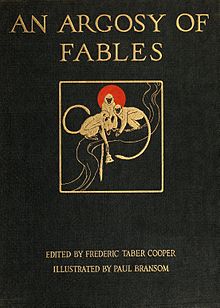
Oh boy, here I go again!  Didn't plan on developing a new research project, but I have a fascinating book which might be considered, if not a Public Domain encyclopedia of fables, certainly a great introductory resource to a major type of storytelling literature.  I started the Keeping the Public in Public Domain series with two very different books of Aesop's fables.  This isn't all I own using that ancient pedagogue's fables, but they were the only two pre-dating 1923, thus safely in Public Domain.  Frederic Taber Cooper in 1921 also saw the value of fables, not just those attributed to Aesop, but their value in classical and modern times and as a view into ethnic literature. The book's subtitle declares it's "A Representative Selection From the Fable Literature of Every Age and Land."
His book is so large, 485 pages, he divided it into three books: Classical Fables; Oriental Fables; and Modern Fables.  In trying to choose one or even one fable from each "book" I felt like Alice having fallen down the rabbit hole into Wonderland. 

I've often recommended going to Project Gutenberg to read the rest of a book featured here, but Wikisource did a loving reproduction of this book, complete with the beautiful Paul Bransom illustrations.  When I go to Project Gutenberg I'm so text-oriented I usually omit the illustrations for a swifter download.  From the cover illustration above, you can see that would be a shame.  They may have used a different edition as I find slight illustration differences from my book.  Their site also is not always as intuitive to search for a book, but once you find it, the reproduction is well done.  I suggest clicking those illustrations to enlarge them.  They were full-size in the original book and deserve a larger look to appreciate them.

The value of fables comes from their taking the wisdom of a culture and putting it in very brief form.  (Brevity...always a trick for a storyteller!)  Animals often are the characters, illustrating human traits, but they aren't the only possible actors.  Wikipedia points out they also can be mythical creatures, plants, inanimate objects or forces of nature.  (That Wikipedia article is worth visiting for its large listing of their many articles on classical and modern fabulists -- way more recent than Cooper's "modern" fabulists, as well as "notable fable collections."  As an example of what I mean, the list of modern fabulists includes people like George Orwell, Dr. Seuss, and James Thurber.)

As a storytelling teaching device, fables are perfect for student storytellers and writers.  I like to create fables starting with a proverb as fables teach a lesson.  Something worth considering is whether that lesson is stated or not.  Cooper seems to prefer stating the moral, especially for Classical Fables.  Modern thinking tends to consider stating the moral at the end too didactic.  That view prefers to let the audience or reader draw their own conclusions without hitting them over the head with a stated moral.

If Cooper calls his anthology three books, who am I to disagree?  It deserves at least three postings here, so starting tomorrow I will post a bit of the Classical Fables.  Aesop will be omitted since he's been covered earlier.  Tomorrow will be a bonus posting since today was spent discussing fables and specifically An Argosy of Fables.  Following my new schedule for the Keeping the Public in Public Domain series, I will post one story a week unless other research needs to interrupt the schedule.    That schedule is explained in the following new series summary.
******************
This is part of a series of weekly posting of stories under the category, "Keeping the Public in Public Domain."  I will post on Saturdays in the series unless that week I have other research articles.  I hope this will satisfy all who have found these stories worthwhile.  I include myself in that audience.  The idea behind Public Domain was to preserve our cultural heritage after the authors and their immediate heirs were compensated.  I feel strongly current copyright law delays this intent on works of the 20th century.  I hope you enjoy discovering new stories. 

At the same time, I'm returning to involvement in projects requiring research as part of my sharing stories with an audience.  Whenever that research needs to be shown here, the publishing of Public Domain stories will not occur that week.  This is a return to my normal monthly posting of a research project here.  Response has convinced me that "Keeping the Public in Public Domain" should continue along with my monthly postings as often as I can manage it.