Tell me if you have a topic you'd like to see. (Contact: LoiS-sez@LoiS-sez.com .)
Please also let others know about this site.
Showing posts with label MI "Fighting Fifth" Infantry. Show all posts

Friday, May 19, 2023

AI and "The Fighting Fifth"

We seem to be constantly hearing about Artificial Intelligence, including the ability to have something written by it.  I decided to go to https://bard.google.com/ and ask "What happened on May 20 or 21?" since finding the weekly topic always is my starting point.  Several notable events happened, but the one that caught my eye was:

    May 20, 1862 - The Battle of Seven Pines, also known as the Battle of Fair Oaks, was fought in Virginia during the American Civil War. The battle was a tactical draw, but it was a strategic victory for the Confederates, as it forced Union General George McClellan to abandon his plans to capture Richmond, the Confederate capital.


That battle was important to Michigan's "Fighting Fifth" Infantry and especially to my program reenacting Liberetta Lerich Green telling about her family's work as an Underground Railroad Station  and her brothers in the Civil War.  Both brothers  after that battle wound up at Libby Prison becoming what was sardonically known as "Guests of the Confederacy."  I next asked "What happened to prisoners of war after the Battle of Fair Oaks?"  Bard today said:

    The Battle of Fair Oaks, also known as the Battle of Seven Pines, was fought on May 31–June 1, 1862, in the Seven Days Battles of the American Civil War. The battle was a tactical draw, but it was a strategic victory for the Confederates, as it forced Union General George McClellan to abandon his plans to capture Richmond, the Confederate capital.

    Prisoners of war (POWs) taken during the Battle of Fair Oaks were held in a variety of locations, including both Union and Confederate prisons. The conditions in these prisons were often harsh, and many POWs died from disease or malnutrition.

    The treatment of POWs during the Civil War was governed by the Lieber Code, a set of rules and regulations issued by President Abraham Lincoln in 1863. The Lieber Code established basic standards for the treatment of POWs, including the right to food, water, shelter, and medical care. However, the Lieber Code was not always followed, and many POWs suffered greatly during their captivity.

    The following are some of the specific locations where POWs from the Battle of Fair Oaks were held:

  • Union Prisons:
    • Camp Douglas, Illinois
    • Camp Morton, Indiana
    • Camp Chase, Ohio
    • Camp Butler, Illinois
    • Camp Parole, Maryland
  • Confederate Prisons:
    • Libby Prison, Richmond, Virginia
    • Castle Thunder, Richmond, Virginia
    • Salisbury Prison, North Carolina
    • Andersonville Prison, Georgia

    The Battle of Fair Oaks was a bloody and costly battle, and the treatment of POWs after the battle was often harsh and inhumane. The experiences of these POWs are a reminder of the terrible cost of war.

That is different from what I was able to receive the other day!  I didn't save that first paragraph, but the difference begins with a subtle change in the opening sentence: 

    Prisoners of war (POWs) taken during the Battle of Fair Oaks were sent to a variety of locations, 

-- from that I find little the same (and find myself wondering if I edited it since my saved material was done earlier this week.)  I find the sentence continues:

    depending on their side of the war and the severity of their injuries.  Union POWs were typically sent to prisoner-of-war camps in the North, while Confederate POWs were sent to camps in the South.  Prisoners who were seriously injured were often sent to hospitals, while those who were not injured were typically held in barracks or tents.

Did I edit out about the Lieber Code?  Possibly, as I certainly wouldn't have Liberetta talk about it.  Instead I find a great deal related to my question about prisoner conditions:

    Conditions in POW camps varied greatly, depending on the resources available to the camp and the attitude of the captors.  Some camps were well-run and provided prisoners with adequate food, clothing, and medical care.  Others were poorly run and prisoners were often subjected to harsh conditions, including malnutrition, disease, and physical abuse.  

    The treatment of POWs during the Civil War was generally better than in previous wars, but it was still far from ideal.  Many prisoners died from disease, malnutrition, or exposure.  Others were killed or injured in  prison riots or escapes.  The war ended with the release of all POWs, but the experience left a lasting legacy of suffering and loss.  

    Here are some additional details about the treatment of POWs after the Battle of Fair Oaks:

    Union POWs: Union POWs were typically held in camps in the North, such as Camp Douglas in Chicago, Illinois; Camp Chase in Columbus, Ohio; and Camp Morton in Indianapolis, Indiana.  Conditions in these camps were generally fair, and prisoners were provided with adequate food, clothing, and medical care.  However, there were some exceptions. For example, Camp Douglas was overcrowded and unsanitary, and prisoners were sometimes subjected to harsh treatment by the guards.

    Confederate POWs: Confederate POWs were typically held in camps in the South, such as Libby Prison in Richmond, Virginia; Castle Thunder in Richmond, Virginia; and Andersonville Prison in Georgia. Conditions in these camps were often poor, and prisoners were often subjected to malnutrition, disease, and physical abuse. Andersonville Prison was particularly notorious for its harsh conditions, and it is estimated that over 13,000 prisoners died there.

    The treatment of POWs during the Civil War was a complex issue, and there is no easy answer to the question of how they were treated. However, it is clear that many prisoners suffered greatly during their time in captivity.

I then asked "What were the conditions in Libby Prison?" because both of Liberetta's brothers were there.   There are some changes I will note in black text, using it to show what I found earlier.  I also note Bard offers to "View other drafts."

      Libby Prison was a Confederate prison located in Richmond, Virginia, during the American Civil War. It was located in a (converted) former tobacco warehouse and (that) was originally intended (used) to house only officers, but it eventually became overcrowded and held enlisted men as well. (Union prisoners of war. The prison gained an infamous reputation for its overcrowded and harsh conditions.) Conditions in Libby Prison were notoriously harsh, and many prisoners died from disease, malnutrition, and exposure.

    Here are some of the specific conditions that prisoners of Libby Prison had to endure:

(This section really contradicts the earlier information):

Overcrowding: Libby Prison was designed to hold 1,000 prisoners, but it eventually held over 2,000. This overcrowding let unsanitary conditions and a lack of privacy.

(Note the statistical differences.)

    The prison was originally designed to hold 300 prisoners, but by the end of the war, it was holding over 1,000. The prisoners were confined to two floors of the building, which had no running water or sewage system. The prisoners were forced to sleep on the floor, and they were given very little food or water.

My earlier "draft" went on to say:

Malnutrition: Prisoners were given a daily ration of cornmeal, bacon, and salt, but this was often not enough to eat. Many prisoners also suffered from scurvy and other diseases due to a lack of vitamin C.

Exposure: The prison had no heating or cooling, so prisoners were exposed to the elements. In the winter, it was often freezing cold, and in the summer, it was often stifling hot.

Disease: Diseases such as typhoid, cholera, and smallpox were rampant in Libby Prison. The lack of sanitation and the overcrowding made it easy for diseases to spread.

Physical abuse: Prisoners were sometimes beaten by the guards for minor infractions. There were also reports of prisoners being tortured.

The conditions in Libby Prison were so harsh that many prisoners died. It is estimated that over 1,200 prisoners died in Libby Prison, including 300 who died in a single outbreak of typhoid fever. The prison was eventually abandoned in 1865, after the end of the Civil War.

The conditions in Libby Prison were a stain on the Confederacy's record. They are a reminder of the human cost of war, and they serve as a warning to future generations.

***In contrast the later look at conditions says:

    The conditions in the prison were ideal for the spread of disease. The prisoners were often crowded together, and they did not have access to proper medical care. As a result, many prisoners died from disease, including typhoid, dysentery, and pneumonia.

    The conditions in Libby Prison were a source of great suffering for the prisoners. Many prisoners lost weight and became emaciated. Some prisoners also suffered from mental illness as a result of the stress of their captivity.

    The conditions in Libby Prison were a violation of the Lieber Code, a set of rules and regulations issued by President Abraham Lincoln in 1863. The Lieber Code established basic standards for the treatment of POWs, including the right to food, water, shelter, and medical care. However, the Confederate government did not always follow the Lieber Code, and the prisoners at Libby Prison suffered greatly as a result.

    The prison was burned by Union troops on April 3, 1865, as they were evacuating Richmond. The fire destroyed the prison and all of the records of the prisoners who were held there.

I then asked "How were prisoners paroled from Libby Prison?" Again I'm offered to View other Drafts. There are only slight wording differences at first.

Prisoners were paroled from Libby Prison in a variety of ways. The most common way was for the prisoner to sign a document agreeing not to take up arms against the Confederate States of America until the end of the war. In exchange, the prisoner would be released and allowed to return home.

My earlier version goes on to name this system the "parole and exchange cartel."

Another way prisoners were paroled was through prisoner exchanges. In a prisoner exchange, the two sides would agree to release a certain number of prisoners on a one-for-one basis. This was often done to relieve overcrowding in the prisons.

Finally, some prisoners were paroled through special arrangements. For example, some prisoners were paroled so that they could attend the funerals of family members.

That isn't my earlier version.  Instead it earlier said:

Another way to be paroled was to be granted a furlough. This was a temporary release from prison, typically granted for medical reasons or to attend to family matters.

Finally, prisoners could also be paroled if they agreed to work for the Confederate government. This was often done in the case of skilled laborers, such as doctors or engineers.

(The next section says essentially the same, although it doesn't mention being rejected and it goes on to say: They also had to post a bond, guaranteeing that they would not take up arms again.)

The process of parole was often slow and bureaucratic. Prisoners could wait weeks or even months for their parole to be approved. In some cases, prisoners were denied parole even after they had signed the parole agreement.

Despite the challenges, parole was a way for prisoners to escape the harsh conditions of Libby Prison and return home to their families.

I finally asked "How frequently were prisoners paroled from Libby Prison?"  Again other drafts were offered.

The frequency of prisoner paroles from Libby Prison varied over time. In the early years of the war, paroles were relatively common. Here the earlier version may have only slightly different wording until it goes on to again cite the cartel: The parole and exchange cartel was in effect from 1862 to 1864, and during that time, thousands of prisoners were exchanged. However the cartel broke down in 1864, and after that, it became much more difficult for prisoners to be paroled.

There were a number of reasons why the parole and exchange cartel broke down. One reason was that the Union and Confederate governments were unable to agree on the terms of exchange. Another reason was that the war was going badly for the Confederacy, and they were reluctant to release prisoners who might be able to fight again.

After the parole and exchange cartel broke down, prisoners were still able to be paroled in some cases. However, it was much more difficult, and the process was often lengthy and complicated. Prisoners who were paroled after the cartel broke down were typically required to sign an oath of allegiance to the United States, and they were also required to post a bond.

***The newer version, however, does give some new and interesting information:

However, as the war progressed, paroles became less frequent. This was due to a number of factors, including the increasing number of prisoners, the growing distrust between the two sides, and the increasing difficulty of transporting prisoners.

According to the National Park Service, approximately 1,200 Union prisoners were paroled from Libby Prison during the course of the war. This represents about 10% of the total number of prisoners who were held at the prison.

The most common time for prisoners to be paroled was during the winter months. This was because the conditions in the prison were particularly harsh during the summer, and prisoners were more likely to die from disease or malnutrition.

The parole process was often slow and bureaucratic. Prisoners could wait weeks or even months for their parole to be approved. In some cases, prisoners were denied parole even after they had signed the parole agreement.

Despite the challenges, parole was a way for prisoners to escape the harsh conditions of Libby Prison and return home to their families.

What does this comparison between versions show?

For teachers and others proofreading to see if AI was used, there may be multiple versions to check.  The statistics about how many prisoners were held is worrisome because it has been said that AI sometimes gives misinformation.  Research in various books, however, may also give contradictory information.  The trick is for a human researcher to note the differences.  

The real question is: how a human might improve this dry information?  In the case of the Lerich brothers, Liberetta has some of the letters her family sent during that time and information directly from her brothers.  Older brother, Will, joined Michigan's "Fighting Fifth" because he wanted to "look out for his brother."  Isaac (commonly called Ike) joined as a bugle boy, but was injured and lay on the Fair Oaks battlefield for ten days.  Will was already in Libby Prison when Ike was finally carried in to join him.  Both wound up eventually being paroled for their injuries.  Ike was sent home, but he left the Invalid Corps or Veteran Reserve Corps to become an officer in the Third Michigan Infantry, as he could ride horseback all day -- although his letters home stress the difficulty of doing it.  By the time he mustered out in San Antonio after the war, he was a major.  Brother Will went back as an ordinary infantry soldier.  He also claimed to have been at Andersonville Prison, but I can find no proof of that.  Human research makes it look as if it was a bit of his own storytelling.  

Short of a time machine, both artificial intelligence and human claims are far from infallible.  As a storyteller I try to present from the point of view of the person telling the story.  AI may add to the story if it has access to information not easily located by the researcher.  As for teachers and other reviewers, the addition of a "human view", like those shared by the Lerichs, will remain important beyond just the facts.


Friday, February 10, 2023

"The Beacon Tree" and the Underground Railroad

Ages ago I began reenacting the story of an Underground Railroad station near Utica, Michigan.  Telling as Liberetta Lerich Green, I used her story recorded in a pamphlet called "The Beacon Tree" produced by the Shelby Township Historical Committee.  That information was rounded out by what I found at the Bentley Historical Library at the University of Michigan, in local newspapers on microfilm, and, of course, members from both the Lerich and Green family.  Among the historical society members I was also helped by Jo Burgess.  She was both a member of their group and a naturalist on staff and founder of what is now called the Burgess-Shadbush Nature Center, which includes the site of the Lerich farm.

I was recently approached by a Utica Community Schools student to participate in a class project about the Beacon Tree.  This is his video, running just under 5 minutes, including brief interviews with Hilary Davis from the Historical Committee and Janice Dobis, a teacher at Beacon Tree Elementary School.  I'm in the center of the interviews appearing first as Liberetta singing the song sung at the planting of the tree and then appearing as myself telling a bit more.  (Personal thoughts to self: I'm beginning to transition to telling more often as the older Liberetta and must get that white wig built up so my own darker hair doesn't show!)

This is a card about the program I do.

Aside from the project done by the student who wishes to remain anonymous, I know this is a bit of history that still needs to be told.  The family were pioneers even before statehood for Michigan and the Lerich boys each were in Michigan Infantry units in the Civil War (although there was nothing Civil about that War!)  This is why the sidebar on this blog has pages about the "Fighting Fifth" Infantry.

Michigan is nearing its bicentennial in 2037.  I like to say my historical storytelling is "as seen by the average person."  I hope the Lerichs and the Greens will continue to have their stories heard.


Saturday, June 8, 2019

Historic Fort Wayne Civil War Days and More!

For most of May through July I feel like I'm constantly on the run, especially when that means being on the road.  This blog comes out on a Saturday so the Anton Art Center in Mount Clemens  will celebrate their 50th anniversary with Super SatARTday.  Their building was the old Carnegie public library, so it seems appropriate that, as former children's librarian at the newer Mount Clemens Public Library, I preview my library summer reading program.  Libraries all across the country are thinking astronomically for their summer reading programs as it's also the 50th anniversary of the Moon Walk.

Sunday I return to Historic Fort Wayne for their annual Civil War Days.

Sarah Edmonds as Franklin Thompson
It's always a reunion to get together with friends and fellow re-enactors, like Elise Parker, who does a great job of presenting as Sarah Emma Edmonds, known for serving as a man and later as a nurse with the Union Army during the American Civil War. She even was granted a military pension.  In 1992, Sarah was inducted into the Michigan Women's Hall of Fame and some of Elise's research helped make that possible. 

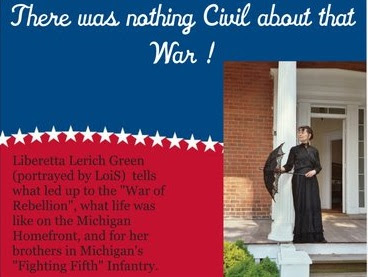
Look for us in the Commandant's house.  I'll only be able to be there on Sunday and look forward once again to bringing the story of Liberetta Lerich Green, who grew up on a Shelby Township Underground Railroad Station and her brothers were in the Michigan "Fighting Fifth" Infantry. 


The sidebar here contains Detroit newspaper articles from the Civil War era I was able to locate and reproduce about the Michigan Fifth Infantry.  Here's a picture of those brothers, Will and Ike.  Ike or Isaac started out as a bugle boy, was a "guest of the Confederacy" along with his older brother, Will, at Libby Prison.  His injuries were so bad, he was sent home, only to be brought back to be a Major with the Third Infantry which suffered even worse fatalities that the Fifth's loss of a quarter of its men.
Major Isaac Lerich and Will Lerich
For those of you who know my husband, yes, he'll be there, too, so listen for his banjo playing music from those days.
Hope to see you there or at another of my historical programs.

Saturday, December 22, 2018

Christmas - 1863 and beyond

FURLOUGHS!!!

Detroit Free Press, January 5, 1864

The furlough of the Fifth offered the Free Press an opportunity to show some support for the Fifth. The newspaper used it as an opportunity to do a good job of giving a retrospective summary of all they have experienced so far.  To my mind it smacks of "too little, too late", but it's up to you if instead it is "better late than never."  At least the writer made it clear that the members of the Fifth Infantry were respected -- even if the newspaper at other times offered criticism of the war itself and President Lincoln.

At the end of today's article you may choose to look for my personal Excuses and Frustrations Rant.  A few comments follow it in bold print to wrap things up.


In 
mid-February coverage will return to the Detroit Advertiser and Tribune.  The Detroit Free Press will wait until warmer weather heats up the action to a point where they feel unable to ignore it.  (See below my Excuses and Frustrations Rant for the conclusion of the Civil War Christmas series.)

Now the previously promised Excuses and Frustrations Rant -- definitely optional "behind the scenes" information:
I had the choice of dealing with a slanted microfilming and decided to let it lean.  However that meant I couldn't make the text as large because the slant on the second segment moves into the sidebar.  I also made the choice to keep the text as close as possible to roughly same size even if some segments might not touch the sidebar.  Then I decided to change text size, however, on the second column as it reproduced lighter if kept to that size.  So much for being consistent.  There also is that curse of microfilming, a small fold in the newspaper, but worse still the bottom of the column was illegible.  That was the first of two spots where information was missing.  I have my own shortcomings in producing this material to remind me the human element needs to be considered.  Surely the person or persons microfilming the newspapers tried to do their best in the shortest amount of time.  I presume time was at a premium with pressure to finish as quickly as possible because of the cost of paying the microfilmer needed to be kept as low as possible.  Similarly I find a day at the Library of Michigan is an attempt to capture the most information in the best condition possible.  Those days can have equipment difficulties including sharing the only machine that lets me save articles on a flash drive.  I've been able to do this twice a year.  Today's microfilm leaves me most apologetic.  It looks as if somehow I omitted Lieutenant Colonel Pulford's speech.  It's impossible at this point to include it.  Considering the difficulties in getting everything quickly found and saved, it's probably surprising this didn't happen before.  It doesn't make me happy that it happened at all and I offer my apologies for it.  Maybe someday the original hard copies will be available for online digitizing.  As long there is public domain availability for such digitized material it would be most welcome.  Until then, this blog will present the best microfilm I can offer.

Vintage postcard by Ellen Clapsaddle
Unlike previous years, because furloughs had the Fifth home briefly, there is no specific mention of the holidays of Christmas or New Year -- although it was a wonderful holiday present.  Christmas news ordinarily appeared later in January of the following year and would have been published in early 1864.
  
At last the final year of the war arrives in 1865!  Christmas that year has all who were fortunate enough to have survived back, home trying to get back to a "normal" reunited United States.  The fact that Lincoln is assassinated and then the trials and executions occur show "normal" may be a long time coming for all sections of the country.  In 1870 President Grant names Christmas an official federal holiday in the hope it will help unite the nation.
Please see my final comments for this series.

 (This is a quick note from LoiS: The wonderful pictures on the Old Design Shop blog are a gift from Julie, the owner of the Etsy Old Design Shop.  They fit these three Civil War Christmas posts -- which sometimes frankly can be a bit bleak just giving the newspaper accounts as the war progressed -- so I suggest the first link for lovers of vintage artwork and hope you will sign up for her blog there and then go on to her Etsy shop to see if there is something you might like to buy.  Scrapbookers, teachers, lovers of antiques, I recommend it to you.  I'm so happy with Julie's work from her large Gallery on the blog and her generosity there, that I included this credit to their source with each of my Civil War Christmas posts with this explanation.  Initially I said it would open the posts, but this expresses my Christmas wish for you, so I've moved it here to wrap up this series of posts.)


Saturday, December 15, 2018

Civil War Christmas - 1862

From Old Design Shop blog (see note at end of today's post.)

The Detroit area families entered the holidays of 1862 receiving only attention in the Detroit newspapers immediately after the battle of Fredericksburg.  I won't post those articles here (see the sidebar, 1862-Michigan's "Fighting Fifth" Infantry in Civil War , and scroll to the end of the year if you want to see them).  I will give only their labels of topics as they may be what Michigan families saw at home, causing considerable woe and worry.

Detroit Advertiser and Tribune, December 24, 1862 
Victorian graveyard

casualties, dead, Fredericksburg

The aftermath of Fredericksburg continues on Christmas eve in a fuller list of those recognized as killed in action.

Similarly 

Detroit Free Press, December 30, 1862

Fredericksburg, Gen. Berry, Lt. Col. Gilluly

This is the official commendation by Brigadier General Berry of the Fifth at Fredericksburg and especially of the Lieutenant Colonel Gilluly, who died leading his regiment into battle.
That same formal commendation of Lieutenant Colonel Gilluly by the Fifth Regiment officers appeared in

Detroit Advertiser and Tribune, December 31, 1862 

Fredericksburg, Lt. Col. Gilluly, Maj. Sherlock, Rev. Pritchard 


Old Design Shop Holly
  • The usual delay, however, into 1863 finally shows Christmas for the soldiers

Detroit Advertiser and Tribune, January 3, 1863 

Army of the Potomac, Christmas, food, Fredericksburg, Gen. Berry, Gen. Birney, Gen. Burnside, Gen. Kearney, Gen. Sigel, Lt. Col. Gilluly, Maj. Sherlock, Rappahannock, supplies, weather

The correspondent G.W.W. sent this on December 24, so it's publishing was delayed by a week and a half until January 3.  During that time the families and friends had only reports of casualties.  This finally gives a more hopeful update.  It also shows that Christmas dinner for the Fifth was hard bread and salt pork.  To add insult to their situation, they saw other regiments who did far less receiving accolades while they are a "war-worn regiment."

As a vital part of the Army of the Potomac, who were crucial to the Battle of Fredericksburg, I, too, feel these brave men have continued to be overlooked.  Even Michigander, Bruce Catton, in writing about Fredericksburg and the Army of the Potomac barely mentioned them.
As they say in Infomercials, "but that's not all!" 

Detroit Advertiser and Tribune, January 13, 1863

Army of the Potomac, Christmas, food, Fredericksburg, Gen. Berry, Gen. Birney, Gen. Burnside, Gen. Kearney, Gen. Sigel, Lt. Bolio, Lt. Col. Gilluly, Maj. Sherlock, Rappahannock, supplies, weather

Correspondent G.W.W. is published ten days after his delayed Christmas eve letter.  That holiday wasn't as good for them as New Year's.  The same issue also gives brief notice of Lieutenant George Bolio's resignation of his commission and return home.  No mention is made of the lieutenant's condition, only that he had "very complimentary testimonials as to his conduct at the battle of Fredericksburg."
This letter from G.W.W. may have its difficulties in clarity, but the Library of Michigan microfilm had the opposite side bleeding through on my own version, so I'm delighted that John Braden had a copy as good as this.
New Year's is a time of hope for  something better coming, but 1863 (published in 1864) is rather a time when the war continues with full fury.  Will Christmas 1863 be any better?  (Hint: The military sometimes recognizes the need for a furlough!)
Olddesignshop.com - lady hanging wreath
 (This is a quick note from LoiS: The wonderful pictures on the Old Design Shop blog are a gift from Julie, the owner of the Etsy Old Design Shop.  They fit these three Civil War Christmas posts -- which sometimes frankly can be a bit bleak just giving the newspaper accounts as the war progresses -- so I suggest the first link for lovers of vintage artwork and hope you will sign up for her blog there and then go on to her Etsy shop to see if there is something you might like to buy.  Scrapbookers, teachers, lovers of antiques, I recommend it to you.  I'm so happy with Julie's work from her large Gallery on the blog and her generosity there, that I will include this credit to their source with each of my Civil War Christmas posts with this explanation.  Initially I said it would open the posts, but the somber nature of Christmas 1862 leads me to move it here.)

Saturday, December 8, 2018

Civil War Christmas - 1861

This Whitney Made antique postcard certainly matches sentiments for Christmas 1861
(This is a quick note from LoiS: The wonderful pictures on the Old Design Shop blog are a gift from Julie, the owner of the Etsy Old Design Shop.  They fit these three Civil War Christmas posts -- which sometimes frankly can be a bit bleak just giving the newspaper accounts as the war progresses -- so I suggest the first link for lovers of vintage artwork and hope you will sign up for her blog there and then go on to her Etsy shop to see if there is something you might like to buy.  Scrapbookers, teachers, lovers of antiques, I recommend it to you.  I'm so happy with Julie's work from her large Gallery on the blog and her generosity there, that I will open each of my Civil War Christmas posts with this explanation.)

Civil War Christmas at Fort Wayne 

Christmas, Fort Wayne

Historic Fort Wayne is where the Fifth Michigan Infantry and many other regiments began by spending the summer of 1861 preparing.  By Christmas of 1861 they were part of the Army of the Potomac away in Camp Michigan near Mount Vernon.  Shortly before Christmas there is a report from there in the Detroit Daily Tribune.  There is no newspaper account about Christmas until January 9 in the Detroit Free Press.  For a taste of Christmas of that time, although they were not indoors in Camp Michigan, I want to recommend the page on the Historic Fort Wayne Coalition's website showing their Civil War Christmas celebration just held last week and annually.
 
The Fifth mustered in after the disaster at 1st Bull Run and Lincoln didn't issue his first special war orders until Jan. 31 of '62, asking the Army of the Potomac to move "before, or on, the 22nd day of February."  Their action built gradually, but definitely.

December 20, 1861 Detroit Daily Tribune 

5th Michigan Regiment Band, Alexandria, blankets, Camp Buhl, Camp Lyon, Captain Gilluly, Captain LaFavour, Captain Miller, Captain Trowbridge, Colonel Halman, flag, health, Mrs. O'Donnell

LSK: Mrs. O'Donnell is the wife of Lieutenant William O. Donnell, Company C from Saginaw (my label misspells it “O'Donnell”). This is from the Roster at https://www.migenweb.org/michiganinthewar/infantry/5compc.htm but somehow both the correspondent for the Detroit Daily Tribune and the Detroit Free Press, while spelling it differently, think that's the name. 
 
Correspondent, Ennius, apologizes for the delay in writing.  Like many soldiers, he tries to provide a positive view of "The Sunny Side of Camp Life - Breaking Up Camp - An Alarm - Preparation for Winter Quarters - Flag Raising - Health of the Regiment - Medical Staff."  At the same time he points to the need for blankets as winter approaches.


Ennius closes with "I will try to make my communications briefer and more frequent in the future."  As the war finally heats up they will indeed become more frequent. 
  
Next on  the 1862 page, January 9th, is the posting here of the Free Press article about the Fifth's Christmas.  The delay in getting a report to the Detroit newspapers occurs regularly.

January 9, 1862 Detroit Free Press 

Lois: Once again I feel apologetic about the quality of these microfilmed newspapers, but know I did what I could to clean up safely the articles using the accessory, Paint.  It's admittedly crude.  Some of the clarification of this article came from alternate filming by John Braden.  In the meantime know that the Fifth Infantry articles will start to increase as they began to see more action. Also note that the Free Press correspondent calls her Mrs. O'Donnell.
3d Michigan Regiment Band, Ada Worden, Camp Michigan, Captain Trowbridge, Christmas, food, General Richardson, John Braden, Lieutenant Dennison, Mrs. O'Donnell, Mount Vernon, Pohick Church, Richardson Brigade, S.B. Curtis
Here's a bit of clarification of a few things in the following article.
The heading is: From the Fifth Regiment with this subheading - In Camp Christmas Among the Soldiers - A Scouting Party - A Rencon-tre (sic).
The date it was sent to the Free Press was January 2d, 1862, which shows the delay receiving and publishing it.
The article begins: The winter air of Virginia freezes the fingers of our troops as severely as does that
of the Wolverine State, and letter writing is but a painful pleasure...
The crease further down, after talking about Mrs. O'Donnell, states: Like the good angel of the fairy legend, her presence is visible everywhere...

That alternate film cannot be cut apart, but it reveals these final two paragraphs (note also a different spelling of the lieutenant's name from the second article which follows this one). 
 From John Braden:   
And now to come to a piece of news which will present the other side of camp life. Lieutenant Denison, Company I, of this regiment, while in charge of a few men who were ordered to accompany a body of cavalry on a scouting expedition towards Pohick Church, was fired upon by a body of rebels lying in ambush, and wounded, a rifle ball passing through his under jaw and out of his neck.  The wound is a serious one, though not dangerous, and will probably compel the gallant Lieutenant to return home for a time to recruit his health.  I am gratified to be able to say that throughout the affair he behaved with great credit to himself, evincing a quiet, determined courage, which with the bravest of men is commendable, and although our party was obliged to retire they did so in good order, without losing a man, while two newly made graves showed the next day that our firing had done some execution.  Such little encounters as those which occur now and then, serve to keep up a healthy excitement which cannot fail to be productive of good to the cause whenever the hour arrive for us to enter a general action.
  It is understood that there are some officers to be sent home on recruiting service, as our regiment needs a few men.  Are there any laggards behind? If so, let them leave the everyday life they are leading and come forward.  Now is the time to join their brothers in arms.  Will they remain at home in the hour of their country's peril and at the moment when the army is about to march on to victory?  Let those remaining behind enroll themselves at once that they may in after years be enabled to say: "And I too was there."

* * *
I am grateful to fellow researcher on the Fighting Fifth, John Braden, for his generous sharing of additional material that adds to a view of this same period.  It comes from an unknown newspaper, found in a scrapbook put together by Ada Worden starting in 1861.  Not only is the newspaper unknown, but the first page also is no longer in the scrapbook and, just as with the illegible parts of the Free Press, not everything can be seen.  In some cases Ms. Worden wrote what was illegible even at the time of obtaining the newspaper.  Even with those important omissions it is worth adding to the information given in the Detroit Free Press article as a useful supplement, even clarifying the name of Lieutenant Dennison, who was shot.  The article's author, S.B. Curtis, I had hoped to turn up in future research so I could update this date.
From the Old Design Shop blog in 2011
While those articles reach into more than a week in 1862, imagine the families waiting to see the articles and receive equally delayed mail.

Next week will be Christmas of 1862 with a similar delay.

Saturday, December 1, 2018

Civil War Christmas Overview

When the United States became disunited in the Civil War, four Christmases were affected. 

The same day this is posted I will bring back my reenactment of Liberetta Lerich Green to talk about her family and, especially, about her brothers Isaac and William who were in the Fighting Fifth and the Third Infantry during the war. 

Wikipedia's article, Christmas in the American Civil War makes a good overview.  Beyond that, this brief summary comes from Civil War Saga's "Christmas during the Civil War" by Rebecca Beatrice Brooks.  She talks about both the homefront and the soldiers themselves.  I particularly appreciate her mention of the soldiers  "decorating their camp Christmas trees with hard-tack and salt-pork and singing carols such as 'Come All Ye Faithful' and 'Silent Night.' ” I also note her mention of some special dinners for "especially Union soldiers in the beginning of the war".  In the coming weeks in December I will post from Detroit newspaper articles about those Christmases.  It's worth noting how circumstances change for the Fighting Fifth Infantry.

My sidebar gives access to the various articles from those Detroit papers I was able to locate and reproduce.  At one time it was a separate blog, but after the sesquicentennial ended in 2015 I transferred it to this site.  The Fighting Fifth was composed of Michigan volunteers.  They were part of the Army of the Potomac and Michigan's contribution to the American Civil War.  Lincoln responded to us with "Thank God for Michigan!" with good reason.

That first Christmas brought contrasts for specific regiments and soldiers versus those at home.  It still does for our military.

"Tad" Lincoln photographed by Matthew Brady
“And when I turned from these musings upon the bill of fare they would have at home to contemplate the dreary realities of my own possible dinner for that day – my oyster can full of coffee and a quarter ration of hard-tack and sow-belly comprised the menu”  wrote one soldier in a book titled The Story of a Common Soldier of Army Life in the Civil War, 1861-1865 while President Lincoln and his family celebrated Christmas during the first year of the war by holding a Christmas party at the White House.  In later years Lincoln had plenty of reason to visit soldiers in the hospital.  He took along his youngest son, "Tad" who, on Christmas Eve 1863, told his father he wanted to send all of his many gifts sent to him by the general public to the soldiers. Lincoln agreed and said: "Yes, my son, Send a big box. Ask Mother for plenty of warm things, and tell David to pack in all the good eatables he can, and let him mark the box, 'From Tad Lincoln."

Mary Todd Lincoln raised money for Christmas dinners for the soldiers and often visited the hospitals bringing fruit and flowers and sometimes even helping with their correspondence.

Over and over I find reference to one of the most famous Christmas gifts: General Sherman after capturing the city of Savannah, Georgia in December of 1864, a significant military achievement  marking the beginning of the end of the war, sent President Lincoln this telegram, “I beg to present you as a Christmas gift, the city of Savannah, with 100 and 50 guns and plenty of ammunition, also about 25,000 bales of cotton.”

Michigan's 21st Infantry is noted for hitching up several of their mule carts and putting branches on the mules to look like reindeer while they distributed food to the Savannah  area.  I've never had a very favorable view of Sherman, although I understood why he caused the devastation he did.  For a more balanced view, including the "reindeer", here's an interview on National Public Radio to read or hear from Stanley Weintraub, the author of General Sherman's Christmas about that area where many Michigan soldiers became a part of history.

For a further look at the homefront, be sure to see "Civil War Christmas" by Maggie MacLean in her Civil War Women blog
During the Civil War, Christmas was celebrated in both the United States and the Confederate States of America although the day was not recognized until 1870, when President Ulysses S. Grant made Christmas an official Federal holiday in an attempt to unite north and south. The war continued to rage on Christmas Day and skirmishes occurred throughout the country.  …
In the United States, the widespread customs of Christmas cards, carols and trees date back to the 1850s. A feature story in the magazine Godey's Ladys' Book initiated the most beloved symbol of the American family Christmas - the Christmas tree. The story was about Queen Victoria's and Prince Albert's Christmas tree, which was a custom Prince Albert brought to England from his native country, Germany.
Godey's Lady's Book on left; Illustrated London News on right
I use both Godey's Lady's Book illustration from 1860 and the Illustrated London News engraving from 1848 in my Victorian Christmas program about turn of the Century Christmas and how it shaped our holiday traditions.  Can you spot the differences between the royal versus American?

While soldier's Civil War trees were decorated with their rations of hard tack and salt pork, at home were strings of popcorn, ribbon, pine cones, and other homemade paper and foil decorations carefully combined with candles.  Traditional greenery, including holly and mistletoe decorated home mantels, windows and doors and even a Yule log in the fireplace, while the soldiers scrounged for firewood just as they would on any winter day.

Santa Claus was particularly used in the war by German immigrant, Thomas Nast, creating so many visuals promoting both Union war efforts and Christmas traditions. His images of Santa Claus combine both the Clement Moore 1822 poem called both "A Visit from St. Nicholas" or "Night Before Christmas" and his own German idea of St. Nicholas.  Nast images of Santa Claus and of the Civil War are Public Domain, but some, like Paul's at Sonofthesouth.net/ have been digitally enhanced and are copyrighted.  Nast is often called the father of American political cartoonists.  Lincoln called him "our best recruiting sergeant."  There is much online about him and I would love to use his illustrations from Harper's Weekly, but for now will go on with more about Christmas at home during the war.

Presents were often homemade, but the economy, especially in the South, sometimes made even the materials to make them difficult to obtain.  In many historical accounts I find mothers explained the absence of presents because Santa Claus couldn't run the 1863 blockade of Southern coasts, or that the Yankees had shot him!

Thanks to the Victorian influence Christmas carols were sung both at home and by homesick soldiers during the Civil War along with more secular songs like "Jingle Bells", "Deck the Halls", and, I was surprised to learn, even "Up on the House Top." The latter surely goes back to the importance of Santa Claus by then.

Another song began as a poem when Henry Wadsworth Longfellow wrote the pacifist poem, "Christmas Bells" on Christmas Day 1863 in the wake of his son, Lieutenant Charles Longfellow's serious injuries.  Charles had enlisted against his father's wishes and had been injured once before in the war.  Longfellow's second wife and Charles's mother, Fanny, earlier had died tragically and his grief is obvious.  (That link is also to the Civil War Women blog and provides an interesting supplement to the more traditional Wikipedia article on Longfellow. ) After the war the poem was set to music and became the carol, "I Heard the Bells on Christmas Day" omitting two stanzas from the original poem about the war.  It was a long way from the Christmas of 1861 which saw soldiers full of bravado, still relatively well fed and equipped, and eagerly anticipating Christmas boxes of treats from home. Often officers then authorized extra rations of spirits and men engaged in greased pig-catching.

Finally this comes from Steven N. Cone's American Civil War.50megs.com.  I give it here as an excellent grouping year by year of Christmas during the war years.  He credits his sources this way:
Information taken from "We Were Marching on Christmas Day:
A History and Chronicle of Christmas During the Civil War" by Kevin Rawlings.
Unfortunately I don't have the book and I'm uncertain how much is originally written by Kevin Rawlings.  It is enough of a standard to find him often quoted elsewhere.  He has graciously given me permission to include work from that book now in its second printing and he is at work on an expanded edition.  He's also planning a new website (that's guaranteed to take time and attention!)  Here's his present site where you can see he portrays the Patriotic Civil War Santa based on Thomas Nast's front page illustration on Harper's Weekly, January 3, 1863. 

His site credits the photo as an Ambrotype image taken by Claude Levet in 1989.

I continue with the information found on American Civil War.50megs.com, but, due to the possibility of copyright problems, as explained in "Are Civil War images in Harpers Weekly protected by copyright" I omit the illustrations.

Many southern children were told that "Santa was a Yankee" so Confederate pickets would not let Santa through.
By contrast though, Many northern children still received gifts and treats because the northern economy actually flourished and expanded as the war dragged on.
One soldier described Christmas 1862 in the union Iron brigade.. " two men from company f provided a temporary diversion on Christmas Day. The two got into a fight that ended with one struck the other over the head with a musket bending the barrel so badly as to render it unserviceable.

"Ought it not be a Merry Christmas?"

ILLUSTRATION
Lonely camp scene from an 1862 Harper's Weekly entitled "Christmas Eve".
Even with all the sorrow that hangs, and will forever hang, over so many households;
even while war still rages; even while there are serious questions yet to be settled - ought
it not to be, and is it not, a merry Christmas?"
Harper's Weekly, December 26, 1863
vs. the familiar Harper's Weekly January 3, 1863 edition about separation.
For a nation torn by civil war, Christmas in the 1860s was observed with conflicting emotions. Nineteenth-century Americans embraced Christmas with all the Victorian trappings that had moved the holiday from the private and religious realm to a public celebration. Christmas cards were in vogue, carol singing was common in public venues, and greenery festooned communities north and south. Christmas trees stood in places of honor in many homes, and a mirthful poem about the jolly old elf who delivered toys to well-behaved children captivated Americans on both sides of the Mason-Dixon line.
But Christmas also made the heartache for lost loved ones more acute. As the Civil War dragged on, deprivation replaced bounteous repasts and familiar faces were missing from the family dinner table. Soldiers used to "bringing in the tree" and caroling in church were instead scavenging for firewood and singing drinking songs around the campfire. And so the holiday celebration most associated with family and home was a contradiction. It was a joyful, sad, religious, boisterous, and subdued event.
Before the war
Many of the holiday customs we associate with Christmas today were familiar to 1840s celebrants. Christmas cards were popularized that decade and Christmas trees were a stylish addition to the parlor. By the 1850s, Americans were singing "It Came Upon a Midnight Clear," "Oh Little Town of Bethlehem," and "Away in a Manger" in public settings. In 1850 and 1860, Godey's Lady's Book featured Queen Victoria's tabletop Christmas tree, placed there by her German husband Prince Albert. Closer to home, in December, 1853, Robert E. Lee's daughter recorded in her diary that her father - then superintendent at West Point - possessed an evergreen tree decorated with dried and sugared fruit, popcorn, ribbon, spun glass ornaments, and silver foil.
Clement Clarke Moore, a religious scholar who for decades was too embarrassed to claim authorship of the 1822 poem, "A Visit From St. Nicholas," was now well-known for his tribute to Santa Claus. "Santa Claus" made his first public appearance in a Philadelphia department store in 1849, marking the advent of holiday commercialism.
By 1860, many worried about civil unrest, fearful this Christmas would be the last before the outbreak of war. An Arkansas diarist writes:
"Christmas has come around in the circle of time, but is not a day of
rejoicing. Some of the usual ceremonies are going on, but there is
gloom on the thoughts and countenances of all the better portion of our people."
1861
ILLUSTRATION
Men of the 5th New Hampshire engaged in a hilarious greased pig chase as their
Christmas entertainment. From Frank Leslie's Illustrated History of the Civil War.
Events proceeded quickly in 1861, hastening war. Abraham Lincoln became the 16th president of the United States in March and the bombardment of Fort Sumter occurred in April. Southern states seceded and the Confederates claimed their first major victory at the first battle of Manassas. For the shopkeeper or farm boy or student away from home for Christmas the first time, melancholy set in.
Robert Gould Shaw, then a 2nd lieutenant in the 2d Massachusetts Infantry, writes about guard duty near Frederick, MD. He would later earn fame as the commander of the heroic African American unit, the 54th Massachusetts.
"It is Christmas morning and I hope a happy and merry one for you all,
though it looks so stormy for our poor country, one can hardly be in merry humor."
. . .
Yet Christmas 1861 also saw soldiers full of bravado, still relatively well fed and equipped, and eagerly anticipating Christmas boxes of treats from home. Often officers authorized extra rations of spirits and men engaged in greased pig-catching contests, footraces, jumping matches, and impromptu pageants dressed as women. Soldiers erected small evergreen trees strung with hardtack and pork. Some were excused from drills, although other references point to the need to haul logs and forage for firewood no matter what day of the year it was.
IL
Artist Winslow Homer depicts soldiers' joy at receiving holiday boxes
from home in this 1861 Harper's Weekly illustration.
1862
ILLUSTRATION
By Christmas, 1862, Thomas Nast had allied Santa Claus with the Union Army.
From Harper's Weekly, January 3, 1863.
This sad year brought forth the war's impact full force with battles at Shiloh, Manassas, and Antietam, and campaigns in the Shenandoah Valley and the Peninsula. Many Fredericksburg, Virginia citizens were homeless or fled their town just prior to Christmas.
Harper's Weekly illustrator Thomas Nast, a staunch Unionist, is now depicting Santa Claus entertaining Federal soldiers by showing them Jefferson Davis with a cord around his neck. Abraham Lincoln would later refer to a politicized Santa as "the best recruiting sergeant the North ever had." More moderate illustrations show soldiers decorating camps with greens and firing salutes to Santa. Ironically, it was Nast who fixed Santa's home and toy workshop address at the "North Pole" "so no nation can claim him as their own."
John Haley of the 17th Maine, for instance, wrote the day before Christmas. "It is rumored that there are sundry boxes and mysterious parcels over at Stoneman's Station directed to us," Haley continued in his diary. "We retire to sleep with feelings akin to those of children expecting Santa Claus. We have become very childish in some matters--grub being one of them." On Christmas Day, Haley returned to his tent to endure a practical joke from his tentmate:
On returning to camp, I was informed by my tentmate that there was no parcel at the station bearing my name. My mental thermometer not only plummeted to below zero, it got right down off the nail and lay on the floor. Seeing this, my tentmate made haste to dive under the bed and produce the box, which he had brought from the station during my absence, and in a few minutes we were discussing the merits of its contents. Most of the men have been remembered, and any that have not received something from home are allowed to share with their more fortunate neighbors.
Officers of the 20th Tennessee gave their men a barrel of whisky to mark the day. "We had many a drunken fight and knock-down before the day closed," wrote one participant. But there were other more somber occurrences recorded for Christmas 1862. One account tells of soldiers being forced to witness an execution for desertion and another grim letter describes how men firing their weapons in a funeral salute were mistakenly punished for unauthorized holiday merrymaking.
1863
ILLUSTRATION
Children still found Christmas morning joyful in this 1864 Harper's Weekly edition.
Note that the youngster on the right is equipped with sword, drum, kepi and a haversack
with "U.S." prominently displayed.
This year saw the battles of Gettysburg and Vickburg and the beginning of the end for the Confederacy. Thomas Nast portrayed Santa Claus in a patriotic uniform, distributing to Yankee soldiers to raise their morale. Southern parents were gently preparing their children that Santa Claus may not "make it through the blockade" to deliver presents this year. Harper's Weekly depicted a tender reunion scene of a soldier husband and father briefly reunited with his family during furlough.
Holiday boxes and barrels from home containing food, clothing and small articles of comfort were highly anticipated by soldier recipients. Depending on their duty assignment, Christmas dinner may have consisted of only crackers, hard tack, rice, beans and a casting of lots for a single piece of beef too small to divide. Those lucky enough to receive boxes from home could supplement a meager meal with turkey, oysters, potatoes, ham, cabbage, eggnog, cranberries and fruitcake.
One of the dreariest accounts of Christmas during the Civil War came from Lt. Col. Frederic Cavada, captured at Gettysburg and writing about Christmas 1863 in Libby Prison in Richmond:
"The north wind comes reeling in fitful gushes through the iron bars,
and jingles a sleighbell in the prisoner's ear, and puffs in his pale
face with a breath suggestively odorous of eggnog."
Cavada continued:
"Christmas Day! A day which was made for
smiles, not sighs - for laughter, not tears - for the hearth, not prison."
He described a makeshift dinner set on a tea towel-covered box. Each prisoner brought his own knife and fork and drank "Eau de James" (water from the nearby James River.) Cavada reported he combed his hair for the occasion and further related that the prisoners staged a "ball" with a "great deal of bad dancing" during which hats were crushed and trousers torn. Sentries called "lights out" at 9 p.m.
1864
ILLUSTRATION
General William Tecumseh Sherman is host at a celebratory Christmas dinner
in Savannah after presenting the captured city to President Lincoln as a holiday.
The final wartime Christmas came as the Confederacy floundered, Lee's Army behind entrenchments in Petersburg and Richmond. Abraham Lincoln received a most unusual holiday - the city of Savannah, GA -presented by General William Tecumseh Sherman via telegram. Union and Confederate sympathizers were hoping this Christmas would be the last at conflict.
Holiday season charity was not forgotten this year. On Christmas Day, 90 Michigan men and their captain loaded up wagons with food and supplies and distributed them to destitute civilians in the Georgia countryside. The Union "Santa Clauses" tied tree branches to the heads of the mule teams to resemble reindeer.
Many other units, however, were on the march, either trying to evade capture or pursuing the opponent for better position. Soldiers left in the squalid conditions of prison camps spent the day remembering holidays at home, as did others in slightly more comfortable settings.
Moods were more bouyant in Washington and New York, where celebrants supped on substantial feasts and attended the theatre.
IL
"Snowy Morning on Picket" from Harper's Weekly January 30, 1864.
After the war
ILLUSTRATION
Thomas Nast's most famous image of Santa Claus was published in Harper's Weekly on January 1, 1881.
The events of 1865 again influenced holiday celebrations. President Lincoln's assassination shocked the nation, but by mid-summer, the conspirators were hung or imprisoned for lengthy terms. War was ended and many soldiers had been mustered out of service. The 13th Amendment to the Constitution became law on December 18, 1865, abolishing the institution of slavery. Soldiers and civilians alike were ready to reunite with their families and again embrace Victorian holiday customs.
At the end of hostilities, commerce once again flowed southward, and goods filled Northern shops. Long-held holiday traditions were re-introduced, as ornamental greens and trees filled the markets and toys and other items went on display. Newspaper illustrations were of domestic and wintry scenes.
The final verse of a poem By the Christmas Hearth published in the Christmas edition of Harper's Weekly reflected the sentiments of many:
Bring holly, rich with berries red,
And bring the sacred mistletoe;
Fill high each glass, and let hearts
With kindliest feelings flow;
So sweet it seems at home once more
To sit with those we hold most dear,
And keep absence once again
To keep the Merry Christmas here.
(LSK: After that, the site gives “The Story Behind: 'I Heard the Bells on Christmas Day' “)

Finally I've previously mentioned the network, My Merry Christmas.  I recommend prowling it thoroughly.  I've published some of my Public Domain stories there and back in 2011 Mary Hansel published in the Christmas History section "Christmas during the Civil War", which draws from many of the sources above for yet another nice summary.

I will publish the relevant Detroit newspaper articles over each of the coming December Saturdays.