Tell me if you have a topic you'd like to see. (Contact: LoiS-sez@LoiS-sez.com .)
Please also let others know about this site.
Showing posts with label Arthur Rackham. Show all posts

Friday, August 29, 2025

Vernon Jones/Aesop - The Father and His Daughters - Keeping the Public in Public Domain

It's Labor Day Weekend with surprisingly good weather predicted. This past week thus predicteth the Old Farmers' Almanac for 2025-26:

The Farmers' Almanac's 2025-26 Winter Outlook calls for "chill, snow, repeat" across the country.Farmers' Almanac 

Here in the Great Lakes region - including Michigan - and other areas of the Midwest we “are set for a classic winter wonderland.” The weather is expected to be very cold and snowy.

RELATED: Michigan winter outlook: NOAA predicts wetter, whiter conditions for southern regions

Winter officially begins with the solstice on Dec. 21, but snow could arrive as early as September in some areas of the country. Nationwide, the coldest times, as usual, are expected in mid-January and mid-February, saying a " significant cold snap in mid-January will keep most shivering. Winter’s wrath continues with another pronounced cold spell predicted for mid-February." As for snow: The Great Lakes, Ohio Valley, and North Central states are set for a classic winter wonderland.

The Almanac's long-range forecasts began over 200 years ago using a formula "set forth back in 1818, but also accounts for fluctuations in the environment on Earth, as well as solar activity (sunspots), the motion of the Moon, and other proprietary factors." They also do an annual review of accuracy and was fairly accurate even if La Niña did make last winter wetter.

All of this made me wonder what story might be appropriate. Aesop, once again, has a short bit of  wisdom. There are many editions, but Aesop's Fables; A New Translation by V.S. Vernon Jones does an easy look at weather and maybe a bit more.

THE FATHER AND HIS DAUGHTERS

A Man had two Daughters, one of whom he gave in marriage to a gardener, and the other to a potter. After a time he thought he would go and see how they were getting on; and first he went to the gardener's wife. He asked her how she was, and how things were going with herself and her husband. She replied that on the whole they were doing very well: "But," she continued, "I do wish we could have some good heavy rain: the garden wants it badly." Then he went on to the potter's wife and made the same inquiries of her. She replied that she and her husband had nothing to complain of: "But," she went on, "I do wish we could have some nice dry weather, to dry the pottery." Her Father looked at her with a humorous expression on his face. "You want dry weather," he said, "and your sister wants rain. I was going to ask in my prayers that your wishes should be granted; but now it strikes me I had better not refer to the subject."

***

If you want to know a bit more, V.S. stands for Vernon Stanley Vernon-Jones and talking about Aesop's Fables Wikipedia states: 

Notable early 20th century editions include V.S. Vernon Jones' new translation of the fables accompanied by the pictures of Arthur Rackham (London, 1912)[97] and in the US Aesop for Children (Chicago, 1919), illustrated by Milo Winter.[98]

This story doesn't  receive an illustration by Rackham, but the general opinion from the time of the book's publication is his translation is highly regarded for preserving the timeless moral clarity of the fables. Rackham's illustrations have kept it popular.

May your storytelling weather be fine!

************** 

This is part of a series of postings of stories under the category, “Keeping the Public in Public Domain.” The idea behind Public Domain was to preserve our cultural heritage after the authors and their immediate heirs were compensated. I feel strongly current copyright law delays this intent on works of the 20th century. My own library of folklore includes so many books within the Public Domain I decided to share stories from them. I hope you enjoy discovering them.

At the same time, my own involvement in storytelling regularly creates projects requiring research as part of my sharing stories with an audience.  Whenever that research needs to be shown here, the publishing of Public Domain stories will not occur that week.  This is a return to my regular posting of a research project here.  (Don't worry, this isn't dry research, my research is always geared towards future storytelling to an audience.)  Response has convinced me that "Keeping the Public in Public Domain" should continue along with my other postings as often as I can manage it.

See the sidebar for other Public Domain story resources I recommend on the page “Public Domain Story Resources."


Friday, November 10, 2023

Grimm - Cat and Mouse in Partnership - Keeping the Public in Public Domain

This month is offiffiffic'ally Gratitude Month.  Of course Thanksgiving shines over the entire month.  This past week I did a Thanksgiving program, telling stories of gratitude, kindness, and thanksgiving.  I had 19 stories, more stories than could fit one program.  I did my favorite way of personalizing it by writing each story title on a separate strip of paper and putting all the strips in a cast iron pot, explaining it was the type of pot used to cook that first Thanksgiving feast.  I said we would go around the room, letting participants reach in to pull out a story.  We were able to go around more than once.

Not every story ended with gratitude or kindness.  Today's story is one of those stories forming a warning about trusting all to end happily.  It's called "Cat and Mouse in Partnership." Now what could possibly go wrong with a pairing like that?

I wanted to use here a picture by Arthur Rackham in a Public Domain book, Grimm's Fairy Tales, he did in 1909.  The book was a breakthrough for Rackham.  If you want to know more, go to https://vintageillustrators.weebly.com/grimms-fairy-tales-332160.html --  Rackham truly shaped book illustration.  Unfortunately that book isn't online and I don't own it.  I do, however, have a copy of his illustration of the story from the Weebly article and will insert it within this version from Household Stories on Gutenberg.org  The online book is from the partnership of Lucy and Walter Crane and also produces some delightful illustrations, but in black and white.


48 
 
 CAT & MOUSE in PARTNERSHIP.
 Acat having made acquaintance with a mouse, professed such great love and friendship for her, that the mouse at last agreed that they should live and keep house together.

"We must make provision for the winter," said the cat, "or we shall suffer hunger, and you, little mouse, must not stir out, or you will be caught in a trap."

So they took counsel together and bought a little pot of fat. And then they could not tell where to put it for safety, but after long consideration the cat said there could not be a better place than the church, for nobody would steal there; and they would put it under the altar and not touch it until they were really in want. So this was done, and the little pot placed in safety.

But before long the cat was seized with a great wish to taste it.

"Listen to me, little mouse," said he; "I have been asked by my cousin to stand god-father to a little son she has brought into the world; he is white with brown spots; and they want to have the christening to-day, so let me go to it, and you stay at home and keep house."

"Oh yes, certainly," answered the mouse, "pray go by all means; and when you are feasting on all the good things, think of me; I should so like a drop of the sweet red wine."

 But there was not a word of truth in all this; the cat had no cousin, and had not been asked to stand god-father: he went to the church, straight up to the little pot, and licked the fat off the top; then he took a walk over the roofs of the town, saw his acquaintances, stretched himself in the sun, and licked his whiskers as often as he thought of the little pot of fat; and then when it was evening he went home.

"Here you are at last," said the mouse; "I expect you have had a merry time."

"Oh, pretty well," answered the cat.

"And what name did you give the child?" asked the mouse.

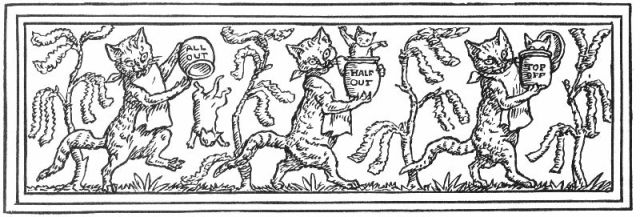
"Top-off," answered the cat, drily.

"Top-off!" cried the mouse, "that is a singular and wonderful name! is it common in your family?"

"What does it matter?" said the cat; "it's not any worse than Crumb-picker, like your god-child."

A little time after this the cat was again seized with a longing.

"Again I must ask you," said he to the mouse, "to do me a favour, and keep house alone for a day. I have been asked a second time to stand god-father; and as the little one has a white ring round its neck, I cannot well refuse."

So the kind little mouse consented, and the cat crept along by the town wall until he reached the church, and going straight to the little pot of fat, devoured half of it.

"Nothing tastes so well as what one keeps to oneself," said he, feeling quite content with his day's work. When he reached home, the mouse asked what name had been given to the child.

"Half-gone," answered the cat.

"Half-gone!" cried the mouse, "I never heard such a name in my life! I'll bet it's not to be found in the calendar."

Soon after that the cat's mouth began to water again for the fat.

"Good things always come in threes," said he to the mouse; "again I have been asked to stand god-father, the little one is quite black with white feet, and not any white hair on its body; such a thing does not happen every day, so you will let me go, won't you?"

"Top-off, Half-gone," murmured the mouse, "they are such curious names, I cannot but wonder at them!"

"That's because you are always sitting at home," said the cat, "in your little grey frock and hairy tail, never seeing the world, and fancying all sorts of things."

So the little mouse cleaned up the house and set it all in order. Meanwhile the greedy cat went and made an end of the little pot of fat.

"Now all is finished one's mind will be easy," said he, and came home in the evening, quite sleek and comfortable. The mouse asked at once what name had been given to the third child.

"It won't please you any better than the others," answered the cat. "It is called All-gone."

"All-gone!" cried the mouse. "What an unheard-of-name! I never met with anything like it! All-gone! whatever can it mean?" And shaking her head, she curled herself round and went to sleep. After that the cat was not again asked to stand god-father.

When the winter had come and there was nothing more to be had out of doors, the mouse began to think of their store.

"Come, cat," said she, "we will fetch our pot of fat, how good it will taste, to be sure!"

"Of course it will," said the cat, "just as good as if you stuck your tongue out of window!"

So they set out, and when they reached the place, they found the pot, but it was standing empty.

"Oh, now I know what it all meant," cried the mouse, "now I see what sort of a partner you have been! Instead of standing god-father you have devoured it all up; first Top-off, then Half-gone, then"——

"Will you hold your tongue!" screamed the cat, "another word, and I devour you too!"

And the poor little mouse, having "All-gone" on her tongue, out it came, and the cat leaped upon her and made an end of her. And that is the way of the world.

50
 
Another version I've read ends by saying: That is why Cats and Mice no longer are friends.  As I sometimes end a story, "That's my story and I'm sticking to it!"

************************

This is part of a series of postings of stories under the category, "Keeping the Public in Public Domain."  The idea behind Public Domain was to preserve our cultural heritage after the authors and their immediate heirs were compensated.  I feel strongly current copyright law delays this intent on works of the 20th century.  My own library of folklore includes so many books within the Public Domain I decided to share stories from them.  I hope you enjoy discovering new stories.  


At the same time, my own involvement in storytelling regularly creates projects requiring research as part of my sharing stories with an audience.  Whenever that research needs to be shown here, the publishing of Public Domain stories will not occur that week.  This is a return to my regular posting of a research project here.  (Don't worry, this isn't dry research, my research is always geared towards future storytelling to an audience.)  Response has convinced me that "Keeping the Public in Public Domain" should continue along with my other postings as often as I can manage it.
Other Public Domain story resources I recommend-

  • There are many online resources for Public Domain stories, maybe none for folklore is as ambitious as fellow storyteller, Yoel Perez's database, Yashpeh, the International Folktales Collection.  I have long recommended it and continue to do so.  He has loaded Stith Thompson's Motif Index into his server as a database so you can search the whole 6 volumes for whatever word or expression you like by pressing one key. http://folkmasa.org/motiv/motif.htm

  • You may have noticed I'm no longer certain Dr. Perez has the largest database, although his offering the Motif Index certainly qualifies for those of us seeking specific types of stories.  There's another site, FairyTalez claiming to be the largest, with "over 2000 fairy tales, folktales, and fables" and they are "fully optimized for phones, tablets, and PCs", free and presented without ads.
    Between those two sites, there is much for story-lovers, but as they say in infomercials, "Wait, there's more!"

The email list for storytellers, Storytell, discussed Online Story Sources and came up with these additional suggestions:        

         - David K. Brown - http://people.ucalgary.ca/~dkbrown/stories.html

         - Richard Martin - http://www.tellatale.eu/tales_page.html

         - Spirit of Trees - http://spiritoftrees.org/featured-folktales

         - Story-Lovers - http://www.story-lovers.com/ is now only accessible through the Wayback Machine, described below, but the late Jackie Baldwin's wonderful site lives on there, fully searchable manually (the Google search doesn't work), at https://archive.org/ .  It's not easy, but go to Story-lovers.com snapshot for December 22 2016  and you can click on SOS: Searching Out Stories to scroll down through the many story topics and click on the story topic that interests you.

       - World of Tales - http://www.worldoftales.com/ 

 
           - Zalka Csenge Virag - http://multicoloreddiary.blogspot.com doesn't give the actual stories, but her recommendations, working her way through each country on a continent, give excellent ideas for finding new books and stories to love and tell.

     
You're going to find many of the links on these sites have gone down, BUT go to the Internet Archive Wayback Machine to find some of these old links.  Tim's site, for example, is so huge probably updating it would be a full-time job.  In the case of Story-Lovers, it's great that Jackie Baldwin set it up to stay online as long as it did after she could no longer maintain it.  Possibly searches maintained it.  Unfortunately Storytell list member, Papa Joe is on both Tim Sheppard's site and Story-Lovers, but he no longer maintains his old Papa Joe's Traveling Storytelling Show website and his Library (something you want to see!) is now only on the Wayback Machine.  It took some patience working back through claims of snapshots but finally in December of 2006 it appears!

    Somebody as of this writing whose stories can still be found by his website is the late Chuck Larkin - http://chucklarkin.com/stories.html.  I prefer to list these sites by their complete address so they can be found by the Wayback Machine, a.k.a. Archive.org, when that becomes the only way to find them.

You can see why I recommend these to you. 

Have fun discovering even more stories

Saturday, August 15, 2015

Grimm - Fred and Kate - Keeping the Public in Public Domain + Frankenmuth exhibit

"Fred and Kate" in Household Stories, illustrated by Walter Crane
Here's my favorite little known story by the Brothers Grimm, but along the way I want to give the story of both how I use it and how I came to put it in the "Keeping the Public in Public Domain"series.
   
Right before the Frankenmuth Historical Museum had a lecture on the Grimm Brothers, I happened to see their exhibit.  There wasn't time to post an announcement here before the lecture, but the exhibit will be there until Halloween.  (I asked about that interesting ending date and was told it was when they would open a new exhibit about the SS Edmund Fitzgerald, which sank in 1975.)  Frankenmuth is a major Michigan tourist site and always offers events, shopping, and dining, so it's worth the trip even without the lecture.  The exhibit is well done even for those of us well informed about Grimm tales beyond the usual Disney versions.  (There's an adults only cabinet with the original tales to explore.)  To see the exhibit you need a museum ticket and it may help to know the exhibit is at the end of all their displays.  If you want to see well done exhibits about Frankenmuth from pioneer times and on throughout its history, follow the normal entrance to the right of the shop.  If you are in a rush, want to walk less, or don't care about those historical exhibits, it might help to know the same ticket could let you see just "Fairy Tales from the Brothers Grimm" by entering to the left where the exhibit hall ends.  With so much happening in Frankenmuth, that also is a reasonable choice letting you see biographical, illustrative, and comparative Grimm displays, as well as some geared to any children accompanying you.
 
Today's story as I tell it is less than I discovered prowling various Grimm editions and finding public domain copies.  HORRORS!  Have I sanitized Grimm!?!  Not really.  It's just the story is often published without the final adventure.  It's also politically incorrect and I love it!  There's a story type called "Noodleheads" where the main character is hopelessly unaware of the crazy, yes, dumb results of actions.  The female version is the stereotypical "dumb blonde", but the sheer zaniness of any Noodlehead has a bouncy lack of awareness.

When I tell it, I rename the main characters "Friedrich and Katya."  This feels more in keeping with their Germanic roots than the title of "Fred and Kate" given by Mrs. E. V. Lucas whose version appears here.  Some versions title it "Frederick and Catherine."  Anytime you use a translated tale, title variations can play havoc with finding the story.  My Katya always earnestly answers her newly wed husband with "I did not know; you should have told me what to do" and from her viewpoint it's true even as he tries to goofproof their recent marriage.

Now for the part that probably only appeals to researchers.  The version I will start with is from Mrs. E. V. Lucas, but, just as her husband is the one noticed in the early 20th century, I found her translation work also almost uncredited in more than one edition.  There's the undated Lippincott book, Fairy Tales, illustrated by Arthur Rackham, but clearly predating the 1915 Index to Fairy Tales, Myths and Legends by Mary Huse Eastman.  There's also this copy found in the Internet Archive edition which has a 1920 publication by E.P. Dutton crediting an earlier version from 1909 of "Grimm's Fairy Tales illustrated by Arthur Rackham" but omitting the translator.
On the same Internet Archive page is mentioned the 1920 edition (yes, same year and pagination) published by Constable & Company crediting that same:

Hansel & Grethel & other tales
by the brothers Grimm. Illustrated by Arthur Rackham.

Published by Constable & Co. in New York .
Written in English.

Edition Notes

Half-title: Grimm's fairy tales.
Title within ornamental border.
Translated by Mrs. Edgar Lucas.

Yes, Arthur Rackham deserves credit, but isn't it interesting how I had to do detective work to find out who translated this since it has the closest to the tellable style I use.  (Also did you notice the use of "Edgar", but E.V. Lucas was actually Edward Verrall Lucas . . . I believe they are Mrs. E.V. Lucas's husband.)


That's where I've been ending the story.  Here's the rest of the tale from the translation by Lucy Crane, truly an interesting 19th century woman.  Oh and about that header on this article by Walter Crane, he's her more famous brother.  I don't care for her version before this as much as the translation by Mrs. Lucas, but think it's time to give "the rest of the story" to you.  I'm not sure if I will add it when I tell the story.  The story picks up where we stopped by jumping into her Household Stories published by Macmillan in 1899 and ends with another illustration by Walter Crane.
Hmmmmm.  What do you think about the story?  What about the extra adventure?

An earlier post in 2012 about the Grimm Brothers bicentennial's Project Grimm points out the KHM number of this story is 59.  Wikipedia's summary of Frederick and Catherine includes the final adventure and also notes it combines eight Aarne-Thompson types.  That number certainly may help you more than the way publishers repackage versions of the story and then copyright the total book for something like different illustrations.  One of the books I have with this story did exactly that.  It never stated if their version came from Lucas, Crane, or a third interpreter who never included this little known story in her collection of stories by the Grimm Brothers.  They count on you thinking the story itself is under copyright.  This is a perfect example of a story told in many translations, but still worth Keeping the Public in Public Domain.
****************

This is part of a series of postings of stories under the category, "Keeping the Public in Public Domain."  The idea behind Public Domain was to preserve our cultural heritage after the authors and their immediate heirs were compensated.  I feel strongly current copyright law delays this intent on works of the 20th century.  My own library of folklore includes so many books within the Public Domain I decided to share stories from them.  I hope you enjoy discovering new stories.  

At the same time, my own involvement in storytelling regularly creates projects requiring research as part of my sharing stories with an audience.  Whenever that research needs to be shown here, the publishing of Public Domain stories will not occur that week.  This is a return to my regular posting of a research project here.  (Don't worry, this isn't dry research, my research is always geared towards future storytelling to an audience.)  Response has convinced me that "Keeping the Public in Public Domain" should continue along with my other postings as often as I can manage it.  



There are many online resources for Public Domain stories, none for folklore is as ambitious as fellow storyteller, Yoel Perez's database, Yashpeh, the International Folktales Collection.  I recommended it earlier and want to continue to do so.  Have fun discovering even more stories!