Tell me if you have a topic you'd like to see. (Contact: LoiS-sez@LoiS-sez.com .)
Please also let others know about this site.
Showing posts with label birds. Show all posts

Friday, August 21, 2026

Bailey - How Drakestail Went to the King - Keeping the Public in Public Domain

I've a program coming up where the audience requested stories about Farm Animals for Harvest season. They want me to start with "Stone Soup" and I plan to end with the "Bremen Town Musicians." Beyond that I began to list all the farm animals that came to mind. The last of ten animals I remembered were ducks and geese. 

With more possibilities than I have time to tell, I will use another favorite way to select my stories. I will write each animal and a story for it on slips of paper. Then they go into an open-mouthed container. For Halloween it would be a cauldron. This time it will be an old cast iron cooking pot. The audience pulls out a strip to determine each story I will tell.

While planning this I mentioned I had not yet looked up a story for ducks and geese to my friend and storytelling colleague, Priscilla Howe. Right away she had a favorite, "Drakestail" and even has a YouTube video of her telling it. 

Hmmm. That sounded interesting, but of course I wanted to prowl a bit further. Along the way I found even more versions of the story such as this picture book version

Denise McGill had created an alphabet book of fairy tales with Drakestail for the letter "D."

Beyond that,of course, Wikipedia has a brief article on it, including noting its use of repetition. I love to use repetition as a method of audience participation. Beyond those resources I was sure such a traditional tale would be found in Public Domain. I was right and found a version by Andrew Lang in his Red Fairy Book and another in The Fairy Ring by Kate Douglas Wiggin and Nora Archibald Smith. Those are indeed favorite authors, but it was Carolyn Sherwin Bailey's version in Once Upon a Time Animal Stories I liked the best. Her background as a storyteller shows why it will tell the best.

I'm giving it here, but looking at all those versions guarantees I'm going to incorporate ideas from more than just Bailey.  

HOW DRAKESTAIL WENT TO THE KING.


Once upon a time there was a wee little duck, with a very long tail, so he was called Drakestail. Now, Drakestail had some money of his very, very own, and the king asked if he might take it. So Drakestail loaned all his money to the king.

But the king kept Drakestail’s money for a year and a day, and still he did not send it back. Drakestail said he would go to the king and bring back the money himself.

So off he started, one very fine morning, for the king’s house. The sun was shining on the ponds, and Drakestail waddled along in the middle of the road, feeling very fine. As he traveled, he met a fox, and the fox said, “Where do you go this fine morning, Friend Drakestail?”

“To the king,” said Drakestail, “for he owes me money.”

“I will travel along with you,” said the fox.

“Ah,” said Drakestail, “your four legs would soon tire. Come along with me this way,” and he opened his wee little bill very wide, and down his wee little throat went the fox.

Then Drakestail traveled on a little farther. As he went he came to a ladder lying beside the road.

“Where do you go this fine morning, Friend Drakestail?” asked the ladder.

“To the king,” said Drakestail, “for he owes me money.”

“I will travel along with you,” said the ladder.

“Your wooden legs would soon tire,” said Drakestail. “Come along with me this way,” and he opened his little bill very wide, and down his wee little throat went the ladder.

Then Drakestail traveled on a bit farther until he came to his friend, the river, lying and glistening in the sunshine.

“Where do you go this fine morning, Friend Drakestail?” asked the river.

“To the king, for he owes me money,” said Drakestail.

“I will travel with you,” said the river.

“You would soon tire if you ran so far, my friend,” said Drakestail. “Come along with me this way.” He opened his wee bill very wide, and down his wee little throat went the little river.

Then Drakestail traveled and traveled until he came to the king’s house. Now Drakestail thought that the king would meet him at the gate, so he called out very loudly:

“Honk! Honk! Drakestail waits at the gate.”

But the king did not come out to meet him. Who should appear at the gate but the king’s cook, and the cook took Drakestail by his two little legs and flung him into the poultry yard. The other fowls, who were ill-bred birds, ran up to Drakestail and bit him, and jeered at his large tail. It would have gone very badly with Drakestail, but he called to his friend, the fox:

“Reynard, Reynard, come out to the earth,
Or Drakestail’s life is of little worth.”

So the fox came out, and he ate up all the ill-bred fowls in the king’s poultry yard. But still Drakestail was badly off. He heard the king’s cook putting the broth pot over the fire.

“Ladder, ladder, come out to the wall,
Drakestail does not wish to be broth at all,”

he cried. So the ladder came out and leaned against the wall, and Drakestail climbed over in safety. But the king’s cook saw Drakestail and set out after him. He caught poor Drakestail and clapped him into the broth pot, and hung him over the fire.

“River, my sweetheart, put out this hot fire,
The flames that would cook me rise higher and higher,”

cried Drakestail. So the river put out the fire with a great noise and sputtering, which the king heard. And the king came running to the kitchen.

“Good morning to you, King,” said Drakestail, hopping out of the broth pot, and making a very low bow, “are you through with my money, which you have kept for a year and a day?”

“That I am, Drakestail,” said the king. “You shall have it at once.”

So the king gave Drakestail the money that he owed him, and Drakestail waddled home again to tell of all his travels.

*************
As I said I liked the repetition and definitely plan to have Drakestail  travel along with a waddle, waddle, waddle throughout the story. I'm not sure I'll use the comments in verse, but certainly plan to have the fox, the ladder and the river each have personalities. Now on to making strips with stories for each of those other animals.
 
*************************** 

This is part of a series of postings of stories under the category, “Keeping the Public in Public Domain.” The idea behind Public Domain was to preserve our cultural heritage after the authors and their immediate heirs were compensated. I feel strongly current copyright law delays this intent on works of the 20th century. My own library of folklore includes so many books within the Public Domain I decided to share stories from them. I hope you enjoy discovering them.

At the same time, my own involvement in storytelling regularly creates projects requiring research as part of my sharing stories with an audience.  Whenever that research needs to be shown here, the publishing of Public Domain stories will not occur that week.  This is a return to my regular posting of a research project here.  (Don't worry, this isn't dry research, my research is always geared towards future storytelling to an audience.)  Response has convinced me that "Keeping the Public in Public Domain" should continue along with my other postings as often as I can manage it.

See the sidebar for other Public Domain story resources I recommend on the page “Public Domain Story Resources."


Friday, October 17, 2025

Cowles - The Beginning of Birds - Keeping the Public in Public Domain

Sometimes serendipity brings what you need while looking for something else! I was looking to see if a story existed that might be a dimly seen tale of how flying creatures like pterodactyls evolved into birds. My search took me to early Twentieth Century storyteller and folklorist, Julia Darrow Cowles, It's been a long time (2013) since I posted something by her and there's still little more known about her except for online copies of her seventeen books. Once again I find her Indian Nature Myths is calling to me.  

Photo by Man from Forest on Unsplash 

It didn't give the prehistoric story I hoped to find, BUT I've also been eager to find a story about leaves changing colors -- this does it beautifully! Every year I'm always flabbergasted to think those gorgeous colors lurk all season long under the chlorophyll keeping them green until now! ! ! Yes, it's great to have green trees, but oh how incredible it is that such reds, oranges, and even yellow were there all along. 

Yes, it's sad when those leaves come down. I call it God's Confetti. I confess here in Michigan we have what I consider too long a time when all those bare branches show us the true shape of a tree. What few birds remain until spring do indeed tend to be the color of any oak leaves clinging to the trees. . . except for the cardinal which I dearly love and they don't seem to fit this story. Still that's no reason to skip a good story. Maybe in Montana and other areas where the Blackfeet Nation live there are no cardinals. If so, may all the other birds hurry back.

THE BEGINNING OF BIRDS

(Blackfeet)

IN very early times, the Red Children believe, there were no birds. And this is the way they account for their beginning:

All summer the trees had been full of leaves, shaking, whispering, dancing, as the winds blew upon them. “I wish I might fly,” said one little leaf. “I would go sailing straight up into the heavens. But the tree holds me tightly; I cannot get away.”

“If the tree should let you go, you would only fall to the ground and die,” said a bigger leaf. “It is better to be content as you are.”

So the leaves fluttered and danced and whispered one to another, day after day.

One morning the wind was cold, and the leaves had to dance fast to keep warm. Then the old tree said, “It is the breath of Po-poon-o-ki. He lives in the ice lodge of the far North. He will soon visit us, with his war paints. I must hold you tightly, little leaves, as long as I can.” But the little leaves did not understand what the tree meant.

Then, one still night, Po-poon-o-ki came. He went from tree to tree, and over each one he splashed his war paints, till the leaves were no longer green, but dashed with red, and brown, and yellow, and crimson.

“How beautiful the trees are!” cried the Indian children the next morning. “See their bright colors.”

For a few days the leaves danced and whispered, laughing over their beautiful hues. Then Po-poon-o-ki came back, and with his swift, cold breath, he blew against the trees, and the little leaves were tossed and torn from the friendly branches. They did not fly up into the heavens, but frightened and sobbing they dropped to the earth.

“We shall die!” they cried. “We shall die!”

Then a strange thing happened. The guardian spirit of the tree whispered, “No, little leaves, you shall not die. You shall be changed into living forms. I will give you breath and life.” And instantly there arose from the earth where the leaves had dropped, a great flock of winged birds, red, and brown, and yellow, and crimson,  all the beautiful colors that Po-poon-o-ki had given the leaves. Then they flew away to the South Land, where winter’s breath could not reach them.


“THERE AROSE A GREAT FLOCK OF WINGED BIRDS”

But in the spring, when Ni-poon-o-ki, the spirit of summer, came stealing up from the South, and Po-poon-o-ki went back to his ice lodge in the far North, then the birds came back, too. There were new leaves on the trees, but the birds flew straight to the branches which had been their home, and there, safely sheltered by the new leaves, they built their nests.

And after awhile, when there were eggs in all the home nests, the hearts of the birds became so full of joy that they could no longer be silent. Their throats swelled, and opening wide their little mouths, they filled all the air with bursts of happy song.

************** 

This is part of a series of postings of stories under the category, “Keeping the Public in Public Domain.” The idea behind Public Domain was to preserve our cultural heritage after the authors and their immediate heirs were compensated. I feel strongly current copyright law delays this intent on works of the 20th century. My own library of folklore includes so many books within the Public Domain I decided to share stories from them. I hope you enjoy discovering them.

At the same time, my own involvement in storytelling regularly creates projects requiring research as part of my sharing stories with an audience.  Whenever that research needs to be shown here, the publishing of Public Domain stories will not occur that week.  This is a return to my regular posting of a research project here.  (Don't worry, this isn't dry research, my research is always geared towards future storytelling to an audience.)  Response has convinced me that "Keeping the Public in Public Domain" should continue along with my other postings as often as I can manage it.

See the sidebar for other Public Domain story resources I recommend on the page “Public Domain Story Resources."

Friday, April 11, 2025

Fleeson - Why the Parrot and the Minor Bird but Echo the Words of Man - Keeping the Public in Public Domain


It's Earth Month, with Earth Day on April 22 so close to Easter and Passover that it seems good to consider it now. Today's story is from Laos Folk-Lore of Farther India by Katherine Neville Fleeson. Its section "Nature's Riddles and Their Answers" opens an important issue... Invasive Species. Not every plant, insect or animal is endangered and some may be considered dangerously invasive. Wikipedia's article on the Common Myna, talks about a bird "popular as cage birds for their singing and 'speaking' abilities." Even though they might be kept as pets: 

The range of the common myna is increasing at such a rapid rate that in 2000 the IUCN Species Survival Commission declared it one of the world's most invasive species and one of only three birds listed among "100 of the World's Worst Invasive Species" that pose a threat to biodiversity, agriculture and human interests. In particular, the species poses a serious threat to the ecosystems of Australia, where it was named "The Most Important Pest/Problem" in 2008.

The Common Myna was first introduced to Australia between 1863 and 1872 to control insects in the market gardens. One of the birds it threatens is the Parrot. "One-third of all parrot species are threatened by extinction, with a higher aggregate extinction risk (IUCN Red List Index) than any other comparable bird group." The Common Myna is notorious for taking over the nests of other birds. At the same time:

Parrots, being cavity nesters, are vulnerable to the loss of nesting sites and to competition with introduced species for those sites. The loss of old trees is a particular problem in some areas, particularly in Australia, where suitable nesting trees must be centuries old.

Both birds share territory in Asia and Australia including Laos. You may notice the story calls the Common Myna a "minor bird" which seems to be the pronunciation the author heard. Because it is also called the "sao bird" I went looking and found a site calling it a "mythical bird." The São Tomé Sunbird couldn't be the bird as it's on an island country in the Gulf of Guinea, off the western equatorial coast of Central Africa.

As a result I'd tell the story as being about the Common Myna and the Parrot and include information about the problem caused by invasive species and endangered species. This story has both!

Why the Parrot and the Minor Bird but Echo the Words of Man

Long ago people caught and nourished the sao bird, because it learned the language of man more readily than either the parrot or minor bird. While they had to be taught with much care, the sao bird had but to hear a word and it could readily utter it; moreover, the sao bird could utter its own thoughts.

Upon a time a man of the north country, owning a sao bird, stole a buffalo from his neighbor and killed it. Part of the buffalo the man cooked and ate; the rest he hid either in the rice bin or over the rice house.

Seeking the buffalo, next day, the neighbor asked the man if he had seen it.

The man replied, “No.” The sao bird, however, cried out, “He killed it; part he hid in the rice bin, part over the rice house.”

The neighbor searched in both of these places and found the parts just as the sao bird had said.

“I did not steal the buffalo,” insisted the man.

But the bird ever called, “He killed it and put part into the rice bin, and part over the rice house.”

Unable to decide between the words of the man and the words of the bird, the neighbor appealed to the court. And, it happened, the night before the trial, that the man took the sao bird, placed it in a jar, covered the jar and poured water over the cloth and beat on the outside of the jar. The noise of the beating was low and rumbling. All that night was the bird kept in the jar, and not once did it see the bright moonlight, which was almost as bright as day, for it was in the midst of the dry season and full moon. When the eye of day opened, the man removed the bird from the jar and placed it in its cage, and then took it to the court as a witness.

When the bird was called, it said, as before, “He killed it; part he put in the rice bin, and part over the rice house.”

All people believed the bird.

“Ask it another question. Ask it what manner of night it was last night. Will you condemn me to death on the word of a bird?” cried the man.

The question was put to the bird, but, remembering its fear, during the night, of the rumbling noise and the sound of running water, it answered, “Last night the sky called and the rain fell.”

Then the people cried, “Of a truth, the bird cannot be believed. Because it has imperilled the life of an innocent man, from this time forth, the sao bird must not be cherished by man.”

The thief was set free because there were but the words of the bird to condemn him.

No longer is the sao bird nourished by man, but lives in the forest. Those who are full of fear, when they hear them talking in the forest, say, “it is the spirits.”

When the sao bird saw the bright plumage of the parrot, and the black and gold of the minor bird, it knew they were strangers who had come to dwell in the north, and it asked the crow and the owl what manner of birds they were.

“Beautiful in plumage, as thou canst readily see,” answered they. “Moreover, they speak the words of man.”

“Speak the words of man,” echoed the sao bird. “I’ll warn them. Come, let us greet them.” And they went forth to meet the beautiful strangers.

And upon a day, as they all came together in one place, the sao bird cried out, “We, the chief birds of the north land, come to greet you and to give you of our wisdom, as you are but strangers in our land. It is told me you speak as 44 does man; even so can I. Nourished by the hand of man many years, I did see with my eyes and hear with my ears, and my tongue uttered not only the things I beheld and heard, but things displeasing to my masters. At one time, all men spoke well of me, but afterward was I cruelly punished and driven from the homes of men. Therefore come I this day unto you to warn you that, if man learns of your speaking tongue, he will capture you and nourish you in his home. Yet, should you speak other than he teaches you, you will be punished and driven from the homes of men, for man loves only to hear his thoughts repeated and loves not even a bird that has wisdom or truth greater than his own.”

Fearful of uttering their thoughts, lest man resent it, the parrot and minor bird but echo the words of man.

 
 Quite by accident the weekend I posted this I also found a version of this story as "Why the Parrot Repeats the Words of Men" In Florence Holbrook's The Book of Nature Myths. I like the Laotian tale for the option of telling about both invasive & threatened birds.

 ******************

This is part of a series of postings of stories under the category, “Keeping the Public in Public Domain.” The idea behind Public Domain was to preserve our cultural heritage after the authors and their immediate heirs were compensated. I feel strongly current copyright law delays this intent on works of the 20th century. My own library of folklore includes so many books within the Public Domain I decided to share stories from them. I hope you enjoy discovering them.

At the same time, my own involvement in storytelling regularly creates projects requiring research as part of my sharing stories with an audience.  Whenever that research needs to be shown here, the publishing of Public Domain stories will not occur that week.  This is a return to my regular posting of a research project here.  (Don't worry, this isn't dry research, my research is always geared towards future storytelling to an audience.)  Response has convinced me that "Keeping the Public in Public Domain" should continue along with my other postings as often as I can manage it.

See the sidebar for other Public Domain story resources I recommend on the page “Public Domain Story Resources."


Friday, May 10, 2024

Asbjørnsen & Moe - One's Own Children Are Always Prettiest - Keeping the Public in Public Domain

I tend to use the original Index to Fairy Tales, Myths and Legends by Mary Huse Eastman, published in 1915, to guarantee Public Domain stores.  I plowed through the stories for Mother's Day and others with Mother in the title.  Maybe it was the mood I was in, but everything just seemed too "quaint" and I wasn't happy with telling them in the 21st century.  In telling Public Domain stories it's sometimes necessary for the storyteller to modernize the language.  "Thees" and other quaint word choice isn't needed to tell the story and can keep a present day audience from hearing what is meant.  These stories just struck me as having an antiquated view of motherhood or children.  

Quite by accident I discovered today's story and believe it will always fit the way mothers view their children.  This translation originally appeared in Sir G. W. Dasent’s Popular Tales from the Norse, but is the Kay Nielsen illustrated version of the Asjornsen and Moe tales titled East of the Sun and West of the Moon; Old Tales from the North.  That's a Project Gutenberg link, but Nielsen's work has had many reprints and I strongly recommend seeing it in book form as both the full-color and black and white illustrations really shine in print. 

The story itself is about a Snipe.  I will say a bit more about it after the tale.

ONE’S OWN CHILDREN ARE ALWAYS PRETTIEST

A sportsman went out once into a wood to shoot, and he met a Snipe.

“Dear friend,” said the Snipe, “don’t shoot my children!”

“How shall I know your children?” asked the Sportsman. “What are they like?”

“Oh!” said the Snipe, “mine are the prettiest children in all the wood.”

“Very well,” said the Sportsman, “I’ll not shoot them; don’t be afraid.”

But for all that, when he came back, there he had a whole 204 string of young snipes in his hand which he had shot.

“Oh, oh!” said the Snipe, “why did you shoot my children after all?”

“What! these your children!” said the Sportsman; “why, I shot the ugliest I could find, that I did!”

“Woe is me!” said the Snipe; “don’t you know that each one thinks his own children the prettiest in the world?”

***

Snipe in Water, by Ohara Koson. Japan, 1900-1930

LoiS again:

I've long heard about Snipe Hunts and presumed they were hunting for something fictitious.  Not so. . . well not entirely.  The Wikipedia article on the Snipe mainly incorporates the old Public Domain article found in Encyclopædia Britannica (11th ed.).  I wanted an update on the bird and find it as the Common snipe, which is not a North American bird.  This is why a "Snipe hunt" -- at least in North America -- is considered a prank or practical joke.  There are however North American birds, known as Wilson's snipe, which had been considered a subspecies until 2003 when it was changed to its own species.

Along the way on my own literary Snipe Hunt I learned the term "sniper" came from the bird because of its ability to hunt and also camouflage.

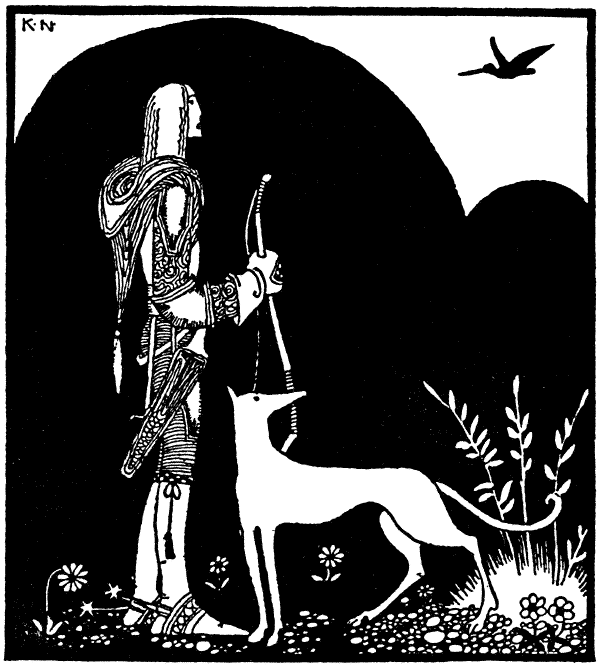
 All of that may be far more than you ever cared to know.  Mr. Nielsen frequently marks the end of stories with an illustration that seems appropriate to this little known tale which ends the book.  (Note the short bird bills, so they are not snipes, but they hide well.)                                                                             


***********************

This is part of a series of postings of stories under the category, "Keeping the Public in Public Domain."  The idea behind Public Domain was to preserve our cultural heritage after the authors and their immediate heirs were compensated.  I feel strongly current copyright law delays this intent on works of the 20th century.  My own library of folklore includes so many books within the Public Domain I decided to share stories from them.  I hope you enjoy discovering new stories.  


At the same time, my own involvement in storytelling regularly creates projects requiring research as part of my sharing stories with an audience.  Whenever that research needs to be shown here, the publishing of Public Domain stories will not occur that week.  This is a return to my regular posting of a research project here.  (Don't worry, this isn't dry research, my research is always geared towards future storytelling to an audience.)  Response has convinced me that "Keeping the Public in Public Domain" should continue along with my other postings as often as I can manage it.

Other Public Domain story resources I recommend-

  • There are many online resources for Public Domain stories, maybe none for folklore is as ambitious as fellow storyteller, Yoel Perez's database, Yashpeh, the International Folktales Collection.  I have long recommended it and continue to do so.  He has loaded Stith Thompson's Motif Index into his server as a database so you can search the whole 6 volumes for whatever word or expression you like by pressing one key. http://folkmasa.org/motiv/motif.htm

  • You may have noticed I'm no longer certain Dr. Perez has the largest database, although his offering the Motif Index certainly qualifies for those of us seeking specific types of stories.  There's another site, FairyTalez claiming to be the largest, with "over 2000 fairy tales, folktales, and fables" and they are "fully optimized for phones, tablets, and PCs", free and presented without ads.
    Between those two sites, there is much for story-lovers, but as they say in infomercials, "Wait, there's more!"

The email list for storytellers, Storytell, discussed Online Story Sources and came up with these additional suggestions:        

         - David K. Brown - http://people.ucalgary.ca/~dkbrown/stories.html

         - Richard Martin - http://www.tellatale.eu/tales_page.html

         - Spirit of Trees - http://spiritoftrees.org/featured-folktales

         - Story-Lovers - http://www.story-lovers.com/ is now only accessible through the Wayback Machine, described below, but the late Jackie Baldwin's wonderful site lives on there, fully searchable manually (the Google search doesn't work), at https://archive.org/ .  It's not easy, but go to Story-lovers.com snapshot for December 22 2016  and you can click on SOS: Searching Out Stories to scroll down through the many story topics and click on the story topic that interests you.

       - World of Tales - http://www.worldoftales.com/ 

 
           - Zalka Csenge Virag - http://multicoloreddiary.blogspot.com doesn't give the actual stories, but her recommendations, working her way through each country on a continent, give excellent ideas for finding new books and stories to love and tell.

     
You're going to find many of the links on these sites have gone down, BUT go to the Internet Archive Wayback Machine to find some of these old links.  Tim's site, for example, is so huge probably updating it would be a full-time job.  In the case of Story-Lovers, it's great that Jackie Baldwin set it up to stay online as long as it did after she could no longer maintain it.  Possibly searches maintained it.  Unfortunately Storytell list member, Papa Joe is on both Tim Sheppard's site and Story-Lovers, but he no longer maintains his old Papa Joe's Traveling Storytelling Show website and his Library (something you want to see!) is now only on the Wayback Machine.  It took some patience working back through claims of snapshots but finally in December of 2006 it appears!

    Somebody as of this writing whose stories can still be found by his website is the late Chuck Larkin - http://chucklarkin.com/stories.html.  I prefer to list these sites by their complete address so they can be found by the Wayback Machine, a.k.a. Archive.org, when that becomes the only way to find them.

You can see why I recommend these to you. 

Have fun discovering even more stories

Friday, April 19, 2024

Parker - The Gwineeboos The Redbreasts - Keeping The Public in Public Domain

Monday is Earth Day and while I have tons of Creation or Pourquois tales, none of them seemed to call out to me until I went to K. Langloh Parker's Australian Legendary Tales.  I've included Parker's book from colonial Australia retelling Australian aboriginal tales twice before here and strongly recommend going to them for background material on her and to understand more about the stories.

Today's story is about sharing, for Earth Day is indeed about learning how to share the earth.  It's also a tale about the robin, but the Australian robin is not the same as the robin most of us, living outside Australasia, know.  There are 51 species of Australasian robins, but like the robins of the rest of the world, today's story is about the red breasted ones that led colonizers to call them robins, but Parker preserved their original name of Gwineeboo.  Gwineeboo's friend, Goomai, is a water rat.  The other characters named in the story, Quarrian and Gidgereegah, are only described as hunters, but the book's glossary tells us they are parrots for that's what they became.

Aside from this being a story pitting two females (plus their noisy hungry baby) against two hunters, it's a great story for audience participation.  Teach the audience to chant like the baby, "Gwineeboo, Gwineeboo. I want kangaroo. I want kangaroo. Gwineeboo. Gwineeboo." They will have a blast, but be sure to teach them to silence when you hold up your hand!  Beyond that I suggest putting the later chant that causes the storm on a card as it's more difficult to remember.  "Moogaray, Moogaray, May, May, Eehu, Eehu, Doongarah."  Then give the translation.  You can say that fortunately the audience aren't birds, so - you hope -the chant only works in the story.

The only other needed explanation, again from the glossary, is that a dardurr is a type of hut.

The scarlet robin, an Australasian robin

THE GWINEEBOOS THE REDBREASTS

Gwineeboo and Goomai, the water rat, were down at the creek one day, getting mussels for food, when, to their astonishment, a kangaroo hopped right into the water beside them. Well they knew that he must be escaping from hunters, who were probably pressing him close. So Gwineeboo quickly seized her yam stick, and knocked the kangaroo on the head; he was caught fast in the weeds in the creek, so could not escape. When the two old women had killed the kangaroo they hid its body under the weeds in the creek, fearing to take it out and cook it straight away, lest the hunters should come up and claim it. The little son of Gwineeboo watched them from the bank. After having hidden the kangaroo, the women picked up their mussels and started for their camp, when up came the hunters, Quarrian and Gidgereegah, who had tracked the kangaroo right to the creek.

Seeing the women they said: "Did you see a kangaroo?"

The women answered: "No. We saw no kangaroo."

"That is strange, for we have tracked it right up to here."

"We have seen no kangaroo. See, we have been digging out mussels for food. Come to our camp, and we will give you some when they are cooked."

The young men, puzzled in their minds, followed the women to their camp, and when the mussels were cooked the hunters joined the old women at their dinner. The little boy would not eat the mussels; he kept crying to his mother, "Gwineeboo, Gwineeboo. I want kangaroo. I want kangaroo. Gwineeboo. Gwineeboo."

"There," said Quarrian. "Your little boy has seen the kangaroo, and wants some; it must be here somewhere."

"Oh, no. He cries for anything he thinks of, some days for kangaroo; he is only a little boy, and does not know what he wants," said old Gwineeboo. But still the child kept saying, "Gwineeboo. Gwineeboo. I want kangaroo. I want kangaroo." Goomai was so angry with little Gwineeboo for keeping on asking for kangaroo, and thereby making the young men suspicious, that she hit him so hard on the mouth to keep him quiet, that the blood came, and trickled down his breast, staining it red. When she saw this, old Gwineeboo grew angry in her turn, and hit old Goomai, who returned the blow, and so a fight began, more words than blows, so the noise was great, the women fighting, little Gwineeboo crying, not quite knowing whether he was crying because Goomai had hit him, because his mother was fighting, or because he still wanted kangaroo.

Quarrian said to Gidgereegah. "They have the kangaroo somewhere hidden; let us slip away now in the confusion. We will only hide, then come back in a little while, and surprise them."

They went quietly away, and as soon as the two women noticed they had gone, they ceased fighting, and determined to cook the kangaroo. They watched the two young men out of sight, and waited some time so as to be sure that they were safe. Then down they hurried to get the kangaroo. They dragged it out, and were just making a big fire on which to cook it, when up came Quarrian and Gidgereegah, saying:

"Ah! we thought so. You had our kangaroo all the time; little Gwineeboo was right."

"But we killed it," said the women.

"But we hunted it here," said the men, and so saying caught hold of the kangaroo and dragged it away to some distance, where they made a fire and cooked it. Goomai, Gwineeboo, and her little boy went over to Quarrian and Gidgereegah, and begged for some of the meat, but the young men would give them none, though little Gwineeboo cried piteously for some. But no; they said they would rather throw what they did not want to the hawks than give it to the women or child. At last, seeing that there was no hope of their getting any, the women went away. They built a big dardurr for themselves, shutting themselves and the little boy up in it. Then they began singing a song which was to invoke a storm to destroy their enemies, for so now they considered Quarrian and Gidgereegah. For some time they chanted:

"Moogaray, Moogaray, May, May, Eehu, Eehu, Doongarah."

First they would begin very slowly and softly, gradually getting quicker and louder, until at length they almost shrieked it out. The words they said meant, "Come hailstones; come wind; come rain; come lightning."

While they were chanting, little Gwineeboo kept crying, and would not be comforted. Soon came a few big drops of rain, then a big wind, and as that lulled, more rain. Then came thunder and lightning, the air grew bitterly cold, and there came a pitiless hailstorm, hailstones bigger than a duck's egg fell, cutting the leaves from the trees and bruising their bark. Gidgereegah and Quarrian came running over to the dardurr and begged the women to let them in.

"No," shrieked Gwineeboo above the storm, "there was no kangaroo meat for us: there is no dardurr shelter for you. Ask shelter of the hawks whom ye fed." The men begged to be let in, said they would hunt again and get kangaroo for the women, not one but many. "No," again shrieked the women. "You would not even listen to the crying of a little child; it is better such as you should perish." And fiercer raged the storm and louder sang the women:

"Moogaray, Moogaray, May, May,
Eehu, Eehu, Doongarah."

So long and so fierce was the storm that the young men must have perished had they not been changed into birds. First they were changed into birds and afterwards into stars in the sky, where they now are, Gidgereegah and Ouarrian with the kangaroo between them, still bearing the names that they bore on the earth. 

***

This story convinced me to add it to my "Storytelling Cruise Around the World."  The "cruise" is one my most popular programs and fits well with this year's Summer Reading theme of "Adventure Begins at Your Library." Stories sometimes just have a way of calling out to be told. . . sort of like that baby calling "Gwineeboo, Gwineeboo. I want kangaroo. I want kangaroo. Gwineeboo. Gwineeboo."

*****************

This is part of a series of postings of stories under the category, "Keeping the Public in Public Domain."  The idea behind Public Domain was to preserve our cultural heritage after the authors and their immediate heirs were compensated.  I feel strongly current copyright law delays this intent on works of the 20th century.  My own library of folklore includes so many books within the Public Domain I decided to share stories from them.  I hope you enjoy discovering new stories.  


At the same time, my own involvement in storytelling regularly creates projects requiring research as part of my sharing stories with an audience.  Whenever that research needs to be shown here, the publishing of Public Domain stories will not occur that week.  This is a return to my regular posting of a research project here.  (Don't worry, this isn't dry research, my research is always geared towards future storytelling to an audience.)  Response has convinced me that "Keeping the Public in Public Domain" should continue along with my other postings as often as I can manage it.

Other Public Domain story resources I recommend-

  • There are many online resources for Public Domain stories, maybe none for folklore is as ambitious as fellow storyteller, Yoel Perez's database, Yashpeh, the International Folktales Collection.  I have long recommended it and continue to do so.  He has loaded Stith Thompson's Motif Index into his server as a database so you can search the whole 6 volumes for whatever word or expression you like by pressing one key. http://folkmasa.org/motiv/motif.htm

  • You may have noticed I'm no longer certain Dr. Perez has the largest database, although his offering the Motif Index certainly qualifies for those of us seeking specific types of stories.  There's another site, FairyTalez claiming to be the largest, with "over 2000 fairy tales, folktales, and fables" and they are "fully optimized for phones, tablets, and PCs", free and presented without ads.
    Between those two sites, there is much for story-lovers, but as they say in infomercials, "Wait, there's more!"

The email list for storytellers, Storytell, discussed Online Story Sources and came up with these additional suggestions:        

         - David K. Brown - http://people.ucalgary.ca/~dkbrown/stories.html

         - Richard Martin - http://www.tellatale.eu/tales_page.html

         - Spirit of Trees - http://spiritoftrees.org/featured-folktales

         - Story-Lovers - http://www.story-lovers.com/ is now only accessible through the Wayback Machine, described below, but the late Jackie Baldwin's wonderful site lives on there, fully searchable manually (the Google search doesn't work), at https://archive.org/ .  It's not easy, but go to Story-lovers.com snapshot for December 22 2016  and you can click on SOS: Searching Out Stories to scroll down through the many story topics and click on the story topic that interests you.

       - World of Tales - http://www.worldoftales.com/ 

 
           - Zalka Csenge Virag - http://multicoloreddiary.blogspot.com doesn't give the actual stories, but her recommendations, working her way through each country on a continent, give excellent ideas for finding new books and stories to love and tell.

     
You're going to find many of the links on these sites have gone down, BUT go to the Internet Archive Wayback Machine to find some of these old links.  Tim's site, for example, is so huge probably updating it would be a full-time job.  In the case of Story-Lovers, it's great that Jackie Baldwin set it up to stay online as long as it did after she could no longer maintain it.  Possibly searches maintained it.  Unfortunately Storytell list member, Papa Joe is on both Tim Sheppard's site and Story-Lovers, but he no longer maintains his old Papa Joe's Traveling Storytelling Show website and his Library (something you want to see!) is now only on the Wayback Machine.  It took some patience working back through claims of snapshots but finally in December of 2006 it appears!

    Somebody as of this writing whose stories can still be found by his website is the late Chuck Larkin - http://chucklarkin.com/stories.html.  I prefer to list these sites by their complete address so they can be found by the Wayback Machine, a.k.a. Archive.org, when that becomes the only way to find them.

You can see why I recommend these to you. 

Have fun discovering even more stories

Friday, September 8, 2023

Beecher - Coming and Going - Keeping the Public in Public Domain

Southeastern Michigan has been what I call "the garden spot of the U.S." this year.  We've barely touched the 90s until this past week.  (I recall starting school in St. Louis -- Missouri, not Michigan -- as summer took its last attack on students stuck in classrooms with the original air conditioning . . . open windows!)  Detroit and Pontiac have shortened school days and Southfield has canceled classes while they work on their air conditioning.  A few days using fans is as close as I've come to wanting air conditioning this summer.  Air conditioning always makes adjusting to the real temperatures outside difficult and, after a time, isn't even comfortable.  Obviously the rest of the country has been a whole different story.


Those 90s this week are about to disappear as we return to our 60s and 70s.  That and seeing a flock of Canadian Geese on our lawn gave me hope that autumn in Michigan is indeed about to start.  

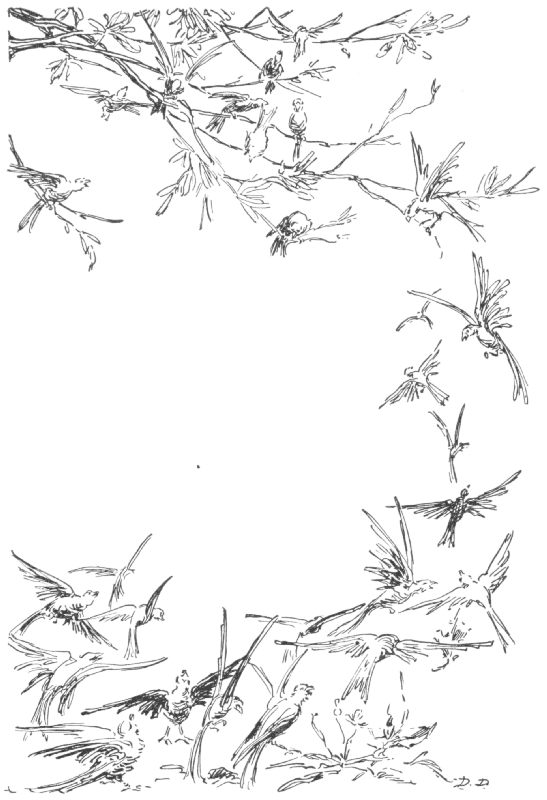
Trees turning colors were hopeful signs, but it's reassuring to know a biological clock in a dozen birds says they need to start their long journey to places with different temperatures.

I'm no real lover of winter, but all the talk of Climate Change makes this seasonal activity beyond the control of humans worth noting.

Just two weeks ago I posted a story from The Topaz Story Book by the Skinner sisters.  The long subtitle for that book is "Stories and Legends of Autumn, Hallowe’en, and Thanksgiving", so it's still worth your checking for months to come.  Back on September 29, 2018 I printed the Henry Ward Beecher story of "The Anxious Leaf" also from The Topaz Story Book.  Today I want to give another brief tale of his that migrating Canadian "Honkers" makes me appreciate.  Geese are certainly not songbirds like in this story, but they, too, leave Michigan for warmer weather.

COMING AND GOING

Henry Ward Beecher

There came to our fields a pair of birds that had never built a nest nor seen a winter. How beautiful was everything! The fields were full of flowers, and the grass was growing tall, and the bees were humming everywhere. Then one of the birds began singing, and the other bird said, “Who told you to sing?” And he answered, “The flowers told me, and the bees told me, and the winds and leaves told me, and the blue sky told me, and you told me to sing.” Then his mate answered, “When did I tell you to sing?” And he said, “Every time you brought in tender grass for the nest, and every time your soft wings fluttered off again for hair and feathers to line the nest.” Then his mate said, “What are you singing about?” And he answered, “I am singing about everything and nothing. It is because I am so happy that I sing.”

By and by five little speckled eggs were in the nest, and his mate said, “Is there anything in all the world as pretty as my eggs?” Then they both looked down on some people that were passing by and pitied them because they were not birds.

In a week or two, one day, when the father-bird came home, the mother-bird said, “Oh, what do you think has happened?” “What?” “One of my eggs has been peeping and moving!” Pretty soon another egg moved under her feathers, and then another and another, till five little birds were hatched! Now the father-bird sang louder and louder than ever. The mother-bird, too, wanted to sing, but she had no time, and so she turned her song into work. So hungry were these little birds that it kept both parents busy feeding them. Away each one flew. The moment the little birds heard their wings fluttering among the leaves, five yellow mouths flew open wide, so that nothing could be seen but five yellow mouths!

“Can anybody be happier?” said the father-bird to the mother-bird. “We will live in this tree always, for there is no sorrow here. It is a tree that always bears joy.”

Soon the little birds were big enough to fly, and great was their parents’ joy to see them leave the nest and sit crumpled up upon the branches. There was then a great time! The two old birds talking and chatting to make the young ones go alone! In a little time they had learned to use their wings, and they flew away and away, and found their own food, and built their own nests, and sang their own songs of joy.

Then the old birds sat silent and looked at each other, until the mother-bird said, “Why don’t you sing?” And he answered, “I can’t sing—I can only think and think.” “What are you thinking of?” “I am thinking how everything changes: the leaves are falling off from this tree, and soon there will be no roof over our heads; the flowers are all going; last night there was a frost; almost all the birds are flown away. Something calls me, and I feel as if I would like to fly far away.”

“Let us fly away together!”

Then they rose silently, and, lifting themselves far up in the air, they looked to the north: far away they saw the snow coming. They looked to the south: there they saw flowers and green leaves! All day they flew; and all night they flew and flew, till they found a land where there was no winter—where flowers always blossom, and birds always sing.

***

Far away that snow is indeed coming.  All too soon I'll be looking forward to it ending, but for now I'll think of this story while hiking with my dog, seeing migrating geese and hearing the last songs of birds. 

**************************

This is part of a series of postings of stories under the category, "Keeping the Public in Public Domain."  The idea behind Public Domain was to preserve our cultural heritage after the authors and their immediate heirs were compensated.  I feel strongly current copyright law delays this intent on works of the 20th century.  My own library of folklore includes so many books within the Public Domain I decided to share stories from them.  I hope you enjoy discovering new stories.  


At the same time, my own involvement in storytelling regularly creates projects requiring research as part of my sharing stories with an audience.  Whenever that research needs to be shown here, the publishing of Public Domain stories will not occur that week.  This is a return to my regular posting of a research project here.  (Don't worry, this isn't dry research, my research is always geared towards future storytelling to an audience.)  Response has convinced me that "Keeping the Public in Public Domain" should continue along with my other postings as often as I can manage it.

Other Public Domain story resources I recommend-

  • There are many online resources for Public Domain stories, maybe none for folklore is as ambitious as fellow storyteller, Yoel Perez's database, Yashpeh, the International Folktales Collection.  I have long recommended it and continue to do so.  He has loaded Stith Thompson's Motif Index into his server as a database so you can search the whole 6 volumes for whatever word or expression you like by pressing one key. http://folkmasa.org/motiv/motif.htm

  • You may have noticed I'm no longer certain Dr. Perez has the largest database, although his offering the Motif Index certainly qualifies for those of us seeking specific types of stories.  There's another site, FairyTalez claiming to be the largest, with "over 2000 fairy tales, folktales, and fables" and they are "fully optimized for phones, tablets, and PCs", free and presented without ads.
    Between those two sites, there is much for story-lovers, but as they say in infomercials, "Wait, there's more!"

The email list for storytellers, Storytell, discussed Online Story Sources and came up with these additional suggestions:        

         - David K. Brown - http://people.ucalgary.ca/~dkbrown/stories.html

         - Richard Martin - http://www.tellatale.eu/tales_page.html

         - Spirit of Trees - http://spiritoftrees.org/featured-folktales

         - Story-Lovers - http://www.story-lovers.com/ is now only accessible through the Wayback Machine, described below, but the late Jackie Baldwin's wonderful site lives on there, fully searchable manually (the Google search doesn't work), at https://archive.org/ .  It's not easy, but go to Story-lovers.com snapshot for December 22 2016  and you can click on SOS: Searching Out Stories to scroll down through the many story topics and click on the story topic that interests you.

       - World of Tales - http://www.worldoftales.com/ 

 
           - Zalka Csenge Virag - http://multicoloreddiary.blogspot.com doesn't give the actual stories, but her recommendations, working her way through each country on a continent, give excellent ideas for finding new books and stories to love and tell.

     
You're going to find many of the links on these sites have gone down, BUT go to the Internet Archive Wayback Machine to find some of these old links.  Tim's site, for example, is so huge probably updating it would be a full-time job.  In the case of Story-Lovers, it's great that Jackie Baldwin set it up to stay online as long as it did after she could no longer maintain it.  Possibly searches maintained it.  Unfortunately Storytell list member, Papa Joe is on both Tim Sheppard's site and Story-Lovers, but he no longer maintains his old Papa Joe's Traveling Storytelling Show website and his Library (something you want to see!) is now only on the Wayback Machine.  It took some patience working back through claims of snapshots but finally in December of 2006 it appears!

    Somebody as of this writing whose stories can still be found by his website is the late Chuck Larkin - http://chucklarkin.com/stories.html.  I prefer to list these sites by their complete address so they can be found by the Wayback Machine, a.k.a. Archive.org, when that becomes the only way to find them.

You can see why I recommend these to you. 

Have fun discovering even more stories

Friday, June 3, 2022

Mockingbirds...including Lanier - Bob: The Story of Our Mockingbird - Keeping the Public in Public Domain

Sometimes it just isn't possible to find exactly the story I want to tell.  <GASP!>  It's true, even with a computer and a large library.  I've been enjoying the return of songbirds from their winter homes in the south.  At the same time I was afraid I might have lost hearing one I especially love.  We had the utility company trim a tree growing around various utility wires.  Supposedly it's a mulberry although I've never seen any berries.  What I have noticed is it's the favorite perch for a mockingbird.  It's lovely to be out on our deck at the barbecue or the laundry line and be serenaded.  I'm relieved to say that tall utility pole and companion tree still attracts my mockingbird, but it also has chosen the top of another tree a short flap of his wings away.

How do I know it's the same bird?  Of course I don't, but All About Birds says "If you’ve been hearing an endless string of 10 or 15 different birds singing outside your house, you might have a Northern Mockingbird in your yard."  I can't be sure it's the same bird year after year, but "Northern Mockingbirds continue to add new sounds to their repertoires throughout their lives. A male may learn around 200 songs throughout its life."  That lifespan can be long with "The oldest Northern Mockingbird on record was at least 14 years, 10 months old when it was found in Texas."  I'm also told they may sing at night, especially if not yet mated and that females may sing, too, just "usually more quietly than the male does."  My boy sings quite loudly and if he's mated, I hope he's teaching the rest of his family.

I've gathered two songs, "Listen to the Mockingbird" and "Mockingbird Hill", but a story I might use with them continues to escape me.  

Thornton Burgess has a book, The Adventures of Mr. Mocker, but the bird isn't seen until right before the book's end when a mystery is solved about how he's been tricking other birds and even a tree toad by singing as they do.  The book's title lets young readers in on the joke from the beginning.  Burgess also gives the Mockingbird part of a chapter called "Jenny Wren's Cousins" in his The Burgess Bird Book for Children, again with its tricky nature featured.  

In contrast the poet, Sidney Lanier, in Bob: The Story of Our Mocking-Bird tells about a real bird from the time his sons found the hatchling abandoned on the forest floor until its death years later.  Be sure to catch an e-version with illustrations as:

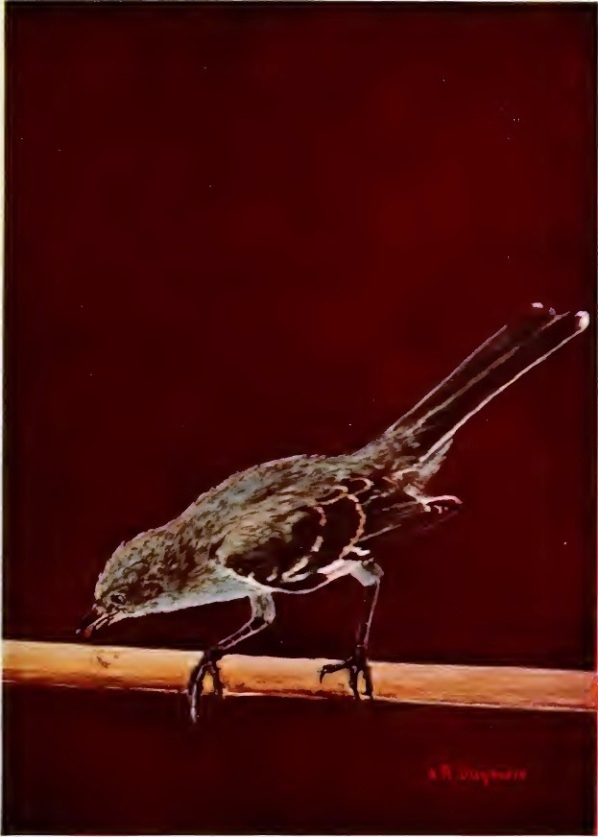
The illustrations which form so important a part of the effort to make a picture of Bob, are unusual in their origin and in their method. Mr. Dugmore made photographic studies of a young mocking-bird, or, rather, of a number of young mocking-birds, the photographs were colored by him, and the plates from these photographs were printed in color. The variety of rare tints in any bird's plumage, their extreme delicacy, and the infinitely fine gradations of shading have almost always baffled the artist and the printer. The present attempt to reproduce Mr. Dugmore's masterly pictures in color shows at least a handsome advance in the difficult art.

I'm going to skip to the raising of the bird and even its battle with a pin cushion and mirror, going instead to the mature bird.  

*****
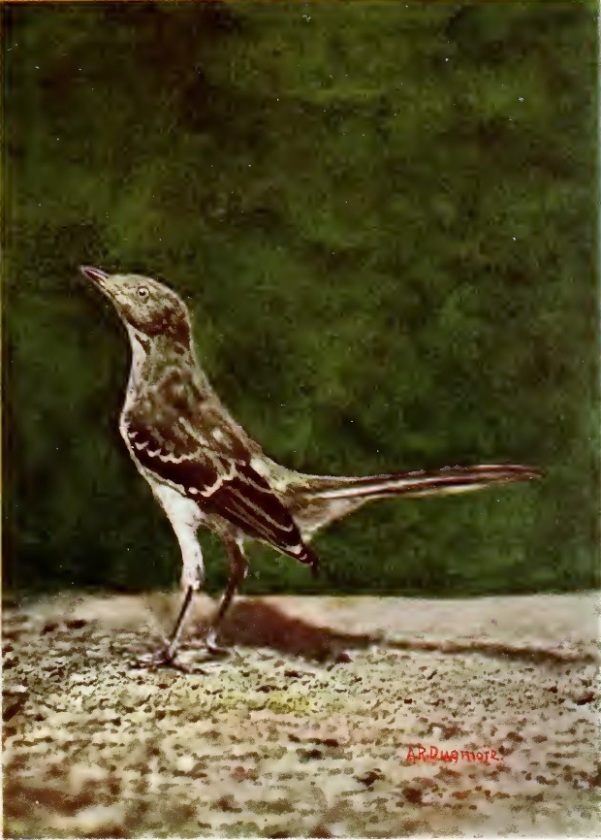
The most elegant, trim ... little dandy
"The most elegant, trim ... little dandy"

At this present writing, Bob is the most elegant, trim, electric, persuasive, cunning, tender, courageous, artistic little dandy of a bird that mind can imagine. He does not confine himself to imitating the songs of his tribe. He is a creative artist. I was witness not long ago to the selection and adoption by him of a rudimentary whistle-language. During an illness it fell to my lot to sleep in a room alone with Bob. In the early morning, when a lady—to whom Bob is passionately attached—would make her appearance in the room, he would salute her with a certain joyful chirrup which appears to belong to him peculiarly. I have not heard it from any other bird. But sometimes the lady would merely open the door, make an inquiry, and then retire. It was now necessary for his artistic soul to find some form of expressing grief. For this purpose he selected a certain cry almost identical with that of the cow-bird—an indescribably plaintive, long-drawn, thin whistle. Day after day I heard him make use of these expressions. He had never done so before. The mournful one he would usually accompany, as soon as the door was shut, with a sidelong, inquiring posture of the head, which was a clear repetition of the lover's Is she gone? Is she really gone?
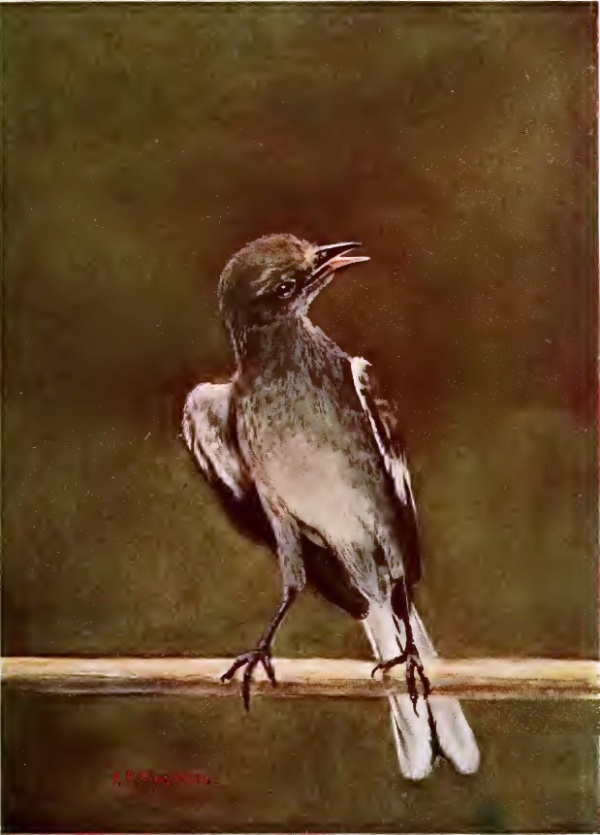
A sidelong, inquiring posture of the head, ... Is she gone?
"A sidelong, inquiring posture of the head, ... Is she gone?"


letter T

here is one particular in which Bob's habits cannot be recommended. He eats very often. In fact if Bob should hire a cook, it would be absolutely necessary for him to write down his hours for her guidance; and this writing would look very much like a time-table of the Pennsylvania, or the Hudson River, or the Old Colony, Railroad. He would have to say: "Bridget will be kind enough to get me my breakfast at the following hours: 5, 5.30, 5.40, 6, 6.15, 6.30, 6.45, 7, 7.20, 7.40, 8 (and so on, every fifteen or twenty minutes, until 12 M.); my dinner at 12, 12.20, 12.40, 1, 1.15, 1.30 (and so on every fifteen or twenty minutes until 6 p.m.); my supper is irregular, but I wish Bridget particularly to remember that I always eat whenever I awake in the night, and that I usually awake four or five times between bedtime and daybreak." With all this eating, Bob never neglects to wipe his beak after each meal. This he does by drawing it quickly, three or four times on each side, against his perch.
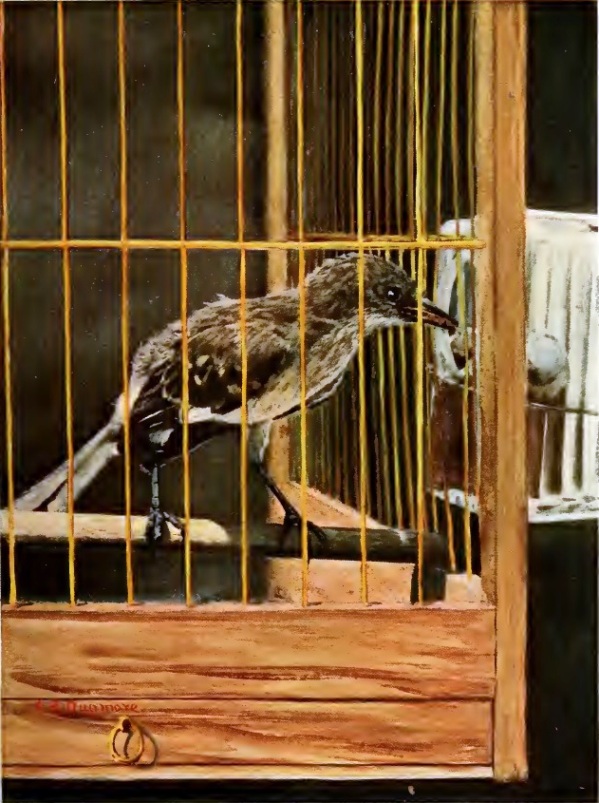
He eats very often
"He eats very often"

Bob never neglects to wipe his beak after each meal
"Bob never neglects to wipe his beak after each meal"

I never tire of watching his motions. There does not seem to be the least friction between any of the component parts of his system. They all work, give, play in and out, stretch, contract, and serve his desires generally with a smoothness and soft precision truly admirable.

Merely to see him leap from his perch to the floor of his cage is to me a never-failing marvel. It is so instantaneous, and yet so quiet: clip, and he is down, with his head in the food-cup: I can compare it to nothing but the stroke of Fate. It is perhaps a strained association of the large with the small: but when he suddenly leaps down in this instantaneous way, I always feel as if, while looking down upon the three large Forms of the antique Sculpture, lying in severe postures along the ground, I suddenly heard the clip of the fatal shears.

His repertory of songs is extensive. Perhaps it would have been much more so if his life had been in the woods where he would have had the opportunity to hear the endlessly-various calls of his race. So far as we can see, the stock of songs which he now sings must have been brought in his own mind from the egg, or from some further source whereof we know nothing. He certainly never learned these calls: many of the birds of whom he gives perfect imitations have been always beyond his reach. He does not apprehend readily a new set of tones. He has caught two or three musical phrases from having them whistled near him. No systematic attempt, however, has been made to teach him anything. His procedure in learning these few tones was peculiar. He would not, on first hearing them, make any sign that he desired to retain them, beyond a certain air of attention in his posture. Upon repetition on a different day, his behavior was the same: there was no attempt at imitation. But sometime afterward, quite unexpectedly, in the hilarious flow of his birdsongs would appear a perfect reproduction of the whistled tones. Like a great artist he was rather above futile and amateurish efforts. He took things into his mind, turned them over, and, when he was perfectly sure of them, brought them forth with perfection and with unconcern.

He has his little joke. His favorite response to the endearing terms of the lady whom he loves is to scold her. Of course he understands that she understands his wit. He uses for this purpose the angry warning cry which mocking-birds are in the habit of employing to drive away intruders from their nests. At the same time he expresses his delight by a peculiar gesture which he always uses when pleased. He extends his right wing and stretches his leg along the inner surface of it as far as he is able.
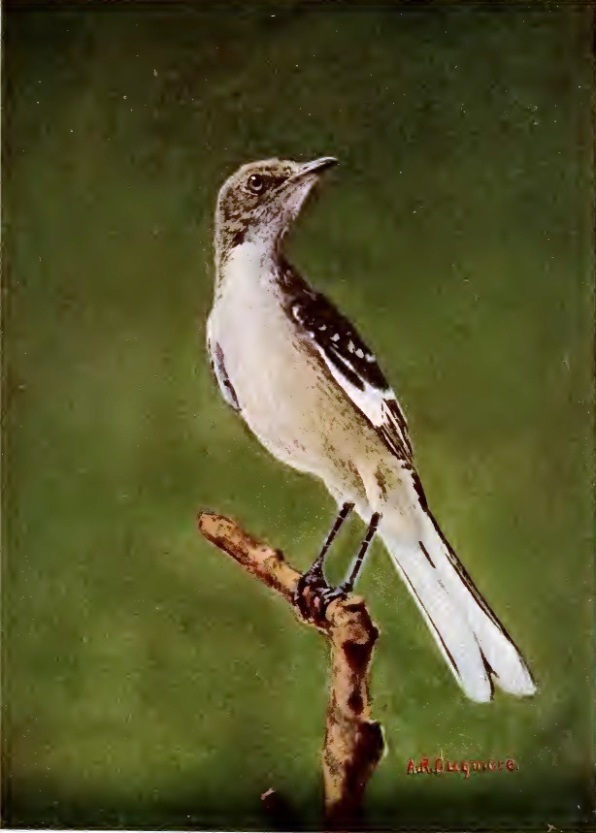
He stretches his body until he seems incredibly tall
"He stretches his body until he seems incredibly tall"

*****

There's more in the book, including a discussion of whether it was a good idea to keep the bird.  All About Birds says:

It’s not just other mockingbirds that appreciate a good song. In the nineteenth century, people kept so many mockingbirds as cage birds that the birds nearly vanished from parts of the East Coast. People took nestlings out of nests or trapped adults and sold them in cities such as Philadelphia, St. Louis, and New York, where, in 1828, extraordinary singers could fetch as much as $50.

Because Lanier is a poet, there is a poem introducing the story and later an Epilogue about the bird's death. 

The problem with animal stories is so often the ending, since every story needs a conflict.  I remember a girl, who is now an adult, when she attended a movie series at the library where I worked.  Her mother said "Don't mind ___, she covers up her eyes when the animal is in danger, but she'll be fine."  


Recently I was telling to some disabled adults.  I've no idea what disabilities were represented, but I quickly found a very bright young woman loudly and emphatically objecting to each story I was going to tell because there was hunting (even if in the most ridiculous tall tale style) or some other way an animal might be hurt.  After the program I learned she had injured a frog long ago, felt guilty, and felt strongly about any animal cruelty.  I, too, agree, but hadn't seen the stories in that way.  To try and help her find a way to enjoy the program, I brought out some of the reusable sticker sets sold by Melissa & Doug I've been using with groups to help the audience create stories.  She was able to join the others, helping create the story, although I had to remind her a story needs some kind of conflict to be resolved.  Unfortunately that didn't leave her able to accept other stories.  Seeing it wasn't going to work for her, the group leader asked her out into the hall while I told to the remaining audience.  They knew her, so they seemed to accept the problems we were having, but wanted to hear the stories.  Nothing says I handled this unexpected problem correctly, but it did leave me thinking further about the dangers of stories with animals or if I ever again have a group vocally unhappy with my stories.  It was the first ever to happen in more years that I will bother to number, but it's a lot!

With all of that in my mind, I'm surprised to find the bird has so little in the way of folklore.  Of course I am limited here in what I can reprint to stories that must be in the Public Domain.  I could find an Aesop tale supposedly about the mockingbird; Eggleston has "The Mocking-Bird's Singing-School"; and Young's Plantation Bird Legends story of "Mocking Bird's Theft" about stealing corn and how people now have it.  None of them are what I wanted to tell. 

Even beyond that, still under copyright I found only four more stories: a Mayan tale learning a song (Bowes - Bird Kingdom of the Mayas); a Hopi story of it giving out calls to the birds (Courlander - People of the Short Blue Corn: Tales and Legends of  the Hopi Indians); another Hopi tale where the mockingbird wins the contest for calling the dawn (Brown - Tepee Tales of the American Indian); and Sis Mockingbird teaches a crude courting song to Br'er B'ar, but a fine one to Br'er Rabbit (Faulkner - Days When the Animals Talked: Black American Folktales and How They Came to Be ). 

I did find two non-fiction articles worth reading.  I'd long heard birdsong is territorial, so "Why Do Birds Sing? (6 reasons and what their songs mean)" attracted me.  Scientific American has an article with a very long title if we include the sub-title, "Mockingbirds Are Better Musicians Than We Thought" followed by "Their complex songs have striking similarities to Beethoven, Tuvan throat singing, a Disney musical and Kendrick Lamar." 

Going back to those two songs I mentioned way earlier, the upbeat melody of "Listen to the Mocking Bird"  is misleading as the song's original lyrics are remembering the bird's song at a grave.  I must have been remembering one of the other versions of it.  It's a story, but not the one I want to tell.  "Mockingbird Hill" has lyrics matching my enjoyment of the bird.  It's interesting that those lyrics take you up there on Mockingbird Hill "Only me and the sky and an old whippoorwill Singing songs in the twilight on Mockin'bird Hill."  I did a quick Wikipedia check thinking maybe Whippoorwill is another name for Mockingbird.  It's not.  The good news for lovers of Whip-poor-will's is there are many stories mentioned there.  The bad news is that bird's becoming rare and now is considered "near threatened."

I'm grateful the tree trimming has not made "my" mockingbird rare.  As for a story and a song, I still don't think I have it. . . unless this search is the story.

*****************

This is part of a series of postings of stories under the category, "Keeping the Public in Public Domain."  The idea behind Public Domain was to preserve our cultural heritage after the authors and their immediate heirs were compensated.  I feel strongly current copyright law delays this intent on works of the 20th century.  My own library of folklore includes so many books within the Public Domain I decided to share stories from them.  I hope you enjoy discovering new stories.  


At the same time, my own involvement in storytelling regularly creates projects requiring research as part of my sharing stories with an audience.  Whenever that research needs to be shown here, the publishing of Public Domain stories will not occur that week.  This is a return to my regular posting of a research project here.  (Don't worry, this isn't dry research, my research is always geared towards future storytelling to an audience.)  Response has convinced me that "Keeping the Public in Public Domain" should continue along with my other postings as often as I can manage it.
Other Public Domain story resources I recommend-
  • There are many online resources for Public Domain stories, maybe none for folklore is as ambitious as fellow storyteller, Yoel Perez's database, Yashpeh, the International Folktales Collection.  I have long recommended it and continue to do so.  He has loaded Stith Thompson's Motif Index into his server as a database so you can search the whole 6 volumes for whatever word or expression you like by pressing one key. http://folkmasa.org/motiv/motif.htm
  • You may have noticed I'm no longer certain Dr. Perez has the largest database, although his offering the Motif Index certainly qualifies for those of us seeking specific types of stories.  There's another site, FairyTalez claiming to be the largest, with "over 2000 fairy tales, folktales, and fables" and they are "fully optimized for phones, tablets, and PCs", free and presented without ads.

    Between those two sites, there is much for story-lovers, but as they say in infomercials, "Wait, there's more!"
The email list for storytellers, Storytell, discussed Online Story Sources and came up with these additional suggestions:            
         - David K. Brown - http://people.ucalgary.ca/~dkbrown/stories.html
         - Richard Martin - http://www.tellatale.eu/tales_page.html
         - Spirit of Trees - http://spiritoftrees.org/featured-folktales
         - Story-Lovers - http://www.story-lovers.com/ is now only accessible through the Wayback Machine, described below, but the late Jackie Baldwin's wonderful site lives on there, fully searchable manually (the Google search doesn't work), at https://archive.org/ .  It's not easy, but go to Story-lovers.com snapshot for October 22 2016  and you can click on SOS: Searching Out Stories to scroll down through the many story topics and click on the story topic that interests you.
       - World of Tales - http://www.worldoftales.com/ 
           - Zalka Csenge Virag - http://multicoloreddiary.blogspot.com doesn't give the actual stories, but her recommendations, working her way through each country on a continent, give excellent ideas for finding new books and stories to love and tell.
     
You're going to find many of the links on these sites have gone down, BUT go to the Internet Archive Wayback Machine to find some of these old links.  Tim's site, for example, is so huge probably updating it would be a full-time job.  In the case of Story-Lovers, it's great that Jackie Baldwin set it up to stay online as long as it did after she could no longer maintain it.  Possibly searches maintained it.  Unfortunately Storytell list member, Papa Joe is on both Tim Sheppard's site and Story-Lovers, but he no longer maintains his old Papa Joe's Traveling Storytelling Show website and his Library (something you want to see!) is now only on the Wayback Machine.  It took some patience working back through claims of snapshots but finally in December of 2006 it appears!
    Somebody as of this writing whose stories can still be found by his website is the late Chuck Larkin - http://chucklarkin.com/stories.html.  I prefer to list these sites by their complete address so they can be found by the Wayback Machine, a.k.a. Archive.org, when that becomes the only way to find them.
You can see why I recommend these to you. Have fun discovering even more stories!