Tell me if you have a topic you'd like to see. (Contact: LoiS-sez@LoiS-sez.com .)
Please also let others know about this site.
Showing posts sorted by relevance for query julia darrow cowles. Sort by date Show all posts

Tuesday, November 26, 2013

Cowles - Bread of Gold - Keeping the Public in Public Domain

Julia Darrow Cowles proved to be an interesting resource, so I tried to see what I could learn about her.  With this I've done two blog posts with stories from her work.  I already completed the first, and this second article includes what little information I could find on her.  She was among those in the late 19th and early 20th century who led that period's storytelling revival.  Personally I'm downloading to an eReader a book of hers, The Art of Storytelling, with Nearly Half a Hundred Stories.  It's great for an eReader as she indexes her stories and does an excellent job of making them accessible to young listeners.  It's just the sort of resource I love when telling on the road, especially in a foreign country, where a theme can pop up and I want to find related stories.  She was a bit more thorough in her own notation of sources than typically found in many anthologies of the era.

I especially thank a fellow librarian and lover of children's literature, Barbara Begin Campbell, at Oakland University's School of Education for checking her own copy of the original edition of Junior Book of Authors!  It saved me trying to find a library in the false hope she might just be mentioned.  (A slight UPDATE here: Google Books is online with that book and it is searchable.  The recent court decision about Google Books providing a research service that doesn't jeopardize copyright is proving true.)  Mrs. Cowles nearly anonymous passing is a perfect example of how important it is to preserve the Public Domain as our cultural heritage.  There's a tiny bit in the paragraph below I was able to find with some online detective work on my part.  It is probably all anybody but her own possible descendants might know. 

The best I could learn online about Julia Darrow Cowles is she was also known as Mrs. Frances Dana Cowles: (January 6, 1862 - September 6, 1919), was from Canada, had a Connecticut ancestor, was probably Baptist (see pages 16 - 18 for a list of all her books in A Baptist Bibliography :  Being a Register of Printed Material By and About Baptists; Including Works Written Against the Baptists edited by Edward C. Starr, Curator of the American Baptist Historical Society), and she also was "a member of a well-known Minneapolis literary family" according to "The Heimatbrief", the newsletter magazine of the German-Bohemian Society, September 2003.   Since only a fraction of her books are currently online, I would hope more are added to the various digital archives.

Here's a tasty story of some bread that won't make good Thanksgiving stuffing or other eating.


I love Cowles telling us this comes from Slav Tales, translated by Emily J. Harding, even noting the publisher.  Not typical.  This slender 124 page volume includes several more from Slav Tales, along with many Tibetan and Gypsy stories -- not the usual sources, and an assortment of other tales.
**********************
This is part of a series of postings of stories under the category, "Keeping the Public in Public Domain."  The idea behind Public Domain was to preserve our cultural heritage after the authors and their immediate heirs were compensated.  I feel strongly current copyright law delays this intent on works of the 20th century.  I hope you enjoy discovering new stories. 

At the same time, I've returned to involvement in projects requiring research as part of my sharing stories with an audience.  Whenever that research needs to be shown here, the publishing of Public Domain stories will not occur that week.  This is a return to my normal monthly posting of a research project here.  Response has convinced me that "Keeping the Public in Public Domain" should continue along with my monthly postings as often as I can manage it.  

Saturday, April 29, 2017

Cowles - Origin of the Violet - Keeping the Public in Public Domain

I call my dog my "cross trainer" as every other day, if at all possible, I try to take him out for a 45 minute to an hour hike, with some days double that if time and energy permits.  (He also becomes a "cross" trainer if he doesn't get enough exercise.)  It's a perfect time to observe nature and think about things like stories.

Hiking the hills and valleys of a nearby state park right now made me wonder what Pourquois story might exist about what I was seeing and even tasting.  Pourquois tales are stories about Why or How something came to be.  When I mention tasting, it's related to

and enjoying the taste of wild plants like the leaves of wild violets which are sweeter than any lettuce.  No, I didn't have a bunch of them, just a leaf or two doesn't hurt those beautiful bits of scattered springtime color.  Euell Gibbons started Americans appreciating the edible bounty of nature without our even planting it.

Here's an Iroquois story to pay for that bite of springtime.
Photo: James Steakley / Wikimedia
A sad end to a story that seems to just pop up out of nowhere even as the wild violet does along the trail.

Earlier on this blog I have what little information could be found about Julia Darrow Cowles,who gave no source for that Iroquois tale, but at least she identified it as coming from the Iroquois.  Many early editors of Native American anthologies from many of those nations didn't identify the tradition.  Her Indian Nature Myths at least gives us that much documentation.

Logo of the Haudenosaunee Confederation
The name itself of Iroquois some say came from the French, while others believe it came from their Algonquin enemies here in this Great Lakes area and means "rattlesnakes."  They call themselves the Haudenosaunee, meaning "people of the long house."  I only use it because it is the more common description for the confederation, but the hotlink on the logo and previous sentence take you to the official website of a people who can easily lay claim to being the oldest living participatory democracy on earth.  A Wikipedia article debates their contribution to the creation of the U.S. Constitution and Bill of Rights, but the U.S. Congress in 1988 passed a resolution recognizing the influence of the Iroquois League.

Similarly it was difficult to find the source where Julia Darrow Cowles found her tale.  I searched well-regarded Iroquois books pre-dating her title. Books I have and online come from the half-Seneca folklorist, Arthur C. Parker, also Harriet Maxwell Converse and Mabel Powers, each of whom were adopted were adopted into the Seneca nation within the Confederation.  Folklorist Jeremiah Curtin was another early recorder, again from the Seneca tradition.  The U.S. Bureau of American Ethnology publications from these individuals, when online are small type and not easily browsed when a title uses an Iroquois/Haudenosaunee word.  It's not in my own books by Parker, Converse, and Powers, and the only books I own by Curtin are his Irish collections, another area of folklore he loved.

I also checked Legends of the Longhouse by J.J. Cornplanter since an Iroquois Reprints of a 1938 book, but Cornplanter is apparently a popular Iroquois name.  Hathi Trust Digital Library has the 1902 Legends of the Iroquois told by "the Cornplanter" with "authoritative notes and studies by William W. Canfield" and it's there on page 81!  I think it does a better job of starting and ending the story.  Canfield described the Cornplanter as a Seneca chief, giving two transliterations of his name meaning the Cornplanter, who told the stories shortly after the American Revolution.  Canfield explains further about the authority of the stories and how he proceeded to document them.

The ending in Legends of the Longhouse says more about the two lovers and the girl's choice to leave her people, but closes with: From this spot sprang the violets; and the winds and birds carried the seeds of the little flowers over all the world, into all countries where men dare and maidens love, so that the Indians of all ages might know that the Great Spirit would always raise a monument to true love and bravery.

Powers, whose book, Stories the Iroquois Tell Their Children, available for free through both Project Gutenberg and Archive.orgArchive.org, tells not only about her sources, but how she became named Yeh Sen Noh Wehs or Daughter of the Senecas.  She is the only one specifically saying she collected from all the Iroquois.  She tells us a story was ended traditionally with "Na ho" meaning "It is the end" -- and for today it is.
*************
Here's my closing for days when I have a story in Keeping the Public in Public Domain
***************** 

This is part of a series of postings of stories under the category, "Keeping the Public in Public Domain."  The idea behind Public Domain was to preserve our cultural heritage after the authors and their immediate heirs were compensated.  I feel strongly current copyright law delays this intent on works of the 20th century.  My own library of folklore includes so many books within the Public Domain I decided to share stories from them.  I hope you enjoy discovering new stories.  


At the same time, my own involvement in storytelling regularly creates projects requiring research as part of my sharing stories with an audience.  Whenever that research needs to be shown here, the publishing of Public Domain stories will not occur that week.  This is a return to my regular posting of a research project here.  (Don't worry, this isn't dry research, my research is always geared towards future storytelling to an audience.)  Response has convinced me that "Keeping the Public in Public Domain" should continue along with my other postings as often as I can manage it. 

Other Public Domain story resources I recommend -
  • There are many online resources for Public Domain stories, maybe none for folklore is as ambitious as fellow storyteller, Yoel Perez's database, Yashpeh, the International Folktales Collection.  I have long recommended it and continue to do so.  He has loaded Stith Thompson's Motif Index into his server as a database so you can search the whole 6 volumes for whatever word or expression you like by pressing one key. http://folkmasa.org/motiv/motif.htm
  • You may have noticed I'm no longer certain Dr. Perez has the largest database, although his offering the Motif Index certainly qualifies for those of us seeking specific types of stories.  There's another site, FairyTalez claiming to be the largest, with "over 2000 fairy tales, folktales, and fables" and they are "fully optimized for phones, tablets, and PCs", free and presented without ads.
Between those two sites, there is much for story-lovers, but as they say in infomercials, "Wait, there's more!"
You can see why I recommend these to you. Have fun discovering even more stories!

Tuesday, November 19, 2013

Cowles (Schoolcraft) - How the Seasons Came to Be - Keeping the Public in Public Domain

First a bit of a story from this storyteller.

On April 15, 2000 I went to a sale at the home of a local used bookseller.  She had other locations where she sold at antique malls, but her basement was a treasure trove from which she also sold.  She was moving to a new home, so I eagerly went to her sale.  Can't recall offhand what books I bought that day, but definitely remember buying this mug

It was by Edward Gorey -- if you're a fan, as I am, you probably recognized it being by him.  Perhaps the name doesn't ring a bell, but if you've watched his wonderful animated introduction to the PBS series, Mystery!, then you've seen his style in action.  He didn't do the animation, Derek Lamb did that, but it's definitely based on his art.  I fell in love with him through his delightfully macabre illustration of children's books and went on to prowl his other books and artwork.
Wikipedia rightfully compares him to Charles Addams (another favorite of mine!) and says he's "an iconic figure in the Goth subculture."  I'm no Goth, but greatly enjoy both author/illustrators.

The reverse side of the mug says
Not all of that is visible and it needs to be seen: So Many Books - So Little Time.  That certainly is appropriate for this bibliomaniac.  My publishing Public Domain works from my own library makes that obvious.  What I didn't know until later that day was Edward Gorey died that very day at age 75.

So Many Books So Little Time 

How true.  It's part of the reason why I consider Keeping the Public in Public Domain important.  I started this series while on sabbatical this past year.  That project, Elder Stories, is still something I hope to continue along with my storytelling as it shows ways to maintain communication and offer a social event for patients with Dementia and Alzheimer's and their caregivers.  Both the Public Domain work here and Elder Stories fit the Edward Gorey motto.  At the same time I've now returned to my professional storytelling, combining it with a very full life beyond work.  As a result this month revealed the schedule for this blog and Keeping the Public in Public Domain needs adjusting.  To maintain the level of research I consider appropriate, it will appear at least monthly, often more -- as may be seen in last month's multiple postings expanding the topic of Victorian Christmas, including the October appropriate idea of "scary ghost stories" which are a part of that Victorian celebration.  Sorry I can't predict it more closely.  Lately I've been living a quote attributed to, of all people, Woody Allen: If you want to make God laugh, tell Him your plans.

Here's November's entry in Keeping the Public in Public Domain.  It came from a children's anthology, Indian Nature Myths, edited by Julia Darrow Cowles.  Ms. Cowles is best known for her 4 works of historical fiction at The Baldwin Project (Our Little Macedonian Cousin of Long Ago, and similarly Roman, Athenian, and Spartan), but she also has the fascinating The Art of Storytelling, with Nearly Half a Hundred Stories.  It's worth downloading.  Great for an eReader as she indexes her stories and does an excellent job of making them accessible to young listeners.  It's that reason why I'm including her version of a tale you should also read and compare in Henry Rowe Schoolcraft'sThe Myth of Hiawatha, and Other Oral Legends..., or at least this specific story, "Ojeeg Annung or The Summer-Maker".  After Cowles' story I'll point to the difference in the two versions and why it makes the story a bit more "accessible to young listeners."


Go also to the version recorded by Henry Rowe Schoolcraft of "Ojeeg Annung or The Summer-Maker" and see how Cowles omits concepts such as Manitos.  While worth exploring in the Anishinaabe or Ojibwe culture, it is a complex issue requiring a great deal of explanation beyond sharing the main ideas of the story.  This does NOT mean Schoolcraft shouldn't be used.  He tried faithfully to preserve the stories from the People of the Three Fires, the Anishinaabe.  I'll say more about him later when I present his work.  Cowles, to her credit and unlike too many public domain editors, at least names each Native American nation rather than just lump it under "Indian."  While she doesn't list her sources, like Schoolcraft, trying to find the original sources for the stories she includes become so much easier if you know how to find standard works of folklore for the nations named. 

The cover of Folklore of the North American Indians -- a woodcut from Once Upon a Totem by Christie Harris, illustrated by John Frazer Mills, based upon the Native American art of the Pacific Northwest
November is Native American Heritage Month.  Combining this month's research with the Keeping the Public in Public Domain series, I want to recommend a reference for finding those solid works of Native American folktales.  The Library of Congress in 1969 published Folklore of the North American Indians; An Annotated Bibliography compiled by Judith C. Ullom.  The sensitivity behind choosing the best material is shown in its criteria: (1) statement of sources and faithfulness to them, (2) a true reflection of Indian cosmology, and (3) a written style that retains the spirit and poetry of the Indian's native manner of telling.  If there is any flaw in the book, it's that it is unable to look beyond 1969.  The book is out of print and has never been updated.  The good news is the work can be found online thanks to Scholars Archive @ OSU (Oregon State University), so it still is in print electronically.

This has been a combined post of both types of posts here -- a bit of research (normally more) and Public Domain stories.  May we all remember the contributions of the Native Americans, our own First Nations, the original spirit of Thanksgiving, including how the national holiday began with the declaration by Abraham Lincoln in 1863 recognizing the celebration of 1621 and, as our seasons settle into Winter, may the gift of Ojeeg return to the land of the Anishinaabe.

************************
Once again a slightly revised series statement of purpose:
This is part of a series of postings of stories under the category, "Keeping the Public in Public Domain."  The idea behind Public Domain was to preserve our cultural heritage after the authors and their immediate heirs were compensated.  I feel strongly current copyright law delays this intent on works of the 20th century.  I hope you enjoy discovering new stories. 

At the same time, I've returned to involvement in projects requiring research as part of my sharing stories with an audience.  Whenever that research needs to be shown here, the publishing of Public Domain stories will not occur that week.  This is a return to my normal monthly posting of a research project here.  Response has convinced me that "Keeping the Public in Public Domain" should continue along with my monthly postings as often as I can manage it.  

Friday, December 6, 2024

Cowles - Why the Wind Wails - Keeping the Public in Public Domain

The only rule for weather predictions for most locations is that it will change. . . and it definitely has!

We may not have received the nation's worst, but Michigan, especially the west and north, is bad enough. Erie Pennsylvania, your residents must love winter. Since winter and cold are my least favorite time of year, anybody there who doesn't love winter has my sympathy.

We had been having above normal weather and I was foolish enough to think that was a trend!

Julia Darrow Cowles and her book Indian Nature Myths hasn't been here in years -- their posting here spans from 2013 - 2017. That first story back in 2013 was before I found ways to reproduce pages better than a simple scan of my own books. That first story was her retelling of the Schoolcraft tale, "How the Seasons Came to Be." Definitely appropriate now. I suggest going to the book listed above at Project Gutenberg as the entire book is a treat for nature lovers.

Cowles notes the nations responsible for her stories, often the Anishinaabe (listing as Ojibwa or Chippewa) but several, including today's story, are merely attributed to the Algonquian. Our area's native people are part of that larger group and stories do travel. For more about the Algonquian peoples go to that link to understand this most populous and widespread North American indigenous North American group. Cowles briefly mentioned such story traveling in her Preface.

Wind chills have made the weather transition particularly brutal, so this Algonquin story is on my mind as the wind howls or it invisibly tries to beat me.

WHY THE WIND WAILS

(Algonquin)

WHEN the pale moon looks down from the sky, and when the wind cries mournfully around the wigwam, this is the story that the old man of the tribe tells to the Indian children:

Many, many moons ago the great chief of our tribe had a very beautiful daughter.

“She shall marry a great warrior,” said the Chief, “and a mighty hunter. Then she will be well cared for, and I shall be happy.”

So the great Chief kept watch of the young men of the tribe, to see which one would prove worthy of his daughter.

One day, as the Chief sat in the door of his lodge, there came a sudden rushing sound, and a young man stood before him. It was the Wind, who had made himself visible that he might talk with the Chief.

When he had saluted, he said, “Great Chief, I love your daughter. May I carry her away to my lodge, and make her my wife?”

The Chief looked at the Wind, and he answered, “No. My daughter is not for such as you. You are no warrior. You are no hunter. You love to play pranks. You cannot marry my daughter.”

So the Wind went away sorrowing, for he loved the Indian maiden.

The next day the maiden came to her father and said, “Father, I love the Wind better than any young warrior of our tribe. May I go to his lodge, and be his wife?”

The Chief looked at his daughter and said, “No. The Wind is no mate for you. He is no warrior. He is no hunter. He loves only to play pranks. You cannot marry him.”

The maiden went away sorrowing, for she loved the Wind.

The next day when the maiden went out to gather sweet marsh grass for her basket weaving, she heard a sudden rushing sound above her head. She looked up, and as she looked the Wind swept down and carried her in his arms far away to his lodge.

There they lived happily together, for the maiden became his wife. But the great Chief was full of wrath. He hunted through all the land for the lodge of the Wind, but he could not find it for many moons. Still he would not give up the search, for his heart was hot with wrath.

One day the Wind heard a great crashing sound among the trees near his lodge, and his heart stood still.

“It is your father,” he cried, and he hid the Chief’s daughter in a thicket, while he made himself invisible, that he might stay close beside her.

The great Chief looked inside the lodge of the Wind, but he found it empty. Then he went through the brush, striking to right and left with his heavy club, and calling, “My daughter: my daughter!”

And when the Wind’s wife heard her father’s voice, she answered, “Oh, my father, strike not! We are here.”

But before her words could reach him, the Chief swung his great club once more, and it fell upon the head of the invisible Wind, who, without a sound, dropped unconscious upon the ground. And because he was invisible, neither the Chief nor his daughter knew what had happened.

Then the Chief took his daughter in his arms and hastened back to his tribe. But each day she grew more and more sorrowful, and longed for her husband, the Wind.

For many hours the Wind lay unconscious beside his lodge. When he awakened, the Chief and his daughter had gone. Sorrowfully he set out in search of his wife. He traveled to her father’s tribe, and there at last he found her. But she was in a canoe with her father, far out upon the lake.

Then the Wind cried, “Come to me, my loved one,” and his voice swept out over the water.

The Chief said, “The winds are blowing,” but his daughter knew her husband’s voice. She could not see him, for he was still invisible, but she lifted herself up in the canoe and stretched out her hands toward the shore. As she did so a breeze stirred the water, and the canoe overturned.

The Chief’s daughter threw up her arms, and the Wind tried to catch her in his embrace, but he was too late. The Great Spirit bore her far up into the sky, and there he gave her a home where she would live
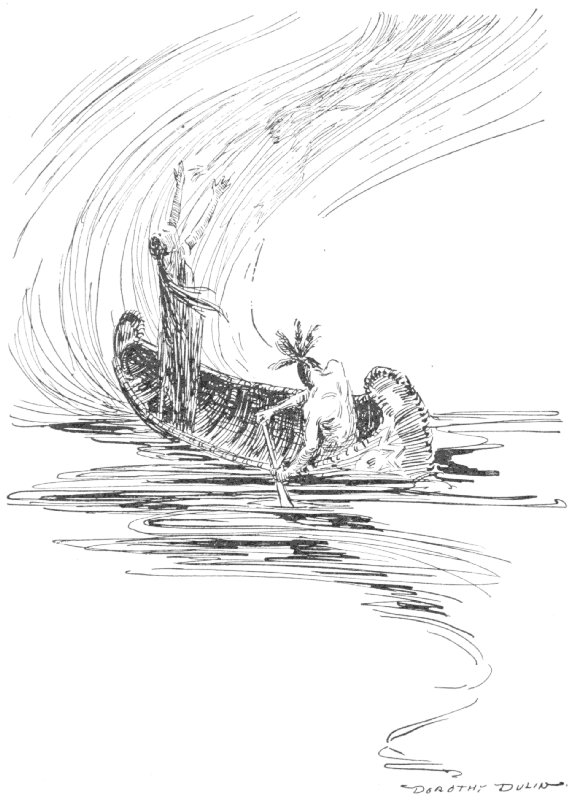


“THE WIND TRIED TO CATCH HER IN HIS EMBRACE”

The great Chief was drowned in the waters of the lake.

Night after night his daughter looks down upon the earth, hoping for a sight of her lost lover. But though the Wind still roams about the earth in search of his bride, he has never, since the Chief’s blow fell upon his head, had the power to become visible to men.

And now you will understand why the voice of the Wind is so mournful as it wails about the wigwam; and why the Moon Maiden’s pale face is always turned downward toward the earth.

***

The book ends with another Algonquin wind tale, "Keepers of the Winds", but it's best saved for a warmer time. 

For my fellow storytellers I want to repeat Cowles' note that appeared right before the stories: 

Before reading or telling the Indian Nature Myths to the children, it is best to explain that just as they love to wonder and imagine about the new and strange sights and sounds of the world, so the early races of men, the children of time, loved to wonder and imagine. And so these stories of nature grew out of their imaginings; and some of the stories are so beautiful, and some of them are so odd, that men have repeated them from one generation to another, ever since,—for even when they no longer believed them to be true, they loved them.

Other anthologies title this story "Bride of the Wind." Florence Holbrook's The Book of Nature Myths and Mary F. Nixon-Roulet's Indian Folk Tales  are two Public Domain books with that title.

 ******************

This is part of a series of postings of stories under the category, “Keeping the Public in Public Domain.” The idea behind Public Domain was to preserve our cultural heritage after the authors and their immediate heirs were compensated. I feel strongly current copyright law delays this intent on works of the 20th century. My own library of folklore includes so many books within the Public Domain I decided to share stories from them. I hope you enjoy discovering them.

At the same time, my own involvement in storytelling regularly creates projects requiring research as part of my sharing stories with an audience.  Whenever that research needs to be shown here, the publishing of Public Domain stories will not occur that week.  This is a return to my regular posting of a research project here.  (Don't worry, this isn't dry research, my research is always geared towards future storytelling to an audience.)  Response has convinced me that "Keeping the Public in Public Domain" should continue along with my other postings as often as I can manage it.

See the sidebar for other Public Domain story resources I recommend on the page “PublicDomain Story Resources."

Friday, October 17, 2025

Cowles - The Beginning of Birds - Keeping the Public in Public Domain

Sometimes serendipity brings what you need while looking for something else! I was looking to see if a story existed that might be a dimly seen tale of how flying creatures like pterodactyls evolved into birds. My search took me to early Twentieth Century storyteller and folklorist, Julia Darrow Cowles, It's been a long time (2013) since I posted something by her and there's still little more known about her except for online copies of her seventeen books. Once again I find her Indian Nature Myths is calling to me.  

Photo by Man from Forest on Unsplash 

It didn't give the prehistoric story I hoped to find, BUT I've also been eager to find a story about leaves changing colors -- this does it beautifully! Every year I'm always flabbergasted to think those gorgeous colors lurk all season long under the chlorophyll keeping them green until now! ! ! Yes, it's great to have green trees, but oh how incredible it is that such reds, oranges, and even yellow were there all along. 

Yes, it's sad when those leaves come down. I call it God's Confetti. I confess here in Michigan we have what I consider too long a time when all those bare branches show us the true shape of a tree. What few birds remain until spring do indeed tend to be the color of any oak leaves clinging to the trees. . . except for the cardinal which I dearly love and they don't seem to fit this story. Still that's no reason to skip a good story. Maybe in Montana and other areas where the Blackfeet Nation live there are no cardinals. If so, may all the other birds hurry back.

THE BEGINNING OF BIRDS

(Blackfeet)

IN very early times, the Red Children believe, there were no birds. And this is the way they account for their beginning:

All summer the trees had been full of leaves, shaking, whispering, dancing, as the winds blew upon them. “I wish I might fly,” said one little leaf. “I would go sailing straight up into the heavens. But the tree holds me tightly; I cannot get away.”

“If the tree should let you go, you would only fall to the ground and die,” said a bigger leaf. “It is better to be content as you are.”

So the leaves fluttered and danced and whispered one to another, day after day.

One morning the wind was cold, and the leaves had to dance fast to keep warm. Then the old tree said, “It is the breath of Po-poon-o-ki. He lives in the ice lodge of the far North. He will soon visit us, with his war paints. I must hold you tightly, little leaves, as long as I can.” But the little leaves did not understand what the tree meant.

Then, one still night, Po-poon-o-ki came. He went from tree to tree, and over each one he splashed his war paints, till the leaves were no longer green, but dashed with red, and brown, and yellow, and crimson.

“How beautiful the trees are!” cried the Indian children the next morning. “See their bright colors.”

For a few days the leaves danced and whispered, laughing over their beautiful hues. Then Po-poon-o-ki came back, and with his swift, cold breath, he blew against the trees, and the little leaves were tossed and torn from the friendly branches. They did not fly up into the heavens, but frightened and sobbing they dropped to the earth.

“We shall die!” they cried. “We shall die!”

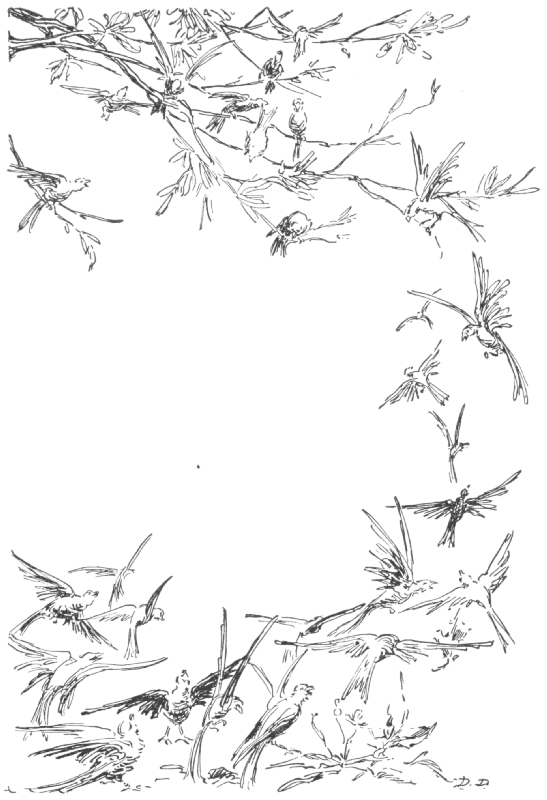
Then a strange thing happened. The guardian spirit of the tree whispered, “No, little leaves, you shall not die. You shall be changed into living forms. I will give you breath and life.” And instantly there arose from the earth where the leaves had dropped, a great flock of winged birds, red, and brown, and yellow, and crimson,  all the beautiful colors that Po-poon-o-ki had given the leaves. Then they flew away to the South Land, where winter’s breath could not reach them.


“THERE AROSE A GREAT FLOCK OF WINGED BIRDS”

But in the spring, when Ni-poon-o-ki, the spirit of summer, came stealing up from the South, and Po-poon-o-ki went back to his ice lodge in the far North, then the birds came back, too. There were new leaves on the trees, but the birds flew straight to the branches which had been their home, and there, safely sheltered by the new leaves, they built their nests.

And after awhile, when there were eggs in all the home nests, the hearts of the birds became so full of joy that they could no longer be silent. Their throats swelled, and opening wide their little mouths, they filled all the air with bursts of happy song.

************** 

This is part of a series of postings of stories under the category, “Keeping the Public in Public Domain.” The idea behind Public Domain was to preserve our cultural heritage after the authors and their immediate heirs were compensated. I feel strongly current copyright law delays this intent on works of the 20th century. My own library of folklore includes so many books within the Public Domain I decided to share stories from them. I hope you enjoy discovering them.

At the same time, my own involvement in storytelling regularly creates projects requiring research as part of my sharing stories with an audience.  Whenever that research needs to be shown here, the publishing of Public Domain stories will not occur that week.  This is a return to my regular posting of a research project here.  (Don't worry, this isn't dry research, my research is always geared towards future storytelling to an audience.)  Response has convinced me that "Keeping the Public in Public Domain" should continue along with my other postings as often as I can manage it.

See the sidebar for other Public Domain story resources I recommend on the page “Public Domain Story Resources."

Saturday, March 7, 2015

First Came the Anishinaabe

Unlike the multi-state cooperative for Summer Reading leading many libraries to use the same theme, media centers and their schools seem to pick their own themes for March Reading Month.  Fortunately years of creating programs weekly as a children's librarian produced a large repertoire of programs from a to z.
As a result when approached this week by a school planning their Camp Read-a-Lot program for March Reading Month, I began working my way through what I already tell possibly meeting their needs.  I'm not against developing new material, but it takes time to develop and time was short.

A curious program factor mentioned was face painters would use the various characters from one of my stories for their inspiration.  My first thought was an African tale with many animals.  I love telling it in voice and sign as that is good for multi-age programs and this was going to be an evening family program, so all ages would need to be involved.  The further we talked, however, it became obvious my program would benefit from a focus on Michigan's original "campers", the Anishinaabe or People of the Three Fires.

While today's article is the title found on my website, I now call the program "Ahneen Means Welcome!"  I start by saying, AHNEEN!  If there's no response, it gives me a great opportunity to tell more about the native people of Michigan whose rich body of stories seem systematically overlooked when folktales are indexed.  An interesting addition to that introduction is now made if no response comes to Ahneen.  I next say "Boozhoo!", a more informal greeting than the one I learned from native Michigan elders.  This was taught to me by a little girl and her father who were grateful for my sharing the culture of her mother, but they hadn't known the word Ahneen.

Whenever I am approached about Michigan's own Native Americans, including booking this program, I always suggest instead the venue book Michigan's too few Anishinaabe tellers.  For my own background, I explain, as I did in the November 1st, 2014 blog here, on the international email list, Storytell, we compared 4 levels of cultural knowledge:
  1. the residents living in and brought up in a culture; 
  2. emigres who fall in love with the culture and take up residence to learn more; 
  3. tourists who have seen the culture briefly; 
  4. armchair travelers who only read and maybe view shows about a culture. 
Level 1 is always the best, but over the years I've come close to level 2.  I'm always aware my own use of the language is as a non-native speaker of this fascinating and complex language.  Words from it can be found throughout Michigan and whenever I cross into nearby Ontario as the Anishinabeg are among Canada's First Nations.  I love to point out as many of these words including Michigan itself (Michigama - Great Water or Large Lake) and other indigenous words all around us as the opportunity permits.

In offering resources before the program, I realized it would be valuable to offer a summary of resources including my previous four articles here related to the Anishinaabe.  If you're wondering about the story to inspire the face painters, I chose a story in my earliest article on the People of the Three Fires (therefore the last shown because of blog formatting), the story of "The Summer Makers."  In addition to comparing two versions of that story there, the topic of Manitos was briefly mentioned in that 11/19/13 article as it was omitted in the simplified version by Julia Darrow Cowles I posted there.  A link was given to the story as told by Henry Rowe Schoolcraft and is the version I use.  If you look at the Schoolcraft version you see the description is still open to artistic interpretation, saying only "His head was enormously large; he had such a queer set of teeth (LSK: I substitute "strange" to avoid present-day reaction to the word "queer"), and no arms." The hero in the story is the Fisher, called by the Anishinaabe name of Ojeeg.  We don't have fishers in Michigan nowadays, so here's a link to more about them including photos.  Other characters in the story are his friends, the Wolverine -- also no longer in the state, but remembered for its spirit in our state's nickname, the Otter, Beaver, Lynx, and Badger, additional characters are the Red Squirrel, and the various Birds released by Ojeeg.  This should give variety for artists.

At the same time my program tells more about both Henry Rowe Schoolcraft, a name well-known in Michigan, and his less well-known but also important Anishinaabe wife, Jane Johnston Schoolcraft or Bamewawagezhikaquay ("Woman of the Sound [that the stars make] Rushing Through the Sky").  My 11/1/14 article gives clues to more about her and also how the poet, Longfellow, used their work to inspire his own epic poem, Hiawatha (even if Michigan's native people know he changed it a great deal).
Hiawatha and Minnehaha sculpture by Jacob Fjelde near Minnehaha Falls in Minneapolis, Minnesota.
That same article mentioned several other print resources, especially a list of those I dearly love by Odawa elder, Simon Otto, and even gave a link to a third grade lesson plan template on Michigan's Native People he presented and used in the Petoskey schools where he lives. Beyond Simon's five books and the work of the Schoolcrafts, I added two other influences, Louise Jean Walker and the late ethnobotanist and Anishinaabe elder, Keewaydinoquay Peschel, another Michigan elder who shared insight into her culture with me.  With Michiganders currently occupied with the cold and snow of winter, my program will probably include a tidbit found on this blog's recent, 2/7/15, article.  Its inclusion in the Anishinaabe topic might seem a bit strange as it was posted with a Cuban story.  Only at its end did I give our Native view from Simon Otto about why we need snow.  I'm trying hard to accept this chilling explanation even if it's an uncomfortable one.

Until now, however, my blog doesn't mention three other resources, the brief Ojibwa Indian Legends by Wahbegwonese (Little Flower) nor the nonfiction People of the Three Fires by Clifton, Cornell, and McClurken and the slender Nishnawbe by Lynne Deur.  The title of that final book is another, colloquial, way of saying Anishinabeg, the plural of Anishinaabe.  When I mention my own slender acquaintance with the language, I'm aware of differences in pronunciation or dialect among the Three Fires.  A perfect example is found in the popular hero whose name is written in many ways since the language developed orally and was used by our three closely related members of the Algonquin people.  Most often I see it as Nanabozho, but my introduction to him was as Nanabashoo.  I was told that pronunciation was nearer the Odawa than the Ojibwa (also known as the Chippewa.)  Since one of my friends, gifted storyteller and member of the Saginaw Chippewa Band, is Robyn Henry, I always look forward to her entertaining way of telling the traditional stories.  She often includes Native American sign language, which I enjoy comparing with American Sign Language.  I've never heard nor asked her about this traditional "trickster/transformer", but really need to talk with her about him.  Robyn is overdue for an internet presence, so maybe she'll consider doing a guest article here.  I know it would be worthwhile. 

Yet another school program, this one at Garden Kids in Dominican Republic
Beyond these specifically Michigan literary resources, the food served at the program was discussed,  including the importance of corn (see the story of Mondawmin on 4/12/14) and blueberries to the Anishinaabe.  We also talked about their school serving that evening the campers' favorites of beans and hot dogs.  This led to my giving the chant and the song about Beans:
Chant - Beans, beans, the musical fruit, the more you eat, the more you toot!
Song (to the tune commonly thought of as either "Coming Through the Rye" or "Auld Lang Syne")  -
Beans for breakfast, beans for supper, beans for good old tea
If I could only be a bean how happy I would be(ans for . . . LSK: repeating as long as you can stand it)  You can blame too many years as a camp counselor for my knowing them!

Of course I always bring the books mentioned here for reference in my program.  They are perfect examples of the value of reading to understand the traditions of Michigan's too frequently little known native population.  I hope you also find it gives you possibilities for your own library's collection, although many would need purchasing from out-of-print sources. 

With or without the beans you can see, it's a program and culture I enjoy sharing and I look forward to presenting it yet again.