Tell me if you have a topic you'd like to see. (Contact: LoiS-sez@LoiS-sez.com .)
Please also let others know about this site.
Showing posts with label Thanksgiving. Show all posts

Friday, November 29, 2024

Poem /prayer by MAX COOTS at this time of year

My undergraduate degree in Theatre Arts is from what is now Webster University in metro Saint Louis. So much of what I do in my storytelling came from there even though I didn't see the path I would eventually follow. Paul Steger is the Dean of the Leigh Gerdine College of Fine Arts and he sent out the following poem or prayer for this time of year. Having recently lost a longtime friend, Loretta Vitek, who was both a storyteller and librarian (and mentioned here about half a dozen times) the poem or prayer seems particularly appropriate. Loretta's family this past month joined with those of us who will miss her in a memorial feast she would have approved. 

This seems to be a most appropriate way to enjoy those around us and " those friends now gone, like gardens past that have been harvested."

Photo by Philippe Murray-Pietsch on Unsplash


Poem /prayer by MAX COOTS


LET US GIVE THANKS


Let us give thanks for a bounty of people

For children who are our second planting

and though they grow like weeds

and the wind too soon blows them away,

May they forgive us our cultivation

and remember fondly where their roots are.


Let us give thanks:

For generous friends, with hearts as big as hubbards

and smiles as bright as their blossoms;

For feisty friends as tart as apples;

For continuous friends, who, like scallions and cucumbers,

keep reminding us we've had them;

For crotchety friends, as sour as rhubarb

and as indestructible;

For handsome friends, who are as gorgeous as eggplants

and as elegant as a row of corn,

and the others, as plain as potatoes and so good for you;

For funny friends, who are as silly as Brussels sprouts

and as amusing as Jerusalem artichokes,

and serious friends, as complex as cauliflowers

and as intricate as onions;

For friends as unpretentious as cabbages,

as subtle as summer squash,

as persistent as parsley,

as delightful as dill,

as endless as zucchini,

and who, like parsnips,

can be counted on to see you throughout the winter;

For old friends,

nodding like sunflowers in the evening-time

and young friends coming on as fast as radishes;

For loving friends, who wind around us like tendrils

and hold us, despite our blights, wilts, and witherings;

And finally, for those friends now gone,

like gardens past that have been harvested,

but who fed us in their times

that we might have life thereafter;

For all these we give thanks.


-- Max Coots

I find all over the internet this poem/prayer by the late Reverend Max Coots. Reverend Coots, was both a minister of the Unitarian Universalist Church and also a passionate gardener who permitted many to share these thoughts. 

Loretta and I shared a love of dragons. A few dragon stories may be found here attached to her name, but I also will long remember her signature not only about dragons, but "There's always a story; it would be a shame not to tell it."


For friends and all who shaped our stories, let us continue to give thanks.

Friday, November 22, 2024

Bailey - Captain Christy's Thanksgiving - Keeping the Public in Public Domain


Just the other day I was hearing about winter visits to Michigan's Mackinac Island. Now I find the perfect story that fits there and so many other places that fit our state's motto of "If you seek a pleasant peninsula, look about you." (I'll also take this beyond Michigan, too.)

Michigan's coastline is 3,288 linear miles long, making it the longest freshwater coastline in the United States. If islands are included, the total shoreline length increases to 4,344 miles. Michigan's coastline is diverse, featuring sandy beaches, dunes, cliffs, bluffs, and wetlands. The state's coastline is also home to several national parks, including:

This coming Thursday is NOT "Turkey Day", but THANKSGIVING! Whatever your reasons or location, may you find reasons to be thankful. We all have those reasons. 

https://quotesproject.com/blessed-thanksgiving-images/

***

This is part of a series of postings of stories under the category, “Keeping the Public in Public Domain.” The idea behind Public Domain was to preserve our cultural heritage after the authors and their immediate heirs were compensated. I feel strongly current copyright law delays this intent on works of the 20th century. My own library of folklore includes so many books within the Public Domain I decided to share stories from them. I hope you enjoy discovering them.

At the same time, my own involvement in storytelling regularly creates projects requiring research as part of my sharing stories with an audience.  Whenever that research needs to be shown here, the publishing of Public Domain stories will not occur that week.  This is a return to my regular posting of a research project here.  (Don't worry, this isn't dry research, my research is always geared towards future storytelling to an audience.)  Response has convinced me that "Keeping the Public in Public Domain" should continue along with my other postings as often as I can manage it.

See the sidebar for other Public Domain story resources I recommend on the page “PublicDomain Story Resources."


Friday, November 24, 2023

Munkittrick - Wishbone Valley - Keeping the Public in Public Domain

By now the Thanksgiving leftovers have taken the place of any feasting on Thursday.  Among the turkey bones one thing seems to always capture attention . . . the wishbone!  There are various blog articles about how the wishbone came to be valued for granting wishes and others on how to win when snapping it.  Country Living has an article giving both along with plans for Thanksgiving since it was written back in August of this year.  If you're not too stuffed or worn out, it might be a time to think back to see what worked and what didn't for next year's plans.

Certainly a story focused on that wishbone, or another Thanksgiving aspect might be reasonable.  Project Gutenberg has The Children's Book of Thanksgiving Stories edited by Asa Don Dickinson.  The book's only illustration is the frontispiece, but following it leads to a most unusual "ghost story", "Wishbone Valley."  The story comes from Harper's Young People, November 21, 1893 -- pages 48-50 and contains another illustration which I will insert in the story even though Dickinson didn't include it.  Both will be as close as I can come to where both the colored frontispiece and the humbler illustration from "Harper's" occur in the story.  Neither give a clue as to their illustrators.

WISHBONE VALLEY

A Thanksgiving ghost story about a boy who dined not wisely but too well.

THE Thanksgiving feast had just ended, and only Donald and his little sister Grace remained at the table, looking drowsily at the plum pudding that they couldn't finish, but which they disliked to leave on their plates.

When the plates had been removed, and the plum-pudding taken to the kitchen and placed beside the well-carved gobbler, Donald and Grace were too tired to rise from their chairs to have their faces washed. They seemed lost in a roseate repose, until Grace finally thought of the wishbone that they intended to break after dinner.

"Come, now, Donald," she said, "let's break the old gobbler's wishbone."

"All right," replied Donald, opening his eyes slowly, and unwrapping the draperies of his sweet plum-pudding dreams from about him, "let's do it now." So he held up the wishbone, and Grace took hold of the other end of it with a merry laugh.

"Here, you must not take hold so far from the end, because I have a fine wish to make, and want to get the big half if possible."

"So have I a nice wish to make," replied Grace, with a sigh, "and I also want the big end."

And so they argued for a few minutes, until their mother entered the room and told them that if they could not stop quarrelling over the wishbone she would take it from them and throw it into the fire. So they lost no time in taking it by the ends and snapping it asunder.

"Hurrah!" exclaimed Donald, observing Grace's expression of disappointment. "I've got it!"

"Well, I've made a wish, too," said Grace.

"But it won't come true," replied Donald, "because you have the little end."

And then Donald thought he would go out in the air and play, because his great dinner made him feel very uncomfortable. When he was out in the barnyard it was just growing dusk, and Donald, through his half-closed eyes, observed a gobbler strutting about. To his great surprise the gobbler approached him instead of running away.

"I thought we had you for dinner to-day," said Donald.

"You did," replied the gobbler coldly, "and you had a fine old time, didn't you?"

"Yes," said Donald, "you made a splendid dinner, and you ought to be pleased to think you made us all so happy. Your second joints were very sweet and juicy, and your drumsticks were like sticks of candy."

"And you broke my poor old wishbone with your little sister, didn't you?"

"I did."

"And what did you wish?" asked the gobbler.

"You mustn't ask me that," replied Donald, "because, you know, if I tell you the wish I made it would not come true."

"But it was my wishbone," persisted the gobbler, "and I think I ought to know something about it."

"You have rights, I suppose, and your argument is not without force," replied Donald, with calm dignity.

The gobbler was puzzled at so lofty a reply, and not understanding it, said:

"I am only the ghost, or spirit, of the gobbler you ate to-day, but still I remember how one day last summer you threw a pan of water on me, and alluded to my wattles as a red necktie, and called me 'Old Harvard.' Now, come along!"

"Where?" asked Donald.

"To Wishbone Valley, where you will see the spirits of my ancestors eaten by your family."

It was now dusk, and Donald didn't like the idea of going to such a place. He was a brave, courageous boy, on most occasions, but the idea of going to Wishbone Valley when the stars were appearing filled him with a dread that he didn't like to acknowledge even to the ghost of a gobbler.

"I can't go with you now, Mr. Gobbler," he said, "because I have a lot of lessons to study for next Monday; wait until to-morrow, and I will gladly go with you."

"Come along," replied the gobbler, with a provoked air, "and let your lessons go until to-morrow, when you will have plenty of light."

Thereupon the gobbler extended his wing and took Donald by the hand, and started on a trot.

"Not so fast," protested Donald.

"Why not?" demanded the gobbler in surprise.

"Because," replied Donald, with a groan, "I have just had my dinner, and I'm too full of you to run."

So the gobbler kindly and considerately slackened his pace to a walk, and the two proceeded out of the barnyard and across a wide meadow to a little valley surrounded by a dense thicket. The moon was just rising and the thicket was silvered by its light, while the dry leaves rustled weirdly in the cold crisp air.

"This," said the gobbler, "is Wishbone Valley. Look and see."

Donald strained his eyes, and, sure enough, there were wishbones sticking out of the ground in every direction. He thought they looked like little croquet hoops, but he made no comments, for fear of offending the old gobbler. But he felt that he must say something to make the gobbler think that he was not frightened, so he remarked, in an offhand way:

"Let's break one and make a wish."

The ghost of the old gobbler frowned, drew himself up, and uttered a ghostly whistle that seemed to cut the air. As he did so, the ghosts of the other turkeys long since eaten popped out of the thickets with a great flapping of wings, and each one perched upon a wishbone and gazed upon poor Donald, who was so frightened that his collar flew into a standing position, while he stood upon his toes, with his knees knocking together at a great rate.

Every turkey fixed its eyes upon the trembling boy, who was beside himself with fear.

"What shall we do with him, grandpapa?" asked the gobbler of an ancient bird that could scarcely contain itself and remain on its wishbone.

"I cannot think of anything terrible enough, Willie," replied the grandparent. "It almost makes my ghostship boil when I think of the way in which he used to amuse himself by making me a target for his bean shooter. Often when I was asleep in the button-ball he would fetch me one on the side of the head that would give me an earache for a week. But now it is our turn."

Here the other turkeys broke into a wild chorus of approval.

"Take his bean shooter from his pocket," suggested another bird, "and let's have a shot at him."

Donald was compelled to hand out his bean shooter, and the grandparent took it, lay on his back, and with the handle of the bean shooter in one claw and the missile end in the other began to send pebbles at Donald at a great rate. He could hear them whistling past his ears, but could not see them to dodge. Fortunately none struck him, and when the turkeys felt that they had had fun enough of that kind at his expense the bean shooter was returned to him.

"Now, then," said the gobbler's Aunt Fanny, "he once gave me a string of yellow beads for corn."

"What shall we do to him for that?" asked the gobbler.

"Make him eat a lot of yellow beads," said the chorus.

"But we have no beads," said the gobbler sadly.

"Then let's poke him with a stick," suggested the gobbler's Granduncle Sylvester; "he used to do that to us."

So they all took up their wishbones and poked Donald until he was sore. Sometimes they would hit him in a ticklish spot, and throw him into such a fit of laughter that they thought he was enjoying it all and chaffing them. So they stuck their wishbones into the ground, and took their positions on them once more, to take a needed rest, for the poor ghosts were greatly exhausted.

There was one quiet turkey who had taken no part in the proceedings.

"Why don't you suggest something?" demanded Uncle Sylvester.

"Because," replied the quiet turkey, "Donald never did anything to me, and I must treat him accordingly. I was raised and killed a long way from here, and canned. Donald's father bought me at a store. To be a ghost in good standing I should be on the farm where I was killed, and really I don't know why I should be here."

"Then you should be an impartial judge," said Aunt Fanny. "Now what shall we do with him?"

"Tell them to let me go home," protested Donald, "and I'll agree never to molest or eat turkey again; I will give them all the angleworms I can dig every day, and on Thanksgiving Day I'll ask my father to have roast beef."

"I think," replied the impartial canned ghost, "that as all boys delight in chasing turkeys with sticks, it would be eminently just and proper for us, with the exception of myself, to chase this boy and beat him with our wishbones, to let him learn by experience that which he could scarcely learn by observation."

"What could I do but eat turkey when it was put on the table?" protested Donald.

"But you could help chasing us around with sticks," sang the chorus.

They thereupon descended from the wishbones upon which they had been perching, and flying after him, they darted the wishbones, which they held in their beaks, into his back and neck as hard as they could. Donald ran up and down Wishbone Valley, calling upon them to stop, and declaring that if turkey should ever be put upon the table again he would eat nothing but the stuffing. When Donald found that the wishbones were sticking into his neck like so many hornet stings, he made up his mind that he would run for the house. Finally the wishbone tattoo stopped, and when he looked around, the gobbler, who was twenty feet away, said: "When a Thanksgiving turkey dies, his ghost comes down here to Wishbone Valley to join his ancestors, and it never after leaves the valley. You will now know why every spring the turkeys steal down here to hatch their little ones. As you are now over the boundary line you are safe."

"Thank you," said Donald gratefully.

"Good-bye," sang all the ghosts in chorus.

There was then a great ghostly flapping and whistling, and the turkeys and wishbones all vanished from sight.

Donald ran home as fast as his trembling legs could carry him, and he fancied that the surviving turkeys on the place made fun of him as he passed on his way.

When he reached the house he was very happy, but made no allusion to his experience in Wishbone Valley, for fear of being laughed at.

"Come, Donald," said his mother, shortly after his arrival, "it is almost bedtime; you had better eat that drumstick and retire."

"I think I have had turkey enough for to-day," replied Donald, with a shudder, "and if it is just the same, I would rather have a nice thick piece of pumpkin pie."

So the girl placed a large piece of pie before him; and while he was eating with the keen appetite given him by the crisp air of Wishbone Valley, he heard a great clattering of hoofs coming down the road. These sounds did not stop until the express wagon drew up in front of the house, and the driver brought in a large package for Donald.

"Hurrah!" shouted Donald, in boundless glee. "Uncle Arthur has sent me a nice bicycle! Wasn't it good of him?"

"Didn't you wish for a bicycle to-day, when you got the big end of the wishbone?" asked his little sister Grace.

"What makes you think so?" asked Donald, with a laugh.

"Oh, I knew it all the time; and my wish came true, too."

"How could your wish come true?" asked Donald, with a puzzled look, "when you got the little half of the wishbone?"

"I don't know," replied Grace, "but my wish did come true."

"And what did you wish?"

"Why," said Grace, running up and kissing her little brother affectionately, "I wished your wish would come true, of course."


Whether you get the long or the short end of the wishbone or skip it altogether, may you enjoy the many stories in Public Domain!

**********************

This is part of a series of postings of stories under the category, "Keeping the Public in Public Domain."  The idea behind Public Domain was to preserve our cultural heritage after the authors and their immediate heirs were compensated.  I feel strongly current copyright law delays this intent on works of the 20th century.  My own library of folklore includes so many books within the Public Domain I decided to share stories from them.  I hope you enjoy discovering new stories.  


At the same time, my own involvement in storytelling regularly creates projects requiring research as part of my sharing stories with an audience.  Whenever that research needs to be shown here, the publishing of Public Domain stories will not occur that week.  This is a return to my regular posting of a research project here.  (Don't worry, this isn't dry research, my research is always geared towards future storytelling to an audience.)  Response has convinced me that "Keeping the Public in Public Domain" should continue along with my other postings as often as I can manage it.

Other Public Domain story resources I recommend-

  • There are many online resources for Public Domain stories, maybe none for folklore is as ambitious as fellow storyteller, Yoel Perez's database, Yashpeh, the International Folktales Collection.  I have long recommended it and continue to do so.  He has loaded Stith Thompson's Motif Index into his server as a database so you can search the whole 6 volumes for whatever word or expression you like by pressing one key. http://folkmasa.org/motiv/motif.htm

  • You may have noticed I'm no longer certain Dr. Perez has the largest database, although his offering the Motif Index certainly qualifies for those of us seeking specific types of stories.  There's another site, FairyTalez claiming to be the largest, with "over 2000 fairy tales, folktales, and fables" and they are "fully optimized for phones, tablets, and PCs", free and presented without ads.
    Between those two sites, there is much for story-lovers, but as they say in infomercials, "Wait, there's more!"

The email list for storytellers, Storytell, discussed Online Story Sources and came up with these additional suggestions:        

         - David K. Brown - http://people.ucalgary.ca/~dkbrown/stories.html

         - Richard Martin - http://www.tellatale.eu/tales_page.html

         - Spirit of Trees - http://spiritoftrees.org/featured-folktales

         - Story-Lovers - http://www.story-lovers.com/ is now only accessible through the Wayback Machine, described below, but the late Jackie Baldwin's wonderful site lives on there, fully searchable manually (the Google search doesn't work), at https://archive.org/ .  It's not easy, but go to Story-lovers.com snapshot for December 22 2016  and you can click on SOS: Searching Out Stories to scroll down through the many story topics and click on the story topic that interests you.

       - World of Tales - http://www.worldoftales.com/ 

 
           - Zalka Csenge Virag - http://multicoloreddiary.blogspot.com doesn't give the actual stories, but her recommendations, working her way through each country on a continent, give excellent ideas for finding new books and stories to love and tell.

     
You're going to find many of the links on these sites have gone down, BUT go to the Internet Archive Wayback Machine to find some of these old links.  Tim's site, for example, is so huge probably updating it would be a full-time job.  In the case of Story-Lovers, it's great that Jackie Baldwin set it up to stay online as long as it did after she could no longer maintain it.  Possibly searches maintained it.  Unfortunately Storytell list member, Papa Joe is on both Tim Sheppard's site and Story-Lovers, but he no longer maintains his old Papa Joe's Traveling Storytelling Show website and his Library (something you want to see!) is now only on the Wayback Machine.  It took some patience working back through claims of snapshots but finally in December of 2006 it appears!

    Somebody as of this writing whose stories can still be found by his website is the late Chuck Larkin - http://chucklarkin.com/stories.html.  I prefer to list these sites by their complete address so they can be found by the Wayback Machine, a.k.a. Archive.org, when that becomes the only way to find them.

You can see why I recommend these to you. 

Have fun discovering even more stories

Friday, November 17, 2023

Aesop - Buried Treasure - Keeping the Public in Public Domain

London-based storyteller, Olivia Armstrong - Storyteller @Oliviasstories, on X(formerly Twitter) for MythologyMonday said: 

Even calling upon the correct god during farming was a task for Roman farmers! 

There was Sterculinus, who fertilised the earth, Vervactor who cleared the land for planting,   Redarator did the digging, Sator sowed and Occator harrowed ...  #Mythology Monday

Photo by Sheila Terry - Science Photo Library

Olivia graciously let me reprint her "tweet."  When I asked to identify that mosaic, she sent me to Science Photo Library where there is even more information.  I was especially interested in its talk of soil exhaustion and erosion.  The more marginal land was converted to olive groves and vines and many forms of today's story are set in vineyards.  I prefer placing the story over an entire farm.

This month I decided to give here some of the stories related to Thanksgiving or Gratitude Month.  At the same time I realize how easy it is to be the overlooked part of what is being called HalloThanksMas.

(found at https://imgflip.com/i/5todyw)

One of my favorite stories is an Aesop tale.  This fable I first discovered as a picture book called Buried Treasure, so that is the way I think of it.  Aesop's short teaching stories have been translated innumerable times, telling this story with varying details just as the facts about Aesop vary.  Still the stories date back to the Graeco-Roman times, so the opening information about Roman farmers is appropriate 

I chose The Aesop for Children; with pictures by Milo Winter(No mention of an author, beyond Aesop is given.)  Why a children's version when Aesop also fits adults?  It tends to give a slightly fuller view of the brief story.  I also must comment on giving "the moral of the story."  Nowadays such morals are never or rarely given, although it may sometimes be woven into the final action.  Why is it now omitted?  Besides making these teaching tales "preachy", it is entirely possible the listeners may each have appropriate but different conclusions.  The Aesop for Children was published in 1919 and gives a moral at its conclusion.  I will give it, but try to avoid reading it first and think of your own conclusion.  It may be quite different.

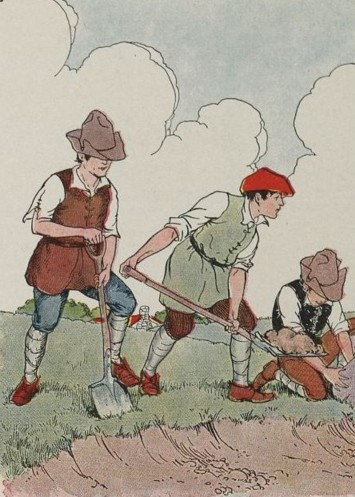
THE FARMER AND HIS SONS

THE FARMER AND HIS SONS

A rich old farmer, who felt that he had not many more days to live, called his sons to his bedside.

"My sons," he said, "heed what I have to say to you. Do not on any account part with the estate that has belonged to our family for so many generations. Somewhere on it is hidden a rich treasure. I do not know the exact spot, but it is there, and you will surely find it. Spare no energy and leave no spot unturned in your search."

The father died, and no sooner was he in his grave than the sons set to work digging with all their might, turning up every foot of ground with their spades, and going over the whole farm two or three times.

No hidden gold did they find; but at harvest time when they had settled their accounts and had pocketed a rich profit far greater than that of any of their neighbors, they understood that the treasure their father had told them about was the wealth of a bountiful crop, and that in their industry had they found the treasure.

Industry is itself a treasure.

***

Have a great, thankful part of Hallowthanksmas!

(from theodysseyonline.com)


********************

This is part of a series of postings of stories under the category, "Keeping the Public in Public Domain."  The idea behind Public Domain was to preserve our cultural heritage after the authors and their immediate heirs were compensated.  I feel strongly current copyright law delays this intent on works of the 20th century.  My own library of folklore includes so many books within the Public Domain I decided to share stories from them.  I hope you enjoy discovering new stories.  


At the same time, my own involvement in storytelling regularly creates projects requiring research as part of my sharing stories with an audience.  Whenever that research needs to be shown here, the publishing of Public Domain stories will not occur that week.  This is a return to my regular posting of a research project here.  (Don't worry, this isn't dry research, my research is always geared towards future storytelling to an audience.)  Response has convinced me that "Keeping the Public in Public Domain" should continue along with my other postings as often as I can manage it.

Other Public Domain story resources I recommend-

  • There are many online resources for Public Domain stories, maybe none for folklore is as ambitious as fellow storyteller, Yoel Perez's database, Yashpeh, the International Folktales Collection.  I have long recommended it and continue to do so.  He has loaded Stith Thompson's Motif Index into his server as a database so you can search the whole 6 volumes for whatever word or expression you like by pressing one key. http://folkmasa.org/motiv/motif.htm

  • You may have noticed I'm no longer certain Dr. Perez has the largest database, although his offering the Motif Index certainly qualifies for those of us seeking specific types of stories.  There's another site, FairyTalez claiming to be the largest, with "over 2000 fairy tales, folktales, and fables" and they are "fully optimized for phones, tablets, and PCs", free and presented without ads.
    Between those two sites, there is much for story-lovers, but as they say in infomercials, "Wait, there's more!"

The email list for storytellers, Storytell, discussed Online Story Sources and came up with these additional suggestions:        

         - David K. Brown - http://people.ucalgary.ca/~dkbrown/stories.html

         - Richard Martin - http://www.tellatale.eu/tales_page.html

         - Spirit of Trees - http://spiritoftrees.org/featured-folktales

         - Story-Lovers - http://www.story-lovers.com/ is now only accessible through the Wayback Machine, described below, but the late Jackie Baldwin's wonderful site lives on there, fully searchable manually (the Google search doesn't work), at https://archive.org/ .  It's not easy, but go to Story-lovers.com snapshot for December 22 2016  and you can click on SOS: Searching Out Stories to scroll down through the many story topics and click on the story topic that interests you.

       - World of Tales - http://www.worldoftales.com/ 

 
           - Zalka Csenge Virag - http://multicoloreddiary.blogspot.com doesn't give the actual stories, but her recommendations, working her way through each country on a continent, give excellent ideas for finding new books and stories to love and tell.

     
You're going to find many of the links on these sites have gone down, BUT go to the Internet Archive Wayback Machine to find some of these old links.  Tim's site, for example, is so huge probably updating it would be a full-time job.  In the case of Story-Lovers, it's great that Jackie Baldwin set it up to stay online as long as it did after she could no longer maintain it.  Possibly searches maintained it.  Unfortunately Storytell list member, Papa Joe is on both Tim Sheppard's site and Story-Lovers, but he no longer maintains his old Papa Joe's Traveling Storytelling Show website and his Library (something you want to see!) is now only on the Wayback Machine.  It took some patience working back through claims of snapshots but finally in December of 2006 it appears!

    Somebody as of this writing whose stories can still be found by his website is the late Chuck Larkin - http://chucklarkin.com/stories.html.  I prefer to list these sites by their complete address so they can be found by the Wayback Machine, a.k.a. Archive.org, when that becomes the only way to find them.

You can see why I recommend these to you. 

Have fun discovering even more stories

Friday, October 6, 2023

Wilkins - The Pumpkin Giant - Keeping the Public in Public Domain

Even as autumn's weather and holidays change, the pumpkin seems to be everywhere!  Roadside stands, pumpkin in food, and pumpkin decorations manage to span from October through November.  Next week I have a program requesting spooky, but not too scary, material.  I have a small cauldron of jokes and riddles and an even bigger cauldron of stories and song parodies for the season.  When I wanted to remind myself of the classic story of The Pumpkin Giant, I was shocked at how it had disappeared from library shelves!  I only found a single copy of Ellin Greene's retelling of the story which definitely belongs in the Public Domain.  While the original by Mary E. Wilkins (Freeman) is no doubt going to be simplified by the storyteller, it's a story with sly humor, a bit of scary, and more, deserving of annual featuring.  I found it in various anthologies, but it dates back to 1892 and the classic The Pot of Gold and Other StoriesThat link is to the Wikipedia article on the book, but the actual book, complete with the definitely classic Pumpkin Giant story, is at Project Gutenberg.

Vintage Halloween Decor - Sweet Pea
Ellin Greene's retelling with illustrations by Trina Schart Hyman

The story is a bit long for just one blog posting.  I'm going to divide it in half with the very important conclusion next week.  (The original book never names the illustrator.)

THE PUMPKIN GIANT.

A very long time ago, before our grandmother's time, or our great-grandmother's, or our grandmothers' with a very long string of greats prefixed, there were no pumpkins; people had never eaten a pumpkin-pie, or even stewed pumpkin; and that was the time when the Pumpkin Giant flourished.

There have been a great many giants who have flourished since the world begun, and although a select few of them have been good giants, the majority of them have been so bad that their crimes even more than their size have gone to make them notorious. But the Pumpkin Giant was an uncommonly bad one, and his general appearance and his behavior were such as to make one shudder to an extent that you would hardly believe possible. The convulsive shivering caused by the mere mention of his name, and, in some cases where the people were unusually sensitive, by the mere thought of him even, more resembled the blue ague than anything else; indeed was known by the name of "the Giant's Shakes."

The Pumpkin Giant was very tall; he probably would have overtopped most of the giants you have ever heard of. I don't suppose the Giant who lived on the Bean-stalk whom Jack visited, was anything to compare with him; nor that it would have been a possible thing for the Pumpkin Giant, had he received an invitation to spend an afternoon with the Bean-stalk Giant, to accept, on account of his inability to enter the Bean-stalk Giant's door, no matter how much he stooped.

The Pumpkin Giant had a very large yellow head, which was also smooth and shiny. His eyes were big and round, and glowed like coals of fire; and you would almost have thought that his head was lit up inside with candles. Indeed there was a rumor to that effect amongst the common people, but that was all nonsense, of course; no one of the more enlightened class credited it for an instant. His mouth, which stretched half around his head, was furnished with rows of pointed teeth, and he was never known to hold it any other way than wide open.

The Pumpkin Giant lived in a castle, as a matter of course; it is not fashionable for a giant to live in any other kind of a dwelling—why, nothing would be more tame and uninteresting than a giant in a two-story white house with green blinds and a picket fence, or even a brown-stone front, if he could get into either of them, which he could not.

The Giant's castle was situated on a mountain, as it ought to have been, and there was also the usual courtyard before it, and the customary moat, which was full of—bones! All I have got to say about these bones is, they were not mutton bones. A great many details of this story must be left to the imagination of the reader; they are too harrowing to relate. A much tenderer regard for the feelings of the audience will be shown in this than in most giant stories; we will even go so far as to state in advance, that the story has a good end, thereby enabling readers to peruse it comfortably without unpleasant suspense.

The Pumpkin Giant was fonder of little boys and girls than anything else in the world; but he was somewhat fonder of little boys, and more particularly of fat little boys.

The fear and horror of this Giant extended over the whole country. Even the King on his throne was so severely afflicted with the Giant's Shakes that he had been obliged to have the throne propped, for fear it should topple over in some unusually violent fit. There was good reason why the King shook: his only daughter, the Princess Ariadne Diana, was probably the fattest princess in the whole world at that date. So fat was she that she had never walked a step in the dozen years of her life, being totally unable to progress over the earth by any method except rolling. And a really beautiful sight it was, too, to see the Princess Ariadne Diana, in her cloth-of-gold rolling-suit, faced with green velvet and edged with ermine, with her glittering crown on her head, trundling along the avenues of the royal gardens, which had been furnished with strips of rich carpeting for her express accommodation.

But gratifying as it would have been to the King, her sire, under other circumstances, to have had such an unusually interesting daughter, it now only served to fill his heart with the greatest anxiety on her account. The Princess was never allowed to leave the palace without a body-guard of fifty knights, the very flower of the King's troops, with lances in rest, but in spite of all this precaution, the King shook.

Meanwhile amongst the ordinary people who could not procure an escort of fifty armed knights for the plump among their children, the ravages of the Pumpkin Giant were frightful. It was apprehended at one time that there would be very few fat little girls, and no fat little boys at all, left in the kingdom. And what made matters worse, at that time the Giant commenced taking a tonic to increase his appetite.

Finally the King, in desperation, issued a proclamation that he would knight any one, be he noble or common, who should cut off the head of the Pumpkin Giant. This was the King's usual method of rewarding any noble deed in his kingdom. It was a cheap method, and besides everybody liked to be a knight.

When the King issued his proclamation every man in the kingdom who was not already a knight, straightway tried to contrive ways and means to kill the Pumpkin Giant. But there was one obstacle which seemed insurmountable: they were afraid, and all of them had the Giant's Shakes so badly, that they could not possibly have held a knife steady enough to cut off the Giant's head, even if they had dared to go near enough for that purpose.

There was one man who lived not far from the terrible Giant's castle, a poor man, his only worldly wealth consisting in a large potato-field and a cottage in front of it. But he had a boy of twelve, an only son, who rivaled the Princess Ariadne Diana in point of fatness. He was unable to have a body-guard for his son; so the amount of terror which the inhabitants of that humble cottage suffered day and night was heart-rending. The poor mother had been unable to leave her bed for two years, on account of the Giant's Shakes; her husband barely got a living from the potato-field; half the time he and his wife had hardly enough to eat, as it naturally took the larger part of the potatoes to satisfy the fat little boy, their son, and their situation was truly pitiable.

The fat boy's name was Æneas, his father's name was Patroclus, and his mother's Daphne. It was all the fashion in those days to have classical names. And as that was a fashion as easily adopted by the poor as the rich, everybody had them. They were just like Jim and Tommy and May in these days. Why, the Princess's name, Ariadne Diana, was nothing more nor less than Ann Eliza with us.

One morning Patroclus and Æneas were out in the field digging potatoes, for new potatoes were just in the market. The Early Rose potato had not been discovered in those days; but there was another potato, perhaps equally good, which attained to a similar degree of celebrity. It was called the Young Plantagenet, and reached a very large size indeed, much larger than the Early Rose does in our time.

Well, Patroclus and Æneas had just dug perhaps a bushel of Young Plantagenet potatoes. It was slow work with them, for Patroclus had the Giant's Shakes badly that morning, and of course Æneas was not very swift. He rolled about among the potato-hills after the manner of the Princess Ariadne Diana; but he did not present as imposing an appearance as she, in his homespun farmer's frock.

All at once the earth trembled violently. Patroclus and Æneas looked up and saw the Pumpkin Giant coming with his mouth wide open. "Get behind me, O, my darling son!" cried Patroclus.

Æneas obeyed, but it was of no use; for you could see his cheeks each side his father's waistcoat.

Patroclus was not ordinarily a brave man, but he was brave in an emergency; and as that is the only time when there is the slightest need of bravery, it was just as well.

The Pumpkin Giant strode along faster and faster, opening his mouth wider and wider, until they could fairly hear it crack at the corners.

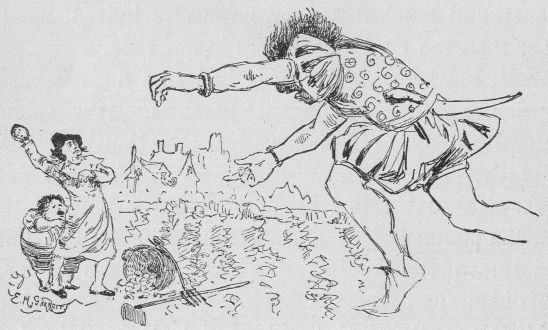
Then Patroclus picked up an enormous Young Plantagenet and threw it plump into the Pumpkin Giant's mouth. The Giant choked and gasped, and choked and gasped, and finally tumbled down and died.

  He picked up an enormous young plantagenet and threw it at him.

HE PICKED UP AN ENORMOUS YOUNG PLANTAGENET AND THREW IT AT HIM.

Patroclus and Æneas while the Giant was choking, had run to the house and locked themselves in; then they looked out of the kitchen window; when they saw the Giant tumble down and lie quite still, they knew he must be dead. Then Daphne was immediately cured of the Giant's Shakes, and got out of bed for the first time in two years. Patroclus sharpened the carving-knife on the kitchen stove, and they all went out into the potato-field.

They cautiously approached the prostrate Giant, for fear he might be shamming, and might suddenly spring up at them and—Æneas. But no, he did not move at all; he was quite dead. And, all taking turns, they hacked off his head with the carving-knife. Then Æneas had it to play with, which was quite appropriate, and a good instance of the sarcasm of destiny.

The King was notified of the death of the Pumpkin Giant, and was greatly rejoiced thereby. His Giant's Shakes ceased, the props were removed from the throne, and the Princess Ariadne Diana was allowed to go out without her body-guard of fifty knights, much to her delight, for she found them a great hindrance to the enjoyment of her daily outings.

It was a great cross, not to say an embarrassment, when she was gleefully rolling in pursuit of a charming red and gold butterfly, to find herself suddenly stopped short by an armed knight with his lance in rest.

But the King, though his gratitude for the noble deed knew no bounds, omitted to give the promised reward and knight Patroclus.

***

The terrible Pumpkin Giant may be dead, but the story is far from over.  While your "Giant's Shakes" may seem cured, please be sure to check back for the true ending next week.

***********************

This is part of a series of postings of stories under the category, "Keeping the Public in Public Domain."  The idea behind Public Domain was to preserve our cultural heritage after the authors and their immediate heirs were compensated.  I feel strongly current copyright law delays this intent on works of the 20th century.  My own library of folklore includes so many books within the Public Domain I decided to share stories from them.  I hope you enjoy discovering new stories.  


At the same time, my own involvement in storytelling regularly creates projects requiring research as part of my sharing stories with an audience.  Whenever that research needs to be shown here, the publishing of Public Domain stories will not occur that week.  This is a return to my regular posting of a research project here.  (Don't worry, this isn't dry research, my research is always geared towards future storytelling to an audience.)  Response has convinced me that "Keeping the Public in Public Domain" should continue along with my other postings as often as I can manage it.

Other Public Domain story resources I recommend-

  • There are many online resources for Public Domain stories, maybe none for folklore is as ambitious as fellow storyteller, Yoel Perez's database, Yashpeh, the International Folktales Collection.  I have long recommended it and continue to do so.  He has loaded Stith Thompson's Motif Index into his server as a database so you can search the whole 6 volumes for whatever word or expression you like by pressing one key. http://folkmasa.org/motiv/motif.htm

  • You may have noticed I'm no longer certain Dr. Perez has the largest database, although his offering the Motif Index certainly qualifies for those of us seeking specific types of stories.  There's another site, FairyTalez claiming to be the largest, with "over 2000 fairy tales, folktales, and fables" and they are "fully optimized for phones, tablets, and PCs", free and presented without ads.
    Between those two sites, there is much for story-lovers, but as they say in infomercials, "Wait, there's more!"

The email list for storytellers, Storytell, discussed Online Story Sources and came up with these additional suggestions:        

         - David K. Brown - http://people.ucalgary.ca/~dkbrown/stories.html

         - Richard Martin - http://www.tellatale.eu/tales_page.html

         - Spirit of Trees - http://spiritoftrees.org/featured-folktales

         - Story-Lovers - http://www.story-lovers.com/ is now only accessible through the Wayback Machine, described below, but the late Jackie Baldwin's wonderful site lives on there, fully searchable manually (the Google search doesn't work), at https://archive.org/ .  It's not easy, but go to Story-lovers.com snapshot for December 22 2016  and you can click on SOS: Searching Out Stories to scroll down through the many story topics and click on the story topic that interests you.

       - World of Tales - http://www.worldoftales.com/ 

 
           - Zalka Csenge Virag - http://multicoloreddiary.blogspot.com doesn't give the actual stories, but her recommendations, working her way through each country on a continent, give excellent ideas for finding new books and stories to love and tell.

     
You're going to find many of the links on these sites have gone down, BUT go to the Internet Archive Wayback Machine to find some of these old links.  Tim's site, for example, is so huge probably updating it would be a full-time job.  In the case of Story-Lovers, it's great that Jackie Baldwin set it up to stay online as long as it did after she could no longer maintain it.  Possibly searches maintained it.  Unfortunately Storytell list member, Papa Joe is on both Tim Sheppard's site and Story-Lovers, but he no longer maintains his old Papa Joe's Traveling Storytelling Show website and his Library (something you want to see!) is now only on the Wayback Machine.  It took some patience working back through claims of snapshots but finally in December of 2006 it appears!

    Somebody as of this writing whose stories can still be found by his website is the late Chuck Larkin - http://chucklarkin.com/stories.html.  I prefer to list these sites by their complete address so they can be found by the Wayback Machine, a.k.a. Archive.org, when that becomes the only way to find them.

You can see why I recommend these to you. 

Have fun discovering even more stories

Wednesday, November 24, 2021

Thanksgiving for Authors AND Public Domain

Yes, I tend to get passionate about the concept of Public Domain and the length of time now keeping books from what was originally intended to become shared.  The Wikipedia article on Public Domain quotes the value of Public Domain this way: 

Pamela Samuelson has identified eight "values" that can arise from information and works in the public domain.[25]

Possible values include:

  1. Building blocks for the creation of new knowledge, examples include data, facts, ideas, theories, and scientific principle.
  2. Access to cultural heritage through information resources such as ancient Greek texts and Mozart's symphonies.
  3. Promoting education, through the spread of information, ideas, and scientific principles.
  4. Enabling follow-on innovation, through for example expired patents and copyright.
  5. Enabling low cost access to information without the need to locate the owner or negotiate rights clearance and pay royalties, through for example expired copyrighted works or patents, and non-original data compilation.[26]
  6. Promoting public health and safety, through information and scientific principles.
  7. Promoting the democratic process and values, through news, laws, regulation, and judicial opinion.
  8. Enabling competitive imitation, through for example expired patents and copyright, or publicly disclosed technologies that do not qualify for patent protection.[25]: 22 

As a storyteller I particularly value #2, its access to our cultural heritage.  

To share access to that Cultural Heritage I'm going to suggest support, whether on next Tuesday's "Giving Tuesday" when many organizations may have special matching funds, or by year's end to Project Gutenberg and the Internet Archive.  As I write this, the Internet Archive has one of those matching funds drive.

I enjoy the daily suggestions found on the blog from Free Kindle Books and Tips.  It works to the benefit of readers, but also lets authors feature an introduction to their works with a free or low cost option.  If you prowl the site a bit, there's an About page where we learn it's the creation of "A gray-haired guy in Texas named Michael Gallagher who doesn’t blog full-time but blogs as a hobby."  That blog lets you view beyond Kindles on tablets and desktops and gives good tips.  I asked and Michael generously let me reprint here the article he wrote this past Monday.  We clearly share a love of Public Domain and Project Gutenberg and he goes beyond just the U.S. versions of both.

Try Project Gutenberg for Free Kindle Books

The first eBook was created 50 years ago, and credit for creating the first one goes to the late Michael Hart. Hart was given a $100,000 credit on an IBM mainframe computer in 1971 and decided to use this credit to develop an electronic storage, retrieval, and search system of library books – unheard of at the time – and created the first eBook. What was that title? The Declaration of Independence!

This initial beginning launched what is now called Project Gutenberg (https://www.gutenberg.org) – a site that has over 60,000 eBooks available on its site, with affiliate / linking sources to over 100,000 eBooks on it – and all of them are free, and most are available in a variety of eBook reader formats.

When is the last time you hit the Project Gutenberg site for free eBooks? If you’ve never tried it, I highly recommend it.

All of the content is in the public domain, and the majority of the titles I have seen are available in the Kindle format –each title has been painstakingly typed up and proofed by a group of worldwide volunteers. I have rediscovered many titles I enjoyed reading growing up plus many more I have never been exposed.

As a resident of the USA, a complaint I often hear – and agree with – is the extraordinary long time things can be protected by copyright in the USA yet in the public domain (and free) elsewhere in the world.  You can’t legally download and read certain titles in the USA if they are in the public domain in other countries but still in copyright in the USA.  A good example of that is Australia – many things are in the public domain in Australia but still protected in the USA.

Which brings me to a listing of other “sister” Project Gutenberg across the globe (this is not meant to be an all-encompassing list):
Project Gutenberg of Australia

Project Gutenberg of Australia (https://gutenberg.net.au/) provides books which are in the public domain in Australia.

As a general rule the works of authors who died before 1955 are in the public domain in Australia. Works by George Orwell (died 1950), Virginia Woolf (died 1941), and James Joyce (died 1941), just to name a few authors, are in the public domain in Australia but not in the USA.

Of course, works which are in the public domain in Australia may remain copyrighted in other countries – even for several decades. People are not supposed to download, or read online, such works if they are in a country where they are still under copyright. That still leaves a lot of readers out there to enjoy eBooks of some of the greatest literary works of the twentieth century.

Project Gutenberg of Australia also provides a list all of the Project Gutenberg eBooks (from both the US and Australian Collections) which were written by Australians or which relate (although loosely) to Australia, and has an extensive collection of books by and about the land and sea explorers who opened up the continent to white settlement.

Project Gutenberg of Canada

Project Gutenberg of Canada (https://www.gutenberg.ca/) specializes in Canadiana literature in English and French, in the public domain in Canada.

Projekt Runeberg

Project Runeberg (http://runeberg.org/) provides free electronic books from Sweden and Nordic countries.

Reading These Titles

You can read Project Gutenberg eBooks on your computer or transfer them to your Kindle. If you download a Kindle book from the site, you will need to transfer it to your computer to your Kindle. Click here or type in https://smarturl.it/xfer into your web browser to read my post on how to do that procedure – this is the same text of the title I charge 99 cents for in the Amazon Kindle store, but the blog readers can read it for free.

So, go check out Project Gutenberg and discover / rediscover a classic!

Michael

*****************

Happy reading, for which I give Thanksgiving.

For a more humorous bit of giving thanks, let us salute the human creators before it may all be taken over by Artificial Intelligence.  This obituary, supposedly written by a robot, has started to appear all over the internet.  (My apologies.  This meme is somebody's delightful creation, but I can't learn its real source and can only hope the creator wanted it covered under Creative Commons.)

Speaking from the longtime librarian inside me, I have a dust allergy, but let my need for books (Bibliomania?) permit my being an "avid collector of dust."

May your Thanksgiving give you plenty of opportunity to read.