Tell me if you have a topic you'd like to see. (Contact: LoiS-sez@LoiS-sez.com .)
Please also let others know about this site.
Showing posts with label Earth Day. Show all posts

Friday, April 11, 2025

Fleeson - Why the Parrot and the Minor Bird but Echo the Words of Man - Keeping the Public in Public Domain


It's Earth Month, with Earth Day on April 22 so close to Easter and Passover that it seems good to consider it now. Today's story is from Laos Folk-Lore of Farther India by Katherine Neville Fleeson. Its section "Nature's Riddles and Their Answers" opens an important issue... Invasive Species. Not every plant, insect or animal is endangered and some may be considered dangerously invasive. Wikipedia's article on the Common Myna, talks about a bird "popular as cage birds for their singing and 'speaking' abilities." Even though they might be kept as pets: 

The range of the common myna is increasing at such a rapid rate that in 2000 the IUCN Species Survival Commission declared it one of the world's most invasive species and one of only three birds listed among "100 of the World's Worst Invasive Species" that pose a threat to biodiversity, agriculture and human interests. In particular, the species poses a serious threat to the ecosystems of Australia, where it was named "The Most Important Pest/Problem" in 2008.

The Common Myna was first introduced to Australia between 1863 and 1872 to control insects in the market gardens. One of the birds it threatens is the Parrot. "One-third of all parrot species are threatened by extinction, with a higher aggregate extinction risk (IUCN Red List Index) than any other comparable bird group." The Common Myna is notorious for taking over the nests of other birds. At the same time:

Parrots, being cavity nesters, are vulnerable to the loss of nesting sites and to competition with introduced species for those sites. The loss of old trees is a particular problem in some areas, particularly in Australia, where suitable nesting trees must be centuries old.

Both birds share territory in Asia and Australia including Laos. You may notice the story calls the Common Myna a "minor bird" which seems to be the pronunciation the author heard. Because it is also called the "sao bird" I went looking and found a site calling it a "mythical bird." The São Tomé Sunbird couldn't be the bird as it's on an island country in the Gulf of Guinea, off the western equatorial coast of Central Africa.

As a result I'd tell the story as being about the Common Myna and the Parrot and include information about the problem caused by invasive species and endangered species. This story has both!

Why the Parrot and the Minor Bird but Echo the Words of Man

Long ago people caught and nourished the sao bird, because it learned the language of man more readily than either the parrot or minor bird. While they had to be taught with much care, the sao bird had but to hear a word and it could readily utter it; moreover, the sao bird could utter its own thoughts.

Upon a time a man of the north country, owning a sao bird, stole a buffalo from his neighbor and killed it. Part of the buffalo the man cooked and ate; the rest he hid either in the rice bin or over the rice house.

Seeking the buffalo, next day, the neighbor asked the man if he had seen it.

The man replied, “No.” The sao bird, however, cried out, “He killed it; part he hid in the rice bin, part over the rice house.”

The neighbor searched in both of these places and found the parts just as the sao bird had said.

“I did not steal the buffalo,” insisted the man.

But the bird ever called, “He killed it and put part into the rice bin, and part over the rice house.”

Unable to decide between the words of the man and the words of the bird, the neighbor appealed to the court. And, it happened, the night before the trial, that the man took the sao bird, placed it in a jar, covered the jar and poured water over the cloth and beat on the outside of the jar. The noise of the beating was low and rumbling. All that night was the bird kept in the jar, and not once did it see the bright moonlight, which was almost as bright as day, for it was in the midst of the dry season and full moon. When the eye of day opened, the man removed the bird from the jar and placed it in its cage, and then took it to the court as a witness.

When the bird was called, it said, as before, “He killed it; part he put in the rice bin, and part over the rice house.”

All people believed the bird.

“Ask it another question. Ask it what manner of night it was last night. Will you condemn me to death on the word of a bird?” cried the man.

The question was put to the bird, but, remembering its fear, during the night, of the rumbling noise and the sound of running water, it answered, “Last night the sky called and the rain fell.”

Then the people cried, “Of a truth, the bird cannot be believed. Because it has imperilled the life of an innocent man, from this time forth, the sao bird must not be cherished by man.”

The thief was set free because there were but the words of the bird to condemn him.

No longer is the sao bird nourished by man, but lives in the forest. Those who are full of fear, when they hear them talking in the forest, say, “it is the spirits.”

When the sao bird saw the bright plumage of the parrot, and the black and gold of the minor bird, it knew they were strangers who had come to dwell in the north, and it asked the crow and the owl what manner of birds they were.

“Beautiful in plumage, as thou canst readily see,” answered they. “Moreover, they speak the words of man.”

“Speak the words of man,” echoed the sao bird. “I’ll warn them. Come, let us greet them.” And they went forth to meet the beautiful strangers.

And upon a day, as they all came together in one place, the sao bird cried out, “We, the chief birds of the north land, come to greet you and to give you of our wisdom, as you are but strangers in our land. It is told me you speak as 44 does man; even so can I. Nourished by the hand of man many years, I did see with my eyes and hear with my ears, and my tongue uttered not only the things I beheld and heard, but things displeasing to my masters. At one time, all men spoke well of me, but afterward was I cruelly punished and driven from the homes of men. Therefore come I this day unto you to warn you that, if man learns of your speaking tongue, he will capture you and nourish you in his home. Yet, should you speak other than he teaches you, you will be punished and driven from the homes of men, for man loves only to hear his thoughts repeated and loves not even a bird that has wisdom or truth greater than his own.”

Fearful of uttering their thoughts, lest man resent it, the parrot and minor bird but echo the words of man.

 
 Quite by accident the weekend I posted this I also found a version of this story as "Why the Parrot Repeats the Words of Men" In Florence Holbrook's The Book of Nature Myths. I like the Laotian tale for the option of telling about both invasive & threatened birds.

 ******************

This is part of a series of postings of stories under the category, “Keeping the Public in Public Domain.” The idea behind Public Domain was to preserve our cultural heritage after the authors and their immediate heirs were compensated. I feel strongly current copyright law delays this intent on works of the 20th century. My own library of folklore includes so many books within the Public Domain I decided to share stories from them. I hope you enjoy discovering them.

At the same time, my own involvement in storytelling regularly creates projects requiring research as part of my sharing stories with an audience.  Whenever that research needs to be shown here, the publishing of Public Domain stories will not occur that week.  This is a return to my regular posting of a research project here.  (Don't worry, this isn't dry research, my research is always geared towards future storytelling to an audience.)  Response has convinced me that "Keeping the Public in Public Domain" should continue along with my other postings as often as I can manage it.

See the sidebar for other Public Domain story resources I recommend on the page “Public Domain Story Resources."


Friday, April 19, 2024

Parker - The Gwineeboos The Redbreasts - Keeping The Public in Public Domain

Monday is Earth Day and while I have tons of Creation or Pourquois tales, none of them seemed to call out to me until I went to K. Langloh Parker's Australian Legendary Tales.  I've included Parker's book from colonial Australia retelling Australian aboriginal tales twice before here and strongly recommend going to them for background material on her and to understand more about the stories.

Today's story is about sharing, for Earth Day is indeed about learning how to share the earth.  It's also a tale about the robin, but the Australian robin is not the same as the robin most of us, living outside Australasia, know.  There are 51 species of Australasian robins, but like the robins of the rest of the world, today's story is about the red breasted ones that led colonizers to call them robins, but Parker preserved their original name of Gwineeboo.  Gwineeboo's friend, Goomai, is a water rat.  The other characters named in the story, Quarrian and Gidgereegah, are only described as hunters, but the book's glossary tells us they are parrots for that's what they became.

Aside from this being a story pitting two females (plus their noisy hungry baby) against two hunters, it's a great story for audience participation.  Teach the audience to chant like the baby, "Gwineeboo, Gwineeboo. I want kangaroo. I want kangaroo. Gwineeboo. Gwineeboo." They will have a blast, but be sure to teach them to silence when you hold up your hand!  Beyond that I suggest putting the later chant that causes the storm on a card as it's more difficult to remember.  "Moogaray, Moogaray, May, May, Eehu, Eehu, Doongarah."  Then give the translation.  You can say that fortunately the audience aren't birds, so - you hope -the chant only works in the story.

The only other needed explanation, again from the glossary, is that a dardurr is a type of hut.

The scarlet robin, an Australasian robin

THE GWINEEBOOS THE REDBREASTS

Gwineeboo and Goomai, the water rat, were down at the creek one day, getting mussels for food, when, to their astonishment, a kangaroo hopped right into the water beside them. Well they knew that he must be escaping from hunters, who were probably pressing him close. So Gwineeboo quickly seized her yam stick, and knocked the kangaroo on the head; he was caught fast in the weeds in the creek, so could not escape. When the two old women had killed the kangaroo they hid its body under the weeds in the creek, fearing to take it out and cook it straight away, lest the hunters should come up and claim it. The little son of Gwineeboo watched them from the bank. After having hidden the kangaroo, the women picked up their mussels and started for their camp, when up came the hunters, Quarrian and Gidgereegah, who had tracked the kangaroo right to the creek.

Seeing the women they said: "Did you see a kangaroo?"

The women answered: "No. We saw no kangaroo."

"That is strange, for we have tracked it right up to here."

"We have seen no kangaroo. See, we have been digging out mussels for food. Come to our camp, and we will give you some when they are cooked."

The young men, puzzled in their minds, followed the women to their camp, and when the mussels were cooked the hunters joined the old women at their dinner. The little boy would not eat the mussels; he kept crying to his mother, "Gwineeboo, Gwineeboo. I want kangaroo. I want kangaroo. Gwineeboo. Gwineeboo."

"There," said Quarrian. "Your little boy has seen the kangaroo, and wants some; it must be here somewhere."

"Oh, no. He cries for anything he thinks of, some days for kangaroo; he is only a little boy, and does not know what he wants," said old Gwineeboo. But still the child kept saying, "Gwineeboo. Gwineeboo. I want kangaroo. I want kangaroo." Goomai was so angry with little Gwineeboo for keeping on asking for kangaroo, and thereby making the young men suspicious, that she hit him so hard on the mouth to keep him quiet, that the blood came, and trickled down his breast, staining it red. When she saw this, old Gwineeboo grew angry in her turn, and hit old Goomai, who returned the blow, and so a fight began, more words than blows, so the noise was great, the women fighting, little Gwineeboo crying, not quite knowing whether he was crying because Goomai had hit him, because his mother was fighting, or because he still wanted kangaroo.

Quarrian said to Gidgereegah. "They have the kangaroo somewhere hidden; let us slip away now in the confusion. We will only hide, then come back in a little while, and surprise them."

They went quietly away, and as soon as the two women noticed they had gone, they ceased fighting, and determined to cook the kangaroo. They watched the two young men out of sight, and waited some time so as to be sure that they were safe. Then down they hurried to get the kangaroo. They dragged it out, and were just making a big fire on which to cook it, when up came Quarrian and Gidgereegah, saying:

"Ah! we thought so. You had our kangaroo all the time; little Gwineeboo was right."

"But we killed it," said the women.

"But we hunted it here," said the men, and so saying caught hold of the kangaroo and dragged it away to some distance, where they made a fire and cooked it. Goomai, Gwineeboo, and her little boy went over to Quarrian and Gidgereegah, and begged for some of the meat, but the young men would give them none, though little Gwineeboo cried piteously for some. But no; they said they would rather throw what they did not want to the hawks than give it to the women or child. At last, seeing that there was no hope of their getting any, the women went away. They built a big dardurr for themselves, shutting themselves and the little boy up in it. Then they began singing a song which was to invoke a storm to destroy their enemies, for so now they considered Quarrian and Gidgereegah. For some time they chanted:

"Moogaray, Moogaray, May, May, Eehu, Eehu, Doongarah."

First they would begin very slowly and softly, gradually getting quicker and louder, until at length they almost shrieked it out. The words they said meant, "Come hailstones; come wind; come rain; come lightning."

While they were chanting, little Gwineeboo kept crying, and would not be comforted. Soon came a few big drops of rain, then a big wind, and as that lulled, more rain. Then came thunder and lightning, the air grew bitterly cold, and there came a pitiless hailstorm, hailstones bigger than a duck's egg fell, cutting the leaves from the trees and bruising their bark. Gidgereegah and Quarrian came running over to the dardurr and begged the women to let them in.

"No," shrieked Gwineeboo above the storm, "there was no kangaroo meat for us: there is no dardurr shelter for you. Ask shelter of the hawks whom ye fed." The men begged to be let in, said they would hunt again and get kangaroo for the women, not one but many. "No," again shrieked the women. "You would not even listen to the crying of a little child; it is better such as you should perish." And fiercer raged the storm and louder sang the women:

"Moogaray, Moogaray, May, May,
Eehu, Eehu, Doongarah."

So long and so fierce was the storm that the young men must have perished had they not been changed into birds. First they were changed into birds and afterwards into stars in the sky, where they now are, Gidgereegah and Ouarrian with the kangaroo between them, still bearing the names that they bore on the earth. 

***

This story convinced me to add it to my "Storytelling Cruise Around the World."  The "cruise" is one my most popular programs and fits well with this year's Summer Reading theme of "Adventure Begins at Your Library." Stories sometimes just have a way of calling out to be told. . . sort of like that baby calling "Gwineeboo, Gwineeboo. I want kangaroo. I want kangaroo. Gwineeboo. Gwineeboo."

*****************

This is part of a series of postings of stories under the category, "Keeping the Public in Public Domain."  The idea behind Public Domain was to preserve our cultural heritage after the authors and their immediate heirs were compensated.  I feel strongly current copyright law delays this intent on works of the 20th century.  My own library of folklore includes so many books within the Public Domain I decided to share stories from them.  I hope you enjoy discovering new stories.  


At the same time, my own involvement in storytelling regularly creates projects requiring research as part of my sharing stories with an audience.  Whenever that research needs to be shown here, the publishing of Public Domain stories will not occur that week.  This is a return to my regular posting of a research project here.  (Don't worry, this isn't dry research, my research is always geared towards future storytelling to an audience.)  Response has convinced me that "Keeping the Public in Public Domain" should continue along with my other postings as often as I can manage it.

Other Public Domain story resources I recommend-

  • There are many online resources for Public Domain stories, maybe none for folklore is as ambitious as fellow storyteller, Yoel Perez's database, Yashpeh, the International Folktales Collection.  I have long recommended it and continue to do so.  He has loaded Stith Thompson's Motif Index into his server as a database so you can search the whole 6 volumes for whatever word or expression you like by pressing one key. http://folkmasa.org/motiv/motif.htm

  • You may have noticed I'm no longer certain Dr. Perez has the largest database, although his offering the Motif Index certainly qualifies for those of us seeking specific types of stories.  There's another site, FairyTalez claiming to be the largest, with "over 2000 fairy tales, folktales, and fables" and they are "fully optimized for phones, tablets, and PCs", free and presented without ads.
    Between those two sites, there is much for story-lovers, but as they say in infomercials, "Wait, there's more!"

The email list for storytellers, Storytell, discussed Online Story Sources and came up with these additional suggestions:        

         - David K. Brown - http://people.ucalgary.ca/~dkbrown/stories.html

         - Richard Martin - http://www.tellatale.eu/tales_page.html

         - Spirit of Trees - http://spiritoftrees.org/featured-folktales

         - Story-Lovers - http://www.story-lovers.com/ is now only accessible through the Wayback Machine, described below, but the late Jackie Baldwin's wonderful site lives on there, fully searchable manually (the Google search doesn't work), at https://archive.org/ .  It's not easy, but go to Story-lovers.com snapshot for December 22 2016  and you can click on SOS: Searching Out Stories to scroll down through the many story topics and click on the story topic that interests you.

       - World of Tales - http://www.worldoftales.com/ 

 
           - Zalka Csenge Virag - http://multicoloreddiary.blogspot.com doesn't give the actual stories, but her recommendations, working her way through each country on a continent, give excellent ideas for finding new books and stories to love and tell.

     
You're going to find many of the links on these sites have gone down, BUT go to the Internet Archive Wayback Machine to find some of these old links.  Tim's site, for example, is so huge probably updating it would be a full-time job.  In the case of Story-Lovers, it's great that Jackie Baldwin set it up to stay online as long as it did after she could no longer maintain it.  Possibly searches maintained it.  Unfortunately Storytell list member, Papa Joe is on both Tim Sheppard's site and Story-Lovers, but he no longer maintains his old Papa Joe's Traveling Storytelling Show website and his Library (something you want to see!) is now only on the Wayback Machine.  It took some patience working back through claims of snapshots but finally in December of 2006 it appears!

    Somebody as of this writing whose stories can still be found by his website is the late Chuck Larkin - http://chucklarkin.com/stories.html.  I prefer to list these sites by their complete address so they can be found by the Wayback Machine, a.k.a. Archive.org, when that becomes the only way to find them.

You can see why I recommend these to you. 

Have fun discovering even more stories

Friday, April 21, 2023

Baum - The Capture of Father Time - Keeping the Public in Public Domain

Many non-Public Domain stories have been written appropriate for Earth Day and telling about ecology.  I thought I had found the perfect story in James Mooney's "Origin of Disease and Medicine" only to discover I had already posted it back in 2014.  


The essence of efforts to improve and save our world, however, can be found in a light-hearted classic by Frank Baum...yes, the man best known for his The Wizard of Oz books.  He wrote so much more and I'm very fond of his The Life and Adventures of Santa Claus and Mother Goose in Prose.  His American Fairy Tales has a less narrow focus: Why should the old world of Europe be the only home to fairies and enchantments? In his collection of fairy tales, American Fairy Tales -- mostly set in America - L. Frank Baum created fifteen amusing captivating, and enchanting tales.

Here is the story of a young cowboy who lassoes Father Time and brings all of creation to a halt.  After the story, Baum tells us what the story "teaches us", but really the reader or listener may form a different idea.

Found without attribution https://alchetron.com/Father-Time

THE CAPTURE OF FATHER TIME
Jim was the son of a cowboy, and lived on the broad plains of Arizona. His father had trained him to lasso a bronco or a young bull with perfect accuracy, and had Jim possessed the strength to back up his skill he would have been as good a cowboy as any in all Arizona.
When he was twelve years old he made his first visit to the east, where Uncle Charles, his father’s brother, lived. Of course Jim took his lasso with him, for he was proud of his skill in casting it, and wanted to show his cousins what a cowboy could do.
At first the city boys and girls were much interested in watching Jim lasso posts and fence pickets, but they soon tired of it, and even Jim decided it was not the right sort of sport for cities.
But one day the butcher asked Jim to ride one of his horses into the country, to a pasture that had been engaged, and Jim eagerly consented. He had been longing for a horseback ride, and to make it seem like old times he took his lasso with him.
He rode through the streets demurely enough, but on reaching the open country roads his spirits broke forth into wild jubilation, and, urging the butcher’s horse to full gallop, he dashed away in true cowboy fashion.
Then he wanted still more liberty, and letting down the bars that led into a big field he began riding over the meadow and throwing his lasso at imaginary cattle, while he yelled and whooped to his heart’s content.
Suddenly, on making a long cast with his lasso, the loop caught upon something and rested about three feet from the ground, while the rope drew taut and nearly pulled Jim from his horse.
This was unexpected. More than that, it was wonderful; for the field seemed bare of even a stump. Jim’s eyes grew big with amazement, but he knew he had caught something when a voice cried out:
“Here, let go! Let go, I say! Can’t you see what you’ve done?”
No, Jim couldn’t see, nor did he intend to let go until he found out what was holding the loop of the lasso. So he resorted to an old trick his father had taught him and, putting the butcher’s horse to a run, began riding in a circle around the spot where his lasso had caught.
As he thus drew nearer and nearer his quarry he saw the rope coil up, yet it looked to be coiling over nothing but air. One end of the lasso was made fast to a ring in the saddle, and when the rope was almost wound up and the horse began to pull away and snort with fear, Jim dismounted. Holding the reins of the bridle in one hand, he followed the rope, and an instant later saw an old man caught fast in the coils of the lasso.
His head was bald and uncovered, but long white whiskers grew down to his waist. About his body was thrown a loose robe of fine white linen. In one hand he bore a great scythe, and beneath the other arm he carried an hourglass.
While Jim gazed wonderingly upon him, this venerable old man spoke in an angry voice:
“Now, then—get that rope off as fast as you can! You’ve brought everything on earth to a standstill by your foolishness! Well—what are you staring at? Don’t you know who I am?”
“No,” said Jim, stupidly.
“Well, I’m Time—Father Time! Now, make haste and set me free—if you want the world to run properly.”
“How did I happen to catch you?” asked Jim, without making a move to release his captive.
“I don’t know. I’ve never been caught before,” growled Father Time. “But I suppose it was because you were foolishly throwing your lasso at nothing.”
“I didn’t see you,” said Jim.
“Of course you didn’t. I’m invisible to the eyes of human beings unless they get within three feet of me, and I take care to keep more than that distance away from them. That’s why I was crossing this field, where I supposed no one would be. And I should have been perfectly safe had it not been for your beastly lasso. Now, then,” he added, crossly, “are you going to get that rope off?”
“Why should I?” asked Jim.
“Because everything in the world stopped moving the moment you caught me. I don’t suppose you want to make an end of all business and pleasure, and war and love, and misery and ambition and everything else, do you? Not a watch has ticked since you tied me up here like a mummy!”
Jim laughed. It really was funny to see the old man wound round and round with coils of rope from his knees up to his chin.
“It’ll do you good to rest,” said the boy. “From all I’ve heard you lead a rather busy life.”
“Indeed I do,” replied Father Time, with a sigh. “I’m due in Kamchatka this very minute. And to think one small boy is upsetting all my regular habits!”
“Too bad!” said Jim, with a grin. “But since the world has stopped anyhow, it won’t matter if it takes a little longer recess. As soon as I let you go Time will fly again. Where are your wings?”
“I haven’t any,” answered the old man. “That is a story cooked up by some one who never saw me. As a matter of fact, I move rather slowly.”
“I see, you take your time,” remarked the boy. “What do you use that scythe for?”
“To mow down the people,” said the ancient one. “Every time I swing my scythe some one dies.”
“Then I ought to win a life-saving medal by keeping you tied up,” said Jim. “Some folks will live this much longer.”
“But they won’t know it,” said Father Time, with a sad smile; “so it will do them no good. You may as well untie me at once.”
“No,” said Jim, with a determined air. “I may never capture you again; so I’ll hold you for awhile and see how the world wags without you.”
Then he swung the old man, bound as he was, upon the back of the butcher’s horse, and, getting into the saddle himself, started back toward town, one hand holding his prisoner and the other guiding the reins.
When he reached the road his eye fell on a strange tableau. A horse and buggy stood in the middle of the road, the horse in the act of trotting, with his head held high and two legs in the air, but perfectly motionless. In the buggy a man and a woman were seated; but had they been turned into stone they could not have been more still and stiff.
“There’s no Time for them!” sighed the old man. “Won’t you let me go now?”
“Not yet,” replied the boy.
He rode on until he reached the city, where all the people stood in exactly the same positions they were in when Jim lassoed Father Time. Stopping in front of a big dry goods store, the boy hitched his horse and went in. The clerks were measuring out goods and showing patterns to the rows of customers in front of them, but everyone seemed suddenly to have become a statue.
There was something very unpleasant in this scene, and a cold shiver began to run up and down Jim’s back; so he hurried out again.
On the edge of the sidewalk sat a poor, crippled beggar, holding out his hat, and beside him stood a prosperous-looking gentleman who was about to drop a penny into the beggar’s hat. Jim knew this gentleman to be very rich but rather stingy, so he ventured to run his hand into the man’s pocket and take out his purse, in which was a $20 gold piece. This glittering coin he put in the gentleman’s fingers instead of the penny and then restored the purse to the rich man’s pocket.
“That donation will surprise him when he comes to life,” thought the boy.
He mounted the horse again and rode up the street. As he passed the shop of his friend, the butcher, he noticed several pieces of meat hanging outside.
“I’m afraid that meat’ll spoil,” he remarked.
“It takes Time to spoil meat,” answered the old man.
This struck Jim as being queer, but true.
“It seems Time meddles with everything,” said he.
“Yes; you’ve made a prisoner of the most important personage in the world,” groaned the old man; “and you haven’t enough sense to let him go again.”
Jim did not reply, and soon they came to his uncle’s house, where he again dismounted. The street was filled with teams and people, but all were motionless. His two little cousins were just coming out the gate on their way to school, with their books and slates underneath their arms; so Jim had to jump over the fence to avoid knocking them down.
In the front room sat his aunt, reading her Bible. She was just turning a page when Time stopped. In the dining-room was his uncle, finishing his luncheon. His mouth was open and his fork poised just before it, while his eyes were fixed upon the newspaper folded beside him. Jim helped himself to his uncle’s pie, and while he ate it he walked out to his prisoner.
“There’s one thing I don’t understand,” said he.
“What’s that?” asked Father Time.
“Why is it that I’m able to move around while everyone else is—is—froze up?”
“That is because I’m your prisoner,” answered the other. “You can do anything you wish with Time now. But unless you are careful you’ll do something you will be sorry for.”
Jim threw the crust of his pie at a bird that was suspended in the air, where it had been flying when Time stopped.
“Anyway,” he laughed, “I’m living longer than anyone else. No one will ever be able to catch up with me again.”
“Each life has its allotted span,” said the old man. “When you have lived your proper time my scythe will mow you down.”
“I forgot your scythe,” said Jim, thoughtfully.
Then a spirit of mischief came into the boy’s head, for he happened to think that the present opportunity to have fun would never occur again. He tied Father Time to his uncle’s hitching post, that he might not escape, and then crossed the road to the corner grocery.
The grocer had scolded Jim that very morning for stepping into a basket of turnips by accident. So the boy went to the back end of the grocery and turned on the faucet of the molasses barrel.
“That’ll make a nice mess when Time starts the molasses running all over the floor,” said Jim, with a laugh.
A little further down the street was a barber shop, and sitting in the barber’s chair Jim saw the man that all the boys declared was the “meanest man in town.” He certainly did not like the boys and the boys knew it. The barber was in the act of shampooing this person when Time was captured. Jim ran to the drug store, and, getting a bottle of mucilage, he returned and poured it over the ruffled hair of the unpopular citizen.
“That’ll probably surprise him when he wakes up,” thought Jim.
Near by was the schoolhouse. Jim entered it and found that only a few of the pupils were assembled. But the teacher sat at his desk, stern and frowning as usual.
Taking a piece of chalk, Jim marked upon the blackboard in big letters the following words:
“Every scholar is requested to yell the minute he enters the room. He will also please throw his books at the teacher’s head. Signed, Prof. Sharpe.”
“That ought to raise a nice rumpus,” murmured the mischiefmaker, as he walked away.
On the corner stood Policeman Mulligan, talking with old Miss Scrapple, the worst gossip in town, who always delighted in saying something disagreeable about her neighbors. Jim thought this opportunity was too good to lose. So he took off the policeman’s cap and brass-buttoned coat and put them on Miss Scrapple, while the lady’s feathered and ribboned hat he placed jauntily upon the policeman’s head.
The effect was so comical that the boy laughed aloud, and as a good many people were standing near the corner Jim decided that Miss Scrapple and Officer Mulligan would create a sensation when Time started upon his travels.
Then the young cowboy remembered his prisoner, and, walking back to the hitching post, he came within three feet of it and saw Father Time still standing patiently within the toils of the lasso. He looked angry and annoyed, however, and growled out:
“Well, when do you intend to release me?”
“I’ve been thinking about that ugly scythe of yours,” said Jim.
“What about it?” asked Father Time.
“Perhaps if I let you go you’ll swing it at me the first thing, to be revenged,” replied the boy.
Father Time gave him a severe look, but said:
“I’ve known boys for thousands of years, and of course I know they’re mischievous and reckless. But I like boys, because they grow up to be men and people my world. Now, if a man had caught me by accident, as you did, I could have scared him into letting me go instantly; but boys are harder to scare. I don’t know as I blame you. I was a boy myself, long ago, when the world was new. But surely you’ve had enough fun with me by this time, and now I hope you’ll show the respect that is due to old age. Let me go, and in return I will promise to forget all about my capture. The incident won’t do much harm, anyway, for no one will ever know that Time has halted the last three hours or so.”
“All right,” said Jim, cheerfully, “since you’ve promised not to mow me down, I’ll let you go.” But he had a notion some people in the town would suspect Time had stopped when they returned to life.
He carefully unwound the rope from the old man, who, when he was free, at once shouldered his scythe, rearranged his white robe and nodded farewell.
The next moment he had disappeared, and with a rustle and rumble and roar of activity the world came to life again and jogged along as it always had before.
Jim wound up his lasso, mounted the butcher’s horse and rode slowly down the street.
Loud screams came from the corner, where a great crowd of people quickly assembled. From his seat on the horse Jim saw Miss Scrapple, attired in the policeman’s uniform, angrily shaking her fists in Mulligan’s face, while the officer was furiously stamping upon the lady’s hat, which he had torn from his own head amidst the jeers of the crowd.
As he rode past the schoolhouse he heard a tremendous chorus of yells, and knew Prof. Sharpe was having a hard time to quell the riot caused by the sign on the blackboard.
Through the window of the barber shop he saw the “mean man” frantically belaboring the barber with a hair brush, while his hair stood up stiff as bayonets in all directions. And the grocer ran out of his door and yelled “Fire!” while his shoes left a track of molasses wherever he stepped.
Jim’s heart was filled with joy. He was fairly reveling in the excitement he had caused when some one caught his leg and pulled him from the horse.
“What’re ye doin’ hear, ye rascal?” cried the butcher, angrily; “didn’t ye promise to put that beast inter Plympton’s pasture? An’ now I find ye ridin’ the poor nag around like a gentleman o’ leisure!”
“That’s a fact,” said Jim, with surprise; “I clean forgot about the horse!”      __________________________________________________________

This should teach us the supreme importance of Time and the folly of trying to stop it. For should you succeed, as Jim did, in bringing Time to a standstill, the world would soon become a dreary place and life decidedly unpleasant. 

****

This story isn't directly related to Earth Day, yet I'm thinking you might see ways to do so.  I'm reminded of the 1939 classic movie "On Borrowed Time", which Wikipedia tells us came from even further roots on Broadway to Chaucer and even Greek fable.  Which Baum might agree with it saying it teaches us "the role death plays in life, and how humanity cannot live without it."  Sounds a bit fatalistic for this Earth Day, but really we need to explore our options to see what their outcomes might be.

If you really want something Earth Day related, I recently discovered a craft site for kids called Red Ted Art.  There are several crafts all related to Earth Day.  Bet you expect me to recommend the bookmarks.  They certainly fit storytelling and many settings where it might occur, but I liked this


earth bowl made from shredded paper (which often isn't accepted for recycling.  Check out https://www.redtedart.com/earth-day-crafts/ for ideas like this and others for Earth Day.  While you're there you can also prowl the site loaded with craft ideas that fit many topics and holidays.

******************

This is part of a series of postings of stories under the category, "Keeping the Public in Public Domain."  The idea behind Public Domain was to preserve our cultural heritage after the authors and their immediate heirs were compensated.  I feel strongly current copyright law delays this intent on works of the 20th century.  My own library of folklore includes so many books within the Public Domain I decided to share stories from them.  I hope you enjoy discovering new stories.  


At the same time, my own involvement in storytelling regularly creates projects requiring research as part of my sharing stories with an audience.  Whenever that research needs to be shown here, the publishing of Public Domain stories will not occur that week.  This is a return to my regular posting of a research project here.  (Don't worry, this isn't dry research, my research is always geared towards future storytelling to an audience.)  Response has convinced me that "Keeping the Public in Public Domain" should continue along with my other postings as often as I can manage it.

Other Public Domain story resources I recommend-

  • There are many online resources for Public Domain stories, maybe none for folklore is as ambitious as fellow storyteller, Yoel Perez's database, Yashpeh, the International Folktales Collection.  I have long recommended it and continue to do so.  He has loaded Stith Thompson's Motif Index into his server as a database so you can search the whole 6 volumes for whatever word or expression you like by pressing one key. http://folkmasa.org/motiv/motif.htm

  • You may have noticed I'm no longer certain Dr. Perez has the largest database, although his offering the Motif Index certainly qualifies for those of us seeking specific types of stories.  There's another site, FairyTalez claiming to be the largest, with "over 2000 fairy tales, folktales, and fables" and they are "fully optimized for phones, tablets, and PCs", free and presented without ads.
    Between those two sites, there is much for story-lovers, but as they say in infomercials, "Wait, there's more!"

The email list for storytellers, Storytell, discussed Online Story Sources and came up with these additional suggestions:        

         - David K. Brown - http://people.ucalgary.ca/~dkbrown/stories.html

         - Richard Martin - http://www.tellatale.eu/tales_page.html

         - Spirit of Trees - http://spiritoftrees.org/featured-folktales

         - Story-Lovers - http://www.story-lovers.com/ is now only accessible through the Wayback Machine, described below, but the late Jackie Baldwin's wonderful site lives on there, fully searchable manually (the Google search doesn't work), at https://archive.org/ .  It's not easy, but go to Story-lovers.com snapshot for December 22 2016  and you can click on SOS: Searching Out Stories to scroll down through the many story topics and click on the story topic that interests you.

       - World of Tales - http://www.worldoftales.com/ 

 
           - Zalka Csenge Virag - http://multicoloreddiary.blogspot.com doesn't give the actual stories, but her recommendations, working her way through each country on a continent, give excellent ideas for finding new books and stories to love and tell.

     
You're going to find many of the links on these sites have gone down, BUT go to the Internet Archive Wayback Machine to find some of these old links.  Tim's site, for example, is so huge probably updating it would be a full-time job.  In the case of Story-Lovers, it's great that Jackie Baldwin set it up to stay online as long as it did after she could no longer maintain it.  Possibly searches maintained it.  Unfortunately Storytell list member, Papa Joe is on both Tim Sheppard's site and Story-Lovers, but he no longer maintains his old Papa Joe's Traveling Storytelling Show website and his Library (something you want to see!) is now only on the Wayback Machine.  It took some patience working back through claims of snapshots but finally in December of 2006 it appears!

    Somebody as of this writing whose stories can still be found by his website is the late Chuck Larkin - http://chucklarkin.com/stories.html.  I prefer to list these sites by their complete address so they can be found by the Wayback Machine, a.k.a. Archive.org, when that becomes the only way to find them.

You can see why I recommend these to you. 

Have fun discovering even more stories


Friday, April 22, 2022

Shannon - The Last of the Leprechauns - Keeping the Public in Public Domain

With Earth Day this year on Friday, April 22, spilling over into the weekend, today's title sounds like it belongs nearer Saint Patrick's Day.  I'll add a bit about the author, Monica Shannon, later, but first the story and then its connection to Earth Day.


This story comes from a book that just entered the Public Domain with the unlikely title of California Fairy Tales, but with no explanation of sources.  Face it, in 1926 unless an author wanted to stress their sources, that information wasn't given.  If we understand the author, Monica Shannon, we can see her own family roots in Ireland combined with a love of California, as explained in the link to Encyclopedia.com in this article's opening:

 In these tales, elements of several cultures—California Spanish, Irish, Native American—are combined in original fairy tales taking place in a land of bean fields, redwood forests, deserts, and droughts. Eyes for the Dark (1928) and More Tales from California (1935) are collections similar to California Fairy Tales in tone and subject.

I list in my labels "Irish folklore" just to catch the Irish elements, but these are "original fairy tales."  Whether you snub them as "fakelore" or "literary", they still are true to their California roots.  

For those not in California, you might read about Eucalyptus and have your doubts.  I know I thought first about Australia, but this KQED news article, "Eucalyptus: How California's Most Hated Tree Took Root" tells they do indeed grow in eucalyptus forests, are tall (100 feet) and early 20th century U.S. Forest Service worries that there would be a timber famine led to investors choosing the fast growing trees for plantations.  Today this non-native plant is considered "moderately invasive" and possibly plays a role in California's wildfire damage.  

In contrast the sequoia and the redwood are California giants which some say are threatened by global warming.  The redwoods live in the foggy coastal areas while the sequoias are more at risk if these mountain trees depend on melting snow and rain.  There are some who predict both species will eventually require watering to keep them alive.  For those of us unfamiliar with either, redwoods are the younger upstarts compared to sequoias.  The tallest redwood is 379 feet and "only" live 2,200 years, while the tallest giant sequoia is 311 feet, but they tend to live about 3,200 years.  

For now both the redwoods and the sequoias are protected at least from logging.  The California state flag features a Golden Grizzly.  The California golden bear or California grizzly (Ursus arctos californicus) is an extinct subspecies of the brown bear.  It disappeared from the state of California in 1922 when the last one was shot in Tulare County.  One of the important things to remember about Earth Day is Extinct means there are no more.  

******************

This is part of a series of postings of stories under the category, "Keeping the Public in Public Domain."  The idea behind Public Domain was to preserve our cultural heritage after the authors and their immediate heirs were compensated.  I feel strongly current copyright law delays this intent on works of the 20th century.  My own library of folklore includes so many books within the Public Domain I decided to share stories from them.  I hope you enjoy discovering new stories.  


At the same time, my own involvement in storytelling regularly creates projects requiring research as part of my sharing stories with an audience.  Whenever that research needs to be shown here, the publishing of Public Domain stories will not occur that week.  This is a return to my regular posting of a research project here.  (Don't worry, this isn't dry research, my research is always geared towards future storytelling to an audience.)  Response has convinced me that "Keeping the Public in Public Domain" should continue along with my other postings as often as I can manage it.
Other Public Domain story resources I recommend-
  • There are many online resources for Public Domain stories, maybe none for folklore is as ambitious as fellow storyteller, Yoel Perez's database, Yashpeh, the International Folktales Collection.  I have long recommended it and continue to do so.  He has loaded Stith Thompson's Motif Index into his server as a database so you can search the whole 6 volumes for whatever word or expression you like by pressing one key. http://folkmasa.org/motiv/motif.htm
  • You may have noticed I'm no longer certain Dr. Perez has the largest database, although his offering the Motif Index certainly qualifies for those of us seeking specific types of stories.  There's another site, FairyTalez claiming to be the largest, with "over 2000 fairy tales, folktales, and fables" and they are "fully optimized for phones, tablets, and PCs", free and presented without ads.

    Between those two sites, there is much for story-lovers, but as they say in infomercials, "Wait, there's more!"
The email list for storytellers, Storytell, discussed Online Story Sources and came up with these additional suggestions:            
         - David K. Brown - http://people.ucalgary.ca/~dkbrown/stories.html
         - Richard Martin - http://www.tellatale.eu/tales_page.html
         - Spirit of Trees - http://spiritoftrees.org/featured-folktales
         - Story-Lovers - http://www.story-lovers.com/ is now only accessible through the Wayback Machine, described below, but the late Jackie Baldwin's wonderful site lives on there, fully searchable manually (the Google search doesn't work), at https://archive.org/ .  It's not easy, but go to Story-lovers.com snapshot for October 22 2016  and you can click on SOS: Searching Out Stories to scroll down through the many story topics and click on the story topic that interests you.
       - World of Tales - http://www.worldoftales.com/ 
           - Zalka Csenge Virag - http://multicoloreddiary.blogspot.com doesn't give the actual stories, but her recommendations, working her way through each country on a continent, give excellent ideas for finding new books and stories to love and tell.
     
You're going to find many of the links on these sites have gone down, BUT go to the Internet Archive Wayback Machine to find some of these old links.  Tim's site, for example, is so huge probably updating it would be a full-time job.  In the case of Story-Lovers, it's great that Jackie Baldwin set it up to stay online as long as it did after she could no longer maintain it.  Possibly searches maintained it.  Unfortunately Storytell list member, Papa Joe is on both Tim Sheppard's site and Story-Lovers, but he no longer maintains his old Papa Joe's Traveling Storytelling Show website and his Library (something you want to see!) is now only on the Wayback Machine.  It took some patience working back through claims of snapshots but finally in December of 2006 it appears!
    Somebody as of this writing whose stories can still be found by his website is the late Chuck Larkin - http://chucklarkin.com/stories.html.  I prefer to list these sites by their complete address so they can be found by the Wayback Machine, a.k.a. Archive.org, when that becomes the only way to find them.
You can see why I recommend these to you. Have fun discovering even more stories!

Saturday, April 25, 2020

Shelter in Place - week 5 Arbor Day/Earth Day/Blursday & Pollinators

This week had both the 50th Anniversary of Earth Day, the long-time celebration of Arbor Day and what a friend called Blursday.

What's Blursday?

With days blurring together while during Shelter in Place it's "The fortyteenth of Maprilay"!

I don't use my Twitter account much, but took up the Arbor Day Foundation's offer to plant a tree in one of our nation's forests if I posted a picture of a favorite tree on Twitter with the hashtag #arbordayathome and tag them.  I posted this picture of a trail at nearby Independence Oaks.
I'm a longtime supporter of Arbor Day Foundation as trees do so much to help us and our planet, too.  By the time you see this the offer may have ended.  They still have so much to offer so I recommend going to https://www.arborday.org/ and becoming a member, too.   You'll get TEN FREE TREES! and the lowest possible discount on other trees and shrubs, and much more.  Can't say enough good things about them, but usually I'm doing it at programs related to Earth Day.  This is only one of many ways you can celebrate Earth Day even while our public gatherings give way to Blursday.

Something else that can help and that I find myself often doing is signing petitions and writing about the need to save our pollinators.  The U.S. Fish and Wildlife Service has a page with lots of resources about Pollinators.  Why am I so passionate about this?  Without them our agriculture will become impossible.  From tiny insects like bees and butterflies to wildlife, domestic animals, and, yes, people, the chain of life requires those pollinators to keep all of our food coming.  Here in our area the Monarch Butterfly migrates through here.  Grow Milkweed where they lay their eggs, if you're not up to raising butterflies yourself, as habitat loss is one of the reasons for their decline. 

While the U.S. Fish and Wildlife Service can only mention generalities on their "Threats to Pollinators"page, the herbicide Glyphosate (commonly sold as Roundup) has been linked to killing Monarch Butterflies and bees whether from loss of habitat or toxicity.  Its among the Neonictinoids or Neonics banned in European countries and a few other countries.  I note this when sending emails to my various elected officials.  Yes, it's made by a U.S. company based in St. Louis, Missouri where I grew up, but they sell many other products, so dropping this one won't put them out of business.  Neonic toxicity and its spread to other wildlife has led the American Bird Conservancy to call for its ban after studies point to its serious risk to the environment.

From Pixabay via Pexels.com
I've often posted about bees, many times with stories.  Too often they are accused when it's their "cousins", the hornet or Yellow Jacket, buzzing around.  August 5, 2017 I gave a Cuffy Bear story by Arthur Scott Bailey, but also briefly retold the Anishinaabe tale about how defending bees with a stinger was generously shared with wasps. 

A neighbor of mine probably is not happy with that generosity of bees sharing with the wasp.  While mowing his lawn on a riding mower requiring holding the handles to steer, he saw what looked like a paper bag in the trees.  On his next swing past, he grabbed the "bag" only to discover it was a paper wasp nest.  During the time it took to discover it, he was stung repeatedly.  The bee only stings in self-defense or to protect its hive because they are unable to sting more than once.

Today I want to add to stories about pollinators by talking about butterflies.  They don't even sting and they manage to look beautiful while fluttering about. 

Be warned, this paragraph may get a bit more involved in the world of publishing than you wish.  If so, skip to the story I retell after this.  In that 2017 article I mentioned the works of Louise Jean Walker, accidentally missing another book of hers I now have, Beneath the Singing Pines.  From all I can tell, she never had the copyright renewed on her books.  Neither Eerdmans, who published Legends of Green Sky Hill nor Hillsdale Educational Publishers, who published the other two, have her work still in their listings.  I've included a bit of a rant here before about how the copyright law was changed, but it also meant publishers were no longer taxed at the rate of a book when it first entered their stock.  Instead what the cost of a book would be when it was sold became the cost for their inventory.  This made it more expensive to keep books in their inventory, resulting in  publishers preference of Pop material guaranteed to sell right away.  Scholarly books and children's books had been staples on that "backlist", but this made them less profitable.  It also has led to a lot of self-publishing of e-books, especially at Amazon.  Reprint publishers show no guarantees of quality -- I've learned caution in buying.  I would love to see Project Gutenberg reproduce Walker's books if it truly is available.  Perhaps the publishers will catch their names mentioned here and decide to reproduce her books.  Until then, your only way is to either buy a used copy (I strongly recommend Better World Books, not only for their own inventory, but additionally because of all they do to support literacy) or borrow it from your library when they finally reopen.  You will not find the books among their digital collections unfortunately.

Benzie Conservation District (MI) also provides seeds reasonably
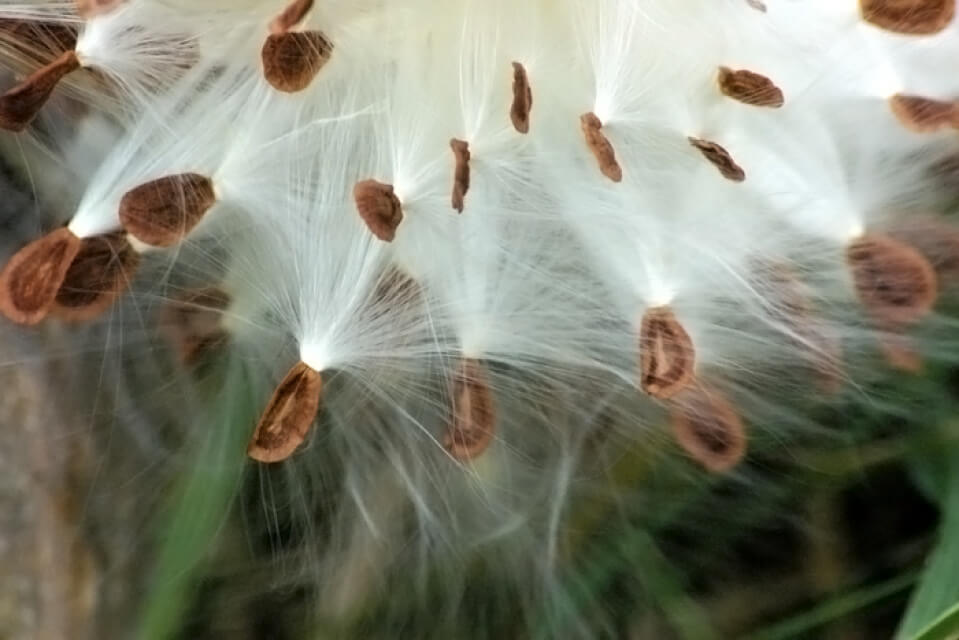
Since I would rather the books become available again, I will re-tell the story Walker and various Anishinaabe storytellers give about how butterflies were created.  It makes no pretense at being as good or thorough as they might tell it, but I hope you will remember it when you see a butterfly and do what you can to support their habitat.  Next autumn remember the value of Milkweed when you see its seeds with their fluffy "parachutes."  The National Wildlife Federation will give you more information on how you can do this and ways to Garden for Wildlife with ideas that can work even in urban and suburban yards.  Get FREE milkweed seeds at LiveMonarch.com along with growing instructions and other activities and resources.

Long ago, it is said by the Anishinaabe, the First People from here in Michigan and around the Great Lakes, that after the Great Spirit had created the world, he looked around with pleasure.  Birds, Fish and other creatures were colorful and useful.  Then he looked at the mountains of the world.  He loved them, too, but knew the People might not appreciate them.  To get the People to enter them, he decided to make rocks of many colors, some of those rocks even sparkled.  It was as if the mountains held rainbows!  He knew the People would discover the stones and then would dig for them.  That was good, but he decided not to keep all the rocks hidden in the mountains.  Scattering rocks around would let children discover them, even without going inside a mountain.  This was no sooner done than Zhaawani Noodin, the South Wind, blew in, singing of trees, birds, and flowers in the spring and summer.  Hearing that song, the Great Spirit tossed the colorful stones into the air, asking the South Wind to carry them to the People.  Those colorful rocks developed wings and fluttered away.  Today we enjoy their beautiful wings knowing that even in their beauty they help pollinate the flowers and other plants wherever they visit. 
Photo by Cindy Gustafson on Pexels.com
Today may be "Blursday", but I like a quote I saw about the current time which said it's end will be like a rainbow that follows a storm.  May this help encourage you to make every day Earth Day and also carry out the purpose of Arbor Day by planting trees which hold the soil (Arbor Day was started to prevent soil erosion, among other things) and do an incredible job to help bring oxygen and reduce pollution.  Already the pollution level is being noticed as reduced by all of us who Shelter in Place.