Tell me if you have a topic you'd like to see. (Contact: LoiS-sez@LoiS-sez.com .)
Please also let others know about this site.
Showing posts with label U.S. Army Signal Corps. Show all posts

Friday, July 12, 2024

"Hello Girls" are overdue to receive the Congressional Gold Medal

Once again this weekend I will portray Oleda Joure Christides, who was a member of the U.S.Army Signal Corps, commonly known as the "Hello Girls."  I believe strongly their long overdue recognition with a Congressional Gold Medal is needed.  It took them 60 years finally to receive their Veterans Status recognition by the Army.  (Oleda was among the few still alive to receive it.)

That is not the only overdue recognition to these telephone operators of World War I.  In 2009, the WASPs received the Congressional Gold Medal. This is the highest medal bestowed by civilians in the United States.  This past year the women working within the United States for World War II, the"Rosies", received the Congressional Gold Medal. Today, the United States World War I Commission is working to honor the Hello Girls with the same award, and we need YOUR help to bring them the recognition they deserve!  

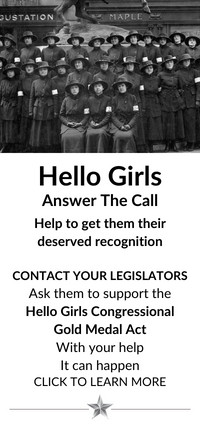
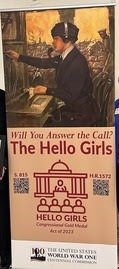
I have reproduced here a flier I will have at my program.  Please read it.  At the bottom I add the information for you to contact your Representative  at https://www.worldwar1centennial.org/honor/valor-medals-image/hello-girls.html

Hello Girls Congressional Medal Legislation Gaining Big Momentum in Senate and House

Great news from the campaign of the World War I Centennial Commission and other organizations, as well as many individuals like you, to encourage the 118th Congress to pass legislation honoring the World War I "Hello Girls" U.S. Army Signal Corps telephone operators, America's First Women Soldiers, with a Congressional Gold Medal. As of the publication of the WWI newsletter, the Senate measure, has gathered 65 of the 67 cosponsors it needs to be brought to a vote and passed in the Senate. H.R.1572, the House measure, has 152 cosponsors, some 70% of the votes needed to pass in the House.This outstanding progress has happened due to all the many organizations and people who have reached out to Senators and Representatives and asked them to cosponsor this important legislation. If you are one of those people, thank you! If you haven't joined the campaign yet, now is a great time to answer the call, and help get this legislation across the finish line.

The Hello Girls made a huge difference in the outcome of WWI. The ability of the bilingual female operators to pass critical tactical information calmly and seamlessly between two allied armies that spoke different languages was a fundamental breakthrough in tactical communications on the Western Front. The service of the Hello Girls helped bring the fighting to an end in the Allies’ favor as much as a year earlier than it might have taken without them, according to General John Pershing, commander of the American Expeditionary Forces. When their nation called in 1918, the Hello Girls answered – will YOU answer their call for recognition in 2024?

Hello Girls Sidebar Ad v2

https://www.worldwar1centennial.org/honor/valor-medals-image/hello-girls.html

That's where my flier ends.  The link also lets you find your representative.  The website also gives the following advice:

You can read the legislation submitted in the House (H.R.1572 - To award a Congressional Gold Medal to the female telephone operators of the Army Signal Corps, known as the "Hello Girls".)

  • On your Representative's web site, navigate to the "Contact form.
  • Fill out the Representative's contact form, then copy and paste the state-specific message in the tab into the "Message" field of the form.
  • We encourage you to customize your note before sending!  Make it a personal message from you.
  • Check "yes, I'd like a response" from your Representative.
  • Click "Send"!
  • If you receive a reply from your Representative, or would otherwise like to contact our team with information, please forward any and all correspondence to hellogirls@worldwar1centennial.org.


Saturday, July 16, 2016

Cher Ami, a true story of World War I

While telling about the "Hello Girls" of World War I, it is also necessary to tell about other ways the Army communicated besides the telephone.  Today's story is about an unusual hero, a pigeon.

The official report of the various methods can be found in.Getting the message through: a branch history of the U.S. Army Signal Corps by Rebecca Robbins Raines, published by the U.S. Army Center of Military History as part of its Army History series.  Chapter V relates how President Wilson's prolonged "insistence on neutrality until nearly the eve of war, however, severely hampered preparedness efforts by the War and Navy Departments. In his view, such activities would not be 'neutral.' "  This created extra problems for the Signal Corps requiring a "rapid and vast expansion...to mobilize its technological, scientific, and economic resources as never before...To obtain needed technical expertise in communications, the Army called upon the private sector."
Yes, they still tried to use the methods that had been part of the Signal Corps methods.  Look at the Signal Corps branch insignia and you'll see the old flags and torch representing their longtime visual method dating back to their formation at the start of the Civil War.

Unfortunately twentieth century signals sent that way caused high mortality.  Flares, of course, were possible, but only showed a location.  Radios were heavy (up to 500 pounds) and the trench warfare methods meant they interfered with each other, so they were more useful in intelligence work.  Speaking of intelligence, cryptography was hardly used.  The Spanish-American War had been unsuccessful in its use of trained pigeons, but again they tried.  This time they created an avian hero, Cher Ami, star of several books, films, and named by Time magazine one of the Top 10 Heroic Animals.

Cher Ami was one of 600 donated by British pigeon fanciers and the last of six birds used by the 554 men known as the Lost Battalion , the 77th Division, who were mainly from New York City, after they became trapped behind German lines in a small ravine area of the Argonne Forest.  Led by Major Charles White Whittlesey, they held out for days against German snipers, waves of German troops armed with hand grenades, and even flame throwers.  Runners attempting to reach French or American lines were either killed or captured.  Food was running out.  The only water at a nearby stream caused so many more wounded in the attempt to bring some back so that eventually the major had to post guards and tell them to shoot anybody attempting to fill a canteen.  "Friendly fire" also meant they were being shelled by their own artillery.  The Germans sent a blindfolded 18 year-old American P.O.W. with a request for surrender.  This was rejected, but the situation was bad enough that bandages were even being taken off the dead to be used again for new men wounded.

Fortunately the men still had three pigeons.  The first bird was sent with this message, "Many wounded. We cannot evacuate." The pigeon carrying the message was shot down. They sent out a second bird with the message, "Men are suffering. Can support be sent?" It, too, was killed.  Eventually Cher Ami was sent.  Cher Ami had delivered 11 messages prior to this current engagement.  Unfortunately, like the earlier two pigeons, the Germans saw when birds were released and so this last bird, too, was shot.  A shell exploded under the bird as it was released, killing five men.  The other soldiers saw it flutter to the ground between the stream and the bridge.  Only later did Cher Ami revive enough to fly again.  Another version, from the book, Yanks; the epic story of the American Army in World War I by John S.D. Eisenhower, says it was able to fly straight up and shivered on the branch of a tree until Whittlesey and the pigeon keeper exposed themselves to German fire while they threw stones at the bird until it took off through German artillery fire.  One thing is certain, by the time it reached its coop 25 miles away to deliver the message attached to one foot, there were several injuries -- one eye was blinded, its breast was shattered by a shot, and the canister with the message was dangling because that leg was only attached by a tendon.  Here's the message.
Fortunately 194 soldiers were able to walk out uninjured because of that message.  Roughly 197 were killed in action and approximately 150 missing or taken prisoner.  Major Whittelsey, whose nickname was "Galloping Charlie", was promoted to a Lieutenant Colonel and, along with others, received the Medal of Honor.

WWI Croix de Guerre
Cher Ami was also honored.  The one-legged, one-eyed bird was given the French Croix de Guerre as well as a U.S. oak leaf cluster -- even though its chest was too injured to display it.  The pigeon was named an Army mascot and retired only to die of the battle wounds about six months later.  In 1931 the bird was inducted into the Racing Pigeon Hall of Fame and received a gold medal from the Organized Bodies of American Pigeon Fanciers.  If you know French, you know the name means "Dear Friend" and is male.  It was only after the bird died and was preserved by a taxidermist for display at the Smithsonian that it was discovered she was a hen.  (Yet another female "Getting the message through"!)

As for the telephone, the Bell System (later AT and T) was called upon to join the Signal Corps.  Here in the Michigan State Telephone Company district, the "Bell Telephone News" - volume 7, which starts in August of 1917 and ends July of 1918 tells about not only the women "switchboard soldiers", as General Pershing called them, but also the men from the Bell System who became soldiers.  Each month opens with personal news like marriages, vacations, transfers, and near the end there's a section called "Of Interest to Our Girls" which not only includes articles aimed at the operators, but even shows fashions occasionally complete with patterns.  The rest of each issue includes news including Chicago and occasional Wisconsin corporate news.  To present day readers the corporate gender discrimination is obvious, as well as the highest supervisory position for a woman at the time was training other operators.
......

Saturday, June 18, 2016

Pershing's "Switchboard Soldiers", Oleda Joure Christides, and Women's Suffrage


Until recently, like Don C. Warrington, I thought General John Pershing might have been called "Black Jack" because it was his favorite card game.  Not at all.  On Warrington's site I learned like me, Pershing was originally from Missouri with a strong background in working with African-Americans.  When he went into the military this was just his start as the general was noted for his long-time command of the so-called "Buffalo Soldiers", an African-American soldiers regiment begun in the Civil War.  When the U.S. entered World War I, his ideas weren't always accepted.  President Wilson rejected Pershing's request and put all black units under the French.  Since the U.S. had been reluctant to enter the war, Pershing was more successful refusing to be part of the Allied army, instead calling our army the American Expeditionary Force (the AEF).  The war was in a stalemate after three years, the French army had mutinied and the Russian revolution had begun.  Pershing's ideas did more than separate the U.S. army, he created the first women soldiers by requesting bi-lingual phone operators "Over There" who became known as "Hello Girls."

As followers of this site know, I'm working on telling the story of those Hello Girls.  This week was the second of my preview programs testing it with some very different audiences.  I present the story of the women Pershing called "Switchboard Soldiers" through the eyes of Oleda Joure Christides, one of the few women who finally received veteran's status, a process that took roughly 60 years.  It also didn't include most of them because by the late 1970s, out of the 223 serving abroad, only 18 of those serving in France were alive and even then were told they had just become "veterans" and it was not retroactive!

The early 20th century saw the battle for Women's Suffrage come to fulfillment almost everywhere.  (Saudi Arabia waited until the end of 2015 to allow women to vote in municipal elections.)  Here in the U.S. President Wilson initially opposed it, but the war eventually convinced him to support the 19th amendment. I'm rather fond of this August 14, 1917 banner from before the war.

I remember vividly a woman in the now defunct storytelling group, the Mount Clemens Raconteurs, tell of her experience at the voting booth when she was among those first women voters.  It was not something most men of her day were ready to accept!

I don't know if Oleda, who was a teenager needing special permission to go overseas with the other women taking oaths with the Army Signal Corps, ever talked about voting, but she certainly was aware of the decades long struggle to be recognized as more than the "civilian contractor" the Army tried to call her and her fellow soldiers.  Soldier is how they were addressed and Pershing was the one who coined the term "Switchboard Soldiers." The more popular name of "Hello Girls" came from the men relieve to hear "Hello" or "Number Please" instead of coping with the French operators.  Beyond that, their chief operator, Grace Banker, received a Distinguished Service medal when her mobile unit came under fire, and also women could prove they were threatened with court martial.  Both their service and the delay for recognition were definitely a part of the struggle involved in Women's History.

I've promised to produce some of my resources here used in preparation for my program.  Be sure to go to the other articles here under the label, Hello Girls, also found on my ever-growing sidebar of links.  It's the librarian in me that tries to produce as many ways to find information as possible.

I presume online readers are good at online searching.  I've given many links in those Hello Girls articles, especially pointing people to a site created by Oleda's daughter, Michelle Christides, but also want to send you to some articles she wrote for the children's historical magazine, Cobblestone.  If you have access to the Gale Virtual Reference Library database (available here in Michigan through the wonderful Michigan eLibrary) you may access the articles online.  Because they were written in 2006, don't be surprised if you own library has "weeded" them out.  Future researchers may find libraries with space and money constraints don't have old issues, then if a journal can't be afforded in the future you may not find it easily.  Sorry, but I think there's a value in warehousing print, as my own overflowing personal library shows.

Be aware, my focus is oral literature and I don't have a dissertation or other need to follow an official stylesheet in the following bibliography, so if that is your goal it may need rearranging, but still should help you find the material.  I also eagerly await the book Michelle Christides is working to produce.  She has the complete list of the Signal Corps operators and has sought information from their descendants to create their definitive history.  (There were seven units and Oleda was in the sixth, the last to go overseas.)

Because my own work focuses on Marine City telephone operator trainer -- the highest supervisory position open to women at the time -- and musician, Oleda Joure Christides, I am abandoning alphabetical order and starting with C first as her daughter and others in Marine City and beyond have been so helpful and Oleda is my primary focal point.
  • Christides, Michelle - Answering the call - Cobblestone, March 2006 page 20+ (My apologies that this and the next article only give the starting page...they were found using the Gale database which doesn't give the final page number.)
  • Christides, Michelle - A 60 year battle - Cobblestone, March 2006page 39+. (LSK: Because these two articles were written for children, they do an excellent job of pointing out changes in telephones and military terminology adults may overlook.)
  • Michelle also has some additional online articles beyond her own site at the Doughboy Center -- a fascinating WWI site, but huge, if you want to prowl it go to http://www.worldwar1.com/dbc/dbc2.htm and prowl each of the 3 icons.  For Oleda's story, it's even beyond that as it's within the "2d Army" section under "Biographies & First Hand Accounts" which is labeled "Under redesign but active."  It includes diaries, letters, and biographies, including four women, among them Marion G. Crandell of the YMCA, who was the first American woman killed in action.
  • Another article by Michelle is a condensed excerpt at the fascinating site by Captain Barb in her Military Women Veterans which looks at American women and their service starting with the American Revolution.
Banker Paddock, Grace - I Was a "Hello Girl" in The World Wars remembered : personal recollections of heroes, hello girls, flying aces, prisoners, survivors, and those on the homefront, prepared by the staff of Yankee Magazine, 1979. pp. 110-115 (As the head over all the operators, in the very first unit, and the only one decorated for her service, her view of the Signal Corps women is a key part of their story.)

Monahan, Evelyn - A few good women : America's military women from World War I to the wars in Iraq and Afghanistan, Knopf, 2010.

Raines, Rebecca Robbins - Getting the message through : a branch history of the U.S. Signal Corps, Center of Military History, United States Army, 1996.

Schneider, Dorothy and Carl J. - Into the breach : American women overseas in World War I, Viking, 1991.

Wyman, Thomas Sage - A telephone switchboard operator with the A.E.F. in France - Army History, Fall 1977/Winter 1998 pp. 1-9.  (Wyman is talking from the viewpoint of his mother, Dorothy Sage Wyman, who, like Oleda, lived long enough to receive her honorable discharge papers.)

The story of these fascinating and determined women is finally being discovered.
Saturday, June 11, 2016

Hello to the "Hello Girls"

#1
Please help me decide something.

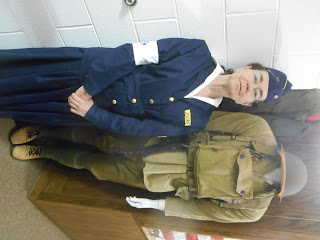
This week I've started my preview performances of the stories of the Hello Girls, the World War I bi-lingual telephone operators of the U.S. Army Signal Corps.  It took  60 years, but they were finally recognized as the first women's combatants.  I will appear as Oleda Joure Christides from Marine City, but also mention many others including Cora Bartlett of Hillsdale County Michigan, the only one of their number lost, although typhoid was the cause.

These soldiers, for that is how they were addressed, had to pay to have their uniforms made.  The uniforms were modeled after that of the Army nurse and cost $300-500.  The present equivalent is slightly more than $4350-7250 in 2016 dollars.  It's no wonder the people of Emmett, Idaho held a benefit to help Anne Campbell Atkinson get uniformed.

Only after my very hot and heavy woolen uniform was made did I learn they also had summer uniforms.  That comparison with the value of 1918 dollars made me feel better about having both sets made.  I did not bother with the woolen underwear nor those black sateen bloomers the women also ignored!

Now for my problem.  I want to send historical groups, libraries, and schools who have seen my historical work a letter accompanied by a photograph of me in uniform.  I know other groups when booking me will also want a photo.  I'm not sure how to make a collage photo and also will need to single out one in particular to get the message across visually.  Could you help me decide?   Frankly I always hate pictures and these are many things, but definitely not "glamour shots."
#2

#3
#4

#5
#6
#8
#7

Sorry, but this really is saved rotated right-side-up with Headless as #9 or my attempt at German humor: Nein!
Photos were graciously taken in Frankenmuth at the Michigan's Military & Space Heroes Museum (on a very busy Memorial Day weekend!) and at the Doughboy Statue in Bay City at the General John J. Pershing Park next to the Sage Branch Library of the Bay County Library System.  Others also most helpful in my preparation have included the Pride and Heritage Museum of Marine City and even as far away as Washington, D.C.'s Smithsonian National Museum of American Heritage Division of Armed Forces History and, of course, Oleda's own daughter, Michelle Christides, who has worked incredibly hard to get the story known.  I look forward to her book about them and will gladly promote and offer it when it becomes available.

In the meantime I need to get the word out and for that I need a best picture or pictures.  I look forward to reactions here, Facebook, or my email.  THANK YOU!

UPDATE: I just realized I never posted the results here, although I did put it on Facebook.  Taking all the reactions convinced me it was better to create a collage of pictures.  This was the result.
 

Next week (6/18/2016) maybe I can show some more of the research behind all of this.  We'll see.  It's a hectic time, including another preview of the program, so maybe I will take the quicker way and post another story. . . we'll see.                                                                  

Saturday, July 11, 2015

The "Hello Girl" Who Died "Over There" (and Another Who Survived)


Back in April I began posting about the "Hello Girls", the bi-lingual phone operators who worked in France during World War I with the U.S.Army Signal Corps.  While they did get shelled and experience some of the other wartime experiences "Over There", only one died and she was from Hillsdale, Michigan.  Cora H. Bartlett wasn't killed by shells or gas, but the world-wide pandemic of the Spanish Influenza, which has been the deadliest in modern history.  The international death toll has been estimated at 20 to 50 million, with 675,000 American victims.  Like Bartlett, it killed mainly healthy young adults, with more U.S. service members killed during the war than from battle.  She died in the spring of 1919 after the Armistice was signed November 11, 1918.
Update: The Hillsdale Historical Society has confirmed the cause of death was Typhoid.  While Spanish Influenza killed many in the war, Typhoid continues to kill and is nowadays something travelers can vaccinate themselves to prevent.  By 1911 the U.S. Army vaccinated its soldiers.  This is yet another example of their not taking the women seriously as soldiers.  Typhoid is a bacterial infection controlled also by better sanitation such as clean drinking water and hand washing.  Those precautions weren't always possible in wartime.

UPDATE: In checking back here I see that the photos have been taken down.  I strongly recommend going to the Hillsdale Historical Society webpage about Cora Bartlett

cora's funeral cortage in france
Burial cortege in France for Cora Bartlett


She was buried in France with full honors.  A memorial tombstone to her was also added at the King Lake Cemetery in Hillsdale County.


Bartlett wasn't the only Hello Girl to suffer from the Spanish Influenza.  Mabel Lapp, of Evanston, Illinois, left the Chicago Telephone Company and became ill while on ship bound for France.  Lapp recovered and went on to serve as she initially planned. 
Norma Finch Carman
I shared my research about the Hello Girls with the Hillsdale Historical Society so they could add Ms. Bartlett  and fellow Hillsdale Hello Girl, Norma Finch Carman.  Miss Finch returned to Hillsdale after the war and married her wartime sweetheart, Captain Ellis Joel Carman.  She later moved to his home in Denellen, New Jersey for the remaining 42 years of her life.  By dying in 1962 she was with the majority missing Congress finally giving Veteran Status/Honorable Discharge in 1978 on the 60th anniversary of the war's end.

Update: Norma Finch Carman's information including photo is now at the Hillsdale Historical Society site.

Much of what I was able to learn about each of them came from old issues of Bell Telephone News, in volumes 7, 8, and 9.  It's somewhat amusing that an article on the need for new women employees follows the article on the Finch/Carman marriage, noting the large number of post-war weddings.

The Hillsdale Historical Society was gracious enough to add an article about the Hello Girls and post information about the two women on their People pages crediting me with passing the information along to them.  I also mentioned another Hillsdale County woman, Louise Gordon, who is usually listed as Detroit because she worked for Michigan State Telephone Company there, but her home was actually the Hillsdale town of Litchfield.

Research is continuing as I prepare to bring stories and songs of these brave women.  Along the way I found this wonderfully appropriate quote from Samuel Johnson in his Works, Lives of the Poets, talking about Joseph Addison, Johnson said "History may be formed from permanent monuments and records; but Lives can only be written from personal knowledge, which is growing every day less, and in a short time is lost for ever. What is known can seldom be immediately told; and when it might be told, it is no longer known."

There's so much more to be found and told!

Saturday, April 18, 2015

"The Hello Girls" -- a project begins

There are always multiple projects underway.  This is a project looking ahead to the 2017 centennial of the U.S. entering World War I . . . the supposedly "War to end all wars."  That war also ended the very limited participation of women in wartime support.

Here in Michigan Oleda Joure became a "Hello Girl", the popular name for members of the U.S. Army Signal Corps.  The "Girls" were requested by General Pershing because of difficulties using the existing French phone system conflicting with his determination to keep phone lines available between the battlefront and headquarters.  He requested bi-lingual (French and English) telephone switchboard operators.  They were subject military regulations, including court martial, and even stood inspection along with soldiers, yet it wasn't until the presidency of Jimmy Carter their service was finally recognized as being the first women veterans of the U.S. Army.

Oleda Joure Christides
I find Oleda an exceptionally interesting Hello Girl, and not just because she was from Michigan, as she was both a telephone operator/training supervisor and an entertainer.  She was also asked by the Red Cross to become a member of their touring program, a precursor to later U.S.O. tours.  She couldn't accept as she was already under orders with the Signal Corps, but her knowledge of music of the era lets me bring it into the fascinating story of the Hello Girls.


This will probably be the first of many articles about World War I, the Hello Girls, and Oleda Joure Christides.  I will be asking historical organizations and libraries:


If you are interested in the various resources checked so far, the primary online source for Oleda is The History of a Hello Girl written by her daughter Michelle Christides.  Yet another website of Ms. Christides gives additional photos, facts, comments by her mother, and also cautionary remarks to teachers and writers.  I also found this abbreviated article by her has a few additional bits of information and anecdotes not mentioned elsewhere.  She has more information, including oral histories of a few of her mother's colleagues, and hopes to publish it in a forthcoming book.

If you go to the Armed Forces History Museum's page on the Hello Girls it mentions Oleda, as it is almost a complete copy of Ms. Christides webpage, but fails to give her credit.  I also found a blog on Women Heroes that did the same.  It's no wonder comments about how the work by Michelle Christides and about the World War I Signal Corps should be handled was posted.  Senior Master Sgt. Jerry Hanes in his article, "Hello Girls set stage for women in the military", on the Malmstrom Air Force Base site does more work as his article features Grace Banker, the Chief Operator or supervisor, but he, too, mentions Oleda and the article by her daughter.  Soldiers; The Official U.S. Army Magazine has "World War I's Hello Girls: Paving the Way for Women in the U.S. Army", an excellent article by Elizabeth M. Collins.  Here's the brief  introductory (dare I say obligatory?) Wikipedia article on the Hello Girls.  Even Facebook has a Hello Girls section within the U.S. Army War College photos. There are a few other online locations that give brief mention.  If you go to Google for a search, it's worth adding "world war 1" or variations as there was also an unrelated t.v. show by that name.


Catch a great YouTube video (November 2013) by Dennis Skupinski about the Hello Girls of Michigan, with Oleda featured as well as Cora Bartlett, who died of Spanish Influenza while serving as a Hello Girl.  This is part of his excellent series, Michigan's WWI Centennial News Report, videos he has been producing for several years.

Beyond that the following books are also worth reading: 
  • Farwell, Byron - Over There; The United States in the Great War, 1917-1918
  • Gavin, Lettie - American Women in World War I; They Also Served
  • Schneider, Dorothy and Carl J. - Into the Breach; American Women Overseas in World War I 
  • Staff of Yankee Magazine - The World Wars Remembered (has a remembrance by Grace Banker Paddock


As the old Y.W.C.A. poster declares, we should "Back our girls over there" both during the war, when they returned to the U.S. but were told they couldn't have been sworn into the army, in 1978 with only 70 of the "Girls" still alive, and as we begin to look at World War I and the women supporting that effort.

Is that my only project in the works?  Dunberidiculous!