Tell me if you have a topic you'd like to see. (Contact: LoiS-sez@LoiS-sez.com .)
Please also let others know about this site.
Showing posts with label World War I. Show all posts

Friday, May 22, 2026

Remembering on Memorial Day

Flanders Field


Memorial Day started after the American Civil War. It was created to remember and mourn the U.S. military personnel who died while serving in the United States Armed Forces. There have been many wars since that "Civil" War, or as I say when performing as local woman, Liberetta Lerich Green,

although that program mainly is about the Lerich family Underground Railroad Station.

Yet another  historical person I portray is Michigan "Hello Girl", Oleda Joure Christides. These bilingual switchboard operators were sworn into the army for World War I, but it took them 60 years to finally receive Veteran Status, including honorable discharges. In December 2024 the group finally was awarded the Congressional Gold Medal.

While the Army in World War I bragged about its vaccination program, Hello Girl, Cora H. Bartlett, died of Typhoid and was initially buried in Tours, France, where she died. The people there gave her a funeral cortege with a floral blanket over her casket, which was rolled to their cemetery in June of 1919. Her casket was later removed in 1922 and sent to be re-buried at her family plot in the Hillsdale, Michigan cemetery of King Lake Cemetery

The Hillsdale County Historical Society has a page memorializing Cora

It also has a general page about the Hello Girls as well as about her fellow Hillsdale operator who was yet another Hello Girl, Norma Finch Carman. She survived the war and later married a Captain, Joel Carman, after they both saw action coming home from "Over There." That was the song Enrico Caruso sang to support all from the United States who accepted service in Europe.  

World War I was supposedly the "War to End All Wars." Of course it wasn't, but on this Memorial Day we should remember both those who died in their service or survived.

Friday, March 1, 2024

The Hello Girls deserve a Congressional Gold Medal

LoiS at Iosco County Historical Museum

I don't normally completely publish an entire article from another source, but today's article from the February WWI  Dispatch not only focuses on the Hello Girls, but what we can do for recognition of their service in World War I.  The Doughboy Foundation spotlights that "War to end all wars", which is too easily forgotten after World War II.  They rightly say it was "The War That Changed the World."  

Starting this month I return to telling the story of Oleda Joure Christides from Marysville, Michigan.  Her family graciously helped me as I put together her story and those of the other bi-lingual phone operators who were America's first women soldiers.  Michigan also had one of two "Hello Girl" deaths.  It took slightly over 60 years for them finally to gain their veterans status as the Army tried to claim they were contractors.

Their descendants are rightfully calling for a Congressional Gold Medal for these brave women.  The article below from the February WW1 Dispatch gives much more detailed information below.  

Dennis SkupinskiOther information in the newsletter includes the death of  Dennis Skupinski, the Michigan State Commission Chair WWI and amateur historian.

Dennis helped me personally as one of his many ways as Commission Chair (and as dedicated "amateur historian") he was recognized as "ceaselessly promoting the Michigan and Michiganders contributions to the Great War."  I am honored to continue the focus on this work that meant so much to him and Oleda.

 Before I give the Dispatch article, I also want to recommend a well-researched work of fiction about the first "Switchboard Soldiers", including Grace Banker, their Chief Operator.  Her diary was one of many sources New York Times bestselling author Jennifer Chiaverini used in creating her well-written novel, Switchboard Soldiers.  My view of Hello Girl preparation and life is from the sixth of seven units sent abroad.  Chiaverini's book looks instead to the start of their work and, by including Banker as one of her three characters, the very top organizational view.  These women of the U.S. Army Signal Corps "broke down gender barriers in the military and battled a pandemic as they helped lead the Allies to victory."

Now my call to action:

Women’s History Month: Ideal Time To Ask Your Senators and Representative To Support Congressional Gold Medal For The Hello Girls

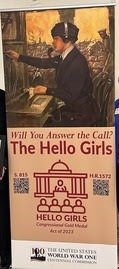
Hello Girls pop-up image

Women's History Month starts on Friday, March 1, a month dedicated to "commemorating and encouraging the study, observance and celebration of the vital role of women in American history." This makes it the ideal time for all Americans to reach out to their two Senators and Representative to request their immediate support for current legislation in each House to award a Congressional Gold Medal to the U.S. Army Signal Corps telephone operators of World War I, known as the "Hello Girls." America's First Women Soldiers earned this honor through their outstanding service in World War I

Women's History Month at Women's Military Memorial vertical

The Hello Girls will be at the top of the agenda on Sunday, March 3 at the Military Women’s Memorial in Arlington, VA, as they kick off “March With Me” – a celebration of Women’s History Month at the only memorial to tell the stories of all women who have served our nation. The award-winning  Hello Girls documentary will be screened in the memorial's Vaught Center at 1:00 pm Sunday (get there early!). Filmmaker James Theres will be on hand to discuss the movie after the showing, and to talk about the essential role that the Hello Girls played in bringing the fighting to a close in World War I.. Joining him will be several descendants and family members of Hello Girls, who will share their knowledge and memories of their family heroines, and take questions from the audience. If you are anywhere in the National Capital Region, request your tickets now to attend this event, which also features “Honoring Her Voice,” a special musical performance by The U.S. Army Band “Pershing’s Own” chamber players, and an Open House at the Memorial.. 

Four of the descendants and family members of Hello Girls have joined forces to pen an eloquent editorial about why America's First Women Soldiers deserve the recognition of a Congressional Gold Medal. The short answer is that it's "A distinction they have earned," but the four authors go into excellent detail on how the "adventurous, even intrepid pioneers of their time" answered their nation's call in 1918.The women of the Hello Girls risked their lives in service, and two died in France. Click here to read the entire editorial, which is seeking placement in publications across the nation to support the Congressional Gold Medal legislation

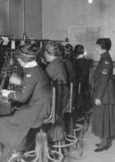
Hello girls at switchboard

You can join these family members in advocating for passage of the Hello Girls Congressional Gold Medal legislation in 2024, and do it right from your computer! Click here for our toolbox that makes the process of reaching out to your Representative and Senators very straightforward. You can also reach out by phone to the local and district offices of your Senators and Representative, and tell them that you want them to answer the call, and cosponsor the Hello Girls Congressional Gold Medal legislation in the 118th Congress.

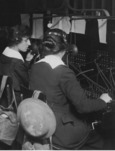
Hello Girls with helmet

The Hello Girls made critical battlefield tactical communications work effectively for U.S. and French military forces on the front lines of World War I, saving the lives of many American by helping bring the long war to a quicker end. However, when the Hello Girls returned home after WWI ended, they were denied veterans status and benefits until 1977. The Hello Girls earned and deserve the recognition of a Congressional Gold Medal, and the World War I Centennial Commission asks you to helpmake that happen in the 118th Congress!

When their nation called in 1918, the Hello Girls answered -- will YOU answer their call for recognition in 2024?

Friday, February 24, 2023

Love, the "War to End All Wars", and a century later

Painting of Oleda in Chaumont by her daughter, Michelle Christides

A week from today I will once again present the story of Oleda Joure Christides, a World War I "Hello Girl."  It will be at 11 a.m. at the Carnegie Branch of the Jackson District Library.  The last time I was able to do this program was in November of 2019 before the pandemic.  In preparing, I was feeling far removed from the story of this woman, a story developed from various sources including her two daughters.  One of the daughters, Helen, has since died and I miss her so much.  I had hoped to contact some of the family last November when Oleda was inducted into the Michigan Military and Veterans Hall of Honor.  Unfortunately I was too sick that week to attend.  Oleda's other daughter, Michelle, was also unable to attend, but sent a prerecorded video.  Michelle has done much to share the story of her mother and these brave women who went "Over There" and then spent 60 years fighting for their promised veteran's status.  The Doughboy Foundation long ago published her article, "The History of a Hello Girl."

That same Doughboy Foundation publishes a newsletter, which this month includes a Valentine's Day story about another aspect of the experience of these Signal Corps bilingual telephone operators. . . finding love.  It's a reprint of the California American Legion's story, "A Love. A War. A Citizen" and that, too, was something Oleda observed among many of her fellow Hello Girls.  I recommend  "A Love. A War. A Citizen" highly and found it helpful in getting me back into the world of Oleda and her colleagues.  There were 6 Hello Girls from Michigan, including Norma Finch Carman, who was from Hillsdale County, but worked in Detroit for the Michigan State Telephone Company.  She returned to her job, but in less than a year married Ellis Joel Carman at the Episcopal rectory in Hillsdale.  Joel had been a captain in the American Expeditionary Force in France.  In my program I mention another, Melina Adam, who was repeatedly reassigned because she fell in love with Signal Corps soldier, Jack Converse.  They didn't wait to come home and were married in Paris shortly after the Armistice.  The California American Legion story does an excellent job of showing the world of the AEF and these brave women.

I don't portray famous people of the past, preferring to present "History as seen by the 'average' person."  As the Michigan Military and Veterans Hall of Honor shows, that can include important history too easily overlooked.  (The history of the Hello Girls was pushed aside for 60 years, but I'm pleased to play my part in keeping it alive.)

Friday, November 11, 2022

Oleda and the Michigan Military & Veterans Hall of Honor

This past Friday was Veterans Day, a day to honor the bravest of our citizens: the many people who have served in the military to defend our freedom. Veterans Day honors all military members, regardless of the war or conflict, or if they survived or perished.  The coming Friday a special Michigan event will occur.

The Michigan Military and Veterans Hall of Honor creates a Hall of Honor for Michigan citizens who have distinguished themselves through military service and/or public service as a veteran of the Armed Forces of the United States. 


The "Hall of Honor" is currently only online, with an annual Hall of Honor Day celebrating the newest additions and learning more about why they were chosen.  This year Oleda Joure Christides, a World War I "Hello Girl" from Marine City, will be honored. 

Online, beyond their website, the Hall of Honor also has a Facebook page, where they have been posting about this year's ten inductees.  This is what they posted about Oleda:

Oleda was born in 1897, in Marine City, and served as a telephone operator in the U.S. Signal Corps' famed "Telephone Girls" Brigade in World War I.
When the U.S. entered the war in 1917, American Expeditionary Forces (AEF) Commander General John Pershing recognized that expert telephone communications and technology support between command units and the front lines would be crucial to victory.
Upon demobilization in 1919, Joure-Christides returned to Marine City and resumed her civilian career as a telephone operator, married, and raised a family. Despite assurances to the contrary, the Army issued Telephone Girls Brigade "Service Termination Letters" instead of a military discharge, denying them veteran status and any benefits. After decades of fighting; in 1978, Joure-Christides was awarded her full official discharge at home with her husband, Chris, by her side.
Oleda passed away in Marine City in 1984.
Hear her incredible story and many others at the #MMVHOH Military & Veterans 2022 Hall of Honor Inductee Ceremony on Friday, Nov. 18th at 12:30 PM!
Event information: https://bit.ly/3sQZ9pj

This will be another opportunity for me to meet with many of Oleda's family.  Whenever my historical programs are about a real individual, I try to work with their family.  Sadly Oleda's daughter, Helen, who was a great help, has passed away, but I hear her son will be there.  I also worked a bit with Oleda's other daughter, Michelle, who has done a great deal to spread the word about these Signal Corps Operators, both their work in World War I as the first female combatants and their 60 year battle that finally succeeded in recognition by the army.  Oleda was fortunate enough to be among the 50 operators still living who finally received their veterans status and honorable discharge in 1978.  

Oleda with Brigadier-General Arthur Wolfe
Oleda died in 1984.  The brief summary of their work and eventual recognition is at Wikipedia

As I understand it, Michelle will be unable to attend the Hall of Honor ceremony, but has prepared a brief video for the occasion.

The Hall of Honor's purpose is twofold, both to honor and to educate.  Those education goals are:

To educate Michigan citizens, and particularly young people, about the military and civic service of state veterans in order to inspire a sense of pride, patriotism, and civic virtue.

To promote through scholarships, grants, and other means, the research and teaching of Michigan’s military heritage and the importance of military service to citizenship throughout the state.

Sometimes storytelling offers an opportunity to touch history and the people who lived it.


Friday, November 4, 2022

For Veterans Day and Beyond, More about World War I

This coming November 11 is Veterans Day. Historically and in some parts of the world it is called Armistice Day or Remembrance Day.  When you say something is at "the eleventh hour" it refers to the ending of World War I on the eleventh month at the eleventh day at the eleventh hour the war's end was signed.  While the war clearly was not "the war to end all wars", this day honors all who have served in the military.

I do a program on a Michigan woman, Oleda Joure Christides, who was in the last team of the bilingual phone operators, commonly called "Hello Girls", for WWI.  Because some men were "buried at sea" due to what was commonly called the Spanish Influenza on her trip to work at Pershing's headquarters, I did a lot of research also on the Great Influenza Epidemic of 1918.  Even with all my research, Victoria Thompson in her book, City of Scoundrels, did indeed give a few "I didn't know that" moments. She graciously gave me permission to share her comments at the end of the book which are relevant to both World War I and the Influenza epidemic.  


I'm hoping to bring the program about Oleda Joure Christides, http://www.lois-sez.com/historical-programs.html, back during Women's History Month. In November Oleda will be honored on November 18 in Lansing by the Michigan Military and Veterans Hall of Fame.  It's by invitation only and I look forward to meeting additional members of Oleda's family.  It's great to have her service honored.


I also very much appreciate Victoria Thompson's permission to reprint her Author's Note in City of Scoundrels. Not only do I want to give full credit to her and would send you to her website at http://www.victoriathompson.com/, but definitely have enjoyed her
Counterfeit Lady series, about a woman raised to be a con woman.  This is a fairly new series of, so far, five books, including the first book, City of Lies, where "Counterfeit Lady",Elizabeth, takes shelter hiding with Suffragists in jail.  When Thompson mentions President Wilson "was notoriously thin-skinned and could not tolerate any criticism" I think about this photo after the War's end when women in the U.S. asked for the same rights granted Germans.

Even before the Counterfeit Lady series my husband and I are longtime fans of Thompson's Gaslight Mysteries set in New York city at the Turn of the 20th Century.  There are 24 so far and all are titled "Murder on (or in) ... " giving the name of a New York street or neighborhood.  I recommend them highly. They move you like a time machine into a well-researched bit of the past.  Added to those settings there are characters who always make you want to see what happens next.  I could say even more, but think it's time to let you discover them for yourself.  May Ms.Thompson keep on writing!

In the meantime, when you see veterans offering poppies for donations, think of all the poppies "In Flanders Fields."


Friday, August 21, 2020

Primary Manual Work (Plus) - Keeping the Public in Public Domain

One of the things about live storytelling, especially historical storytelling, there's always more that can be said.  It reminds me of the final chapter of Peg Bracken's Appendix to the I Hate to Cook Book which she titled "Tail Gate, Shutting the; Now What Did I Forget This Time?"  This past week I was once again the One Room School Teacher, treating the board of the Iosco County Historical Society as if they were a local group considering starting a One Room School.  The program was live streamed and I've given permission for a clip from it for their website or their Facebook page. I'm not able to post it yet.  Volunteers work as their time permits, but will add it here when available.

Because everyone was wearing a mask, I acted as if I thought the Spanish Influenza might have returned.   This let me expand the program a bit to talk of how it affected their county (a 25% increase in deaths), how it had affected Michigan including soldiers at Camp Custer (nearly 700 deaths), and how President Wilson's refusal ever to discuss it led to deaths here and in the trenches of World War I.  I also mentioned his own stroke led to Mrs. Wilson being the undeclared first woman president.

Probably coverage of both Spanish Influenza and briefly women's suffrage made my omission of today's material reasonable.  Still I was sorry to leave out this aspect.
The term "manual work" refers to the crafts a teacher would use to supplement course work.  In this case it was for the public schools of Los Angeles, California.  While other instances of manual work can be seen online, this book is only available for sale at present.  The book might be interlibrary loaned, however, and the bibliography pages at the end are particularly worthwhile.  The example I wanted to include was the start of second grade when it was tied to Daniel Defoe's Robinson Crusoe.  With the interest in survival, it was interesting how it could tie curriculum elements together with this classic.

Second graders?!?  While one-room schools served roughly ages five to fifteen, U.S. second graders are approximately seven years old.  How could they handle Robinson Crusoe?  I grew up with "Classics Illustrated" comic books and wondered how much was eliminated, but here are two versions listed in the book's bibliography.  Robinson Crusoe for Boys and Girls and  An American Robinson Crusoe do a surprisingly good job of eliminating the more adult part of the classic.  The crafts essentially start where Crusoe began to establish his island survival home.  The first book opens that topic in chapter three, "Robinson in His New Home", while the other is chapter eight, "Robinson on an Island."

Later I'll point out some projects still used in crafts today.  Let's see how it is suggested.


You'll notice the cover isn't completely shown.  This is because the book is 9 1/2" by 13 1/2" and I will need to add a little bit of what didn't scan.  Several of these projects are standard crafts worth using even without the Robinson Crusoe thematic work.

First the text and then the illustrations.
Notice the quotations at the top, including from Plato and the second page has the poet, Whittier.
I believe most of the first column on the second page can be easily guessed with the possible exception of "Jute Hammock."  The definite exception is the material for "Special Days" where a "Portfolio" is suggested.  Since the text is not complete (and small) I'll give it all.  It also is a general idea useful throughout the year (and is first shown in the September of the First Grade).  The materials and tools are "1/4 Sheet Manila or Kraft Paper, 36"x48"; Paste; Scissors."  The third column says:
As no Special Days occur during this First Month, the time assigned for this work may be utilized in making a Portfolio from Manila or Kraft paper, to be used as a receptacle for preserving incomplete work.  Divide the large sheet of paper, 36"x48", into fourths, resulting in sheets 12"x36".  From each of these sheets cut off a square 12"x12", leaving sheets 12"x24".  Fold lower short edge up to within 4" of upper short edge.    Open.  Beginning at lower short edge, cut off strips 1"x10" from right and left edges.  Again fold on horizontal crease.  Fold over side flaps.  Fold down upper flap, cutting off the inch margins.  Paste side flaps.  (Figs. 93 and 93a)
 Those figures were earlier in the First Grade material where they also made a Portfolio:
The top 3 pictures on the page are not part of the Portfolio
 Nowadays a quick trip to the office supply store is probably how most of us would handle it, but it's interesting to know how it was done before that and could be made again.  The time would supposedly be 30 minutes.

Here are the two pages of examples, numbers 165 through 174 with a few explanations of what is cut off.


The top rows' numbers were cut off.  The Tree Spelling Blank is 165, the Furniture for the Table has 166 in the center and then 166a.  Number 169b is part of the tent with the bottom of the paper cut off when scanning.

The top row middle is 171a for the Tool Chest and the upper right is 172a for the Circular Raffia Table Mat and that's certainly a craft idea worth using beyond the Robinson Crusoe projects.  The cut off of 173 and 173b are the sort of pot holder and mat loom projects you may remember from scouts or summer camps just like the Raffia Mat.  Robinson Crusoe's Raft, number 170, while not explained beyond being a "supplementary model by interweaving slats", should be recognized as something often made nowadays with craft or popsicle sticks to make a trivet.  Number 174, the Jute Hammock can be enlarged to make a hammock for things like toys or a catchall in the car or kitchen.

Bet you never realized those craft projects from summer camps and scout meetings were common even at the start of the Twentieth Century (and probably much earlier).  You also may note my copy of this book originally came from the Grand Traverse County Normal Training Class.  Normal today has other meanings, but back then said it fit "norms" or standards required in education.
******************
This is part of a series of postings of stories under the category, "Keeping the Public in Public Domain."  The idea behind Public Domain was to preserve our cultural heritage after the authors and their immediate heirs were compensated.  I feel strongly current copyright law delays this intent on works of the 20th century.  My own library of folklore includes so many books within the Public Domain I decided to share stories from them.  I hope you enjoy discovering new stories.  


At the same time, my own involvement in storytelling regularly creates projects requiring research as part of my sharing stories with an audience.  Whenever that research needs to be shown here, the publishing of Public Domain stories will not occur that week.  This is a return to my regular posting of a research project here.  (Don't worry, this isn't dry research, my research is always geared towards future storytelling to an audience.)  Response has convinced me that "Keeping the Public in Public Domain" should continue along with my other postings as often as I can manage it.
Other Public Domain story resources I recommend-
  • There are many online resources for Public Domain stories, maybe none for folklore is as ambitious as fellow storyteller, Yoel Perez's database, Yashpeh, the International Folktales Collection.  I have long recommended it and continue to do so.  He has loaded Stith Thompson's Motif Index into his server as a database so you can search the whole 6 volumes for whatever word or expression you like by pressing one key. http://folkmasa.org/motiv/motif.htm
  • You may have noticed I'm no longer certain Dr. Perez has the largest database, although his offering the Motif Index certainly qualifies for those of us seeking specific types of stories.  There's another site, FairyTalez claiming to be the largest, with "over 2000 fairy tales, folktales, and fables" and they are "fully optimized for phones, tablets, and PCs", free and presented without ads.

    Between those two sites, there is much for story-lovers, but as they say in infomercials, "Wait, there's more!"
The email list for storytellers, Storytell, discussed Online Story Sources and came up with these additional suggestions:            
         - David K. Brown - http://people.ucalgary.ca/~dkbrown/stories.html
         - Richard Martin - http://www.tellatale.eu/tales_page.html
         - Spirit of Trees - http://spiritoftrees.org/featured-folktales
         - Story-Lovers - http://www.story-lovers.com/ is now only accessible through the Wayback Machine, described below, but the late Jackie Baldwin's wonderful site lives on there, fully searchable manually (the Google search doesn't work), at https://archive.org/ .  It's not easy, but go to Story-lovers.com snapshot for October 22 2016  and you can click on SOS: Searching Out Stories to scroll down through the many story topics and click on the story topic that interests you.
       - World of Tales - http://www.worldoftales.com/ 
           - Zalka Csenge Virag - http://multicoloreddiary.blogspot.com doesn't give the actual stories, but her recommendations, working her way through each country on a continent, give excellent ideas for finding new books and stories to love and tell.
     
You're going to find many of the links on these sites have gone down, BUT go to the Internet Archive Wayback Machine to find some of these old links.  Tim's site, for example, is so huge probably updating it would be a full-time job.  In the case of Story-Lovers, it's great that Jackie Baldwin set it up to stay online as long as it did after she could no longer maintain it.  Possibly searches maintained it.  Unfortunately Storytell list member, Papa Joe is on both Tim Sheppard's site and Story-Lovers, but he no longer maintains his old Papa Joe's Traveling Storytelling Show website and his Library (something you want to see!) is now only on the Wayback Machine.  It took some patience working back through claims of snapshots but finally in December of 2006 it appears!
    Somebody as of this writing whose stories can still be found by his website is the late Chuck Larkin - http://chucklarkin.com/stories.html.  I prefer to list these sites by their complete address so they can be found by the Wayback Machine, a.k.a. Archive.org, when that becomes the only way to find them.
You can see why I recommend these to you. Have fun discovering even more stories!

Saturday, April 27, 2019

The 19th Amendment

Today, April 27, I'm once again telling the story of World War I's "Hello Girls" as if I was Marine City's Oleda Joure Christides.  The story is as much a story of women's history as it is that of World War I because it took 60 years for those women to finally gain their veteran's status promised to them when they initially took their oaths as soldiers.

When the Victory Parade was held in New York, the Navy recognized its Yeomanettes and let them march, but the Army refused, claiming the bilingual telephone operators were "contract employees", thus lacking veteran's status.  The Army insisted only males had been in the Army.

Part of the delay in recognition, beyond the Army's refusal to recognize the women after the war ended, included the many things taking priority in the United States.  Returning soldiers also sought their promised compensation which led to Bonus Marches or the Bonus Army during the Great Depression.

Why does this involve the League of Women Voters?

One of those matters, definitely a major issue in women's history, was giving women the vote.  This was more than just an issue in the United States.  Wikipedia's article on Women's Suffrage shows the changes internationally.  I was stunned when only recently I learned about Great Britain, "From 1918–1928, women could vote at 30 with property qualifications or as graduates of UK universities, while men could vote at 21 with no qualification. From 1928 women had equal suffrage with men."  In both the U.S. and around the world the movement, which had been growing since the 19th century, was strengthened by the role women took in World War I.

I'm particularly fond of the historic photo addressed to President Woodrow Wilson as "Kaiser Wilson" talking about how his post-war concerns for Germany's self-government (which did give all Germans the vote in 1918) ignored the twenty million women in the U.S. without the vote.

I have two books of newspaper front pages showing major events.  Neither Great Pages of Michigan History from the Detroit Free Press nor The New York Times Page One; Major Events 1900-1998 as Presented in The New York Times show the passage of the Nineteenth Amendment to the U.S. Constitution in 1920.  Somehow a constitutional amendment would seem like front page news.  Certainly the eighteenth amendment banning alcohol and the later 21st amendment repealing it received plenty of attention. 

On a personal level, many years ago I remember an elderly woman telling of the disparaging looks and comments made when, as a young woman, she proudly marched up to vote when it first became possible. 

Fortunately local newspapers recorded when Brigadier General Arthur Wolfe was finally sent to Marine City in 1978 to present Oleda with her long-promised official honorable discharge papers and Victory Medal.  At the time she was one of only 15 alive who served abroad.
It may not have made front page news, but like the 19th amendment, we need to recognize these important events in women's history and the contribution of women who went before us. 


Saturday, January 5, 2019

Bouvé - Old Glory and New - Keeping the Public in Public Domain

HURRAY FOR PUBLIC DOMAIN REOPENING!

Photo by Jarred Craig on Unsplash
Currently on sale at Amazon for a mere $8
As mentioned last week, our cultural heritage of the Twentieth Century has reopened in 2019 with a gradual trickle of material from 1923!  Checking my personal library collection, fifteen books are now available to publish online for "Keeping the Public in Public Domain."  At this time I have a book I was all prepared to post until I realized it was unavailable until this year,Lamp-Light Fairy Tales and Other Stories by Pauline Carrington Bouvé.  That link, by the way is not one of the many ubiquitous Wikipedia articles.  Although she's mentioned in various other Wikipedia articles, she has yet to receive one of her own.  That link is actually to a fascinating article about her at Find-a-Grave's section on Green Hill Cemetery's tour of "Avenue of the Armies"  related to the United States Civil War and is under an article about her uncle, Confederate surgeon, Dr. George W. Rust.   The source of the thorough coverage about Lena, as she was familiarly called, is attributed to Cenantua’s Blog by Robert H. Moore, II licensed under a Creative Commons Attribution-Noncommercial-No Derivative Works 3.0 United States License.  Based on a work at www.cenantua.wordpress.com.  More about her and her family background after the story.  For now I want to post a fascinating story spanning last month's Civil War Christmas program and posts and my coming World War I "Hello Girl" programs.

I am changing one thing about the way Bouvé arranged it in the book as each story is preceded by an illustration by Mabel Betsy Hill, (who does have a Wikipedia article about her illustrating other authors and her own books, including the "Judy Jo" series).  Here's a quick title page sampling of Hill's work.

The illustration for today's story gives us too much advance information, but I do begin with Bouvé's poem.  Her original poems introduce each story.  This book uses a frame of the telling of the stories to a group of children.  Normally I omit that, but this story may benefit from seeing how the book handles it.  The stories can definitely stand on their own, but it gives a bit of flavor from 1923 children's literature.

If you look closely at Mabel Betsy Hill's drawing, you not only see both Old and New Glory in it, but also Joe Jessop in his coach-and-four saluting.

I checked and wish I knew if that was a true story in the sense that it actually happened that way, but, as I sometimes reply when asked "Is that a true story?" -- "Did you believe it?  If so, then it was true for you."  Certainly much of the story is true for soldiers throughout the ages.

I promised to say a bit more about the author.  Bouvé's actual "Find a Grave" listing is mainly dry genealogical information, but it does give a bit more resources if you wish to learn more about her and her family.  Instead I want to look at that Cenantua’s Blog by Robert H. Moore, II mentioned initially and talk about her Confederate roots. Moore's blog carries this overall description:
As a Southerner and native of the Shenandoah Valley, I offer reflections on the Civil War-era South… and sometimes a little more. But… expect the unexpected.
 His November 21, 2112 article about her is titled "A Confederate general’s daughter embraces New England" and tells of how she came to be the author of a 1927 book (I have) on Tales of the Mayflower Children and her embracing both her Southern roots and her adopted New England home.  She is cited for her 1899 ground-breaking look in novel form at the Nat Turner rebellion, Their Shadows Before: A Story of the Southampton Insurrection, which, in her day,
Some critics have averred that this book will hold a higher place in the future in the literature of the war than even Uncle Tom’s Cabin will hold. Their Shadows Before had a great sale in London, and was translated into French.
 Even in recent times it has stood up to scrutiny as Moore states:
In 1999, Bouve’s novel, along with many others written about Turner, was analyzed by Mary Kemp Davis in her book, Nat Turner Before the Bar of Judgement: Fictional Treatments of the Southampton Slave Rebellion (LSU Press, 1999). In short, Davis discusses Bouve’s work as showing Nat Turner as a charismatic preacher as opposed to the more radical portrayals. Furthermore, as recent as last year, Bouve’s work was brought up again in a lecture series (Race, Ethnicity, and Constructions of National Identity Lecture Series) at the University of Wisconsin, La Crosse, where Joseph Young lectured on the “Erasure and Retrieval of the Public Memory: Artful Deceit in Mary Johnston’s ‘Prisoner’s of Hope’; and Subtle Disclosure in Pauline Bouve’s Their Shadows Before.”
 According to the website featuring details about the presentation, Young’s book manuscript-in-progress (“Broken Fetters and Heroic Slaves”) demonstrates the “cultural war conducted between two literary artists over the question of whether African-Americans should be included in the mainstream during the emergence of segregation in the last part of the twentieth century. Johnston uses the 1663 unsuccessful slave revolt of colonial Virginia as interaction between civilized and savage rather than as an attempt by slaves and Native Americans to secure their identity as human. Bouve offers a narrative to undo the violence wrought by the racist narration of history that excludes the non-European voice.”
 The rest of his article provides both information on her father, General Albert Rust, who had "Unionist connections" as "near the end of the war he became quite outspoken and bold critic of the Confederate government".  He went on to serve "in the U.S. House of Representatives and was even a Republican candidate for the U.S. Senate in 1869, before he withdrew his own name from candidacy."  His sudden death came as his youngest child, Lena, was 10.  The family moved from Arkansas to be near family in Virginia and, as an adult, she moved herself to Massachusetts where she married a young Harvard poet/author, Thomas Tracy Bouve (1875-1938), who also had Civil War ancestry, a 4th Massachusetts Cavalry major for a father and a mother who was a distant cousin of President Lincoln.  Moore really does an excellent job of giving us more about her personally and as an author.

That's a bit of background on an author I expect to come back to with future stories.  Right now I look forward to more celebration of the re-opening of Public Domain next week with an author I've long linked with the closing, Carl Sandburg, and his Rootabaga Pigeons which now can join the 1922 Rootabaga Stories I love so well and have wanted to be able to pass along legally.
************************* (The fine print for finding even more Public Domain stories)
This is part of a series of postings of stories under the category, "Keeping the Public in Public Domain."  The idea behind Public Domain was to preserve our cultural heritage after the authors and their immediate heirs were compensated.  I feel strongly current copyright law delays this intent on works of the 20th century.  My own library of folklore includes so many books within the Public Domain I decided to share stories from them.  I hope you enjoy discovering new stories.  


At the same time, my own involvement in storytelling regularly creates projects requiring research as part of my sharing stories with an audience.  Whenever that research needs to be shown here, the publishing of Public Domain stories will not occur that week.  This is a return to my regular posting of a research project here.  (Don't worry, this isn't dry research, my research is always geared towards future storytelling to an audience.)  Response has convinced me that "Keeping the Public in Public Domain" should continue along with my other postings as often as I can manage it.
Other Public Domain story resources I recommend-
  • There are many online resources for Public Domain stories, maybe none for folklore is as ambitious as fellow storyteller, Yoel Perez's database, Yashpeh, the International Folktales Collection.  I have long recommended it and continue to do so.  He has loaded Stith Thompson's Motif Index into his server as a database so you can search the whole 6 volumes for whatever word or expression you like by pressing one key. http://folkmasa.org/motiv/motif.htm
  • You may have noticed I'm no longer certain Dr. Perez has the largest database, although his offering the Motif Index certainly qualifies for those of us seeking specific types of stories.  There's another site, FairyTalez claiming to be the largest, with "over 2000 fairy tales, folktales, and fables" and they are "fully optimized for phones, tablets, and PCs", free and presented without ads.

    Between those two sites, there is much for story-lovers, but as they say in infomercials, "Wait, there's more!"
The email list for storytellers, Storytell, discussed Online Story Sources and came up with these additional suggestions:            
         - David K. Brown - http://people.ucalgary.ca/~dkbrown/stories.html
         - Richard Martin - http://www.tellatale.eu/tales_page.html
         - Spirit of Trees - http://spiritoftrees.org/featured-folktales
         - Story-Lovers - http://www.story-lovers.com/ is now only accessible through the Wayback Machine, described below, but Jackie Baldwin's wonderful site lives on there, fully searchable manually (the Google search doesn't work), at https://archive.org/ .  It's not easy, but go to Story-lovers.com snapshot for October 22 2016  and you can click on SOS: Searching Out Stories to scroll down through the many story topics and click on the story topic that interests you.
       - World of Tales - http://www.worldoftales.com/ 
     
You're going to find many of the links on these sites have gone down, BUT go to the Internet Archive Wayback Machine to find some of these old links.  Tim's site, for example, is so huge probably updating it would be a full-time job.  In the case of Story-Lovers, it's great that Jackie Baldwin set it up to stay online as long as it did after she could no longer maintain it.  Possibly searches maintained it.  Unfortunately Storytell list member, Papa Joe is on both Tim Sheppard's site and Story-Lovers, but he no longer maintains his old Papa Joe's Traveling Storytelling Show website and his Library (something you want to see!) is now only on the Wayback Machine.  It took some patience working back through claims of snapshots but finally in December of 2006 it appears!
    Somebody as of this writing whose stories can still be found by his website is the late Chuck Larkin - http://chucklarkin.com/stories.html.  I prefer to list these sites by their complete address so they can be found by the Wayback Machine, a.k.a. Archive.org, when that becomes the only way to find them.
You can see why I recommend these to you. Have fun discovering even more stories!