Tell me if you have a topic you'd like to see. (Contact: LoiS-sez@LoiS-sez.com .)
Please also let others know about this site.
Showing posts with label Underground Railroad. Show all posts

Friday, February 10, 2023

"The Beacon Tree" and the Underground Railroad

Ages ago I began reenacting the story of an Underground Railroad station near Utica, Michigan.  Telling as Liberetta Lerich Green, I used her story recorded in a pamphlet called "The Beacon Tree" produced by the Shelby Township Historical Committee.  That information was rounded out by what I found at the Bentley Historical Library at the University of Michigan, in local newspapers on microfilm, and, of course, members from both the Lerich and Green family.  Among the historical society members I was also helped by Jo Burgess.  She was both a member of their group and a naturalist on staff and founder of what is now called the Burgess-Shadbush Nature Center, which includes the site of the Lerich farm.

I was recently approached by a Utica Community Schools student to participate in a class project about the Beacon Tree.  This is his video, running just under 5 minutes, including brief interviews with Hilary Davis from the Historical Committee and Janice Dobis, a teacher at Beacon Tree Elementary School.  I'm in the center of the interviews appearing first as Liberetta singing the song sung at the planting of the tree and then appearing as myself telling a bit more.  (Personal thoughts to self: I'm beginning to transition to telling more often as the older Liberetta and must get that white wig built up so my own darker hair doesn't show!)

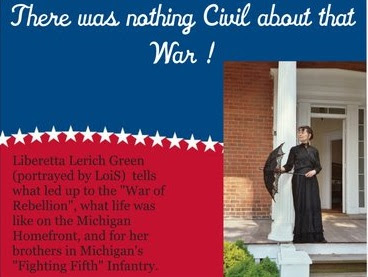
This is a card about the program I do.

Aside from the project done by the student who wishes to remain anonymous, I know this is a bit of history that still needs to be told.  The family were pioneers even before statehood for Michigan and the Lerich boys each were in Michigan Infantry units in the Civil War (although there was nothing Civil about that War!)  This is why the sidebar on this blog has pages about the "Fighting Fifth" Infantry.

Michigan is nearing its bicentennial in 2037.  I like to say my historical storytelling is "as seen by the average person."  I hope the Lerichs and the Greens will continue to have their stories heard.


Saturday, June 8, 2019

Historic Fort Wayne Civil War Days and More!

For most of May through July I feel like I'm constantly on the run, especially when that means being on the road.  This blog comes out on a Saturday so the Anton Art Center in Mount Clemens  will celebrate their 50th anniversary with Super SatARTday.  Their building was the old Carnegie public library, so it seems appropriate that, as former children's librarian at the newer Mount Clemens Public Library, I preview my library summer reading program.  Libraries all across the country are thinking astronomically for their summer reading programs as it's also the 50th anniversary of the Moon Walk.

Sunday I return to Historic Fort Wayne for their annual Civil War Days.

Sarah Edmonds as Franklin Thompson
It's always a reunion to get together with friends and fellow re-enactors, like Elise Parker, who does a great job of presenting as Sarah Emma Edmonds, known for serving as a man and later as a nurse with the Union Army during the American Civil War. She even was granted a military pension.  In 1992, Sarah was inducted into the Michigan Women's Hall of Fame and some of Elise's research helped make that possible. 

Look for us in the Commandant's house.  I'll only be able to be there on Sunday and look forward once again to bringing the story of Liberetta Lerich Green, who grew up on a Shelby Township Underground Railroad Station and her brothers were in the Michigan "Fighting Fifth" Infantry. 


The sidebar here contains Detroit newspaper articles from the Civil War era I was able to locate and reproduce about the Michigan Fifth Infantry.  Here's a picture of those brothers, Will and Ike.  Ike or Isaac started out as a bugle boy, was a "guest of the Confederacy" along with his older brother, Will, at Libby Prison.  His injuries were so bad, he was sent home, only to be brought back to be a Major with the Third Infantry which suffered even worse fatalities that the Fifth's loss of a quarter of its men.
Major Isaac Lerich and Will Lerich
For those of you who know my husband, yes, he'll be there, too, so listen for his banjo playing music from those days.
Hope to see you there or at another of my historical programs.

Saturday, February 3, 2018

Blaisdell - The Clothes-Line Telegraph

Black History month tends to bring my programs about the local Lerich family to audiences.  Liberetta Lerich Green and her family were abolitionists and had an Underground Railroad Station in Utica.  Here's the event presented by the  Novi Historical Commission at the Novi Public Library on February 8.  Learn about Michigan's role in abolition, the Underground Railroad, and the Civil War as told by a woman who grew up with it.

There are so many stories, including claims some historians doubt about the use of the laundry line for signals to the Underground Railroad.  This story from Albert F. Blaisdell's Stories of the Civil War takes a different view showing the clothes line's value for military intelligence.

The story follows a picture of a simple craft I made several years ago at Greenfield Village's Civil War Days.  It's the rosette or cockade worn by a Union sympathizer, which the Lerichs certainly were.  I let the safety pin show as it's simply red, white, and blue ribbon pulled into a circle and stitched onto a pin.  Yes, that Wikipedia link says safety pins were patented in 1849.  Campaign buttons are a form of communication, as is storytelling.  If you go to Creative Cockades you will find they are a centuries old way of showing support for a cause, the political lapel pins of yesteryear.  There are pages about cockades for the Union, Confederate, Mourning, Revolutionary War, Suffragette, and Copperhead (opponents of the Civil War and the Union) opinions.  Today's story shows Dabney figured out yet another useful form of communication easily overlooked.
As Albert Blaisdell explained in putting his book together, "These stories are designed to interest as well as to instruct young people, and to excite in their minds a keen desire to know more of the noble deeds of their fathers and grandfathers, who sacrificed so much during this momentous period of our country's history."  Even now that desire and knowledge is needed.
*******************
This is part of a series of postings of stories under the category, "Keeping the Public in Public Domain."  The idea behind Public Domain was to preserve our cultural heritage after the authors and their immediate heirs were compensated.  I feel strongly current copyright law delays this intent on works of the 20th century.  My own library of folklore includes so many books within the Public Domain I decided to share stories from them.  I hope you enjoy discovering new stories.  


At the same time, my own involvement in storytelling regularly creates projects requiring research as part of my sharing stories with an audience.  Whenever that research needs to be shown here, the publishing of Public Domain stories will not occur that week.  This is a return to my regular posting of a research project here.  (Don't worry, this isn't dry research, my research is always geared towards future storytelling to an audience.)  Response has convinced me that "Keeping the Public in Public Domain" should continue along with my other postings as often as I can manage it.
Other Public Domain story resources I recommend-
  • There are many online resources for Public Domain stories, maybe none for folklore is as ambitious as fellow storyteller, Yoel Perez's database, Yashpeh, the International Folktales Collection.  I have long recommended it and continue to do so.  He has loaded Stith Thompson's Motif Index into his server as a database so you can search the whole 6 volumes for whatever word or expression you like by pressing one key. http://folkmasa.org/motiv/motif.htm
  • You may have noticed I'm no longer certain Dr. Perez has the largest database, although his offering the Motif Index certainly qualifies for those of us seeking specific types of stories.  There's another site, FairyTalez claiming to be the largest, with "over 2000 fairy tales, folktales, and fables" and they are "fully optimized for phones, tablets, and PCs", free and presented without ads.

    Between those two sites, there is much for story-lovers, but as they say in infomercials, "Wait, there's more!"
The email list for storytellers, Storytell, discussed Online Story Sources and came up with these additional suggestions:            
         - David K. Brown - http://people.ucalgary.ca/~dkbrown/stories.html
         - Richard Martin - http://www.tellatale.eu/tales_page.html
         - Spirit of Trees - http://spiritoftrees.org/featured-folktales
         - Story-Lovers - http://www.story-lovers.com/ is now only accessible through the Wayback Machine, described below, but Jackie Baldwin's wonderful site lives on there, fully searchable manually (the Google search doesn't work), at https://archive.org/ .  It's not easy, but go to Story-lovers.com snapshot for October 22 2016  and you can click on SOS: Searching Out Stories to scroll down through the many story topics and click on the story topic that interests you.
       - World of Tales - http://www.worldoftales.com/ 
     
You're going to find many of the links on these sites have gone down, BUT go to the Internet Archive Wayback Machine to find some of these old links.  Tim's site, for example, is so huge probably updating it would be a full-time job.  In the case of Story-Lovers, it's great that Jackie Baldwin set it up to stay online as long as it did after she could no longer maintain it.  Possibly searches maintained it.  Unfortunately Storytell list member, Papa Joe is on both Tim Sheppard's site and Story-Lovers, but he no longer maintains his old Papa Joe's Traveling Storytelling Show website and his Library (something you want to see!) is now only on the Wayback Machine.  It took some patience working back through claims of snapshots but finally in December of 2006 it appears!
    Somebody as of this writing whose stories can still be found by his website is the late Chuck Larkin - http://chucklarkin.com/stories.html.  I prefer to list these sites by their complete address so they can be found by the Wayback Machine, a.k.a. Archive.org, when that becomes the only way to find them.
You can see why I recommend these to you. Have fun discovering even more stories!


Friday, September 11, 2015

Civil War Days + Browne - Union War Songs and Confederate Officers - Keeping the Public in Public Domain

The Bicentennial of the United States Civil War is still being celebrated in many places including the annual celebration of the Historic Fort Wayne Coalition.
http://www.historicfortwaynecoalition.com/cwdays.html
Please notice Historic Fort Wayne is in Detroit.  From 1701 through World War II the location was an active military location.  Today the Historic Fort Wayne Coalition is working to preserve as much of the fort's heritage as possible.  Toward that, I'm proud to continue being part of the annual celebration.  While portraying Liberetta Lerich Green I will talk, among other things, about how her brothers, Will and Isaac, mustered in and out of the fort for the Michigan Fifth Infantry and later Isaac returned when the Third Infantry was reconstituted.  I will also tell of her family's abolition and Underground Railroad work and life on the homefront.  In addition, Liberetta joins General Grant's widow, Governor Blair's wife, and Sarah Edmonds in the Commanding Officer's house.  All of these women have fascinating stories worth hearing.

Music is a great way to recall these events.  In telling Liberetta's story I use the abolition song, "Roll on the Liberty Ball", which was written by the Hutchinson Family Singers to the tune of "Old Rosin the Beau", then used again as the election song, "Lincoln and Liberty, Too" .  The YouTube video above merges the two songs.  It comes from ex-Weaver, Ronnie Gilbert, and gives a lively amalgamation of both while incorporating pictures from the era.

Today's story is a remembrance by Richard Wentworth Browne in The Century Magazine, from January 1888.  The Online Books Page has an archive of the magazine from its origins in 1881 up through Volume 97 on April 1919, although the magazine didn't cease operation until 1930.  It's always worth checking periodicals of a period for a time travel experience.  The story was part of a larger article, "Memoranda on the Civil War."  Browne also explains he was inspired to write after reading Brander Matthews in The Century Magazine, August 1887, article "The Songs of the Civil War."  That article isn't a story, but may interest lovers of Civil War music, a topic occasionally discussed here.  After the story I'll give links to the songs mentioned by Browne.


The many treasuries by Benjamin A.Botkin overflow with such interesting bits.  My copy was in his A Civil War Treasury of Tales, Legends and Folklore.  It only omitted Browne's introductory paragraph about the earlier article by Brander Matthews influencing him.  I strongly recommend at least reading the Wikipedia article on this "Father of Public Folklore" I hotlinked at the start of this paragraph to show his philosophy on folklore and his work at the Library of Congress in the Archive of American Folk Song.  You might even want to read the book, America's Folklorist: B.A.Botkin and American Culture, edited by Lawrence Rodgers and Jerrold Hirsch.


Songs mentioned in the story

Each of these songs has background information, so the titles are hotlinked to Wikipedia.  Space and time limitations meant it's the only source given here for quick background information.  I encourage checking even further because more exists for each song.   I try to give at least the melody line and, when available, the chords.  I leave it up to you to see if a midi file or video of the song exists to help you learn the songs.

Along the way I discovered the wonderful Civil War Song Book pdf from the Kit Carson's 1st New Mexico Volunteer Infantry String Band, a reenactment group.  They have a good list of sources in their introduction to this 82 page book by Joe Dietrich and David Poulin.  Their book is specifically chords + lyrics, so I rarely had to worry about chords, just being sure to locate the melody lines on songs. 8 Notes.com was another good resource, but since these are all Public Domain, I made sure the links skipped paid sheet music.  For other chords beyond the Civil War Song Book, another resource is Ultimate-Guitar.com.


Battle Hymn of theRepublic the melody is given in Wikipedia and see the Civil War Song Book about chords
John Brown’s Body (same melody as above was eventually used, but read the article on it)
We’re Coming, Father Abraham (Lyrics used by 8 different composers, including Stephen Foster and the Hutchinson Family Singers!  Darned if I know what version to use.  Check the article by Irwin Silber in Songs of the Civil War.)
Tramp, Tramp, Tramp the Boys Are Marching find chords in the Civil War Song Book and the melody at 8 Notes.com/scores/6670.asp
Rally ‘Round the Flag,Boys (or Battle Cry of Freedom -- the title used in Civil War Song Book for chords) either melody alone or guitar tab at 8 Notes.com
Dixie for the melody choose Dixie's Land and Dixie for guitar tab at 8 Notes; in Civil War Song Book chords use Dixie's Land as the title
Maryland, My Maryland (set to the tune of Lauriger Horatius as Browne mentions, but best known as O Tannenbaum or Oh Christmas Tree) with melody at 8 Notes.com
Dead March in Saul this was only mentioned as it is often played at state funerals, including during the trip by Lincoln's body back to Springfield.

Serendipity often helped in finding resources. Research tends to go that way, with serendipity ruling!  In the meantime may this bit of time traveling through history encourage your own research.

Saturday, January 17, 2015

Story Starters

Thank heavens for computer keyboards.  With a little bit of persistence I can tap out messages even with a cast on my dominant hand.  How did that happen everybody asks.  Years ago I chopped off the tip of my other hand -- the same hand which had earlier been in a cast for a broken wrist.  Fortunately there was just enough to reattach the thumb tip, but again everybody asked "How did that happen?"  Friends suggested all manner of answers.  This time my Ob/Gyn doctor gave a doozie of a story.

Dr. Zaidan said I should say I was at Target when a terrorist tried to take over.  I sized up the situation and did a Tom Cruise, Mission Impossible-style somersault, ending in a kick to the terrorist, knocking him senseless and tossing the gun out of his hand.  Police arrived and were stunned to learn I'd ended the hostage situation and only had a broken wrist for damages.  Thank you, Dr. Z!

I'd been saying I did a Triple Klutz . . . which I could have expanded into a late in life attempt to join the U.S. Olympic skating team.  Yeahrightsure.

What really happened was fairly boring.  Missed the step coming down off a ladder and had a limited space to land.

What really worried me was what would I do if I am still in a cast when my next Liberetta Lerich Green program is scheduled?  Liberetta grew up on an Underground Railroad Station here in Michigan (as well as having brothers in the Fighting Fifth Infantry during the Civil War), so February is often a month when I tell about the Underground Railroad from the stationmaster's point of view.  Asked my doctor what casts looked like 100 years ago since that's usually the timeframe in which I present her.  By that time she was the widow of Addison Green, who raised horses.  It would be easy to make a papier mache "cast" to fit over my more modern cast and say I was kicked by a horse.  Did it happen?  Not that I know, but it is true to her life and lets me get back to telling history as she viewed it.

All this got me thinking about the times when I offer workshops on story creation.  I'm not a big fan of personal stories.  I prefer either historical material or traditional folklore that has stood the test of time.  Is that all I tell?  Dunberidiculous!  I love to say I tell lies for fun and profit.  Part of that includes Tall Tales.  It's great to take a story and start out believably, gradually stretching it into wilder and wilder extremes.  Dr. Z. is a natural.

Story starters are how I like to get a workshop thinking in stories.  Right now I'm exhausted trying to type all of this, so I'll use a favorite technique of storytellers . . . Suspense!  For some story starting ideas for you without even attending a workshop, look next week as I have a few that should really get you telling.

While prowling images of Tom Cruise I found a great image of him in Total Recall where his picture is dissolving.  The picture is copy protected, but what was really great and leads into next week is the question it asked . . .

Thursday, January 17, 2013

History as seen by the "average" person

Storytelling is both my passion and my profession, but there are subgroups within storytelling.  Sean Buvala, acting as my coach, asked me, "If money was no problem, what type of storytelling would you most like to do?"  HISTORY! I said, but not history as viewed by somebody famous...history as seen by the "average" person.

Books, television, and often movies, when looking at history focus on either someone famous or on many people without seeing life as it appeared to the "average" person.  This type of program takes similar research, so it doesn't come quickly.  That makes it hard for historical societies and museums, schools, and libraries to produce their own programs.  Added to that, coming in the persona of an individual from back in time does something movies, television, books, and even the authors of those books can't do, present a living, talking person who can react to the audience and its interests.

Liberetta Lerich Green was a very real woman who grew up here in Michigan on an Underground Railroad Station and later helped her parents in their abolition efforts.  She was here on the homefront when her brothers fought with the "Fighting Fifth" Infantry.  (I must mention here my separate blog, Michigan's "Fighting Fifth" Civil War Infantry.  Local newspaper articles on that regiment appear at the pace they appeared 150 years ago, just as the families and friends of that regiment tried to follow what was happening to the boys they loved.)  I also have copies of letters her brothers sent home and a few by her parents trying to see if their sons and others they knew might be in a military hospital needing help. Liberetta's parents, Sarah and Peter Lerich, came here as pioneers before statehood.  Teachers and elders taught Liberetta about pioneer life and even the War of 1812.  Additionally Liberetta was a Macomb County farmer's wife and later widow, and she raised three boys and three girls, including one, Loa, who was a pioneering educator. As Liberetta I've had the joy of telling about her family's contributions and what life was like for them and what she learned from others.

Beyond Liberetta there have been what I call "generic" characters.  The Michigan Arts and Humanities Touring Program posted a video of my One-Room Schoolteacher.  I also have a character I call The Hired Girl, a position common to many women of all ages.  ("Girl" is how she might be called back then.)  It was a way for women to work beyond their own homes.  The Hired Girl can let me also include folktales she might have heard in addition to talking about her work.  The Hired Girl is able to explain how a Victorian Christmas was celebrated, too.  My researching One-Room Schools and their Teachers as well as Victorian Christmas led to posts here.  (Check the sidebar to find the many posts here that have come from Liberetta and these various historical programs.) While still working as a librarian in Mount Clemens, which has a history going back to the Bath House Era, I even took the Hired Girl and worked as a "Rubber", a person involved in the baths and massages of these long ago spas.

Just for fun, I also have a program that, like Liberetta telling about the War of 1812, was developed for the Lorenzo Cultural Center's series of historical programs.  Why do I say "just for fun"?  It looks at my own childhood growing up and "Skipping Through the Halls of Fifties Memories", both the things I noticed and things going on all around me that I was too young to notice until grown-ups told me about them later.  It's a great way to get an audience recalling their own childhoods for oral history programs.

Where in time will I go next?  I don't know.  Right now I'm beginning work on the story of a Polish woman's emigration to the U.S. 

I'm in the state's Touring Directory, so my programs qualify for state grants.  It's hard to guess what might be requested next, but it will be fun using my Storytelling + Research skills to bring to new audiences "History as seen by the 'average' person."  

Thursday, July 12, 2012

A Conference to Remember!

Fellow storytellers said they found my account of the 2012 National Storytelling Conference like being there with me.  Starting with the Pre-conference, looking at Cincinnati and the Kentucky elements, this may encourage you to find out more about some of the sessions and other experiences.  It may even encourage you to plan towards the August! 2013 conference in Richmond, VA.

Signed up for the National Storytelling Network conference waaay in advance, as the earliest of Early Bird registration saved money, also a year ago I promised YES! chair, Lyn Ford, I'd help with the Youth, Educators, Storytellers (YES!) Alliance pre-conference.  In the past, since the NSN conference always moves to various locations, I'd stayed offsite (a) at a relative's home; (b) with my husband in a tourist cabin near a commuting route; (c) at a "sleep cheap" with a roommate.  As a result of "c" I waited, expecting to find a MI or other roommate, but as the conference approached I began to panic.  MI residents either couldn't attend or weren't coming for my entire time.  (The pre-conference meant arriving Tuesday to help with set-up, NOT a popular option, but still within the range of any others attending the two pre-conferences which began early Wednesday.)  Cincinnati's nicknamed the Queen City and it began to look like it might require a queen's ransom.   This time the bulletin board for roommate and travel didn't help me because I wanted to stay in one place throughout.  The incredibly helpful Kit and Karin at the NSN office -- multiply me times similar members to show how spectacular these 2 are -- suggested hotels on the trolley line since the conference hotel was booked.  They also suggested parking garages, local members to answer questions, and taxi possibilities for when the trolley stopped at 10 or started late on the weekend. 

Couldn't micro-manage it from a distance.  Was incredibly lucky to find a roommate in Renee Englot from Canada.  She thought surely I'd found a roommate when she requested 1 on Storytell, the international email list for storytellers.  We took a chance on a downtown Cincy 3 star hotel w/o knowing what it was.  Reviews, factoring out snobs and the hard to please, still were worrisome -- that + trolley/parking difficulties.  Through it all Renee was a great mate in the week's constant activity.  (The hotel, the Milennium, also turned out fine.)

Not to worry.  It was easy circling downtown Cincy and KY areas to find the best parking choices.  The trolley  was fun, even when I accidentally caught the Newport trolley.  Got a story loving driver who gave a tour through Newport.  Passed Thompson House -- owned by the inventor of the Tommie Gun.  Go to Thompson House history to learn way more than just the marker mentions.  It has history in the War of 1812 -- see my 2 April posts about the War of 1812 and the River Raisin Massacre for a bit more on Kentucky in that war, was part of the Underground Railroad, and is said to be haunted.  Perfect material for storytellers.

Even my briefest of visiting revealed downtown Cincinnati was fun to walk, with the Cincinnati Library (had to visit it, of course!), interesting decorated pigs all over, the Underground Railroad Freedom Center,  the river -- I'm a born and bred St. Louisan so it felt like home, and lively nightly music in Fountain Square where I could pick up and return on the trolley.

Tuesday night we learned YES!'s 2d of our 2 afternoon pre-conference speakers flight was canceled.  We managed with our a.m. keynote from Susan O'Halloran and our other afternoon speaker, Karen Chace.  I was to introduce Karen and was confident, correctly so, as she talked about the many ways she handles youth storytelling clubs.  I've known her and her work from Storytell for a long time.  Fabulous job...of course.  Karen's website and blog has a great many of her ideas and handouts on storytelling clubs and much more. The evening ended with a lively performance by Filament Theatre inspired by folktales.
From the Circle, Filament Theatre Ensemble, Folktales, Sustainability, Chicago, Theatre, Music
From the Circle: Remembering the Earth Through Folktales

Thursday I walked to the library for a few questions and then spent the rest of the day at the Underground Railroad Freedom Center.  There's also a surprising amount of Native American information there and their research library gave leads on an UGRR conductor important to the woman, Liberetta Lerich Green, whom I portray.  (See past posts.) She grew up on a local UGRR station.  I'll check the Troy, MI location where Peter Jackson apparently lived in the 1850s, then more on his later family life in Canada's Essex County.

I read somebody's (?) post about storytelling friend, the late Mark Wilson, and continue to learn from him...I plan to set aside money all year long to decide if I can afford future conferences.  My Scottish ancestors might have fits at how I committed myself, then began to panic, but the conference was needed and useful.  Such conferences
  1. reconnect me with friends and colleagues; 
  2. provide new ideas and stories; 
  3. refresh my commitment to a career that often can feel as if I'm all alone.  My next post will hit the high points about the actual conference's value.  Not the same as attending, but still hope it may provide leads to you on those 3 conference benefits.
LoiS(orting through a PACKED week)

Tuesday, January 31, 2012

Another look at "The Underground Railroad Didn't Run on Tracks (UGRR)"

That was about a post from last year, on the Underground Railroad.  Click on that hotlink to see that earlier post.  (Did you also notice the site's address now is http://www.StorytellingResearchLois.com -- but the old address also works.)

This topic is large and definitely worth reviewing further, this time with a focus on Michigan's role in the Underground Railroad -- often abbreviated UGRR.  Michigan split up the former Department of History, Arts and Libraries, with the historical work moved to the Department of Natural Resources.  The Historical Center archives the historical materials moved from the former department.  Find online from 2000 to 2004 a newspaper, "Michigan Time Traveler", for children with accompanying teacher guides.  There are two issues specifically about the UGRR.
Adam Crosswhite
  • The Underground Railroad and Teacher's Guide. - This highlights Cass County's Ramptown and the Crosswhite Family rescue by the citizens of Marshall, MI.  Here is more about the "Crosswhite Affair" including a lesson plan on it.  Similarly both the UGRR and the Crosswhites are covered in this issue for children of "The Mitten", published by "Michigan History" magazine.
  • The Blackburns Escape and Teacher's Guide - Thorton (not Thornton) and Lucie Blackburn escaped slavery to settle in Detroit, but when they were spotted here in Michigan they were captured, tried, and scheduled to return to Kentucky.  African Americans helped them escape to Windsor where Canada rejected demands for their return. 
There's also a section called Freedom Trail Lessons  and just as with the two previous Teacher's Guides, there are uses beyond the classroom.

In Vandalia, MI they're uncovering proof of Young's Prairie, an early to mid-1800s Quaker offer of farmland and safety to runaways.


To learn of the very real incidents of free African Americans being sold into slavery, go to either the 1893, volume 22, of the Michigan Pioneer and Historical Collections or to the online text and search using your own computer's search feature (not the one offered on the site) for Malinda Paris.  The memorial of her by the people of St. Clair tells of a family repeatedly sold into slavery even though they were legally free.
Laura Smith Haviland
Elizabeth Margaret Chandler
Early leaders of the Abolition movement here in Michigan were Quakers Laura Smith Haviland, along with friend and neighbor, Elizabeth Margaret Chandler.  They were seen as "radical abolitionists" by the majority of Quakers in the late 1830s, so they joined with the northern Methodists who were also devoted to anti-slavery efforts. 


(Liberetta Lerich Green, whom I portray, grew up in such a Methodist family.)

**** UPDATE
I've just discovered, after "finishing" this post a wonderful C-Span video of Kimberley Davis-Tranumn talking about "Aunt Laura" and the active role Lenawee County played in the UGRR.  Go to  C-Span Video Library for her well-researched and inspirational video.

Friend to the Havilands and the Lerichs was well-known UGRR conductor and speaker,
Sojourner Truth, who settled in Battle Creek, MI.  As noted in my earlier post, that is also the home of the Sojourner Truth Institute as well as this statue honoring her.  Much has been written about her including this issue for children of "The Mitten", published by "Michigan History" magazine.  Battle Creek was a good spot for her as it was another Michigan location prominent in abolition and the UGRR thanks to Erastus Hussey's political efforts and publishing the abolitionist "Michigan Liberty Press."

Tour online a site in Schoolcraft, MI estimated to have sheltered 1,000 to 1,500 by yet more Quakers, Dr. Nathan Thomas and his wife Pamela Brown Thomas. 
Detroit Historical Museum's "Doorway to Freedom" current exhibit shows sites associated with the UGRR in Detroit including the Finney House barn (in use from 1833) where Liberetta overheard her father and Reverend Charles C. Foote discussing runaways there in danger of discovery.  Peter Lerich promptly told his wife he was leaving for a "load of plaster" in Detroit after he found Liberetta listening.

In Detroit George DeBaptiste and the Second Baptist Church of Detroit provided sanctuary and transportation to Canada.  DeBaptiste also helped organize the 1st Michigan Colored Volunteer Infantry Regiment, later known officially as the 102nd Regiment United States Colored Troops.  It's interesting to show the role of disease in the civil war, with 6 killed in action, 5 more of wounds, but 129 died of disease. After the war he returned to successful business life and continued advocacy for black rights including the 15th amendment which gave African Americans the right to vote.

It's always hard to bring such a large topic to a close.  A fellow librarian once said about me, "You can take the librarian out of the library, but you can't take the library out of the librarian."  As a result I want to recommend a book to help you find much more than I have space to mention here.  Carol E. Mull's The Underground Railroad in Michigan has been described as "the first comprehensive exploration of abolitionism and the network of escape from slavery in the state."  Ms. Mull is a founding member and current chair of the Michigan Freedom Trail Commission.


****UPDATE

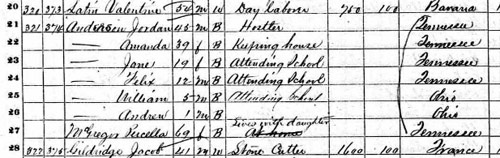
I can't resist this interesting UPDATE.  I just read "To my old master" , a fascinating and, yes, funny letter by Jordan Anderson.  It responds to a letter by Colonel P.H. Anderson of Big Spring, Tennessee, to his former slave, requesting he come back to work on the colonel's farm.  While Jordan Anderson took his family to Dayton, Ohio, and this month's post looks specifically at the Underground Railroad in Michigan, it is a delightful way to look at the later life of many who came from similar backgrounds to benefit from the Underground Railroad and emancipation.