Tell me if you have a topic you'd like to see. (Contact: LoiS-sez@LoiS-sez.com .)
Please also let others know about this site.
Showing posts with label translation. Show all posts

Friday, February 23, 2024

Jones - The Old King and the Young King - Keeping the Public in Public Domain

When I was a child I was a very good and fairly voracious reader.  One type of book popular then that I didn't like were stories told in a heavy dialect.  Since these stories were often folktales, it's ironic I now find myself hunting them up sometimes.  Modern folklorists seem to have found a better way to convey the sense of stories while giving the flavor of their teller's dialect.  An apt comparison might be foreign dishes where the spices are toned down a bit to give a hint of the original culture without overwhelming the taste for a new audience.  

This year's Black History Month theme is “African Americans and the Arts", exploring the key influence African Americans have had in the fields of "visual and performing arts, literature, fashion, folklore, language, film, music, architecture, culinary and other forms of cultural expression."  Since Public Domain with all its legal limitations means I'm not free to reprint more recent stories, I must look among those stories recorded in a heavy dialect or vernacular.  Then to make it understandable, I must attempt a translation into more typical English.


This story in an election year when people are worrying about the age of presidential candidates seems extra appropriate.  It comes from Negro Myths from the Geogia Coast and the 1888 book of stories recorded by Charles C. Jones, but the subtitle warns us it is "told in the vernacular."  The book's dedication gives us the location: "In memory of Monte Video Plantation, and of the family servants whose fidelity and affection contributed so materially to its comfort and happiness."  The preface notes Joel Chandler Harris, but cites the importance of recording tales from the "largely untrodden" Georgia coast and the Carolinas -- "myths and fanciful stories, often repeated before the war, and now seldom heard."  Like Harris's Br'er Rabbit tales, the majority are animal tales, so this tale stands out both for its brevity and view of human government clearly going back to African roots.  (It also reminds me of the Biblical story of Solomon's son's unwise leadership due to his poor choice of young advisors.)

Another excellent help the book provides is the Glossary at the end to help understand the "vernacular."  I will give the story and  after each section my attempt at putting it into standard English.  I highly recommend, at the very least, that Glossary which begins on page 185 if you find yourself similarly facing that dialect.

The Old King and the Young King

The old King heard it said they were going to put a young King in his place.  This thing worried him and made him vexed.  He wanted to keep the throne; so he gave an order to his head man to make his soldiers kill all the old people in the nation, so the young King shouldn't have any wise person for help in carrying on the business of the kingdom.  The soldiers took guns and clubs and massacred all the older people in the land.

Then the old King sent word to the young King, who the people have picked out to rule over them, that he must fetch a fat hog, but it mustn't be either a sow-hog  (a female) nor a boy-hog, but it must be a fat hog.

When the young King got the message, he returned this answer: "Tell the old King I say I have a fat barrow (a castrated male pig) in the pen, and he must come for him; but he mustn't come in the day, nor he mustn't come for him in the night."  The old King, when he heard this message, made up his mind (and ) said the young King must have a heap of sense, or else some wise man must have helped him; and he couldn't see how that can be, because all the old and the wise people in the nation were killed.  He didn't know that when the order to destroy all the old people in the kingdom, the young King hid his father in one hollow tree, and so he escaped from the soldiers, and (?) gave his son sense.

The young King returned such a smart answer, with the help of his father, that the old King couldn't make out what time to go for the fat hog; and so he gave up, and the young King, before long, came and turned him out and took his office. 

***

Whether it be Ebonics or Hip-Hop, or other linguistic changes, may the stories survive and enrich us all!

********************

Saturday, June 21, 2014

Andersen - The Snow Man - Keeping the Public in Public Domain

I did NOT like this story that much -- even if it does talk of Snow now that the weather is hot, BUT found another translation also in Public Domain a bit better AND a puppet production that expands it in a more entertaining way.  I know Hans Christian Andersen often wrote sad endings to his stories.  I don't mind those endings, they often are needed and do tend to regret Disneyfication of those stories.  The crucial problem is the audience needs a reason to identify with the story and its characters, even if we know it won't end well for them. 

Last week the issue of translation was mentioned and even included a bit of academic criticism of the 1872 translation by Mrs. Paull.  I was delighted to find the livelier 20th century translation by Jean Hersholt apparently is available.  This is based upon finding it online.  If this is incorrect I'll have to insert the 19th century version here, but it's a perfect example of why it's important to check several translations to get the flavor of a story.  My own copy's illustration isn't used since I'm uncertain if my 1948 illustrated edition of Hersholt's translations is still under copyright.

Stan the Lovesick Snowman with the Moose Mailman

Instead I will insert a picture from the production of Stan the Lovesick Snowman based on "The Snow Man" by Andersen by Center for Puppetry Arts.  The website of Stan the Lovesick Snowman does an outstanding job of explaining why they fell in love with Andersen's original story because of the "wide-eyed innocence" of the newly made snowman and how the family dog takes it upon herself to "explain the world to him - albeit from a decidedly canine point of view. Their relationship is like a slightly older child interpreting the world to a younger child. It is Stan’s innocence that gets him into trouble when he falls in love with a wood stove. There is a lot of humor in this potentially disastrous infatuation. Everyone but Stan can see that the stove is too 'hot' for him."


They also appreciated the wintry setting of the story, with its "dreamy snow-laden countryside complete with snowflakes, icicles, and cold starry nights without ever having to leave the relatively mild Georgia winter."
CPA is in Georgia and developed the program back in 2008. This show is still in their repertory, but has gone through a few changes. You can still find their original study guide for teachers along with school performance standards from kindergarten through 6th grade. You will notice that originally Stan was called Sam.  This was to avoid confusion with another "Sam the Snowman" in yet another show they offer.

Be sure to also look further down on the web page of Stan the Lovesick Snowman for information on the style of puppetry.  It gives a great explanation of this very professional use of rod puppetry, a puppetry form students can easily use in a simplified introduction to puppetry.  There is a teacher's eye view of rod puppetry in the study guide.

The CPA study guide includes biographical information on Andersen, including his own growing up producing puppet shows and a brief glimpse of some of the difficulties in his life.  There's also one of Andersen's many elaborate paper cuttings. The one in the guide doesn't specifically accompany the story, but does mention how Andersen would cut while telling his stories to children, only to end by unfolding it and showing how it fit the story's theme.  I don't know if he ever did one of this story, but such artistry certainly gives ordinary cut paper snowflakes quite a challenge!


Of course the guide includes an explanation of how the CPA production uses rod and shadow puppets.  It also mentions their show was expanded by adding a young snowwoman interested in the Lovesick Snowman, even as he's falling in love with the stove to make a "hilarious and heartwarming story perfect for the holiday season!"  There are hints that, just as in the Andersen tale, this "seems like a romance destined to fail."  The guide's bibliography and internet listings cover a range of topics: Andersen, snow,  snowflakes, snowmen, paper cutting, and more since it's intended to serve classes from kindergarten through sixth grade. 


Stan and Alice the Dog


Stan and the kids
Doesn't that leave you wanting to see how the Center for Puppetry Arts handled the story?  The guide gives us enough clues we can tell it ends with the Snow Man melting, but both their production and Hersholt's more modern translation show a story that shouldn't melt away...or at least we might have yet another look at it when winter returns.  Based upon the way they caught the story's appealing innocence and, yes, even their appreciation for winter -- (BRRRRRRR!  I'm enjoying its end right now here in Michigan!) -- I'm ready to revise my view of the story, it might even be a great way to counteract those rare Michigan days when it seems too hot.

I also hope you will turn to the start of this month when I featured the coming Great Lakes Regional Festival,

held at the Detroit Institute of Arts.

The festival information -- as well as my own workshop which will give ideas for using puppets with storytelling, teaching, or other ways beyond the traditional puppet show -- can be found at "A-to-Z Puppets Are Easy" earlier this month.

Next week I'll return with yet another posting that's puppet-related.  Say that 10 times fast!

In the meantime . . .
**********
This is part of a series of postings of stories under the category, "Keeping the Public in Public Domain."  The idea behind Public Domain was to preserve our cultural heritage after the authors and their immediate heirs were compensated.  I feel strongly current copyright law delays this intent on works of the 20th century.  My own library of folklore includes so many books within the Public Domain I decided to share stories from them.  I hope you enjoy discovering new stories. 

At the same time, my own involvement in storytelling regularly creates projects requiring research as part of my sharing stories with an audience.  Whenever that research needs to be shown here, the publishing of Public Domain stories will not occur that week.  This is a return to my normal monthly posting of a research project here.  Response has convinced me that "Keeping the Public in Public Domain" should continue along with my monthly postings as often as I can manage it. 


There are many online resources for Public Domain stories, none for folklore is as ambitious as fellow storyteller, Yoel Perez's database, Yashpeh, the International Folktales Collection.  I recommended it earlier and want to continue to do so.  Have fun discovering even more stories!

Friday, June 13, 2014

Andersen - Puppet-Show Man - Keeping the Public in Public Domain

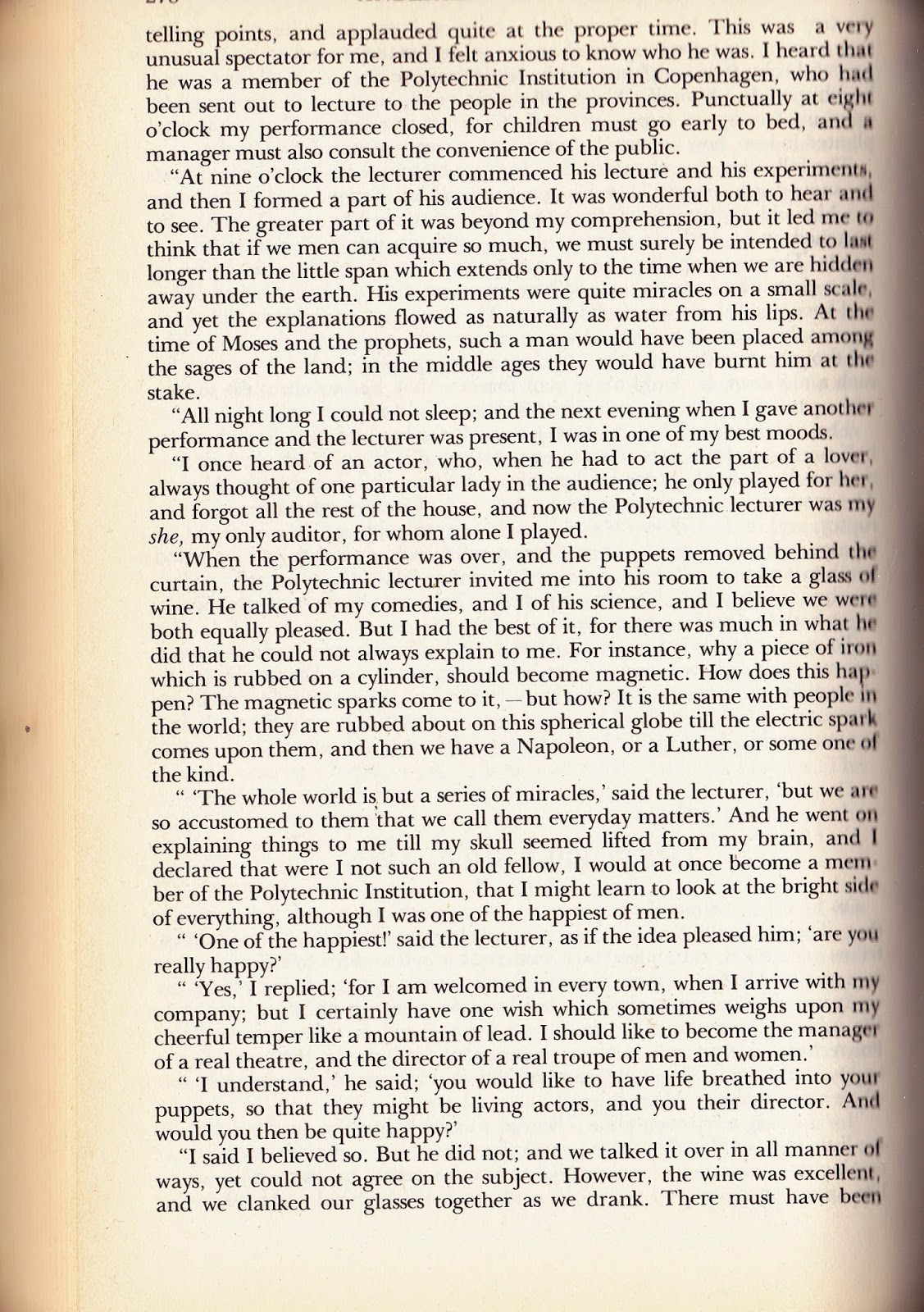
Hans Christian Andersen's theatre fascination began with an introduction using the puppet stage his father made.  At the risk of revealing too much from today's story, theatre directors will appreciate the Puppet-Show Man's choice of a suitcase full of puppets over actors.

Because the Great Lakes Regional Festival, Motor City Puppet Blast, is next month at the Detroit Institute of Arts, this month looks at PUPPETS!  To include stories in this blog's Keeping the Public in Public Domain, I'm convinced the best story on the topic is Andersen's "The Puppet-Show Man."  While children can follow the simpler outline of the story's basics, like so many of his writings there is much for adults in the work, including autobiographical elements.

Illustrator: A. W. Bayes, and Brothers Dalziel (Engravers)


The stories depend on translation to bring the Danish author to English speaking audiences, whether reading or hearing the stories.  Amazon books have 101 pages of Andersen books.  My favorite interpretations are by the actress Eva Le Gallienne, but she only translated seven of his more than 150 stories.  Added to that, while Andersen died in 1875, the translations I must show here need to be in the Public Domain for more than just my usual desire to keep older stories alive.  As I mentioned nearly a year ago when featuring an Andersen story, I encourage you to compare many of them before telling something by him.

Just as I did then, I turn to the translation by Mrs. H.B. Paull because her work is safely within the Public Domain and covers the largest number of his stories.  At the same time even her first and middle name is debated, as Susannah Mary Paull or as Margaret Agnes Paull.  While her work interpreting both Andersen and Grimm is well known, she wrote much more that now is nearly as obscure as her name.  Modern scholarship examines her work in the book, Voices in Translation: Bridging Cultural Divides edited by Gunilla Anderman.  The chapter, "Little Snowdrop and the Magic Mirror: Two Approaches to Creating a 'Suitable' Translation in 19th Century England" by Niamh Chapelle and Jenny Williams contrasts Paull with the popular Victorian writer, Dinah Mulock, who was later known as Mrs. Craik.  The story of "Little Snowdrop and the Magic Mirror" is from the Brothers Grimm.  Chapelle and Williams analysis of the two translators faults Paull for being moralistic both in her choice of words and omissions.  They aren't looking at her work with Andersen, but  still would probably have a similar opinion.

Unfortunately "Puppet-Show Man" is not one of Andersen's better known works with a large number of versions to compare.  When I did look at others, the differences felt minor.
Andersen's statue in Central Park
Would Andersen as a writer agree?  Because so many of his fairy tales began orally, I would like to think when I tell them he would understand.  After all, he said (essentially the same in all translations) through his Puppet-Show Man: "I can arrange my pieces just as I please. I choose out of every comedy what I like best, and no one is offended. Plays that are neglected now-a-days by the great public were ran after thirty years ago, and listened to till the tears ran down the cheeks of the audience. These are the pieces I bring forward. I place them before the little ones, who cry over them as papa and mamma used to cry thirty years ago. But I make them shorter, for the youngsters don’t like long speeches; and if they have anything mournful, they like it to be over quickly.”

By the way, blogs place the most recent article first, but all this month, if you haven't yet read the start of this month my article "A to Z, Puppets Are Easy", which began this month, be sure to catch it.
**********
This is part of a series of postings of stories under the category, "Keeping the Public in Public Domain."  The idea behind Public Domain was to preserve our cultural heritage after the authors and their immediate heirs were compensated.  I feel strongly current copyright law delays this intent on works of the 20th century.  My own library of folklore includes so many books within the Public Domain I decided to share stories from them.  I hope you enjoy discovering new stories. 

At the same time, my own involvement in storytelling regularly creates projects requiring research as part of my sharing stories with an audience.  Whenever that research needs to be shown here, the publishing of Public Domain stories will not occur that week.  This is a return to my normal monthly posting of a research project here.  Response has convinced me that "Keeping the Public in Public Domain" should continue along with my monthly postings as often as I can manage it.