Tell me if you have a topic you'd like to see. (Contact: LoiS-sez@LoiS-sez.com .)
Please also let others know about this site.
Showing posts with label farming. Show all posts

Friday, August 21, 2026

Bailey - How Drakestail Went to the King - Keeping the Public in Public Domain

I've a program coming up where the audience requested stories about Farm Animals for Harvest season. They want me to start with "Stone Soup" and I plan to end with the "Bremen Town Musicians." Beyond that I began to list all the farm animals that came to mind. The last of ten animals I remembered were ducks and geese. 

With more possibilities than I have time to tell, I will use another favorite way to select my stories. I will write each animal and a story for it on slips of paper. Then they go into an open-mouthed container. For Halloween it would be a cauldron. This time it will be an old cast iron cooking pot. The audience pulls out a strip to determine each story I will tell.

While planning this I mentioned I had not yet looked up a story for ducks and geese to my friend and storytelling colleague, Priscilla Howe. Right away she had a favorite, "Drakestail" and even has a YouTube video of her telling it. 

Hmmm. That sounded interesting, but of course I wanted to prowl a bit further. Along the way I found even more versions of the story such as this picture book version

Denise McGill had created an alphabet book of fairy tales with Drakestail for the letter "D."

Beyond that,of course, Wikipedia has a brief article on it, including noting its use of repetition. I love to use repetition as a method of audience participation. Beyond those resources I was sure such a traditional tale would be found in Public Domain. I was right and found a version by Andrew Lang in his Red Fairy Book and another in The Fairy Ring by Kate Douglas Wiggin and Nora Archibald Smith. Those are indeed favorite authors, but it was Carolyn Sherwin Bailey's version in Once Upon a Time Animal Stories I liked the best. Her background as a storyteller shows why it will tell the best.

I'm giving it here, but looking at all those versions guarantees I'm going to incorporate ideas from more than just Bailey.  

HOW DRAKESTAIL WENT TO THE KING.


Once upon a time there was a wee little duck, with a very long tail, so he was called Drakestail. Now, Drakestail had some money of his very, very own, and the king asked if he might take it. So Drakestail loaned all his money to the king.

But the king kept Drakestail’s money for a year and a day, and still he did not send it back. Drakestail said he would go to the king and bring back the money himself.

So off he started, one very fine morning, for the king’s house. The sun was shining on the ponds, and Drakestail waddled along in the middle of the road, feeling very fine. As he traveled, he met a fox, and the fox said, “Where do you go this fine morning, Friend Drakestail?”

“To the king,” said Drakestail, “for he owes me money.”

“I will travel along with you,” said the fox.

“Ah,” said Drakestail, “your four legs would soon tire. Come along with me this way,” and he opened his wee little bill very wide, and down his wee little throat went the fox.

Then Drakestail traveled on a little farther. As he went he came to a ladder lying beside the road.

“Where do you go this fine morning, Friend Drakestail?” asked the ladder.

“To the king,” said Drakestail, “for he owes me money.”

“I will travel along with you,” said the ladder.

“Your wooden legs would soon tire,” said Drakestail. “Come along with me this way,” and he opened his little bill very wide, and down his wee little throat went the ladder.

Then Drakestail traveled on a bit farther until he came to his friend, the river, lying and glistening in the sunshine.

“Where do you go this fine morning, Friend Drakestail?” asked the river.

“To the king, for he owes me money,” said Drakestail.

“I will travel with you,” said the river.

“You would soon tire if you ran so far, my friend,” said Drakestail. “Come along with me this way.” He opened his wee bill very wide, and down his wee little throat went the little river.

Then Drakestail traveled and traveled until he came to the king’s house. Now Drakestail thought that the king would meet him at the gate, so he called out very loudly:

“Honk! Honk! Drakestail waits at the gate.”

But the king did not come out to meet him. Who should appear at the gate but the king’s cook, and the cook took Drakestail by his two little legs and flung him into the poultry yard. The other fowls, who were ill-bred birds, ran up to Drakestail and bit him, and jeered at his large tail. It would have gone very badly with Drakestail, but he called to his friend, the fox:

“Reynard, Reynard, come out to the earth,
Or Drakestail’s life is of little worth.”

So the fox came out, and he ate up all the ill-bred fowls in the king’s poultry yard. But still Drakestail was badly off. He heard the king’s cook putting the broth pot over the fire.

“Ladder, ladder, come out to the wall,
Drakestail does not wish to be broth at all,”

he cried. So the ladder came out and leaned against the wall, and Drakestail climbed over in safety. But the king’s cook saw Drakestail and set out after him. He caught poor Drakestail and clapped him into the broth pot, and hung him over the fire.

“River, my sweetheart, put out this hot fire,
The flames that would cook me rise higher and higher,”

cried Drakestail. So the river put out the fire with a great noise and sputtering, which the king heard. And the king came running to the kitchen.

“Good morning to you, King,” said Drakestail, hopping out of the broth pot, and making a very low bow, “are you through with my money, which you have kept for a year and a day?”

“That I am, Drakestail,” said the king. “You shall have it at once.”

So the king gave Drakestail the money that he owed him, and Drakestail waddled home again to tell of all his travels.

*************
As I said I liked the repetition and definitely plan to have Drakestail  travel along with a waddle, waddle, waddle throughout the story. I'm not sure I'll use the comments in verse, but certainly plan to have the fox, the ladder and the river each have personalities. Now on to making strips with stories for each of those other animals.
 
*************************** 

This is part of a series of postings of stories under the category, “Keeping the Public in Public Domain.” The idea behind Public Domain was to preserve our cultural heritage after the authors and their immediate heirs were compensated. I feel strongly current copyright law delays this intent on works of the 20th century. My own library of folklore includes so many books within the Public Domain I decided to share stories from them. I hope you enjoy discovering them.

At the same time, my own involvement in storytelling regularly creates projects requiring research as part of my sharing stories with an audience.  Whenever that research needs to be shown here, the publishing of Public Domain stories will not occur that week.  This is a return to my regular posting of a research project here.  (Don't worry, this isn't dry research, my research is always geared towards future storytelling to an audience.)  Response has convinced me that "Keeping the Public in Public Domain" should continue along with my other postings as often as I can manage it.

See the sidebar for other Public Domain story resources I recommend on the page “Public Domain Story Resources."


Friday, November 17, 2023

Aesop - Buried Treasure - Keeping the Public in Public Domain

London-based storyteller, Olivia Armstrong - Storyteller @Oliviasstories, on X(formerly Twitter) for MythologyMonday said: 

Even calling upon the correct god during farming was a task for Roman farmers! 

There was Sterculinus, who fertilised the earth, Vervactor who cleared the land for planting,   Redarator did the digging, Sator sowed and Occator harrowed ...  #Mythology Monday

Photo by Sheila Terry - Science Photo Library

Olivia graciously let me reprint her "tweet."  When I asked to identify that mosaic, she sent me to Science Photo Library where there is even more information.  I was especially interested in its talk of soil exhaustion and erosion.  The more marginal land was converted to olive groves and vines and many forms of today's story are set in vineyards.  I prefer placing the story over an entire farm.

This month I decided to give here some of the stories related to Thanksgiving or Gratitude Month.  At the same time I realize how easy it is to be the overlooked part of what is being called HalloThanksMas.

(found at https://imgflip.com/i/5todyw)

One of my favorite stories is an Aesop tale.  This fable I first discovered as a picture book called Buried Treasure, so that is the way I think of it.  Aesop's short teaching stories have been translated innumerable times, telling this story with varying details just as the facts about Aesop vary.  Still the stories date back to the Graeco-Roman times, so the opening information about Roman farmers is appropriate 

I chose The Aesop for Children; with pictures by Milo Winter.  (No mention of an author, beyond Aesop is given.)  Why a children's version when Aesop also fits adults?  It tends to give a slightly fuller view of the brief story.  I also must comment on giving "the moral of the story."  Nowadays such morals are never or rarely given, although it may sometimes be woven into the final action.  Why is it now omitted?  Besides making these teaching tales "preachy", it is entirely possible the listeners may each have appropriate but different conclusions.  The Aesop for Children was published in 1919 and gives a moral at its conclusion.  I will give it, but try to avoid reading it first and think of your own conclusion.  It may be quite different.

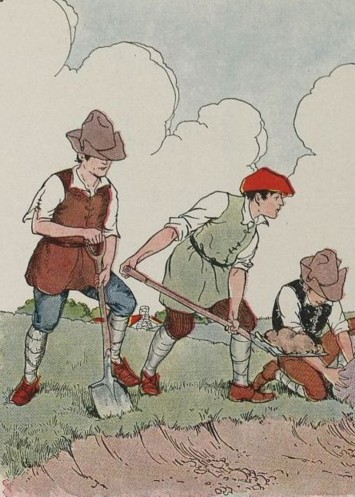
THE FARMER AND HIS SONS

THE FARMER AND HIS SONS

A rich old farmer, who felt that he had not many more days to live, called his sons to his bedside.

"My sons," he said, "heed what I have to say to you. Do not on any account part with the estate that has belonged to our family for so many generations. Somewhere on it is hidden a rich treasure. I do not know the exact spot, but it is there, and you will surely find it. Spare no energy and leave no spot unturned in your search."

The father died, and no sooner was he in his grave than the sons set to work digging with all their might, turning up every foot of ground with their spades, and going over the whole farm two or three times.

No hidden gold did they find; but at harvest time when they had settled their accounts and had pocketed a rich profit far greater than that of any of their neighbors, they understood that the treasure their father had told them about was the wealth of a bountiful crop, and that in their industry had they found the treasure.

Industry is itself a treasure.

***

Have a great, thankful part of Hallowthanksmas!

(from theodysseyonline.com)


********************

This is part of a series of postings of stories under the category, "Keeping the Public in Public Domain."  The idea behind Public Domain was to preserve our cultural heritage after the authors and their immediate heirs were compensated.  I feel strongly current copyright law delays this intent on works of the 20th century.  My own library of folklore includes so many books within the Public Domain I decided to share stories from them.  I hope you enjoy discovering new stories.  


At the same time, my own involvement in storytelling regularly creates projects requiring research as part of my sharing stories with an audience.  Whenever that research needs to be shown here, the publishing of Public Domain stories will not occur that week.  This is a return to my regular posting of a research project here.  (Don't worry, this isn't dry research, my research is always geared towards future storytelling to an audience.)  Response has convinced me that "Keeping the Public in Public Domain" should continue along with my other postings as often as I can manage it.

Other Public Domain story resources I recommend-

  • There are many online resources for Public Domain stories, maybe none for folklore is as ambitious as fellow storyteller, Yoel Perez's database, Yashpeh, the International Folktales Collection.  I have long recommended it and continue to do so.  He has loaded Stith Thompson's Motif Index into his server as a database so you can search the whole 6 volumes for whatever word or expression you like by pressing one key. http://folkmasa.org/motiv/motif.htm

  • You may have noticed I'm no longer certain Dr. Perez has the largest database, although his offering the Motif Index certainly qualifies for those of us seeking specific types of stories.  There's another site, FairyTalez claiming to be the largest, with "over 2000 fairy tales, folktales, and fables" and they are "fully optimized for phones, tablets, and PCs", free and presented without ads.
    Between those two sites, there is much for story-lovers, but as they say in infomercials, "Wait, there's more!"

The email list for storytellers, Storytell, discussed Online Story Sources and came up with these additional suggestions:        

         - David K. Brown - http://people.ucalgary.ca/~dkbrown/stories.html

         - Richard Martin - http://www.tellatale.eu/tales_page.html

         - Spirit of Trees - http://spiritoftrees.org/featured-folktales

         - Story-Lovers - http://www.story-lovers.com/ is now only accessible through the Wayback Machine, described below, but the late Jackie Baldwin's wonderful site lives on there, fully searchable manually (the Google search doesn't work), at https://archive.org/ .  It's not easy, but go to Story-lovers.com snapshot for December 22 2016  and you can click on SOS: Searching Out Stories to scroll down through the many story topics and click on the story topic that interests you.

       - World of Tales - http://www.worldoftales.com/ 

 
           - Zalka Csenge Virag - http://multicoloreddiary.blogspot.com doesn't give the actual stories, but her recommendations, working her way through each country on a continent, give excellent ideas for finding new books and stories to love and tell.

     
You're going to find many of the links on these sites have gone down, BUT go to the Internet Archive Wayback Machine to find some of these old links.  Tim's site, for example, is so huge probably updating it would be a full-time job.  In the case of Story-Lovers, it's great that Jackie Baldwin set it up to stay online as long as it did after she could no longer maintain it.  Possibly searches maintained it.  Unfortunately Storytell list member, Papa Joe is on both Tim Sheppard's site and Story-Lovers, but he no longer maintains his old Papa Joe's Traveling Storytelling Show website and his Library (something you want to see!) is now only on the Wayback Machine.  It took some patience working back through claims of snapshots but finally in December of 2006 it appears!

    Somebody as of this writing whose stories can still be found by his website is the late Chuck Larkin - http://chucklarkin.com/stories.html.  I prefer to list these sites by their complete address so they can be found by the Wayback Machine, a.k.a. Archive.org, when that becomes the only way to find them.

You can see why I recommend these to you. 

Have fun discovering even more stories