Tell me if you have a topic you'd like to see. (Contact: LoiS-sez@LoiS-sez.com .)
Please also let others know about this site.
Showing posts with label language. Show all posts

Saturday, September 1, 2018

Daudet - The Last Lesson in French - Keeping the Public in Public Domain

As schools start up again, imagine being suddenly told you could no longer speak the language you normally speak!  This has happened at times.  Here in the U.S., when many Native American children were shipped off to "Indian" boarding schools in the late 19th and early 20th century, it almost resulted in the loss of those languages.  (There's a lot more to say than the Wikipedia link.  Search using the term "Indian boarding schools."  Here in Michigan the topic is in The Tree That Never Dies.)  Even today some are told they may not use American Sign Language, although much less than in the past.  To return to the idea of being told your language was forbidden, imagine the northeastern U.S. being told French only or, vice versa, Quebecois told no French.  In the southwest or Mexico it would be Spanish or English being forbidden.

Today's story is by Alphonse Daudet, a French author not from Alsace-Lorraine where this story is set, even though he tells it as if it was a memory from his childhood.  I'll say more later, but it's true that area has been at times French and at other times German depending on who was controlling the area over the centuries and various wars.

My copy comes from Child Life in Many Lands, a 1911 textbook meant as a Third Reader.  I mention the textbook along with others in my One-Room Schoolteacher program.  As a result it begins with vocabulary words.
 
I found the Wikipedia article on Daudet interesting, especially how he began as a teacher, only to find it intolerable and claimed for months afterwards "he would wake with horror, thinking he was still among his unruly pupils", but used it in his writing.  The story's certainly realistic enough and also re-tells easily.  This happened repeatedly over the centuries in the area where he set it, especially when he tells about it during the Franco-Prussian War of 1870-1871, but also in the two major wars of the twentieth century.

Daudet was primarily a novelist and sometimes wrote for children.  It took detective work to find the story originated in Contes du Lundi (1873; English: The Monday Tales, 1900; short stories) .  While searching I found a teacher's lesson using the story to raise many questions and ideas about the importance of language and cultural identity.  I also found an article on this short story from the National Council of the Teachers of English which explained Daudet was so nearsighted he wasn't a soldier during the war, but did observe the area and the times while serving in the French National Guard and used it in many of his books.

May the 2018-2019 school year be a good one for you.  And now for something called in English, "the fine print."
**************************
This is part of a series of postings of stories under the category, "Keeping the Public in Public Domain."  The idea behind Public Domain was to preserve our cultural heritage after the authors and their immediate heirs were compensated.  I feel strongly current copyright law delays this intent on works of the 20th century.  My own library of folklore includes so many books within the Public Domain I decided to share stories from them.  I hope you enjoy discovering new stories.  


At the same time, my own involvement in storytelling regularly creates projects requiring research as part of my sharing stories with an audience.  Whenever that research needs to be shown here, the publishing of Public Domain stories will not occur that week.  This is a return to my regular posting of a research project here.  (Don't worry, this isn't dry research, my research is always geared towards future storytelling to an audience.)  Response has convinced me that "Keeping the Public in Public Domain" should continue along with my other postings as often as I can manage it.
Other Public Domain story resources I recommend-
  • There are many online resources for Public Domain stories, maybe none for folklore is as ambitious as fellow storyteller, Yoel Perez's database, Yashpeh, the International Folktales Collection.  I have long recommended it and continue to do so.  He has loaded Stith Thompson's Motif Index into his server as a database so you can search the whole 6 volumes for whatever word or expression you like by pressing one key. http://folkmasa.org/motiv/motif.htm
  • You may have noticed I'm no longer certain Dr. Perez has the largest database, although his offering the Motif Index certainly qualifies for those of us seeking specific types of stories.  There's another site, FairyTalez claiming to be the largest, with "over 2000 fairy tales, folktales, and fables" and they are "fully optimized for phones, tablets, and PCs", free and presented without ads.

    Between those two sites, there is much for story-lovers, but as they say in infomercials, "Wait, there's more!"
The email list for storytellers, Storytell, discussed Online Story Sources and came up with these additional suggestions:            
         - David K. Brown - http://people.ucalgary.ca/~dkbrown/stories.html
         - Richard Martin - http://www.tellatale.eu/tales_page.html
         - Spirit of Trees - http://spiritoftrees.org/featured-folktales
         - Story-Lovers - http://www.story-lovers.com/ is now only accessible through the Wayback Machine, described below, but Jackie Baldwin's wonderful site lives on there, fully searchable manually (the Google search doesn't work), at https://archive.org/ .  It's not easy, but go to Story-lovers.com snapshot for October 22 2016  and you can click on SOS: Searching Out Stories to scroll down through the many story topics and click on the story topic that interests you.
       - World of Tales - http://www.worldoftales.com/ 
     
You're going to find many of the links on these sites have gone down, BUT go to the Internet Archive Wayback Machine to find some of these old links.  Tim's site, for example, is so huge probably updating it would be a full-time job.  In the case of Story-Lovers, it's great that Jackie Baldwin set it up to stay online as long as it did after she could no longer maintain it.  Possibly searches maintained it.  Unfortunately Storytell list member, Papa Joe is on both Tim Sheppard's site and Story-Lovers, but he no longer maintains his old Papa Joe's Traveling Storytelling Show website and his Library (something you want to see!) is now only on the Wayback Machine.  It took some patience working back through claims of snapshots but finally in December of 2006 it appears!
    Somebody as of this writing whose stories can still be found by his website is the late Chuck Larkin - http://chucklarkin.com/stories.html.  I prefer to list these sites by their complete address so they can be found by the Wayback Machine, a.k.a. Archive.org, when that becomes the only way to find them.
You can see why I recommend these to you. Have fun discovering even more stories!

Thursday, March 22, 2012

Project Grimm @ the Grimm Brothers Bicentennial

Federation for European Storytelling (FEST), which represents many European countries and many storytelling traditions, consider the Grimm fairy tales a part of our common cultural heritage.  FEST specifically calls for their celebration, especially since Kinder und Hausmärchen (KHM) was first published two hundred years ago.
December 20, 1812

To celebrate both the well-known and less well-known Grimm tales and all their distant cousins in other European storytelling traditions, participants of Project Grimm created a game producing online video using the KHM numbering of their 211 tales collected. 

The videos are gradually being put online. Already you may browse the videos by language, name and country of the teller, KHM number, and tale title.  Some give the entire tale while others are only a performance excerpt.  Sixty-five participated from these countries:
  • Austria
  • England
  • Germany
  • Hungary
  • Ireland
  • Italy
  • Netherlands
  • Norway
  • Scotland
  • Spain with storytelling in both Catalan and Basque
  • Switzerland
  • Wales
  • There's even a video with an interpreter for Austrian Sign Language...see how many "natural" signs you understand! Our family uses American Sign Language and enjoys learning the sign differences for other countries.
In mentioning Austrian Sign Language, I imagine the fun coming from the many languages used to tell these tales.  Watch Rapunzel in a language you don't know and see if the teller still helps you follow it.  Catch a story in a European language you are studying.  The Project is international entertainment.

So far, the most popular stories are: Rapunzel, The Three Spinners, Mother Hulda, Rumpelstiltskin, and Cinderella but that may change in the course of the project.  Also each participant is assigned two tales beyond the two chosen by the storyteller.

There now is also an official Facebook page at http://www.facebook.com/projectgrimm with more videos uploaded all the time.

Wikipedia on the Grimms' Fairy Tales puts some of this in perspective as it notes:
The first volumes were much criticized because, although they were called "Children's Tales", they were not regarded as suitable for children, both for the scholarly information included and the subject matter. Many changes through the editions – such as turning the wicked mother of the first edition in Snow White and Hansel and Gretel to a stepmother, were probably made with an eye to such suitability. They removed sexual references—such as Rapunzel's innocently asking why her dress was getting tight around her belly, and thus naïvely revealing her pregnancy and the prince's visits to her stepmother—but, in many respects, violence, particularly when punishing villains, was increased.

In 1825 the Brothers published their Kleine Ausgabe or "small edition," a selection of 50 tales designed for child readers. This children's version went through ten editions between 1825 and 1858.   

The Wikipedia article lists the KHM number and title of all tales, plus listing those omitted from the final edition. Titles may differ from what you recognize as translations vary.  British storyteller in Germany, Richard Martin, helped me learn what 50 tales were considered appropriate for 19th century children.  Here are the KHM numbers and you can check them with Wikipedia: KHM 1, 3, 4, 5, 6, 7, 9, 10, 11, 13, 14, 15, 19, 21, 24, 25, 26, 27, 34, 37,  45, 46, 47, 50, 51, 52, 53, 55, 58, 59,  65, 69, 80, 83, 87, 89, 94, 98, 102, 104a, 105,106, 110, 114, 124, 129, 130, 135, 151, 153.  It's interesting to see what famous stories are included and what are omitted.  For example, Hansel and Gretel are in, also Rumpelstiltskin.  Rapunzel is out, but also The Elves and the Shoemaker are missing.  It includes many unfamiliar tales, which is exactly why the Project Grimm exists.

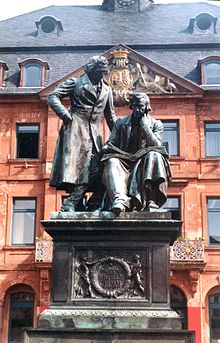
Statue of Jakob and Wilhelm Grimm in the Hanau marketplace (Hessen, Germany)

The Wikipedia article's added features include a tab labelled Talk for added views of the topic. To research folklore use an external link to Aarne-Thompson Tale Types on D.L. Ashliman's excellent website, matching Grimm stories to familiar themes. Another Wikipedia article is also referenced about the German Fairy Tale Route -- a German tourism project of various locations important to their work, established in 1975, in case you visit Germany.

With all the current attention on fairy tales in movies and television, I side with both the Fairy Tale Lobby and FEST in seeking to promote fairy tales for all ages, yes, including adults since these tales were never solely intended for children.  Jakob and Wilhelm knew this and so do you.


Friday, August 19, 2011

Third Most Used Language in the U.S. -- American Sign Language

Our family began signing long ago because my older daughter is severely hard of hearing.    To spread interest and beginning knowledge of the third most used language in the U.S., I sometimes tell stories in voice and sign language simultaneously.  Additionally I offer a program called a Playful Introduction to Sign Language.

If you wish to go further in learning it, I recommend:
  • Start at the library for books and videos for all ages and even in Spanish.  For the most items, search the catalog under keywords "signing" and "sign language."  American Sign Language (abbreviated ASL) is the official name, but using "sign language" as keywords retrieves more titles, including ASL.  "Baby Sign" is more complicated, the most popular subject headings are: "nonverbal communication in infants"; "interpersonal communication in infants"; "interpersonal communication in children"; and "language acquisition--parent participation."
  • Online YouTube has many videos.  "Deaf" covers many cultural issues, but again "sign language" opens the most items. Note the source as there are sign languages and even fingerspelling all over the world different from the U.S.  My daughter loves to compare the sign languages of different countries! Claude O. Proctor shows this in his Signing in Fourteen Languages : A Multilingual Dictionary of 2,500 American Sign Language Words and his earlier NTC's Multilingual Dictionary of American Sign Language.  Both include fingerspelling charts.  Similar to spoken English regional accents, some signs vary throughout the U.S.  
  • Have fun learning sign language!  A handy one-stop online source is Harris Communications.  They sell puzzle books such as the two for the classic book, Joy of Signing, lots of flash cards, many games, a magnetic poetry sign language kit, and, in their Books and Multimedia -- Teaching Resources section (but also available at Amazon and elsewhere), American Sign Language Clip and Create 5 CD-ROM

    American Sign Language Clip and Create 5 CD-ROM
    This fifth version of American Sign Language Clip and Create includes nearly 5,555 clipart signs for making crossword puzzles, posters, banners, postcards and more.

  • ASLPro was created for teachers, but includes quizzes and related products.
  • As with any language, practice is essential.  Partner with a fellow student or someone who grew up with the language.  Recently I was signing songs at the back of my church for my own understanding and practice.  A man in the final row told me he had deaf parents, but now has no opportunity to use ASL and has forgotten how to speak it.  How sad! 
  • The logo at the top of this blog issue came from eHow.com's article, "How to Learn ASL Fast."  That logo often is used by a location offering services to the deaf.  The article includes other online resources in their sidebars.  Their articles and videos are free, but the section called "Related Ads" leads to commercial sites.
  •                             
I probably also should mention Tell the World; Storytelling Across Language Barriers, compiled and edited by Margaret Read MacDonald.  I wrote an article in the book, "Telling with Sign Language Translation."


Signed communication is a continuum stretching from informal mime when necessary; through Pidgin Sign which adapts signing to an English word order, especially when both talking and signing simultaneously; through Signed English created to help deaf children learn English grammar and parts of speech in an educational setting; to American Sign Language with its own grammar and is the standard for interpreter certification.  Just as variations in signs exist, so can the communication style, although ASL generally has become the standard.

Remember communication is what it's all about in this practical and beautiful language used by so many people.
My signing puppet, Ivan, signs "Friend"