Tell me if you have a topic you'd like to see. (Contact: LoiS-sez@LoiS-sez.com .)
Please also let others know about this site.
Showing posts with label Kay Nielsen. Show all posts

Friday, September 13, 2024

Asbjornsen and Moe - The Husband Who Was to Mind the House - Keeping the Public in Public Domain

Sunday, September 15 is Wife Appreciation Day, complete with lots of commercial suggestions like "72 Best gifts for your wife that she'll be genuinely excited about." A show of appreciation and good humor is always a good start. 

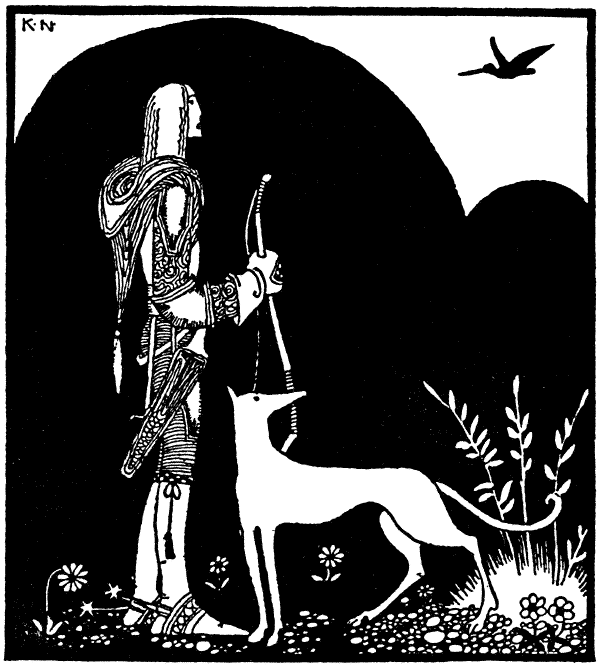
The Norwegian storytelling team of  Peter Christen Asbjørnsen and Jørgen Engebretsen Moe wrote Norske Folkeeventyr with plenty of good humor, which Sir George Webbe Dasent managed to keep in his Popular Tales from the Norse. Kay Nielsen took 15 of those stories and illustrated them in East of the Sun and West of the Moon; Old Tales from the North. Many stories have full color illustrations worth looking up at Project Gutenberg if you can't find a reprint.

This story only gets a black and white illustration. Before starting the story, I should explain that the wife is called a "goody" which is short for "good wife", a common way to refer to women who were wives or might just call her his wife.

THE HUSBAND WHO WAS TO MIND THE HOUSE

Once on a time there was a man, so surly and cross, he never thought his Wife did anything right in the house. So, one evening, in haymaking time, he came home, scolding and swearing, and showing his teeth and making a dust.

“Dear love, don’t be so angry; there’s a good man,” said his goody; “to-morrow let’s change our work. I’ll go out with the mowers and mow, and you shall mind the house at home.”

Yes! the Husband thought that would do very well. He was quite willing, he said.

So, early next morning, his goody took a scythe over her neck, and went out into the hayfield with the mowers, and began to mow; but the man was to mind the house, and do the work at home.

First of all, he wanted to churn the butter; but when he had churned a while, he got thirsty, and went down to the cellar to tap a barrel of ale. So, just when he had knocked in the bung, and was putting the tap into the cask, he heard overhead the pig come into the kitchen.  Then off he ran up the cellar steps, with the tap in his hand, as fast as he could, to look after the pig, lest it should upset the churn; but when he got up, and saw the pig had already knocked the churn over, and stood there, routing and grunting amongst the cream which was running all over the floor, he got so wild with rage that he quite forgot the ale-barrel, and ran at the pig as hard as he could. He caught it, too, just as it ran out of doors, and gave it such a kick, that piggy lay for dead on the spot. Then all at once he remembered he had the tap in his hand; but when he got down to the cellar, every drop of ale had run out of the cask.

Then he went into the dairy and found enough cream left to fill the churn again, and so he began to churn, for butter they must have at dinner. When he had churned a bit, he remembered that their milking cow was still shut up in the byre, and hadn’t had a bit to eat or a drop to drink all the morning, though the sun was high. Then all at once he thought ’twas too far to take her down to the meadow, so he’d just get her up on the house top—for the house, you must know, was thatched with sods, and a fine crop of grass was growing there. Now the house lay close up against a steep down, and he thought if he laid a plank across to the thatch at the back he’d easily get the cow up.

But still he couldn’t leave the churn, for there was his little babe crawling about on the floor, and “if I leave it,” he thought, “the child is safe to upset it.” So he took the churn on his back, and went out with it; but then he thought he’d better first water the cow before he turned her out on the thatch; so he took up a bucket to draw water out of the well; but, as he stooped down at the well’s brink, all the cream ran out of the churn over his shoulders, and so down into the well.

Now it was near dinner-time, and he hadn’t even got the butter yet; so he thought he’d best boil the porridge, and filled the pot with water and hung it over the fire. When he had done that, he thought the cow might perhaps fall off the thatch and break her legs or her neck. So he got up on the house to tie her up. One end of the rope he made fast to the cow’s neck and the other he slipped down the chimney and tied round his own thigh; and he had to make haste, for the water now began to boil in the pot, and he had still to grind the oatmeal.

So he began to grind away; but while he was hard at it, down fell the cow off the house-top after all, and as she fell, she dragged the man up the chimney by the rope. There he stuck fast; and as for the cow, she hung half-way down the wall, swinging between heaven and earth, for she could neither get down nor up.

And now the goody had waited seven lengths and seven breadths for her Husband to come and call them home to dinner; but never a call they had. At last she thought she’d waited long enough, and went home. But when she got there and saw the cow hanging in such an ugly place, she ran up and cut the rope in two with her scythe. But, as she did this, down came her Husband out of the chimney; and so, when his old dame came inside the kitchen, there she found him standing on his head in the porridge pot.

* * * 

Obviously few today would be churning butter or even watering cows, so maybe a new modern version of the possible chaos in role swapping is needed. I first discovered this story in the picture book,

The Man Who Kept House

with wonderful visual humor by the husband and wife team of
Kathleen and Michael Hague.

So I hope on Wife Appreciation Day or on any day you enjoy this story wherever you may find it. If you decide to re-tell it in a modern version, I'd love to hear it.

**********

This is part of a series of postings of stories under the category, "Keeping the Public in Public Domain."  The idea behind Public Domain was to preserve our cultural heritage after the authors and their immediate heirs were compensated.  I feel strongly current copyright law delays this intent on works of the 20th century.  My own library of folklore includes so many books within the Public Domain I decided to share stories from them.  I hope you enjoy discovering new stories.  


At the same time, my own involvement in storytelling regularly creates projects requiring research as part of my sharing stories with an audience.  Whenever that research needs to be shown here, the publishing of Public Domain stories will not occur that week.  This is a return to my regular posting of a research project here.  (Don't worry, this isn't dry research, my research is always geared towards future storytelling to an audience.)  Response has convinced me that "Keeping the Public in Public Domain" should continue along with my other postings as often as I can manage it.

Other Public Domain story resources I recommend-

  • There are many online resources for Public Domain stories, maybe none for folklore is as ambitious as fellow storyteller, Yoel Perez's database, Yashpeh, the International Folktales Collection.  I have long recommended it and continue to do so.  He has loaded Stith Thompson's Motif Index into his server as a database so you can search the whole 6 volumes for whatever word or expression you like by pressing one key. http://folkmasa.org/motiv/motif.htm

  • You may have noticed I'm no longer certain Dr. Perez has the largest database, although his offering the Motif Index certainly qualifies for those of us seeking specific types of stories.  There's another site, FairyTalez claiming to be the largest, with "over 2000 fairy tales, folktales, and fables" and they are "fully optimized for phones, tablets, and PCs", free and presented without ads.
    Between those two sites, there is much for story-lovers, but as they say in infomercials, "Wait, there's more!"

The email list for storytellers, Storytell, discussed Online Story Sources and came up with these additional suggestions:        

         - David K. Brown - http://people.ucalgary.ca/~dkbrown/stories.html

         - Richard Martin - http://www.tellatale.eu/tales_page.html

         - Spirit of Trees - http://spiritoftrees.org/featured-folktales

         - Story-Lovers - http://www.story-lovers.com/ is now only accessible through the Wayback Machine, described below, but the late Jackie Baldwin's wonderful site lives on there, fully searchable manually (the Google search doesn't work), at https://archive.org/ .  It's not easy, but go to Story-lovers.com snapshot for December 22 2016  and you can click on SOS: Searching Out Stories to scroll down through the many story topics and click on the story topic that interests you.

       - World of Tales - http://www.worldoftales.com/ 

 
           - Zalka Csenge Virag - http://multicoloreddiary.blogspot.com doesn't give the actual stories, but her recommendations, working her way through each country on a continent, give excellent ideas for finding new books and stories to love and tell.

     
You're going to find many of the links on these sites have gone down, BUT go to the Internet Archive Wayback Machine to find some of these old links.  Tim's site, for example, is so huge probably updating it would be a full-time job.  In the case of Story-Lovers, it's great that Jackie Baldwin set it up to stay online as long as it did after she could no longer maintain it.  Possibly searches maintained it.  Unfortunately Storytell list member, Papa Joe is on both Tim Sheppard's site and Story-Lovers, but he no longer maintains his old Papa Joe's Traveling Storytelling Show website and his Library (something you want to see!) is now only on the Wayback Machine.  It took some patience working back through claims of snapshots but finally in December of 2006 it appears!

    Somebody as of this writing whose stories can still be found by his website is the late Chuck Larkin - http://chucklarkin.com/stories.html.  I prefer to list these sites by their complete address so they can be found by the Wayback Machine, a.k.a. Archive.org, when that becomes the only way to find them.

You can see why I recommend these to you. 

Have fun discovering even more stories

Friday, May 10, 2024

Asbjørnsen & Moe - One's Own Children Are Always Prettiest - Keeping the Public in Public Domain

I tend to use the original Index to Fairy Tales, Myths and Legends by Mary Huse Eastman, published in 1915, to guarantee Public Domain stores.  I plowed through the stories for Mother's Day and others with Mother in the title.  Maybe it was the mood I was in, but everything just seemed too "quaint" and I wasn't happy with telling them in the 21st century.  In telling Public Domain stories it's sometimes necessary for the storyteller to modernize the language.  "Thees" and other quaint word choice isn't needed to tell the story and can keep a present day audience from hearing what is meant.  These stories just struck me as having an antiquated view of motherhood or children.  

Quite by accident I discovered today's story and believe it will always fit the way mothers view their children.  This translation originally appeared in Sir G. W. Dasent’s Popular Tales from the Norse, but is the Kay Nielsen illustrated version of the Asjornsen and Moe tales titled East of the Sun and West of the Moon; Old Tales from the North.  That's a Project Gutenberg link, but Nielsen's work has had many reprints and I strongly recommend seeing it in book form as both the full-color and black and white illustrations really shine in print. 

The story itself is about a Snipe.  I will say a bit more about it after the tale.

ONE’S OWN CHILDREN ARE ALWAYS PRETTIEST

A sportsman went out once into a wood to shoot, and he met a Snipe.

“Dear friend,” said the Snipe, “don’t shoot my children!”

“How shall I know your children?” asked the Sportsman. “What are they like?”

“Oh!” said the Snipe, “mine are the prettiest children in all the wood.”

“Very well,” said the Sportsman, “I’ll not shoot them; don’t be afraid.”

But for all that, when he came back, there he had a whole 204 string of young snipes in his hand which he had shot.

“Oh, oh!” said the Snipe, “why did you shoot my children after all?”

“What! these your children!” said the Sportsman; “why, I shot the ugliest I could find, that I did!”

“Woe is me!” said the Snipe; “don’t you know that each one thinks his own children the prettiest in the world?”

***

Snipe in Water, by Ohara Koson. Japan, 1900-1930

LoiS again:

I've long heard about Snipe Hunts and presumed they were hunting for something fictitious.  Not so. . . well not entirely.  The Wikipedia article on the Snipe mainly incorporates the old Public Domain article found in Encyclopædia Britannica (11th ed.).  I wanted an update on the bird and find it as the Common snipe, which is not a North American bird.  This is why a "Snipe hunt" -- at least in North America -- is considered a prank or practical joke.  There are however North American birds, known as Wilson's snipe, which had been considered a subspecies until 2003 when it was changed to its own species.

Along the way on my own literary Snipe Hunt I learned the term "sniper" came from the bird because of its ability to hunt and also camouflage.

 All of that may be far more than you ever cared to know.  Mr. Nielsen frequently marks the end of stories with an illustration that seems appropriate to this little known tale which ends the book.  (Note the short bird bills, so they are not snipes, but they hide well.)                                                                             


***********************

This is part of a series of postings of stories under the category, "Keeping the Public in Public Domain."  The idea behind Public Domain was to preserve our cultural heritage after the authors and their immediate heirs were compensated.  I feel strongly current copyright law delays this intent on works of the 20th century.  My own library of folklore includes so many books within the Public Domain I decided to share stories from them.  I hope you enjoy discovering new stories.  


At the same time, my own involvement in storytelling regularly creates projects requiring research as part of my sharing stories with an audience.  Whenever that research needs to be shown here, the publishing of Public Domain stories will not occur that week.  This is a return to my regular posting of a research project here.  (Don't worry, this isn't dry research, my research is always geared towards future storytelling to an audience.)  Response has convinced me that "Keeping the Public in Public Domain" should continue along with my other postings as often as I can manage it.

Other Public Domain story resources I recommend-

  • There are many online resources for Public Domain stories, maybe none for folklore is as ambitious as fellow storyteller, Yoel Perez's database, Yashpeh, the International Folktales Collection.  I have long recommended it and continue to do so.  He has loaded Stith Thompson's Motif Index into his server as a database so you can search the whole 6 volumes for whatever word or expression you like by pressing one key. http://folkmasa.org/motiv/motif.htm

  • You may have noticed I'm no longer certain Dr. Perez has the largest database, although his offering the Motif Index certainly qualifies for those of us seeking specific types of stories.  There's another site, FairyTalez claiming to be the largest, with "over 2000 fairy tales, folktales, and fables" and they are "fully optimized for phones, tablets, and PCs", free and presented without ads.
    Between those two sites, there is much for story-lovers, but as they say in infomercials, "Wait, there's more!"
The email list for storytellers, Storytell, discussed Online Story Sources and came up with these additional suggestions:        

         - David K. Brown - http://people.ucalgary.ca/~dkbrown/stories.html

         - Richard Martin - http://www.tellatale.eu/tales_page.html

         - Spirit of Trees - http://spiritoftrees.org/featured-folktales

         - Story-Lovers - http://www.story-lovers.com/ is now only accessible through the Wayback Machine, described below, but the late Jackie Baldwin's wonderful site lives on there, fully searchable manually (the Google search doesn't work), at https://archive.org/ .  It's not easy, but go to Story-lovers.com snapshot for December 22 2016  and you can click on SOS: Searching Out Stories to scroll down through the many story topics and click on the story topic that interests you.

       - World of Tales - http://www.worldoftales.com/ 

 
           - Zalka Csenge Virag - http://multicoloreddiary.blogspot.com doesn't give the actual stories, but her recommendations, working her way through each country on a continent, give excellent ideas for finding new books and stories to love and tell.

     
You're going to find many of the links on these sites have gone down, BUT go to the Internet Archive Wayback Machine to find some of these old links.  Tim's site, for example, is so huge probably updating it would be a full-time job.  In the case of Story-Lovers, it's great that Jackie Baldwin set it up to stay online as long as it did after she could no longer maintain it.  Possibly searches maintained it.  Unfortunately Storytell list member, Papa Joe is on both Tim Sheppard's site and Story-Lovers, but he no longer maintains his old Papa Joe's Traveling Storytelling Show website and his Library (something you want to see!) is now only on the Wayback Machine.  It took some patience working back through claims of snapshots but finally in December of 2006 it appears!

    Somebody as of this writing whose stories can still be found by his website is the late Chuck Larkin - http://chucklarkin.com/stories.html.  I prefer to list these sites by their complete address so they can be found by the Wayback Machine, a.k.a. Archive.org, when that becomes the only way to find them.

You can see why I recommend these to you. 

Have fun discovering even more stories