Tell me if you have a topic you'd like to see. (Contact: LoiS-sez@LoiS-sez.com .)
Please also let others know about this site.
Showing posts with label English folklore. Show all posts

Friday, January 17, 2025

Jacobs - Hereafterthis - Keeping the Public in Public Domain

The fires of Los Angeles rightfully have been THE news item in a week still loaded with major events. Locally Mitch Albom, who supports a Haitian orphanage, has compared this to what happened after the earthquake in Haiti. I certainly hope L.A. doesn't evolve into the lawlessness and further destruction of Haiti, but agree the problems will outlast the attention currently trying to help after this disaster. For my own part I want to give to organizations who won't give now and then move on. To look at a recent U.S. event, this can be seen in the battle for support after the devastation from Hurricane Helene with its own "1,000 Year Flood."

I searched in Public Domain stories trying to find an appropriate story. Other than the unhelpful tale of Pandora opening the box bringing misery, I was dissatisfied with what I found. I did find the Joseph Jacobs tale of "Hereafterthis" in More English Fairy Tales. Yes, it's a "fairy tale" with all the implied simplification. The people affected by the fires have far more serious problems, but it does show how things can progress until disaster can wipe out everything. (I heard one woman "fortunate" to find a rental property say its monthly rent equals the amount she still must pay on her ruined home's mortgage.) So, yes, this story has a "fairy tale ending", but comes with the hope better days still come to all devastated by a 21st Century disaster comparable to the devastation of the 1906 San Francisco Earthquake.
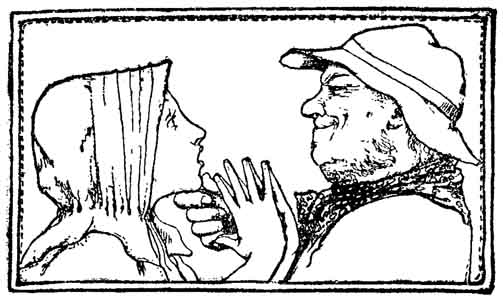
Hereafterthis

Hereafterthis


Once upon a time there was a farmer called Jan, and he lived all alone by himself in a little farmhouse.

By-and-by he thought that he would like to have a wife to keep it all vitty for him.

So he went a-courting a fine maid, and he said to her: "Will you marry me?"

"That I will, to be sure," said she.

So they went to church, and were wed. After the wedding was over, she got up on his horse behind him, and he brought her home. And they lived as happy as the day was long.

One day, Jan said to his wife, "Wife can you milk-y?"

"Oh, yes, Jan, I can milk-y. Mother used to milk-y, when I lived home."

So he went to market and bought her ten red cows. All went well till one day when she had driven them to the pond to drink, she thought they did not drink fast enough. So she drove them right into the pond to make them drink faster, and they were all drowned.

When Jan came home, she up and told him what she had done, and he said, "Oh, well, there, never mind, my dear, better luck next time."

So they went on for a bit, and then, one day, Jan said to his wife, "Wife can you serve pigs?"

"Oh, yes, Jan, I can serve pigs. Mother used to serve pigs when I lived home."

So Jan went to market and bought her some pigs. All went well till one day, when she had put their food into the trough she thought they did not eat fast enough, and she pushed their heads into the trough to make them eat faster, and they were all choked.

When Jan came home, she up and told him what she had done, and he said, "Oh, well, there, never mind, my dear, better luck next time."

So they went on for a bit, and then, one day, Jan said to his wife, "Wife can you bake-y?"

"Oh, yes, Jan, I can bake-y. Mother used to bake-y when I lived home."

So he bought everything for his wife so that she could bake bread. All went well for a bit, till one day, she thought she would bake white bread for a treat for Jan. So she carried her meal to the top of a high hill, and let the wind blow on it, for she thought to herself that the wind would blow out all the bran. But the wind blew away meal and bran and all—so there was an end of it.

When Jan came home, she up and told him what she had done, and he said, "Oh, well, there, never mind, my dear, better luck next time."

So they went on for a bit, and then, one day, Jan said to his wife, "Wife can you brew-y?"

"Oh, yes, Jan, I can brew-y. Mother used to brew-y when I lived home."

So he bought everything proper for his wife to brew ale with. All went well for a bit, till one day when she had brewed her ale and put it in the barrel, a big black dog came in and looked up in her face. She drove him out of the house, but he stayed outside the door and still looked up in her face. And she got so angry that she pulled out the plug of the barrel, threw it at the dog, and said, "What dost look at me for? I be Jan's wife." Then the dog ran down the road, and she ran after him to chase him right away. When she came back again, she found that the ale had all run out of the barrel, and so there was an end of it.

When Jan came home, she up and told him what she had done, and he said, "Oh well, there, never mind, my dear, better luck next time."

So they went on for a bit, and then, one day, she thought to herself, "'T is time to clean up my house." When she was taking down her big bed she found a bag of groats on the tester. So when Jan came home, she up and said to him, "Jan, what is that bag of groats on the tester for?"

"That is for Hereafterthis, my dear."

Now, there was a robber outside the window, and he heard what Jan said. Next day, he waited till Jan had gone to market, and then he came and knocked at the door. "What do you please to want?" said Mally.

"I am Hereafterthis," said the robber, "I have come for the bag of groats."

Now the robber was dressed like a fine gentleman, so she thought to herself it was very kind of so fine a man to come for the bag of groats, so she ran upstairs and fetched the bag of groats, and gave it to the robber and he went away with it.

When Jan came home, she said to him, "Jan, Hereafterthis has been for the bag of groats."

"What do you mean, wife?" said Jan.

So she up and told him, and he said, "Then I'm a ruined man, for that money was to pay our rent with. The only thing we can do is to roam the world over till we find the bag of groats." Then Jan took the house-door off its hinges, "That's all we shall have to lie on," he said. So Jan put the door on his back, and they both set out to look for Hereafterthis. Many a long day they went, and in the night Jan used to put the door on the branches of a tree, and they would sleep on it. One night they came to a big hill, and there was a high tree at the foot. So Jan put the door up in it, and they got up in the tree and went to sleep. By-and-by Jan's wife heard a noise, and she looked to see what it was. It was an opening of a door in the side of the hill. Out came two gentlemen with a long table, and behind them fine ladies and gentlemen, each carrying a bag, and one of them was Hereafterthis with the bag of groats. They sat round the table, and began to drink and talk and count up all the money in the bags. So then Jan's wife woke him up, and asked what they should do.

"Now's our time," said Jan, and he pushed the door off the branches, and it fell right in the very middle of the table, and frightened the robbers so that they all ran away. Then Jan and his wife got down from the tree, took as many money-bags as they could carry on the door, and went straight home. And Jan bought his wife more cows, and more pigs, and they lived happy ever after.

***

May the people having to start over find a way, once again, to find reasons to continue and even to find happiness.  

For the rest of us, let us not forget the need to continue helping. 

***************

This is part of a series of postings of stories under the category, “Keeping the Public in Public Domain.” The idea behind Public Domain was to preserve our cultural heritage after the authors and their immediate heirs were compensated. I feel strongly current copyright law delays this intent on works of the 20th century. My own library of folklore includes so many books within the Public Domain I decided to share stories from them. I hope you enjoy discovering them.

At the same time, my own involvement in storytelling regularly creates projects requiring research as part of my sharing stories with an audience.  Whenever that research needs to be shown here, the publishing of Public Domain stories will not occur that week.  This is a return to my regular posting of a research project here.  (Don't worry, this isn't dry research, my research is always geared towards future storytelling to an audience.)  Response has convinced me that "Keeping the Public in Public Domain" should continue along with my other postings as often as I can manage it.

See the sidebar for other Public Domain story resources I recommend on the page “PublicDomain Story Resources."


Friday, August 27, 2021

Rhys - Robin Goodfellow - Keeping the Public in Public Domain

Puck (1789) by Joshua Reynolds
Today's story goes back in English folklore to Old English about a character known as Puck or by one of his other names as Robin Goodfellow in our story's title.  There are other name variations as well.  Hob for the shortened Rob or Robert, and also Hobgoblin.  Wikipedia traces the earliest written reference in the Oxford English Dictionary back to 1531.  I first heard about him in Shakespeare's A Midsummer Night's Dream when Puck is introduced and also called Robin Goodfellow.  At the time I had no idea this mischievous spirit was something an audience in the late 16th and early 17th century would know by both names quite well.

Interest and knowledge of this prankster continued into the next century with the painting by the great English painter, Joshua Reynolds, needing no explanation for its title.  

Even the word "puckish" may be unfamiliar to many today.  Looking up the word's meaning using various dictionaries gives a fine introduction to the character: impish, whimsical, cheeky, devilish, mischievous, teasing, naughty, sly, playful, whimsical, roguish, frolicsome, waggish, sportive, but most often impish.  We are told somebody who is puckish plays tricks on people, is up to a little trouble, and might play practical jokes on you, but they're more silly than mean spirited.  

The Welsh-English writer, Ernest Rhys, calls Robin Goodfellow a "Knave" and at times calls his actions "knavish."  That's so thoroughly British that I always wondered if a knave was a title somebody had at a royal court, rather like the nursery rhyme:

The Queen of Hearts
She made some tarts,
    All on a summer's day;
The Knave of Hearts
He stole those tarts,
    And took them clean away.

The poem goes on to have the King of Hearts beat the Knave who then promises to steal no more.

The knavish Robin Goodfellow may deserve a good beating, but we'll have to catch the story to see what happens.  I might give all I've said so far or a briefer version of it to talk about "knave", "knavish", "Puck" and "puckish", all good bits for vocabulary.  I'd also explain the story has a "red-faced clown", but it isn't a circus clown, merely a rather dim-witted man Robin meets.

With that explanation, I'd tell the story, but adapt it for modern listeners.  Rhys has the story in Fairy Gold; A Book of Classic English Fairy Tales.  It's not easily found online, but if you go to Project Gutenberg you can read it in Ada and Eleanor Skinner's The Turquoise Story Book: Stories and Legend of Summer and Nature.  I am not going to give the original here, but instead my slightly modernized version omitting the "thees" and "thous" and other things not helpful for many of today's listeners.  I will, however, include the drawing by Herbert Cole which opened the story in Fairy Gold as it shows Robin, the "red-faced clown", and a certain horse.

ROBIN GOODFELLOW

Once upon a time, a great while ago, when men did eat and drink less, and were more honest, and knew no knavery, there used to be many harmless sprites called fairies, dancing in fairy rings on green hills with sweet music. Sometimes they were invisible, and sometimes took various shapes. Many mad pranks they would play, such as pinching untidy girls black and blue, and misplacing things in disorderly houses; but lovingly would they treat good girls, giving them silver and other pretty toys, which they would leave for them, sometimes in their shoes, other times in their pockets, sometimes in bright basins and other clean containers.

Now it happened that in those happy days, a baby was born in a house which the fairies liked. This baby was a boy, and the fairies, to show their pleasure, brought many pretty things, coverlets and delicate linen for his cradle; and woodcock and quail for the christening, at which there was so much good cheer that the clerk almost forgot to say the baby's name—Robin Goodfellow.  So much for the birth and christening of little Robin.

When Robin was grown to six years of age, he was so knavish that all the neighbors complained about him; for, no sooner was his mother's back turned, he was in one knavish action or other, so that his mother was forced (to avoid the complaints) to take him with her to market or wherever she went or rode on horseback. But this helped little or nothing, for, if he rode before her, then he would make awful faces at all he met: if he rode behind her, then he would clap his hand on the horse's tail; so that his mother was weary of the many complaints that came about him. Yet she didn't know how to beat him properly for it, because she never saw him do anything deserving blows. The complaints came daily, so his mother promised him a whipping. Robin didn't like that, and to avoid it, he ran away, and left his mother crying for him.

After Robin had traveled a good day's journey from his mother's house he sat down, and, being tired, he fell asleep. No sooner had sleep closed his eye-lids, but he thought he saw many little people dancing about him, and he heard such music Orpheus, a famous Greek fiddler (had he still been alive), compared to one of these would have been a poor musician. As delights usually don't last long, so  these ended sooner than Robin wanted.  Sadly he awoke, and found lying by him a scroll.  On it was written in golden letters:—

"Robin, my only son and heir,

How to live take you no care:

By nature you have cunning shifts,

Which I'll increase with other gifts.

You have the power to change your shape,

To horse, to hog, to dog, to ape,

Transformed thus, by any means

See none you harm but knaves and queens:

But love you those that honest be,

And help them in necessity.

Do this and all the world shall know

The pranks of Robin Goodfellow,

For by that name you called shall be

To age's last posterity;

And if you keep my just command,

One day you shall see Fairy-land!"

Robin, having read this, was very joyful, yet he longed to know whether he had the power or not, and to try it he wished for some meat.  Immediately a fine dish of roast veal was before him. Then he wished for plum-pudding; right away he had it. This he liked well, and, because he was weary, he wished he was a horse: no sooner was his wish ended, but he was changed into as fine a horse as you could see, and leaped as nimbly as if he had been one at least a month. Then he wished himself a black dog, and he was so; then a green tree, and he was so. So from one thing to another, till he was quite sure that he could change himself to anything he liked.

Full of delight at his new powers, Robin Goodfellow set out, eager to put them to the test.

As he was crossing a field, he met a red-faced clown and called him to stop.

"Friend," said he, "what is a clock?"

"A thing," answered the clown, "that shows the time of the day."

"Why, then," said Robin Goodfellow, "be you a clock and tell me what time of the day it is."

"I owe you no service," answered the clown again, "but, because you shall think yourself owing me, know that it is the same time of the day as it was yesterday at this time!"

These shrewd answers upset Robin Goodfellow, so he promised revenge on the clown, which he did in this manner.

Robin Goodfellow turned himself into a bird and followed this fellow, who was going into a field a little way away from that place to catch a horse eating grass. The horse, being wild, jumped over the hedge, and the fellow followed after it, but the horse was too swift for him. Robin was glad, for now was the perfect time to have his revenge.

Robin shaped himself exactly like the horse that the clown followed, and so stood right before him. Then the clown took hold of the horse's mane and got on his back, but he had not ridden far when, with a stumble, Robin hurled his rider over his head, so that the rider almost broke his neck. But then again the horse stood still and let the clown mount him once more.

The clown now started to ride through a pond of water of good-sized depth, which covered the road. No sooner did he ride into the very middle of the pond than Robin Goodfellow turned himself into a fish, and so left him with nothing but the saddle on which he was riding between his legs. Meanwhile the fish swiftly swam to the bank. And then Robin, changed to a naughty boy again, ran away laughing, "Ho, ho, hoh!" leaving the poor clown half drowned and covered with mud.

As Robin went along a green hedge-side he started singing:—

"And can the doctor make sick men well?

And can the gypsy a fortune tell

Without lily, germander, and cockle-shell?

With sweet-brier,

And bon-fire

And strawberry wine,

And columbine."

And when he had sung this, he wondered what he should next turn himself into. Then, as he saw the smoke rise from the chimneys of the next town, he thought to himself it would be great sport to walk the streets with a broom on his shoulder, and cry:

"Chimney sweep."

But when Robin did this, and someone called him, then Robin ran away laughing, "Ho, ho, hoh!"

Next he set about to imitate a beggar on crutches, begging very pitifully; but when a stout shop keeper came out of his shop to give Robin money, again he skipped off nimbly, laughing in his naughty manner.

That same night, he knocked at many men's doors, and when in the dark the servants came out, he blew out their candle and vanished in the dark street, with his "Ho, ho, hoh!"

All these tricks Robin played, day and night.  He had many songs, one of which he sang in his chimney-sweeper's disguise:

"Black I am from head to foot,

And all does come from chimney soot.

Then, maidens, come and cherish him

That makes your chimneys neat and trim."

But it happened that, on the very next night of his playing the chimney-sweep, Robin had a summons from the land where there are no chimneys. For King Oberon, seeing Robin Goodfellow do so many merry tricks, called him out of his bed with these words, saying:—

"Robin, my son, come; quickly rise:

First stretch, then yawn, and rub your eyes;

For you must go with me tonight,

And taste of Fairy-land's delight."

Robin, hearing this, rose and went to him. There were with King Oberon many fairies, all dressed in green. All these, with King Oberon, did welcome Robin Goodfellow into their company. Oberon took Robin by the hand and led him in a fairy dance: their musician had an excellent bag-pipe made of a wren's quill and the skin of a Greenland fly. This pipe was so shrill and so sweet that a Scottish pipe, compared to it, would no more come near it than a Jaw's-harp does to an Irish harp. After they had danced, King Oberon said to Robin:—

"Whene'er you hear the piper blow,

Round and round the fairies go!

And nightly you must with us dance,

In meadows where the moonbeams glance,

And make the circle, hand in hand—

That is the law of Fairy-land!

There you shall see what no man knows;

While sleep the eyes of men does close!"

So marched they, with their piper in front, to the Fairy-land. There King Oberon showed Robin Goodfellow many secrets, which he never showed the rest of the world. And there, in Fairy-land, does Robin Goodfellow live now these many long years.

***

I confess I'm currently in a Shakespearian mood after seeing an outdoor performance of MacBeth recently.  Shakespeare's such fun, especially outdoors, and this has me wishing I could catch again a performance of A Midsummer Night's Dream.  Taking out the nearly Shakespearian sound of the story, as Rhys wrote it, especially leaves me sighing for the Bard.  Maybe next summer.

In the meantime I hope you enjoyed this medieval "Dennis the Menace" who became a member of Oberon's court.  (Yes, Oberon is a part of A Midsummer Night's Dream, too.)

****************

This is part of a series of postings of stories under the category, "Keeping the Public in Public Domain."  The idea behind Public Domain was to preserve our cultural heritage after the authors and their immediate heirs were compensated.  I feel strongly current copyright law delays this intent on works of the 20th century.  My own library of folklore includes so many books within the Public Domain I decided to share stories from them.  I hope you enjoy discovering new stories.  


At the same time, my own involvement in storytelling regularly creates projects requiring research as part of my sharing stories with an audience.  Whenever that research needs to be shown here, the publishing of Public Domain stories will not occur that week.  This is a return to my regular posting of a research project here.  (Don't worry, this isn't dry research, my research is always geared towards future storytelling to an audience.)  Response has convinced me that "Keeping the Public in Public Domain" should continue along with my other postings as often as I can manage it.
Other Public Domain story resources I recommend-
  • There are many online resources for Public Domain stories, maybe none for folklore is as ambitious as fellow storyteller, Yoel Perez's database, Yashpeh, the International Folktales Collection.  I have long recommended it and continue to do so.  He has loaded Stith Thompson's Motif Index into his server as a database so you can search the whole 6 volumes for whatever word or expression you like by pressing one key. http://folkmasa.org/motiv/motif.htm
  • You may have noticed I'm no longer certain Dr. Perez has the largest database, although his offering the Motif Index certainly qualifies for those of us seeking specific types of stories.  There's another site, FairyTalez claiming to be the largest, with "over 2000 fairy tales, folktales, and fables" and they are "fully optimized for phones, tablets, and PCs", free and presented without ads.

    Between those two sites, there is much for story-lovers, but as they say in infomercials, "Wait, there's more!"
The email list for storytellers, Storytell, discussed Online Story Sources and came up with these additional suggestions:            
         - David K. Brown - http://people.ucalgary.ca/~dkbrown/stories.html
         - Richard Martin - http://www.tellatale.eu/tales_page.html
         - Spirit of Trees - http://spiritoftrees.org/featured-folktales
         - Story-Lovers - http://www.story-lovers.com/ is now only accessible through the Wayback Machine, described below, but the late Jackie Baldwin's wonderful site lives on there, fully searchable manually (the Google search doesn't work), at https://archive.org/ .  It's not easy, but go to Story-lovers.com snapshot for October 22 2016  and you can click on SOS: Searching Out Stories to scroll down through the many story topics and click on the story topic that interests you.
       - World of Tales - http://www.worldoftales.com/ 
           - Zalka Csenge Virag - http://multicoloreddiary.blogspot.com doesn't give the actual stories, but her recommendations, working her way through each country on a continent, give excellent ideas for finding new books and stories to love and tell.
     
You're going to find many of the links on these sites have gone down, BUT go to the Internet Archive Wayback Machine to find some of these old links.  Tim's site, for example, is so huge probably updating it would be a full-time job.  In the case of Story-Lovers, it's great that Jackie Baldwin set it up to stay online as long as it did after she could no longer maintain it.  Possibly searches maintained it.  Unfortunately Storytell list member, Papa Joe is on both Tim Sheppard's site and Story-Lovers, but he no longer maintains his old Papa Joe's Traveling Storytelling Show website and his Library (something you want to see!) is now only on the Wayback Machine.  It took some patience working back through claims of snapshots but finally in December of 2006 it appears!
    Somebody as of this writing whose stories can still be found by his website is the late Chuck Larkin - http://chucklarkin.com/stories.html.  I prefer to list these sites by their complete address so they can be found by the Wayback Machine, a.k.a. Archive.org, when that becomes the only way to find them.
You can see why I recommend these to you. Have fun discovering even more stories!


Monday, October 21, 2019

Wickes - The Queer Company - Keeping the Public in Public Domain

Two weeks ago I presented another "classic" spooky tale from the anthology by Frances G. Wickes, Happy Holidays.  Today's story was supposed to be published on schedule while I was on the road storytelling.  I just discovered I didn't get it out because I skipped one small step!  My apologies.

This story is also found in Joseph Jacobs' English Fairy Tales under the title of "The Strange Visitor."  Jacobs offers some important differences that I'll mention after the story and then, to make it more friendly for the youngest listeners, another idea will be given by Carolyn Sherwin Bailey from her Firelight Stories.


That last part is usually shouted out and aimed at the most vulnerable member of the audience.  It fits in a category of spooky tale called a "jump story" because it's meant to make the audience jump. 

I mentioned the story could be found under the title of "The Strange Visitor" in Joseph Jacobs' English Fairy Tales with some differences.  Jacobs uses the refrain of "Aih-h-h! -- late -- and wee-e-e moul" for every other answer by the Strange Visitor and Jacobs candidly confessed to not having the slightest idea what it meant, but it was in his original source, The Nursery Rhymes of Scotland by W. Chambers, published in 1842 and it was accepted by Jacobs' young listeners.  He further suggests "The prosaic-minded may substitute 'Up-late-and-little-food.' " Perhaps, but Wickes omits it and gives a more streamlined response.  Jacobs also gives directions as to how the Visitor sounds with his responses -- to just see his version of the tale go to https://americanliterature.com/author/joseph-jacobs/fairy-tale/the-strange-visitor
 and you will see that final answer is "FOR YOU!" and the teller is directed:
(At the top of the voice, with a wave of the arm and a stamp of the feet.")
To make it less frightening for the youngest listeners, Carolyn Sherwin Bailey in her Firelight Stories changed the ending ever so slightly so that after the Strange Visitor talks about his pumpkin head and the little old woman asks, "What did you come for?" she has this ending instead:
"TO KEEP YOU COMPANY," said Somebody, as he danced about the kitchen.
          So the little old woman was not lonely any more.

I leave it to you and your audience to decide what you find more appropriate.


Additionally last week I said I would give a bit more information about the illustrator, Gertrude  Kay, for this story and last week's story from Frances G. Wickes' Happy Holidays.  While neither of the two tales show all she was able to do, there is an interesting article about how she not only was a student of the famous author/illustrator, Howard Pyle and his slightly less famous sister, Katherine, who was also an author/illustrator, but Gertrude was also successfully an early 20th century illustrator in the male-dominated world of commercial illustration.

An excellent article about her and several samples of her usually colorful illustrations can be found at Illustration Art Solutions.com, which also mentions her travels in China and Japan and then, after that, to other lands.  Those first travels began right about the time Happy Holidays was published, so I can imagine how much she would have loved to do more with next week's Japanese story, "Shippeitaro."  Her samples include several from China and Japan.  The publisher of Happy Holidays kept the book's cost down by sticking to black and white illustrations even on those that were full page.

In looking at the source for next week's story, Teresa Peirce Williston, I decided it would be a shame to omit the illustrations in Williston's Japanese Fairy Tales, by Sanchi Ogawa.  The story Wickes presents faithfully enough, but Williston's telling of the story benefits immensely from Ogawa's illustrations.  I hope you'll see what I mean when I post it next week.
*********************************************
This is part of a series of postings of stories under the category, "Keeping the Public in Public Domain."  The idea behind Public Domain was to preserve our cultural heritage after the authors and their immediate heirs were compensated.  I feel strongly current copyright law delays this intent on works of the 20th century.  My own library of folklore includes so many books within the Public Domain I decided to share stories from them.  I hope you enjoy discovering new stories.  


At the same time, my own involvement in storytelling regularly creates projects requiring research as part of my sharing stories with an audience.  Whenever that research needs to be shown here, the publishing of Public Domain stories will not occur that week.  This is a return to my regular posting of a research project here.  (Don't worry, this isn't dry research, my research is always geared towards future storytelling to an audience.)  Response has convinced me that "Keeping the Public in Public Domain" should continue along with my other postings as often as I can manage it.
Other Public Domain story resources I recommend-
  • There are many online resources for Public Domain stories, maybe none for folklore is as ambitious as fellow storyteller, Yoel Perez's database, Yashpeh, the International Folktales Collection.  I have long recommended it and continue to do so.  He has loaded Stith Thompson's Motif Index into his server as a database so you can search the whole 6 volumes for whatever word or expression you like by pressing one key. http://folkmasa.org/motiv/motif.htm
  • You may have noticed I'm no longer certain Dr. Perez has the largest database, although his offering the Motif Index certainly qualifies for those of us seeking specific types of stories.  There's another site, FairyTalez claiming to be the largest, with "over 2000 fairy tales, folktales, and fables" and they are "fully optimized for phones, tablets, and PCs", free and presented without ads.

    Between those two sites, there is much for story-lovers, but as they say in infomercials, "Wait, there's more!"
The email list for storytellers, Storytell, discussed Online Story Sources and came up with these additional suggestions:            
         - David K. Brown - http://people.ucalgary.ca/~dkbrown/stories.html
         - Richard Martin - http://www.tellatale.eu/tales_page.html
         - Spirit of Trees - http://spiritoftrees.org/featured-folktales
         - Story-Lovers - http://www.story-lovers.com/ is now only accessible through the Wayback Machine, described below, but Jackie Baldwin's wonderful site lives on there, fully searchable manually (the Google search doesn't work), at https://archive.org/ .  It's not easy, but go to Story-lovers.com snapshot for October 22 2016  and you can click on SOS: Searching Out Stories to scroll down through the many story topics and click on the story topic that interests you.
       - World of Tales - http://www.worldoftales.com/ 
           - Zalka Csenge Virag - http://multicoloreddiary.blogspot.com doesn't give the actual stories, but her recommendations, working her way through each country on a continent, give excellent ideas for finding new books and stories to love and tell.
     
You're going to find many of the links on these sites have gone down, BUT go to the Internet Archive Wayback Machine to find some of these old links.  Tim's site, for example, is so huge probably updating it would be a full-time job.  In the case of Story-Lovers, it's great that Jackie Baldwin set it up to stay online as long as it did after she could no longer maintain it.  Possibly searches maintained it.  Unfortunately Storytell list member, Papa Joe is on both Tim Sheppard's site and Story-Lovers, but he no longer maintains his old Papa Joe's Traveling Storytelling Show website and his Library (something you want to see!) is now only on the Wayback Machine.  It took some patience working back through claims of snapshots but finally in December of 2006 it appears!
    Somebody as of this writing whose stories can still be found by his website is the late Chuck Larkin - http://chucklarkin.com/stories.html.  I prefer to list these sites by their complete address so they can be found by the Wayback Machine, a.k.a. Archive.org, when that becomes the only way to find them.
You can see why I recommend these to you. Have fun discovering even more stories!

Saturday, October 28, 2017

Jacobs - The Buried Moon - Keeping the Public in Public Domain

When I do spooky storytelling I love using my hooded cape and it's especially needed when telling The Buried Moon.  You'll see why as you get into this story I love to tell from Joseph Jacobs' More English Fairy Tales.  The full-length cape also flows well for movement.

By the way, my picture above was taken at the fence railing outside a cemetery crypt here in Clarkston.  Notice the one bent spike?

My telling of the story nowadays isn't the same as folklorist Jacobs.  I don't use all the same wording (my memory doesn't work that way, for one thing!) He admitted using the archaic dialect, but he believed this added to the fun of it.  Here in Keeping the Public in Public Domain segments I let you judge from the original.  However ages ago I must have made a few minor alterations in writing.  As needed I'll insert them if they seem unclear.  For a variety of reasons I was playing up the Bogles in the story.  I love that Scottish or Northumbrian term and give the Wikipedia link for you to start learning a bit more about them.

My first introduction to the story came from Susan Jeffers' illustrations of it for the book using Jacobs' text.  Go to Rivka Stein's Book Artists and Their Illustrations to see it all.  That's also a site many will enjoy prowling for its coverage of illustrators.  The Jeffers page on her illustrations for The Buried Moon will not only give you her complete work on the story, but also take you to another Jeffers illustrated tale, Thumbelina, and yet a different illustrated version of The Buried Moon.

This is one of those stories where I urge you to form your own visions of the action first.  Yes, Jacobs' book, as always, has an illustration from John D. Batten, but fortunately it's the third page in, so try to create your own image first.  When done with the story, you might want to prowl Google Images for Buried Moon images .  You'll see a few more books and it inspired theater productions, lyrics, a YouTube video of the musical version by the French symphonic metal band, Wildpath, and even a book called Buried Moon combining "stories and yoga for children during difficult times" which might give you additional ideas for the value of this story for dealing with fears and anxiety.

Save all that for later.  Let's make our own images.  (A few pages are a bit fuzzy on the edges due to the tight binding, but legible enough.  I'll insert text clarification as needed.)
Next I substituted "frightened" for "feared", which sounds like a mistake to modern ears.
(my changes from here on still show the original)
Haunting isn't it?  I always think of this story on nights when I'm out and the moon is missing.  May it haunt you in only the best way and Happy Halloween to you this coming week.
*******************


This is part of a series of postings of stories under the category, "Keeping the Public in Public Domain."  The idea behind Public Domain was to preserve our cultural heritage after the authors and their immediate heirs were compensated.  I feel strongly current copyright law delays this intent on works of the 20th century.  My own library of folklore includes so many books within the Public Domain I decided to share stories from them.  I hope you enjoy discovering new stories.  


At the same time, my own involvement in storytelling regularly creates projects requiring research as part of my sharing stories with an audience.  Whenever that research needs to be shown here, the publishing of Public Domain stories will not occur that week.  This is a return to my regular posting of a research project here.  (Don't worry, this isn't dry research, my research is always geared towards future storytelling to an audience.)  Response has convinced me that "Keeping the Public in Public Domain" should continue along with my other postings as often as I can manage it.
 
Other Public Domain story resources I recommend-
  • There are many online resources for Public Domain stories, maybe none for folklore is as ambitious as fellow storyteller, Yoel Perez's database, Yashpeh, the International Folktales Collection.  I have long recommended it and continue to do so.  He has loaded Stith Thompson's Motif Index into his server as a database so you can search the whole 6 volumes for whatever word or expression you like by pressing one key. http://folkmasa.org/motiv/motif.htm
  • You may have noticed I'm no longer certain Dr. Perez has the largest database, although his offering the Motif Index certainly qualifies for those of us seeking specific types of stories.  There's another site, FairyTalez claiming to be the largest, with "over 2000 fairy tales, folktales, and fables" and they are "fully optimized for phones, tablets, and PCs", free and presented without ads.

    Between those two sites, there is much for story-lovers, but as they say in infomercials, "Wait, there's more!"
The email list for storytellers, Storytell, discussed Online Story Sources and came up with these additional suggestions:            
         - David K. Brown - http://people.ucalgary.ca/~dkbrown/stories.html
         - Richard Martin - http://www.tellatale.eu/tales_page.html
         - Spirit of Trees - http://spiritoftrees.org/featured-folktales
         - Story-Lovers - http://www.story-lovers.com/ is now only accessible through the Wayback Machine, described below, but Jackie Baldwin's wonderful site lives on there, fully searchable manually (the Google search doesn't work), at https://archive.org/ and put in http://www.story-lovers.com/ in the search box.  I recommend using the latest "snapshot" on November 2016
       - World of Tales - http://www.worldoftales.com/ 
   
    You're going to find many of the links on these sites have gone down, BUT go to the Internet Archive Wayback Machine to find some of these old links.  Tim's site, for example, is so huge probably updating it would be a full-time job.  In the case of Story-Lovers, it's great that Jackie Baldwin set it up to stay online as long as it did after she could no longer maintain it.  For an example of using the "Wayback Machine", list member, Papa Joe is on both Tim Sheppard's site and Story-Lovers, but he no longer maintains his old Papa Joe's Traveling Storytelling Show website and his Library (something you want to see!) is gone, but using the Wayback Machine you can still see it.  At the Wayback Machine I put in his site's address, then chose 2006 since it was a later year and clicked until I reached the Library at http://www.pjtss.net/library/.  
    Somebody as of this writing whose stories can still be found by his website is the late Chuck Larkin - http://chucklarkin.com/stories.html.  I prefer to list these sites by their complete address so they can be found by the Wayback Machine, a.k.a. Archive.org, when that becomes the only way to find them.
You can see why I recommend these to you. Have fun discovering even more stories!

Saturday, October 21, 2017

Jacobs - The Old Witch - Keeping the Public in Public Domain

  'Tis the season to tell spooky stuff!

(as if losing Net Neutrality isn't scary enough)

Of course some stories are scarier than others.  Today's story is on the gentler side, incorporating a familiar Tale Type I won't name before presenting it.  Next week I'll give a very different story I find especially haunting.

Both come from Joseph Jacobs' More English Folk Tales.  That link takes you to the five stories I've already used from his various anthologies.  He collected such a variety of folklore I haven't scratched the surface of his work.  All of his books were illustrated by John D. Batten.  I've mentioned Batten in the past because my own maternal lineage has Batten roots.  Fortunately the internet continues to grow.  The Batten link from Wikipedia is from this year and more recent than Sur La Lune's gallery  of his illustrations from ten years ago when they were unable to give further information about him personally.  Wikipedia's biographical information isn't very extensive, but it shows him living in England through his death in 1932.  Guess it was only the most distant of connections, if at all.  His artwork, however, is so interesting I must go back and edit previous posts to tag and credit him.

The Jacobs anthologies are pure gold mined in the days when folklorists were still beginning to preserve the oldest tales of Britain, Ireland, and Europe.  As a result I know I'm not familiar with all he collected and today's story is one I've missed before, but now find very useful.  (Those Tale Types I mentioned earlier are how storytellers can identify themes.)
 
There might be other versions, scarier versions where the witch might treat the other sister worse, but the thing I found most interesting was its use of the Kind and Unkind Girls Tale Type.  To understand more about this classification system, the Wikipedia article, The Aarne-Thompson classification systems, tells about it, including why, since 2004, it's now the ATU  types since Hans-Jörg Uther updated it.  (I also recommend following the link there to the Wikipedia article on Motifs as Thompson's motif index supplements tale types.)  A discussion of this particular tale type can be found on the SurLaLune Fairy Tales Blog article, Not really a Cinderella type: ATU480 the kind and unkind girls.  Personally I have found Asian tales where it's neither females nor even relatives, but the idea of one kind person being treated well, while an unkind person receives punishment.  This is good for pointing to the benefit of good actions without being didactic.

Next week I will present another Jacobs story.  It's one of my favorite tales to tell when spooky stories are requested.
*************


This is part of a series of postings of stories under the category, "Keeping the Public in Public Domain."  The idea behind Public Domain was to preserve our cultural heritage after the authors and their immediate heirs were compensated.  I feel strongly current copyright law delays this intent on works of the 20th century.  My own library of folklore includes so many books within the Public Domain I decided to share stories from them.  I hope you enjoy discovering new stories.  


At the same time, my own involvement in storytelling regularly creates projects requiring research as part of my sharing stories with an audience.  Whenever that research needs to be shown here, the publishing of Public Domain stories will not occur that week.  This is a return to my regular posting of a research project here.  (Don't worry, this isn't dry research, my research is always geared towards future storytelling to an audience.)  Response has convinced me that "Keeping the Public in Public Domain" should continue along with my other postings as often as I can manage it.
 
Other Public Domain story resources I recommend-
  • There are many online resources for Public Domain stories, maybe none for folklore is as ambitious as fellow storyteller, Yoel Perez's database, Yashpeh, the International Folktales Collection.  I have long recommended it and continue to do so.  He has loaded Stith Thompson's Motif Index into his server as a database so you can search the whole 6 volumes for whatever word or expression you like by pressing one key. http://folkmasa.org/motiv/motif.htm
  • You may have noticed I'm no longer certain Dr. Perez has the largest database, although his offering the Motif Index certainly qualifies for those of us seeking specific types of stories.  There's another site, FairyTalez claiming to be the largest, with "over 2000 fairy tales, folktales, and fables" and they are "fully optimized for phones, tablets, and PCs", free and presented without ads.

    Between those two sites, there is much for story-lovers, but as they say in infomercials, "Wait, there's more!"
The email list for storytellers, Storytell, discussed Online Story Sources and came up with these additional suggestions:            
         - David K. Brown - http://people.ucalgary.ca/~dkbrown/stories.html
         - Richard Martin - http://www.tellatale.eu/tales_page.html
         - Spirit of Trees - http://spiritoftrees.org/featured-folktales
         - Story-Lovers - http://www.story-lovers.com/ is now only accessible through the Wayback Machine, described below, but Jackie Baldwin's wonderful site lives on there, fully searchable manually (the Google search doesn't work), at https://archive.org/ and put in http://www.story-lovers.com/ in the search box.  I recommend using the latest "snapshot" on November 2016
       - World of Tales - http://www.worldoftales.com/ 
   
    You're going to find many of the links on these sites have gone down, BUT go to the Internet Archive Wayback Machine to find some of these old links.  Tim's site, for example, is so huge probably updating it would be a full-time job.  In the case of Story-Lovers, it's great that Jackie Baldwin set it up to stay online as long as it did after she could no longer maintain it.  For an example of using the "Wayback Machine", list member, Papa Joe is on both Tim Sheppard's site and Story-Lovers, but he no longer maintains his old Papa Joe's Traveling Storytelling Show website and his Library (something you want to see!) is gone, but using the Wayback Machine you can still see it.  At the Wayback Machine I put in his site's address, then chose 2006 since it was a later year and clicked until I reached the Library at http://www.pjtss.net/library/.  
    Somebody as of this writing whose stories can still be found by his website is the late Chuck Larkin - http://chucklarkin.com/stories.html.  I prefer to list these sites by their complete address so they can be found by the Wayback Machine, a.k.a. Archive.org, when that becomes the only way to find them.
You can see why I recommend these to you. Have fun discovering even more stories!

Wednesday, July 31, 2013

Bulfinch - Hereward the Wake - Keeping the Public in Public Domain

The fun in selecting stories for this series is often finding something I might have overlooked otherwise.  The legend of Hereward certainly fits that!  It even led to a mystery across the Atlantic.  I admit short selections are looked at first as they are more easily read (and posted) online.  This brief tale combines adventure with the best tales of princesses forced into an unhappy marriage.  I'm told most English, either now or at one time, heard of Hereward.  As an American, I confess his story was new to me.  It's found almost at the end of Thomas Bulfinch's The Age of Fable, which is part of Bulfinch's Mythology.

Yes, I would re-tell it differently and wonder why, in the second paragraph, Bulfinch felt it necessary to tell there how Hereward met his end?  Yet I mainly agree when he says, "If Roland is the ideal of Norman feudal chivalry, Hereward is equally the ideal of Anglo-Saxon sturdy manliness and knighthood."  So maybe you would prefer saving that second paragraph for the end after reading the first paragraph and the story that starts in the third paragraph?


Did you notice the princess is never named!?!  That's where my own mystery began.  When I went to learn more, I found she wasn't totally helpless in all of this.  She stole the giant's magical sword that always kills and secretly gave it to Hereward.  That I could find, but trying to find her name left me feeling like Alice falling down the Rabbit Hole of Research.  Since the legend is based on historical fact, I was prepared to research and, if necessary, ask for reader help.  

I also checked with friend and British storyteller, Tim Sheppard, about the pronunciation of the various names.  I'm glad I did as Hereward should be HEH-ruh-wurd, the would-be husband is HACK-oh, and, while Prince Sigtryg is Danish, the English would call him SIG-trig or the Irish call him SIT-rick. (Hmmmm.  Sounds like the origin of the name Cedric.)

Hereward and the anonymous princess fascinated me and from this brief "fable", I discovered there's much more to his story.  Trying to find the princess, I went to more storytelling friends "across the pond", including Richard Marsh, who led me to The War of the Gaedhil with the Gaul, or the Invasions of Ireland by the Danes and Other Norsemen where I found the name of Sitric was incredibly common among the Norse kings and princes, but rarely was a female named and never the wife of a Sitric.  (I also see where the fair coloring for the Irish, Scottish, and even many British came from when the Vikings went out from Scandinavia.  No wonder each year's Highland Games here seems to end in a lot of sunburns!)

Depending on how curious you are, Ely Online has a readable online article giving even more interesting glimpses into the story of Hereward.  Many of Hereward's adventures took place on the Isle of  Ely.  Find fast facts at his page at Middle Ages.org.uk -- a quick but broad reference site on the Middle Ages.  Wikipedia says Hereward also was known as Hereward the Outlaw or Hereward the Exile.  The 'true' history of Hereward the Wake is on, Distracting from the Now, a blog about the Middle Ages history and literature.  Comments on "Distracting..." point out "the author of the Gesta used two eye witnesses and a bio written by Hereward's priest to put his bio together."  A scholarly view is offered by Rolf Bremmer in The "Gesta Herewardi": Transforming an Anglo-Saxon into an Englishman .  If, after the more factual approach, you still want more about Hereward or some storytelling background material on Hereward and Bulfinch's story, two more sources exist that say much more, but use a fictional style.  You may go to this story from Robin Hood and Other Outlaw Tales, edited by Stephen Knight and Thomas H. Ohlgren.  (Wikipedia even claims some Robin Hood stories may have either been influenced by or originated in Hereward stories.)  Project Gutenberg has the entire book, Hereward, the Last of the English, by Charles Kingsley, which Wikipedia says elevated Hereward to a national hero in 1865.

Still no princess named!  Then I remembered Jill Lamede, whose delightful Tales of the Tintagel Dragon is now available on Kindle.  I had bought from her a hard copy of the book years ago, ordering it for Mount Clemens Public Library so I could tell it.  It's still there and I finally remembered her saying another name for Tintagel was Land's End.  That's Cornwall!  She found at Forgotten Books a truly forgotten book, The Story of Hereward the Champion of England by Douglas C. Stedman, whose preface gives excellent resources used.  He says her name is "Margaret."  My only concern was the Wikipedia article doesn't mention Stedman and I would have expected him mentioned.  My own search reassured me by showing he was active in the early 20th century in the Viking Society for Northern Research, founded in 1892 and is the world’s foremost learned society in the field of medieval Scandinavian and Northern studies.

So much for my choosing a "short selection." After all, this blog is named Storytelling + Research = LoiS.
**************************
This is part of a series of bi-weekly posting of stories under the category, "Keeping the Public in Public Domain."  The idea behind Public Domain was to preserve our cultural heritage after the authors and their immediate heirs were compensated.  I feel strongly current copyright law delays this intent on works of the 20th century.  I hope you enjoy discovering new stories. 

Currently I'm involved in projects taking me out of my usual work of sharing stories with an audience.  My own library of folklore includes so many books within the Public Domain I decided to share stories from them.  This fall I expect to return to my normal monthly posting of a research project here.  Depending on response, I will decide at that time if "Keeping the Public in Public Domain" should continue along with my monthly postings.