Tell me if you have a topic you'd like to see. (Contact: LoiS-sez@LoiS-sez.com .)
Please also let others know about this site.
Showing posts with label fables. Show all posts

Friday, December 19, 2025

Aesop and Joseph Jacobs - Four fables on Peace - Keeping the Public in Public Domain

Photo  by Disha Sheta of India on Pexels

Sometimes the news goes against everything that seems right. 

Before giving a story and wishing holiday greetings, I want to extend condolences to my friends and readers in Australia. I celebrate Christmas, but dozens of my friends celebrate Hanukkah and Kwanza and I wish only the best for all of them.

If ever there seemed to be a time when Peace is needed, but missing, it seems to be now. 

Perhaps it is time we look at some of the world's attempts at wisdom concerning Peace since we so desperately need it. Many of these efforts can be found in fables.  

Joseph Jacobs, in his book, The Fables of Aesop, admits that many attribute fables to "Aesop", but  as a result he "felt at liberty to retell the fables in such a way as would interest children, and have adopted from the various versions that which seemed most suitable in each case, telling the fable anew in my own way." 

We are in good hands with his efforts, so I went there for a few brief stories on Peace. His versions follow the older, more traditional idea of including the moral after the story.  Fables nowadays usually take the view of letting the audience form their own conclusion. How you tell it is up to you as a storyteller or teacher. As a reader you may feel free to skip to the next fable or read what Jacobs says is the lesson the story tells.

The Dog and the Shadow

It happened that a Dog had got a piece of meat and was carrying it home in his mouth to eat it in peace. Now on his way home he had to cross a plank lying across a running brook. As he crossed, he looked down and saw his own shadow reflected in the water beneath. Thinking it was another dog with another piece of meat, he made up his mind to have that also. So he made a snap at the shadow in the water, but as he opened his mouth the piece of meat fell out, dropped into the water and was never seen more.

Beware lest you lose the substance by grasping at the shadow.  

The Town Mouse and the Country Mouse

Now you must know that a Town Mouse once upon a time went on a visit to his cousin in the country. He was rough and ready, this cousin, but he loved his town friend and made him heartily welcome. Beans and bacon, cheese and bread, were all he had to offer, but he offered them freely. The Town Mouse rather turned up his long nose at this country fare, and said: “I cannot understand, Cousin, how you can put up with such poor food as this, but of course you cannot expect anything better in the country; come you with me and I will show you how to live. When you have been in town a week you will wonder how you could ever have stood a country life.” No sooner said than done: the two mice set off for the town and arrived at the Town Mouse’s residence late at night. “You will want some refreshment after our long journey,” said the polite Town Mouse, and took his friend into the grand dining-room. There they found the remains of a fine feast, and soon the two mice were eating up jellies and cakes and all that was nice. Suddenly they heard growling and barking. “What is that?” said the Country Mouse. “It is only the dogs of the house,” answered the other. “Only!” said the Country Mouse. “I do not like that music at my dinner.” Just at that moment the door flew open, in came two huge mastiffs, and the two mice had to scamper down and run off. “Good-bye, Cousin,” said the Country Mouse. “What! going so soon?” said the other. “Yes,” he replied;

“Better beans and bacon in peace than cakes and ale in fear.”  

The Bat, the Birds, and the Beasts

A great conflict was about to come off between the Birds and the Beasts. When the two armies were collected together the Bat hesitated which to join. The Birds that passed his perch said: “Come with us”; but he said: “I am a Beast.” Later on, some Beasts who were passing underneath him looked up and said: “Come with us”; but he said: “I am a Bird.” Luckily at the last moment peace was made, and no battle took place, so the Bat came to the Birds and wished to join in the rejoicings, but they all turned against him and he had to fly away. He then went to the Beasts, but soon had to beat a retreat, or else they would have torn him to pieces. “Ah,” said the Bat, “I see now,

“He that is neither one thing nor the other has no friends.” 

The Fox, the Cock, and the Dog

One moonlight night a Fox was prowling about a farmer’s hen-coop, and saw a Cock roosting high up beyond his reach. “Good news, good news!” he cried.

“Why, what is that?” said the Cock.

“King Lion has declared a universal truce. No beast may hurt a bird henceforth, but all shall dwell together in brotherly friendship.”

“Why, that is good news,” said the Cock; “and there I see some one coming, with whom we can share the good tidings.” And so saying he craned his neck forward and looked afar off.

“What is it you see?” said the Fox.

“It is only my master’s Dog that is coming towards us. What, going so soon?” he continued, as the Fox began to turn away as soon as he had heard the news. “Will you not stop and congratulate the Dog on the reign of universal peace?”

“I would gladly do so,” said the Fox, “but I fear he may not have heard of King Lion’s decree.”

Cunning often outwits itself. 

***

Personally I look to the book of John, chapter 14, verse 27 when Jesus said,“Peace I leave with you, my peace I give unto you: not as the world giveth, give I unto you. Let not your heart be troubled, neither let it be afraid.”

However you celebrate, may you enjoy the season and have a good rest of 2025 and may 2026 be the best yet. 

******** 

This is part of a series of postings of stories under the category, “Keeping the Public in Public Domain.” The idea behind Public Domain was to preserve our cultural heritage after the authors and their immediate heirs were compensated. I feel strongly current copyright law delays this intent on works of the 20th century. My own library of folklore includes so many books within the Public Domain I decided to share stories from them. I hope you enjoy discovering them.

At the same time, my own involvement in storytelling regularly creates projects requiring research as part of my sharing stories with an audience.  Whenever that research needs to be shown here, the publishing of Public Domain stories will not occur that week.  This is a return to my regular posting of a research project here.  (Don't worry, this isn't dry research, my research is always geared towards future storytelling to an audience.)  Response has convinced me that "Keeping the Public in Public Domain" should continue along with my other postings as often as I can manage it.

See the sidebar for other Public Domain story resources I recommend on the page “Public Domain Story Resources."

Friday, September 5, 2025

Babbitt - The Penny-Wise Monkey - Keeping the Public in Public Domaihn

Like many with a bit of change in my pocket, I've been thinking about the coming demise of the penny. Then I found this 


kenr2155
To give credit to the artist I tried to find a bit more about The Unknown Punster. It looks as if he (Ken R 2155) hangs out on Pinterest. 

I sometimes change the common saying that puns are the lowest form of humor. Puns are the LoiS form of humor!

Possibly I should join The Unknown Punster's 1,500 followers.  

So many sayings about pennies have been part of our culture. Looking through folk literature I found a very appropriate (and timely!) story that fits the "penny wise/pound foolish" idea. Will future translations from the Sanskrit need to change the title?

THE PENNY-WISE MONKEY

Once upon a time the king of a large and rich country gathered together his army to take a faraway little country. The king and his soldiers marched all morning long and then went into camp in the forest.

When they fed the horses they gave them some peas to eat. One of the Monkeys living in the forest saw the peas and jumped down to get some of them. He filled his mouth and hands with them, and up into the tree he went again, and sat down to eat the peas.

As he sat there eating the peas, one pea fell from his hand to the ground. At once the greedy Monkey dropped all the peas he had in his hands, and ran down to hunt for the lost pea. But he could not find that one pea. He climbed up into his tree again, and sat still looking very glum. "To get more, I threw away what I had," he said to himself.

The king had watched the Monkey, and he said to himself: "I will not be like this foolish Monkey, who lost much to gain a little. I will go back to my own country and enjoy what I now have."

So he and his men marched back home. 

***

Ellen C. Babbitt's More Jataka Tales was the source of that and her first book of Jataka Tales with her translation from the Sanskrit of early Buddhist fables is equally good. 

Her Foreword to the second book gives even more background: The Jataka tales, regarded as historic in the Third Century B. C., are the oldest collection of folk-lore extant. They come down to us from that dim far-off time when our forebears told tales around the same hearth fire on the roof of the world. Professor Rhys Davids speaks of them as "a priceless record of the childhood of our race. The same stories are found in Greek, Latin, Arabic, Persian, and in most European languages. The Greek versions of the Jataka tales were adapted and ascribed to the famous storyteller, Aesop, and under his name handed down as a continual feast for the children in the West,--tales first invented to please and instruct our far-off cousins in the East." Here East, though East, meets West!  

Whether it's a penny or inflated to a nickel for your thoughts, it's a story with wisdom worth sharing. 

******************

This is part of a series of postings of stories under the category, “Keeping the Public in Public Domain.” The idea behind Public Domain was to preserve our cultural heritage after the authors and their immediate heirs were compensated. I feel strongly current copyright law delays this intent on works of the 20th century. My own library of folklore includes so many books within the Public Domain I decided to share stories from them. I hope you enjoy discovering them.

At the same time, my own involvement in storytelling regularly creates projects requiring research as part of my sharing stories with an audience.  Whenever that research needs to be shown here, the publishing of Public Domain stories will not occur that week.  This is a return to my regular posting of a research project here.  (Don't worry, this isn't dry research, my research is always geared towards future storytelling to an audience.)  Response has convinced me that "Keeping the Public in Public Domain" should continue along with my other postings as often as I can manage it.

See the sidebar for other Public Domain story resources I recommend on the page “Public Domain Story Resources."


Friday, August 1, 2025

P.V. Ramaswami Raju - The Fawn and the Little Tiger

Fables were an ancient form of teaching using stories. While many are by well known fabulists, I've been unable to learn anything about P.V. Ramaswami Raju. His book Indian Fables dates back to 1887, relatively new for a collection of fables. In the Preface Sir William P. Andrew states:

 Of these a few have long had a standing in the literature of India, though in a slightly different garb. The rest may be said to have been derived from original sources.

During the past two years these Fables, with illustrations, have been before the public in the columns of The Leisure Hour. 

The book is also for sale at Yesterdays Classics , who describe it as:

 An appealing collection of more than a hundred Indian fables that are delightful as well as short, pithy, and ingenious. Each fable has its separate moral in prose or rhyme; these are often epigrams of the shrewdest kind, full of wit and subtlety. Most of these fables are likely to be new to the majority of readers.

I chose "The Fawn and the Tiger" to fit this past week's Global Tiger Day mascot. The photo is available at World Wildlife.org where you can upload it as computer wallpaper. There are other mature tigers there, but this little guy was my choice and certainly fits today's story. How often I've heard people wish they could pet baby tigers, lion or bear cubs! "The Fawn and the Little Tiger" is a warning. 


Beyond that story and the tiger cub photo, World Wildlife posted this earlier this week on Monday: 

Did you know that every part of the tiger—from whisker to tail—has been found in the illegal wildlife trade? Poaching is one of the biggest threats to tigers in the wild—and many other species. These beautiful animals won't survive without our help.

Tomorrow is Global Tiger Day, and we're hoping to find 500 people who will create a safer world for wildlife with a very meaningful gift. Can we count on you?

Symbolically adopt a tiger with a monthly donation to protect nature and help us reach our goal.

****************** 

This is part of a series of postings of stories under the category, “Keeping the Public in Public Domain.” The idea behind Public Domain was to preserve our cultural heritage after the authors and their immediate heirs were compensated. I feel strongly current copyright law delays this intent on works of the 20th century. My own library of folklore includes so many books within the Public Domain I decided to share stories from them. I hope you enjoy discovering them.

At the same time, my own involvement in storytelling regularly creates projects requiring research as part of my sharing stories with an audience.  Whenever that research needs to be shown here, the publishing of Public Domain stories will not occur that week.  This is a return to my regular posting of a research project here.  (Don't worry, this isn't dry research, my research is always geared towards future storytelling to an audience.)  Response has convinced me that "Keeping the Public in Public Domain" should continue along with my other postings as often as I can manage it.

See the sidebar for other Public Domain story resources I recommend on the page “Public Domain Story Resources."


Friday, June 6, 2025

Aesop - Father and Sons - Keeping the Public in Public Domain

A search of Project Gutenberg for Aesop produces 38 books. How to tell Aesop, with or without the moral is sometimes debated, but the fables are always easily retold -- or 38 volumes (and many more!) wouldn't exist. Father's Day calls for a bit of paternal wisdom and today's story is a brief and easy way to do so.

While it comes from V.S. Vernon Jones with illustrations by Arthur Rackham, Rackham didn't illustrate this story. After it another book with illustrations by the author, Thomas Bewick, does match the story.


FATHER AND SONS

A certain man had several Sons who were always quarrelling with one another, and, try as he might, he could not get them to live together in harmony. So he determined to convince them of their folly by the following means. Bidding them fetch a bundle of sticks, he invited each in turn to break it across his knee. All tried and all failed: and then he undid the bundle, and handed them the sticks one by one, when they had no difficulty at all in breaking them. "There, my boys," said he, "united you will be more than a match for your enemies: but if you quarrel and separate, your weakness will put you at the mercy of those who attack you."

Union is strength. 

Illustration by Thomas Bewick for his "The Old Man and His Sons" in The Fables of Aesop and Others

May families have reason to celebrate Father's Day with this little story or the other two longer classic tales of Fathers here given by Andersen and Asbjornsen. Hmmmmm both Danish, but Aesop shows Fathers have long desrved recognition.

*****************************************

This is part of a series of postings of stories under the category, “Keeping the Public in Public Domain.” The idea behind Public Domain was to preserve our cultural heritage after the authors and their immediate heirs were compensated. I feel strongly current copyright law delays this intent on works of the 20th century. My own library of folklore includes so many books within the Public Domain I decided to share stories from them. I hope you enjoy discovering them.

At the same time, my own involvement in storytelling regularly creates projects requiring research as part of my sharing stories with an audience.  Whenever that research needs to be shown here, the publishing of Public Domain stories will not occur that week.  This is a return to my regular posting of a research project here.  (Don't worry, this isn't dry research, my research is always geared towards future storytelling to an audience.)  Response has convinced me that "Keeping the Public in Public Domain" should continue along with my other postings as often as I can manage it.

See the sidebar for other Public Domain story resources I recommend on the page “Public Domain Story Resources."


Friday, February 21, 2025

Cather - The Discontented Pig - Keeping the Public in Public Domain

Shakespeare said it best: Now is the winter of our discontent.

The weather has been awful enough I'm sure I'm not the only one feeling discontented. Even my friends and classmates from Saint Louis have been getting way more snow than usually falls there! Couldn't seem to find a story I wanted to tell. There was always something wrong with whatever I wanted to post . . . until I found the story of "The Discontented Pig."

Sometimes old collections of stories get too obvious with their purpose or too moralistic. Nothing says you have to tell the lesson from a fable or other story, just tell it and let your audience draw their own conclusions. I might be discontented with Katherine Dublap Cather's obvious title for her Educating by Story-Telling and her explanation of the story's purpose, but that doesn't stop me recognizing myself in this little story.

THE DISCONTENTED PIG (Thuringian Folk Tale—Ethics, teaching contentment) Ever so long ago, in the time when there were fairies, and men and animals talked together, there was a curly-tailed pig. He lived by himself in a house at the edge of the village, and every day he worked in his garden. Whether the sun shone or the rain fell he hoed and dug and weeded, turning the earth around his tomato vines and loosening the soil of the carrot plot, until word of his fine vegetables traveled through seven counties, and each year he won the royal prize at the fair. 

But after a time that little pig grew tired of the endless toil. 

“What matters it if I do have the finest vegetables in the kingdom,” he thought, “since I must work myself to death getting them to grow? I mean to go out and see the world and find an easier way of making a living.”

So he locked the door of his house and shut the gate of his garden and started down the road. 

A good three miles he traveled, till he came to a cottage almost hidden in a grove of trees. Lovely music sounded around him and Little Pig smiled, for he had an ear for sweet sounds. 

“I will go look for it,” he said, following in the direction from which it seemed to come. 

Now it happened that in that house dwelt Thomas, a cat, who made his living playing on the violin. Little Pig saw him standing in the door pushing the bow up and down across the strings. It put a thought into his head. Surely this must be easier and far more pleasant than digging in a garden! 

“Will you teach me to play the violin, friend cat?” he asked. 

Thomas looked up from his bow and nodded his head. “To be sure,” he answered; “just do as I am doing.” And he gave him the bow and fiddle. 

Little Pig took them and began to saw, but squeak! quang! No sweet music fell upon his ear. The sounds he heard were like the squealing of his baby brother pigs when a wolf came near them.  

“Oh!” he cried; “this isn’t music!” 

Thomas, the cat, nodded his head. “Of course not,” he said. “You haven’t tried long enough. He who would play the violin must work.”  

“Then I think I’ll look for something else,” Piggywig answered, “because this is quite as hard as weeding my garden.” And he gave back the bow and fiddle and started down the road. 

He walked on and on, until he came to a hut where lived a dog who made cheese. He was kneading and molding the curd into cakes, and Little Pig thought it looked quite easy. 

“I think I’d like to go into the cheese business myself,” he said to himself. So he asked the dog if he would teach him. This the dog was quite willing to do, and a moment later Little Pig was working beside him. Soon he grew hot and tired and stopped to rest and fan himself.  

“No, no!” exclaimed the dog, “you will spoil the cheese. There can be no rest time until the work is done.” 

Little Pig opened his eyes in amazement. “Indeed!” he replied. “Then this is just as hard as growing vegetables or learning to play a violin. I mean to look for something easier.” And he started down the road. 

On the other side of the river, in a sweet green field, a man was taking honey out of beehives. Little Pig saw him as he crossed the bridge and thought that of all the trades he had seen, this suited him best. It must be lovely there in the meadow among the flowers. Honey was not heavy to lift, and once in a while he could have a mouthful of it. He ran as fast as he could go to ask the man if he would take him into his employ.  

This plan pleased the bee man as much as it pleased the pig. “I’ve been looking for a helper for a year and a day,” he said. “Begin work at once.” He gave Little Pig a veil and a pair of gloves, telling him to fasten them on well. Then he told him to lift a honeycomb out of a hive. 

Little Pig ran to do it, twisting his curly tail in the joy of having at last found a business that suited him. But buzz, buzz! The bees crept under his veil and inside his gloves. They stung him on his fingers, his mouth, his ears, and the end of his nose, and he squealed and dropped the honey and ran. 

“Come back, come back!” the man called. 

“No, no!” Little Pig answered with a big squeal. “No, no, the bees hurt me!” 

The man nodded his head. “Of course they do,” he said. “They hurt me too! That is part of the work. You cannot be a beekeeper without getting stung.” 

Little Pig blinked his beady eyes and began to think hard. “It seems that every kind of work has something unpleasant about it. To play the violin you must practice until your arm aches. When you make cheese you dare not stop a minute until the work is done, and in taking honey from a hive the bees sting you until your head is on fire. Work in my garden is not so bad after all, and I am going back to it.” 

So he said good-by to the bee man and was soon back in his carrot patch. He hoed and raked and weeded, singing as he worked, and there was no more contented pig in all that kingdom. Every autumn he took his vegetables to the fair and brought home the royal prize, and sometimes, on holidays, the cat and the dog and the bee man came to call. 

************* 

The English philosopher and economist, John Stuart Mill probably said it best, "It is better to be a human being dissatisfied, than a pig satisfied." I still can't wait for the weather to warm up and melt the snow. In the meantime it's a great time to read and tell stories. 

 *************************** 

This is part of a series of postings of stories under the category, “Keeping the Public in Public Domain.” The idea behind Public Domain was to preserve our cultural heritage after the authors and their immediate heirs were compensated. I feel strongly current copyright law delays this intent on works of the 20th century. My own library of folklore includes so many books within the Public Domain I decided to share stories from them. I hope you enjoy discovering them.

At the same time, my own involvement in storytelling regularly creates projects requiring research as part of my sharing stories with an audience.  Whenever that research needs to be shown here, the publishing of Public Domain stories will not occur that week.  This is a return to my regular posting of a research project here.  (Don't worry, this isn't dry research, my research is always geared towards future storytelling to an audience.)  Response has convinced me that "Keeping the Public in Public Domain" should continue along with my other postings as often as I can manage it.

See the sidebar for other Public Domain story resources I recommend on the page “Public Domain Story Resources."


Friday, October 7, 2022

Lakeview Cemetery Walk and Richards - The Silver Crown - Keeping the Public in Public Domain

Hope to see you at this Cemetery Walk and I have a bit of information on why cemeteries are important plus a very brief story.  If you know Clarkston, I will become the owner of the green house at the intersection of Holcomb and Washington.  Elizabeth Vliet's husband was a "Guest of the Confederacy" and died at Andersonville Prison. 

I went looking and found this explanation of why cemeteries are important.  It originated with the Texas Historical Commission and my only changes are changing the state to Michigan because it's certainly true here and wherever you may be.

Importance of Cemeteries

Cemeteries are among the most valuable of historic resources. They are reminders of various settlement patterns, such as villages, rural communities, urban centers, and ghost towns. Cemeteries can reveal information about historic events, religions, lifestyles, and genealogy.

Names on gravemarkers serve as a directory of early residents and reflect the ethnic diversity and unique population of an area. Cultural influence in gravemarker design, cemetery decoration, and landscaping contribute to the complete narrative of Michigan history. Established in large part for the benefit of the living, cemeteries perpetuate the memories of the deceased, giving a place character and definition.

Unfortunately, historic cemeteries do not necessarily remain permanent reminders of our heritage. Across Michigan, they are threatened by development and expanding urban areas, natural forces such as weathering and uncontrolled vegetation, lack of fences to keep cattle from toppling headstones, and vandalism and theft, including removal of headstones and objects. Neglect accelerates and compounds the process.

If not recorded and cared for, these reminders of early settlements could be lost forever.

***

I tend to think of cemeteries as being Cities of the Dead -- rather like Spoon River Anthology, by Edgar Lee Masters and also adapted into a play and similarly the play, Our Town, by Thornton Wilder.  Just think of all the stories in any cemetery!

That started me looking for a story about cemeteries.  I found the title story in The Silver Crown; Another Book of Fables, but was surprised to discover a different Laura E. Richards story about The  Grave Diggers was here back in September 23, 2020 before other cemetery walks.  Richards has the skill to write something just big enough to cover the subject and keep it interesting.

THE SILVER CROWN

"And shall I be a king?" asked the child, "and shall I wear a crown?"

"You shall surely wear a crown," said the Angel, "and a kingdom is waiting for you."

"Oh, joy!" said the child. "But tell me, how will it come about? for now I am only a little child, and the crown would hardly stay on my curls."

"Nay! that I may not tell," said the Angel. "Only ride and run your best, for the way is long to your kingdom, and the time short."

So the child rode and ran his best, crossing hills and valleys, broad streams and foaming torrents. Here and there he saw people at work or at play, and on these he looked eagerly.

"Perhaps, when they see me," he said, "they will run to meet me, and will crown me with a golden crown, and lead me to their palace and throne me there as king!"

But the folk were all busy with their tasks or their sport, and none heeded him, or left their business for him; and still he must fare forward alone, for the Way called him.

Also, he came upon many travellers like himself, some coming toward him, others passing him by. On these, too, he looked earnestly, and would stop now one, now another, and question him.

"Do you know," he asked, "of any kingdom in these parts where the crown is ready and the folk wait for a king?"

Then one would laugh, and another weep, and another jeer, but all alike shook their heads.

"I am seeking crown and kingdom for myself," cried one; "is it likely that I can be finding one for you, too? Each one for himself, and the Way for all!"

Another said: "You seek in vain. There are no crowns, only fools' caps with asses' ears and bells that jingle in them."

But others, and these they who had been longest on the way, only looked on him, some sadly, some kindly, and made no answer; and still he fared onward, for the Way called him.

Now and then he stopped to help some poor soul who had fallen into trouble, and when he did that the way lightened before him, and he felt the heart light within him; but at other times the hurry was strong on him, so that he would turn away his face, and shut his ears to the cries that rang in them; and when he did that, the way darkened, and oftentimes he stumbled himself, and fell into pits and quagmires, and must cry for help, sometimes on those to whom he had refused it.

By and by he forgot about the crown and the kingdom; or if he thought of them, it was but as a far-off dream of dim gold, such as one sees at morning when the sun breaks through the mist. But still he knew that the way was long and the time short, and still he rode and ran his best.

At the last he was very weary, and his feet could carry him no further, when, looking up, he saw that the way came to an end before him, and there was a gate, and one in white sitting by it, who beckoned to him. Trembling, yet glad, the child drew near, and knew the Angel who had spoken to him at the beginning.

"Welcome!" said the Angel, "you come in good time. And what of the Way?"

"I came as fast as I could," said the child, "but many things hindered me, and now I am weary, and can go no further."

"But what did you find on the way?" asked the Angel.

"Oh! I found joy and sorrow," said the child, "good measure of both; but never a crown, such as you promised me, and never a kingdom."

"Oh, dear, foolish child," said the Angel. "You are wearing your crown. It is of purest silver, and shines like white frost; and as for your kingdom, the name of it is Rest, and here the entrance to it."

***

Cemeteries should make us think and want to know the stories there.  May you, too, earn a crown.

******************** 

This is part of a series of postings of stories under the category, "Keeping the Public in Public Domain."  The idea behind Public Domain was to preserve our cultural heritage after the authors and their immediate heirs were compensated.  I feel strongly current copyright law delays this intent on works of the 20th century.  My own library of folklore includes so many books within the Public Domain I decided to share stories from them.  I hope you enjoy discovering new stories.  


At the same time, my own involvement in storytelling regularly creates projects requiring research as part of my sharing stories with an audience.  Whenever that research needs to be shown here, the publishing of Public Domain stories will not occur that week.  This is a return to my regular posting of a research project here.  (Don't worry, this isn't dry research, my research is always geared towards future storytelling to an audience.)  Response has convinced me that "Keeping the Public in Public Domain" should continue along with my other postings as often as I can manage it.

Other Public Domain story resources I recommend-

  • There are many online resources for Public Domain stories, maybe none for folklore is as ambitious as fellow storyteller, Yoel Perez's database, Yashpeh, the International Folktales Collection.  I have long recommended it and continue to do so.  He has loaded Stith Thompson's Motif Index into his server as a database so you can search the whole 6 volumes for whatever word or expression you like by pressing one key. http://folkmasa.org/motiv/motif.htm

  • You may have noticed I'm no longer certain Dr. Perez has the largest database, although his offering the Motif Index certainly qualifies for those of us seeking specific types of stories.  There's another site, FairyTalez claiming to be the largest, with "over 2000 fairy tales, folktales, and fables" and they are "fully optimized for phones, tablets, and PCs", free and presented without ads.
    Between those two sites, there is much for story-lovers, but as they say in infomercials, "Wait, there's more!"

The email list for storytellers, Storytell, discussed Online Story Sources and came up with these additional suggestions:        

         - David K. Brown - http://people.ucalgary.ca/~dkbrown/stories.html

         - Richard Martin - http://www.tellatale.eu/tales_page.html

         - Spirit of Trees - http://spiritoftrees.org/featured-folktales

         - Story-Lovers - http://www.story-lovers.com/ is now only accessible through the Wayback Machine, described below, but the late Jackie Baldwin's wonderful site lives on there, fully searchable manually (the Google search doesn't work), at https://archive.org/ .  It's not easy, but go to Story-lovers.com snapshot for October 22 2016  and you can click on SOS: Searching Out Stories to scroll down through the many story topics and click on the story topic that interests you.

       - World of Tales - http://www.worldoftales.com/ 

 
           - Zalka Csenge Virag - http://multicoloreddiary.blogspot.com doesn't give the actual stories, but her recommendations, working her way through each country on a continent, give excellent ideas for finding new books and stories to love and tell.

     
You're going to find many of the links on these sites have gone down, BUT go to the Internet Archive Wayback Machine to find some of these old links.  Tim's site, for example, is so huge probably updating it would be a full-time job.  In the case of Story-Lovers, it's great that Jackie Baldwin set it up to stay online as long as it did after she could no longer maintain it.  Possibly searches maintained it.  Unfortunately Storytell list member, Papa Joe is on both Tim Sheppard's site and Story-Lovers, but he no longer maintains his old Papa Joe's Traveling Storytelling Show website and his Library (something you want to see!) is now only on the Wayback Machine.  It took some patience working back through claims of snapshots but finally in December of 2006 it appears!

    Somebody as of this writing whose stories can still be found by his website is the late Chuck Larkin - http://chucklarkin.com/stories.html.  I prefer to list these sites by their complete address so they can be found by the Wayback Machine, a.k.a. Archive.org, when that becomes the only way to find them.

You can see why I recommend these to you. 

Have fun discovering even more stories

Friday, March 11, 2022

Colum - The King of the Birds - Keeping the Public in Public Domain

I'm torn between wanting to feature Irish material before next week's St. Patrick's Day and remain with resources related to the current Ukrainian invasion by Russia.  Today's story is an Irish story told by Padriac Colum in The Boy Who Knew What the Birds Said .  I hope it's prophetic of the Ukrainian people managing to use their wits and limited resources to fight back against what would seem the obvious ruler over them and other countries.

(There's a bit of a "frame" before the story begins.  It starts after the dividing line.)

The King of the Birds

The thirteen little wrens sat on the Apple-yard wall in the King's Garden and their mother was there to teach them to fly. One called them the little wrens, but really each one was as big as their mother. She had a tail, however, that was most cunningly cocked and they had no tails, and the consequence was that when they made their little flights they always went sideways. Moreover, their beaks were still yellow and wide and open and this is always a sign of the young bird.

"All I ask of you," said the mother, "is that when you go into the World you remember that you are the Children of the King of the Birds."

"Now why does our Mother call us the Children of the King of the Birds?" said one little wren to the other. "I think we're really very small. And I think our Mother is very small. And there's our Father behind that ivy-leaf and he's very small too."
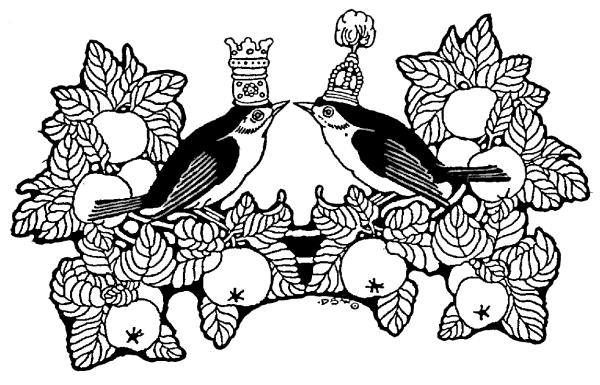
"And wherever you go, be sure to conduct yourselves like the Children of the King of the Birds," said the Mother.

"It's because we were reared in such a fine nest," said another little wren. "No other birds in the world had ever a finer nest than we have had. That's the reason we're called the Children of the King of the Birds."

"Men call the Wren the King of the Birds," said the Father Wren, as he flew up on a tree, "and surely men ought to know who is the King of the Birds."

"Why do men call the Wren the King of the Birds?" said the little wrens.

"I will tell you," said the Mother. "As we fly from the wall to the tree, and from the tree back to the wall, I will tell you why men honor the wren as the King of the Birds."

She spent a whole day telling the little wrens the story and the Boy Who Knew What the Birds Said was there, and he heard the whole of it.—


The King of the Hither-side of the Mountain conquered the two villages of Half-a-Loaf and Windy-Gap, and the very day he conquered he ordered the two Headmen to come before him.

"You two Headmen are to see that your villages, Half-a-Loaf and Windy-Gap, send me my rightful tribute," said the King to them.

"There isn't much we can send...." said the Headman of Half-a-Loaf.

"A string of salmon," said the Headman of Windy-Gap.

"A basket of plover's eggs," said the Headman of Half-a-Loaf.

"No," said the King, "the tribute that each of your villages must send me is the King of the Birds."

The two Headmen went back to their villages, and that very day each told at the council what tribute the King had ordered them to send. "The King of the Birds," said the people of Half-a-Loaf, "that's the Eagle surely." "The King of the Birds," said the people of Windy-Gap. "What Bird might that be? We'll have to give thought to this."

The people of Windy-Gap thought about it and thought about it, but the people of Half-a-Loaf declared there was no doubt at all about it—the Eagle was the King of the Birds. And while the people of Windy-Gap were thinking and pondering the people of Half-a-Loaf were sending their young men off to catch an eagle.

But an eagle is a hard fowl to catch, and the people of Half-a-Loaf found they had to send all of their young men out and to send them out every day. And the young men climbed high hills and stony ditches, and they searched the east and they hunted the west; they went out at sunrise and they came back at sunset, but never an eagle did they bring with them.

"It may be that the Eagle is the King of the Birds," said the people of Windy-Gap, "but we had better consider it."

They thought about it from sunrise to sunset; they thought about it while they plowed their fields and sowed them, while they spun their cloth and made their coats, while they mended their nets and mended their shoes, while they thatched their roofs and planted their apple-trees.

And in Half-a-Loaf there was few left to plow the fields and sow them, to spin cloth and to make coats, to mend nets and to mend shoes, to thatch roofs and to plant apple-trees—there was few left to do these things for all the young men were out on the mountain hunting for an eagle.

"The people of Windy-Gap will be ruined," said the people of Half-a-Loaf, "they have done nothing yet to catch the Eagle. When the King gets no tribute from them he'll come down and sell them and their village. Call the young men back that have gone into the fields to work and send them up the mountain again."

At last the people of Half-a-Loaf caught their Eagle—a great golden Eagle he was. They built for him a shed and they fed him on what lambs they had that year.

"We're safe anyway," said the people of Half-a-Loaf, "but the unfortunate folk in Windy-Gap have lost their chance. They'll not have time to catch an eagle now."

The time was coming near when the two villages would have to send their tribute to the King.

"We have our Eagle," said the people of Half-a-Loaf, "But O, Bad Fortune! we have hardly a crop growing. This will be a hard year for us—we haven't lambs to grow into sheep even."

"We have our crops," said the people of Windy-Gap, "but, Bad Cess to it! What are we to do about paying our tribute to the King?"

And still they couldn't decide whether it was the Eagle or the Cuckoo or the Woodpecker that was King of the Birds. They were still considering it when the King's Messenger came to bid them come with their tribute to the King's Castle.

What were the people of Windy-Gap to do? They searched round and about but no bird at all could they find. And then as he was being marched off the Headman put his hand under the thatch of his house and took out a Wren that was sheltering there. He put the Wren under his hat and went off with the King's Messenger.

And there, before him on the way to the King's Castle was the Headman of Half-a-Loaf. The riders of the village were with him and they bore their golden Eagle most triumphantly.

"Give to my Falconer the King of the Birds," said the King.

The Headman of Half-a-Loaf presented the Eagle.

"It is well," said the King, "and where have you," said he to the Headman of Windy-Gap, "bestowed the King of the Birds?"

The Headman put his hand under his hat and handed over the Wren to the King's Falconer.

"Tush," said the King, "Why do you call this the King of the Birds?"

The Headman of Windy-Gap was going to say "Because his family is great," but he said instead "Because he flies the highest, my lord."

"If it be truth it's unknown to me," said the King, "but it shall be tried out."

Then said he to the Royal Falconer, "Let the Eagle and the Wren soar together. And when the Eagle outsoars the Wren it shall be proved that the Headman of Windy-Gap is a catiff, and his village and everyone in it will be sold to the Saracens. But if it so happens that the Wren outsoars the Eagle, the tribute sent from the village of Windy-Gap must be accepted."

The Eagle and the Wren rose from the same perch and soared up together. Up and up the Eagle went. "So far my father went, but I shall go farther," said the Eagle. Higher and higher he rose. "So far my grandfather went but I shall go farther." Farther and farther he soared. "So far went my great-grandfather, and no eagle again will fly so high." His wings were stiff and tired. "No bird will ever out-soar this flight of mine," said the Eagle.

He went to close his wings so that he might rest them as he went down. But as he did the Wren came from under his wings.

Up went the Wren, down went the Eagle. Up and up went the Wren. He had been resting while the Eagle had been flying, and now he was able to soar past the point the Eagle had reached at his dead-best.

"No bird will ever out-soar this flight of mine," said the Eagle. 


The Eagle flew down and lighted on the Falconer's perch. "Has he flown high, Falconer?" asked the King. "No bird has flown so high," said the Falconer. "By the rime on his wings he has gone into the line of frost."

"The Eagle is King of the Birds and no one can deny it," said the King. "The village of Windy-Gap has not sent me my tribute."

"Mercy," said the Headman of Windy-Gap.

"The village and all in it shall be sold to the Saracens," said the King.

Just then the Wren came down and lighted on the perch beside the Eagle. "Where did the Wren fly to?" said the King. "By my glove," said the Falconer "he soared past the line of frost, and went into the line of snow, for what's on his feathers is a drop of snow."

"The Wren is King of the Birds," said the Headman of Windy-Gap.

"Yes, King of the Birds," said the King, "and, therefore, my lawful tribute."

And so, for ever after the villages sent to the King, not an Eagle, but a Wren as tribute. And in no village ever after were the lands unplowed and the fields unsown, the cloth unspun and the coats not made, the roofs unthatched and the apple-trees unplanted. And in every village in the hollow and on the height the people shouted for the Wren—"The Wren, the Wren, the King of all Birds."

*************************

May the present situation change so once again the lands are being plowed (Ukraine has long been the bread basket of Europe and beyond), the fields sown, the cloth spun and coats made, the roofs thatched (and the incredible amount of reconstruction needed), and apple trees and other trees replanted.

For those seeking a picture book version, Jane Goodall created a fable based on her remembrance of a story she and her sister heard nightly.  She doesn't name the book where it was found and probably no longer recalls it.  The incident of the wren hiding in the eagle's wing occurs, but it occurs because there's a contest among the birds.  She uses the fable format to illustrate the idea of teamwork and need for everyone to have a little help now and then.  

Was it the same story?  Did her memory shape her view of it?

Similarly I could swear there's a Native American version, but couldn't find it.

Among storytellers the question of "should we state the moral at the end of a fable or not" is often discussed.  Goodall clearly believes it should, although the Horn Book review faults her for the book being "heavy on message."  The explanation storytellers often give for NOT stating a conclusion to a story is it can and should mean many different things to the many different members of your audience.  Teachers can check this, if they wish, by offering a story and then asking students what the story might be trying to teach.  In a discussion it might become obvious we all hear what we need or want to hear.

Similarly there are many views of the current invasion.  I pray it ends well and actually has an ending since it's stirring up events dating back to times many believed were settled.

*********************


This is part of a series of postings of stories under the category, "Keeping the Public in Public Domain."  The idea behind Public Domain was to preserve our cultural heritage after the authors and their immediate heirs were compensated.  I feel strongly current copyright law delays this intent on works of the 20th century.  My own library of folklore includes so many books within the Public Domain I decided to share stories from them.  I hope you enjoy discovering new stories.  


At the same time, my own involvement in storytelling regularly creates projects requiring research as part of my sharing stories with an audience.  Whenever that research needs to be shown here, the publishing of Public Domain stories will not occur that week.  This is a return to my regular posting of a research project here.  (Don't worry, this isn't dry research, my research is always geared towards future storytelling to an audience.)  Response has convinced me that "Keeping the Public in Public Domain" should continue along with my other postings as often as I can manage it.
Other Public Domain story resources I recommend-
  • There are many online resources for Public Domain stories, maybe none for folklore is as ambitious as fellow storyteller, Yoel Perez's database, Yashpeh, the International Folktales Collection.  I have long recommended it and continue to do so.  He has loaded Stith Thompson's Motif Index into his server as a database so you can search the whole 6 volumes for whatever word or expression you like by pressing one key. http://folkmasa.org/motiv/motif.htm
  • You may have noticed I'm no longer certain Dr. Perez has the largest database, although his offering the Motif Index certainly qualifies for those of us seeking specific types of stories.  There's another site, FairyTalez claiming to be the largest, with "over 2000 fairy tales, folktales, and fables" and they are "fully optimized for phones, tablets, and PCs", free and presented without ads.

    Between those two sites, there is much for story-lovers, but as they say in infomercials, "Wait, there's more!"
The email list for storytellers, Storytell, discussed Online Story Sources and came up with these additional suggestions:            
         - David K. Brown - http://people.ucalgary.ca/~dkbrown/stories.html
         - Richard Martin - http://www.tellatale.eu/tales_page.html
         - Spirit of Trees - http://spiritoftrees.org/featured-folktales
         - Story-Lovers - http://www.story-lovers.com/ is now only accessible through the Wayback Machine, described below, but the late Jackie Baldwin's wonderful site lives on there, fully searchable manually (the Google search doesn't work), at https://archive.org/ .  It's not easy, but go to Story-lovers.com snapshot for October 22 2016  and you can click on SOS: Searching Out Stories to scroll down through the many story topics and click on the story topic that interests you.
       - World of Tales - http://www.worldoftales.com/ 
           - Zalka Csenge Virag - http://multicoloreddiary.blogspot.com doesn't give the actual stories, but her recommendations, working her way through each country on a continent, give excellent ideas for finding new books and stories to love and tell.
     
You're going to find many of the links on these sites have gone down, BUT go to the Internet Archive Wayback Machine to find some of these old links.  Tim's site, for example, is so huge probably updating it would be a full-time job.  In the case of Story-Lovers, it's great that Jackie Baldwin set it up to stay online as long as it did after she could no longer maintain it.  Possibly searches maintained it.  Unfortunately Storytell list member, Papa Joe is on both Tim Sheppard's site and Story-Lovers, but he no longer maintains his old Papa Joe's Traveling Storytelling Show website and his Library (something you want to see!) is now only on the Wayback Machine.  It took some patience working back through claims of snapshots but finally in December of 2006 it appears!
    Somebody as of this writing whose stories can still be found by his website is the late Chuck Larkin - http://chucklarkin.com/stories.html.  I prefer to list these sites by their complete address so they can be found by the Wayback Machine, a.k.a. Archive.org, when that becomes the only way to find them.
You can see why I recommend these to you. Have fun discovering even more stories!


Friday, July 30, 2021

Cooper - A Quartet of Tree Fables from The Argosy of Fables - Keeping the Public in Public Domain

White Lake Township in Michigan is right next to my own township.  I often substitute at their library and there is the huge Pontiac Lake State Recreation Area and the Indian Springs metropark as two major places where I take my malamutt (malamute/husky) for some of our roughly every other day hikes.

Photo by Lukasz Szmigiel on Unsplash

That township is currently trying to get disaster recognition after this past weekend's tornado.  Yes, our area had trees toppled and branches torn off, but it's painful in White Lake.  Traveling through the township through the middle of this past week was an obstacle course as some roads were closed (some still are) and everywhere tried to cope with the damage.  Trees overnight have gone from something that looked like this 

Instead to something a bit closer to these two photos, except both are more orderly.

Photo by Ca Ku on Unsplash


Photo by Annie Spratt on Unsplash


Those photos may eventually look like the area with a semblance of order, but right now trees are uprooted, laying all over.  

Right now it just hurts to see the randomness of damage that was done with a heavy blow.  It's not like the horrible fires decimating the western U.S. in the sense that it seems so very random.  Scientists have been discussing the consciousness and possible communication of trees in recent years.  A good example is the March 2018 Smithsonian article "Do Trees Talk to Each Other?" I would hate to hear them shouting and crying out right now.  It all seems rather like J.R.R. Tolkien's the Ents.  (If you don't recognize who they are, I strongly recommend learning.  Trees may never seem the same to you.)

From ancient times trees have been with us, so it's no wonder they even are in fables.  I found four in An Argosy of Fable selected and edited by Frederic Taber Cooper.  The book starts with Classical Fables and the ones I've selected are in that section by Aesop and Phaedrus.  Aesop opens and closes this group of four.


Argosy has other less prolific classical fabulists, then continues with "Oriental Fables" (Hindoo [sic], Persian, Chinese, Armenian and Turkish), then goes on to "Modern Fables" (English, French, Spanish, Russian, German, Polish) and finally a section called "Kraal and Wigwam Fables" (African and American Indian).  Some of those have been given here in earlier blogs.  Obviously Cooper not only selected but edited a work that attempts to cover the teachings of a great many cultures.  It's interesting that the Wikipedia article says so little about him personally (although his Latin and Sanskrit professorship gives a hint) and somehow doesn't even list the Argosy.

If the trees have any wisdom or thoughts I suspect these four fables give a hint of their thoughts at this time.  Anthropomorphic?  Perhaps, but it hurts to see their present condition.

I believe the Jewish fable of the old man planting trees he'll never see grow is appropriate here.  His answer is that he's planting them for the next generation.  I've long talked about Arbor Day and the Arbor Day Foundation.  I don't know if baby trees can save the western part of our country, but I certainly hope, here in the middle and beyond, trees continue to provide shade, be useful, and beautiful while adding their necessary oxygen to our planet.

******************

This is part of a series of postings of stories under the category, "Keeping the Public in Public Domain."  The idea behind Public Domain was to preserve our cultural heritage after the authors and their immediate heirs were compensated.  I feel strongly current copyright law delays this intent on works of the 20th century.  My own library of folklore includes so many books within the Public Domain I decided to share stories from them.  I hope you enjoy discovering new stories.  


At the same time, my own involvement in storytelling regularly creates projects requiring research as part of my sharing stories with an audience.  Whenever that research needs to be shown here, the publishing of Public Domain stories will not occur that week.  This is a return to my regular posting of a research project here.  (Don't worry, this isn't dry research, my research is always geared towards future storytelling to an audience.)  Response has convinced me that "Keeping the Public in Public Domain" should continue along with my other postings as often as I can manage it.
Other Public Domain story resources I recommend-
  • There are many online resources for Public Domain stories, maybe none for folklore is as ambitious as fellow storyteller, Yoel Perez's database, Yashpeh, the International Folktales Collection.  I have long recommended it and continue to do so.  He has loaded Stith Thompson's Motif Index into his server as a database so you can search the whole 6 volumes for whatever word or expression you like by pressing one key. http://folkmasa.org/motiv/motif.htm
  • You may have noticed I'm no longer certain Dr. Perez has the largest database, although his offering the Motif Index certainly qualifies for those of us seeking specific types of stories.  There's another site, FairyTalez claiming to be the largest, with "over 2000 fairy tales, folktales, and fables" and they are "fully optimized for phones, tablets, and PCs", free and presented without ads.

    Between those two sites, there is much for story-lovers, but as they say in infomercials, "Wait, there's more!"
The email list for storytellers, Storytell, discussed Online Story Sources and came up with these additional suggestions:            
         - David K. Brown - http://people.ucalgary.ca/~dkbrown/stories.html
         - Richard Martin - http://www.tellatale.eu/tales_page.html
         - Spirit of Trees - http://spiritoftrees.org/featured-folktales
         - Story-Lovers - http://www.story-lovers.com/ is now only accessible through the Wayback Machine, described below, but the late Jackie Baldwin's wonderful site lives on there, fully searchable manually (the Google search doesn't work), at https://archive.org/ .  It's not easy, but go to Story-lovers.com snapshot for October 22 2016  and you can click on SOS: Searching Out Stories to scroll down through the many story topics and click on the story topic that interests you.
       - World of Tales - http://www.worldoftales.com/ 
           - Zalka Csenge Virag - http://multicoloreddiary.blogspot.com doesn't give the actual stories, but her recommendations, working her way through each country on a continent, give excellent ideas for finding new books and stories to love and tell.
     
You're going to find many of the links on these sites have gone down, BUT go to the Internet Archive Wayback Machine to find some of these old links.  Tim's site, for example, is so huge probably updating it would be a full-time job.  In the case of Story-Lovers, it's great that Jackie Baldwin set it up to stay online as long as it did after she could no longer maintain it.  Possibly searches maintained it.  Unfortunately Storytell list member, Papa Joe is on both Tim Sheppard's site and Story-Lovers, but he no longer maintains his old Papa Joe's Traveling Storytelling Show website and his Library (something you want to see!) is now only on the Wayback Machine.  It took some patience working back through claims of snapshots but finally in December of 2006 it appears!
    Somebody as of this writing whose stories can still be found by his website is the late Chuck Larkin - http://chucklarkin.com/stories.html.  I prefer to list these sites by their complete address so they can be found by the Wayback Machine, a.k.a. Archive.org, when that becomes the only way to find them.
You can see why I recommend these to you. Have fun discovering even more stories!