This past week has been frustrating, with computer problems that seem to keep multiplying.
http://www.quotesvalley.com has a section of quotes on
computers/ and here are two of the most appropriate:
 and
and
with those ideas to guide me I went looking for appropriate stories. The Shoemaker's Apron: A Second Book of Czechoslovak Fairy Tales and Folk Tales by Parker Fillmore has not one, two, or even three, but four tales about the devil and by going to https://www.gutenberg.org/ , even as my computer slowly tries to return my backed up data, I was able to bring today's story. (That's the link for the whole book, so you can go there for the other three stories and the other non-devilish tales.) I'll say a bit more about the book afterwards. Unfortunately, since I couldn't scan the individual pages of my own book, the story proceeds without breaks making it a bit unwieldy.
One quick warning, the old Czechoslovakian belief has all devils appear black. Politically correct? No. As someone telling the story today I might say blackened. I notice, however, the Devil himself, as opposed to his lesser apprentice devils, is able to appear normal and then reveal his true blackened appearance. The blackened coloring of the young man who goes to work for the Devil is easily explained within the story from his long seven years working in Hell. It's similar to the appearance and fate of the main character in the Brothers Grimm's "Bear Skinner" and the Russian tale of "Never-Wash" I posted this summer.
THE DEVIL'S LITTLE BROTHER-IN-LAW
THE STORY OF A YOUTH WHO COULDN'T FIND WORK
THE DEVIL'S LITTLE BROTHER-IN-LAW
Once upon a time there was a youth named
Peter. He was the son of a rich farmer but
on his father's death his stepmother robbed him of
his inheritance and drove him out into the world,
penniless and destitute.
"Begone with you now!" she shouted. "Never
let me see your face again!"
"Where shall I go?" Peter asked.
"Go to the Devil, for all I care!" the stepmother
cried and slammed the door in his face.
Peter felt very sad at being driven away from
the farm that had always been his home, but he was
an able-bodied lad, industrious and energetic, and he
thought he would have no trouble making his way
in the world.
He tramped to the next village and stopped at a
big farmhouse. The farmer was standing at the
door, eating a great hunk of buttered bread.
Peter touched his hat respectfully and said:
"Let every one praise Lord Jesus!"
With his mouth stuffed full, the farmer responded:
"Until the Day of Judgment!" Then in a
different tone he demanded: "What do you want?"
"I'm looking for work," Peter said. "Do you
need a laborer?"
Peter was well dressed for he had on the last
clothes his kind father had given him. The farmer
looked him over and sneered.
"A fine laborer you would make! You would do
good work at meals—I see that, and spend the rest
of your time at cards and teasing the maids! I
know your kind!"
Peter tried to tell the farmer that he was industrious
and steady but with an oath the farmer told him to
go to the Devil. Then stepping inside the house he
slammed the door in Peter's face.
In the next village he applied for work at the
bailiff's house. The bailiff's wife answered his knock.
"The master is playing cards with two of his
friends," she said. "I'll go in and ask him if he
has anything for you to do."
Peter heard her speak to some one inside and then
a rough voice bellowed out:
"No! How often have I told you not to interrupt
me when I'm busy! Tell the fellow to go to the
Devil!"
Without waiting for the bailiff's wife, Peter turned
away. Tired and discouraged he took a path into
the woods and sat down.
"There doesn't seem to be any place for me in
all the world," he thought to himself. "They all tell
me to go to the Devil—my stepmother, the farmer,
and now the bailiff. If I knew the way to hell I
think I'd take their advice. I'm sure the Devil would
treat me better than they do!"
Just then a handsome gentleman, dressed in green,
walked by. Peter touched his hat politely and said:
"Let every one praise Lord Jesus."
The man passed him without responding. Then he
looked back and asked Peter why he looked so
discouraged.
"I have reason to look discouraged," Peter said.
"Everywhere I ask for work they tell me to go to
the Devil. If I knew the way to hell I think I'd
take their advice and go."
The stranger smiled.
"But if you saw the Devil, don't you think you'd
be afraid of him?"
Peter shook his head.
"He can't be any worse than my stepmother, or
the farmer, or the bailiff."
The man suddenly turned black.
"Look at me!" he cried. "Here I am, the very
person we've been talking about!"
With no show of fear Peter looked the Devil up
and down.
Then the Devil said that if Peter still wished to
enter his service, he would take him. The work
would be light, the Devil said, and the hours good, and
if Peter did as he was told he would have a pleasant
time. The Devil promised to keep him seven years
and at the end of that time to make him a handsome
present and set him free.
Peter shook hands on the bargain and the Devil,
taking him about the waist, whisked him up into the
air, and, pst! before Peter knew what was happening,
they were in hell.
The Devil gave Peter a leather apron and led
him into a room where there were three big cauldrons.
"Now it's your duty," the Devil said, "to keep the
fires under these cauldrons always burning. Keep
four logs under the first cauldron, eight logs under
the second, and twelve under the third. Be careful
never to let the fires go out. And another thing,
Peter: you're never to peep inside the cauldrons. If
you do I'll drive you away without a cent of wages.
Don't forget!"
So Peter began working for the Devil and the
treatment he received was so much better than that
which he had had on earth that, sometimes, it seemed
to him he was in heaven rather than hell. He had
plenty of good food and drink and, as the Devil had
promised him, the work was not heavy.
For companions he had the young apprentice devils,
a merry black crew, who told droll stories and played
amusing pranks.
Time passed quickly. Peter was faithful at his work
and never once peeped under the lids of his three
cauldrons.
At last he began to grow homesick for the world
and one day he asked the Devil how much longer he
had still to serve.
"Tomorrow," the Devil told him, "your seven years
are up."
The next day while Peter was piling fresh logs under
the cauldrons, the Devil came to him and said:
"Today, Peter, you are free. You have served
me faithfully and well and I am going to reward you
handsomely. Money would be too heavy for you to
carry, so I am going to give you this bag which
is a magic bag. Whenever you open it and say: 'Bag,
I need some ducats,' the bag will always have just as
many as you need. Good luck go with you, Peter.
However, I don't believe you'll have a very good time
at first for people will think you're a devil. You know
you do look pretty black for you haven't washed for
seven years and you haven't cut your hair or nails."
"That's true," said Peter. "I just remember I
haven't washed ever since I've been down here. I
certainly must take a bath and get my hair cut and
my nails trimmed."
The Devil shook his head.
"No, Peter, one bath won't do it. Water won't
wash off the kind of black you get down here. I
know what you must do but I won't tell you just yet.
Go up into the world as you are and, if ever you need
me, call me. If the people up there ask you who
you are, tell them you're the Devil's little brother-in-law.
This isn't a joke. It's true as you'll find
out some day."
Peter then took leave of all the little black apprentices
and the Devil, lifting him on his back, whisked
him up to earth and set him down in the forest on
exactly the same spot where they had met seven years
before.
The Devil disappeared and Peter, stuffing the magic
bag in his pocket, walked to the nearest village.
His appearance created a panic. On sight of him
the children ran screaming home, crying out:
"The Devil! The Devil is coming!"
Mothers and fathers ran out of the houses to see
what was the matter but on sight of Peter they ran
in again, barred all the doors and windows, and making
the sign of the cross prayed God Almighty to protect
them.
Peter went on to the tavern. The landlord and his
wife were standing in the doorway. As Peter came
toward them, they cried out in fright:
"O Lord, forgive us our sins! The Devil is
coming!"
They tried to run away but they tripped over each
other and fell down, and before they could scramble
to their feet Peter stood before them.
He looked at them for a moment and laughed.
Then he went inside the tavern, sat down, and said:
"Landlord, bring me a drink!"
Quaking with fright the landlord went to the cellar
and drew a pitcher of beer. Then he called the little
herd who was working in the stable.
"Yirik," he said to the boy, "take this beer into
the house. There's a man in there waiting for it. He's
a little strange looking but you needn't be afraid. He
won't hurt you."
Yirik took the pitcher of beer and started in. He
opened the door and then, as he caught sight of
Peter, he dropped the pitcher and fled.
The landlord scolded him angrily.
"What do you mean," he shouted, "not giving
the gentleman his beer? And breaking the pitcher,
too! The price of it will be deducted from your
wages! Draw another pitcher of beer and place it
at once before the gentleman."
Yirik feared Peter but he feared the landlord more.
He was an orphan, poor lad, and served the landlord
for his keep and three dollars a year.
So with trembling fingers he drew a pitcher of beer
and then, breathing a prayer to his patron saint, he
slowly dragged himself into the tavern.
"There, there, boy," Peter called out kindly. "You
needn't be afraid. I'm not going to hurt you. I'm
not the Devil. I'm only his little brother-in-law."
Yirik took heart and placed the beer in front of
Peter. Then he stood still, not daring to raise his eyes.
Peter began asking him about himself, who he
was, how he came to be working for the landlord, and
what kind of treatment he was receiving. Yirik
stammered out his story and as he talked he forgot his
fear, he forgot that Peter looked like a devil, and
presently he was talking to him freely as one friend
to another.
Peter was touched by the orphan's story and, pulling
out his magic money bag, he filled Yirik's cap with
golden ducats. The boy danced about the room with
delight. Then he ran outside and showed the landlord
and the people who had gathered the present
which the strange gentleman had made him.
"And he says he's not the Devil," Yirik reported,
"but only his brother-in-law."
When the landlord heard that Peter really hadn't
any horns or a flaming tongue, he picked up courage
and going inside he begged Peter to give him, too,
a few golden ducats. But Peter only laughed at him.
Peter stayed at the tavern overnight. Just as he
fell asleep some one shook his hand and, as he opened
his eyes, he saw his old master standing beside him.
"Quick!" the Devil whispered. "Get up and hurry
out to the shed! The landlord is about to murder
the orphan for his money."
Peter jumped out of bed and ran outside to the
shed where Yirik slept. He burst open the door
just as the landlord was ready to stab the sleeping
boy with a dagger.
"You sinner!" Peter cried. "I've caught you at
last! Off to hell you go with me this instant to stew
forever in boiling oil!"
The landlord fainted with terror. Peter dragged
him senseless into the house. When he came to himself
he fell on his knees before Peter and begged for
mercy. He offered Peter everything he possessed if
only Peter would grant him another chance and he
solemnly vowed that he would repent and give up
his evil ways.
At last Peter said:
"Very well. I'll give you another chance provided
that, from this time on, you treat Yirik as your son.
Be kind to him and send him to school. The moment
you forget your promise and treat him cruelly, I'll
come and carry you off to hell! Remember!"
There was no need to urge the landlord to remember.
From that night he was a changed man. He became
honest in all his dealings and he really did treat Yirik
as though he were his own son.
Peter stayed on at the tavern and stories about
him and his golden ducats began to spread through
the country-side. The prince of the land heard of
him and sent word that he would like to see him at
the castle. Peter answered the prince's messenger
that if the prince wished to see him he could come to
the tavern.
"Who is this prince of yours," Peter asked the
landlord, "and why does he want to see me?"
"He'd probably like to borrow some money from
you," the landlord said. "He's deep in debt for he
has two of the wickedest, most extravagant daughters
in the world. They're the children of his first
marriage. They are proud and haughty and they
waste the money of the realm as though it were so
much sand. The people are crying out against them
and their wasteful ways but the prince seems unable
to curb them. The prince has a third daughter, the
child of his second wife. Her name is Angelina and
she certainly is as good and beautiful as an angel.
We call her the Princess Linka. There isn't a man in
the country that wouldn't go through fire and water
for her—God bless her! As for the other two—may
the Devil take them!"
Suddenly remembering himself, the landlord clapped
his hand to his mouth in alarm.
Peter laughed good-humoredly.
"That's all right, landlord. Don't mind me. As
I've told you before I'm not the Devil. I'm only his
little brother-in-law."
The landlord shook his head.
"Yes, I know, but I must say it seems much the
same to me."
One afternoon the prince came riding down to
the tavern and asked for Peter. He was horrified
at first by Peter's appearance, but he treated him most
politely, invited him to the castle, and ended by begging
the loan of a large sum of money.
Peter said to the prince:
"I'll give you as much money as you want provided
you let me marry one of your daughters."
The prince wasn't prepared for this but he needed
money so badly that he said:
"H'm, which one of them?"
"I'm not particular," Peter answered. "Any of
them will do."
When he gave the prince some money in advance,
the prince agreed and Peter promised to come to the
castle the next day to meet his bride to be.
The prince when he got home told his daughters
that he had seen Peter. They questioned him about
Peter's appearance and asked him what sort of a looking
person this brother-in-law of the Devil was.
"He isn't so very ugly," the prince said, "really he
isn't. If he washed his face and trimmed his hair and
nails he'd be fairly good-looking. In fact I rather like
him."
He then talked to them very seriously about the
state of the treasury and he told them that unless he
could raise a large sum of money shortly there was
danger of an uprising among the people.
"If you, my daughters, wish to see the peace of the
country preserved, if you want to make me happy
in my old age, one of you will have to marry this
young man, for I see no other way to raise the
money."
At this the two older princesses tossed their heads
scornfully and laughed loud and long.
"You may rest assured, dear father, that neither of
us will marry such a creature! We are the daughters
of a prince and won't marry beneath us, no, not even
to save the country from ruin!"
"Then I don't know what I'll do," the prince said.
"Father," whispered Linka, the youngest. Her
voice quavered and her face turned pale. "Father,
if your happiness and the peace of the country depend
on this marriage, I will sacrifice myself, God help
me!"
"My child! My dear child!" the prince cried, taking
Linka in his arms and kissing her tenderly.
The two elder sisters jeered and ha-ha-ed.
"Little sister-in-law of the Devil!" they said mockingly.
"Now if you were to marry Prince Lucifer
himself that would be something, for at least you would
be a princess! But only to be his sister-in-law—ha!
ha!—what does that amount to?"
And they laughed with amusement and made nasty
evil jokes until poor little Linka had to put her hands
to her ears not to hear them.
The next day Peter came to the castle. The older
sisters when they saw how black he was were glad
enough they had refused to marry him. As for Linka,
the moment she looked at him she fainted dead away.
When she revived the prince led her over to Peter
and gave Peter her hand. She was trembling violently
and her hand was cold as marble.
"Don't be afraid, little princess," Peter whispered
to her gently. "I know how awful I look. But
perhaps I won't always be so ugly. I promise you,
if you marry me, I shall always love you dearly."
Linka was greatly comforted by the sound of his
pleasant voice, but each time she looked at him she
was terrified anew.
Peter saw this and made his visit short. He handed
out to the prince as much money as he needed and then,
after agreeing to return in eight days for the wedding,
he hurried off.
He went to the place where he had met the Devil
the first time and called him by name with all his
might.
The Devil instantly appeared.
"What do you want, little brother-in-law?"
"I want to look like myself again," Peter said.
"What good will it do me to marry a sweet little
princess and then have the poor girl faint away every
time she looks at me!"
"Very well, brother-in-law. If that is how you
feel about it, come along with me and I'll soon make
you into a handsome young man."
Peter leaped on the Devil's back and off they flew
over mountains and forests and distant countries.
They alighted in a deep forest beside a bubbling
spring.
"Now, little brother-in-law," the Devil said, "wash
in this water and see how handsome you'll soon be."
Peter threw off his clothes and jumped into the
water and when he came out his skin was as beautiful
and fresh as a girl's. He looked at his own reflection
in the spring and it made him so happy that he
said to the Devil:
"Brother-in-law, I'm more grateful to you for this
than for all the money you've given me. Now my
dear Linka will love me!"
He put his arms about the Devil's neck and off
they flew once again. This time they went to a big
city where Peter bought beautiful clothes and jewels
and coaches and horses. He engaged servants in fine
livery and, when he was ready to go to his bride, he
had a following that was worthy of any prince.
At the castle the Princess Linka paced her
chamber pale and trembling. The two older sisters
were with her, laughing heartlessly and making evil
jokes, and running every moment to the window to
see if the groom were coming.
At last they saw in the distance a long line of
shining coaches with outriders in rich livery. The
coaches drew up at the castle gate and from the first
one a handsome youth, arrayed like a prince, alighted.
He hurried into the castle and ran straight upstairs
to Linka's chamber.
At first Linka was afraid to look at him for she
supposed he was still black. But when he took her
hand and whispered: "Dear Linka, look at me now
and you won't be frightened," she looked and it
seemed to her that Peter was the very handsomest
young man in all the world. She fell in love with
him on sight and I might as well tell you she's been
in love with him ever since.
The two older sisters stood at the window frozen
stiff with envy and surprise. Suddenly they felt some
one clutch them from behind. They turned in fright
and who did they see standing there but the Devil
himself!
"Don't be afraid, my dear brides," he said. "I'm
not a common fellow. I'm Prince Lucifer himself.
So, in becoming my brides you are not losing
rank!"
Then he turned to Peter and chuckled.
"You see now, Peter, why you are my brother-in-law.
You're marrying one sister and I'm taking the
other two!"
With that he picked up the two wicked sisters
under his arm and
puff! with a whiff of sulphur they
all three disappeared through the ceiling.
The Princess Linka as she clung to her young
husband asked a little fearfully:
"Peter, do you suppose we'll have to see our brother-in-law
often?"
"Not if you make me a good wife," Peter said.
And you can understand what a good wife Linka
became when I tell you that never again all her life
long did she see the Devil.
***********
Yes, the youngest daughter and her two wicked sisters is a familiar traditional touch in this tale that could be said to end justly for the wicked and "happily ever after for Peter and Linka."
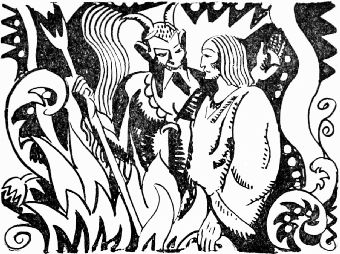
This story only opens with a picture from
Jan Matulka, but his work in this book and in the earlier
Czechoslovak Fairy Tales by Parker Fillmore is worth seeing. That link is from Wikipedia, but a search under his name will show he has much more to be found.
As for the book itself, Fillmore explains:
The stories in this volume are all of Czech,
Moravian, and Slovak origin, and are to be
found in many versions in the books of folk tales
collected by Erben, Nemcova, Kulda, Dobsinsky,
Rimavsky, Benes-Trebizsky, Miksicek. I got them first
by word of mouth and afterwards hunted them out in
the old books. My work has been that of retelling rather
than translating since in most cases I have put myself
in the place of a storyteller who knows several forms of
the same story, equally authentic, and from them all
fashions a version of his own. It is of course always
the same story although told in one form to a group
of children and in another form to a group of soldiers.
The audience that I hope particularly to interest is the
English-speaking child.

I also like Fillmore's concluding comment of "Besides its fairy tales and folk tales the present
volume contains a cluster of charming little nursery
tales and a group of rollicking devil tales."
Rollicking indeed. The closest I've found are two highly enjoyable books by Natalie Babbitt,
The Devil's Storybook and
The Devil's Other Storybook, which now can also be found in a combined volume. Don't let the subtitle calling them "delightfully wicked stories" keep you away.
Well I may have had to work around my computer problems for today's story, but it all started by going to Fillmore's (and Babbitt's) books.
*************************
This
is part of a series of postings of stories under the category,
"Keeping the Public in Public Domain." The idea
behind Public Domain was to preserve our cultural heritage after the
authors and their immediate heirs were compensated. I feel
strongly current copyright law delays this intent on works of the
20th century. My
own library of folklore includes so many books within the Public
Domain I decided to share stories from them. I hope you enjoy
discovering new stories.

At
the same time, my own involvement in storytelling regularly creates
projects requiring research as part of my sharing stories with an
audience. Whenever that research needs to be shown here, the publishing
of Public Domain stories will not occur that week. This is a return to
my regular posting of a research project here. (Don't worry, this
isn't dry research, my research is always geared towards future
storytelling to an audience.) Response has convinced me that "Keeping
the Public in Public Domain" should continue along with my other
postings as often as I can manage it.
Other
Public Domain story resources I recommend-
There
are many online resources for Public Domain stories, maybe none for
folklore is as ambitious as fellow storyteller, Yoel Perez's
database, Yashpeh,
the International Folktales Collection. I have long
recommended it and continue to do so. He has loaded
Stith Thompson's Motif Index into his server as a database so
you can search the whole 6 volumes for whatever word or expression
you like by pressing one key. http://folkmasa.org/motiv/motif.htm
- You may have noticed I'm no
longer certain Dr. Perez has the largest database, although his
offering the Motif Index certainly qualifies for those of us seeking
specific types of stories. There's another site, FairyTalez
claiming to be the largest, with "over 2000 fairy tales,
folktales, and fables" and they are "fully optimized for
phones, tablets, and PCs", free and presented without ads.
Between those two sites, there
is much for story-lovers, but as they say in infomercials, "Wait,
there's more!"
The
email list for storytellers, Storytell,
discussed Online Story Sources and came up with these additional
suggestions:
-
Story-Lovers - http://www.story-lovers.com/ is now only accessible
through the Wayback Machine, described below, but Jackie Baldwin's
wonderful site lives on there, fully searchable manually (the Google
search doesn't work), at https://archive.org/ . It's not easy, but go to Story-lovers.com snapshot for October 22 2016 and you can click on SOS: Searching Out Stories to scroll down through the many story topics and click on the story topic that interests you.
You're
going to find many of the links on these sites have gone down, BUT
go to the Internet Archive
Wayback Machine to find some of these old links. Tim's
site, for example, is so huge probably updating it would be a
full-time job. In the case of Story-Lovers, it's great that
Jackie Baldwin set it up to stay online as long as it did after she
could no longer maintain it. Possibly searches maintained it.
Unfortunately Storytell list member, Papa Joe is on both Tim
Sheppard's site and Story-Lovers, but he no longer maintains his old
Papa Joe's Traveling Storytelling Show website and his Library
(something you want to see!) is now only on the Wayback Machine. It
took some patience working back through claims of snapshots but finally
in December of 2006 it appears!
Somebody
as of this writing whose stories can still be found by his website
is the late Chuck Larkin - http://chucklarkin.com/stories.html.
I prefer to list these sites by their complete address so they can
be found by the Wayback Machine, a.k.a. Archive.org, when that
becomes the only way to find them.
You
can see why I recommend these to you. Have fun
discovering even more stories!

.jpeg)