Back on April 18 I posted on Literacy and the "bones" of stories. Here's the bones of a fun story for Mother's Day. The great thing about Story Bones is you make the story your own and can learn it Quickly!
The "Be Nice" story about the mother who stroked her
pregnant-with-twins belly constantly saying, "Be nice." Nine months - no
births, nine years - no births - finally when the woman is in her
nineties and about to die, she gives birth to two old men who are
arguing, "No, no. please, you go first."
That's from Jackie Baldwin's wonderful S.O.S. -- Searching Out Stories section under Patience in section 9's Emotions, the General category. That same section, a bit further has The Human Condition and you might want to look there at Parenting stories, even though it says "Parenting - Discipline Stories." I particularly liked #4 there. What is it? A great idea for getting help with housecleaning. Look it up.
Her site won't be growing further, so you may want to know many of the suggestions on it came from fellow storytellers on the Storytell email list hosted by the National Storytelling Network. It's an excellent resource.
I'll be back next with a wonderful Public Domain story easily used for Memorial Day plus some resources on the holiday. (To see more, click on Keeping the Public in Public Domain where I frequently offer Public Domain stories too good to be forgotten. There are 64 so far and I'm only in the "D" authors working my way through my collection.)
Until then, Happy Mother's Day.
Showing posts with label literacy. Show all posts
Showing posts with label literacy. Show all posts
Saturday, May 10, 2014


Friday, April 18, 2014
"Just the facts, er bones, ma'am"
The old Dragnet t.v. show used to have a deadpan policeman say to people, "Just the facts, ma'am" (or sir). Storytellers tend to be like those witnesses, fleshing out a tale, bringing it to life. Still storytellers know the outline, called the bones of a story, gives room to personalize a story. Both the storyteller and the story listener come to a story with experiences shaping the way a story is told and heard. The bones, however, like a skeleton, form a framework worth uncovering.
Switching to a more modern television detective metaphor, if we take the "C.S.I." forensic approach we can reconstruct a story while staying true to its origins. But where can we dig up these bones?!? I have some favorite sources worth keeping handy.
Just this past week, in doing a Literacy Evening at a school, I used some of these bones as part of teaching how to tell stories. As storyteller, Donald Davis, puts it so well in his book, Writing as a Second Language,
 if you ask people: When you have a computer, you have the hardware, which is the computer itself, but you also have to have ______." It's true, people do say software, although one creative child first mentioned in my program you have to have a person. Davis goes on to ask: Do you have to have anything else besides hardware and software to work a computer program?
That is where I sometimes hear a person, but agree with Davis that Bill Gates's fortune came from the realization of the importance of language or what is now called an operating system and similarly, just as such language is important and has changed over the years it is crucial for children to hear language. Reading can help, although that is easier with a good spoken vocabulary, and reading alone can lead to occasional mispronunciation. Traditionally family stories and folklore helped children transition to reading and written language. I love the back of the book where Donald Davis quotes overhearing an actual elementary school teacher say: Stop talking! You're supposed to be working on language!
The elementary students I had this past week, with their parents, were young enough the children didn't know the word, outline. It was easy to show how my final story was squeezed in by knowing the bones. Those bones helped me give the essential 8 elements of the story and we all could "flesh it out" by thinking how the characters and place looked, sounded, and maybe even smelled to make a richer story.
I also was delighted with the way a Romanian mother there was keeping her children aware of her cultural background and, therefore, their family's background. As Ramon Royal Ross says in his book, Storyteller, "For storytelling, in all its richness and variations, is, ultimately, a way for people to know themselves and to know others."
Switching to a more modern television detective metaphor, if we take the "C.S.I." forensic approach we can reconstruct a story while staying true to its origins. But where can we dig up these bones?!? I have some favorite sources worth keeping handy.
- Conrad Bladey's website provided probably my first experience with story bones. All his 192 stories are Irish. I vividly remember a story there helping me teach a new storyteller to jump into the craft of storytelling. Some of the stories are barely an idea and require adding the basic story elements of beginning, middle and end. When I use his material in a workshop I either stick to what is truly a story or warn the briefest ones require more work.
- The work of Jackie Baldwin's wonderful Story-Lovers site looks as if it won't grow beyond what is currently online. For years Jackie incorporated suggestions from Storytell, an international email list for storytellers,while maintaining the privacy of contributors in her SOS, Searching Out Stories section as a type of searchable archive. Storytell, by the way, continues. The National Storytelling Network provides the list on its own website as a service to all. Go to Jackie's SOS to find those suggestions which often are in bones format with additional sources frequently given. Jackie's site is still up thanks to her planning for the day she would stop maintaining it.
- Talking about site continuance, while not part of actual bones, if you're ever digging up a site that has disappeared, use the Wayback Machine at the Internet Archive by taking the site address there to locate a past time when it appeared.
- In Germany English storyteller, Richard Martin, created a list of Tales to Read, with about a dozen so far in story bones format. They are Beth Gellert; Blood-Covered Vampire; Candle in the Barn; Death and the Gardener; Frightened Mouse; Kate Crackernuts; Miraculous Crane; One Innocent Farmer; Rabbi's Journey;
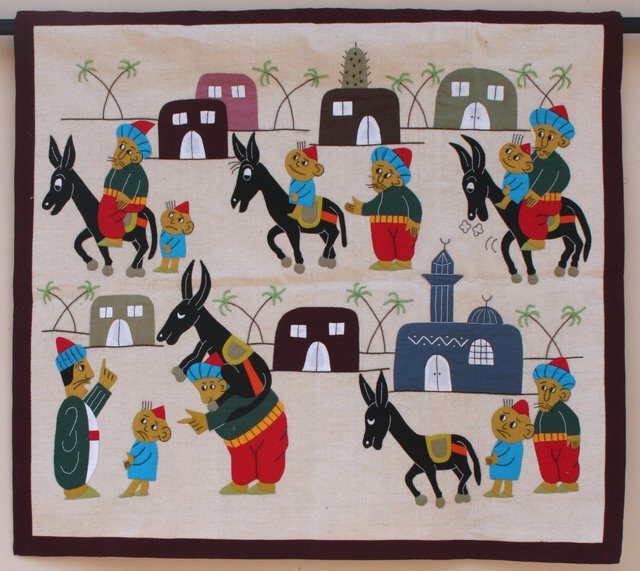
- Throughout the Middle East and beyond, from Egypt on into Turkey and the Islamic countries of the former Soviet Union a "wise fool" is told about. In Egypt he's called Goha. Turkey claims his origins as the Hodja, from back in the days of the ruler called Tamerlaine in English speaking countries. (That's a mispronunciation of Timur Ling, which means Timur the Lame, but his orthopedic difficulties were not something people pointed out in his presence for fear of being killed!) Stories about the Hodja are a favorite of mine and About Nasruddin has 15 tales fully told, but then you could go back to their summaries. The summaries don't quite work as bones by themselves, but after reading the story it would be almost complete.
- While the Hodja originates in Islam, Stories for Preaching and Teaching from Father Tommy Lane's site has a Christian focus, but like the Hodja, can fit needs way beyond religion.
Just this past week, in doing a Literacy Evening at a school, I used some of these bones as part of teaching how to tell stories. As storyteller, Donald Davis, puts it so well in his book, Writing as a Second Language,
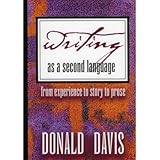
That is where I sometimes hear a person, but agree with Davis that Bill Gates's fortune came from the realization of the importance of language or what is now called an operating system and similarly, just as such language is important and has changed over the years it is crucial for children to hear language. Reading can help, although that is easier with a good spoken vocabulary, and reading alone can lead to occasional mispronunciation. Traditionally family stories and folklore helped children transition to reading and written language. I love the back of the book where Donald Davis quotes overhearing an actual elementary school teacher say: Stop talking! You're supposed to be working on language!
The elementary students I had this past week, with their parents, were young enough the children didn't know the word, outline. It was easy to show how my final story was squeezed in by knowing the bones. Those bones helped me give the essential 8 elements of the story and we all could "flesh it out" by thinking how the characters and place looked, sounded, and maybe even smelled to make a richer story.
I also was delighted with the way a Romanian mother there was keeping her children aware of her cultural background and, therefore, their family's background. As Ramon Royal Ross says in his book, Storyteller, "For storytelling, in all its richness and variations, is, ultimately, a way for people to know themselves and to know others."
Friday, July 22, 2011
Oral Literacy Starts with Storytelling
This month's post started after I was contacted by a teacher in Egypt working with new mothers. I've changed it a bit to fit (mainly) U.S. readers -- teachers, librarians, and parents -- interested in starting children on the road to oral literacy.
 One of the best aids to literacy is the use of "nursery rhymes." There are short simple rhymes meant for very young children
in many languages. I know such rhymes exist in Spanish and Chinese, but I've no
idea if there's anything comparable in the children's
literature of other cultures. I expect there is as such verbal play is important for toddlers. The benefit of such rhymes has less to do with story and more to
do with predictability of the rhyme and the creative use of language.
One of the best aids to literacy is the use of "nursery rhymes." There are short simple rhymes meant for very young children
in many languages. I know such rhymes exist in Spanish and Chinese, but I've no
idea if there's anything comparable in the children's
literature of other cultures. I expect there is as such verbal play is important for toddlers. The benefit of such rhymes has less to do with story and more to
do with predictability of the rhyme and the creative use of language.
One of the best aids to literacy is the use of "nursery rhymes." There are short simple rhymes meant for very young children
in many languages. I know such rhymes exist in Spanish and Chinese, but I've no
idea if there's anything comparable in the children's
literature of other cultures. I expect there is as such verbal play is important for toddlers. The benefit of such rhymes has less to do with story and more to
do with predictability of the rhyme and the creative use of language.
Dr. Betsy Diamant Cohen, http://www.mgol.org/ , offers ideas on the many ways
to use nursery rhymes. She travels a good deal, but you can email her at info@mgol.org or call 443-928-3915. She's a
very creative educator used to working with parents and teachers of preschool
children. There are various resources on her website and she has an occasional e-newsletter.
After such rhymes, I like to make up stories telling more about what
may have happened before, during, or after the rhyme. A similar
resource might be songs meant for young children. As the children get a bit
older, they can help make up such stories. L. Frank Baum, the author of the Oz books, did a similar book, Mother Goose in Prose. It's interesting to see another side of his creativity.
When teaching storytelling I find many beginners do well with these steps I learned years ago in Wordweaving training as a simple way to learn stories quickly and easily. As a children's librarian I needed to learn new programs with several stories weekly.
1. Select a story you want to tell.
2. Learn the structure and block the
story.
3. Visualize the settings and
characters.
4. See the action as if you’re
watching a silent movie.
5. Tell the story aloud, using your
voice to project the images you visualized.
6. Learn the story by heart, not word
for word.
7. Practice telling the story until it comes
naturally.
#2 mentions learning the structure of a story and
"blocking" it. You may think of this as "outlining" the minimum things
that must happen. Some people like to make a visual outline or "storyboard" by
folding a paper in 1/2 lengthwise, then take the folded paper and fold
it twice again so it has a total of 6 boxes. (It forms 2 columns of 3
boxes each.) Drawing stick figures of what happens in the 6 boxes gives a
visual outline of the story which helps, too.
I found this idea from storyteller, Caren Niele, a bit ironic for a class in Egypt to
use. English speaking students love to use acronyms to
help learn and remember concepts. In the National Storytelling Network's small (80
pages) inexpensive ($5 US) book, A Beginner's Guide to Storytelling, in the segment called "Developing Your Story" she uses the acronym
"CAMELS." It stands for: Characters -- getting to understand the characters in a
story and beyond the story; Audience -- tailoring your telling to your
listeners; Message -- the purpose of the story; Energy -- matching it to your
listeners; Language -- repetition, opening and closing of a story, and other
important or unusual words; Setting.
Some of her method was covered also in the Wordweaving steps, but they all combine to add a special flavor to a story.
Margaret Read MacDonald's book, The Parent's Guide to Storytelling; How to
Make Up New Stories and Retell Old Favorites, would be useful for students as a textbook. I also have heard good things about
Sean Buvala's, Daddyteller, but haven't read it myself. I know Sean and
trust him. He's passionate about getting fathers to feel at home with
storytelling, but I expect much of what he says would also work for
mothers. There are other books for parents as their children get older,
especially when they are school age, but those 2 would be a good starting point
for telling to the youngest.
 |
| From http://jennybowker.blogspot.com/2007/10/goha-and-donkey-walk.html |
Here's a page, Parent Connection (on The Story Connection), which explains both why parents should tell stories and gives a few tips for storytelling. At the bottom of the page Dianne De Las Casas gives both websites and a bibliography. Some of this is aimed at much older children, but your students will be able to grow in their storytelling with the other resources.
***
That's a lot to absorb, so I'll stop there. Please stay in touch and let
me know what you might like to discuss after this.
Subscribe to:
Posts (Atom)