The
Wee Bairns area of the
173rd Highland Games of the
St. Andrews Society of Detroit is returning! It was missing at the 2020 and 2021 Highland Games due to Covid concerns. It's always in a big open area at
Greenmead Historical Village in Livonia so its elimination was surprising. The intent behind the Wee Bairns area is bringing an understanding of Scottish heritage to children with fun events tailored to them.
While North Oakland County Storytellers no longer hold meetings, some of us treasure our Scottish heritage and have told stories in the Wee Bairns area for a great many years. Once again from 10 to 3 on Saturday, August 6, N.O.C.S. will bring it to listeners. Ten of those stories can be found here under the heading of Scottish Folklore. That reflects only some of the long history of participation there. It goes back even further than is shown here.
Today's story comes from Joseph Jacobs, More English Fairy Tales, but don't let that title fool you as Jacobs definitely includes Scottish material. You may jump down to the story, but if that English connection troubles you, read his discussion of this as part of his Preface to the book:
Then as to using tales in Lowland Scotch, whereat a Saturday
Reviewer, whose identity and fatherland were not difficult to guess,
was so shocked. Scots a dialect of English! Scots tales the same as
English! Horror and Philistinism! was the Reviewer's outcry. Matter of
fact is my reply, which will only confirm him, I fear, in his
convictions. Yet I appeal to him, why make a difference between tales
told on different sides of the Border? A tale told in Durham or
Cumberland in a dialect which only Dr. Murray could distinguish from
Lowland Scotch, would on all hands be allowed to be "English." The
same tale told a few miles farther North, why should we refuse it the
same qualification? A tale in Henderson is English: why not a tale in
Chambers, the majority of whose tales are to be found also south of
the Tweed?
The truth is, my folk-lore friends and my Saturday Reviewer differ
with me on the important problem of the origin of folk-tales. They
think that a tale probably originated where it was found. They
therefore attribute more importance than I to the exact form in which
it is found and restrict it to the locality of birth. I consider the
probability to lie in an origin elsewhere: I think it more likely than
not that any tale found in a place was rather brought there than born
there. I have discussed this matter elsewhere[1]
with all the solemnity its importance deserves, and cannot attempt
further to defend my position here. But even the reader innocent of
folk-lore can see that, holding these views, I do not attribute much
anthropological value to tales whose origin is probably foreign, and
am certainly not likely to make a hard-and-fast division between tales
of the North Countrie and those told across the Border.
[1]
See "The Science of Folk Tales and the Problem of Diffusion" in
Transactions of the International Folk-Lore Congress, 1891.
Don't know if you bothered to read all of that, but here's "Johnny Gloke" which will start out sounding rather familiar. I'll give Jacobs' brief Notes and References after it.
Johnny Gloke
Johnny Gloke was a tailor by trade, but like a man of spirit he
grew tired of his tailoring, and wished to follow some other path
that would lead to honour and fame. But he did not know what to do at
first to gain fame and fortune, so for a time he was fonder of
basking idly in the sun than in plying the needle and scissors. One
warm day as he was enjoying his ease, he was annoyed by the flies
alighting on his bare ankles. He brought his hand down on them with
force and killed a goodly number of them. On counting the victims of
his valour, he was overjoyed at his success; his heart rose to the
doing of great deeds, and he gave vent to his feelings in the
saying:—
"Well done! Johnny Gloke,
Kilt fifty flies at one stroke."
His resolution was now taken to cut out his path to fortune and
honour. So he took down from its resting-place a rusty old sword that
had belonged to some of his forebears, and set out in search of
adventures. After travelling a long way, he came to a country that
was much troubled by two giants, whom no one was bold enough to meet,
and strong enough to overcome. He was soon told of the giants, and
learned that the King of the country had offered a great reward and
the hand of his daughter in marriage to the man who should rid his
land of this scourge. John's heart rose to the deed, and he offered
himself for the service. The great haunt of the giants was a wood,
and John set out with his old sword to perform his task. When he
reached the wood, he laid himself down to think what course he would
follow, for he knew how weak he was compared to those he had
undertaken to kill. He had not waited long, when he saw them coming
with a waggon to fetch wood for fuel. My! they were big ones, with
huge heads and long tusks for teeth. Johnny hid himself in the hollow
of a tree, thinking only of his own safety. Feeling himself safe, he
peeped out of his hiding-place, and watched the two at work. Thus
watching he formed his plan of action. He picked up a pebble, threw
it with force at one of them, and struck him a sharp blow on the
head. The giant in his pain turned at once on his companion, and
blamed him in strong words for hitting him. The other denied in anger
that he had thrown the pebble. John now saw himself on the high way
to gain his reward and the hand of the King's daughter. He kept
still, and carefully watched for an opportunity of striking another
blow. He soon found it, and right against the giant's head went
another pebble. The injured giant fell on his companion in fury, and
the two belaboured each other till they were utterly tired out. They
sat down on a log to breathe, rest, and recover themselves.
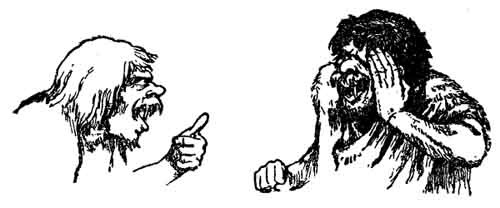
While sitting, one of them said, "Well, all the King's army
was not able to take us, but I fear an old woman with a rope's end
would be too much for us now."
"If that be so," said Johnny Gloke, as he sprang, bold
as a lion, from his hiding-place, "What do you say to Johnny
Gloke with his old roosty sword?" So saying he fell upon them,
cut off their heads, and returned in triumph. He received the King's
daughter in marriage and for a time lived in peace and happiness. He
never told the mode he followed in his dealing with the giants.
Some time after a rebellion broke out among the subjects of his
father-in-law. John, on the strength of his former valiant deed, was
chosen to quell the rebellion. His heart sank within him, but he
could not refuse, and so lose his great name. He was mounted on the
fiercest horse that ever saw sun or wind, and set out on his
desperate task. He was not accustomed to ride on horseback, and he
soon lost all control of his steed. It galloped off at full speed, in
the direction of the rebel army. In its wild career it passed under
the gallows that stood by the wayside. The gallows was somewhat old
and frail, and down it fell on the horse's neck. Still the horse made
no stop, but always forward at furious speed towards the rebels. On
seeing this strange sight approaching towards them at such a speed
they were seized with terror, and cried out to one another, "There
comes Johnny Gloke that killed the two giants with the gallows on his
horse's neck to hang us all." They broke their ranks, fled in
dismay, and never stopped till they reached their homes. Thus was
Johnny Gloke a second time victorious. So in due time he came to the
throne and lived a long, happy, and good life as king.
***
I'm sure you recognized that story under a different name. Jacobs addresses that:
JOHNNY GLOKE
Source.—Contributed by Mr. W. Gregor to Folk-Lore
Journal, vii. I have rechristened "Johnny Glaik" for the sake of
the rhyme, and anglicised the few Scotticisms.
Parallels.—This is clearly The Valiant Tailor
of the Grimms: "x at a blow" has been bibliographised. (See my
List of Incidents in Trans. Folk-Lore Congress, 1892, sub
voce.)
Remarks.—How The Valiant Tailor got to Aberdeen
one cannot tell, though the resemblance is close enough to suggest a
direct "lifting" from some English version of Grimm's Goblins.
At the same time it must be remembered that Jack the Giant
Killer (see Notes on No. xix.) contains some of the incidents of
The Valiant Tailor.
Hope to see you and Nessie at the Highland Games next week on August 6.
****************
This
is part of a series of postings of stories under the category,
"Keeping the Public in Public Domain." The idea
behind Public Domain was to preserve our cultural heritage after the
authors and their immediate heirs were compensated. I feel
strongly current copyright law delays this intent on works of the
20th century. My
own library of folklore includes so many books within the Public
Domain I decided to share stories from them. I hope you enjoy
discovering new stories.

At
the same time, my own involvement in storytelling regularly creates
projects requiring research as part of my sharing stories with an
audience. Whenever that research needs to be shown here, the publishing
of Public Domain stories will not occur that week. This is a return to
my regular posting of a research project here. (Don't worry, this
isn't dry research, my research is always geared towards future
storytelling to an audience.) Response has convinced me that "Keeping
the Public in Public Domain" should continue along with my other
postings as often as I can manage it.
Other
Public Domain story resources I recommend-
There
are many online resources for Public Domain stories, maybe none for
folklore is as ambitious as fellow storyteller, Yoel Perez's
database, Yashpeh,
the International Folktales Collection. I have long
recommended it and continue to do so. He has loaded
Stith Thompson's Motif Index into his server as a database so
you can search the whole 6 volumes for whatever word or expression
you like by pressing one key. http://folkmasa.org/motiv/motif.htm
You may have noticed I'm no
longer certain Dr. Perez has the largest database, although his
offering the Motif Index certainly qualifies for those of us seeking
specific types of stories. There's another site, FairyTalez
claiming to be the largest, with "over 2000 fairy tales,
folktales, and fables" and they are "fully optimized for
phones, tablets, and PCs", free and presented without ads.
Between those two sites, there
is much for story-lovers, but as they say in infomercials, "Wait,
there's more!"
The
email list for storytellers, Storytell,
discussed Online Story Sources and came up with these additional
suggestions:
-
Story-Lovers - http://www.story-lovers.com/ is now only accessible
through the Wayback Machine, described below, but the late Jackie Baldwin's
wonderful site lives on there, fully searchable manually (the Google
search doesn't work), at https://archive.org/ . It's not easy, but go to Story-lovers.com snapshot for October 22 2016 and you can click on SOS: Searching Out Stories to scroll down through the many story topics and click on the story topic that interests you.
- Zalka Csenge Virag - http://multicoloreddiary.blogspot.com
doesn't give the actual stories, but her recommendations, working her
way through each country on a continent, give excellent ideas for
finding new books and stories to love and tell.
You're
going to find many of the links on these sites have gone down, BUT
go to the Internet Archive
Wayback Machine to find some of these old links. Tim's
site, for example, is so huge probably updating it would be a
full-time job. In the case of Story-Lovers, it's great that
Jackie Baldwin set it up to stay online as long as it did after she
could no longer maintain it. Possibly searches maintained it.
Unfortunately Storytell list member, Papa Joe is on both Tim
Sheppard's site and Story-Lovers, but he no longer maintains his old
Papa Joe's Traveling Storytelling Show website and his Library
(something you want to see!) is now only on the Wayback Machine. It
took some patience working back through claims of snapshots but finally
in December of 2006 it appears!
Somebody
as of this writing whose stories can still be found by his website
is the late Chuck Larkin - http://chucklarkin.com/stories.html.
I prefer to list these sites by their complete address so they can
be found by the Wayback Machine, a.k.a. Archive.org, when that
becomes the only way to find them.
You
can see why I recommend these to you.
Have fun
discovering even more stories


