Tell me if you have a topic you'd like to see. (Contact: LoiS-sez@LoiS-sez.com .)
Please also let others know about this site.
Showing posts with label Arbor Day. Show all posts

Friday, June 2, 2023

Beckwith - The Boy Who Hated Trees - Keeping the Public in Public Domain


Photo by Amir Kalhor on Unsplash
I'm blessed in my area by woods for hiking with my dog. . . state recreation area, county and metro parks, a nearby golf course when it's not wanted by golfers, and even more.  Even with all of those areas every year I plant ten trees as they come with my annual membership to the Arbor Day Foundation.  (My membership card says I've been a member since 2011!)  They also offer the option: Send me no trees - Plant 10 trees in one of America's forests devastated by fires, insects, disease, and deforestation.

At least the option of having trees planted gets past the objection a former late brother-in-law had to trees requiring mowing around them and also coping with any leaves or branches on the ground.  I was shocked to learn he cut down century-old trees.

I'm not sure it's fair to say he hated trees, nor do I think the following story would have changed his mind.  I do hope telling it to younger listeners, might etch the importance of trees in their minds so they support the goal of the Arbor Day Foundation "to plant 500 million trees by 2027 in areas where they’re needed most. With a strong network of global partners, a science-based approach, and more than 50 years of planting trees all over the world, we know what it takes to make it happen."

This story comes from the Jewel Series originally published in the early 20th century by Duffield & Company.  The sisters Ada M. and Eleanor L. Skinner did several in the series, including one for each season.  This is from their editing The Turquoise Story Book; Stories and Legends of Summer and Nature now found on Gutenberg.org  as well as in a reprinted paperback by Forgotten Books in their Classic Reprint Series.  The reprinted book omits the frontispiece by Maxfield Parish (included in the Gutenberg version), but is otherwise a good reprint.  That can be hard to verify when ordering reprints unseen.  I've regretted the quality of some, but not those by Forgotten Books.  The Skinner sisters, in their acknowledgements say the story was first published by the Educational Company.

THE BOY WHO HATED TREES
 
Alice L. Beckwith

"Good night, Dick. Remember, now, to wake up with the robins so that you may be ready to help me set out our new trees."

"Good night," answered Dick in a sulky tone, for Dick was cross.

"Trees, trees, trees!" he mumbled to himself, as he began to undress. "I'm so sick of hearing about trees. And now father has bought some old twigs to set out to-morrow, and I want to go fishing.

"I wish I lived in a land where there were no trees. We could get along well enough without them." And with this thought he jumped into bed.

Dick had been asleep perhaps an hour or more when he heard a queer, rustling noise, and then a voice called out: "Here he is—the boy who hates trees!"

There was the strangest procession coming toward him. It was made up of trees of all kinds. The Pine and Elm came first; the Maple and Oak followed: the Maple's leaves were flushed scarlet, she was so excited. The Willow was weeping, and the Poplar was trembling all over.

Next came all the fruit trees, led by the Cherry, while the Walnut, the White Birch, and the Palm were behind.

What did it all mean? Dick was frightened for a moment. It seemed as if every tree of which he had ever heard was there, and he wondered how the room could hold them all.

When they had all grown quiet, the Pine said: "Dear brothers and sisters, here is a boy who hates trees; he cannot see that we are of any use. It is more than I can stand, and I have called this meeting to see what can be done about it. Has anyone anything to say?"

The Cherry looked very sour. "I cannot see that boys are of any use," she said. "Many years ago, when cherry trees were scarce in this country, a boy named George cut down my great-grandfather just to try his new hatchet."

"And boys know so little," said the White Birch; "they are always hacking me with knives, and taking off my coat, no matter how cold the weather is. I loved a boy once, but it was many years ago. He was a little Indian boy. He loved trees. I remember how he stood beside me one day and said:
"'Give me of your bark, O Birch Tree!
For the summer time is coming,
And the sun is warm in heaven,
And you need no white skin wrapper.'

"Then he took off my bark so carefully that he did not hurt me a bit. But he is not living now. This boy is not like him."

"I don't like boys, either," spoke up the Apple. "One day a boy climbed up into my branches and broke off one of my limbs. He was a very silly boy, for he wanted green apples. Had my fruit been ripe, I would have tossed one down to him. How happy we should be if it were not for boys!"

The Maple was very angry. "This boy said we were of no use, but it was only this morning that I heard him tease his grandfather for a cake of my sugar."

"He ate it as if he liked it, too," said the Palm. "I saw him; he was fanning himself with one of my leaves."

The Willow wiped her eyes. "Boys, boys, boys!" she said. "I'm so sick of boys! This same boy made a whistle out of one of my children this very night, when he went for the cows."

Then a queer tree in the corner spoke in a thick voice: "We are of no use, are we? If it were not for me, where would he get the tires for his bicycle? There are his rubber boots, too. Why, he uses me every day about something. But I've thought of a plan."

The trees crowded around him, talking together excitedly. "But how shall we do it?" Dick heard them say. "Oh," said the Elm, "the Wind will help us. He is our friend."

Before Dick could cry out, he found himself being carried away by the Wind.

"Where am I going?" he called.

"To the land of no trees," they answered; and they bowed and smiled. Even the Willow held up her head long enough to call, "Good-by!" and then home and trees were left far behind.

How fast the Wind traveled! On and on they rushed, until suddenly the Wind dropped him and went whistling away.

Dick felt really frightened when he found himself all alone.

"Oh, I'm so hot!" he exclaimed. "Where am I?"

Certainly he had never before been in such a place.

There were no trees nor green grass anywhere in sight. As far as he could see, there was only sand—white sand, hot and scorching.

"It seems to me I've seen pictures in my geography like this," he said to himself. "I can't stay here. What shall I do?"

All at once he noticed a tiny speck far away in the distance. Now it looked larger. He brushed away something that looked very much like a tear, though he told himself that it was only because he was so warm.

Yes, that speck surely moved, and was coming nearer. What if it were a bear!

"There is no tree to climb, and I cannot run—I am so tired, and it is very hot."

Nearer and nearer it came, moving slowly. Dick watched it with a beating heart. At last he saw that it was not a single animal, but a great many in line.

"Oh, they are camels!" he cried. "Yes, I know they are. Once at a circus I saw some that looked just like them—but what queer-looking men are on them!"

They were now very near him, and one of the men beckoned with his hand and said something.

"I can't understand him," said Dick to himself, "but I suppose he meant he'll give me a ride."

The man helped him up and they journeyed on. After a time Dick grew very tired even of riding.

"The camel joggles me so," he said, "and I am so thirsty I shall die. If they would only stop a minute!"

What was the matter? What were they saying? Each man was bowing himself toward the ground and waving his hands.

"I don't see what they are making all that fuss about. I can't see anything; the sun hurts my eyes so." And Dick covered his eyes with his hand.

Suddenly there was a shout, and the camels stood still. Dick lifted his head. Could he believe his eyes? Right before him was a little spot of green grass, a spring of cool water, and one of those things he hated—a tree.

Hate a tree? He thought that he had never seen anything so beautiful in his life.

He fairly tumbled off the camel in his haste to reach it. The tears ran down his face as he threw his arms around its trunk.

"Dear tree!" he cried.

"Dick, Dick, are you going to help me plant the new trees?" called his father.

Opening his eyes, Dick found himself in his own little room, both hands clasping his pillow.

Dick was soon dressed and downstairs, and so anxious was he to plant trees that he could hardly eat his breakfast.
In just one night he had learned to see
The wonderful beauty there is in a tree.
 

****************** 

If that story seems improbable, look to Lebanon.  Wikipedia does an excellent job of summarizing what deforestation can do. 

In ancient times, Lebanon was covered by large forests of cedar trees, the national emblem of the country.[171] Millennia of deforestation have altered the hydrology in Mount Lebanon and changed the regional climate adversely.[172] As of 2012, forests covered 13.4% of the Lebanese land area;[173] they are under constant threat from wildfires caused by the long dry summer season.[174]

As a result of longstanding exploitation, few old cedar trees remain in pockets of forests in Lebanon, but there is an active program to conserve and regenerate the forests.

Flag of Lebanon  The cedar is Lebanon's national emblem and on the national flag.  May it replace the deserts.

*** One last comment: Arbor Day members also can purchase all kinds of trees far less expensively and trees come with a one year guarantee.  Now I really need to get back to my newly planted trees.

*******************


Saturday, April 25, 2020

Shelter in Place - week 5 Arbor Day/Earth Day/Blursday & Pollinators

This week had both the 50th Anniversary of Earth Day, the long-time celebration of Arbor Day and what a friend called Blursday.

What's Blursday?

With days blurring together while during Shelter in Place it's "The fortyteenth of Maprilay"!

I don't use my Twitter account much, but took up the Arbor Day Foundation's offer to plant a tree in one of our nation's forests if I posted a picture of a favorite tree on Twitter with the hashtag #arbordayathome and tag them.  I posted this picture of a trail at nearby Independence Oaks.
I'm a longtime supporter of Arbor Day Foundation as trees do so much to help us and our planet, too.  By the time you see this the offer may have ended.  They still have so much to offer so I recommend going to https://www.arborday.org/ and becoming a member, too.   You'll get TEN FREE TREES! and the lowest possible discount on other trees and shrubs, and much more.  Can't say enough good things about them, but usually I'm doing it at programs related to Earth Day.  This is only one of many ways you can celebrate Earth Day even while our public gatherings give way to Blursday.

Something else that can help and that I find myself often doing is signing petitions and writing about the need to save our pollinators.  The U.S. Fish and Wildlife Service has a page with lots of resources about Pollinators.  Why am I so passionate about this?  Without them our agriculture will become impossible.  From tiny insects like bees and butterflies to wildlife, domestic animals, and, yes, people, the chain of life requires those pollinators to keep all of our food coming.  Here in our area the Monarch Butterfly migrates through here.  Grow Milkweed where they lay their eggs, if you're not up to raising butterflies yourself, as habitat loss is one of the reasons for their decline. 

While the U.S. Fish and Wildlife Service can only mention generalities on their "Threats to Pollinators"page, the herbicide Glyphosate (commonly sold as Roundup) has been linked to killing Monarch Butterflies and bees whether from loss of habitat or toxicity.  Its among the Neonictinoids or Neonics banned in European countries and a few other countries.  I note this when sending emails to my various elected officials.  Yes, it's made by a U.S. company based in St. Louis, Missouri where I grew up, but they sell many other products, so dropping this one won't put them out of business.  Neonic toxicity and its spread to other wildlife has led the American Bird Conservancy to call for its ban after studies point to its serious risk to the environment.

From Pixabay via Pexels.com
I've often posted about bees, many times with stories.  Too often they are accused when it's their "cousins", the hornet or Yellow Jacket, buzzing around.  August 5, 2017 I gave a Cuffy Bear story by Arthur Scott Bailey, but also briefly retold the Anishinaabe tale about how defending bees with a stinger was generously shared with wasps. 

A neighbor of mine probably is not happy with that generosity of bees sharing with the wasp.  While mowing his lawn on a riding mower requiring holding the handles to steer, he saw what looked like a paper bag in the trees.  On his next swing past, he grabbed the "bag" only to discover it was a paper wasp nest.  During the time it took to discover it, he was stung repeatedly.  The bee only stings in self-defense or to protect its hive because they are unable to sting more than once.

Today I want to add to stories about pollinators by talking about butterflies.  They don't even sting and they manage to look beautiful while fluttering about. 

Be warned, this paragraph may get a bit more involved in the world of publishing than you wish.  If so, skip to the story I retell after this.  In that 2017 article I mentioned the works of Louise Jean Walker, accidentally missing another book of hers I now have, Beneath the Singing Pines.  From all I can tell, she never had the copyright renewed on her books.  Neither Eerdmans, who published Legends of Green Sky Hill nor Hillsdale Educational Publishers, who published the other two, have her work still in their listings.  I've included a bit of a rant here before about how the copyright law was changed, but it also meant publishers were no longer taxed at the rate of a book when it first entered their stock.  Instead what the cost of a book would be when it was sold became the cost for their inventory.  This made it more expensive to keep books in their inventory, resulting in  publishers preference of Pop material guaranteed to sell right away.  Scholarly books and children's books had been staples on that "backlist", but this made them less profitable.  It also has led to a lot of self-publishing of e-books, especially at Amazon.  Reprint publishers show no guarantees of quality -- I've learned caution in buying.  I would love to see Project Gutenberg reproduce Walker's books if it truly is available.  Perhaps the publishers will catch their names mentioned here and decide to reproduce her books.  Until then, your only way is to either buy a used copy (I strongly recommend Better World Books, not only for their own inventory, but additionally because of all they do to support literacy) or borrow it from your library when they finally reopen.  You will not find the books among their digital collections unfortunately.

Benzie Conservation District (MI) also provides seeds reasonably
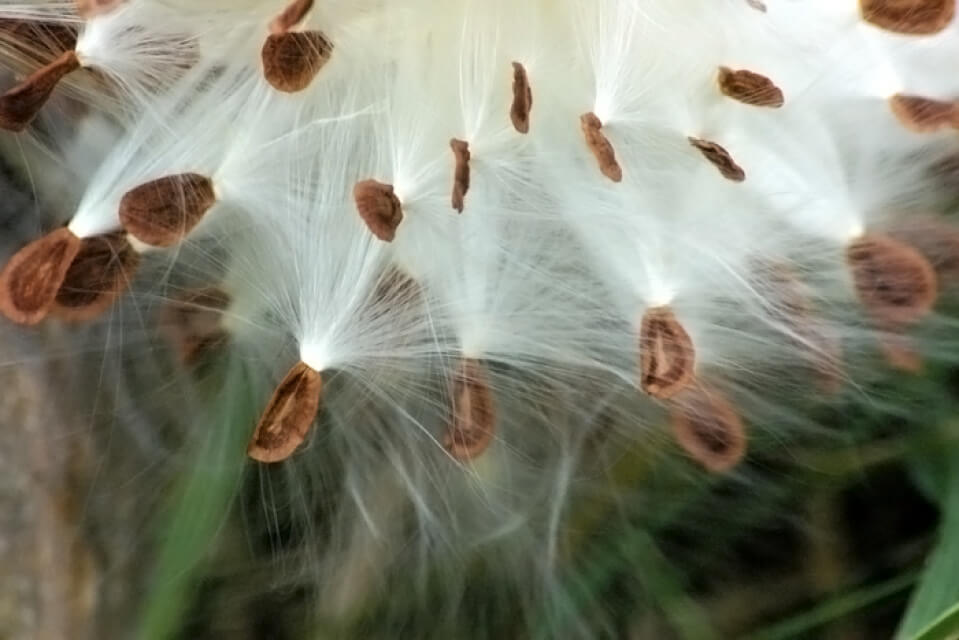
Since I would rather the books become available again, I will re-tell the story Walker and various Anishinaabe storytellers give about how butterflies were created.  It makes no pretense at being as good or thorough as they might tell it, but I hope you will remember it when you see a butterfly and do what you can to support their habitat.  Next autumn remember the value of Milkweed when you see its seeds with their fluffy "parachutes."  The National Wildlife Federation will give you more information on how you can do this and ways to Garden for Wildlife with ideas that can work even in urban and suburban yards.  Get FREE milkweed seeds at LiveMonarch.com along with growing instructions and other activities and resources.

Long ago, it is said by the Anishinaabe, the First People from here in Michigan and around the Great Lakes, that after the Great Spirit had created the world, he looked around with pleasure.  Birds, Fish and other creatures were colorful and useful.  Then he looked at the mountains of the world.  He loved them, too, but knew the People might not appreciate them.  To get the People to enter them, he decided to make rocks of many colors, some of those rocks even sparkled.  It was as if the mountains held rainbows!  He knew the People would discover the stones and then would dig for them.  That was good, but he decided not to keep all the rocks hidden in the mountains.  Scattering rocks around would let children discover them, even without going inside a mountain.  This was no sooner done than Zhaawani Noodin, the South Wind, blew in, singing of trees, birds, and flowers in the spring and summer.  Hearing that song, the Great Spirit tossed the colorful stones into the air, asking the South Wind to carry them to the People.  Those colorful rocks developed wings and fluttered away.  Today we enjoy their beautiful wings knowing that even in their beauty they help pollinate the flowers and other plants wherever they visit. 
Photo by Cindy Gustafson on Pexels.com
Today may be "Blursday", but I like a quote I saw about the current time which said it's end will be like a rainbow that follows a storm.  May this help encourage you to make every day Earth Day and also carry out the purpose of Arbor Day by planting trees which hold the soil (Arbor Day was started to prevent soil erosion, among other things) and do an incredible job to help bring oxygen and reduce pollution.  Already the pollution level is being noticed as reduced by all of us who Shelter in Place.

Saturday, September 29, 2018

Beecher - The Anxious Leaf - Keeping the Public in Public Domain

Long before the late Leo Buscaglia's classic look at life and death from the viewpoint of a leaf in 1982's The Fall of Freddie the Leaf, today's little story from the viewpoint of "The Anxious Leaf" appeared.  It's in an early 20th century series of textbooks by E.C. Hartwell I find most useful, Story Hour Readings, in this case for the Fourth Year.  There is a bit of suggestions at the end for ways to use it in class added by Doctor Hartwell, but the story originates with Henry Ward Beecher.  The book gives the simplest of author's biography, suitable for a child, but his own life seems right out of today's news and I'll give more after the story.  I'll also add ways to use it.
It's a simple enough story and I like to include the sort of supplementary books a One Room School Teacher might include in her classroom when doing my program on One Room Schools as I did this past week, but it has many uses beyond that.

Of course teachers like to assign leaf identification as it's an easy assignment at this time of year.  I'm a longtime member of the Arbor Day Foundation and believe strongly in their goals of planting trees where they are so needed.  As a result I recommend purchasing their pocket field guides, "What Tree Is That?", which now even has an iPhone app. (I hope they soon do one for Android.)

Also colorful autumn leaves have a multitude of craft uses.  Google "leaf crafts" for more than you could possibly use.  There are crafts all the way from preschoolers to adult.  I like to mention how the One Room School Teachers would give the little ones a simple craft related to what they were studying.  I even show a large early 20th century book of "manual seatwork" with the kind of simple crafts we all should experience in school or in after-school activities.

Of course fallen leaves are useful also to gardeners.  The "Old Farmer's Almanac" urges using them instead of sending them to a landfill.

Beyond the One Room School I will soon be back doing classroom residencies and work with homeschoolers.  This little story is a perfect introduction to getting into the mind of an inanimate object and creating an adventure or even a biography.

Now speaking of biographies, I promised the author would fit right into today's news: People magazine would notice his famous family (his father, Lyman Beecher, was the best-known evangelist of his day, while his brothers and sisters were also prominent, especially his famous sister, Harriet Beecher Stowe, who wrote Uncle Tom's Cabin); he was a popular public speaker beyond the pulpit; he was an abolitionist, which today continues in the crusade against human trafficking; supported the suffragists and temperance, which could be called women's issues; then came a scandal worthy of the "Me, Too" movement from which he was officially exonerated.  Take a look at least at Wikipedia, but you should also search for Henry Ward Beecher quotes.  There are well over 300 and many are illustrated in a style worthy of inspirational posters.

Of course my favorite is
I hope you feel the same about keeping alive the many stories that are part of the Public Domain.
**************************
This is part of a series of postings of stories under the category, "Keeping the Public in Public Domain."  The idea behind Public Domain was to preserve our cultural heritage after the authors and their immediate heirs were compensated.  I feel strongly current copyright law delays this intent on works of the 20th century.  My own library of folklore includes so many books within the Public Domain I decided to share stories from them.  I hope you enjoy discovering new stories.  


At the same time, my own involvement in storytelling regularly creates projects requiring research as part of my sharing stories with an audience.  Whenever that research needs to be shown here, the publishing of Public Domain stories will not occur that week.  This is a return to my regular posting of a research project here.  (Don't worry, this isn't dry research, my research is always geared towards future storytelling to an audience.)  Response has convinced me that "Keeping the Public in Public Domain" should continue along with my other postings as often as I can manage it.
Other Public Domain story resources I recommend-
  • There are many online resources for Public Domain stories, maybe none for folklore is as ambitious as fellow storyteller, Yoel Perez's database, Yashpeh, the International Folktales Collection.  I have long recommended it and continue to do so.  He has loaded Stith Thompson's Motif Index into his server as a database so you can search the whole 6 volumes for whatever word or expression you like by pressing one key. http://folkmasa.org/motiv/motif.htm
  • You may have noticed I'm no longer certain Dr. Perez has the largest database, although his offering the Motif Index certainly qualifies for those of us seeking specific types of stories.  There's another site, FairyTalez claiming to be the largest, with "over 2000 fairy tales, folktales, and fables" and they are "fully optimized for phones, tablets, and PCs", free and presented without ads.

    Between those two sites, there is much for story-lovers, but as they say in infomercials, "Wait, there's more!"
The email list for storytellers, Storytell, discussed Online Story Sources and came up with these additional suggestions:            
         - David K. Brown - http://people.ucalgary.ca/~dkbrown/stories.html
         - Richard Martin - http://www.tellatale.eu/tales_page.html
         - Spirit of Trees - http://spiritoftrees.org/featured-folktales
         - Story-Lovers - http://www.story-lovers.com/ is now only accessible through the Wayback Machine, described below, but Jackie Baldwin's wonderful site lives on there, fully searchable manually (the Google search doesn't work), at https://archive.org/ .  It's not easy, but go to Story-lovers.com snapshot for October 22 2016  and you can click on SOS: Searching Out Stories to scroll down through the many story topics and click on the story topic that interests you.
       - World of Tales - http://www.worldoftales.com/ 
     
You're going to find many of the links on these sites have gone down, BUT go to the Internet Archive Wayback Machine to find some of these old links.  Tim's site, for example, is so huge probably updating it would be a full-time job.  In the case of Story-Lovers, it's great that Jackie Baldwin set it up to stay online as long as it did after she could no longer maintain it.  Possibly searches maintained it.  Unfortunately Storytell list member, Papa Joe is on both Tim Sheppard's site and Story-Lovers, but he no longer maintains his old Papa Joe's Traveling Storytelling Show website and his Library (something you want to see!) is now only on the Wayback Machine.  It took some patience working back through claims of snapshots but finally in December of 2006 it appears!
    Somebody as of this writing whose stories can still be found by his website is the late Chuck Larkin - http://chucklarkin.com/stories.html.  I prefer to list these sites by their complete address so they can be found by the Wayback Machine, a.k.a. Archive.org, when that becomes the only way to find them.
You can see why I recommend these to you. Have fun discovering even more stories!

Saturday, April 16, 2016

Hug Those Trees!

April sometimes feels like


I've seen Michigan blizzards in mid-April, right now spring looks like it's here to stay, but there's all manner of cold west of us, so I'll just join with T.S.Eliot in saying "April is the cruelest month"...although suggest looking at this interesting discussion of its meaning, including the suggestion by Chris Day, "April is the cruellest month because the life and colour of spring throws one's depression into stark relief and forces painful memories to surface."  Let's face it, April and Spring are both fickle.

There's a way to make it better . . . plant trees, enjoy or create parks -- I get some of my best thoughts as my Malamutt (a wonderful blend of Husky and Malamute) leads me down trails, or do something to help our planet.  

Maybe that's why there are three special celebrations in April: National Parks Week (this year from April 16 to the 24th) celebrating our National Parks; Earth Day on April 22 (but look below for a local celebration on the 24th), and Arbor Day nationally on the last Friday in April (but some states choose different dates to match the best planting days).  Notice each of those have offiffiffic'al links?

My husband says April celebrations fall too early for Michigan, but I say that's because it's time to look ahead.  Anybody planting trees, especially baby trees, is looking to the future.  That's how Arbor Day started as J.Sterling Morton -- who was originally a Michigander, along with his wife, began Arbor Day after seeing the need for trees to encourage his fellow Nebraska pioneers to plant trees for windbreaks, fuel, building materials, and shade on the prairie.  You'd never know his adopted state was once a treeless plain thanks to him.  That initial planting of more than a million trees on the first Arbor Day attracted the attention of other states as they created their own Arbor Days -- especially when Morton became the U.S. Secretary of Agriculture.

Go to the Arbor Day foundation's website given above and become a member to get an assortment of ten free baby trees and also shop nearly 200 trees and shrubs there at the lowest prices available.


 For more free baby trees, if in metro Detroit, come to this Earth Day celebration in Milford.  "Mother Earth" gladly will give you some.  Story lovers can also hear North Oakland County Storytellers in the Aerobics Room from 12:30-1 p.m. and again from 3-3:30, with possible busking of short stories either outside, weather permitting, or otherwise inside. 

The Carls Family YMCA location moves you into a building overflowing with earth-related activities, and removes the worry of fickle April weather.  I love being a part of it every year if my schedule permits.  Try it, you may become similarly inclined to return.


Still all this talk reminds me that April is known for April Showers.  I confess to having that also remind me of this:
If April brings April Showers and April Showers bring May Flowers, what do Mayflowers bring?
. . .
Pilgrims!

Hope you make a pilgrimage of your own, wherever you might be, to Hug Those Trees, Plant Those Trees, and start in April to help this planet become greener in oh so many ways...after all, so far it's the only planet we have.

* * *
Here's an update:
It may be after National Parks Week, but that doesn't mean you can't still enjoy them for FREE or greatly reduced cost.

Do you know about the MAP program available from your library?  Here's a link to a Detroit Free Press article that tells you about FREE or reduced cost tickets to our state's National Parks and oh so many more attractions -- enjoy!

(I'm adding it to this blog article and hope to see you Sunday getting your FREE baby trees from "Mother Earth" at the Earth Day event ... and remember the Arbor Day Foundation for 10 more FREE baby trees!  Hug -- and Plant -- those trees!!!)

Saturday, April 25, 2015

Make every day Earth Day


 Earth Day 2015 Image

While Earth Day was officially April 22, it was never intended to be a focus for one day only.  Here are some good ideas to keep it going + a look at storytelling and even puppetry ideas for Earth Day and beyond. 

Because it fell during the week, if you are here in the metro Detroit area you might want to go to an excellent annual celebration held at Carl's Family YMCA in Milford this Sunday.  From 1-5p.m.   If you can, go to this practical, fun family festival.  Notice the first thing the article mentions is giving out free seedling trees.  "Mother Earth" always has lots to give away.  Planting them also fits Arbor Day, whose dates vary, but here in Michigan is the last Friday in April.  There's much more than the article had space to list, but North Oakland County Storytellers, yes, including me, will be telling stories related to the day also.    Once you go, you'll want to attend every year.


The Arbor Day Foundation
While mentioning Arbor Day, why not go to the Arbor Day Foundation site and join?  With your membership you will get ten free trees, a tree guide to more than 200 varieties of trees, 100 varieties of additional trees discounted with free shipping included, and the Arbor Day newsletter.  This non-profit carries on the work of  the first Arbor Day observance in 1872. The Foundation has grown to become the largest nonprofit membership organization dedicated to planting trees, with over one million members, supporters, and valued partners.  The story of Arbor Day itself is interesting and especially the story of the U.S. start by Julius Sterling Morton which stretches from his roots here in Michigan, to seeing its need on the plains of Nebraska, to Washington, D.C. where he was Secretary of Agriculture in the administration of President Cleveland, to Chicago where his son, Joy, the founder of the Morton Salt Company, carried on the family love of trees with an enormous arboretum and estate.

Here's a list of 8 common things you didn't know you could recycle.  If you don't want to ship your nylons off to No Nonsense (the second to the last item), you can give them to me for puppet stuffing.  I use them in puppet making workshops with old stuffed animals.  Here I am at a different workshop on how to use puppets with "Ivan", who has appeared here before because he lets me use sign language.  He has a bit of a story about the day I made him from a very old stuffed animal.  Detroit Puppeteers Guild had a workshop led by deaf puppeteer, April Cooper, on how to make him, but neither of us expected that the oldest stuffed animals were stuffed with styrofoam pellets.  I'm a big recycler of styrofoam, but those pesky pellets are probably still lurking in cracks at the Livonia Civic Center Library because opening the toy erupted into pellets everywhere! 
Ivan the Signing Siberian Tiger

and being eaten by Rainbow Boa Boa
I also have something else you might want to recycle with 7 surprising ways to use pet hair.  You could combine the nylons with the pet hair for absorbing oil spills -- the first surprising way to use all that pet hair.  With the double fur coat of my husky/malamute, I plan to try #7 for my rural garden, but know many people do indeed spin it into yarn.

You may have noticed both those last two links go to Care2.com.  If you join that site you can find a wide array of free e-cards along with information supporting a multitude of causes and healthy living.

As I write this, National Storytelling Network's special interest group National Storytelling Network's Healing Story Alliance Special Interest Group
is due to post its April 7 teleconference with storyteller/biologist Fran Stallings.  H.S.A. has the March 24, 2015 up, so I presume the lively discussion will be available soon as their teleconferences, along with other resources, are always posted afterward.  Fran's topic was "Stealth Eco-telling, Putting Your Repertory Where Your Heart Is" and she did exactly that, showing ways to use stories you may already know.  She also was wise enough to point out the need for including positive stories to avoid the easy to fall into "gloom and doom" mood when mentioning the need for ecology.

Take care of the Earth . . . so far it's the only livable  planet we have and need to keep it that way.