Tell me if you have a topic you'd like to see. (Contact: LoiS-sez@LoiS-sez.com .)
Please also let others know about this site.
Showing posts with label autumn. Show all posts

Friday, September 11, 2026

Skinner - The King's Candles - Keeping the Public in Public Domain

As autumn begins, the Skinner sisters, Ada and Eleanor, have a book for the season worth checking, The Topaz Story Book. It starts with the season changing the leaves on through pumpkins, Halloween and Thanksgiving. Wildflowers seem to color the fields in purple and gold. One of those, mullein, takes two years to become golden. Herbal medicine also values those plants, but a story offers an unusual use.


https://www.gardeningknowhow.com/ornamental/flowers/mullein/mullein-uses-and-disadvantages.htm 

THE KING’S CANDLES

Once upon a time there lived a good king who was driven from his throne by an enemy. A few faithful knights and servants fled with his majesty to a forest where they found shelter in deep, rocky caves.

The flight from the king’s palace had been so hasty that the knights and servants could bring only a few things for their king’s comfort. It was in the early autumn and his majesty feared it would be necessary to live in secret during the coming winter. You may be sure the king was well pleased to find his knights had brought a few warm blankets and robes. After he had praised his followers for their thoughtfulness in providing for the winter, a young page stepped forward and said, “Your Majesty, I did not bring clothing, but I brought as many candles as I could carry.”

“Candles,” laughed the king, “now pray tell me, lad, why you brought candles. You served me well in the palace by seeing that my throne was properly lighted, but in our forest exile we shall have little use for candles, I fear.”

“Sire,” replied the page, “I thought that your majesty would wish to hold council in the evenings, and that I could light your throne seat with candles as was the custom in the palace.”

“I fear my throne seat, as you call it, will be nothing more than a rocky ledge for some time,” said the king. “See, there is one in the inner cave which will serve. So long as the candles last, my faithful lad, your king will not be obliged to hold council in darkness.”

“So long as the candles last,” repeated the king’s page to himself. “I hope our king’s soldiers, who are seeking help, will be able to drive the usurper away before winter comes.”

The king and his followers soon adapted themselves to life in exile. During the daytime they hunted game which lurked in the thickets; in the evening they gathered together in the deep cave and held council. Then it was that the king sat on his rude throne lit by two candles.

The king’s page with sinking heart saw the candles grow fewer and fewer until there were but two left. Then at last came an evening when the lights were missing from the king’s throne. In a dark corner of the cave the little page sat grieving because he could not see his king’s face.

It happened one morning that the lad wandered to the edge of the woodland where the highway separated the richly coloured forest trees from a stretch of meadowland where the white mist was slowly lifting. On the roadside was an old woman carrying a large sack on her bent shoulders. When she reached the place where the king’s page was standing she set her sack on the ground and looked wistfully at the meadow, then at the deep ditch which separated the field from the highway.

“Shall I help you across the ditch?” asked the king’s page.

“Thank you, my lad,” said the old woman. “Perhaps I’d better not go across. It would be hard for me to reach the highway again. But I should like a few of those tall mullein spikes. I’ve none in my bag so fine as those growing in the meadow.”

“I’ll gather some for you” said the king’s page.

He leaped across the ditch, and soon filled his hands with the tall mullein spikes.

The old woman was delighted. She tucked them into her bag and said, “They make such fine winter candles. Thank you, my lad.”

“Winter candles!” exclaimed the king’s page.

“Aye,” nodded the old woman. “Dip them in tallow, a thin coat will do—and you have candles fit for a king. Thank you kindly.”

“We are in sore need of candles where I live, but——” the page stopped.

“Use mullein spikes. They make candles fit for a king, I say,” and the old woman picked up her sack.

“But we have no tallow,” said the lad.

“I can spare you a lump of tallow, my boy. Come along with me to my cottage,” said the old woman.

So the king’s page carried the sack of mullein spikes to the old woman’s cottage and she gave him a large lump of tallow. On his way back he leaped across the ditch again and filled his arms with tall mullein spikes. He hurried back to the cave, melted the tallow, and dipped the weeds into the liquid fat.

When the king and his party returned that evening to the cave, two tall candles were standing on the rude throne.

“See,” cried the king’s page, “we have a fresh supply of candles.”

“Tell us where you got them,” said the surprised king.

“They are made from spikes of the mullein weed,” explained the king’s page. Then he told his majesty about the afternoon’s adventure.

“The mullein weed shall have a new name,” declared the king. “It shall be called the King’s Candles.”

A few days later the king called his followers around his throne seat and said, “A message has come to me declaring that the usurper has been driven out of my country. Tomorrow we’ll hold a feast in the palace, and the table shall be lighted by ‘King’s Candles. ’”

Every year since that far-off time when the reigning king holds an autumn festival, the banquet table is lighted with mullein spikes dipped in tallow, and they are called the “King’s Candles.”

“The mullein’s yellow candles burn Over the heads of dry, sweet fern.”

********

This is part of a series of postings of stories under the category, “Keeping the Public in Public Domain.” The idea behind Public Domain was to preserve our cultural heritage after the authors and their immediate heirs were compensated. I feel strongly current copyright law delays this intent on works of the 20th century. My own library of folklore includes so many books within the Public Domain I decided to share stories from them. I hope you enjoy discovering them.

At the same time, my own involvement in storytelling regularly creates projects requiring research as part of my sharing stories with an audience.  Whenever that research needs to be shown here, the publishing of Public Domain stories will not occur that week.  This is a return to my regular posting of a research project here.  (Don't worry, this isn't dry research, my research is always geared towards future storytelling to an audience.)  Response has convinced me that "Keeping the Public in Public Domain" should continue along with my other postings as often as I can manage it.

See the sidebar for other Public Domain story resources I recommend on the page “Public Domain Story Resources."


Friday, October 17, 2025

Cowles - The Beginning of Birds - Keeping the Public in Public Domain

Sometimes serendipity brings what you need while looking for something else! I was looking to see if a story existed that might be a dimly seen tale of how flying creatures like pterodactyls evolved into birds. My search took me to early Twentieth Century storyteller and folklorist, Julia Darrow Cowles, It's been a long time (2013) since I posted something by her and there's still little more known about her except for online copies of her seventeen books. Once again I find her Indian Nature Myths is calling to me.  

Photo by Man from Forest on Unsplash 

It didn't give the prehistoric story I hoped to find, BUT I've also been eager to find a story about leaves changing colors -- this does it beautifully! Every year I'm always flabbergasted to think those gorgeous colors lurk all season long under the chlorophyll keeping them green until now! ! ! Yes, it's great to have green trees, but oh how incredible it is that such reds, oranges, and even yellow were there all along. 

Yes, it's sad when those leaves come down. I call it God's Confetti. I confess here in Michigan we have what I consider too long a time when all those bare branches show us the true shape of a tree. What few birds remain until spring do indeed tend to be the color of any oak leaves clinging to the trees. . . except for the cardinal which I dearly love and they don't seem to fit this story. Still that's no reason to skip a good story. Maybe in Montana and other areas where the Blackfeet Nation live there are no cardinals. If so, may all the other birds hurry back.

THE BEGINNING OF BIRDS

(Blackfeet)

IN very early times, the Red Children believe, there were no birds. And this is the way they account for their beginning:

All summer the trees had been full of leaves, shaking, whispering, dancing, as the winds blew upon them. “I wish I might fly,” said one little leaf. “I would go sailing straight up into the heavens. But the tree holds me tightly; I cannot get away.”

“If the tree should let you go, you would only fall to the ground and die,” said a bigger leaf. “It is better to be content as you are.”

So the leaves fluttered and danced and whispered one to another, day after day.

One morning the wind was cold, and the leaves had to dance fast to keep warm. Then the old tree said, “It is the breath of Po-poon-o-ki. He lives in the ice lodge of the far North. He will soon visit us, with his war paints. I must hold you tightly, little leaves, as long as I can.” But the little leaves did not understand what the tree meant.

Then, one still night, Po-poon-o-ki came. He went from tree to tree, and over each one he splashed his war paints, till the leaves were no longer green, but dashed with red, and brown, and yellow, and crimson.

“How beautiful the trees are!” cried the Indian children the next morning. “See their bright colors.”

For a few days the leaves danced and whispered, laughing over their beautiful hues. Then Po-poon-o-ki came back, and with his swift, cold breath, he blew against the trees, and the little leaves were tossed and torn from the friendly branches. They did not fly up into the heavens, but frightened and sobbing they dropped to the earth.

“We shall die!” they cried. “We shall die!”

Then a strange thing happened. The guardian spirit of the tree whispered, “No, little leaves, you shall not die. You shall be changed into living forms. I will give you breath and life.” And instantly there arose from the earth where the leaves had dropped, a great flock of winged birds, red, and brown, and yellow, and crimson,  all the beautiful colors that Po-poon-o-ki had given the leaves. Then they flew away to the South Land, where winter’s breath could not reach them.


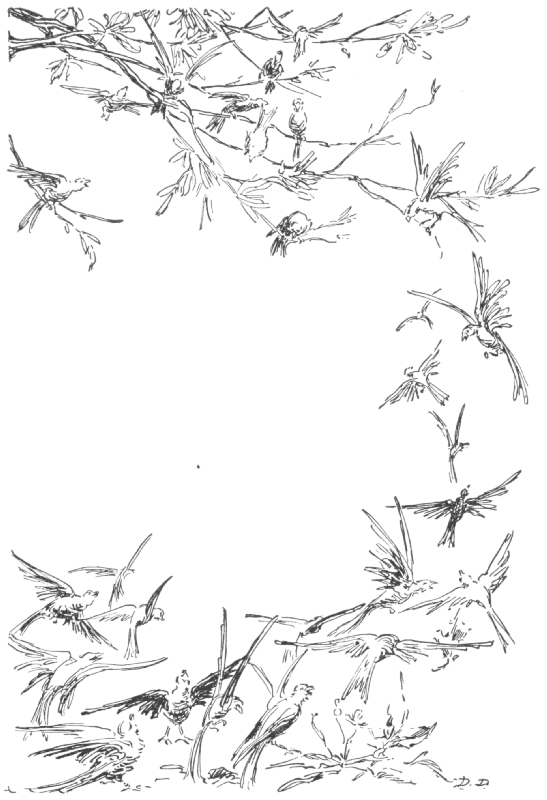
“THERE AROSE A GREAT FLOCK OF WINGED BIRDS”

But in the spring, when Ni-poon-o-ki, the spirit of summer, came stealing up from the South, and Po-poon-o-ki went back to his ice lodge in the far North, then the birds came back, too. There were new leaves on the trees, but the birds flew straight to the branches which had been their home, and there, safely sheltered by the new leaves, they built their nests.

And after awhile, when there were eggs in all the home nests, the hearts of the birds became so full of joy that they could no longer be silent. Their throats swelled, and opening wide their little mouths, they filled all the air with bursts of happy song.

************** 

This is part of a series of postings of stories under the category, “Keeping the Public in Public Domain.” The idea behind Public Domain was to preserve our cultural heritage after the authors and their immediate heirs were compensated. I feel strongly current copyright law delays this intent on works of the 20th century. My own library of folklore includes so many books within the Public Domain I decided to share stories from them. I hope you enjoy discovering them.

At the same time, my own involvement in storytelling regularly creates projects requiring research as part of my sharing stories with an audience.  Whenever that research needs to be shown here, the publishing of Public Domain stories will not occur that week.  This is a return to my regular posting of a research project here.  (Don't worry, this isn't dry research, my research is always geared towards future storytelling to an audience.)  Response has convinced me that "Keeping the Public in Public Domain" should continue along with my other postings as often as I can manage it.

See the sidebar for other Public Domain story resources I recommend on the page “Public Domain Story Resources."

Friday, September 22, 2023

Cooke - Golden-rod and Aster - Keeping the Public in Public Domain

It's beautiful seeing the goldenrod and purple asters decorating roadsides and fields right now.

Lately I've been looking a lot at The Topaz Story Book's many stories for autumn. So when I went looking for stories about goldenrod and asters I was delighted to see a story about both plants in the same tale.  I also saw it was in The Topaz Story Book.  Read it there and noted it was "adapted."  Since the original author, Flora J. Cooke, was also easily located at Project Gutenberg, I compared the two.  Differences are minimal...almost as if the Skinner sisters wanted to take credit for "adapting" it.  

Ms Cooke was active during the first half of the twentieth century's "Progressive" school movement and especially for the secondary school.  As a result her book title of Nature Myths and Stories with the title continuing as For Little Children I think is a bit misleading as we would apply it today.  Similarly her other book, Greek Myths for Children, might today have a slightly broader audience than the title of the two books implies.  (Another view of her work is an essay at Thefreelibrary.com.)

Here's her story of why these two plants are so often seen together.  May it pop into your head when you see them!

GOLDEN-ROD AND ASTER.

G

OLDEN HAIR and Blue Eyes lived at the foot of a great hill.

On the top of this hill in a little hut lived a strange, wise woman.

It was said that she could change people into anything she wished. She looked so grim and severe that people were afraid to go near her.

One summer day the two little girls at the foot of the hill thought they would like to do something to make everybody happy.

image

“I know,” said Golden Hair, “Let us go and ask the woman on the hill about it. She is very wise and can surely tell us just what to do.”

“Oh, yes,” said Blue Eyes, and away they started at once.

It was a warm day and a long walk to the top of the hill.

The little girls stopped many times to rest under the oak trees which shaded their pathway.

They could find no flowers, but they made a basket of oak leaves and filled it with berries for the wise woman.

They fed the fish in the brook and talked to the squirrels and the birds.

They walked on and on in the rocky path.

After a while the sun went down. The birds stopped singing.

The squirrels went to bed.

The trees fell asleep.

Even the wind was resting.

Oh, how still and cool it was on the hillside!

The moon and stars came out.

The frogs and toads awoke.

The night music began.

The beetles and fireflies flew away to a party.

But the tired little children climbed on towards the hilltop.

At last they reached it.

There at the gate was the strange, old woman, looking even more stern than usual.

The little girls were frightened. They clung close together while brave Golden Hair said, “we know you are wise and we came to see if you would tell us how to make everyone happy.”

“Please let us stay together,” said timid Blue Eyes.

As she opened the gate for the children, the wise woman was seen to smile in the moonlight. The two little girls were never seen again at the foot of the hill. The next morning all over the hillside people saw beautiful, waving golden-rod and purple asters growing.

It has been said that these two bright flowers, which grow side by side, could tell the secret, if they would, of what became of the two little girls on that moonlight summer night.

image

***

The story was also anthologized in Bailey and Lewis's For the Children's Hour; Hall and Gilman's Story Land. 2d reader; McFee's Treasury of Flower Stories;  Pratt's Fairyland of Flowers as well as by the Skinners.  Obviously a sign of a story considered worth "Keeping the Public in Public Domain.

*******************

This is part of a series of postings of stories under the category, "Keeping the Public in Public Domain."  The idea behind Public Domain was to preserve our cultural heritage after the authors and their immediate heirs were compensated.  I feel strongly current copyright law delays this intent on works of the 20th century.  My own library of folklore includes so many books within the Public Domain I decided to share stories from them.  I hope you enjoy discovering new stories.  


At the same time, my own involvement in storytelling regularly creates projects requiring research as part of my sharing stories with an audience.  Whenever that research needs to be shown here, the publishing of Public Domain stories will not occur that week.  This is a return to my regular posting of a research project here.  (Don't worry, this isn't dry research, my research is always geared towards future storytelling to an audience.)  Response has convinced me that "Keeping the Public in Public Domain" should continue along with my other postings as often as I can manage it.

Other Public Domain story resources I recommend-

  • There are many online resources for Public Domain stories, maybe none for folklore is as ambitious as fellow storyteller, Yoel Perez's database, Yashpeh, the International Folktales Collection.  I have long recommended it and continue to do so.  He has loaded Stith Thompson's Motif Index into his server as a database so you can search the whole 6 volumes for whatever word or expression you like by pressing one key. http://folkmasa.org/motiv/motif.htm

  • You may have noticed I'm no longer certain Dr. Perez has the largest database, although his offering the Motif Index certainly qualifies for those of us seeking specific types of stories.  There's another site, FairyTalez claiming to be the largest, with "over 2000 fairy tales, folktales, and fables" and they are "fully optimized for phones, tablets, and PCs", free and presented without ads.
    Between those two sites, there is much for story-lovers, but as they say in infomercials, "Wait, there's more!"

The email list for storytellers, Storytell, discussed Online Story Sources and came up with these additional suggestions:        

         - David K. Brown - http://people.ucalgary.ca/~dkbrown/stories.html

         - Richard Martin - http://www.tellatale.eu/tales_page.html

         - Spirit of Trees - http://spiritoftrees.org/featured-folktales

         - Story-Lovers - http://www.story-lovers.com/ is now only accessible through the Wayback Machine, described below, but the late Jackie Baldwin's wonderful site lives on there, fully searchable manually (the Google search doesn't work), at https://archive.org/ .  It's not easy, but go to Story-lovers.com snapshot for December 22 2016  and you can click on SOS: Searching Out Stories to scroll down through the many story topics and click on the story topic that interests you.

       - World of Tales - http://www.worldoftales.com/ 

 
           - Zalka Csenge Virag - http://multicoloreddiary.blogspot.com doesn't give the actual stories, but her recommendations, working her way through each country on a continent, give excellent ideas for finding new books and stories to love and tell.

     
You're going to find many of the links on these sites have gone down, BUT go to the Internet Archive Wayback Machine to find some of these old links.  Tim's site, for example, is so huge probably updating it would be a full-time job.  In the case of Story-Lovers, it's great that Jackie Baldwin set it up to stay online as long as it did after she could no longer maintain it.  Possibly searches maintained it.  Unfortunately Storytell list member, Papa Joe is on both Tim Sheppard's site and Story-Lovers, but he no longer maintains his old Papa Joe's Traveling Storytelling Show website and his Library (something you want to see!) is now only on the Wayback Machine.  It took some patience working back through claims of snapshots but finally in December of 2006 it appears!

    Somebody as of this writing whose stories can still be found by his website is the late Chuck Larkin - http://chucklarkin.com/stories.html.  I prefer to list these sites by their complete address so they can be found by the Wayback Machine, a.k.a. Archive.org, when that becomes the only way to find them.

You can see why I recommend these to you. 

Have fun discovering even more stories

Friday, September 8, 2023

Beecher - Coming and Going - Keeping the Public in Public Domain

Southeastern Michigan has been what I call "the garden spot of the U.S." this year.  We've barely touched the 90s until this past week.  (I recall starting school in St. Louis -- Missouri, not Michigan -- as summer took its last attack on students stuck in classrooms with the original air conditioning . . . open windows!)  Detroit and Pontiac have shortened school days and Southfield has canceled classes while they work on their air conditioning.  A few days using fans is as close as I've come to wanting air conditioning this summer.  Air conditioning always makes adjusting to the real temperatures outside difficult and, after a time, isn't even comfortable.  Obviously the rest of the country has been a whole different story.


Those 90s this week are about to disappear as we return to our 60s and 70s.  That and seeing a flock of Canadian Geese on our lawn gave me hope that autumn in Michigan is indeed about to start.  

Trees turning colors were hopeful signs, but it's reassuring to know a biological clock in a dozen birds says they need to start their long journey to places with different temperatures.

I'm no real lover of winter, but all the talk of Climate Change makes this seasonal activity beyond the control of humans worth noting.

Just two weeks ago I posted a story from The Topaz Story Book by the Skinner sisters.  The long subtitle for that book is "Stories and Legends of Autumn, Hallowe’en, and Thanksgiving", so it's still worth your checking for months to come.  Back on September 29, 2018 I printed the Henry Ward Beecher story of "The Anxious Leaf" also from The Topaz Story Book.  Today I want to give another brief tale of his that migrating Canadian "Honkers" makes me appreciate.  Geese are certainly not songbirds like in this story, but they, too, leave Michigan for warmer weather.

COMING AND GOING

Henry Ward Beecher

There came to our fields a pair of birds that had never built a nest nor seen a winter. How beautiful was everything! The fields were full of flowers, and the grass was growing tall, and the bees were humming everywhere. Then one of the birds began singing, and the other bird said, “Who told you to sing?” And he answered, “The flowers told me, and the bees told me, and the winds and leaves told me, and the blue sky told me, and you told me to sing.” Then his mate answered, “When did I tell you to sing?” And he said, “Every time you brought in tender grass for the nest, and every time your soft wings fluttered off again for hair and feathers to line the nest.” Then his mate said, “What are you singing about?” And he answered, “I am singing about everything and nothing. It is because I am so happy that I sing.”

By and by five little speckled eggs were in the nest, and his mate said, “Is there anything in all the world as pretty as my eggs?” Then they both looked down on some people that were passing by and pitied them because they were not birds.

In a week or two, one day, when the father-bird came home, the mother-bird said, “Oh, what do you think has happened?” “What?” “One of my eggs has been peeping and moving!” Pretty soon another egg moved under her feathers, and then another and another, till five little birds were hatched! Now the father-bird sang louder and louder than ever. The mother-bird, too, wanted to sing, but she had no time, and so she turned her song into work. So hungry were these little birds that it kept both parents busy feeding them. Away each one flew. The moment the little birds heard their wings fluttering among the leaves, five yellow mouths flew open wide, so that nothing could be seen but five yellow mouths!

“Can anybody be happier?” said the father-bird to the mother-bird. “We will live in this tree always, for there is no sorrow here. It is a tree that always bears joy.”

Soon the little birds were big enough to fly, and great was their parents’ joy to see them leave the nest and sit crumpled up upon the branches. There was then a great time! The two old birds talking and chatting to make the young ones go alone! In a little time they had learned to use their wings, and they flew away and away, and found their own food, and built their own nests, and sang their own songs of joy.

Then the old birds sat silent and looked at each other, until the mother-bird said, “Why don’t you sing?” And he answered, “I can’t sing—I can only think and think.” “What are you thinking of?” “I am thinking how everything changes: the leaves are falling off from this tree, and soon there will be no roof over our heads; the flowers are all going; last night there was a frost; almost all the birds are flown away. Something calls me, and I feel as if I would like to fly far away.”

“Let us fly away together!”

Then they rose silently, and, lifting themselves far up in the air, they looked to the north: far away they saw the snow coming. They looked to the south: there they saw flowers and green leaves! All day they flew; and all night they flew and flew, till they found a land where there was no winter—where flowers always blossom, and birds always sing.

***

Far away that snow is indeed coming.  All too soon I'll be looking forward to it ending, but for now I'll think of this story while hiking with my dog, seeing migrating geese and hearing the last songs of birds. 

**************************

This is part of a series of postings of stories under the category, "Keeping the Public in Public Domain."  The idea behind Public Domain was to preserve our cultural heritage after the authors and their immediate heirs were compensated.  I feel strongly current copyright law delays this intent on works of the 20th century.  My own library of folklore includes so many books within the Public Domain I decided to share stories from them.  I hope you enjoy discovering new stories.  


At the same time, my own involvement in storytelling regularly creates projects requiring research as part of my sharing stories with an audience.  Whenever that research needs to be shown here, the publishing of Public Domain stories will not occur that week.  This is a return to my regular posting of a research project here.  (Don't worry, this isn't dry research, my research is always geared towards future storytelling to an audience.)  Response has convinced me that "Keeping the Public in Public Domain" should continue along with my other postings as often as I can manage it.

Other Public Domain story resources I recommend-

  • There are many online resources for Public Domain stories, maybe none for folklore is as ambitious as fellow storyteller, Yoel Perez's database, Yashpeh, the International Folktales Collection.  I have long recommended it and continue to do so.  He has loaded Stith Thompson's Motif Index into his server as a database so you can search the whole 6 volumes for whatever word or expression you like by pressing one key. http://folkmasa.org/motiv/motif.htm

  • You may have noticed I'm no longer certain Dr. Perez has the largest database, although his offering the Motif Index certainly qualifies for those of us seeking specific types of stories.  There's another site, FairyTalez claiming to be the largest, with "over 2000 fairy tales, folktales, and fables" and they are "fully optimized for phones, tablets, and PCs", free and presented without ads.
    Between those two sites, there is much for story-lovers, but as they say in infomercials, "Wait, there's more!"

The email list for storytellers, Storytell, discussed Online Story Sources and came up with these additional suggestions:        

         - David K. Brown - http://people.ucalgary.ca/~dkbrown/stories.html

         - Richard Martin - http://www.tellatale.eu/tales_page.html

         - Spirit of Trees - http://spiritoftrees.org/featured-folktales

         - Story-Lovers - http://www.story-lovers.com/ is now only accessible through the Wayback Machine, described below, but the late Jackie Baldwin's wonderful site lives on there, fully searchable manually (the Google search doesn't work), at https://archive.org/ .  It's not easy, but go to Story-lovers.com snapshot for December 22 2016  and you can click on SOS: Searching Out Stories to scroll down through the many story topics and click on the story topic that interests you.

       - World of Tales - http://www.worldoftales.com/ 

 
           - Zalka Csenge Virag - http://multicoloreddiary.blogspot.com doesn't give the actual stories, but her recommendations, working her way through each country on a continent, give excellent ideas for finding new books and stories to love and tell.

     
You're going to find many of the links on these sites have gone down, BUT go to the Internet Archive Wayback Machine to find some of these old links.  Tim's site, for example, is so huge probably updating it would be a full-time job.  In the case of Story-Lovers, it's great that Jackie Baldwin set it up to stay online as long as it did after she could no longer maintain it.  Possibly searches maintained it.  Unfortunately Storytell list member, Papa Joe is on both Tim Sheppard's site and Story-Lovers, but he no longer maintains his old Papa Joe's Traveling Storytelling Show website and his Library (something you want to see!) is now only on the Wayback Machine.  It took some patience working back through claims of snapshots but finally in December of 2006 it appears!

    Somebody as of this writing whose stories can still be found by his website is the late Chuck Larkin - http://chucklarkin.com/stories.html.  I prefer to list these sites by their complete address so they can be found by the Wayback Machine, a.k.a. Archive.org, when that becomes the only way to find them.

You can see why I recommend these to you. 

Have fun discovering even more stories

Friday, August 25, 2023

Ewald - The Weeds - Keeping the Public in Public Domain

There's a tree near my home that always gives the first warning that summer is leaving.  It has turned into a fiery scarlet, now being joined by other trees starting to show a bit of color.  I believe it has something to do with the amount of sugar in its sap, the moisture hitting it from dew, and maybe its position on the road.  The many oaks here in Oakland County don't make the gorgeous autumns of some areas, so these glimpses of autumnal color are appreciated.

What is not appreciated are the "weeds" getting ready for the cold winter.  Taking my dog on hikes can often have an after-hike activity...removing burrs!  Do an online search for burrs and find it sometimes with one "r" and often with two, but always about how to remove them from clothing and dog fur.

The Burdock is a frequent and fairly obvious pest.  Healthbenefitstimes.com assures us it has both health and nutritional values, but I'm not a fan.  Let a naturalist sing their praises, my dog and I just want to leave them alone.  

My real puzzle is the tiny burrs.  What do they look like before becoming persistent little burrs?  I love wildflowers, so I'd really like to know if they are something I enjoy before they become invaders on clothing and fur.  They are sneaky enough that you often don't spot them, unlike burdock, until it's too late.

Autumn nearing means it's time to take out The Topaz Story Book anthology, subtitled "Stories and Legends of Autumn, Hallowe'en, and Thanksgiving" by the Skinner sisters, Ada and Eleanor.  In there I found a story and a half (one is barely big enough to be a full story) about "weeds" entering this time of year.

The main story is by turn-of-the-previous-century Danish author, Carl Ewald.  He's little known and appreciated these days, but I recommend going to Project Gutenberg for his books translated into English (mainly by Alexander Teixeira de Mattos), including the lovely source of today's story, "The Weeds" in The Old Willow Tree, and Other Stories, which includes charming drawings by Helen M. Jacobs and G.E. Lee.  I'm giving the version in The Topaz Story Book as it's a bit simplified and closer to telling.  My suggestion in retelling it is to change to plants in your own locality as some are wild plants in the author's Denmark. (Here in the United States wheat also is more likely than rye for the farmer's crop.)  Definitely keep the personification of the Breeze and various "Weeds."

Illustration by Helen M. Jacobs and G.E. Lee 
THE WEEDS

Carl Ewald

It was a beautiful, fruitful season. Rain and sunshine came by turns just as it was best for the corn. As soon as ever the farmer began to think that things were rather dry, you might depend upon it that next day it would rain. And when he thought that he had had rain enough, the clouds broke at once, just as if they were under his command.
So the farmer was in good humour, and he did not grumble as he usually does. He looked pleased and cheerful as he walked over the field with his two boys.
“It will be a splendid harvest this year,” he said. “I shall have my barns full, and shall make a pretty penny. And then Jack and Will shall have some new trousers, and I’ll let them come with me to market.”
“If you don’t cut me soon, farmer, I shall sprawl on the ground,” said the rye, and she bowed her heavy ear quite down towards the earth.
The farmer could not hear her talking, but he could see what was in her mind, and so he went home to fetch his scythe.
“It is a good thing to be in the service of man,” said the rye. “I can be quite sure that all my grain will be cared for. Most of it will go to the mill: not that that proceeding is so very enjoyable, but it will be made into beautiful new bread, and one must put up with something for the sake of honour. The rest the farmer will save, and sow next year in his field.”
At the side of the field, along the hedge, and the bank above the ditch, stood the weeds. There were dense clumps of them—thistle and burdock, poppy and harebell, and dandelion; and all their heads were full of seed. It had been a fruitful year for them also, for the sun shines and the rain falls just as much on the poor weed as on the rich corn.
“No one comes and mows us down and carries us to a barn,” said the dandelion, and he shook his head, but very cautiously, so that the seeds should not fall before their time. “But what will become of all our children?”
“It gives me a headache to think of it,” said the poppy. “Here I stand with hundreds and hundreds of seeds in my head, and I haven’t the faintest idea where I shall drop them.”
“Let us ask the rye to advise us,” answered the burdock.
And so they asked the rye what they should do.
“When one is well off, one had better not meddle with other people’s business,” answered the rye. “I will give you only one piece of advice: take care you don’t throw your stupid seed on to the field, for then you will have to settle accounts with me.”
This advice did not help the wild flowers at all, and the whole day they stood pondering what they should do. When the sun set they shut up their petals and went to sleep; but the whole night through they were dreaming about their seed, and next morning they had found a plan.
The poppy was the first to wake. She cautiously opened some little trap-doors at the top of her head, so that the sun could shine right in on the seeds. Then she called to the morning breeze, who was running and playing along the hedge.
“Little breeze,” she said, in friendly tones, “will you do me a service?”
“Yes, indeed,” said the breeze. “I shall be glad to have something to do.”
“It is the merest trifle,” said the poppy. “All I want of you is to give a good shake to my stalk, so that my seeds may fly out of the trap-doors.”
“All right,” said the breeze.
And the seeds flew out in all directions. The stalk snapped, it is true; but the poppy did not mind about that.
“Good-bye,” said the breeze, and would have run on farther.
“Wait a moment,” said the poppy. “Promise me first that you will not tell the others, else they might get hold of the same idea, and then there would be less room for my seeds.”
“I am mute as the grave,” answered the breeze, running off.
“Ho! ho!” said the harebell. “Haven’t you time to do me a little, tiny service?”
“Well,” said the breeze, “what is it?”
“I merely wanted to ask you to give me a little shake,” said the harebell. “I have opened some trap-doors in my head, and I should like to have my seed sent a good way off into the world. But you mustn’t tell the others, or else they might think of doing the same thing.”
“Oh! of course not,” said the breeze, laughing. “I shall be as dumb as a stone wall.” And then she gave the flower a good shake and went on her way.
“Little breeze, little breeze,” called the dandelion, “whither away so fast?”
“Is there something the matter with you too?” asked the breeze.
“Nothing at all,” answered the dandelion. “Only I should like a few words with you.”
“Be quick then,” said the breeze, “for I am thinking seriously of lying down and having a rest.”
“You cannot help seeing,” said the dandelion, “what trouble we are in this year to get all our seeds put out in the world; for, of course, one wishes to do what one can for one’s children. What is to happen to the harebell and the poppy and the poor burdock I really don’t know. But the thistle and I have put our heads together, and we have hit on a plan. Only we must have you to help us.”
“That makes four of them,” thought the breeze, and she could not help laughing out loud.
“What are you laughing at?” asked the dandelion. “I saw you whispering just now to the harebell and poppy; but if you breathe a word to them, I won’t tell you anything.”
“Why, of course not,” said the breeze. “I am mute as a fish. What is it you want?”
“We have set up a pretty little umbrella on the top of our seeds. It is the sweetest little plaything imaginable. If you will only blow a little on me, the seeds will fly into the air and fall down wherever you please. Will you do so?”
“Certainly,” said the breeze.
And hush! it went over the thistle and the dandelion and carried all the seeds with it into the cornfield.
The burdock still stood and pondered. Its head was rather thick, and that was why it waited so long. But in the evening a hare leapt over the hedge.
“Hide me! Save me!” he cried. “The farmer’s dog Trusty is after me.”
“You can creep behind the hedge,” said the burdock, “then I will hide you.”
“You don’t look able to do that,” said the hare, “but in time of need one must help oneself as one can.” And so he got in safely behind the hedge.
“Now you may repay me by taking some of my seeds with you over into the cornfield,” said the burdock; and it broke off some of its many heads and fixed them on the hare.
A little later Trusty came trotting up to the hedge.
“Here’s the dog,” whispered the burdock, and with one spring the hare leapt over the hedge and into the rye.
“Haven’t you seen the hare, burdock?” asked Trusty. “I see I have grown too old to go hunting. I am quite blind in one eye, and I have completely lost my scent.”
“Yes, I have seen him,” answered the burdock; “and if you will do me a service, I will show you where he is.”
Trusty agreed, and the burdock fastened some heads on his back, and said to him:
“If you will only rub yourself against the stile there in the cornfield, my seeds will fall off. But you must not look for the hare there, for a little while ago I saw him run into the wood.” Trusty dropped the burrs on the field and trotted to the wood.
“Well, I’ve sent my seeds out in the world all right,” said the burdock, laughing as if much pleased with itself; “but it is impossible to say what will become of the thistle and the dandelion and the harebell and the poppy.”
Spring had come round once more, and the rye stood high already.
“We are pretty well off on the whole,” said the rye plants. “Here we stand in a great company, and not one of us but belongs to our own noble family. And we don’t get in each other’s way in the very least. It is a grand thing to be in the service of man.”
But one fine day a crowd of little poppies, and thistles and dandelions, and burdocks and harebells poked up their heads above ground, all amongst the flourishing rye.
“What does this mean?” asked the rye. “Where in the world are you sprung from?”
And the poppy looked at the harebell and asked: “Where did you come from?”
And the thistle looked at the burdock and asked: “Where in the world have you come from?”
They were all equally astonished, and it was an hour before they had explained. But the rye was the angriest, and when she had heard all about Trusty and the hare and the breeze she grew quite wild.
“Don’t be in such a passion, you green rye,” said the breeze, who had been lying behind the hedge and hearing everything. “I ask no one’s permission, but do as I like; and now I’m going to make you bow to me.”
Then she passed over the young rye, and the thin blades swayed backwards and forwards.
“You see,” she said, “the farmer attends to his rye, because that is his business. But the rain and the sun and I—we attend to all of you without respect of persons. To our eyes the poor weed is just as pretty as the rich corn.”
(Abridged.)

***I promised a short tale, too, about Weeds from The Topaz Story Book and no source is given.

THE LITTLE WEED
“You’re nothing but a weed,” said the children in the fall. The little weed hung its head in sorrow. No one seemed to think that a weed was of any use.
By and by the snow came and the cold winds blew. There were many hungry little birds hunting for food.
“Twit! Twit Twee! See! See! See!” sang a merry little bird one cold morning.
“Here is a lovely weed full of nice brown seeds!” And he made a good meal from those seeds that morning. Then three other little birds came to share the feast.
The little weed was so happy that she held her head up straight and tall again.
“That is what I was meant for,” she said. “I am good for something. Four hungry little birds had as many seeds as they wished for their breakfast. Next year I’ll grow as many seeds as I can to feed many more hungry little birds. Good-bye, little birds,” she called out to the little feathery friends. “Come again next year. I’ll have another dinner for you.”
“Good-bye, little weed,” sang the birds. “We have had a fine meal and we thank you very much. You’ll see us again next year. It is so hard to get enough to eat during the cold weather, and we are grateful to you for holding your seeds for us.”
“It’s nice to find that one is of some use after all, isn’t it?” called out the little weed to her neighbour in the next field.
—Selected.

***Happy telling and hiking among the "weeds."  If the definition of a weed is something that grows where you don't want it, I find grass sneaking into garden areas a frustrating weed.  (As for those of you thinking about a different kind of "weed" legal in some areas and not in others. . . "that's a whole 'nother story.")

Friday, October 21, 2022

Danielson - A Legend of the Golden-Rod - Keeping the Public in Public Domain

The work of Ada and Eleanor Skinner have been represented here before.  Sometimes it has been their original work or stories they adapted.  This is especially true because of their anthologies for each of the seasons.  Autumn stories and poems are gathered in The Topaz Story Book.  The subtitle says why now it is worth returning to and prowling for "Stories and Legends of Autumn, Halloween, and Thanksgiving."  I'm not always certain how authentic the "legends" may be, but they do give us a chance to think about how something came to be.  Such stories are called "Pourquis" tales, from the French word for "Why."  As frost starts to kill off flowers it's no wonder the few remaining catch our attention.  So it is with the Goldenrod.  Fields with asters and goldenrod take our eyes off the changing leaves both in the trees and on the ground.  Topaz has two short poems and two stories about this plant.  Like the plants, let us enjoy it while it lasts.


Photo by Isabella and Zsa Fischer on Unsplash.com


BY THE WAYSIDE

On the hill the golden-rod,  

And the aster in the wood,  

And the yellow sunflower by the brook, 

In autumn beauty stood.  

                 William Cullen Bryant.


Just as that poem mentions both goldenrod and aster, one of the two stories is about both.  This story is about the goldenrod alone. 

A LEGEND OF THE GOLDEN-ROD

Frances Weld Danielson

(From “Story-Telling Time.” Used by permission of Pilgrims Press.)

Once there were a great many weeds in a field. They were very ugly-looking weeds, and they didn’t seem to be the least bit of use in the world. The cows would not eat them, the children would not pick them, and even the bugs did not seem to like them very well.

“I don’t see what we’re here for,” said one of the weeds. “We are not any good.”

“No good at all,” growled a dozen little weeds, “only to catch dust.”

“Well, if that’s what we’re here for,” cried a very tall weed, “then I say let’s catch dust! I suppose somebody’s got to do it. We can’t all bear blueberries or blossom into hollyhocks.”

“But it isn’t pleasant work at all,” whined a tiny bit of a weed.

“No whining allowed in this field,” laughed a funny little fat weed, with a hump in his stalk. “We’re all going to catch dust, so let’s see which one can catch the most. What do you say to a race?”

The little fat weed spoke in such a jolly voice that the weeds all cheered up at once, and before long they were as busy as bees, and as happy as Johnnie-jump-ups. They worked so well stretching their stalks and spreading out their fingers that before the summer was half over they were able to take every bit of dust that flew up from the road. In the field beyond, where the clover grew and the cows fed, there was not any to be seen.

One morning, toward the end of summer, the weeds were surprised to see a number of people standing by the fence looking at them. Pretty soon some children came and gazed at them. Then the weeds noticed that people driving by called each other’s attention to them. They were much surprised at this, but they were still more surprised when one day some children climbed the fence and commenced to pick them.

“See,” cried a little girl, “how all the dust has been changed to gold!”

The weeds looked at each other, and, sure enough, they were all covered with gold-dust.

“A fairy has done it,” they whispered one to the other.

But the fairies were there on the spot, and declared they had had nothing to do with it.

“You did it yourselves,” cried the queen of the fairies. “You were happy in your work, and a cheerful spirit always changes dust into gold. Didn’t you know it?”

“You’re not weeds any more, you’re flowers,” sang the fairies.

“Golden-rod, golden-rod!” shouted the children.

***

According to Find-A-Grave.com Frances Weld Danielson was "an acclaimed writer of children's books" and it lists some of her early 20th century work.  Her publisher, The Pilgrim Press, is "North America's oldest English language publishing tradition" going back to "the Bay Psalm Book produced in 1640 by the Puritans of Massachusetts Bay Colony."  Certainly Danielson's story and its publisher deserve their place in the Public Domain.

The following Goldenrod poem is attributed to Anna E. Skinner.  At first I thought it might be a typo, but the name looks like it might honor Eleanor in its middle initial.  <SIGH!>  The work of the authors in Public Domain don't always tell us much about them.  Their work must speak for them.

Photo by Emily Thompson on Unsplash

GOLDEN-ROD

 
Pretty, slender golden-rod, 
Like a flame of light,  
On the quiet, lonely way,
Glows your torch so bright.
 
With your glorious golden staff,  
Gay in autumn hours,  
Now you lead to wintry rest,  
All the lovely flowers.
Cheering with a joyous face, 
All that pass you by,  
How you light the meadows round,  
With your head so high.  
                 
                Anna E. Skinner.
 
 
As I write this, the ground is starting to be coated by wet snow that the weather report says, as of this weekend, will be replaced by temperatures in the 60s and 70s.  Fortunately Goldenrod will still survive a while longer to brighten our fields!
 
Similarly the stories, poetry, illustrations, and music will survive in Public Domain as long as we continue to pay attention to them.
 
*****************

This is part of a series of postings of stories under the category, "Keeping the Public in Public Domain."  The idea behind Public Domain was to preserve our cultural heritage after the authors and their immediate heirs were compensated.  I feel strongly current copyright law delays this intent on works of the 20th century.  My own library of folklore includes so many books within the Public Domain I decided to share stories from them.  I hope you enjoy discovering new stories.  


At the same time, my own involvement in storytelling regularly creates projects requiring research as part of my sharing stories with an audience.  Whenever that research needs to be shown here, the publishing of Public Domain stories will not occur that week.  This is a return to my regular posting of a research project here.  (Don't worry, this isn't dry research, my research is always geared towards future storytelling to an audience.)  Response has convinced me that "Keeping the Public in Public Domain" should continue along with my other postings as often as I can manage it.

Other Public Domain story resources I recommend-

  • There are many online resources for Public Domain stories, maybe none for folklore is as ambitious as fellow storyteller, Yoel Perez's database, Yashpeh, the International Folktales Collection.  I have long recommended it and continue to do so.  He has loaded Stith Thompson's Motif Index into his server as a database so you can search the whole 6 volumes for whatever word or expression you like by pressing one key. http://folkmasa.org/motiv/motif.htm

  • You may have noticed I'm no longer certain Dr. Perez has the largest database, although his offering the Motif Index certainly qualifies for those of us seeking specific types of stories.  There's another site, FairyTalez claiming to be the largest, with "over 2000 fairy tales, folktales, and fables" and they are "fully optimized for phones, tablets, and PCs", free and presented without ads.
    Between those two sites, there is much for story-lovers, but as they say in infomercials, "Wait, there's more!"

The email list for storytellers, Storytell, discussed Online Story Sources and came up with these additional suggestions:        

         - David K. Brown - http://people.ucalgary.ca/~dkbrown/stories.html

         - Richard Martin - http://www.tellatale.eu/tales_page.html

         - Spirit of Trees - http://spiritoftrees.org/featured-folktales

         - Story-Lovers - http://www.story-lovers.com/ is now only accessible through the Wayback Machine, described below, but the late Jackie Baldwin's wonderful site lives on there, fully searchable manually (the Google search doesn't work), at https://archive.org/ .  It's not easy, but go to Story-lovers.com snapshot for October 22 2016  and you can click on SOS: Searching Out Stories to scroll down through the many story topics and click on the story topic that interests you.

       - World of Tales - http://www.worldoftales.com/ 

 
           - Zalka Csenge Virag - http://multicoloreddiary.blogspot.com doesn't give the actual stories, but her recommendations, working her way through each country on a continent, give excellent ideas for finding new books and stories to love and tell.

     
You're going to find many of the links on these sites have gone down, BUT go to the Internet Archive Wayback Machine to find some of these old links.  Tim's site, for example, is so huge probably updating it would be a full-time job.  In the case of Story-Lovers, it's great that Jackie Baldwin set it up to stay online as long as it did after she could no longer maintain it.  Possibly searches maintained it.  Unfortunately Storytell list member, Papa Joe is on both Tim Sheppard's site and Story-Lovers, but he no longer maintains his old Papa Joe's Traveling Storytelling Show website and his Library (something you want to see!) is now only on the Wayback Machine.  It took some patience working back through claims of snapshots but finally in December of 2006 it appears!

    Somebody as of this writing whose stories can still be found by his website is the late Chuck Larkin - http://chucklarkin.com/stories.html.  I prefer to list these sites by their complete address so they can be found by the Wayback Machine, a.k.a. Archive.org, when that becomes the only way to find them.

You can see why I recommend these to you. 

Have fun discovering even more stories


Friday, October 23, 2020

Bailey - The Goose Who Tried to Keep the Summer - Keeping the Public in Public Domain

Last week's story was a literary tale and would require revising to tell it well.  BUT when a teacher or a librarian or anyone else who does a lot of storytelling puts together an anthology of stories, they are more likely to be Ready-to-Tell.  I've posted other stories here by one such anthologer deserving to be in the Public Domain and continue to have her work told: Carolyn Sherwin Bailey.

Here's her tale of a goose who typifies the term "silly goose."  May it cross your mind as you see birds migrating.

photo by Ian Cumming on Unsplash.com


Photo by Christopher Rodgers at Unsplash.com


I'm told some of our local geese actually stay the winter because they are fed by people locally.  Sounds like a silly goose of an idea interfering with what should happen at this time of year.

**********************

This is part of a series of postings of stories under the category, "Keeping the Public in Public Domain."  The idea behind Public Domain was to preserve our cultural heritage after the authors and their immediate heirs were compensated.  I feel strongly current copyright law delays this intent on works of the 20th century.  My own library of folklore includes so many books within the Public Domain I decided to share stories from them.  I hope you enjoy discovering new stories.  


At the same time, my own involvement in storytelling regularly creates projects requiring research as part of my sharing stories with an audience.  Whenever that research needs to be shown here, the publishing of Public Domain stories will not occur that week.  This is a return to my regular posting of a research project here.  (Don't worry, this isn't dry research, my research is always geared towards future storytelling to an audience.)  Response has convinced me that "Keeping the Public in Public Domain" should continue along with my other postings as often as I can manage it.
Other Public Domain story resources I recommend-
  • There are many online resources for Public Domain stories, maybe none for folklore is as ambitious as fellow storyteller, Yoel Perez's database, Yashpeh, the International Folktales Collection.  I have long recommended it and continue to do so.  He has loaded Stith Thompson's Motif Index into his server as a database so you can search the whole 6 volumes for whatever word or expression you like by pressing one key. http://folkmasa.org/motiv/motif.htm
  • You may have noticed I'm no longer certain Dr. Perez has the largest database, although his offering the Motif Index certainly qualifies for those of us seeking specific types of stories.  There's another site, FairyTalez claiming to be the largest, with "over 2000 fairy tales, folktales, and fables" and they are "fully optimized for phones, tablets, and PCs", free and presented without ads.

    Between those two sites, there is much for story-lovers, but as they say in infomercials, "Wait, there's more!"
The email list for storytellers, Storytell, discussed Online Story Sources and came up with these additional suggestions:            
         - David K. Brown - http://people.ucalgary.ca/~dkbrown/stories.html
         - Richard Martin - http://www.tellatale.eu/tales_page.html
         - Spirit of Trees - http://spiritoftrees.org/featured-folktales
         - Story-Lovers - http://www.story-lovers.com/ is now only accessible through the Wayback Machine, described below, but the late Jackie Baldwin's wonderful site lives on there, fully searchable manually (the Google search doesn't work), at https://archive.org/ .  It's not easy, but go to Story-lovers.com snapshot for October 22 2016  and you can click on SOS: Searching Out Stories to scroll down through the many story topics and click on the story topic that interests you.
       - World of Tales - http://www.worldoftales.com/ 
           - Zalka Csenge Virag - http://multicoloreddiary.blogspot.com doesn't give the actual stories, but her recommendations, working her way through each country on a continent, give excellent ideas for finding new books and stories to love and tell.
     
You're going to find many of the links on these sites have gone down, BUT go to the Internet Archive Wayback Machine to find some of these old links.  Tim's site, for example, is so huge probably updating it would be a full-time job.  In the case of Story-Lovers, it's great that Jackie Baldwin set it up to stay online as long as it did after she could no longer maintain it.  Possibly searches maintained it.  Unfortunately Storytell list member, Papa Joe is on both Tim Sheppard's site and Story-Lovers, but he no longer maintains his old Papa Joe's Traveling Storytelling Show website and his Library (something you want to see!) is now only on the Wayback Machine.  It took some patience working back through claims of snapshots but finally in December of 2006 it appears!
    Somebody as of this writing whose stories can still be found by his website is the late Chuck Larkin - http://chucklarkin.com/stories.html.  I prefer to list these sites by their complete address so they can be found by the Wayback Machine, a.k.a. Archive.org, when that becomes the only way to find them.
You can see why I recommend these to you. Have fun discovering even more stories!