Tell me if you have a topic you'd like to see. (Contact: LoiS-sez@LoiS-sez.com .)
Please also let others know about this site.

Friday, September 25, 2026

Skinner - The Alligator Tree - Keeping the Public in Public Domain

Wikipedia tells us Juniperus deppeana (alligator juniper or checkerbark juniper) is a small to medium-sized tree reaching 10–15 metres (33–49 feet) in height. It is native to central and northern Mexico and the southwestern United States.

That's the factual information, but Myths and Legends Beyond Our Borders By Charles M. Skinner gives a delightful Mexican "Pourquois" tale of misbehaving alligators.


That light-hearted bit for Hispanic Heritage Month is probably more popular in our southwestern states where that tree can be found. Here in Michigan it would be mainly useful if a story about alligators is needed.

 *************

This is part of a series of postings of stories under the category, “Keeping the Public in Public Domain.” The idea behind Public Domain was to preserve our cultural heritage after the authors and their immediate heirs were compensated. I feel strongly current copyright law delays this intent on works of the 20th century. My own library of folklore includes so many books within the Public Domain I decided to share stories from them. I hope you enjoy discovering them.

At the same time, my own involvement in storytelling regularly creates projects requiring research as part of my sharing stories with an audience.  Whenever that research needs to be shown here, the publishing of Public Domain stories will not occur that week.  This is a return to my regular posting of a research project here.  (Don't worry, this isn't dry research, my research is always geared towards future storytelling to an audience.)  Response has convinced me that "Keeping the Public in Public Domain" should continue along with my other postings as often as I can manage it.

See the sidebar for other Public Domain story resources I recommend on the page “Public Domain Story Resources."


Friday, September 18, 2026

Seton - How the Shad Came and How the Chestnut Got Its Burrs - Keeping the Public in Public Domain

If you take a walk in the woods with your dog, expect to remove burrs or other prickly bits intended to cling to your clothes and that dog's fur. It's nature's way of planting more of the plants that made them. The chestnut tree has some that are large enough to contain an edible nut. 

Ernest Thompson Seton, in his Woodland Tales gives an interesting legend about how they came to be. He also mentions a fish, the Shad. (I confess to needing to look it up as they aren't common around here.) 

https://www.summitpost.org/american-chestnut-burr/349354

The online site where I found the picture to accompany Seton's tale says that Chestnut trees once were so numerous there were 4 billion of them, but a blight nearly wiped them out. According to Wikipedia "In the 1970s, geneticist Charles Burnham began back-breeding Asian chestnut into American chestnut populations to confer blight resistance with the minimum difference in genes." It goes on to say today demand outstrips supply. 

I say the tree and maybe the nut are worth the supply, but hate removing the burr and others of the sort clinging to fur and clothes.

How the Shad Came and How the Chestnut Got Its Burrs

In the woods of Poconic there once roamed a very discontented Porcupine. She was forever fretting. She complained that everything was wrong, till it was perfectly scandalous, and Wahkonda, the Great Spirit, getting tired of her grumbling, said:

"You and the world I have made don't seem to fit; one or the other must be wrong. It is easier to change you. You don't like the trees, you are unhappy on the ground, and think everything is upside down, therefore I'll turn you inside out, and put you in the water." And so the Porcupine was turned into a new creature, a fish, called the Shad. That is why he is so full of little sharp bones.

Then after the old Porcupine had been turned into a Shad, the young ones missed their mother, and crawled up into a high Chestnut tree to look for her coming. Wahkonda happened to pass that way, and they all chattered their teeth at him, thinking themselves safe. They were not wicked, but at heart quite good, only badly brought up; oh, so ill-trained, and some of them chattered and groaned as Wahkonda came nearer. Then Wahkonda was sorry for them, remembering that he had taken their mother from them, and said: "You look very well up there, you little Porkys, so you had better stay there for always, and be part of the Chestnut tree." And he touched each one with his magic wand and turned it into a burr that grew tight to the tree. That is how it came about. There they hang like a lot of little Porcupines on the twigs of the tree. They are spiney and dangerous, utterly without manners, and yet most of them have a good little heart inside.

***

Hearing about how chestnut trees nearly disappeared makes the use of the word "chestnut" to describe something old and common seem a bit in conflict with reality.

******************* 

This is part of a series of postings of stories under the category, “Keeping the Public in Public Domain.” The idea behind Public Domain was to preserve our cultural heritage after the authors and their immediate heirs were compensated. I feel strongly current copyright law delays this intent on works of the 20th century. My own library of folklore includes so many books within the Public Domain I decided to share stories from them. I hope you enjoy discovering them.

At the same time, my own involvement in storytelling regularly creates projects requiring research as part of my sharing stories with an audience.  Whenever that research needs to be shown here, the publishing of Public Domain stories will not occur that week.  This is a return to my regular posting of a research project here.  (Don't worry, this isn't dry research, my research is always geared towards future storytelling to an audience.)  Response has convinced me that "Keeping the Public in Public Domain" should continue along with my other postings as often as I can manage it.

See the sidebar for other Public Domain story resources I recommend on the page “Public Domain Story Resources."


Friday, September 11, 2026

Skinner - The King's Candles - Keeping the Public in Public Domain

As autumn begins, the Skinner sisters, Ada and Eleanor, have a book for the season worth checking, The Topaz Story Book. It starts with the season changing the leaves on through pumpkins, Halloween and Thanksgiving. Wildflowers seem to color the fields in purple and gold. One of those, mullein, takes two years to become golden. Herbal medicine also values those plants, but a story offers an unusual use.


https://www.gardeningknowhow.com/ornamental/flowers/mullein/mullein-uses-and-disadvantages.htm 

THE KING’S CANDLES

Once upon a time there lived a good king who was driven from his throne by an enemy. A few faithful knights and servants fled with his majesty to a forest where they found shelter in deep, rocky caves.

The flight from the king’s palace had been so hasty that the knights and servants could bring only a few things for their king’s comfort. It was in the early autumn and his majesty feared it would be necessary to live in secret during the coming winter. You may be sure the king was well pleased to find his knights had brought a few warm blankets and robes. After he had praised his followers for their thoughtfulness in providing for the winter, a young page stepped forward and said, “Your Majesty, I did not bring clothing, but I brought as many candles as I could carry.”

“Candles,” laughed the king, “now pray tell me, lad, why you brought candles. You served me well in the palace by seeing that my throne was properly lighted, but in our forest exile we shall have little use for candles, I fear.”

“Sire,” replied the page, “I thought that your majesty would wish to hold council in the evenings, and that I could light your throne seat with candles as was the custom in the palace.”

“I fear my throne seat, as you call it, will be nothing more than a rocky ledge for some time,” said the king. “See, there is one in the inner cave which will serve. So long as the candles last, my faithful lad, your king will not be obliged to hold council in darkness.”

“So long as the candles last,” repeated the king’s page to himself. “I hope our king’s soldiers, who are seeking help, will be able to drive the usurper away before winter comes.”

The king and his followers soon adapted themselves to life in exile. During the daytime they hunted game which lurked in the thickets; in the evening they gathered together in the deep cave and held council. Then it was that the king sat on his rude throne lit by two candles.

The king’s page with sinking heart saw the candles grow fewer and fewer until there were but two left. Then at last came an evening when the lights were missing from the king’s throne. In a dark corner of the cave the little page sat grieving because he could not see his king’s face.

It happened one morning that the lad wandered to the edge of the woodland where the highway separated the richly coloured forest trees from a stretch of meadowland where the white mist was slowly lifting. On the roadside was an old woman carrying a large sack on her bent shoulders. When she reached the place where the king’s page was standing she set her sack on the ground and looked wistfully at the meadow, then at the deep ditch which separated the field from the highway.

“Shall I help you across the ditch?” asked the king’s page.

“Thank you, my lad,” said the old woman. “Perhaps I’d better not go across. It would be hard for me to reach the highway again. But I should like a few of those tall mullein spikes. I’ve none in my bag so fine as those growing in the meadow.”

“I’ll gather some for you” said the king’s page.

He leaped across the ditch, and soon filled his hands with the tall mullein spikes.

The old woman was delighted. She tucked them into her bag and said, “They make such fine winter candles. Thank you, my lad.”

“Winter candles!” exclaimed the king’s page.

“Aye,” nodded the old woman. “Dip them in tallow, a thin coat will do—and you have candles fit for a king. Thank you kindly.”

“We are in sore need of candles where I live, but——” the page stopped.

“Use mullein spikes. They make candles fit for a king, I say,” and the old woman picked up her sack.

“But we have no tallow,” said the lad.

“I can spare you a lump of tallow, my boy. Come along with me to my cottage,” said the old woman.

So the king’s page carried the sack of mullein spikes to the old woman’s cottage and she gave him a large lump of tallow. On his way back he leaped across the ditch again and filled his arms with tall mullein spikes. He hurried back to the cave, melted the tallow, and dipped the weeds into the liquid fat.

When the king and his party returned that evening to the cave, two tall candles were standing on the rude throne.

“See,” cried the king’s page, “we have a fresh supply of candles.”

“Tell us where you got them,” said the surprised king.

“They are made from spikes of the mullein weed,” explained the king’s page. Then he told his majesty about the afternoon’s adventure.

“The mullein weed shall have a new name,” declared the king. “It shall be called the King’s Candles.”

A few days later the king called his followers around his throne seat and said, “A message has come to me declaring that the usurper has been driven out of my country. Tomorrow we’ll hold a feast in the palace, and the table shall be lighted by ‘King’s Candles. ’”

Every year since that far-off time when the reigning king holds an autumn festival, the banquet table is lighted with mullein spikes dipped in tallow, and they are called the “King’s Candles.”

“The mullein’s yellow candles burn Over the heads of dry, sweet fern.”

********

This is part of a series of postings of stories under the category, “Keeping the Public in Public Domain.” The idea behind Public Domain was to preserve our cultural heritage after the authors and their immediate heirs were compensated. I feel strongly current copyright law delays this intent on works of the 20th century. My own library of folklore includes so many books within the Public Domain I decided to share stories from them. I hope you enjoy discovering them.

At the same time, my own involvement in storytelling regularly creates projects requiring research as part of my sharing stories with an audience.  Whenever that research needs to be shown here, the publishing of Public Domain stories will not occur that week.  This is a return to my regular posting of a research project here.  (Don't worry, this isn't dry research, my research is always geared towards future storytelling to an audience.)  Response has convinced me that "Keeping the Public in Public Domain" should continue along with my other postings as often as I can manage it.

See the sidebar for other Public Domain story resources I recommend on the page “Public Domain Story Resources."


Friday, September 4, 2026

Jacobs - Keep Cool - Keeping the Public in Public Domain


I must confess I love telling stories collected by Joseph Jacobs, but there's one book I've barely opened: Europa's Fairy Tales. It's every bit as good as his other work. Once again the illustrations are by John D. Batten. Jacobs says "It must, of course, be understood that the tales I now give are only those found practically identical in all European countries." 

As this weekend is the long Labor Day weekend, I went looking for a story about "laboring" or work. "Keep Cool" offers an unusual look at it.  At the end of the book Jacobs gives notes about the various stories. While he waits until the book's end, I think it's worth knowing how it is handled around the world. For this story he provides this information:

XV. KEEP COOL

There is no doubt about the European character of this tale, which is found in Brittany, Picardy, Lorraine, among the Basques, in Spain, Corsica, Italy, Tyrol, Germany (though not in Grimm), among Lithuanians, Moravians, Roumanians, Greeks, Irish, Scotch, Danes, Norwegians (Cosquin, ii., 50). The central idea of the Rage-Wager is retained throughout, and in many places the punishment is the same—the loss of a strip of skin. In all but three instances the story is told of three brothers, which practically proves its identity. I have given the Irish version in More Celtic Fairy Tales.

The "sells" however change considerably, though in most of them the final dénoument comes with the death or wounding of the wife. The pigs' tails incident is also very common and is indeed found in another set of tales, more of the Master Thief type. Campbell's No. 45 had an entirely different set, some of them very amusing. Mac-A-Rusgaich has all three meals at once and lies down. He holds the plough and does nothing else; he sees after themountain; literally casts ox-eyes at the master, and makes a sheep foot-path out of sheep's feet. I have taken from Campbell the direction to wash horses and stable within and without, though it does not occur elsewhere. Yet Mac-A-Rusgaich has a bout with a giant, in which he slits an artificial stomach, like Jack the Giant Killer; and this incident occurs in four other of the European tales, again showing identity. "Keep cool" is thus an interesting example of identity of framework, with variation of incident.

Hmmm. I knew I recognized this story even if it seemed a bit different. Now I need to check More Celtic Fairy Tales. 

But Labor Day is a time to relax from our labors, so for now I will tell myself to "Keep Cool."


KEEP COOL

There was once a man and he had three sons, and when he died they all had to go out to seek a living. So the eldest went out first, leaving his two brothers at home, and went to a neighbouring farmer to try and get work from him.

"Well, well, my man," said the farmer, "I can give you work but on only one condition."

"What is that?"

"I cannot abear any high talk on my farm. You must keep cool and not lose your temper."

"Oh, never bother about that," said the youngster, "I never lose my temper, or scarcely ever."

"Ah, but if you do," said the farmer, "I make it a condition that I shall tear a strip of your skin from your nape to your waist; that will make a pretty ribbon to tie around the throat of my dog there."

"That doesn't suit me," was the reply. "So fare thee well, master, I must try another place."

"Keep cool, keep cool," said the farmer. "I am a just man; what's good for the man I consider good for the master. So if I should lose my temper I am quite willing that you should take the ribbon of flesh from my back."

"Oh, if that's so," said the youngster, "I'll agree to stay. But we must have it in black and white."

So they sent for the notary and wrote it all down that if either lost his temper he should also lose a strip of skin from his back. But the eldest son had not been in the house a week when the master gave him so hard a task that he lost his temper and had to give up a strip of skin from his back. So he went home and told his brothers about it.

Well, the brothers were savage at hearing what he had suffered. And the second son went to the same man in the hope of getting revenge for his brother. But the same thing happened to him, and he had to come with a strip of skin from his back like his elder brother.

Now the third son, whose name was Jack, made up his mind he wouldn't be done like the other two. And he went to the man and he engaged himself to serve him for the same wage but on the same conditions that his two brothers had done.

The very first morning that Jack had to go out to work his master gave him a piece of dry bread and told him to mind the sheep.

"Is this all I'm to get to eat?" said Jack.

"Why, yes," said the master; "there'll be supper when you come home."

Jack was going to complain when his master called out to him, "Keep cool, Jack, keep cool," and pointed to his back.

So Jack swallowed his rage and went out into the field. But on his way he met a man, to whom he sold one of the sheep for five shillings, and went and bought enough to eat and drink for a whole week.

When he got home that evening his master began to count the sheep, and when he found one was missing, he said to Jack:

"You've let one of the sheep run away."

"No, no, sir," said Jack, "I sold him to a man passing along."

"You shouldn't have done that without my telling you; but where's the money?"

"Oh, with the money," said Jack, "I went and bought me some eats." And he showed him what he had bought.

The master was going to fly in a rage, but Jack said to him: "Keep cool, master, keep cool," and pointed to his back. So he remembered and said nothing more.

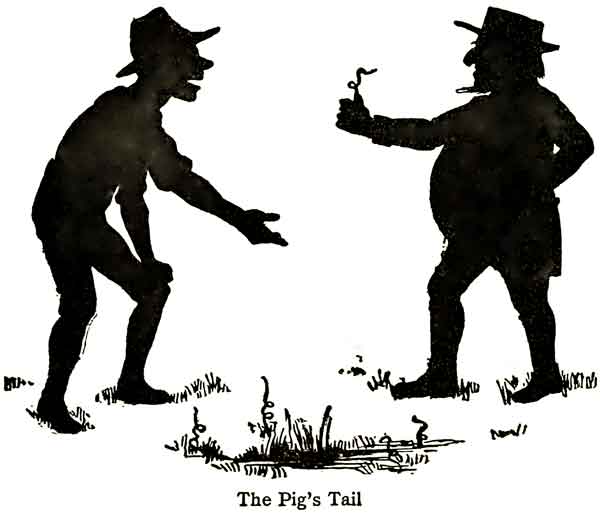
The next day Jack was ordered to take the pigs to market to sell them, and after he had cut off all their tails he sold them and pocketed the money; and then he went to a marsh near the farm and planted all the tails in the marsh.

When he got home the master asked him if he had sold the pigs.

He said: "No, they all rushed into the marsh at the foot of the valley."

"I don't believe you," said the master, and was going to get into a rage when Jack said to him:

"Keep cool, master, keep cool."

So he went with Jack to the marsh, and when he saw the pigs' tails all peeping out the marsh he went and plucked one of them out of the ground, and Jack said:

"There, you've torn the tail from the poor pig's back."

Then the master was going to get into a rage again but Jack said: "Keep cool, master, keep cool," and pointed to his back.

Next day the master didn't like sending Jack out with the animals or else he might sell them to get some dinner. So he said to him:

"Jack, I want you today to clean the horses and the stable within and without."

"Very well, master," said Jack, and went to the stable; and he whitewashed it within and he whitewashed it without. Then he went to the horses and killed them and took out their insides and cleaned them within; and then he washed their skins.

In the evening the master came to see how Jack had got on with his work and was delighted to find the stable looking so clean.

"But where are the horses?" he said; and Jack pointed to them lying dead on their backs.

"Why, what have you done?" said the master.

"You told me to clean them within and without and how could I clean them within without killing them?" said Jack.

Then the master was just going to fly into a rage, when Jack said to him: "Keep cool, master, keep cool," and pointed to his back.

So next day the master had sent Jack out with the sheep, but so that he should not sell any of them to get money for his lunch he sent his wife with them telling her to watch Jack from behind a bush, and if he tried to sell any of the sheep to stop him. But Jack saw her and didn't say anything or try and sell any of the sheep.

But next day, when he went out with them, he took with him his gun, and when the farmer's wife got behind the bush to watch him, he called out: "Ah, wolf, I see you," and fired his gun at her and hit her in the leg. She screamed out, and the master came running up and said:

"What's this, Jack, what's this?"

Then Jack said: "Why, master, I thought that was a wolf and I shot my gun at it and it turned out to be the missus."

"How dare you, you scoundrel, shoot my wife!" cried out the master.

"Don't be in a rage, master, don't be in a rage," said Jack.

"Anybody would be in a rage if his wife was shot," said the master.

"Well, then," said Jack, "I'll have that strip off your back." And as there were witnesses present the master had to let Jack take a strip of skin from his back.

And with that he went home to his brothers.

The Pig's Tail 
******************** 

This is part of a series of postings of stories under the category, “Keeping the Public in Public Domain.” The idea behind Public Domain was to preserve our cultural heritage after the authors and their immediate heirs were compensated. I feel strongly current copyright law delays this intent on works of the 20th century. My own library of folklore includes so many books within the Public Domain I decided to share stories from them. I hope you enjoy discovering them.

At the same time, my own involvement in storytelling regularly creates projects requiring research as part of my sharing stories with an audience.  Whenever that research needs to be shown here, the publishing of Public Domain stories will not occur that week.  This is a return to my regular posting of a research project here.  (Don't worry, this isn't dry research, my research is always geared towards future storytelling to an audience.)  Response has convinced me that "Keeping the Public in Public Domain" should continue along with my other postings as often as I can manage it.

See the sidebar for other Public Domain story resources I recommend on the page “Public Domain Story Resources."