Tell me if you have a topic you'd like to see. (Contact: LoiS-sez@LoiS-sez.com .)
Please also let others know about this site.
Showing posts with label flowers. Show all posts

Friday, June 13, 2025

Olcott - Why Wild Roses Have Thorns - Keeping the Public in Public Domain

With summer days being enveloped in clouds from the Canadian wildfires, it may be tempting to stay indoors. The very area where these fire originate has a story about a wildflower that sometimes catches us -- quite literally -- and how it came to have thorns.

Today's story is from the Saulteaux, also Anishinaabe, who spread out from here in the Great Lakes to western Canada. The tale itself is found in Frances Jenkins Olcott's The Red Indian Fairy Book. While the book title might seem disrespectful in today's terminology, her retelling fits perfectly with the way I've heard elders tell Anishinaabe tales. 


May the firefighters win their battle so we may safely enjoy the beauties of nature. As my friend, the elder Simon Otto, who has gone on the Long Walk, would say "May you Walk in Peace."
 
********************** 

This is part of a series of postings of stories under the category, “Keeping the Public in Public Domain.” The idea behind Public Domain was to preserve our cultural heritage after the authors and their immediate heirs were compensated. I feel strongly current copyright law delays this intent on works of the 20th century. My own library of folklore includes so many books within the Public Domain I decided to share stories from them. I hope you enjoy discovering them.

At the same time, my own involvement in storytelling regularly creates projects requiring research as part of my sharing stories with an audience.  Whenever that research needs to be shown here, the publishing of Public Domain stories will not occur that week.  This is a return to my regular posting of a research project here.  (Don't worry, this isn't dry research, my research is always geared towards future storytelling to an audience.)  Response has convinced me that "Keeping the Public in Public Domain" should continue along with my other postings as often as I can manage it.

See the sidebar for other Public Domain story resources I recommend on the page “Public Domain Story Resources."

Friday, May 23, 2025

Olcott - The Bad Poppy-Seeds - Keeping the Public in Public Domain

It seems a week early to have Memorial Day, but it's this coming Monday instead of having it fixed at May 30th as it was until 1968 when Congress changed its observance to the last Monday in May. That change took effect at the federal level in 1971. Probably the American Legion will be selling Poppies this weekend through May 30th. Wikipedia explains:

In 1915, following the Second Battle of Ypres, Lieutenant Colonel John McCrae, a physician with the Canadian Expeditionary Force, wrote the poem "In Flanders Fields". Its opening lines refer to the fields of poppies that grew among the soldiers' graves in Flanders.[80] Inspired by the poem, YWCA worker Moina Michael attended a YWCA Overseas War Secretaries' conference three years later wearing a silk poppy pinned to her coat and distributed over two dozen more to others present. The National American Legion adopted the poppy as its official symbol of remembrance in 1920.[81]

Not just the United States, but around the world the Remembrance poppy is a symbol "to commemorate their military personnel who died in war. " Its choice goes way back in history as "Poppies have long been used as a symbol of sleep, peace, and death: Sleep because the opium extracted from them is a sedative, and death because of the common blood-red colour of the red poppy in particular.[16]"  

The Twentieth Century especially chose poppies after that previously mentioned poem, ""In Flanders Fields", was written after the First World War by Canadian physician Lieutenant-Colonel John McCrae.

It's certainly worth seeing those poppies, in Flanders Field or elsewhere, whether in Belgium or other cemeteries and battlefields or in the Youtube video of "Why Do Poppies Grow on Battlefields; The Science Behind Flanders Fields"


Here is a Bengali legend telling even a bit more about these flowers so closely involved with our Memorial Day and Remembrance Day in other countries. It comes from The Wonder Garden, an anthology that is perfect for garden lovers.


*************

This is part of a series of postings of stories under the category, “Keeping the Public in Public Domain.” The idea behind Public Domain was to preserve our cultural heritage after the authors and their immediate heirs were compensated. I feel strongly current copyright law delays this intent on works of the 20th century. My own library of folklore includes so many books within the Public Domain I decided to share stories from them. I hope you enjoy discovering them.

At the same time, my own involvement in storytelling regularly creates projects requiring research as part of my sharing stories with an audience.  Whenever that research needs to be shown here, the publishing of Public Domain stories will not occur that week.  This is a return to my regular posting of a research project here.  (Don't worry, this isn't dry research, my research is always geared towards future storytelling to an audience.)  Response has convinced me that "Keeping the Public in Public Domain" should continue along with my other postings as often as I can manage it.

See the sidebar for other Public Domain story resources I recommend on the page “Public Domain Story Resources."

Friday, March 21, 2025

Walker - Jack the Preacher - Keeping the Public in Public Domain

Offiffiffic'ally Spring started this past week when: The vernal equinox arrives on Thursday, marking the start of the spring season for the Northern Hemisphere and the fall in the Southern Hemisphere. On the equator, the sun will be directly overhead at noon. Equinoxes are the only time when both the north and south poles are lit by sunshine at the same time.(AP News.com ) Even earlier, "meteorological spring" began on March 1 as that AP article continues: While astronomical seasons depend on how the Earth moves around the sun, meteorological seasons are defined by the weather. They break down the year into three-month seasons based on annual temperature cycles. By that calendar, spring starts on March 1, summer on June 1, fall on Sept. 1 and winter on Dec. 1.

As a result spring seems firmly entrenched in March. Looking at the past week, southeastern Michigan hit 70s only to let the next day's vernal equinox bring flakes of snow! I know spring will come here even if the present temperatures "roller coaster." Is it any wonder fairy tales enjoy this hopeful sign of Spring? Many exist, but as I look out at the evergreens swaying in the wind, I can appreciate this story poking fun at the pride of the trees thinking they announce spring to the woodland flowers.

(I'll tell a bit more about the book where this story is found after the tale.)

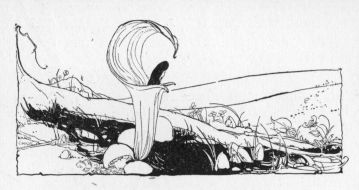
JACK THE PREACHER

Jack the Preacher

Jack the Preacher

One morning in very early springtime the big Evergreen Trees began to talk about the part they took in telling all the woodland flowers that it was spring.

"Why, if we were not here," said one Evergreen Tree, "who would awake these sleepy springtime flowers to their duty? I should like you to tell me!"

"You speak truly, brother," said another tree. "We are ever green and need no awakening to our duty; but for us the woods would be a sorry-looking place in the summer. Those lazy crocuses would sleep right on and on!"

"Yes, and the little violets never would dare show their timid little heads," said another Evergreen Tree, "when the soft winds begin to run through the woods. It is then we call forth to all sleeping flowers and shrubs and bushes: 'Awake! It is time to get up!'"

"And who would tell the Bee summer was on its way?" said another Tree. "He would never get his work started at all if it were not for us. How lucky the flowers and all the woodland things are that we are here to tell them when to get up!"

So the Evergreens talked and bragged about how they preached Springtime to the woodland folk, and as they talked all the spring flowers awoke and the insects began lazily to stretch their wings, but it was not because of what the big Evergreen Trees were saying; no, it was because they had heard the voice of the little woodland preacher.

And who was he, do you think? Why, no other than Jack-in-the-pulpit, who gives a talk every spring to all the woodland dwellers on just how to bloom and how to buzz and when to do it.

Every night for ever so long before it is time for the crocus or the violet or any early spring flower to bloom, when it is the magic hour the Fairies come running through the woods and touch Jack on his nodding little head under the dry leaves and up he pops and begins to preach.

So when the flowers and bees and things heard the big Evergreen Trees talking they nodded to each other and laughed. "Isn't it funny to hear them?" said a beautiful yellow crocus. "Those tall trees know nothing about the real truth of things, do they?"

"Fancy thinking they awaken us!" said another flower. "Why, they themselves are asleep. They get so used to winter they stand still all the time, but who is to tell them the truth about our Preacher Jack? The Evergreen Trees never bend or sway to one side or the other far enough to see the beauties of our woodland spring. They only know what the winds tell them."

"Let them think what they like," said a little bush of pretty blossoms. "It does not hurt Jack-in-the-pulpit if the Evergreens think they are the preachers of the woods, for all the spring and summer flowers know that Jack has always been our preacher and the Evergreens haven't any pulpit to preach from. Only they do not know it."

And so the sleepy old Evergreens thought they were the ones who awakened the flowers and preached to them about their duty, and no one ever told them about little Jack-in-the-pulpit, who always has and always will preach about the spring and summer to all the woodland dwellers. 

***

That story is from Sandman's Goodnight Stories by Abbie Phillips Walker and the illustration was by Rhoda C. Chase. I find it interesting that Chase has a Wikipedia page, but the only thing I could find about Walker was essentially a list of her several "Sandman" books and at Find-A-Grave. For the first two decades of the Twentieth Century her "Sandman" books were quite popular. Currently Project Gutenberg has three of them and Archive.org has several more.

In case that illustration of a Jack in the Pulpit isn't enough, here's a photo of one sprouting up on the forest floor. May you soon find one!


***************

This is part of a series of postings of stories under the category, “Keeping the Public in Public Domain.” The idea behind Public Domain was to preserve our cultural heritage after the authors and their immediate heirs were compensated. I feel strongly current copyright law delays this intent on works of the 20th century. My own library of folklore includes so many books within the Public Domain I decided to share stories from them. I hope you enjoy discovering them.

At the same time, my own involvement in storytelling regularly creates projects requiring research as part of my sharing stories with an audience.  Whenever that research needs to be shown here, the publishing of Public Domain stories will not occur that week.  This is a return to my regular posting of a research project here.  (Don't worry, this isn't dry research, my research is always geared towards future storytelling to an audience.)  Response has convinced me that "Keeping the Public in Public Domain" should continue along with my other postings as often as I can manage it.

See the sidebar for other Public Domain story resources I recommend on the page “Public Domain Story Resources."


Friday, August 2, 2024

Olcott - The Morning-Glory Fan - Keeping the Public in Public Domain

Sometimes when I find a story I wonder if it truly is well-known in the listed culture. I searched and found not only today's story, "The Morning-Glory Fan", but traditional morning-glory Japanese fans for sale.

Read more about the artist, Rieko Morita, at https://www.alexcious.com/products/detail638.html


unique traditional Japanese uchiwa fans

Flowers both wild and cultivated at this time of the year seem to be everywhere!  If you want to find stories about them, I strongly recommend The Wonder Garden by Frances Jenkins Olcott. She has deserved posting her stories here a dozen times. The subtitle shows it covers "nature myths and tales from all the world over for story-telling and reading aloud and for the children's own reading."


Enjoy those Morning-Glories as they only last a short time. May your memory of this lovely story last far longer.

**************************

This is part of a series of postings of stories under the category, "Keeping the Public in Public Domain."  The idea behind Public Domain was to preserve our cultural heritage after the authors and their immediate heirs were compensated.  I feel strongly current copyright law delays this intent on works of the 20th century.  My own library of folklore includes so many books within the Public Domain I decided to share stories from them.  I hope you enjoy discovering new stories.  


At the same time, my own involvement in storytelling regularly creates projects requiring research as part of my sharing stories with an audience.  Whenever that research needs to be shown here, the publishing of Public Domain stories will not occur that week.  This is a return to my regular posting of a research project here.  (Don't worry, this isn't dry research, my research is always geared towards future storytelling to an audience.)  Response has convinced me that "Keeping the Public in Public Domain" should continue along with my other postings as often as I can manage it.

Other Public Domain story resources I recommend-

  • There are many online resources for Public Domain stories, maybe none for folklore is as ambitious as fellow storyteller, Yoel Perez's database, Yashpeh, the International Folktales Collection.  I have long recommended it and continue to do so.  He has loaded Stith Thompson's Motif Index into his server as a database so you can search the whole 6 volumes for whatever word or expression you like by pressing one key. http://folkmasa.org/motiv/motif.htm

  • You may have noticed I'm no longer certain Dr. Perez has the largest database, although his offering the Motif Index certainly qualifies for those of us seeking specific types of stories.  There's another site, FairyTalez claiming to be the largest, with "over 2000 fairy tales, folktales, and fables" and they are "fully optimized for phones, tablets, and PCs", free and presented without ads.
    Between those two sites, there is much for story-lovers, but as they say in infomercials, "Wait, there's more!"

The email list for storytellers, Storytell, discussed Online Story Sources and came up with these additional suggestions:        

         - David K. Brown - http://people.ucalgary.ca/~dkbrown/stories.html

         - Richard Martin - http://www.tellatale.eu/tales_page.html

         - Spirit of Trees - http://spiritoftrees.org/featured-folktales

         - Story-Lovers - http://www.story-lovers.com/ is now only accessible through the Wayback Machine, described below, but the late Jackie Baldwin's wonderful site lives on there, fully searchable manually (the Google search doesn't work), at https://archive.org/ .  It's not easy, but go to Story-lovers.com snapshot for December 22 2016  and you can click on SOS: Searching Out Stories to scroll down through the many story topics and click on the story topic that interests you.

       - World of Tales - http://www.worldoftales.com/ 

 
           - Zalka Csenge Virag - http://multicoloreddiary.blogspot.com doesn't give the actual stories, but her recommendations, working her way through each country on a continent, give excellent ideas for finding new books and stories to love and tell.

     
You're going to find many of the links on these sites have gone down, BUT go to the Internet Archive Wayback Machine to find some of these old links.  Tim's site, for example, is so huge probably updating it would be a full-time job.  In the case of Story-Lovers, it's great that Jackie Baldwin set it up to stay online as long as it did after she could no longer maintain it.  Possibly searches maintained it.  Unfortunately Storytell list member, Papa Joe is on both Tim Sheppard's site and Story-Lovers, but he no longer maintains his old Papa Joe's Traveling Storytelling Show website and his Library (something you want to see!) is now only on the Wayback Machine.  It took some patience working back through claims of snapshots but finally in December of 2006 it appears!

    Somebody as of this writing whose stories can still be found by his website is the late Chuck Larkin - http://chucklarkin.com/stories.html.  I prefer to list these sites by their complete address so they can be found by the Wayback Machine, a.k.a. Archive.org, when that becomes the only way to find them.

You can see why I recommend these to you. 

Have fun discovering even more stories

Friday, June 14, 2024

Skinner - Why Roses Have Thorns - Keeping the Public Domain

Years ago I tried to outsmart a dog who liked to dig next to the foundation of my house. A nearby garden center suggested "carpet roses." The thorns were predicted to stop him.  They didn't, but a fence around the roses did.  He's no longer alive, but a memory of many wonderful years.  I still have the roses to enjoy and remind me that while he was indeed a wonderful dog, he wasn't perfect.  (That helps keep the comparison fair next to our present dog.)

Today's story is about roses and their thorns from the summer anthology The Turquoise Story Book : Stories and Legends of Summer and Nature and was adapted by Eleanor Skinner from Algonquin Indian Tales, by Egerton R. Young.

by Micah Tindell on Unsplash

WHY ROSES HAVE THORNS
 
(ALGONQUIN LEGEND)

In the far-off days of long ago roses had no thorns. The branches of the bushes and the flower stems were smooth and delicate and made delicious food for the animals. They greedily ate the leaves, stems, and lovely blossoms; sometimes, indeed, they devoured the entire plant.

With grief the roses saw that each year the number of bushes was growing fewer and they feared the time would come when there would be none of their blossoms left to gladden the summer days. At last they held a council to see if anything could be done to prevent the animals from destroying the bushes. But no one could think of a way out of the difficulty.

"We must go to Manabozho, the Great 328Chief," said one of them. "He will advise us what to do."

Accordingly, it was decided that several messengers, chosen from the council, should seek the Great Chief and tell him how the animals were fast destroying the roses.

It was no easy matter to find Manabozho, for while he lived on earth among the Red Men he took many disguises. They who sought him were carried by the swiftest wind through valleys and meadows and far over the hilltops. All along the path of their journey, whenever they asked the question, "Where shall we find Manabozho?" they received the same answer, "Travel on toward the sunrise. There you will find the Great Chief. He is tending a wonderful garden."

At last one morning they saw the sun shining on a marvellous garden where vegetables grew in abundance. There were beds of cucumbers and squash, rows of corn and beans, and many other plants, whose names the messengers did not know. And what surprised them most was the beautiful hedge of rose-bushes which surrounded the garden. They 329looked anxiously for the Great Gardener Chief but he was nowhere to be seen. Silently the messengers hid themselves in a forest which grew near, for they believed Manabozho would soon return. The thought of talking to him filled them with awe, but they were determined to be brave and tell him their mission.

"He values roses or he would not have chosen them for his garden hedge," they whispered, looking with pride at the beauty of the flowering bushes.

While they were waiting a surprising thing happened. In the forest they heard quiet, stealthy steps approaching. Soon they saw a procession of animals from the woods. There were field mice, squirrels, rabbits, foxes, coyotes, elks, and bears, all making their way to Manabozho's garden. They were sniffing the air as if they scented something delicious. On they came until they reached the rose-hedge where they stopped to taste the dainty, fragrant leaves. Various cries of satisfaction were uttered and immediately they began feasting on the delicate bushes. Leaves, flowers, 330and stems were all devoured and in a short time not one bit of the rose-hedge around the Great Chief's garden was left. It could not have disappeared more completely if Manabozho himself had cut it down. The dainty morsel of the rose-hedge, however, was not enough to satisfy the hunger of the animals from the woods. They turned their attention to the vegetables and were devouring the very choicest of them when suddenly the smaller animals pricked up their ears and listened. The next moment they scuttled away as fast as they could into the forest. The larger animals took this for a sign of danger and hurried after them.

In a little while the messengers of the Rose Council heard a loud voice singing. Manabozho was returning from his adventure. As he drew near his song ceased for he saw that destruction had come to his precious garden. His rage was terrible! In a voice which shook the neighboring hillsides he declared he would punish the intruders. He was particularly grieved at the destruction of his rose-hedge which he valued not only for its beauty 331but because he believed it was a means of protection to his garden.

When the messengers saw this they came forward and stated the object of their journey. Manabozho listened with eager interest while one of them told the story of the rapidly decreasing number of rose-bushes.

"Great Manabozho," said the speaker, "the animals of the woods find rose-bushes such delicious food that they eat blossoms, leaves, and stems. Our number is decreasing so rapidly that in a little while there will be none left to gladden the earth. The destruction of your hedge proves how ruthlessly the animals destroy us. Help us, O Chief! Devise some plan to protect us."

"You shall, indeed, have my help," said Manabozho, thoughtfully.

For some time the chief was silent. Then he said, "I'll give you weapons and you shall protect yourselves. Sharp thorns shall grow on your branches and needle-like prickles shall cover the stems which hold your lovely blossoms. While you are armed with these, 332the cruel animals will not venture to touch you."

The messengers thanked Manabozho with all their hearts. Delighted with his gift, they hastened back to tell the Council how the Great Chief had saved the roses of the world. Ever since that day roses have had thorns.

Adapted from Algonquin Indian Tales, by Egerton R. Young. Copyright, 1903, by Egerton R. Young. Reprinted by permission of the Abingdon Press, Publishers.

**************

If you are looking to find seasonal material in the Public Domain, Duffield and Company in the early Twentieth Century produced a series of books known as the Jewel Series.  Many of them are anthologies specifically about the seasons by Ada M. Skinner and Eleanor L. Skinner with three not about the seasons by Penrhyn W. Coussens. 

The Jewel Series:

THE DIAMOND STORY BOOK. Compiled by Penrhyn W. Coussens. Illustrations in color by Ethel Green.

THE EMERALD STORY BOOK. Stories of Spring, Nature, and Easter. By Ada and Eleanor Skinner. Frontispiece in color by Maxfield Parrish.

THE RUBY STORY BOOK. Tales of Courage and Heroism. Retold by Penrhyn W. Coussens. Frontispiece in color by Maxfield Parrish.

THE SAPPHIRE STORY BOOK. Tales of the Sea. Collected and retold by Penrhyn W. Coussens. Frontispiece in color by Maxfield Parrish.

THE TOPAZ STORY BOOK. Stories and Legends of Autumn, Hallowe’en, and Thanksgiving. Compiled by Ada M. and Eleanor L. Skinner. Frontispiece in color by Maxfield Parrish.

THE TURQUOISE STORY BOOK. Stories and Legends of Summer and Nature. By Ada M. and Eleanor L. Skinner. Frontispiece in color by Maxfield Parrish.

THE PEARL STORY BOOK. Stories and Legends of Winter, Christmas and New Year’s Day. Compiled by Ada M. and Eleanor L. Skinner. Frontispiece in color by Maxfield Parrish.

THE GARNET STORY BOOK. Tales of Cheer both Old and New. Compiled by Ada M. and Eleanor L. Skinner. Frontispiece in color by Dugald S. Walker.

THE JADE STORY BOOK. Stories from the Orient. Compiled by Penrhyn W. Coussens. Frontispiece in color by Dugald Stewart Walker.


Friday, June 7, 2024

Field - Buttercup Gold - Keeping the Public inPublic Domain

We all have things we wish we could go back and ask people who are no longer with us.  My mother would visit me in the spring and shout "THE OLD MAN SPILLED HIS BAG OF GOLD!" upon seeing our fields covered in dandelions.  

After she was gone and once again we were painted with dandelions, I found myself wondering who this Old Man was and why he spilled his Bag of Gold?  I felt sure it was something she read as a child, possibly in school, so that other people from her generation would also know it.  I've asked about the Old Man and that Bag of Gold for years.  I always mentioned dandelions.  Nobody spoke up.

https://x.com/VenetiaJane

Venetia Jane, THANK YOU!  I never would have found it as the original was not about dandelions, but buttercups! She wrote on her X account for V
enetiaJane's Garden back on May 10 2023:A tale tells of a greedy man who found the pot of gold hidden at the end of the rainbow. Hastily he carried the gold away but it fell through a hole in his bag, scattering amongst the grass where it was transformed into fields of golden buttercups by the fairies #FolkloreThursday Her glorious photography would have been loved by my mother.
YES!

I found it's from Ellen Robena Field's Buttercup Gold, and Other Stories (1894) -- definitely before even my mom, but the book it comes from would have been considered a classic when she was a child

It's at Project Gutenberg (it's a text only and feels a bit dry).  I like a pdf version I found online which is done with a bit more style than just the text.  Unfortunately that pdf doesn't reproduce larger online for easy reading. 
 
The actual text is:

Did you ever hear of the pot of gold hidden at the end of the rainbow? Some people think it is there now, but they are mistaken, for a long time ago somebody found it. How he happened to find it, nobody knows, for a great many people have searched in vain, and have never even been able to discover that the rainbow has any ends at all. The man who found it was very selfish and did not want anybody to know, for fear they might want some of his money. So one night he put it in a bag, which he slung over his shoulder, and walked across the fields toward a thick wood where he meant to hide it.

In the bag was something beside the gold—something so small that the greedy man in his hurry had not noticed it. It was a hole, and, as he walked on, one by one the gold coins fell out into the grass. When he reached the wood and found all of his money gone, he hurried back to search for it, but something strange had happened. It was a midsummer night, and the fairies were having a dance out in the meadows. They were good, loving little people, and despised selfishness above everything. One little fairy spied the glittering gold among the grasses. She had seen the greedy man passing by, and knew he would soon be back to hunt for his treasure. “It will do him no good,” she said, “if he hides it away, and neither will it help anybody else. I will change it into something that will give joy to rich and poor.”

When the greedy man reached the meadow he could see no gold money, but in its place were bright, yellow flowers—buttercup gold for the children.

***

If you go to this link you also can hear it and find a student activity which looks at that old man and why he became the man in the story.  I especially like the activity incorporating the fairy and his effort to understand the old man's behavior.  
 
Since actual buttercups aren't in the student activity, I'd reproduce or send them to VenetiaJane's work and also spend some time on buttercups.  Unfortunately that includes "Everything you need to know about buttercups" including the fact they "are considered poisonous and may cause dermatitis, or skin irritation."  It discusses the various types of buttercups and talks about their tendency to become invasive.  Whether buttercups or dandelions I know they spread easily...just like the old man's gold, the very thing causing my mother's exuberant rejoicing!
 
Field's entire book is similarly accessed at Lit2Go by searching the author's name.  No credit is given to the illustrator of each poem and story activity, but they are much more visually friendly as well as offering activities and an audio file.  As Lit2Go explains: 
Lit2Go is a free online collection of stories and poems in Mp3 (audiobook) format. An abstract, citation, playing time, and word count are given for each of the passages. Many of the passages also have a related reading strategy identified. Each reading passage can also be downloaded as a PDF and printed for use as a read-along or as supplemental reading material for your classroom.
The Florida Center for Instructional Technology produces more than just Lit2Go, offering among other digital resources,  "over 100,000 pieces of free digital content for non-commercial classroom use by students and teachers."  That includes a huge collection of royalty-free photos, maps, and illustrations.  Take a look at that home page link.  Right now it looks at resources (mainly historical or literary) for the months of June and July.  I am so impressed with their work that I subscribed to their newsletter.  I'm certain it will be worthwhile both in storytelling and here on this blog!

For those wanting the actual book it has been reprinted if you want to buy it.  The reprint book gives this offiffiffic'al information:

The book "Buttercup Gold, and Other Stories " has been considered important throughout the human history, and so that this work is never forgotten we have made efforts in its preservation by republishing this book in a modern format for present and future generations. This whole book has been reformatted, retyped and designed. These books are not made of scanned copies and hence the text is clear and readable.

Product Details
ISBN: 9789356153639
ISBN-10: 9356153639
Publisher: Alpha Edition
Publication Date: May 17th, 2022
Pages: 32

Such a slender work has influenced readers from before the Twentieth Century.

Now for yet another mystery, besides dandelions the gold spreading as rapidly on my lawn is not a buttercup, it has a large number of tiny petals.  Just in case it, too, can cause skin irritation, I will use gloves harvesting one to show a naturalist for identification.

After the years pondering the mystery mom left me, why not another?

*************

This is part of a series of postings of stories under the category, "Keeping the Public in Public Domain."  The idea behind Public Domain was to preserve our cultural heritage after the authors and their immediate heirs were compensated.  I feel strongly current copyright law delays this intent on works of the 20th century.  My own library of folklore includes so many books within the Public Domain I decided to share stories from them.  I hope you enjoy discovering new stories.  


At the same time, my own involvement in storytelling regularly creates projects requiring research as part of my sharing stories with an audience.  Whenever that research needs to be shown here, the publishing of Public Domain stories will not occur that week.  This is a return to my regular posting of a research project here.  (Don't worry, this isn't dry research, my research is always geared towards future storytelling to an audience.)  Response has convinced me that "Keeping the Public in Public Domain" should continue along with my other postings as often as I can manage it.

Other Public Domain story resources I recommend-

  • There are many online resources for Public Domain stories, maybe none for folklore is as ambitious as fellow storyteller, Yoel Perez's database, Yashpeh, the International Folktales Collection.  I have long recommended it and continue to do so.  He has loaded Stith Thompson's Motif Index into his server as a database so you can search the whole 6 volumes for whatever word or expression you like by pressing one key. http://folkmasa.org/motiv/motif.htm

  • You may have noticed I'm no longer certain Dr. Perez has the largest database, although his offering the Motif Index certainly qualifies for those of us seeking specific types of stories.  There's another site, FairyTalez claiming to be the largest, with "over 2000 fairy tales, folktales, and fables" and they are "fully optimized for phones, tablets, and PCs", free and presented without ads.
    Between those two sites, there is much for story-lovers, but as they say in infomercials, "Wait, there's more!"

The email list for storytellers, Storytell, discussed Online Story Sources and came up with these additional suggestions:        

         - David K. Brown - http://people.ucalgary.ca/~dkbrown/stories.html

         - Richard Martin - http://www.tellatale.eu/tales_page.html

         - Spirit of Trees - http://spiritoftrees.org/featured-folktales

         - Story-Lovers - http://www.story-lovers.com/ is now only accessible through the Wayback Machine, described below, but the late Jackie Baldwin's wonderful site lives on there, fully searchable manually (the Google search doesn't work), at https://archive.org/ .  It's not easy, but go to Story-lovers.com snapshot for December 22 2016  and you can click on SOS: Searching Out Stories to scroll down through the many story topics and click on the story topic that interests you.

       - World of Tales - http://www.worldoftales.com/ 

 
           - Zalka Csenge Virag - http://multicoloreddiary.blogspot.com doesn't give the actual stories, but her recommendations, working her way through each country on a continent, give excellent ideas for finding new books and stories to love and tell.

     
You're going to find many of the links on these sites have gone down, BUT go to the Internet Archive Wayback Machine to find some of these old links.  Tim's site, for example, is so huge probably updating it would be a full-time job.  In the case of Story-Lovers, it's great that Jackie Baldwin set it up to stay online as long as it did after she could no longer maintain it.  Possibly searches maintained it.  Unfortunately Storytell list member, Papa Joe is on both Tim Sheppard's site and Story-Lovers, but he no longer maintains his old Papa Joe's Traveling Storytelling Show website and his Library (something you want to see!) is now only on the Wayback Machine.  It took some patience working back through claims of snapshots but finally in December of 2006 it appears!

    Somebody as of this writing whose stories can still be found by his website is the late Chuck Larkin - http://chucklarkin.com/stories.html.  I prefer to list these sites by their complete address so they can be found by the Wayback Machine, a.k.a. Archive.org, when that becomes the only way to find them.

You can see why I recommend these to you. 

Have fun discovering even more stories

Friday, May 17, 2024

Farmer - Dandelion Stars - Keeping the Public in Public Domain

Hot on the heels of last weekend's Mother's Day I found myself once again wondering about something my mother used to say whenever she saw a lawn with dandelions.  "Oh the old man spilled his bag of gold!" she would shout with great delight.  I have searched and searched to find out what was behind that exclamation.  

If you know please tell me.  I suspect it was something going back to her childhood.

Aside from having dandelions on my own lawn, over on X, look at https://twitter.com/VenetiaJane.  

That inspired me to hunt once again hoping to learn more about Public Domain stories of Dandelions.  I found this in Florence Virginia Farmer's book, Nature Myths of Many Lands.  I recommend it as a very useful book for storytellers and naturalists.

I told VenetiaJane about Farmer's version.  She did a bit of prowling her own files as she remembered the story a bit differently and found this from the Journal of Education 

October 17, 1912 JOURNAL OF EDUCATION page 409

NEWTON SPELLING

[Continued from page 405.]

Here are some sentences used for spelling

orally and in writing: -


Did you see the sky last night?

The moon was shining.

The stars were bright.

The moon is the mother.

The stars are her children.

Can you tell who is the father?

One night some stars were cross.

They would not shine.

They hid behind à cloud.

Mother moon felt very sad.

Where are my baby stars?

Why are they not shining?

We do not want to work.

Let the other stars shine.

We are too sleepy to-night.

You were born to shine.

I will have no lazy stars in my home.

You must go to the earth below.

The lazy stars shook with fear.

They lost their hold.

Down, down they fell to the earth.

The little stars fell on the grass.

All night they lay there.

They wished they had been good.

In the morning father sun looked down.

He saw the little stars.

He was sorry for them.

How cold they look!

Come, clouds, send down some snow.

Cover the baby stars with a soft blanket.

All winter the stars slept in their warm bed.

The stars above shone down on them,

But they never woke.

At last the spring came,

Father sun sent his warm beams to the earth

It is time to wake, little stars.

The stars opened their sleepy eyes.

They looked up into their father's kind facc.

He smiled at them.

These stars now live on the earth.

They shine all day long.

Children call them dandelions.

*****

I edited out parts of that page unrelated to the Dandelion story.  <sigh!>  That was from an idea for teachers shortly before my own mother was born.  I intend to keep looking for what inspired mom's cries of "The old man spilled his bag of gold!"  Perhaps it was something created by a teacher she had. I can certainly tell you her lawn never tried to eliminate dandelions.  

Whether you want dandelions or not, if you love nature, especially plants, I want to give a shout out to https://www.venetiajane.co.uk/ as well as her work on X (Twitter), Instagram, Pinterest, and YouTube.  Her photography is both lovely and lovingly done with cards, calendars, and photos.  She mixes those images with folklore, literature, and history.  Here in the mitten-shaped state of Michigan I sometimes see her part of the United Kingdom warming up before us.  As winter tends to drag on too long, it's wonderful to see what she sees.

You may see dandelions as a weed taking over your lawn, but my mom, VenetiaJane, and I see so much more.  Blow on those dandelion stars to spread them and, while you're at it, spread a story about them.

Friday, March 29, 2024

Olcott - The Beauty of the Lily - Keeping the Public in Public Domain

Last week I promised another tale from Frances Jenkins Olcott, in this case from her book, The Wonder Garden; Nature Myths and Tales from All the World Over...  That subtitle is condensed, but it goes on to say it's "For Storytelling and Reading Aloud and for the Children's Own Reading."  Last week I once again gave a bit of Olcott's background.  Her desire to keep children reading and intent for storytelling was very much a part of her success.  I went to https://www.amortization.org and learned the half million dollars earned in her lifetime today would be over five million dollars!  Clearly her work was well-loved.  It took a bit of prowling, but discovered she wrote today's story for The Churchman.  It's a very unusual Easter tale.  Personally I love the way it incorporates the Easter greeting of "Christ is risen!" and it's response of "He is risen indeed!"

THE BEAUTY OF THE LILY


By Matt on Unsplash

Easter Tale

ONCE upon a time, in a far-distant land, there dwelt a peasant named Ivan, and with him lived his little nephew Vasily.

Ivan was gloomy and unkempt, and his restless eyes looked out from his matted hair and beard. As for the little Vasily, he was a manly child; but though his uncle was kind enough to him in his way, he neither washed him, nor combed his hair, nor taught him anything.

The hut they lived in was very miserable. Its walls were full of holes, the furniture of its one room was broken down and dusty, and its floor unswept. The little garden was filled with stones and weeds. The neighbours passing by in the daytime turned aside their heads. But they never passed at night, for fear of Ivan.

Now it happened one Easter morning that Ivan, feeling restless, rose early and went and stood before the door of the hut. The trees were budding, the air was full of bird-songs, the dew lay glittering on the grass, and a near-by brook ran leaping and gurgling along. The rays of the rising Sun shone slanting from the tops of the distant hills, and seemed to touch the hut.

And as Ivan looked, he saw a young man coming swiftly and lightly from the hills, and he bore on his arm a sheaf of pure white Lilies. The stranger drew near, and stopped before the hut.

"Christ is risen!" he said in flute-like tones.

"He is risen indeed!" muttered Ivan through his beard.

Then the young man took a Lily from his sheaf and gave it to Ivan, saying: —

"Keep it white !”: And, smiling, he passed on.

Wonderingly Ivan gazed at the flower in his hand. Its gold-green stem seemed to support a pure white crown, — or was it a translucent cup filled with light! And as the man looked into the flower's gold-fringed heart, awe stole into his soul.

Then he turned and entered the hut, saying to himself, "I will put it in water."

But when he went to lay the Lily on the window-sill, so that he might search for a vessel to set it in, he dared not put it down, for the sill was covered with thick dust.

He turned to the table, but its top was soiled with crumbs of mouldy bread and cheese mingled with dirt. He looked about the room, and not one spot could he see where he might lay the Lily without sullying its pure loveliness.

He called the little Vasily, and bade him stand and hold the flower. He then searched for something to put it in. He found an empty bottle, which he carried to the brook and washed and filled with sparkling water. This he placed upon the table, and in it set the Lily.

Then as he looked at the begrimed hands of little Vasily he thought to himself, "When I leave the room he may touch the flower and soil it." So he took the child and washed him, and combed his yellow hair; and the little one seemed to bloom like the Lily itself. And Ivan gazed on him in amazement, murmuring, “I never saw it thus before!'

From that hour a change came over Ivan. He cared tenderly for the little Vasily. He washed himself and combed his own hair. He cleaned the hut and mended its walls and furniture. He carried away the weeds and stones from the garden. He sowed flowers and planted vegetables. And the neighbours passing by no longer turned their heads aside, but stopping talked with Ivan, and sometimes gave the little Vasily presents of clothes and toys.

As for the Lily, seven days it blossomed in freshness and beauty, and gave forth a delicate fragrance; but on the eighth day, when Ivan and Vasily woke, it was gone. And though they sought it in hut and garden, they did not find it.

So Ivan and the little Vasily worked from day to day among their flowers and vegetables, and talked to their neighbours, and were happy. When the long winter nights came, Ivan read aloud about the Lilies of the Field, that toil not, neither do they spin, yet Solomon in all his glory was not arrayed like them. He read of that Beloved that feedeth among the Lilies, and of the Rose of Sharon and the Lily -of -the- Valley.

. . . . . .

So Easter came again. And early, very early in the morning, Ivan and the little Vasily arose and dressed, and went and stood before the hut. And when the splendour of the coming day shone above the distant hills, lo! the young man came swiftly and lightly, and in his arms he bore crimson Roses.

He drew near, and, stopping before the hut, said sweetly: —

"Christ is risen!"

"He is risen, indeed !': responded Ivan and Vasily joyously.

"How beautiful is thy Lily!'1' said the young man.

"Alas!'' answered Ivan, "it is vanished away, and we know not whither."

"Its beauty lives in thy heart," said the young man. "It can never die!"

And he took from his arm a crimson Rose and gave it to Vasily, saying : —

"Keep it fresh!"

But he smiled tenderly at Ivan, and passed on.

*****************************

This is part of a series of postings of stories under the category, "Keeping the Public in Public Domain."  The idea behind Public Domain was to preserve our cultural heritage after the authors and their immediate heirs were compensated.  I feel strongly current copyright law delays this intent on works of the 20th century.  My own library of folklore includes so many books within the Public Domain I decided to share stories from them.  I hope you enjoy discovering new stories.  


At the same time, my own involvement in storytelling regularly creates projects requiring research as part of my sharing stories with an audience.  Whenever that research needs to be shown here, the publishing of Public Domain stories will not occur that week.  This is a return to my regular posting of a research project here.  (Don't worry, this isn't dry research, my research is always geared towards future storytelling to an audience.)  Response has convinced me that "Keeping the Public in Public Domain" should continue along with my other postings as often as I can manage it.

Other Public Domain story resources I recommend-

  • There are many online resources for Public Domain stories, maybe none for folklore is as ambitious as fellow storyteller, Yoel Perez's database, Yashpeh, the International Folktales Collection.  I have long recommended it and continue to do so.  He has loaded Stith Thompson's Motif Index into his server as a database so you can search the whole 6 volumes for whatever word or expression you like by pressing one key. http://folkmasa.org/motiv/motif.htm

  • You may have noticed I'm no longer certain Dr. Perez has the largest database, although his offering the Motif Index certainly qualifies for those of us seeking specific types of stories.  There's another site, FairyTalez claiming to be the largest, with "over 2000 fairy tales, folktales, and fables" and they are "fully optimized for phones, tablets, and PCs", free and presented without ads.
    Between those two sites, there is much for story-lovers, but as they say in infomercials, "Wait, there's more!"

The email list for storytellers, Storytell, discussed Online Story Sources and came up with these additional suggestions:        

         - David K. Brown - http://people.ucalgary.ca/~dkbrown/stories.html

         - Richard Martin - http://www.tellatale.eu/tales_page.html

         - Spirit of Trees - http://spiritoftrees.org/featured-folktales

         - Story-Lovers - http://www.story-lovers.com/ is now only accessible through the Wayback Machine, described below, but the late Jackie Baldwin's wonderful site lives on there, fully searchable manually (the Google search doesn't work), at https://archive.org/ .  It's not easy, but go to Story-lovers.com snapshot for December 22 2016  and you can click on SOS: Searching Out Stories to scroll down through the many story topics and click on the story topic that interests you.

       - World of Tales - http://www.worldoftales.com/ 

 
           - Zalka Csenge Virag - http://multicoloreddiary.blogspot.com doesn't give the actual stories, but her recommendations, working her way through each country on a continent, give excellent ideas for finding new books and stories to love and tell.

     
You're going to find many of the links on these sites have gone down, BUT go to the Internet Archive Wayback Machine to find some of these old links.  Tim's site, for example, is so huge probably updating it would be a full-time job.  In the case of Story-Lovers, it's great that Jackie Baldwin set it up to stay online as long as it did after she could no longer maintain it.  Possibly searches maintained it.  Unfortunately Storytell list member, Papa Joe is on both Tim Sheppard's site and Story-Lovers, but he no longer maintains his old Papa Joe's Traveling Storytelling Show website and his Library (something you want to see!) is now only on the Wayback Machine.  It took some patience working back through claims of snapshots but finally in December of 2006 it appears!

    Somebody as of this writing whose stories can still be found by his website is the late Chuck Larkin - http://chucklarkin.com/stories.html.  I prefer to list these sites by their complete address so they can be found by the Wayback Machine, a.k.a. Archive.org, when that becomes the only way to find them.

You can see why I recommend these to you. 

Have fun discovering even more stories