Tell me if you have a topic you'd like to see. (Contact: LoiS-sez@LoiS-sez.com .)
Please also let others know about this site.
Showing posts with label Cornplanter. Show all posts

Friday, January 27, 2023

The First Winter - Ada and Eleanor Skinner/ William Walker Canfield - Keeping the Public in Public Domain

Personal update upfront: Those experimental Covid pills worked!  I'm testing negative and will N95mask for 5 days just in case.  The "mild cold" disappeared with the pills although there's a trace of dizziness lurking in my inner ears.  

Here in metro Detroit we finally got our first real snowstorm and this Iroquois legend has much to teach us.  I went first to the wonderful seasonal books by the Skinner sisters, each labeled for a gem and they truly are gems!  Their story comes from The Pearl Story Book: Stories and Legends of Winter, Christmas & New Year's DayBut my search went further using their acknowledgements to find W.W. Canfield's The Legends of the Iroquois; Told by "The Cornplanter".  Because there are differences I'm giving both to show how the story changed.  I will start with the Skinner adapted version.  

THE FIRST WINTER

(Iroquois Legend)

There was a time when the days were always of the same length, and it was always summer. The red men lived continually in the smile of the Great Spirit and were happy. But there arose a chief who was so powerful that he at last declared himself mightier than the Great Spirit, and taught his brothers to go forth to the plain and mock him. They would call upon the Great Spirit to come and fight with them or would challenge him to take away the crop of growing corn or drive the game from the woods. They would say he was an unkind father to keep himself and their dead brothers in the Happy Hunting Grounds, where the red men could hunt forever without weariness.

They laughed at their old men who had feared for so many moons to reproach the Great Spirit for his unfair treatment of the Indians who were compelled to hunt and fish for game for their wives and children, while their own women had to plant the corn and harvest it.

“In the Happy Hunting Grounds,” they said, “the Great Spirit feeds our brothers and their wives and does not let any foes or dangers come upon them, but here he lets us go hungry many times. If he is as great as you have said, why does he not take care of his children here?”

Then the Great Spirit told them he would turn his smiling face away from them, so that they should have no more light and warmth and they must build fires in the forest if they would see.

But the red men laughed and taunted him, telling him that he had followed one trail so long that he could not get out of it, but would have to come every day and give them light and heat as usual. Then they would dance and make faces at him and taunt him with his helplessness.

In a few days the quick eyes of some of the red men saw in the morning the face of the Great Spirit appear where it was not wont to appear, but they were silent, fearing the jibes of their brothers. Finally, duller eyes noticed the change, and alarm and consternation spread among the people. Each day brought less and less of the Great Spirit’s smile and his countenance was often hidden by dark clouds, while terrible storms beat upon the frightened faces turned in appeal toward the heavens. The strong braves and warriors became as women; the old men covered their heads with skins and starved in the forests; while the women in their lodges crooned the low, mournful wail of the death song. Frosts and snows came upon an unsheltered and stricken race, and many of them perished.

Then the Great Spirit, who had almost removed his face from the sight of men, had pity and told them he would come back. Day after day the few that remained alive watched with joy the return of the sun. They sang in praise of the approaching summer and once more hailed with thankfulness the first blades of growing corn as it burst from the ground. The Great Spirit told his children that every year, as a punishment for the insults they had given their Father, they should feel for a season the might of the power they had mocked; and they murmured not, but bowed their heads in meekness.

***

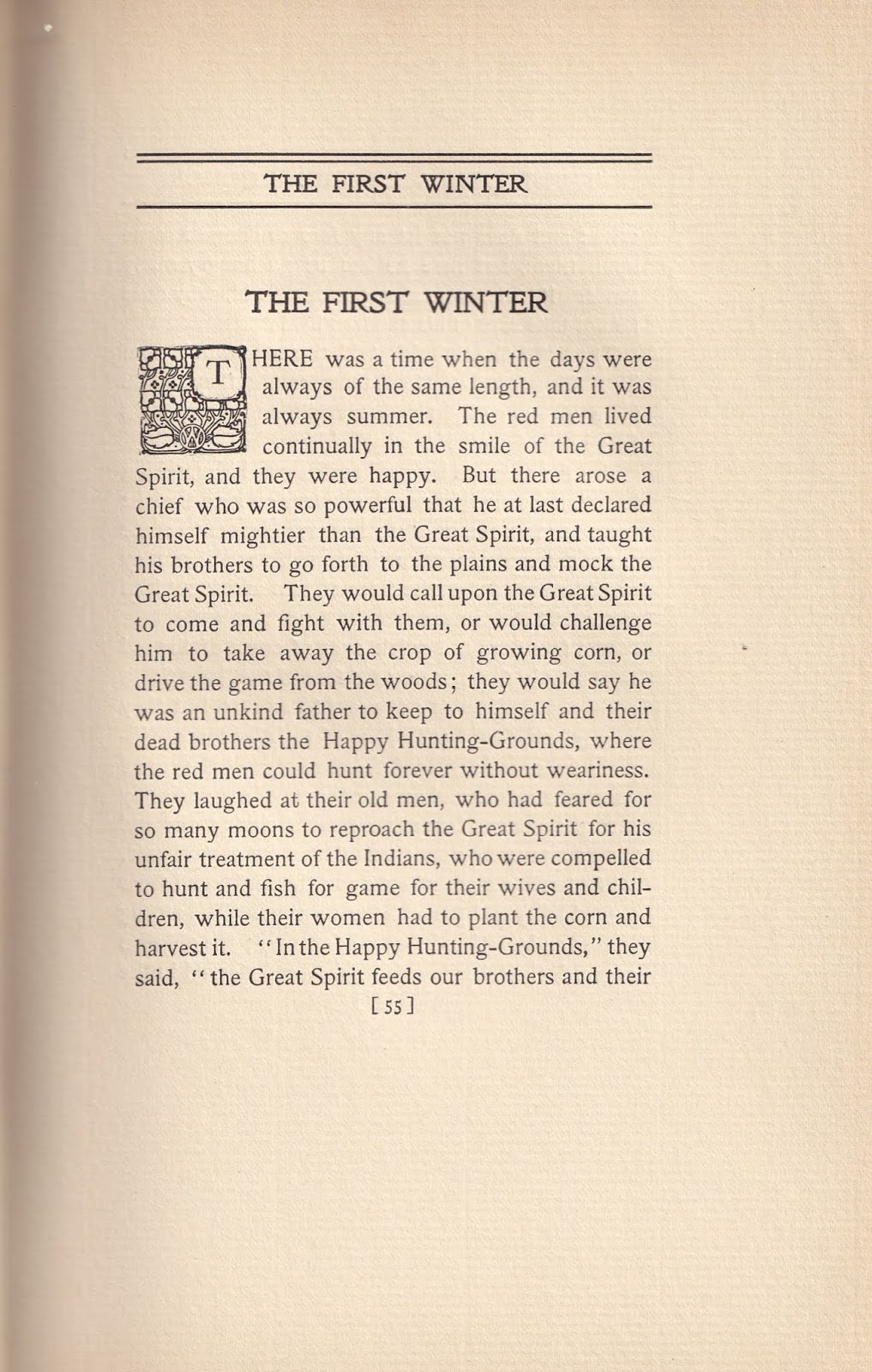
The Skinner sisters, Ada Maria and Eleanor Louise in their acknowledgements section of The Pearl Story Book: Stories & Legends of Winter, Christmas & New Year's Day credit W.W. Canfield and I was able to track down his The Legends of the Iroquois; Told by "The Cornplanter".  I want to show this version told by the Seneca chief known as The Cornplanter.  It is slightly different, but worth looking at the original traditional version.

THE FIRST WINTER

T

HERE was a time when the days were always of the same length, and it was always summer. The red men lived continually in the smile of the Great Spirit, and they were happy. But there arose a chief who was so powerful that he at last declared himself mightier than the Great Spirit, and taught his brothers to go forth to the plains and mock the Great Spirit. They would call upon the Great Spirit to come and fight with them, or would challenge him to take away the crop of growing corn, or drive the game from the woods; they would say he was an unkind father to keep to himself and their dead brothers the Happy Hunting-Grounds, where the red men could hunt forever without weariness. They laughed at their old men, who had feared for so many moons to reproach the Great Spirit for his unfair treatment of the Indians, who were compelled to hunt and fish for game for their wives and children, while their women had to plant the corn and harvest it. "In the Happy Hunting-Grounds," they said, "the Great Spirit feeds our brothers and their wives and does not let any foes or dangers come upon them, but here he lets us go hungry many times. If he is as great as you have said, why does he not take care of his children here?"

Then the Great Spirit told them he would turn his smiling face away from them, so that they should have no more light and warmth, and must build fires in the forests if they would see.

But the red men laughed and taunted him, telling him that he had followed one trail so long that he could not get out of it, but would have to come every day and give them light and heat. Then they would dance and make faces at him and taunt him with his helplessness.

In a few days the quick eyes of some of the red men saw in the morning the face of the Great Spirit appear where it was not wont to appear, but they were silent, fearing the jibes of their brothers. Finally duller eyes noticed the change, and alarm and consternation spread among the people. Each day brought less and less of the Great Spirit's smile and his countenance was often hidden by dark clouds, while terrible storms beat upon the frightened faces turned in appeal toward the heavens. The strong braves and warriors became as women; the old men covered their heads with skins and starved in the forests; while the women in their lodges crooned the low, mournful wail of the death-song, and the papooses crawled among the caves in the rocks and mountains and died unheeded. Frosts and snows came upon an unsheltered and stricken race, and many of them perished.

Then the Great Spirit, who had almost removed his face from the sight of the red men, had pity, and told them he would come back. Day after day the few that remained alive watched with joy the return of the sun. They sang in praise of the approaching summer, and once more hailed with thankfulness the first blades of growing corn as it burst from the ground. The Great Spirit told his children that every year, as a punishment for the insults they had given their Father, they should feel for a season the might of the power they had mocked; and they murmured not, but bowed their heads in meekness.

From the bodies of those who had perished of cold and hunger sprang all manner of poisonous plants, which spread themselves over the earth to vex and endanger the lives of the Indians of all generations; and in after years when any of the Indians from any reason "ate of the fatal root," it was said of them that they had "eaten of the bodies of their brothers who had defied the Great Spirit."

***

Be careful of how you interpret the weather.  If there's one thing it's guaranteed to do . . . it's change!  Until our days get much longer, let's remember this wisdom of when that respect was missing.

****************

This is part of a series of postings of stories under the category, "Keeping the Public in Public Domain."  The idea behind Public Domain was to preserve our cultural heritage after the authors and their immediate heirs were compensated.  I feel strongly current copyright law delays this intent on works of the 20th century.  My own library of folklore includes so many books within the Public Domain I decided to share stories from them.  I hope you enjoy discovering new stories.  


At the same time, my own involvement in storytelling regularly creates projects requiring research as part of my sharing stories with an audience.  Whenever that research needs to be shown here, the publishing of Public Domain stories will not occur that week.  This is a return to my regular posting of a research project here.  (Don't worry, this isn't dry research, my research is always geared towards future storytelling to an audience.)  Response has convinced me that "Keeping the Public in Public Domain" should continue along with my other postings as often as I can manage it.

Other Public Domain story resources I recommend-

  • There are many online resources for Public Domain stories, maybe none for folklore is as ambitious as fellow storyteller, Yoel Perez's database, Yashpeh, the International Folktales Collection.  I have long recommended it and continue to do so.  He has loaded Stith Thompson's Motif Index into his server as a database so you can search the whole 6 volumes for whatever word or expression you like by pressing one key. http://folkmasa.org/motiv/motif.htm

  • You may have noticed I'm no longer certain Dr. Perez has the largest database, although his offering the Motif Index certainly qualifies for those of us seeking specific types of stories.  There's another site, FairyTalez claiming to be the largest, with "over 2000 fairy tales, folktales, and fables" and they are "fully optimized for phones, tablets, and PCs", free and presented without ads.
    Between those two sites, there is much for story-lovers, but as they say in infomercials, "Wait, there's more!"

The email list for storytellers, Storytell, discussed Online Story Sources and came up with these additional suggestions:        

         - David K. Brown - http://people.ucalgary.ca/~dkbrown/stories.html

         - Richard Martin - http://www.tellatale.eu/tales_page.html

         - Spirit of Trees - http://spiritoftrees.org/featured-folktales

         - Story-Lovers - http://www.story-lovers.com/ is now only accessible through the Wayback Machine, described below, but the late Jackie Baldwin's wonderful site lives on there, fully searchable manually (the Google search doesn't work), at https://archive.org/ .  It's not easy, but go to Story-lovers.com snapshot for October 22 2016  and you can click on SOS: Searching Out Stories to scroll down through the many story topics and click on the story topic that interests you.

       - World of Tales - http://www.worldoftales.com/ 

 
           - Zalka Csenge Virag - http://multicoloreddiary.blogspot.com doesn't give the actual stories, but her recommendations, working her way through each country on a continent, give excellent ideas for finding new books and stories to love and tell.

     
You're going to find many of the links on these sites have gone down, BUT go to the Internet Archive Wayback Machine to find some of these old links.  Tim's site, for example, is so huge probably updating it would be a full-time job.  In the case of Story-Lovers, it's great that Jackie Baldwin set it up to stay online as long as it did after she could no longer maintain it.  Possibly searches maintained it.  Unfortunately Storytell list member, Papa Joe is on both Tim Sheppard's site and Story-Lovers, but he no longer maintains his old Papa Joe's Traveling Storytelling Show website and his Library (something you want to see!) is now only on the Wayback Machine.  It took some patience working back through claims of snapshots but finally in December of 2006 it appears!

    Somebody as of this writing whose stories can still be found by his website is the late Chuck Larkin - http://chucklarkin.com/stories.html.  I prefer to list these sites by their complete address so they can be found by the Wayback Machine, a.k.a. Archive.org, when that becomes the only way to find them.

You can see why I recommend these to you. 

Have fun discovering even more stories

Saturday, April 4, 2020

Shelter in Place - week 2: Cornplanter/Canfield - The Origin of the Violet - Keeping the Public in Public Domain

Last week I showed my "Beast" a.k.a. "Malamutt", but, now that grass is again started to grow, he's also a "Malamoot" enjoying the pleasure of something fresh and growing.  Similarly, since walking him is allowed under Shelter in Place, I've seen something else that is wild, starting to grow, and that people can eat . . . violets.  What you didn't know that?  Grab a copy of Stalking the Wild Asparagus by that long ago forager, Euell Gibbons.  That was the first of his efforts towards showing the bounty of wild plants that grow without people doing anything more than knowing what is edible.  I learned long ago that violets taste like the sweetest of lettuce.  Can't say I ever went to the bother of harvesting those flowers and making jam from it, but was delighted to see them popping up at the edge of wooded areas.  If you decide to try them, be sure you don't take them roots and all so they can recover.

Just as those dog walks and food are needed, stories are, too.  Earlier this year on February 1, 2020 a story, "The First Winter", from The Legends of the Iroquois, officially listed as being written by William W. Canfield, but he attributes the source to "The Cornplanter", a Seneca chief who died in 1836.  We certainly hope Winter (and our reason for Shelter in Place) is going to end as soon as possible.  From that same book comes today's story about "The Origin of the Violet."

The story includes a young Iroquois warrior falling in love with a maiden from an enemy tribe.  Right about there I can just picture the story being told backed by the Native American flute.  Back in December of 2016 I devoted three weeks to the Native American flute.  It traditionally is believed to have originated as a means of courting, so I can picture it for part of this story, but the story is filled with adventure and so much more.  The Native American flute may have started with courting, but what it can play is limited only by the person playing it, so the other parts can give the animals, battles, and elements I don't want to give away.  Let the story form a soundtrack in your mind, changing as the story changes.

For a graphic to open the story, I want to add this page from a 1906 dictionary owned by Julie J. who offers many wonderful Public Domain images on her website.  This graphic from her https://olddesignshop.com gives flowers for every month.  March is the violet and I did indeed start seeing it on March 30th and April's showers will help them grow.
I'm sure you always wash your produce, but doing it in vinegar is both cleansing and a bit of salad dressing.  Now may this bit of spring brighten your own time to Shelter in Place.
Also from https://olddesignshop.com
******************
This is part of a series of postings of stories under the category, "Keeping the Public in Public Domain."  The idea behind Public Domain was to preserve our cultural heritage after the authors and their immediate heirs were compensated.  I feel strongly current copyright law delays this intent on works of the 20th century.  My own library of folklore includes so many books within the Public Domain I decided to share stories from them.  I hope you enjoy discovering new stories.  


At the same time, my own involvement in storytelling regularly creates projects requiring research as part of my sharing stories with an audience.  Whenever that research needs to be shown here, the publishing of Public Domain stories will not occur that week.  This is a return to my regular posting of a research project here.  (Don't worry, this isn't dry research, my research is always geared towards future storytelling to an audience.)  Response has convinced me that "Keeping the Public in Public Domain" should continue along with my other postings as often as I can manage it.
Other Public Domain story resources I recommend-
  • There are many online resources for Public Domain stories, maybe none for folklore is as ambitious as fellow storyteller, Yoel Perez's database, Yashpeh, the International Folktales Collection.  I have long recommended it and continue to do so.  He has loaded Stith Thompson's Motif Index into his server as a database so you can search the whole 6 volumes for whatever word or expression you like by pressing one key. http://folkmasa.org/motiv/motif.htm
  • You may have noticed I'm no longer certain Dr. Perez has the largest database, although his offering the Motif Index certainly qualifies for those of us seeking specific types of stories.  There's another site, FairyTalez claiming to be the largest, with "over 2000 fairy tales, folktales, and fables" and they are "fully optimized for phones, tablets, and PCs", free and presented without ads.

    Between those two sites, there is much for story-lovers, but as they say in infomercials, "Wait, there's more!"
The email list for storytellers, Storytell, discussed Online Story Sources and came up with these additional suggestions:            
         - David K. Brown - http://people.ucalgary.ca/~dkbrown/stories.html
         - Richard Martin - http://www.tellatale.eu/tales_page.html
         - Spirit of Trees - http://spiritoftrees.org/featured-folktales
         - Story-Lovers - http://www.story-lovers.com/ is now only accessible through the Wayback Machine, described below, but Jackie Baldwin's wonderful site lives on there, fully searchable manually (the Google search doesn't work), at https://archive.org/ .  It's not easy, but go to Story-lovers.com snapshot for October 22 2016  and you can click on SOS: Searching Out Stories to scroll down through the many story topics and click on the story topic that interests you.
       - World of Tales - http://www.worldoftales.com/ 
           - Zalka Csenge Virag - http://multicoloreddiary.blogspot.com doesn't give the actual stories, but her recommendations, working her way through each country on a continent, give excellent ideas for finding new books and stories to love and tell.
     
You're going to find many of the links on these sites have gone down, BUT go to the Internet Archive Wayback Machine to find some of these old links.  Tim's site, for example, is so huge probably updating it would be a full-time job.  In the case of Story-Lovers, it's great that Jackie Baldwin set it up to stay online as long as it did after she could no longer maintain it.  Possibly searches maintained it.  Unfortunately Storytell list member, Papa Joe is on both Tim Sheppard's site and Story-Lovers, but he no longer maintains his old Papa Joe's Traveling Storytelling Show website and his Library (something you want to see!) is now only on the Wayback Machine.  It took some patience working back through claims of snapshots but finally in December of 2006 it appears!
    Somebody as of this writing whose stories can still be found by his website is the late Chuck Larkin - http://chucklarkin.com/stories.html.  I prefer to list these sites by their complete address so they can be found by the Wayback Machine, a.k.a. Archive.org, when that becomes the only way to find them.
You can see why I recommend these to you. Have fun discovering even more stories!

Saturday, February 1, 2020

Cornplanter/Canfield - The First Winter - Keeping the Public in Public Domain

This is not the start of winter (thank heavens!), but we still have a lot of it left.  This past week I saw the first hopeful sign...the local parks have changed their sunset closing to half an hour later!  It means the days are finally a bit longer with more coming.  Winter is starting to leave -- HOORAY!  Okay, it's a long way until it's over, but it fits with today's story.


Recently I was able to purchase The Legends of the Iroquois which is officially listed as being written by William W. Canfield, but he attributes the source to "The Cornplanter", a Seneca who died in 1836 at the age of 104.  I have quite a few Iroquois books, including one by J.(Jesse)J. Cornplanter which is a reprint from Iroqrafts, so it is recognized as an important book to the Iroquois (originally published in 1938 and still under copyright because of renewal).  Jesse died in 1957 and was a descendant of the chief commonly called "The Cornplanter."  Jesse's father worked closely with the Seneca folklorist, Arthur C. Parker, whose books are starting to enter Public Domain.  The Seneca are among the five original (and still are) members of the Iroquois Confederation or League.  Their own name is the Haudenosaunee or "People of the Longhouse."  Living so long and training his son and Arthur Parker was not the extent of the Cornplanter's passing on of Iroquois folklore, so when I saw this book with its close reproduction of legends, I had to get it!

None of my half dozen other books include this story which matches my delight in the lengthening of daylight.  After the story I will include the notes accompanying the story, but first let it speak to us as we huddle in our "shorthouses."  (Yes, I made up that name, but the longhouses of the Haudenosaunee were perfect for this elder's passing along their traditions.)  Canfield explained it was during the last twenty years of his life the Cornplanter "recalled and told (the legends).  He did not speak of them generally, for he held them sacred, but reserved them for the ears of those in full sympathy with the people of which he was one of the last true representatives."  May you receive them with respect.
The notes show the work of William C. Canfield in interpreting and explaining the stories.  The type size in the Notes is truly the "fine print" so I will provide it here for your understanding and "full sympathy" with the Haudenosaunee values.
The Indians were taught never to speak ill of any of the celestial bodies or of the works of nature.  They must never complain of the glare and heat of the sun, lest they be stricken blind; nor must they complain of the clouds for fear that they might be shut up in caves in the mountains where no light could enter.  The moon must be treated with the same respect and consideration, for those who said aught against her were in imminent danger of death by a fall of rocks from the sky.  The most severe storms of wind, snow, frost or hail must be treated only with great respect.  Those who complained about them were by this act unarmed and could not resist their attacks and rigors.  In fact, they were taught to 'take the bitter with the sweet' without making wry faces.  This training through long generations rendered the race cold and stoical, apparently indifferent to suffering.  They probably suffered the same as others, but they bore it without a sign.  This legend was a very common one and was frequently told the young in order that the lesson might be deeply impressed upon them that they should never set themselves up in opposition to the Great Spirit or complain of the enforcement of his laws.
Canfield calls the legend "a very common one", but I find it interesting none of my other major Iroquois sources give it.  This is both a "pourquois" tale explaining how something came to be and a cautionary tale.  It does indeed offer lessons, but the trick is for the teller to avoid becoming "preachy", turning off the listeners.  The common saying about the weather is "everybody talks about it; no one does a thing about it."  This story shows an extreme our common grumbling, thank heaven!, doesn't create.  I plan to keep on grumbling, but am grateful something like this isn't caused by it.

Until next week "that's my story and I'm sticking to it!"
******************
This is part of a series of postings of stories under the category, "Keeping the Public in Public Domain."  The idea behind Public Domain was to preserve our cultural heritage after the authors and their immediate heirs were compensated.  I feel strongly current copyright law delays this intent on works of the 20th century.  My own library of folklore includes so many books within the Public Domain I decided to share stories from them.  I hope you enjoy discovering new stories.  


At the same time, my own involvement in storytelling regularly creates projects requiring research as part of my sharing stories with an audience.  Whenever that research needs to be shown here, the publishing of Public Domain stories will not occur that week.  This is a return to my regular posting of a research project here.  (Don't worry, this isn't dry research, my research is always geared towards future storytelling to an audience.)  Response has convinced me that "Keeping the Public in Public Domain" should continue along with my other postings as often as I can manage it.
Other Public Domain story resources I recommend-
  • There are many online resources for Public Domain stories, maybe none for folklore is as ambitious as fellow storyteller, Yoel Perez's database, Yashpeh, the International Folktales Collection.  I have long recommended it and continue to do so.  He has loaded Stith Thompson's Motif Index into his server as a database so you can search the whole 6 volumes for whatever word or expression you like by pressing one key. http://folkmasa.org/motiv/motif.htm
  • You may have noticed I'm no longer certain Dr. Perez has the largest database, although his offering the Motif Index certainly qualifies for those of us seeking specific types of stories.  There's another site, FairyTalez claiming to be the largest, with "over 2000 fairy tales, folktales, and fables" and they are "fully optimized for phones, tablets, and PCs", free and presented without ads.

    Between those two sites, there is much for story-lovers, but as they say in infomercials, "Wait, there's more!"
The email list for storytellers, Storytell, discussed Online Story Sources and came up with these additional suggestions:            
         - David K. Brown - http://people.ucalgary.ca/~dkbrown/stories.html
         - Richard Martin - http://www.tellatale.eu/tales_page.html
         - Spirit of Trees - http://spiritoftrees.org/featured-folktales
         - Story-Lovers - http://www.story-lovers.com/ is now only accessible through the Wayback Machine, described below, but Jackie Baldwin's wonderful site lives on there, fully searchable manually (the Google search doesn't work), at https://archive.org/ .  It's not easy, but go to Story-lovers.com snapshot for October 22 2016  and you can click on SOS: Searching Out Stories to scroll down through the many story topics and click on the story topic that interests you.
       - World of Tales - http://www.worldoftales.com/ 
           - Zalka Csenge Virag - http://multicoloreddiary.blogspot.com doesn't give the actual stories, but her recommendations, working her way through each country on a continent, give excellent ideas for finding new books and stories to love and tell.
     
You're going to find many of the links on these sites have gone down, BUT go to the Internet Archive Wayback Machine to find some of these old links.  Tim's site, for example, is so huge probably updating it would be a full-time job.  In the case of Story-Lovers, it's great that Jackie Baldwin set it up to stay online as long as it did after she could no longer maintain it.  Possibly searches maintained it.  Unfortunately Storytell list member, Papa Joe is on both Tim Sheppard's site and Story-Lovers, but he no longer maintains his old Papa Joe's Traveling Storytelling Show website and his Library (something you want to see!) is now only on the Wayback Machine.  It took some patience working back through claims of snapshots but finally in December of 2006 it appears!
    Somebody as of this writing whose stories can still be found by his website is the late Chuck Larkin - http://chucklarkin.com/stories.html.  I prefer to list these sites by their complete address so they can be found by the Wayback Machine, a.k.a. Archive.org, when that becomes the only way to find them.
You can see why I recommend these to you. Have fun discovering even more stories!