Tell me if you have a topic you'd like to see. (Contact: LoiS-sez@LoiS-sez.com .)
Please also let others know about this site.
Showing posts with label Hanukkah. Show all posts

Friday, December 27, 2024

2 Hanukkah Stories by 6th Graders


This year Hanukkah begins the evening of Wednesday, December 25, and ends the evening of Thursday, January 2, 2025. Although the dates change annually, this year marks a particularly late observance of the holiday, with the beginning corresponding with Christmas and the ending spilling into the new year. This won't happen again until 2035 and then not until 2054! (In some past years, it's been early enough to overlap Thanksgiving.) It is a Festival of Lights and always occurs during the Winter Solstice, symbolizing the bringing of light into the darkest of times. 

I wanted to find a Hanukkah story to share. It wasn't easy, but while searching I found an unusual resource: http://www.zuzu.org/contents.html is a site dedicated to the writing and art of New York City school children. It resurrected a print newspaper named ZuZu. I'm uncertain if additions are being made to the website, but its Happy Holidays section presents "Holiday celebrations and traditions from around the world" including Chanukah Stories

You may notice and be puzzled by how to spell the holiday. AI does a good job of explaining how transliterating from Hebrew to Latin letters creates more than one way to do it. Zuzu chooses "Chanukah." Growing up in University City, Missouri hearing Yiddish and bits of Hebrew from my Jewish neighbors, I can appreciate the sound of "Ch", but personally have chosen the more common "Hanukkah" which is "The most widely used spelling, which is easier for English speakers to pronounce."

Two (or maybe three) of the stories I believe do the best job of telling simply why Hanukkah is historically important and how it continues to be important. Zuzu presents it through the eyes of children who, at the time, were 6th graders at Ramaz Lower School in New York City. I've no idea how to request permission to reprint them here. It was back in that 1994 printed newspaper the stories appeared. I hope my presenting them with full credit both to the students and Zuzu.org is acceptable. They were 10 then and now 40. I hope they enjoy others seeing their work from 30 years ago!

Marta Herschkopf, writes why Hanukkah is important:

The Story of Chanukah
by Marta Herschkopf, age 10

    A long time ago the Greeks led by Alexander the Great, their king, were trying to take over the world. They were very good fighters and were succeeding so far. They defeated Persia, who was ruling the land of Israel and then marched off to the Jews' holy land.

    When they reached Jerusalem, they put it under Grecian rule. The Jews weren't sure if they wanted to become Greek. So the Greeks put up an idol and commanded the Jews to bow to it. Then a man named Matityaho spoke up and cried, "All Jews who wish to obey Hashim follow me!"

    He was joined by his sons and other Jews. They gathered weapons and fled for the mountains. There they kept the Sabbath and all of the Torah's commandments.

    Meanwhile the Greeks had taken over Israel. They had gone to the Holy Temple and placed a huge idol inside. Then they overturned tables and altars and knocked down the golden Menorah. Indeed, the temple was destroyed.

    Then they descended upon the Jews in the hills. They were led by Matitayo's oldes son Judah. These Jews got the name Maccabbees, which means "hammers," in Hebrew because they fought with the power of hammers.

    The real miracle of Chanukah was that even though there were so many Greeks, and so few Maccabees, the Maccabees won and chased the Greeks out of Jerusalem.

    The first thing they did was they went to the temple and lit the Menorah. But they found only enough oil for one day. But the oil lasted for eight days which is the best known miracle of Chanukah.

Stepping out of nearly 2200 years ago, a 10 year-old boy only named as Jonathan, tells "What Chanukah Means to Me." If I was to re-tell about Hanukkah's meaning today, I would prefer both the story and illustration by another 10 year-old, Sarah Edelsburg:

My Family Chanukah Party
by Sarah Edelsburg, age 10

    Every year, my mom, dad, brother and I have a big party in the middle of Chanukah. But this is not an ordinary party. It's a Chanukah party with Chanukah decorations, latkes, jelly donuts and presents for everyone. We only invite relatives. This party is so much fun!! It's usually at night. I get to make the invitations by hand. That's a lot of fun too. Two hours before the party will start, my mom starts setting up. We usually buy Chanukah tablecloths, plates, cups, napkins, and signs. My Mom pulls out the table so there is more space to put the food. The food is set up like a buffet. You're supposed to take what you want to eat. Mom puts the tablecloth on and starts taking out plates, cups, silverware and napkins. While she does that, my brother and I get dressed for the party. When we come out there are more chairs in the living room and little bowls with potato chips, M&Ms, and nuts in them. The decorations are up. Our cameras are out. Soon the guest will arrive.

    The guest arrive!!! The party starts. First we light the menorah as everyone gathers around and we sing a Chanukah song or two with everybody. Then mom takes out the food. Everyone piles around the table to get food. We all sit together talking as we eat. We all walk around and talk to every single person. I usually have so much to say. We eat for a long time. Many get up for seconds of latkes and apple sauce. After that mom brings out a delicious chocolate cake. It always tastes great!! After that we open presents. Everyone gives something to each other. My brother and I usually make our presents by hand. There would always be a smile on everybody's face because we all give great presents. After that we eat some more dessert and everybody for while looks at their gifts. My brother and I start playing with our presents. Soon people have to leave Soon everyone is gone. We pile all our presents in our rooms, then we quickly go to bed. My Chanukah party is my favorite party of the year. It's so much fun!!!

illustration by Sarah Edelsburg, age 10

- originally submitted for the Holiday 1994 issue of ZuZu

Three typos were corrected, including Sarah's first name ending with an "h", as seen in her illustration.

Happy Hanukkah!


Friday, December 8, 2023

The 30th Anniversary of the Christmas Menorahs in Billings, Montana

With the tensions following the Israel-Hamas War and the growing antisemitism that had begun even before it, my mind went back to an award winning book, The Christmas Menorahs, that came out in 1995.  I went looking to find more about this true story from Billings, Montana telling how that town in 1993 fought back when a rock was thrown through the bedroom window of a boy who had a menorah there.  

To my surprise, I find there is now an expanded 30th Anniversary Edition of the book.  I may mention sites here worth visiting, but try not to become a "commercial."  In this case I'm going to recommend it.


Both the Amazon ad (which only sells the paperback edition) and the Barnes and Noble ad (selling both hardback and paperback) tell about the expansion:

This expanded 30th anniversary edition includes additional material on the events in Billings, including interviews and a discussion guide, and invites us all to be upstanders in the face of injustice. At a time of division and incivility in our country, with the alarming rise of antisemitism and other forms of bigotry, true stories like The Christmas Menorahs are needed more than ever to show children and adults alike what our "better angels" can achieve.

Librarian that I still am, I had to look at reviews included.  Barnes and Noble includes  a 12 year old review from a teacher of 4th, 5th, and 6th graders and how the original book influenced those students.  Amazon reprints the original book's publisher reviews, but drop down to the customer reviews.  Right now at the start of all of them is one from 2016 titled "This one's close to home" by a reader who has a close tie saying "The boy in this book, Isaac, is the son of my pediatrician. Our families knew each other and only became closer after this incident. My grandparents sat on the human rights committee which convinced the Billings Gazette to print the page in question..."  The reviewer gives the book to someone every year and also said "This season, I think it's more important than ever."  Today's news only expands that 2016 opinion!  The reviewer goes on to tell how the incident was "instrumental in my choosing a career as a social worker."

In trying to find the publisher, Lechambon Press, I learned the name relates to "Le Chambon, the French Village That Saved Thousands of Jews" during Nazi occupation.

My own history goes back to growing up in suburban Saint Louis, Missouri's University City.  I well remember Rosie, who had a cafe next to my father's store.  Her tattooed arm was my first, but not my last encounter with the Holocaust.  How can anyone doubt it?  A more pleasant memory was Christmas caroling which meant checking windows first to see if there was a menorah

Yes, there are entirely too many innocent people on both the Palestinian and Israeli sides of the current war.  For those of us outside Israel, we watch increasing incidents of hatred create a spiral of hatred.  While the stated military response is to remove the terrorists, it is surely creating new people turning to terrorism.  I find it frightening looking back to a time not that long before I was born, as well as long before that the "holy war" era.  Such frightening hatred now appears to be growing again.

May the stories you tell help to bring peace -- around you and hopefully beyond!

Friday, December 17, 2021

Compton - The Coyote or Prairie Wolf - Keeping the Public in Public Domain

If ever there was a time for stories of Light, Hope, and Working Together it is now.  School shootings and threats, tornadoes upending whole lives, the pandemic are only some of the reasons, but they're big ones.

The terrible events of the shootings at nearby Oxford knocked off any possible Hanukkah stories for this year.  Yet if that celebration is called a "Festival of Light", certainly light is needed at this time.  Looking for stories about light took me to tales of how fire was given to people.  Our long ago ancestors recognized the hope fire brought.

There are many stories about this, but the one I found came from a book I had dismissed because of its title which seemed to have little authenticity: American Indian Fairy Tales by Margaret Compton.  The failure to note the tribal background made me even more hesitant.  Then I noticed in the introductory pages Compton's "Author's Note" to her 1895 book:

Through the courtesy of the librarian of the Smithsonian Institute, the author has had access to government reports of Indian life.  Upon these and the folk-lore contained in the standard works of Schoolcraft, Copway, and Catlin these stories are founded. 

As for Compton, via library cataloging notes, I learned she lived from 1852-1903, but nothing more.  There probably exists genealogical information, but her literary information hasn't made it to the internet.  I'll give more background to the story after letting it stand on its own.  I particularly appreciate that, while it is yet one more trickster tale about the mythical Coyote, in this version it requires a group willing to risk their lives.  (Compton also tacks on two very brief Coyote anecdotes, showing his less benevolent nature.) 


To save my own copy, I made use of Internet Archive, and needed to use two copies of the book.  The one with the anonymous botanical illustrations matches my own.  Internet Archive is currently offering a 2-to-1 Matching Gift Campaign, tripling the impact of every donation.  I am donating and hope you do, too.

It reminded me of a 1997 picture book version called Fire Race.   Only when I looked further into the "reteller", Jonathan London, did I realize what a different work this was for him.  He is best known for the series of over 30 books about the best-selling Froggy, which started as a tale told to his young sons.  But a look at the over 120 books he has written shows, once he began writing, his love of nature has often taken him way beyond the lovable Froggy.  Fire Race is indeed his version, with action packed illustrations by Sylvia Long.  The book does a great job of showing how this effort to get fire would never have happened if dependent on only one thief.  (I also enjoy the Raven version where Raven does it alone, but the teamwork and action in this story make it a special version.)

At least London corrected the name to Karuk, but it certainly isn't the first time a name's spelling changes and becomes standardized over time.  That led me to look for further background information.

The Klamath River is discussed fully in Wikipedia including this discussion of the five main Klamath River Basin Tribes Today, especially the Karuk who are surely the Cahrocs of the story:

Karuk

The Karuk tribe recognized self-governance in 1994 and gained federal recognition in 1979. As the California legislature rejected treaties to create federal designated land, the Karuk peoples do not have a reservation. The Klamath Forest Reserve was created by the U.S. government in 1905 and claimed Karuk land as public land. Members have been working to reclaim parcels of their original land and place them in trusts.
The concept of World Renewal plays heavily into both Karuk and Yurok culture. Although the term "world renewal" was coined by anthropologist Kroeber and Gifford, the Karuk tribe has adopted the phrase to refer to their annual ceremony that they view as essential to maintaining the reciprocal and stewarding relationship they have with the environment. The ceremony is meant to renew and sustain this relationship.[84] Many aspects of the larger ceremony involve being near or on the Klamath river, such as boat dances that take place in canoes and involve giving thanks and gratitude to the river.[85] Salmon are an integral aspect of Karuk identity, culture, and subsistence. Karuk fisherman continue to sustainably fish for Salmon despite their decreasing numbers, drought and myriad other ecological issues. Ishi Pishi falls, located near the town of Somes Bar, remains the traditional location for Karuk men to fish.[86] Karuk fishermen use a traditional dip-net fishing technique using long poles with nets on the end. This style of fishing works to naturally limit the amount of fish caught in a fishing session, thus ensuring that many salmon are able to spawn upstream and resupply the fishery.[87]
The Karuk language also revolves around the Klamath River, and the word "karuk" means "upriver". To indicate uphill, the word maruk is used, meaning away from the river. Conversely, the word saruk, meaning towards the river, is used to indicate downhill.[88]

The Wikipedia article specifically on the Karuk people has an interesting note about back in the mid-1870s there were two different types of shamans "There are two classes of shamans—the root doctors and the barking doctors ... It is the province of the barking-doctor to diagnose the case, which she (most doctors are women) does by squatting down ... before the patient, and barking at him ... for hours together. After her comes the root-doctor, and with numerous potions, poultices, etc., seeks to medicate the part where the other has discovered the ailment resides."  

(Comment by LoiS) Coyote would surely have been pleased.

That description of the two types of shamans comes from the work of Stephen Powers, and much of the retelling of this story of Coyote comes from his third chapter, "Karok Fables" in 1877 Tribes of California.  His work was also in that Smithsonian Institute collection and surely was checked by Compton.  Powers, before entering the American Civil War as a newspaper correspondent in the Union Army, was a graduate of the University of Michigan.  U. of M. offers a free download of the book.  Powers wrote many articles and re-worked other notes to create his Tribes of California.  The book was the product of his walking and horseback riding thousands of miles studying the various tribes.  Fifty years later it was still considered "the best introduction to the subject" by Alfred Kroeber, then dean of Native California ethnologists.

How much of the Karuk tale is authentically retold by Compton, London or others?  I'm not an ethnologist.  I'm a storyteller who recognizes the value of this tale and believe in “Keeping the Public in the Public Domain."

*********************** 

This is part of a series of postings of stories under the category, "Keeping the Public in Public Domain."  The idea behind Public Domain was to preserve our cultural heritage after the authors and their immediate heirs were compensated.  I feel strongly current copyright law delays this intent on works of the 20th century.  My own library of folklore includes so many books within the Public Domain I decided to share stories from them.  I hope you enjoy discovering new stories.  


At the same time, my own involvement in storytelling regularly creates projects requiring research as part of my sharing stories with an audience.  Whenever that research needs to be shown here, the publishing of Public Domain stories will not occur that week.  This is a return to my regular posting of a research project here.  (Don't worry, this isn't dry research, my research is always geared towards future storytelling to an audience.)  Response has convinced me that "Keeping the Public in Public Domain" should continue along with my other postings as often as I can manage it.
Other Public Domain story resources I recommend-
  • There are many online resources for Public Domain stories, maybe none for folklore is as ambitious as fellow storyteller, Yoel Perez's database, Yashpeh, the International Folktales Collection.  I have long recommended it and continue to do so.  He has loaded Stith Thompson's Motif Index into his server as a database so you can search the whole 6 volumes for whatever word or expression you like by pressing one key. http://folkmasa.org/motiv/motif.htm
  • You may have noticed I'm no longer certain Dr. Perez has the largest database, although his offering the Motif Index certainly qualifies for those of us seeking specific types of stories.  There's another site, FairyTalez claiming to be the largest, with "over 2000 fairy tales, folktales, and fables" and they are "fully optimized for phones, tablets, and PCs", free and presented without ads.

    Between those two sites, there is much for story-lovers, but as they say in infomercials, "Wait, there's more!"
The email list for storytellers, Storytell, discussed Online Story Sources and came up with these additional suggestions:            
         - David K. Brown - http://people.ucalgary.ca/~dkbrown/stories.html
         - Richard Martin - http://www.tellatale.eu/tales_page.html
         - Spirit of Trees - http://spiritoftrees.org/featured-folktales
         - Story-Lovers - http://www.story-lovers.com/ is now only accessible through the Wayback Machine, described below, but the late Jackie Baldwin's wonderful site lives on there, fully searchable manually (the Google search doesn't work), at https://archive.org/ .  It's not easy, but go to Story-lovers.com snapshot for October 22 2016  and you can click on SOS: Searching Out Stories to scroll down through the many story topics and click on the story topic that interests you.
       - World of Tales - http://www.worldoftales.com/ 
           - Zalka Csenge Virag - http://multicoloreddiary.blogspot.com doesn't give the actual stories, but her recommendations, working her way through each country on a continent, give excellent ideas for finding new books and stories to love and tell.
     
You're going to find many of the links on these sites have gone down, BUT go to the Internet Archive Wayback Machine to find some of these old links.  Tim's site, for example, is so huge probably updating it would be a full-time job.  In the case of Story-Lovers, it's great that Jackie Baldwin set it up to stay online as long as it did after she could no longer maintain it.  Possibly searches maintained it.  Unfortunately Storytell list member, Papa Joe is on both Tim Sheppard's site and Story-Lovers, but he no longer maintains his old Papa Joe's Traveling Storytelling Show website and his Library (something you want to see!) is now only on the Wayback Machine.  It took some patience working back through claims of snapshots but finally in December of 2006 it appears!
    Somebody as of this writing whose stories can still be found by his website is the late Chuck Larkin - http://chucklarkin.com/stories.html.  I prefer to list these sites by their complete address so they can be found by the Wayback Machine, a.k.a. Archive.org, when that becomes the only way to find them.
You can see why I recommend these to you. Have fun discovering even more stories!

Saturday, December 24, 2016

Lindsay and Poulsson - The Caroler - Keeping the Public in Public Domain

Once when the berries were red on the holly-trees and the Christmas geese were fattening in the pen, a certain Squire of the North Country bent his mind to hospitable plans.
"The Christmas pie," quoth he, "will taste the better if its plums are shared with guests.  A full house, a heaping board, and a roaring fire at Christmas-tide, say I; and a long life to Father Christmas!"
So he bade his Lady write by post ("and let the post be quick," said he) to summon friends from far and near to keep high holiday with him and his.
Thus it befell that when the Christmas time had come a goodly company of Joyous Guests gathered around the Squire's hearth . . .
Illustrated by W.M.Berger
That's the opening lines of Maud Lindsay and Emily Poulsson's book Joyous Guests.  The introductory section tells about the guests and concludes with:
And for twelve merry nights with songs and tales and games the Christmas festival was kept.

After that there's a section for each of the Christmastides twelve nights, complete with those "songs and tales and games."  What a great way to celebrate the season!  Even if you can't have a "full house, a heaping board, and a roaring fire", it's wonderful to step back into an era where it was possible.  This story is from the final Twelfth Night, a date made famous by Shakespeare, but not usually celebrated in the U.S.  It's other name is Candlemas.  I included a link for those curious about it, but when February 2 rolls around, know it was actually an ancient festival marking the midpoint in winter!  What a beautiful hopeful time.

Today's story also brings hope and maybe why it was the final story.  It tells of music always possible, even without instruments . . . the voice.  For Christmas we often sing carols a capella.  I love caroling, complete with memories dating back to childhood, so I give you today's story told to those Joyous Guests.  Carols should be for Christmas day and before, so it seems better to tell this now, rather than in February.

Of course I always enjoy sharing a bit beyond the story if I can find it and today I can, so look for it after the story, also a bit of a storytelling suggestion.


End papers from The Joyous Guests

I grew up in St. Louis, Missouri and especially in University City's "Loop" area for my father's store.  My second half of elementary school was also there, complete with caroling in a very Jewish neighborhood with friends having menorahs in 2 and 3 story flats.  Earlier this month in an Advent program I had an opportunity to share a bit of my own remembrances (offiffiffic'ally that's called oral history and a darned good thing to share some of those memories at this time).  Today's story would pair well with telling your own memories.

For those with menorahs and seeking Hanukkah stories, there's an online resource from fellow storyteller, Rachmiel Tobeson.  Here's one story for each night with his "The Chanukah Gift of Stories."  This is typical of his generosity I've grown to appreciate on Professional Storyteller, the worldwide network of storytellers where I'm the assistant administrator.  For all storytellers looking to find a way to fight prejudice at a time when peace is wanted more than ever, you also couldn't do better than The Christmas Menorahs; How a Town Fought Hate. Don't let the picture book format stop you as Janice Cohn's research about what happened in Billings, Montana in 1993 could easily have been a magazine article.  For a look behind the scenes and further resources from Cohn go to this blog article, "Christmas Menorahs: The Power of Courage and Goodness."


Thinking back to my St. Louis roots, I knew the city's importance to the Kindergarten movement.  The idea of Kindergarten started in the late 18th century in Germany, so it was at first conducted in German when it started in the U.S. by the mid-19th century.  St. Louis had a large German population and in 1873 had the first U.S. publicly funded Kindergarten with Susan Blow translating the German games and songs of Friedrich Frobel.  He was a founder of the idea and named the movement, "Kindergarten."

Maud McKnight Lindsay
Why mention all this?  Because today's authors were each active in the early days of U.S. kindergartens.  Maud Lindsay followed St. Louis and broke with her own Alabama social class by founding the first free kindergarten in the state -- it's still in existence.  The Lindsay link is a page on the Alabama Women's Hall of Fame, but the online Encyclopedia of Alabama article shows what a step away from her established position it was for the daughter of a college professor and later state governor.
Maud Lindsay Free Kindergarten
Poulsson ca. 1860-65
Lindsay's childhood friendship with Helen Keller is mentioned in each case and I wonder if that's how she met Emilie Poulsson?  I've known Poulsson's fingerplays a long time and wasn't surprised to find her activity in early childhood, but had no idea she was blind.  I recommend any readers with young children, or working with them, look up both Poulsson's fingerplay work and Lindsay's stories.  The authors may come from another age, but they understood the interests and abilities of young children.  Today's story shows this work with preschoolers was not the limit of their ability.

LibriVox recognized this in their production of a dozen stories under the title of The Story-Teller, yet another book of Lindsay's, but not mentioned in the two Alabama articles.  The bibliographies for both Poulsson and Lindsay have omissions, for example, Joyous Guests mentions them working together on an earlier book, Joyous Travelers.
Librivox's The Story-Teller described it this way for their audio book:
Are you a story teller? Almost all of us are, you know. Well, these 12 stories were written by Maud Lindsay to be told by someone who can weave the magic thread of speech into a performance that will hold the children spellbound. And we don't need to be perfect, just willing to tell a story; that is really all children ask, someone willing to tell a story.

Find a few more in print by going to Project Gutenberg for Maud Lindsay and Emilie Poulsson, although even then there is more they wrote that doesn't appear there.  I would recommend inter-library loans if you want to find more.

Let's close with this verse from Poulsson's Rhyme Time for Children
"Books are keys to wisdom's treasure;
Books are gates to lands of pleasure;
Books are paths that upward lead;
Books are friends. Come, let us read."
*******************
The merriest of Christmases to you or a very happy Hanukkah!
Here's my closing for days when I have a story in Keeping the Public in Public Domain
***************** 

This is part of a series of postings of stories under the category, "Keeping the Public in Public Domain."  The idea behind Public Domain was to preserve our cultural heritage after the authors and their immediate heirs were compensated.  I feel strongly current copyright law delays this intent on works of the 20th century.  My own library of folklore includes so many books within the Public Domain I decided to share stories from them.  I hope you enjoy discovering new stories.  


At the same time, my own involvement in storytelling regularly creates projects requiring research as part of my sharing stories with an audience.  Whenever that research needs to be shown here, the publishing of Public Domain stories will not occur that week.  This is a return to my regular posting of a research project here.  (Don't worry, this isn't dry research, my research is always geared towards future storytelling to an audience.)  Response has convinced me that "Keeping the Public in Public Domain" should continue along with my other postings as often as I can manage it. 

Other Public Domain story resources I recommend -
  • There are many online resources for Public Domain stories, maybe none for folklore is as ambitious as fellow storyteller, Yoel Perez's database, Yashpeh, the International Folktales Collection.  I have long recommended it and continue to do so.  He has loaded Stith Thompson's Motif Index into his server as a database so you can search the whole 6 volumes for whatever word or expression you like by pressing one key. http://folkmasa.org/motiv/motif.htm
  • You may have noticed I'm no longer certain Dr. Perez has the largest database, although his offering the Motif Index certainly qualifies for those of us seeking specific types of stories.  There's another site, FairyTalez claiming to be the largest, with "over 2000 fairy tales, folktales, and fables" and they are "fully optimized for phones, tablets, and PCs", free and presented without ads.
Between those two sites, there is much for story-lovers, but as they say in infomercials, "Wait, there's more!"
You can see why I recommend these to you. Have fun discovering even more stories!


Thursday, December 20, 2012

Cookie Stories Good Enough to Eat


https://encrypted-tbn2.gstatic.com/images?q=tbn:ANd9GcRFPw47Mf7z7-uV-6_ZZ5LVeQtHcTbxXYNPYbnoJxOe7lD2pSzE

‘Tis the season to be…eating!  Here are some calorie-free cookie stories.
These brief cookie stories are seasoned with facts about libraries.  The sources for the research are in this A.L.A. reference book.  I see that when this post appeared, it wiped out information from earlier this month on the problem of e-books prices and conditions so that libraries can offer them.  Please also go to my post, "Smart Cookies Read."


Facts like:  58% of adults in the U.S. have public library cards. 

In my illustration,I love the dreidel cookies along with the other holiday cookies.  Dreidels are tops, often homemade, and are traditionally played at Hanukkah.  Here's a virtual dreidel  you can play by yourself.  This is the song traditionally sung about dreidels.  These jolly fellows stick to the part about the clay dreidel.  On YouTube you can find other verses added to make a longer song (also parodies).  It’s not traditional, but you may enjoy the expanded versions.  Similarly storyteller/author, Eric Kimmel, often expands folklore to make original stories like his The Magic Dreidels.


I’m not sure if dreidel cookies are traditional, but I am sure that Americans go to school, public and academic libraries more than three times more often than they go to the movies.


Elijah tales are traditionally told, especially at the various Jewish holidays, as he is found in the Talmud, folklore, and even in Islam and other faiths. Foodies should love hearing about his taking refuge from King Ahab by staying with the Widow of Zarephath.  He's an uninvited guest who wants food.  There's not sufficient food to keep her and her own son alive!  Elijah tells her God won't let their supply of flour or oil run out.  She feeds him the last of their food, and Elijah's promise miraculously comes true.  There's more in 1 Kings, especially chapter 17, but that and his being taken bodily up to heaven in 2 Kings 2 led people to set a place for him at feasts in case he should appear. . . so save some cookies.


An excellent collection of Elijah stories is in 
The Mysterious Visitor; Stories of the Prophet Elijah by  Nina Jaffe

There are more public libraries than McDonald’s in the U.S. – a total of 16,766 including branches.
 

Another religious figure for this time is St. Nicholas.  In the U.S. we condensed his name from Sinterklaas to Santa Claus and his red suit comes from the red robes of a bishop.  St. Nicholas was a bishop known for his generosity to the poor, especially tossing three bags of gold over the wall into the yard of  three sisters for marriage dowries, saving them from probable prostitution.  His feast day is celebrated on December 6. 


In the colonial days of the U.S. it is said that in Albany an expert Dutch baker named Van Amsterdam was known for his Sinterklaas cookies until he upset an old woman.  She asked for a dozen.  He gave her 12, but she insisted on 13.  When he refused, she rebuked him for his lack of the saint's generosity.  A year passed and nothing he baked was worth eating.  By the following Dec. 6 he had just enough to make his trademark cookies one last time.  Some say in a dream the saint talked to him about generosity, so when the woman reappeared he gave her the extra 13th cookie forming the first Baker's Dozen (and restoring his baking abilities). 

Here are two excellent versions of the tale.  (The photos of various book covers all originated on Amazon.com where you may read their summaries and find ordering information.  Any "Click to look inside" comments only work on the Amazon site.)


by Aaron Shepard
by Heather Forest


Americans spend nearly three times as much on candy as they do on public libraries.


Of course Gingerbread Cookies don't have to be made as Gingerbread Men or made into Gingerbread Houses, but there are so many wonderful versions.  If you feel sorry that the cookie gets eaten, why not try the tasty illustrations and two versions by Jan Brett, the Gingerbread Baby and Gingerbread Friends. I also noticed a Gingerbread Thematic Unit by Daphne Ransom.  Haven't tried it yet, but it's an appetizing idea.


Americans spend over 18 times as much money on home video games as they do on school library materials for their children.

For baking cookies and more, I’m also reminded of the Scottish tale about the Woman Who Flummoxed the Fairies.  When fairies kidnap a fabulous baker she insists they bring her the ingredients, then the utensils and other tools, then her purring cat and snoring dog because it helps her mixing rhythm, then she's too worried to bake properly without her husband and baby.  She whispers to him to step on the cat's tail.  Cat yowls, dog barks, baby cries, husband shouts for dinner and fairies send her home because of the noise, but from that time on every week she leaves baked goods (o.k., we’ll say just cookies) on the entrance to the fairy mound for them.  They pay her handsomely, but never again try to keep her a prisoner.  I love telling this as an audience participation tale, but there’s also a picture book version and once again it features retelling by Heather Forest. 


Americans check out an average of more than 8 books per year, but their per capita tax cost is about the cost of an average hardback book. 


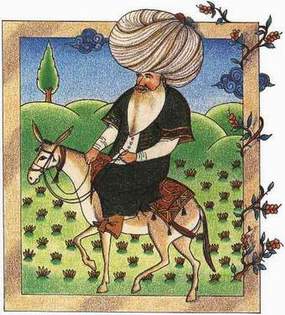
While thinking about cookies and the various religious traditions, why not also include the “wise fool” character loved throughout Islamic countries?  While he's spelled many different ways and also goes by many names, I especially enjoy the Turkish versions about the Hodja as they often include a bit of historical background.  Timur (sometimes called Tamerlaine) makes the Hodja his new tax collector.  The previous collector had to eat his receipts since they were unsatisfactory to Timur.  The Hodja has his wife make thin cookie dough and writes his records on them, making it better later than eating paper.  There are many anthologies and online stories about the Hodja.  (Don't stop with just the one online source linked here as he has many fans and his stories appear in many places.)   As for books, my first exposure came from the works of Alice Geer Kelsey and Barbara Walker, but, like cookies, I didn't stop there and I hope you don't either.

Taxes may not be tasty, but here's a library value calculator, showing libraries are a bargain, so pass the cookies and enjoy these sweet cookie stories by borrowing them from your local library.