Tell me if you have a topic you'd like to see. (Contact: LoiS-sez@LoiS-sez.com .)
Please also let others know about this site.
Showing posts with label War of 1812. Show all posts

Saturday, June 30, 2018

Irving et al about the Declaration of Independence

from a National Park Service photo with Independence Hall in the background
The musical 1776 gives a great view of the fighting involved in signing the Declaration of Independence and how our Founding Fathers were as creator, Sherman Edwards, said "the cream of their colonies. ... They disagreed and fought with each other. But they understood commitment, and though they fought, they fought affirmatively." (Personally I look at our country and its divisions and wonder if such a consensus could be reached today.)

I didn't know Washington Irving had written a Life of Washington, but it gives a glimpse of how we nearly celebrated the Second of July.  (Like the musical, he focuses on John Adams.)

I let that flow into H.A. Guerber's look at the signing as the one followed the other in Frances Jenkins Olcott's book, Good Stories for Great Holidays.  Irving's book, by the way, gets two more excerpts in Olcott's coverage showing better the sense of drama relayed by the author best known for short stories like "Rip Van Winkle" and "The Legend of Sleepy Hollow." Actually there was very little beyond his best-known work that I knew.  Scanning an article about Washington Irving, I learned he must have had a great interest in his namesake as the Washington biography is five volumes! long, spending much of his life on it.  Also Irving represented the United States in both Spain and England under Presidents Van Buren and Tyler.

Now for an anonymous third look at the event from outside Independence Hall and the ringing of the Liberty Bell.  (It comes from the Fifth Year of Story Hour Readings a textbook popular in the early Twentieth Century by E.C. Hartwell, who may have written it.  There were several illustrators for the book, including Joseph Franke', whose signature is in the left corner.)

I opened this article with a look at the Liberty Bell and want to mention the National Park Service site about Independence National Historical Park in Philadelphia. It includes such information as the Liberty Bell was originally the State House bell made in London and taken to Philadelphia for the tower of the Pennsylvania State House. It is inscribed with the words from Leviticus 25:10 “Proclaim liberty throughout the land”. It cracked on the first test ring in 1752, so it was melted down and cast again in Philadelphia. Further cracks occurred, so in 1846 for Washington's birthday, the city attempted to repair it. The repair failed, widening the crack further and silencing the bell forever, but not its significance. The site also has teacher lesson plans. While looking for images of the Liberty Bell, I discovered https://notebookingfairy.com/liberty-bell-notebooking-page/ which has various graphics teachers, homeschoolers, and others might appreciate.  

Here in Michigan next week I'll be doing a program that includes a mention of the War of 1812 with a bit of emphasis on here in Detroit and across the river at Canada's Fort Amherstburg (now Fort Malden) and the wrap-up of that war in the song, "The Battle of New Orleans."

Because that means we had not one, but two wars with Britain, I appreciated this from the N.P.S. site:
There are two other bells in the park today, in addition to the Liberty Bell. The Centennial Bell, made for the nation's 100th birthday in 1876, still rings every hour in the tower of Independence Hall. It weighs 13,000 lbs. - a thousand pounds for each original state. The Bicentennial Bell was a gift to the people of the United States from the people of Great Britain in 1976. That bell is currently in storage.
Considering the way Queen Elizabeth II at the dedication in 1976 mentioned our shared heritage of the principles of the Magna Carta, I hope we dust off that bell and display it, too.

Can't resist this image for a bit of a chuckle.  Even so, remember those who fought in the Revolutionary War were indeed considered traitors and paid with their lives and fortunes.

After two wars, these Ungrateful Colonials are definitely different, but glad to share a heritage and get along again.


********************************
This is part of a series of postings of stories under the category, "Keeping the Public in Public Domain."  The idea behind Public Domain was to preserve our cultural heritage after the authors and their immediate heirs were compensated.  I feel strongly current copyright law delays this intent on works of the 20th century.  My own library of folklore includes so many books within the Public Domain I decided to share stories from them.  I hope you enjoy discovering new stories.  


At the same time, my own involvement in storytelling regularly creates projects requiring research as part of my sharing stories with an audience.  Whenever that research needs to be shown here, the publishing of Public Domain stories will not occur that week.  This is a return to my regular posting of a research project here.  (Don't worry, this isn't dry research, my research is always geared towards future storytelling to an audience.)  Response has convinced me that "Keeping the Public in Public Domain" should continue along with my other postings as often as I can manage it.
Other Public Domain story resources I recommend-
  • There are many online resources for Public Domain stories, maybe none for folklore is as ambitious as fellow storyteller, Yoel Perez's database, Yashpeh, the International Folktales Collection.  I have long recommended it and continue to do so.  He has loaded Stith Thompson's Motif Index into his server as a database so you can search the whole 6 volumes for whatever word or expression you like by pressing one key. http://folkmasa.org/motiv/motif.htm
  • You may have noticed I'm no longer certain Dr. Perez has the largest database, although his offering the Motif Index certainly qualifies for those of us seeking specific types of stories.  There's another site, FairyTalez claiming to be the largest, with "over 2000 fairy tales, folktales, and fables" and they are "fully optimized for phones, tablets, and PCs", free and presented without ads.

    Between those two sites, there is much for story-lovers, but as they say in infomercials, "Wait, there's more!"
The email list for storytellers, Storytell, discussed Online Story Sources and came up with these additional suggestions:            
         - David K. Brown - http://people.ucalgary.ca/~dkbrown/stories.html
         - Richard Martin - http://www.tellatale.eu/tales_page.html
         - Spirit of Trees - http://spiritoftrees.org/featured-folktales
         - Story-Lovers - http://www.story-lovers.com/ is now only accessible through the Wayback Machine, described below, but Jackie Baldwin's wonderful site lives on there, fully searchable manually (the Google search doesn't work), at https://archive.org/ .  It's not easy, but go to Story-lovers.com snapshot for October 22 2016  and you can click on SOS: Searching Out Stories to scroll down through the many story topics and click on the story topic that interests you.
       - World of Tales - http://www.worldoftales.com/ 
     
You're going to find many of the links on these sites have gone down, BUT go to the Internet Archive Wayback Machine to find some of these old links.  Tim's site, for example, is so huge probably updating it would be a full-time job.  In the case of Story-Lovers, it's great that Jackie Baldwin set it up to stay online as long as it did after she could no longer maintain it.  Possibly searches maintained it.  Unfortunately Storytell list member, Papa Joe is on both Tim Sheppard's site and Story-Lovers, but he no longer maintains his old Papa Joe's Traveling Storytelling Show website and his Library (something you want to see!) is now only on the Wayback Machine.  It took some patience working back through claims of snapshots but finally in December of 2006 it appears!
    Somebody as of this writing whose stories can still be found by his website is the late Chuck Larkin - http://chucklarkin.com/stories.html.  I prefer to list these sites by their complete address so they can be found by the Wayback Machine, a.k.a. Archive.org, when that becomes the only way to find them.
You can see why I recommend these to you. Have fun discovering even more stories!

Saturday, August 23, 2014

The Burning of Washington, D.C.

On August 19 I caught a show on National Public Radio worth sharing with everyone.  Breaking: British Burn Washington is done in the style of breaking news from the battlefront with various correspondents and even debating "experts" about whether the War of 1812 should have been undertaken.  (If the NPR link is confusing because of other current news archived with it, be sure to look for "Breaking.")  Two hundred years ago the young United States fought this "Second War of Independence" from Britain.  NPR was a bit premature as the date was August 24 according to everything I have found.  The War of 1812 is often overlooked among other U.S. conflicts, so the Bicentennial reminds us just how close we came to losing.
Listening to the program it was easy to imagine the horror of that historic day.  My own historical programs look at "History as seen by the 'average' person" as opposed to the many people who portray famous people.  If anyone famous would entice me, it's Dolley Madison.  Back when I did three articles specifically on the War of 1812 I mentioned her in 12 Reasons to Remember the War of 1812 (reason 9), but 13 Resources to Remember the War of 1812 (resource 10) took us to pages 14 to 17 of "The Burning of Washington" by Anthony S. Pitch published in White House History (Fall of 1998), an article that also gives a "You Are There" feeling to how the day went.  For some unusual facts about this special First Lady and a sidebar taking you to resources about her, I recommend the FAQ page of The Dolley Madison Project.  Hearing the radio program, with it's excellent feeling of being in the midst of the burning of Washington, it hit me: I've ancestors named Dolley!  I ought to look and see how close to the war years they were born.  That sidebar I mentioned includes a page about her name and makes me more convinced than ever her name was chosen by members of my mother's family because of Dolley Madison.  She wasn't Dorothy or Dorothea, no matter how much others might try to make her that.  She was Dolley.  So were they.  It wasn't a nickname, nor was it Dolly.
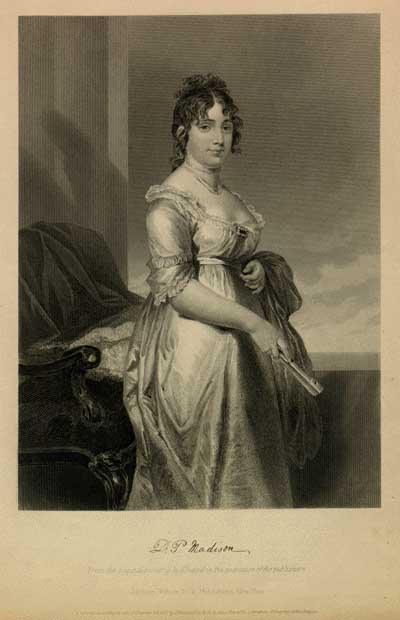
Engraving of Dolley Payne Madison done in 1812 by ?William Chappell. Prints and Photographs Division, Library of Congress.

Here in Michigan The Michigan Commission on the Commemoration of the Bicentennial of the War of 1812 has resources to know more about it's impact here.  Wikipedia has a page of links to both Canadian and State Bicentennial resources.

The final page of Anthony Pitch's article discusses looting after the burning of the President's House (not yet called the White House) and the Capitol.  Looking at other news on the N.P.R. archive of the same day, looting and international threats against the United State are in the news.  There are many quotes about history repeating itself.  General Patton said: Prepare for the unknown by studying how others in the past have coped with the unforeseeable and the unpredictable.

Just to show the issue is still touchy,  UPDATE:

British embassy apologizes after tweet joking about burning the White House during the War of 1812 (Be sure also to read the Huffington post article, "Torch of Friendship" mentioned in the sidebar.)

Thursday, January 17, 2013

History as seen by the "average" person

Storytelling is both my passion and my profession, but there are subgroups within storytelling.  Sean Buvala, acting as my coach, asked me, "If money was no problem, what type of storytelling would you most like to do?"  HISTORY! I said, but not history as viewed by somebody famous...history as seen by the "average" person.

Books, television, and often movies, when looking at history focus on either someone famous or on many people without seeing life as it appeared to the "average" person.  This type of program takes similar research, so it doesn't come quickly.  That makes it hard for historical societies and museums, schools, and libraries to produce their own programs.  Added to that, coming in the persona of an individual from back in time does something movies, television, books, and even the authors of those books can't do, present a living, talking person who can react to the audience and its interests.

Liberetta Lerich Green was a very real woman who grew up here in Michigan on an Underground Railroad Station and later helped her parents in their abolition efforts.  She was here on the homefront when her brothers fought with the "Fighting Fifth" Infantry.  (I must mention here my separate blog, Michigan's "Fighting Fifth" Civil War Infantry.  Local newspaper articles on that regiment appear at the pace they appeared 150 years ago, just as the families and friends of that regiment tried to follow what was happening to the boys they loved.)  I also have copies of letters her brothers sent home and a few by her parents trying to see if their sons and others they knew might be in a military hospital needing help. Liberetta's parents, Sarah and Peter Lerich, came here as pioneers before statehood.  Teachers and elders taught Liberetta about pioneer life and even the War of 1812.  Additionally Liberetta was a Macomb County farmer's wife and later widow, and she raised three boys and three girls, including one, Loa, who was a pioneering educator. As Liberetta I've had the joy of telling about her family's contributions and what life was like for them and what she learned from others.

Beyond Liberetta there have been what I call "generic" characters.  The Michigan Arts and Humanities Touring Program posted a video of my One-Room Schoolteacher.  I also have a character I call The Hired Girl, a position common to many women of all ages.  ("Girl" is how she might be called back then.)  It was a way for women to work beyond their own homes.  The Hired Girl can let me also include folktales she might have heard in addition to talking about her work.  The Hired Girl is able to explain how a Victorian Christmas was celebrated, too.  My researching One-Room Schools and their Teachers as well as Victorian Christmas led to posts here.  (Check the sidebar to find the many posts here that have come from Liberetta and these various historical programs.) While still working as a librarian in Mount Clemens, which has a history going back to the Bath House Era, I even took the Hired Girl and worked as a "Rubber", a person involved in the baths and massages of these long ago spas.

Just for fun, I also have a program that, like Liberetta telling about the War of 1812, was developed for the Lorenzo Cultural Center's series of historical programs.  Why do I say "just for fun"?  It looks at my own childhood growing up and "Skipping Through the Halls of Fifties Memories", both the things I noticed and things going on all around me that I was too young to notice until grown-ups told me about them later.  It's a great way to get an audience recalling their own childhoods for oral history programs.

Where in time will I go next?  I don't know.  Right now I'm beginning work on the story of a Polish woman's emigration to the U.S. 

I'm in the state's Touring Directory, so my programs qualify for state grants.  It's hard to guess what might be requested next, but it will be fun using my Storytelling + Research skills to bring to new audiences "History as seen by the 'average' person."  

Monday, June 18, 2012

War of 1812 Bicentennial starts

Today on June 18, 1812 President James Madison, with congressional approval, signed the declaration of war against Great Britain.  The war became unpopular enough to be known as President Madison's War.  In April, while preparing for a program series at the Lorenzo Cultural Center, I published two blogs: 12 Reasons to Remember the War of 1812 and 13 Resources to Remember the War of 1812.  This war became a second War of Liberation as the Revolutionary War was formerly called.  While the war ended with a return to pre-war boundaries, it established the young United States as a sovereign nation in the eyes of the world, transforming its army and navy, strengthened Canadian solidarity, and assured American western expansion, changing forever the relationship with Native Americans (called in Canada the First Nations), who lost their bid for sovereignty by their alliance with the British.

Wednesday, April 25, 2012

13 Resources to Remember the War of 1812


In my previous article, "12 Reasons to Remember the War of 1812" I discovered those points worth remembering it.  Now to find resources to help you find that information easily and a few unusual ones.  Some will be general resources and some are specific to one of those reasons. 

  1. Donald R. Hickey wrote 2 books giving a brief option, The War of 1812; A Short History and he also wrote the award winning War of 1812: A Forgotten Conflict for deeper coverage
  2. Never overlook the value of children's books for a quicker introduction and Don Nardo's The War of 1812 offers both basic coverage and knows how to capture the curiosity of young readers.  Try it!
  3. Wikipedia has become a more reliable source than in its early days.  Be sure always to check also the "Talk" tab to see further discussion.  Find it at English language Wikipedia.org and put in your topic in the search box
  4. Amy Elliott Bragg's book, Hidden History of Detroit, and her blog, The Night Train provide unusual information worth knowing
  5. Visit Fort Malden in Amherstburg, Ontario just across the river from Detroit.  Hear about life there watching for the Yankee "insurgents"
  6. Nardo's book gives a great view of Old Ironsides in battle, but David L.  Weitzman's book is an outstanding printed look at the entire ship
  7. The River Raisin Battlefield in Monroe, MI has something at all times to help you understand the importance of the rallying cry "Remember the River Raisin!" plus a January reenactment and quarterly discussions
  8. Commodore Perry has 3 attractions in Put in Bay, OH to look at the Battle of Lake Erie along with plenty of recreation. ("We have met the enemy" and forgive Ohio for the nearby later Toledo War of 1835-36)
  9. Tecumseh was unsuccessful in halting American expansion by siding with the British, but his bravery and qualities were honored by William Henry Harrison, who fought him at the Battle of Tippecanoe and the Battle of the Thames.  The best information I've found on the internet is this thorough article available through The "Wayback Machine" internet archive
  10. Dolley Madison's story is exciting enough, but the full information on The Burning of Washington is by Anthony S. Pitch and climaxes on p.14 to the end on p.17 -- she was personally in danger, threatened by the British
  11. Controversy about Alexander Macomb, "the Hero of Plattsburgh" and namesake of a local county and township, is included with facts about his Detroit statue at Detroit: The History and Future of the Motor City
  12. The Smithsonian's look at Francis Scott Key's writing "The Star-Spangled Banner" is interactive and offers many ways of understanding it and its role in the war and beyond
  13. While researching #10 I developed a love of Eyewitness to History.com for its "History through the eyes of those who lived it."  Looking for historical stories to bring an event to life? Start there. The Battle of New Orleans facts are as lively as Johnny Horton's tall tale song. (The lyrics have a few minor typos, but you can also hear it.)

Tuesday, April 24, 2012

12 Reasons to Remember the War of 1812

It's the Bicentennial of the War of 1812 and even the award winning book about it is titled, "War of 1812: A Forgotten Conflict."  Teachers must cover the Revolutionary War and the Civil War. At a recent history conference it was admitted this war is easily overlooked and too often indeed "Forgotten."

First a disclaimer since this will focus mainly on the Great Lakes region. I grew up in Missouri and didn't hear about this while in school. My daughters did grow up here and never had any assignments about the War of 1812.

I've discovered a dozen things crucial to this area:
  1. What started this war?
  2. This was the Northwest Territory, the frontier for the still quite young and barely United States
  3. I'd heard the phrase "Tippecanoe and Tyler, too!", knew it was a political slogan, but not the role of the Battle of Tippecanoe with William Henry Harrison (Nov. 7, 1811)
  4. The surrender of Detroit by General William Hull put the whole outcome of the war in doubt immediately (Aug. 16, 1812)
  5. General Hull's nephew, Isaac Hull, on the east coast proved the fledgling Yankee fleet could defeat the British Navy with his USS Constitution, now known as Old Ironsides (Aug. 19, 1812)
  6. The massacre of wounded and surrendered soldiers at Frenchtown, now Monroe, created the rallying cry "Remember the River Raisin!" (Jan. 23, 1813) and the soldiers came mainly from Kentucky
  7. Commodore Perry took a newly built fleet and won the Battle of Lake Erie. He wrote on the back of a letter to William Henry Harrison: We have met the enemy and they are ours (Sept. 10, 1813)
  8. Tecumseh unsuccessfully tried to halt American expansion by siding with the British. When Americans retook Detroit after the Battle of Lake Erie, they crossed into Canada, found Fort Malden burned, then charged into the Battle of the Thames shouting "Remember the Raisin!", killing Tecumseh and winning the battle (Oct. 5, 1813)
  9. Dolley Madison saved White House treasures when the British burned it, but that was only part of the story (Aug. 24-25, 1814)
  10. Alexander Macomb, namesake of a local county and township, was the Hero of Plattsburgh. He stated "Fortune always favors the brave", refusing to retreat although greatly outnumbered.  He succeeded (Sept. 11, 1814)
  11. Francis Scott Key's writing "The Star-Spangled Banner" matched Yankee resistance (Sept. 14, 1814)
  12. Andrew Jackson won the Battle of New Orleans even as the final treaty was being completed. (Jan. 8, 1815) 
Next 12 Resources to Remember the War of 1812 will form the second half of this look at 12 Reasons to Remember the War of 1812.  (Some are unusual!)