Tell me if you have a topic you'd like to see. (Contact: LoiS-sez@LoiS-sez.com .)
Please also let others know about this site.
Showing posts with label Project Grimm. Show all posts

Saturday, May 20, 2017

Follow-up on the Brothers Grimm and The Three Apprentices

Last week I mentioned getting ideas while hiking over hills and Michigan's dales with my Malamutt (Siberian Husky/Malamute).  That recently produced a pair of wildflower inspired stories.  Those wildflowers keep changing.  Here's the latest addition I'm seeing, along with a useful identification website.
The Wild Geranium has VERY LITTLE to do with today's story, but here's a source of wildflower identification.
As I hiked this week, I decided to give a follow-up to both the way I used "The Three Apprentices" and a few resources for the stories of Jacob and Wilhelm Grimm.

Five years ago on March 12, 2012 I told about Project Grimm which celebrated the 200th year anniversary of the publication of Kinder-und Hausmärchen.  Using the KHM numbering system for the listing of stories, the site challenged storytellers to videotape Grimm tales.  Because this was especially an international challenge, many are in other languages, so you might review your second (or more) language on a few stories.  Even those in another language include written versions in German, English, and Spanish.  Unfortunately "The Three Apprentices", KHM 120, wasn't performed, but there's still a lot there to enjoy.

Want to find the Grimm tales by KHM, which gives all the stories and legends?  When I went to find "The Three Apprentices" I didn't know if the story's title might be different, since so many versions of the stories have been translated.  Duke University professor, Jakob Norberg, posted the list at Fairy Tales by KHM as part of his course work.  You can't get to the stories by his hotlinks unless you have a Duke i.d. or are willing to work through the process for a guest pass.  Instead I recommend either the Hathi Trust copy of the book translated by Margaret Hunt, I mentioned last week, OR, if you prefer something a bit quicker, go to World of Tales.com section on the Brothers Grimm and scroll down to the stories interesting you.  While there you can also see a few other Grimm Public Domain translations, but those books don't include "The Three Apprentices."  It truly was an overlooked story.  The site has enough beyond the work of the Brothers Grimm, that I'm going to add it to my recommended sites that follows on days when I do a segment on Keeping the Public in Public Domain.

I promised other resources about these Grimm tales and have an audio version of the complete tales.  While nobody currently is on YouTube or elsewhere performing a video of this story, Grimm's Fairy Tales, Complete and Unabridged is an audio book read by Paul Martin with a sidebar to let you scroll down and find the specific story you want.   For people wanting lesson plans, activities, or tests, I found Bookrags.com.  This is a paid subscription site, so I've no idea if it will be what you want, but think it's worth mentioning for its work with the Grimm stories.

I also promised more about the ways I used "The Three Apprentices" this past week.  I prepared by making signs for the comments made by each apprentice.  Apprentice number 1 says: All three of us -- I typed that on my word processing program in the Landscape position to give the maximum width and used the largest font that would fit across the page.  The second apprentice says: For money -- the same method was used.  The third apprentice's statement, if I used the same font, would have needed two lines: And quite right too! -- I preferred to use a smaller font.  After printing those out I trimmed them and attached them to three different colored strips.  That gave me a quick visual of which strip I was using (and I also put the number on the back).  This helps with participation as there's always that bit of uncertainty for an audience to remember their part.

While preparing I became a bit worried about the age levels attending as the youngest would be in second grade.  I know some disagree with "watering down" a story.  Personally I consider it caring for your audience to think in advance about what they might need explained or otherwise handled.  Before telling the story I explained what an apprentice is.  This also meant listing for myself the most well-known Grimm tales and then, before telling the story, mentioning many stories they know were collected by the brothers.  I said some have even used their name to call the tales "grim" and agreed there are some things sometimes in the stories like "Hansel and Gretel" or "Little Red Riding Hood."  I did not mention the ways those stories are sometimes sanitized.  Instead I said life sometimes has some grim things happen and it's the sort of thing that might appear on the news.  While actually telling the story I said the innkeeper and his wife killed the wealthy merchant, but didn't tell about the scene being bloody.  Later I didn't go into details about how the execution was to be done.  (It seemed to be a beheading, but might at times talk about a hanging.)  Bruno Bettelheim in his The Uses of Enchantment specifically tells about the need for such stories to show justice in the end by having the villain punished.  I don't mention that, but if someone questioned me afterwards I would certainly do so.  My husband also suggested, after he heard me tell the story, its inclusion of the devil might make it a bit problematic for some audiences.  He's right, it might not work with every community.  Similarly the same audiences might dislike the use of magic.  Both are part of the story, but if an objection was made on religious grounds it would be more likely that magic was questioned.

After the program I asked the organizer for any feedback.  I was relieved and delighted to hear: Thank you for presenting at 2017 Young Writers Day!  It was a huge success, I received numerous compliments!

That also brings up another reason why I chose this story.  Before telling it I told the brief fable of "The Wind and the Sun."  I didn't end with the story's moral, instead asking what was the problem and who had the problem.  It was almost time for "The Three Apprentices."  This is when I divided the young attendees by going across the front row and counting off 1, 2, 3 for everyone.  I then had other rows do the same.  We went over their role in the story and then told it.  Because the program was intended to promote Young Writers, I then went into a story creation exercise using those three groups.  A few rows weren't exactly divisible by 3.  Adjustments were made  to use those triads.  The basic plan was for each #1 to choose a setting and character(s) for their own story.  The choice of a problem for it went to #2.  The conclusion went to #3. Since they were in auditorium seating, for those not in threes, I asked the group that might have four to let the extra person be the one to choose the character or characters.  If there were only two, they could decide how to divide up the choices.  What an auditorium full of creation!  I asked for any groups who wanted to share their stories and there was more than enough!  This was then coupled with my announcing and reading the day's winning stories submitted as books by the local schools.  Those two had been selected in advance by the program organizers.

Was anything created that will last as long as the tales collected by the Brothers Grimm over 200 years ago?  Doubtful, but it did give the young attendees a chance to see it wasn't just the two books chosen.  They all had lots of ability to create stories.

You do, too, so I hope you'll share some storytelling, with or without the Brothers Grimm.


Saturday, August 15, 2015

Grimm - Fred and Kate - Keeping the Public in Public Domain + Frankenmuth exhibit

"Fred and Kate" in Household Stories, illustrated by Walter Crane
Here's my favorite little known story by the Brothers Grimm, but along the way I want to give the story of both how I use it and how I came to put it in the "Keeping the Public in Public Domain"series.
   
Right before the Frankenmuth Historical Museum had a lecture on the Grimm Brothers, I happened to see their exhibit.  There wasn't time to post an announcement here before the lecture, but the exhibit will be there until Halloween.  (I asked about that interesting ending date and was told it was when they would open a new exhibit about the SS Edmund Fitzgerald, which sank in 1975.)  Frankenmuth is a major Michigan tourist site and always offers events, shopping, and dining, so it's worth the trip even without the lecture.  The exhibit is well done even for those of us well informed about Grimm tales beyond the usual Disney versions.  (There's an adults only cabinet with the original tales to explore.)  To see the exhibit you need a museum ticket and it may help to know the exhibit is at the end of all their displays.  If you want to see well done exhibits about Frankenmuth from pioneer times and on throughout its history, follow the normal entrance to the right of the shop.  If you are in a rush, want to walk less, or don't care about those historical exhibits, it might help to know the same ticket could let you see just "Fairy Tales from the Brothers Grimm" by entering to the left where the exhibit hall ends.  With so much happening in Frankenmuth, that also is a reasonable choice letting you see biographical, illustrative, and comparative Grimm displays, as well as some geared to any children accompanying you.
 
Today's story as I tell it is less than I discovered prowling various Grimm editions and finding public domain copies.  HORRORS!  Have I sanitized Grimm!?!  Not really.  It's just the story is often published without the final adventure.  It's also politically incorrect and I love it!  There's a story type called "Noodleheads" where the main character is hopelessly unaware of the crazy, yes, dumb results of actions.  The female version is the stereotypical "dumb blonde", but the sheer zaniness of any Noodlehead has a bouncy lack of awareness.

When I tell it, I rename the main characters "Friedrich and Katya."  This feels more in keeping with their Germanic roots than the title of "Fred and Kate" given by Mrs. E. V. Lucas whose version appears here.  Some versions title it "Frederick and Catherine."  Anytime you use a translated tale, title variations can play havoc with finding the story.  My Katya always earnestly answers her newly wed husband with "I did not know; you should have told me what to do" and from her viewpoint it's true even as he tries to goofproof their recent marriage.

Now for the part that probably only appeals to researchers.  The version I will start with is from Mrs. E. V. Lucas, but, just as her husband is the one noticed in the early 20th century, I found her translation work also almost uncredited in more than one edition.  There's the undated Lippincott book, Fairy Tales, illustrated by Arthur Rackham, but clearly predating the 1915 Index to Fairy Tales, Myths and Legends by Mary Huse Eastman.  There's also this copy found in the Internet Archive edition which has a 1920 publication by E.P. Dutton crediting an earlier version from 1909 of "Grimm's Fairy Tales illustrated by Arthur Rackham" but omitting the translator.
On the same Internet Archive page is mentioned the 1920 edition (yes, same year and pagination) published by Constable & Company crediting that same:

Hansel & Grethel & other tales
by the brothers Grimm. Illustrated by Arthur Rackham.

Published by Constable & Co. in New York .
Written in English.

Edition Notes

Half-title: Grimm's fairy tales.
Title within ornamental border.
Translated by Mrs. Edgar Lucas.

Yes, Arthur Rackham deserves credit, but isn't it interesting how I had to do detective work to find out who translated this since it has the closest to the tellable style I use.  (Also did you notice the use of "Edgar", but E.V. Lucas was actually Edward Verrall Lucas . . . I believe they are Mrs. E.V. Lucas's husband.)


That's where I've been ending the story.  Here's the rest of the tale from the translation by Lucy Crane, truly an interesting 19th century woman.  Oh and about that header on this article by Walter Crane, he's her more famous brother.  I don't care for her version before this as much as the translation by Mrs. Lucas, but think it's time to give "the rest of the story" to you.  I'm not sure if I will add it when I tell the story.  The story picks up where we stopped by jumping into her Household Stories published by Macmillan in 1899 and ends with another illustration by Walter Crane.
Hmmmmm.  What do you think about the story?  What about the extra adventure?

An earlier post in 2012 about the Grimm Brothers bicentennial's Project Grimm points out the KHM number of this story is 59.  Wikipedia's summary of Frederick and Catherine includes the final adventure and also notes it combines eight Aarne-Thompson types.  That number certainly may help you more than the way publishers repackage versions of the story and then copyright the total book for something like different illustrations.  One of the books I have with this story did exactly that.  It never stated if their version came from Lucas, Crane, or a third interpreter who never included this little known story in her collection of stories by the Grimm Brothers.  They count on you thinking the story itself is under copyright.  This is a perfect example of a story told in many translations, but still worth Keeping the Public in Public Domain.
****************

This is part of a series of postings of stories under the category, "Keeping the Public in Public Domain."  The idea behind Public Domain was to preserve our cultural heritage after the authors and their immediate heirs were compensated.  I feel strongly current copyright law delays this intent on works of the 20th century.  My own library of folklore includes so many books within the Public Domain I decided to share stories from them.  I hope you enjoy discovering new stories.  

At the same time, my own involvement in storytelling regularly creates projects requiring research as part of my sharing stories with an audience.  Whenever that research needs to be shown here, the publishing of Public Domain stories will not occur that week.  This is a return to my regular posting of a research project here.  (Don't worry, this isn't dry research, my research is always geared towards future storytelling to an audience.)  Response has convinced me that "Keeping the Public in Public Domain" should continue along with my other postings as often as I can manage it.  


There are many online resources for Public Domain stories, none for folklore is as ambitious as fellow storyteller, Yoel Perez's database, Yashpeh, the International Folktales Collection.  I recommended it earlier and want to continue to do so.  Have fun discovering even more stories!

Thursday, March 22, 2012

Project Grimm @ the Grimm Brothers Bicentennial

Federation for European Storytelling (FEST), which represents many European countries and many storytelling traditions, consider the Grimm fairy tales a part of our common cultural heritage.  FEST specifically calls for their celebration, especially since Kinder und Hausmärchen (KHM) was first published two hundred years ago.
December 20, 1812

To celebrate both the well-known and less well-known Grimm tales and all their distant cousins in other European storytelling traditions, participants of Project Grimm created a game producing online video using the KHM numbering of their 211 tales collected. 

The videos are gradually being put online. Already you may browse the videos by language, name and country of the teller, KHM number, and tale title.  Some give the entire tale while others are only a performance excerpt.  Sixty-five participated from these countries:
  • Austria
  • England
  • Germany
  • Hungary
  • Ireland
  • Italy
  • Netherlands
  • Norway
  • Scotland
  • Spain with storytelling in both Catalan and Basque
  • Switzerland
  • Wales
  • There's even a video with an interpreter for Austrian Sign Language...see how many "natural" signs you understand! Our family uses American Sign Language and enjoys learning the sign differences for other countries.
In mentioning Austrian Sign Language, I imagine the fun coming from the many languages used to tell these tales.  Watch Rapunzel in a language you don't know and see if the teller still helps you follow it.  Catch a story in a European language you are studying.  The Project is international entertainment.

So far, the most popular stories are: Rapunzel, The Three Spinners, Mother Hulda, Rumpelstiltskin, and Cinderella but that may change in the course of the project.  Also each participant is assigned two tales beyond the two chosen by the storyteller.

There now is also an official Facebook page at http://www.facebook.com/projectgrimm with more videos uploaded all the time.

Wikipedia on the Grimms' Fairy Tales puts some of this in perspective as it notes:
The first volumes were much criticized because, although they were called "Children's Tales", they were not regarded as suitable for children, both for the scholarly information included and the subject matter. Many changes through the editions – such as turning the wicked mother of the first edition in Snow White and Hansel and Gretel to a stepmother, were probably made with an eye to such suitability. They removed sexual references—such as Rapunzel's innocently asking why her dress was getting tight around her belly, and thus naïvely revealing her pregnancy and the prince's visits to her stepmother—but, in many respects, violence, particularly when punishing villains, was increased.

In 1825 the Brothers published their Kleine Ausgabe or "small edition," a selection of 50 tales designed for child readers. This children's version went through ten editions between 1825 and 1858.   

The Wikipedia article lists the KHM number and title of all tales, plus listing those omitted from the final edition. Titles may differ from what you recognize as translations vary.  British storyteller in Germany, Richard Martin, helped me learn what 50 tales were considered appropriate for 19th century children.  Here are the KHM numbers and you can check them with Wikipedia: KHM 1, 3, 4, 5, 6, 7, 9, 10, 11, 13, 14, 15, 19, 21, 24, 25, 26, 27, 34, 37,  45, 46, 47, 50, 51, 52, 53, 55, 58, 59,  65, 69, 80, 83, 87, 89, 94, 98, 102, 104a, 105,106, 110, 114, 124, 129, 130, 135, 151, 153.  It's interesting to see what famous stories are included and what are omitted.  For example, Hansel and Gretel are in, also Rumpelstiltskin.  Rapunzel is out, but also The Elves and the Shoemaker are missing.  It includes many unfamiliar tales, which is exactly why the Project Grimm exists.

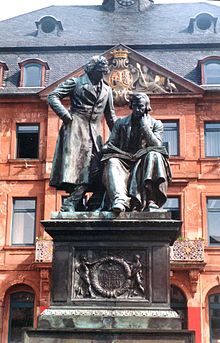
Statue of Jakob and Wilhelm Grimm in the Hanau marketplace (Hessen, Germany)

The Wikipedia article's added features include a tab labelled Talk for added views of the topic. To research folklore use an external link to Aarne-Thompson Tale Types on D.L. Ashliman's excellent website, matching Grimm stories to familiar themes. Another Wikipedia article is also referenced about the German Fairy Tale Route -- a German tourism project of various locations important to their work, established in 1975, in case you visit Germany.

With all the current attention on fairy tales in movies and television, I side with both the Fairy Tale Lobby and FEST in seeking to promote fairy tales for all ages, yes, including adults since these tales were never solely intended for children.  Jakob and Wilhelm knew this and so do you.