September 15 through October 15, 2024 is National Hispanic Heritage Month with this year's theme being “Pioneers of Change: Shaping the Future Together.” The intent of that theme is to
" highlight the trailblazers who have led the way for future generations
through their innovation, leadership, and unwavering dedication to
progress in various fields, including education, science, business, the
arts, and social justice."
It's interesting the way the month is split between September and October. This Saturday is the last chance this month for a tale to fit and then it leads into October. October, of course, is a time filled with spooky tales, so the stories I found in Thomas A. Janvier's Legends of the City of Mexico seem to have sought me out. I have books with Hispanic stories, but they don't focus on "Pioneers of Change." Prowling Project Gutenberg I found only this 1910 book mentioning specific people in stories. The book tends to name the stories for places in Mexico City...but all the stories are a ghostly guide to the city. I guess, since next week begins October, it's reasonable to give this week and the next two stories in the spooky category.
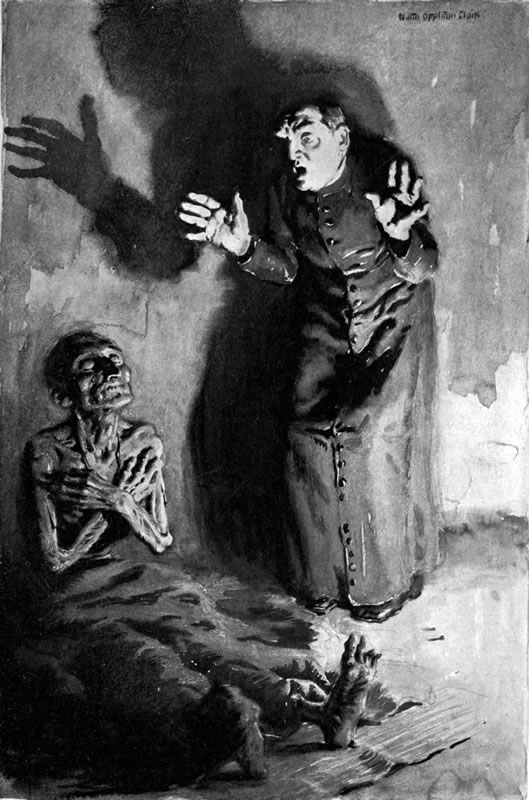
The title for today's story tells it happens on a "Callejón." Calle is Spanish for street and Callejón means an alley. The other word that pops up repeatedly is "shrive" meaning a priest listens to someone's confession about what they have done wrong, and offers forgiveness. The number 7 at the end of the title is because the author gives further notes. I'll add them on at the end. The photo is one of six by Walter Appleton Clark in the book, plus the author adds a few showing the actual places.
LEGEND OF THE CALLEJÓN DEL
PADRE LECUONA[7]
Who Padre Lecuona was, Señor, and what
he did or had done to him in this street
that caused his name to be given to it, I do
not know. The Padre about whom I now am
telling you, who had this strange thing happen
to him in this street, was named Lanza; but he
was called by everybody Lanchitas—according
to our custom of giving such endearing diminutives
to the names of those whom we love.
He deserved to be loved, this excellent Padre
Lanchitas: because he himself loved everybody,
and freely gave to all in sickness or in
trouble his loving aid. Confessing to him was
a pleasure; and his absolution was worth
having, because it was given always with the
approval of the good God. My own grandfather
knew him well, Señor, having known a
man who had seen him when he was a boy. Therefore this strange story about him is
true.
On a night—and it was a desponding night,
because rain was falling and there was a chill
wind—Padre Lanchitas was hurrying to the
house of a friend of his, where every week he and
three other gentlemen of a Friday evening played
malilla together. It is a very serious game,
Señor, and to play it well requires a large mind.
He was late, and that was why he was hurrying.
When he was nearly come to the house of his
friend—and glad to get there because of the
rain and the cold—he was stopped by an old
woman plucking at his wet cloak and speaking
to him. And the old woman begged him for
God's mercy to come quickly and confess a
dying man. Now that is a call, Señor, that a
priest may not refuse; but because his not
joining them would inconvenience his friends,
who could not play at their game of malilla
without him, he asked the woman why she did
not go to the parish priest of the parish in which
the dying man was. And the woman answered
him that only to him would the dying
man confess; and she begged him again for
God's mercy to hurry with her, or the confession would not be made in time—and then
the sin of his refusal would be heavy on his
own soul when he himself came to die.
So, then, the Padre went with her, walking
behind her along the cold dark streets in the
mud with the rain falling; and at last she
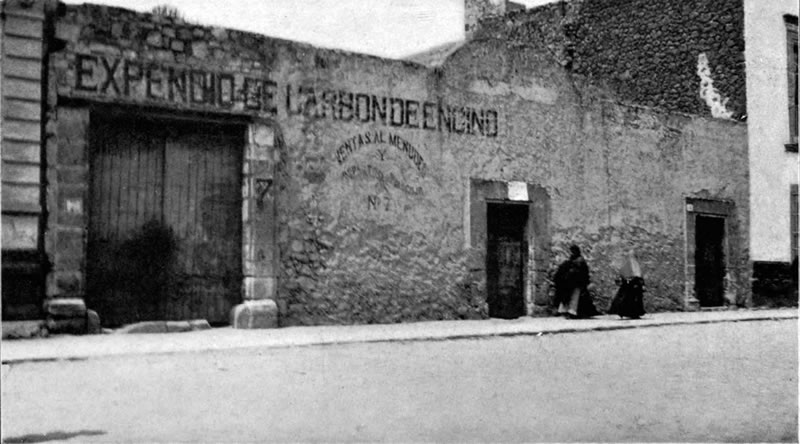
brought him to the eastern end of this street
that is called the Callejón del Padre Lecuona,
and to the long old house there that faces toward
the church of El Carmen and has a hump in
the middle on the top of its front wall. It is
a very old house, Señor. It was built in the
time when we had Viceroys, instead of the
President Porfírio; and it has no windows—only
a great door for the entering of carriages at
one end of it, and a small door in the middle of
it, and another small door at the other end. A
person who sells charcoal, Señor, lives there now.
It was to the middle door that the woman
brought Padre Lanchitas. The door was not
fastened, and at a touch she pushed it open
and in they went together—and the first thing
that the Padre noticed when he was come
through the doorway was a very bad smell.
It was the sort of smell, Señor, that is found in
very old houses of which all the doors and windows have been shut fast for a very long
time. But the Padre had matters more important
than bad smells to attend to, and all
that he did about it was to hold his handkerchief
close to his nose. One little poor
candle, stuck on a nail in a board, was set in a
far corner; and in another corner was a man
lying on a mat spread upon the earth floor; and
there was nothing else whatever—excepting
cobwebs everywhere, and the bad smell, and
the old woman, and the Padre himself—in that
room.
That he might see him whom he was to
confess, Padre Lanchitas took the candle in
his hand and went to the man on the mat and
pulled aside the ragged and dirty old blanket
that covered him; and then he started back
with a very cold qualm in his stomach, saying
to the woman: "This man already is dead! He
cannot confess! And he has the look of having
been dead for a very long while!" And that
was true, Señor—for what he saw was a dry
and bony head, with yellow skin drawn tight
over it, having shut eyes deep sunken. Also,
the two hands which rested crossed upon the
man's breast were no more than the same dry yellow skin shrunk close over shrunken bones!
And, seeing such a bad strange sight, the
Padre was uneasy and alarmed.
But the woman said back to him with assurance,
yet also coaxingly: "This man is
going to confess, Padrecito"—and, so speaking,
she fetched from its far corner the board
with the nail in it, and took the candle from
him and set it fast again upon the nail. And
then the man himself, in the light and in the
shadow, sat up on the mat and began to recite
in a voice that had a rusty note in it the
Confiteor Deo—and after that, of course, there
was nothing for the Padre to do but to listen
to him till the end.
 EL CALLEJÓN DEL PADRE LECVONA
What he told, Señor, being told under the
seal of confession, of course remained always
a secret. But it was known, later, that he
spoke of matters which had happened a good
two hundred years back—as the Padre knew
because he was a great reader of books of history;
and that he put himself into the very
middle of those matters and made the terrible
crime that he had committed a part of them;
and that he ended by telling that in that
ancient time he had been killed in a brawl suddenly, and so had died unconfessed and unshriven,
and that ever since his soul had blistered
in hell.
Hearing such wild talk from him, the Padre
was well satisfied that the poor man's wits were
wandering in his fever—as happens with many,
Señor, in their dying time—and so bade him
lie quietly and rest himself; and promised that
he would come to him and hear his confession
later on.
But the man cried out very urgently that
that must not be: declaring that by God's
mercy he had been given one single chance to
come back again out of Eternity to confess his
sins and to be shriven of them; and that unless
the Padre did hearken then and there to the
confession of his sins, and did shrive him of
them, this one chance that God's mercy had
given him would be lost and wasted—and
back he would go forever to the hot torments
of hell.
Therefore the Padre—being sure, by that
time, that the man was quite crazy in his
fever—let him talk on till he had told the whole
story of his frightful sinnings; and then did
shrive him, to quiet him—just as you promise the moon to a sick, fretful child. And the
devil must have been very uneasy that night,
Señor, because the good nature of that kind-hearted
priest lost to him what by rights was
his own!
As Padre Lanchitas spoke the last words of
the absolution, the man fell back again on his
mat with a sharp crackling sound like that of
dry bones rattling; and the woman had left
the room; and the candle was sputtering out its
very last sparks. Therefore the Padre went
out in a hurry through the still open door into
the street; and no sooner had he come there
than the door closed behind him sharply, as
though some one on the inside had pushed
against it strongly to shut it fast.
Out in the street he had expected to find the
old woman waiting for him; and he looked
about for her everywhere, desiring to tell her
that she must send for him when the man's
fever left him—that he might return and hear
from the man a real confession, and really
shrive him of his sins. But the old woman was
quite gone. Thinking that she must have
slipped past him in the darkness into the house,
he knocked at the door lightly, and then loudly; but no answer came to his knocking—and
when he tried to push the door open, using all
his strength, it held fast against his pushing as
firmly as though it had been a part of the stone
wall.
So the Padre, having no liking for standing
there in the cold and rain uselessly, hurried
onward to his friend's house—and was glad
to get into the room where his friends were
waiting for him, and where plenty of candles
were burning, and where it was dry and warm.
He had walked so fast that his forehead was
wet with sweat when he took his hat off, and
to dry it he put his hand into his pocket for his
handkerchief; but his handkerchief was not in
his pocket—and then he knew that he must
have dropped it in the house where the dying
man lay. It was not just a common handkerchief,
Señor, but one very finely embroidered—having
the letters standing for his name
worked upon it, with a wreath around them—that
had been made for him by a nun of his
acquaintance in a convent of which he was the
almoner; and so, as he did not at all like to lose
it, he sent his friend's servant to that old house
to get it back again. After a good long while, the servant returned: telling that the house
was shut fast, and that one of the watch—seeing
him knocking at the door of it—had told
him that to knock there was only to wear out
his knuckles, because no one had lived in that
house for years and years!
All of this, as well as all that had gone
before it, was so strange and so full of mystery,
that Padre Lanchitas then told to his three
friends some part of what that evening had
happened to him; and it chanced that one of
the three was the notary who had in charge
the estate of which that very house was a part.
And the notary gave Padre Lanchitas his true
word for it that the house—because of some
entangling law matters—had stood locked fast
and empty for as much as a lifetime; and he
declared that Padre Lanchitas must be mixing
that house with some other house—which
would be easy, since all that had happened had
been in the rainy dark. But the Padre, on his
side, was sure that he had made no mistake in
the matter; and they both got a little warm in
their talk over it; and they ended by agreeing—so
that they might come to a sure settlement—to
meet at that old house, and the notary to bring with him the key of it, on the morning
of the following day.
So they did meet there, Señor, and they went
to the middle door—the one that had opened
at a touch from the old woman's hand. But
all around that door, as the notary bade Padre
Lanchitas observe before they opened it, were
unbroken cobwebs; and the keyhole was choked
with the dust that had blown into it, little by
little, in the years that had passed since it had
known a key. And the other two doors of the
house were just the same. However, Padre
Lanchitas would not admit, even with that
proof against him, that he was mistaken; and
the notary, smiling at him but willing to satisfy
him, picked out the dust from the keyhole and
got the key into it and forced back hardly the
rusty bolt of the lock—and together they went
inside.
Coming from the bright sunshine into that
dusky place—lighted only from the doorway,
and the door but part way open because it was
loose on its old hinges and stuck fast—they
could see at first nothing more than that the
room was empty and bare. What they did
find, though—and the Padre well remembered it—was the bad smell. But the notary said
that just such bad smells were in all old shut-up
houses, and it proved nothing; while the cobwebs
and the closed keyhole did prove most
certainly that Padre Lanchitas had not entered
that house the night before—and that
nobody had entered it for years and years. To
what the notary said there was nothing to be
answered; and the Padre—not satisfied, but
forced to give in to such strong proof that he
was mistaken—was about to come away out of
the house, and so have done with it. But just
then, Señor, he made a very wonderful and
horrifying discovery. By that time his eyes
had grown accustomed to the shadows; and so
he saw over in one corner—lying on the floor
close beside where the man had lain whose
confession he had taken—a glint of something
whitish. And, Señor, it was his very own handkerchief
that he had lost!
That was enough to satisfy even the notary;
and as nothing more was to be done there they
came out, and gladly, from that bad dark place
into the sunshine. As for Padre Lanchitas,
Señor, he was all mazed and daunted—knowing
then the terrible truth that he had confessed a dead man; and, what was worse, that
he had given absolution to a sinful soul come
hot to him from hell! He held his hat in his
hand as he came out from the house—and
never did he put it on again: bareheaded he
went thenceforward until the end of his days!
He was a very good man, and his life had been
always a very holy life; but from that time on,
till the death of him, he made it still holier
by his prayings and his fastings and his endless
helpings of the poorest of the poor. At last
he died. And it is said, Señor, that in the
walls of that old house they found dead men's
bones.
***
The author promised notes on this story and it gives an alternate story:
LEGEND OF THE CALLEJÓN DEL PADRE LECUONA
By a natural confusion of the name of the street in
which the dead man was confessed with the name of
the priest who heard his confession, this legend frequently
is told nowadays as relating not to Padre
Lanza but to Padre Lecuona. An old man whom
I met in the Callejón del Padre Lecuona, when I was
making search for the scene of the confession, told me
the story in that way—and pointed out the house to
me in all sincerity. Following that telling, I so mixed
the matter myself in my first publication of the legend.
Who Padre Lecuona was, or why the street was named
after him, I have not discovered. Probably still another
legend lurks there. Señor Riva Palacio tells the story as of an unnamed friar "whom God now holds
in his glory," and assigns it to the year 1731. The
motive of the story is found in Spain long before the
oldest date assigned to it in Mexico. The wicked hero
of Calderon's play, La devocion de la Cruz, is permitted
to purge his sinful soul by confession after
death. The Padre Lanza whose name has been tacked
fast to the story—probably because his well-known
charitable ministrations to the poor made him a likely
person to yield to the old woman's importunities—was
a real man who lived in the City of Mexico, greatly
loved and respected, in the early years of the nineteenth
century. Señor Roa Bárcena fixes the decade 1820-1830
as the date of his strange adventure with a dead
body in which was a living soul.
 WHERE THE DEAD MAN WAS CONFESSED
Aside from minor variants, two distinct versions of
this legend are current. That which I have given in
my text is the more popular. The other, less widely
known, has for its scene an old house in the Calle de
Olmedo—nearly a mile away from the Callejón del
Padre Lecuona, and in a far more ancient quarter of the
City. Concisely stated, the Calle de Olmedo version
is to this effect:
Brother Mendo, a worthy and kind-hearted friar,
is met of a dark night in the street by a man who begs
him to come and hear a dying person confess. The
friar wears the habit of his Order, and from his girdle
hangs his rosary. He is led to a house near by; and
finds within the house a very beautiful woman, richly
clad in silks, whose arms are bound. That she is not
in a dying state is obvious, and the friar asks for an
explanation. For answer, the man tells him roughly:
"This woman is about to die by violence. I must give her death. As you please, wash clean her sinful soul—or
leave it foul!" At that, he yields, and her confession
begins. It is so prolonged that the man, losing
patience, ends it abruptly by thrusting forth the friar
from the house. Through the closed door he hears
shrieks and tries to re-enter; but the door remains
closed firmly, and his knocking is unheeded. He finds
that his rosary no longer is at his girdle. In order to
recover it, and to allay his fears for the woman's safety,
he calls a watchman to aid him by demanding in the
name of the law that the door shall be opened. No
response is made from within to their violent knocking;
and an old woman, aroused by it, comes out from a nearby
dwelling and tells them that knocking there is useless—that
through all her long lifetime she has lived
beside that house, and that never through all her long
lifetime has that house been inhabited. The watchman—holding
his lantern close to the door, and so
perceiving that what she tells is verified by the caked
dust that fills its crevices and that clogs its key-hole—is
for abandoning their attempt to enter. The friar
insists that they must enter: that his rosary is within
the house; that he is determined to recover it; that the
door must be forced. Yielding to him, the watchman
forces the door and together they enter: to find a
yellowed skeleton upon the floor; scattered around it
scraps of mouldering silk; in the eye-sockets of the
skull cobwebs—and lying across that yellowed skeleton
is the friar's rosary! Brother Mendo covers his face
with his hands, totters for a moment, and then falls
dying as he exclaims in horror: "Holy God! I have
confessed a soul from the other life!" And the
crowd of neighbors, by that time assembled, cries out: "Brother Mendo is dead because he has confessed the
dead!"
***
How factual and whether you want the story of the priest or brother is up to you in re-telling this Hispanic Heritage tale.
***************************
This
is part of a series of postings of stories under the category,
"Keeping the Public in Public Domain." The idea
behind Public Domain was to preserve our cultural heritage after the
authors and their immediate heirs were compensated. I feel
strongly current copyright law delays this intent on works of the
20th century. My
own library of folklore includes so many books within the Public
Domain I decided to share stories from them. I hope you enjoy
discovering new stories.

At
the same time, my own involvement in storytelling regularly creates
projects requiring research as part of my sharing stories with an
audience. Whenever that research needs to be shown here, the publishing
of Public Domain stories will not occur that week. This is a return to
my regular posting of a research project here. (Don't worry, this
isn't dry research, my research is always geared towards future
storytelling to an audience.) Response has convinced me that "Keeping
the Public in Public Domain" should continue along with my other
postings as often as I can manage it.
Other
Public Domain story resources I recommend-
There
are many online resources for Public Domain stories, maybe none for
folklore is as ambitious as fellow storyteller, Yoel Perez's
database, Yashpeh,
the International Folktales Collection. I have long
recommended it and continue to do so. He has loaded
Stith Thompson's Motif Index into his server as a database so
you can search the whole 6 volumes for whatever word or expression
you like by pressing one key. http://folkmasa.org/motiv/motif.htm
You may have noticed I'm no
longer certain Dr. Perez has the largest database, although his
offering the Motif Index certainly qualifies for those of us seeking
specific types of stories. There's another site, FairyTalez
claiming to be the largest, with "over 2000 fairy tales,
folktales, and fables" and they are "fully optimized for
phones, tablets, and PCs", free and presented without ads.
Between those two sites, there
is much for story-lovers, but as they say in infomercials, "Wait,
there's more!"
The
email list for storytellers, Storytell,
discussed Online Story Sources and came up with these additional
suggestions:
-
Story-Lovers - http://www.story-lovers.com/ is now only accessible
through the Wayback Machine, described below, but the late Jackie Baldwin's
wonderful site lives on there, fully searchable manually (the Google
search doesn't work), at https://archive.org/ . It's not easy, but go to Story-lovers.com snapshot for December 22 2016 and you can click on SOS: Searching Out Stories to scroll down through the many story topics and click on the story topic that interests you.
- Zalka Csenge Virag - http://multicoloreddiary.blogspot.com
doesn't give the actual stories, but her recommendations, working her
way through each country on a continent, give excellent ideas for
finding new books and stories to love and tell.
You're
going to find many of the links on these sites have gone down, BUT
go to the Internet Archive
Wayback Machine to find some of these old links. Tim's
site, for example, is so huge probably updating it would be a
full-time job. In the case of Story-Lovers, it's great that
Jackie Baldwin set it up to stay online as long as it did after she
could no longer maintain it. Possibly searches maintained it.
Unfortunately Storytell list member, Papa Joe is on both Tim
Sheppard's site and Story-Lovers, but he no longer maintains his old
Papa Joe's Traveling Storytelling Show website and his Library
(something you want to see!) is now only on the Wayback Machine. It
took some patience working back through claims of snapshots but finally
in December of 2006 it appears!
Somebody
as of this writing whose stories can still be found by his website
is the late Chuck Larkin - http://chucklarkin.com/stories.html.
I prefer to list these sites by their complete address so they can
be found by the Wayback Machine, a.k.a. Archive.org, when that
becomes the only way to find them.
You
can see why I recommend these to you.
Have fun
discovering even more stories


.jpg)


