There's so much going on this weekend, Father's Day and the first nationally celebrated Juneteenth, but it all is affected by the weather. The south of North and Central America is about to be hit by the first tropical storm, possibly hurricane, of the season. A large part of the United States is being hit by record heat and drought. Even places like Michigan has seen record heat this June even though it's nothing like weather west of us and our drought is also there, but not as devastating. Climate refugees might want to remember Michigan's motto of "If you seek a pleasant peninsula, look around you."
Today's story also goes by the name of "How the sun, moon, and wind went out to dinner" or a form of that. I will give links to other versions after it.
 |
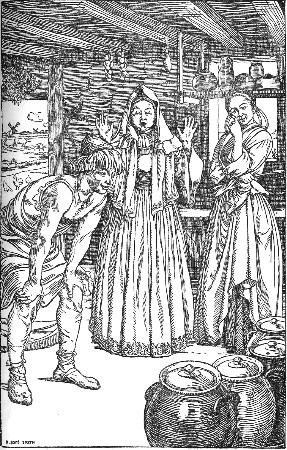
| John D. Batten in Indian Fairy Tales by Joseph Jacobs |
|
WHY ALL MEN LOVE THE MOON.
Thunder and Lightning were going to give a feast. It was to be a
most delightful banquet, for all the good things that could be
imagined were to be brought from every corner of the world.
For many days before the feast these good things were coming. The
birds flew up with what they could find in the cold air of the north
and the warm air of the south. The fishes came from the east and from
the west with what they could find in the cold water or in the warm
water. As for what grew on the earth, there was no end to the
luxuries that came every morning and every evening. Squirrels brought
nuts, crows brought corn, the ants brought sweet things of many
kinds. Food that was rich and rare came from India and Japan. The
butterflies and the humming-birds were to arrange the flowers, the
peacocks and the orioles promised to help make the place beautiful,
and the waves and the brooks agreed to make their most charming
music.
Thunder and Lightning were talking about whom to invite, and they
questioned whether to ask the sun, the moon, and the wind. These
three were children of the star mother.
"The star mother has been so kind to us that I suppose we
ought to invite her children," said Thunder.
"The moon is charming, but the sun and the wind are rough and
wild. If I were the star mother, I would keep them in a corner all
day, and they should stay there all night, too, if they did not
promise to be gentle," said Lightning.
"We must invite them," replied Thunder, with what
sounded much like a little growl, "but it would be delightful if
they would agree to stay away, all but the moon."
That is why the sun and wind were invited as well as the moon.
When the invitation came, the two brothers said to their little
sister, "You are too small to go to a feast, but perhaps they
asked you because they were going to ask us."
"Star mother, I think I will stay at home," said the
moon tearfully.
"No, little moon," replied the star mother; "go to
the feast with the other children."
So the three children went to the feast, and the star mother
waited for them to come home.
When they came, she asked, "What did you bring for me?"
The hands of the sun were full of good things, but he said, "I
brought only what I am going to eat myself," and he sat down in
a corner with his back to the others, and went on eating.
"Did you bring anything for me?" she asked the wind.
"I brought some good things halfway home, and then I was
weary of carrying them," answered the wind, "so I have
eaten them."
"I should never have imagined that you would be so selfish,"
said the star mother sadly, and she asked the little moon, "My
daughter, did you bring anything for me?"
"Yes, star mother," answered the little moon, and she
gave her mother more good things than any one had ever seen in their
home before. There were rare luxuries that the fishes and the birds
had brought. There were rich colors that the peacocks and orioles had
promised, and there was even some of the charming music that the
waves and brooks had agreed to make.
The star mother praised the little maiden.
Then she looked at her two boys. She was sad, for she knew that they
must be punished for their selfishness. "Sun," said she,
"you wish to turn your back on all, and your punishment shall be
that when the warm days of summer have come, all men will turn their
backs on you." To the wind she said, "Wind, you thought of
no one but yourself. When the storm is coming and you are afraid and
fly before it, no one shall think of you. All men shall close their
doors against you and fasten them." Then to her little daughter
she said, "My little moon, you were unselfish and thoughtful.
You shall always be bright and beautiful, and men shall love you and
praise you whenever they look upon your gentle, kindly face."
This is why men hide from the sun and the wind, but never from the
moon.

Those illustrations come from the classic Indian Fairy Tales by Joseph Jacobs and it is worth checking. It does a nice simple job of telling the story. I chose Florence Holbrook's version because I like the way she expands this simple story with the contributions of birds, fish, and animals. Jacobs, in his notes says his source is the pioneering work by Miss Frere roughly a quarter of a century before in Old Deccan Days, or, Indian Fairy Legends current in Southern India, collected from oral tradition by M. Frere. Initially I went to Kate Douglas Wiggin's Tales of Laughter, but was surprised and disappointed. Not only does that anthology promise humor, Wiggin deserves being considered a standard author and editor. I found her version felt preachy over the greed and its consequences. Maybe after reading other versions, it wasn't any worse. I do think it's worth pointing out our actions have consequences, including how people view us. She does possibly a better job of pointing out the "pourquois" elements of why the sun and wind are as disliked as they are. This is especially true as our current weather makes so many suffer.
If you want still other versions, William Patten in the first of his nine volume Junior Classics repeats Frere's telling. It was also in two major early Twentieth Century readers, Blaisdell's Child Life, 2d Reader and Coe's Second Book of Stories. I have each and use the books in my One Room School Teacher program as they were examples of some of the books that shaped our recent ancestors.
*********************
This
is part of a series of postings of stories under the category,
"Keeping the Public in Public Domain." The idea
behind Public Domain was to preserve our cultural heritage after the
authors and their immediate heirs were compensated. I feel
strongly current copyright law delays this intent on works of the
20th century. My
own library of folklore includes so many books within the Public
Domain I decided to share stories from them. I hope you enjoy
discovering new stories.

At
the same time, my own involvement in storytelling regularly creates
projects requiring research as part of my sharing stories with an
audience. Whenever that research needs to be shown here, the publishing
of Public Domain stories will not occur that week. This is a return to
my regular posting of a research project here. (Don't worry, this
isn't dry research, my research is always geared towards future
storytelling to an audience.) Response has convinced me that "Keeping
the Public in Public Domain" should continue along with my other
postings as often as I can manage it.
Other
Public Domain story resources I recommend-
There
are many online resources for Public Domain stories, maybe none for
folklore is as ambitious as fellow storyteller, Yoel Perez's
database, Yashpeh,
the International Folktales Collection. I have long
recommended it and continue to do so. He has loaded
Stith Thompson's Motif Index into his server as a database so
you can search the whole 6 volumes for whatever word or expression
you like by pressing one key. http://folkmasa.org/motiv/motif.htm
- You may have noticed I'm no
longer certain Dr. Perez has the largest database, although his
offering the Motif Index certainly qualifies for those of us seeking
specific types of stories. There's another site, FairyTalez
claiming to be the largest, with "over 2000 fairy tales,
folktales, and fables" and they are "fully optimized for
phones, tablets, and PCs", free and presented without ads.
Between those two sites, there
is much for story-lovers, but as they say in infomercials, "Wait,
there's more!"
The
email list for storytellers, Storytell,
discussed Online Story Sources and came up with these additional
suggestions:
-
Story-Lovers - http://www.story-lovers.com/ is now only accessible
through the Wayback Machine, described below, but the late Jackie Baldwin's
wonderful site lives on there, fully searchable manually (the Google
search doesn't work), at https://archive.org/ . It's not easy, but go to Story-lovers.com snapshot for October 22 2016 and you can click on SOS: Searching Out Stories to scroll down through the many story topics and click on the story topic that interests you.
You're
going to find many of the links on these sites have gone down, BUT
go to the Internet Archive
Wayback Machine to find some of these old links. Tim's
site, for example, is so huge probably updating it would be a
full-time job. In the case of Story-Lovers, it's great that
Jackie Baldwin set it up to stay online as long as it did after she
could no longer maintain it. Possibly searches maintained it.
Unfortunately Storytell list member, Papa Joe is on both Tim
Sheppard's site and Story-Lovers, but he no longer maintains his old
Papa Joe's Traveling Storytelling Show website and his Library
(something you want to see!) is now only on the Wayback Machine. It
took some patience working back through claims of snapshots but finally
in December of 2006 it appears!
Somebody
as of this writing whose stories can still be found by his website
is the late Chuck Larkin - http://chucklarkin.com/stories.html.
I prefer to list these sites by their complete address so they can
be found by the Wayback Machine, a.k.a. Archive.org, when that
becomes the only way to find them.
You
can see why I recommend these to you. Have fun
discovering even more stories!