While this is almost the end of this year's Native American Heritage Month, it certainly should never be the
end of some of the wisdom told in the stories of this continent's First
Nations both in the U.S. and Canada. Our country seems particularly in
the grip of mass murders and hate. This week has been our
Thanksgiving, but it has too often felt like we are doing everything
possible to hurt each other. That sent me hunting for stories with a
possibility of helping. Margaret Read MacDonald's book, Peace Tales; World Folktales to Talk About is an excellent modern book with the added benefit generally found in folklore books nowadays of including a bibliography of the sources for its stories. MacDonald has her doctorate in folklore and is particularly thorough in not only giving her sources and other books on her topic, but much more including ways to tell the stories.
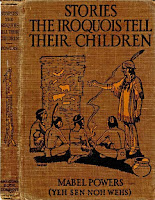
MacDonald gave a version of an Iroquois peacemaking technique that she found as a story in a book by Mabel Powers (or Yeh Sen Noh Wehs, which means "The One Who Carries and Tells the Stories"). Back on November 13, 2020 I have included another story,
"How Giving Evil for Evil Ends" from Powers' book,
Around an Iroquois Story Fire. It is definitely appropriate for a desire to find a conflict resolution or Peace tale to talk about.
Peace Tales, however, uses a story Powers tells in
Stories the Iroquois Tell Their Children. MacDonald re-tells "How Two Indian Boys Settled a Quarrel" calling her version, "The Argument Sticks." It is so condensed it looks more like poetry. I will include the original story, but only
after the story named in today's blog title. At first the title story seems more like an explanation of Iroquois customs including the role of women as Peacemakers, but the story part really begins when telling of "a Peacewoman" who "proved untrue to her trust." Because the story of the boys is both short and another method of peacekeeping, it will follow today's title story.

A FIREMAKER AND A PEACEMAKER
In the olden times, tribes of Indians did not always live in one
place as they do now. They sometimes wandered from one valley or
woodland to another. When they came to a sheltered place, where there
was pure running water, and where plenty of game and wood were to be
found, they would build their lodges and light their council fires.
There they might camp for one moon, or for many moons. As long as
their arrows brought game on the hunting trails near, they would not
break camp. But if game grew scarce, or if for any reason they did
not like the camp ground, they would move farther on.
Sometimes they would go several days' journey, before they found a
camping place such as they liked.
The first thing that was done in making a camp was to secure fire
and light the council fire. This fire was always kept burning. It
never went out while they remained.
The Indians loved the fire. It was the gift of the Great Spirit to
the Red Children. It kept them warm and cooked their food by day, and
protected them by night.
A line of fires was kept burning around the camp. This protected
the Red Children from the wild animals, for all animals fear fire,
and are charmed by it. They might prowl and howl all night long
outside the fire ring, but never would they attempt to come within
that ring. There the Indians could sleep in peace, guarded by the
spirits of the fire.

The Indian that could make fire first became a chief and leader.
When it was decided to camp at a certain place, a signal would be
given. At this the young braves would leap into the woods, to see
which one first could bring back fire. Each had his own secret way of
making it. Usually a bowstring was twisted about a fire stick, and
the stick was turned rapidly in a groove. In a few seconds, smoke
would rise from the sawdust that formed. After a little fanning a
flame would leap forth.
The Indian whose brain and hand worked swiftest and surest was the
smartest and best man. He became a Firemaker, and was made a chief of
the tribe. He could do something that the rest could not,—at least
he had proved himself to be more skillful. Such a man, it was
thought, had a better understanding of all things, and therefore
could tell the rest of the tribe what ought to be done.
He no longer was just a man who ate and slept, walked and ran. He
was a man with a mind. He could think and could do things. So he
became a Firemaker chief, and he helped the tribe to think and do.
The Iroquois Red Children believe that there are three kinds of
men: those that use the body only; those that use body and mind; and
those that use body, mind, and spirit.
Now it happened that sometimes an Indian grew to be so kind and so
great, that he could not only strike the fire we see, but the fire we
do not see,—the fire of love that burns in the hearts of people.

When an Indian could strike this kind of fire, and warm the hearts
not only of his own tribe but of all tribes, so that they came to
love one another, he was a great chief, a Peacemaker chief. Such a
man would go from tribe to tribe, teaching the people how they should
do, so that all might live in peace and plenty, like brothers.

To be a Peacemaker was the highest seat an Indian could take. Few
Indians became Peacemaker chiefs, and they were the great men of the
tribe.
Indian women also might become Peacemakers. At one time the
Iroquois had a Peace Wigwam, where all disputes and quarrels were
settled.
The most beautiful, just, and fair-minded woman of all the tribes
was chosen to sit in this wigwam. It was her duty to tend the Peace
fire, and to see that it never went out. She also kept a pot of
hominy always steaming over the fire.
If two Indians had a dispute, it was the custom for them to run to
the Peacemaker's wigwam. They entered from opposite sides. Inside the
wigwam, a deerskin curtain separated them from each other.
The Peacemaker would listen to the grievance of the one and then
to that of the other. Then she would draw aside the curtain, get the
enemies together, and settle the dispute with justice.
The two would then eat of the hominy, and depart in peace,—no
longer enemies, but friends.
No nation could fight another nation without the consent of the
Peacemaker. Because the peacewomen were wise, and just, and kind, and
taught men to love, not fight each other, the Iroquois were for many
years at peace.
But one day, it is said, a Peacewoman proved untrue to her trust.
She thought more of her own happiness than that of the nation.

This woman was very beautiful, and the people loved her. For some
time she sat in the Peace Wigwam, and tended faithfully the Peace
fire.
One day an Oneida and a Cayuga chief fell to quarreling. They
sought the Peace Wigwam. As they entered and saw the young Peacewoman
tending the fire, each thought he had never seen a woman so
beautiful.
Into the heart of each there leaped the desire that she might tend
his wigwam fire.
The Peacemaker listened to the quarrel of the young chiefs and
settled it justly. Then each tried to persuade her to leave the Peace
fire and return with him to his lodge. But the Peacemaker said, "No,
I must tend the fire, it must be kept burning." The chiefs
departed with heavy hearts.
But the Oneida chief could not forget the beautiful woman. When a
moon had passed, he returned to the Peace Wigwam. This time he
persuaded the Peacemaker to leave her fire and return with him to sit
at his wigwam door.
The Peace fire flickered and went out. The Iroquois again went on
the warpath, and for many, many moons, they fought and suffered and
died.
HOW TWO INDIAN BOYS SETTLED A QUARREL

Flying Squirrel and Lightning Bow were two little Indian boys.
They lived by Singing River, and they played from sunrise to sunset.
They were as happy as the day was long.
In the summer, they fished and swam in Singing River, and they
shot their arrows into chipmunk and woodpecker holes. Sometimes they
played "Dodging Arrows," a game their mother had taught
them when they were very young.
In the winter, they jumped into fleecy snowdrifts and rolled until
their little bronze bodies took on a red-raspberry tint. Then they
would send their snow-snakes skimming over the hard crust of snow.
Snow-snakes were small rods of wood, polished smooth with resin,
oil, or wax. They could be thrown long distances. Long
Moose—Lightning Bow and Flying Squirrel's father—could throw a
snow-snake a mile and a half, over the crust of the snow. But the
snow-snakes he used were eight feet long and tipped with lead.
It was the Moon of Berries. Six times had Flying Squirrel and
Lightning Bow seen the Berry Moon hang her horn in the night sky. And
not once in all their lives had they quarreled.
One morning, Flying Squirrel and Lightning Bow planned a foot
race. Seven times they were to run. Three times, Flying Squirrel had
made the goal first. Three times, Lightning Bow had outrun him. The
seventh race was claimed by each. No one saw them run, so no one
could decide the game. And they fell to quarreling.

Louder and louder their voices were raised. More and more angry
they grew.
White Fawn, their mother, was baking corn bread on the coals of
the wigwam fire. The angry voices reached her ears. She stepped to
the door.
"For shame!" she called. "Go and set up your
sticks."

Then she showed Lightning Bow and Flying Squirrel how to set up
three sticks so they would stand for many days.
"Now go into the wood, set up your sticks, and leave your
quarrel there," she said. "When the Berry Moon has passed,
you shall return and see if the sticks are still standing.
"If they lean toward the rising sun, Lightning Bow was right.
If they lean toward the setting sun, Flying Squirrel won. If they
have fallen down, neither was right and neither won."
Lightning Bow and Flying Squirrel went into the wood and set up
their sticks. Then they began to throw balls with willow wands, and
soon they were happy again.
The sun had risen and set many times. The Berry Moon had passed.
It was the Thunder Moon, when White Fawn said to Lightning Bow and
Flying Squirrel, "Today you may go into the wood and see if your
sticks are still standing."
Hand in hand, the two little Indian boys ran into the wood. They
found only a heap of rotting sticks.
Flying Squirrel and Lightning Bow stood and looked at the sticks.
They thought and thought.
"What did we set up the sticks for?" each asked of the
other.
And for the life of them they could not remember what they had
quarreled about, and why they had set up the sticks!
Further thoughts beyond the book
While the book's title page and cover don't list the illustrator, it's easily seen on the drawing of the two boys (and less easily on the one of three Iroquois) by W. Fletcher White. I was able to learn he was born in Indiana. I searched because the two boys surely would have needed more to wear than just loincloths on days snowy enough to play Snow Snakes!
However you may be dressed these days, let us all try to not repeat the ending of the first story:
The Peace fire flickered and went out. The Iroquois again went on
the warpath, and for many, many moons, they fought and suffered and
died.
George Santayana's quote about “Those who cannot remember the past are condemned to repeat it” seems most appropriate
*****************
This
is part of a series of postings of stories under the category,
"Keeping the Public in Public Domain." The idea
behind Public Domain was to preserve our cultural heritage after the
authors and their immediate heirs were compensated. I feel
strongly current copyright law delays this intent on works of the
20th century. My
own library of folklore includes so many books within the Public
Domain I decided to share stories from them. I hope you enjoy
discovering new stories.

At
the same time, my own involvement in storytelling regularly creates
projects requiring research as part of my sharing stories with an
audience. Whenever that research needs to be shown here, the publishing
of Public Domain stories will not occur that week. This is a return to
my regular posting of a research project here. (Don't worry, this
isn't dry research, my research is always geared towards future
storytelling to an audience.) Response has convinced me that "Keeping
the Public in Public Domain" should continue along with my other
postings as often as I can manage it.
Other
Public Domain story resources I recommend-
There
are many online resources for Public Domain stories, maybe none for
folklore is as ambitious as fellow storyteller, Yoel Perez's
database, Yashpeh,
the International Folktales Collection. I have long
recommended it and continue to do so. He has loaded
Stith Thompson's Motif Index into his server as a database so
you can search the whole 6 volumes for whatever word or expression
you like by pressing one key. http://folkmasa.org/motiv/motif.htm
You may have noticed I'm no
longer certain Dr. Perez has the largest database, although his
offering the Motif Index certainly qualifies for those of us seeking
specific types of stories. There's another site, FairyTalez
claiming to be the largest, with "over 2000 fairy tales,
folktales, and fables" and they are "fully optimized for
phones, tablets, and PCs", free and presented without ads.
Between those two sites, there
is much for story-lovers, but as they say in infomercials, "Wait,
there's more!"
The
email list for storytellers, Storytell,
discussed Online Story Sources and came up with these additional
suggestions:
-
Story-Lovers - http://www.story-lovers.com/ is now only accessible
through the Wayback Machine, described below, but the late Jackie Baldwin's
wonderful site lives on there, fully searchable manually (the Google
search doesn't work), at https://archive.org/ . It's not easy, but go to Story-lovers.com snapshot for October 22 2016 and you can click on SOS: Searching Out Stories to scroll down through the many story topics and click on the story topic that interests you.
- Zalka Csenge Virag - http://multicoloreddiary.blogspot.com
doesn't give the actual stories, but her recommendations, working her
way through each country on a continent, give excellent ideas for
finding new books and stories to love and tell.
You're
going to find many of the links on these sites have gone down, BUT
go to the Internet Archive
Wayback Machine to find some of these old links. Tim's
site, for example, is so huge probably updating it would be a
full-time job. In the case of Story-Lovers, it's great that
Jackie Baldwin set it up to stay online as long as it did after she
could no longer maintain it. Possibly searches maintained it.
Unfortunately Storytell list member, Papa Joe is on both Tim
Sheppard's site and Story-Lovers, but he no longer maintains his old
Papa Joe's Traveling Storytelling Show website and his Library
(something you want to see!) is now only on the Wayback Machine. It
took some patience working back through claims of snapshots but finally
in December of 2006 it appears!
Somebody
as of this writing whose stories can still be found by his website
is the late Chuck Larkin - http://chucklarkin.com/stories.html.
I prefer to list these sites by their complete address so they can
be found by the Wayback Machine, a.k.a. Archive.org, when that
becomes the only way to find them.
You
can see why I recommend these to you.
Have fun
discovering even more stories


