Tell me if you have a topic you'd like to see. (Contact: LoiS-sez@LoiS-sez.com .)
Please also let others know about this site.
Showing posts with label Native American history. Show all posts

Friday, November 21, 2025

Powers - Corn Plume and Bean Maiden - Keeping the Public in Public Domain

As we fill our tables to celebrate Thanksgiving it is appropriate to look back to the cultural roots of what is there. History.com has an interesting article, "What Are the 'Three Sisters' of Native American Agriculture?" It shows that companion planting "reflects Indigenous agricultural knowledge and teachings about cooperation and balance."

That story of the Three Sisters and the Sky Woman should have been easy to find. 

It wasn't. 

First of all I checked about  the Haudenosaunee, better known as the Iroquois Confederation.I even went to Wikipedia's article on the Three Sisters, but was unable to find a Public Domain source. I checked Arthur C. Parker, who was a Seneca and recorded many of their stories, but apparently not this one. There also is an Iroquois reprint named  Legends of the Longhouse by J.J. Cornplanter (that is a popular Iroquois last name) it opens with the Sky Woman story of the Three Sisters, but it was first published in 1938, so unfortunately we must wait another nine (9!) years for it to to become Public Domain.

Then I went to another source, Mabel Powers, who has several books telling stories from the Haudenosaunee.. While not Native American herself, she became named Yeh Sen Noh Wehs or Daughter of the Senecas for her work saving and republishing their large body of stories. Today's story is from her Stories the Iroquois Tell Their Children. Her several books unfortunately do not include the Three Sisters, but she does have today's different story, which involves all three -- Corn, Bean, and Squash. It seems to continue after the "three sustainers" were first created in that origin story. It certainly continues the idea of companion planting.

CORN PLUME AND BEAN MAIDEN

The Great Spirit had smiled upon his Red Children. The land was filled with plenty, for the Great Spirit had given to them the three sustainers of life, the corn, the bean, and the squash. Flowers bloomed, birds sang, and all the earth was glad with the Red Children, for the gifts of the Great Spirit.

On one side of a hill grew the tall, waving corn, with its silk tassels and plumes. On another side, beans, with their velvety pods, climbed toward the sky. Some distance down a third slope, beautiful yellow squashes turned their faces to the sun.

One day, the Spirit of the corn grew restless. There came a rustling through the waving leaves, and a great sigh burst from the heart of the tall stalks. The Spirit of the corn was lonely.

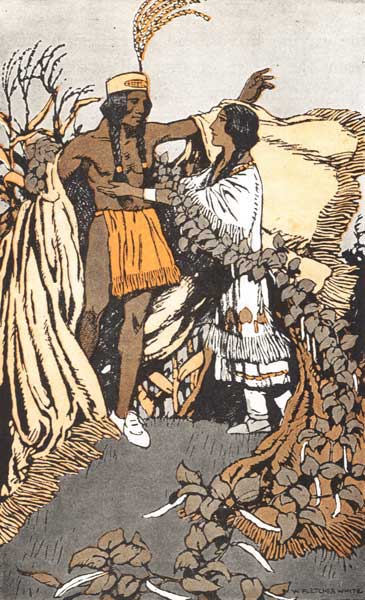
After that, every morning at sunrise, a handsome young chief was seen to come and stand on the brow of the hill. On his head were shining red plumes. Tall, and strong, and splendid he stood, wrapped in the folds of his waving blanket, whose fringed tassels danced to the summer breeze.

"Che che hen! Che che hen! Some one I would marry! Some one I would marry!" the young chieftain would sing, many, many times.

One day, his voice reached the Squash Maiden, on the other side of the hill. The Squash Maiden drew about her a rich green blanket, into which she had woven many flaunting gold trumpet-shaped flowers. Then she ran swiftly to the young chieftain.
Marry me! Marry me

"Marry me! Marry me!" said the Squash Maiden, as she spread her beautiful gold and green blanket at his feet.

Corn Plume looked down at the Squash Maiden sitting on her blanket at his feet. She was good to look upon, and yet Corn Plume was not content. He wanted a maiden who would stand by his side, not always sit at his feet.

Then Corn Plume spoke thus to the Squash Maiden.

"Corn Plume cannot marry Squash Maiden. She is very beautiful, but she will not make song in Corn Plume's heart. Squash Maiden will grow tired of his lodge. She will not stay in his wigwam. She likes to go a long trail, and wander far from the lodge.

"Corn Plume cannot make Squash Maiden his wife, for he is not content with her. But she shall be Corn Plume's sister, and sit in his lodge whenever she will. The maiden Corn Plume weds must be ever at his side. She must go where he goes, stay where he stays."

Next morning at sunrise, the voice of Corn Plume was again heard, singing from the hilltop, "Che che hen! Che che hen! Some one I would marry! Some one I would marry! Che che hen! Che che hen!"

This time his song reached the ears of the Bean Maiden. Her heart sang, when she heard the voice of Corn Plume, for she knew that he was calling her. So light of heart was Bean Maiden, that she ran like a deer up the hillside. On and on, up and over the brow of the hill she climbed, till she reached the young chieftain's side.

Then Corn Plume turned and beheld the most beautiful maiden he had ever seen. Her eyes were deep and dark, like mountain pools. Her breath was sweet as the waters of the maple. She threw off her blanket of green, and purple, and white, and stretched her twining arms to him.

Corn Plume desired to keep Bean Maiden forever close to him. He bent his tall plumed head to her. Her arms wound round and round the young chieftain, and Corn Plume was content.

So closely were the arms of Corn Plume and the Bean Maiden entwined, so truly were they wed, that the Indians never attempted to separate them. Ever after, corn and beans were planted in the same hill, and often a squash seed was added.

Since the Great Spirit had placed the corn, the bean, and the squash together on a hill, the Indian said they should continue to live and grow and occupy a hill together.

The door of Corn Plume's lodge was ever open to the Squash Maiden, if she chose to enter. But seldom did she stay in his wigwam. More often, she was found running off on a long trail.

But Bean Maiden remained true to Corn Plume. Always she was found by his side. Never did she leave the lodge unless he went with her. Corn Plume's lodge was her lodge, and her trail was his trail.

And because the Spirits of the corn and the bean are as one, the Indians not only plant and grow them together, but cook and eat them together. "In life, they were one," they say, "We will not separate them in death."

And now, when a great rustling and sighing of the corn is heard in the White man's land, the Indians often say, "'Tis the Spirit of Corn Plume, crying for his lost Bean Maiden!"
corn ear

 **********

There is another book by Mabel Powers, Around an Iroquois Story Fire which also has a very similar story, "How Corn and Beans Came to Be", complete with a Bean Song, but Squash is not in it and, because it was copyrighted in 1950, it certainly is not Public Domain. She lived a long life, 1872-1966, and was an "Advocate for Native Americans, Women and Peace", especially in the Chautauqua area. Her own legacy deserves to remembered.

As we close today's story I want to conclude with a link to the 1933 Haudenosaunee Thanksgiving Address, which is also called "Greetings to the Natural World." Each segment ends with "Now our minds are one." Certainly in our divided world that is something worth wishing. I especially like

The Creator
Now we turn our thoughts to the Creator, or Great Spirit, and send greetings and thanks for all
the gifts of Creation. Everything we need to live a good life is here on this Mother Earth. For all the love that is still around us, we gather our minds together as one and send our choicest
words of greetings and thanks to the Creator.
Now our minds are one. 

***************************** 

This is part of a series of postings of stories under the category, “Keeping the Public in Public Domain.” The idea behind Public Domain was to preserve our cultural heritage after the authors and their immediate heirs were compensated. I feel strongly current copyright law delays this intent on works of the 20th century. My own library of folklore includes so many books within the Public Domain I decided to share stories from them. I hope you enjoy discovering them.

At the same time, my own involvement in storytelling regularly creates projects requiring research as part of my sharing stories with an audience.  Whenever that research needs to be shown here, the publishing of Public Domain stories will not occur that week.  This is a return to my regular posting of a research project here.  (Don't worry, this isn't dry research, my research is always geared towards future storytelling to an audience.)  Response has convinced me that "Keeping the Public in Public Domain" should continue along with my other postings as often as I can manage it.

See the sidebar for other Public Domain story resources I recommend on the page “Public Domain Story Resources."


Friday, May 6, 2022

Zitkála-Šá - The Toad and the Boy - Keeping the Public in Public Domain

It's always great to learn articles here have been appreciated in some way.  I received an email from a family in Colorado this past week thanking me for an earlier article here.

If you don't mind I would like to send you a quick thank you from our family. My daughter Grace had to do a report for her social studies class for Womens History Month. She chose to write about the women's suffrage movement.  I let her use my computer for their homework stuff (while looking over the shoulder) which is how we discovered your helpful page, https://www.storytellingresearchlois.com/2019/04/the-19th-amendment.html

Since I am quite cautious it was tough getting sites for her to use on her own so you have my thanks! She had the wonderful idea to send a personal note so I asked if she had any questions or favorites to share for fun. She did print out this article that has a lot of fun facts about Women's Suffrage in America: https://wyomingllcattorney.com/Blog/Womens-Suffrage-and-Voting-Rights-in-Wyoming . We thought you might enjoy it too, and even thought it could be a good addition to your page- would you consider adding it maybe? I'd love to surprise her! If you have any more favorites or ideas feel free to share but only if it's no trouble. 

Thanks again for the information and have a great day!

Best wishes,
Julie (and Grace)

Zitkála-Šá, by Gertrude Käsebier, 1898

That other article Julie and Grace listed called to me.  It was actually a webliography of articles and the link, "Not all women gained right to vote in 1920" , took me even further.  That article is a discussion of how minority women had to continue to fight beyond the national women's suffrage amendment.  What really caught my attention was seeing Zitkála-Šá (Lakota for Red Bird)!  I have her book Old Indian Legends, but was surprised to see her described as an activist.  (I also was perturbed with WGBH-TV  covering up part of her write-up to promote their series, "She Resisted; Strategies of Suffrage.")  It always is worthwhile reading an overview of any topic and the Wikipedia article on her shows how much she achieved in her life.  

Yes, she was an activist achieving Native American citizenship and women's suffrage, although her campaign for voting rights was still incomplete upon her death in 1938.  Her occupations are listed as

  • Writer
  • editor
  • musician
  • teacher
  • Native American activist
Her musical talents started with the violin, culminating in her writing the libretto and songs for the first Native American opera, The Sun Dance Opera, in collaboration with composer William F. Hanson.  The Wikipedia article summarized her achievements:
Zitkála-Šá's legacy lives on as one of the most influential Native American activists of the 20th century.[46] She left an influential theory of Indian resistance and a crucial model for reform. Through her activism, Zitkála-Šá was able to make crucial changes to education, health care, and legal standing for Native American people and the preservation of Indian culture.[47]
I've been using Project Gutenberg copies whenever possible to produce a good copy here, at the same time avoiding hurting my own books.  I went there for Old Indian Legends, but also found her autobiography, American Indian Stories, written in 1921.  Her autobiography explains her activism and efforts for Native American culture.
 
For retelling, however, there are wonderful stories in Old Indian Legends.  Many of the stories are about the trickster character, Iktomi, and seven were made into picture books by Paul Goble.  The Caldecott-winning illustrator's obituary from 2017 gives a fuller picture of his work.  While Goble helped visualize Iktomi, Zitkála-Šá opens her book with a wonderful description of the trickster.  Rather than repeat the stories Goble offered, and he didn't cover all of the Iktomi stories, there also are five stories in the book not about Iktomi.  
 
For Mother's Day Zitkála-Šá offers a tale of the kidnapping of a boy, with views of the love and emotions of both mothers.

THE TOAD AND THE BOY

THE water-fowls were flying over the marshy lakes. It was now the hunting season. Indian men, with bows and arrows, were wading waist deep amid the wild rice. Near by, within their wigwams, the wives were roasting wild duck and making down pillows.

In the largest teepee sat a young mother wrapping red porcupine quills about the long fringes of a buckskin cushion. Beside her lay a black-eyed baby boy cooing and laughing. Reaching and kicking upward with his tiny hands and feet, he played with the dangling strings of his heavy-beaded bonnet hanging empty on a tent pole above him.

At length the mother laid aside her red quills and white sinew-threads. The babe fell fast asleep. Leaning on one hand and softly whispering a little lullaby, she threw a light cover over her baby. It was almost time for the return of her husband.

Remembering there were no willow sticks for the fire, she quickly girdled her blanket tight about her waist, and with a short-handled ax slipped through her belt, she hurried away toward the wooded ravine. She was strong and swung an ax as skillfully as any man. Her loose buckskin dress was made for such freedom. Soon carrying easily a bundle of long willows on her back, with a loop of rope over both her shoulders, she came striding homeward.

Near the entrance way she stooped low, at once shifting the bundle to the right and with both hands lifting the noose from over her head. Having thus dropped the wood to the ground, she disappeared into her teepee. In a moment she came running out again, crying, “My son! My little son is gone!” Her keen eyes swept east and west and all around her. There was nowhere any sign of the child.

Running with clinched fists to the nearest teepees, she called: “Has any one seen my baby? He is gone! My little son is gone!”

“Hinnu! Hinnu!” exclaimed the women, rising to their feet and rushing out of their wigwams.

“We have not seen your child! What has happened?” queried the women.

With great tears in her eyes the mother told her story.

“We will search with you,” they said to her as she started off.

They met the returning husbands, who turned about and joined in the hunt for the missing child. Along the shore of the lakes, among the high-grown reeds, they looked in vain. He was nowhere to be found. After many days and nights the search was given up. It was sad, indeed, to hear the mother wailing aloud for her little son.

It was growing late in the autumn. The birds were flying high toward the south. The teepees around the lakes were gone, save one lonely dwelling.

Till the winter snow covered the ground and ice covered the lakes, the wailing woman's voice was heard from that solitary wigwam. From some far distance was also the sound of the father's voice singing a sad song.

Thus ten summers and as many winters have come and gone since the strange disappearance of the little child. Every autumn with the hunters came the unhappy parents of the lost baby to search again for him.

Toward the latter part of the tenth season when, one by one, the teepees were folded and the families went away from the lake region, the mother walked again along the lake shore weeping. One evening, across the lake from where the crying woman stood, a pair of bright black eyes peered at her through the tall reeds and wild rice. A little wild boy stopped his play among the tall grasses. His long, loose hair hanging down his brown back and shoulders was carelessly tossed from his round face. He wore a loin cloth of woven sweet grass. Crouching low to the marshy ground, he listened to the wailing voice. As the voice grew hoarse and only sobs shook the slender figure of the woman, the eyes of the wild boy grew dim and wet.

At length, when the moaning ceased, he sprang to his feet and ran like a nymph with swift outstretched toes. He rushed into a small hut of reeds and grasses.

“Mother! Mother! Tell me what voice it was I heard which pleased my ears, but made my eyes grow wet!” said he, breathless.

“Han, my son,” grunted a big, ugly toad. “It was the voice of a weeping woman you heard. My son, do not say you like it. Do not tell me it brought tears to your eyes. You have never heard me weep. I can please your ear and break your heart. Listen!” replied the great old toad.

Stepping outside, she stood by the entrance way. She was old and badly puffed out. She had reared a large family of little toads, but none of them had aroused her love, nor ever grieved her. She had heard the wailing human voice and marveled at the throat which produced the strange sound. Now, in her great desire to keep the stolen boy awhile longer, she ventured to cry as the Dakota woman does. In a gruff, coarse voice she broke forth:

“Hin-hin, doe-skin! Hin-hin, Ermine, Ermine! Hin-hin, red blanket, with white border!”

Not knowing that the syllables of a Dakota's cry are the names of loved ones gone, the ugly toad mother sought to please the boy's ear with the names of valuable articles. Having shrieked in a torturing voice and mouthed extravagant names, the old toad rolled her tearless eyes with great satisfaction. Hopping back into her dwelling, she asked:

“My son, did my voice bring tears to your eyes? Did my words bring gladness to your ears? Do you not like my wailing better?”

“No, no!” pouted the boy with some impatience. “I want to hear the woman's voice! Tell me, mother, why the human voice stirs all my feelings!”

The toad mother said within her breast, “The human child has heard and seen his real mother. I cannot keep him longer, I fear. Oh, no, I cannot give away the pretty creature I have taught to call me 'mother' all these many winters.”

“Mother,” went on the child voice, “tell me one thing. Tell me why my little brothers and sisters are all unlike me.”

The big, ugly toad, looking at her pudgy children, said: “The eldest is always best.”

This reply quieted the boy for a while. Very closely watched the old toad mother her stolen human son. When by chance he started off alone, she shoved out one of her own children after him, saying: “Do not come back without your big brother.”

Thus the wild boy with the long, loose hair sits every day on a marshy island hid among the tall reeds. But he is not alone. Always at his feet hops a little toad brother. One day an Indian hunter, wading in the deep waters, spied the boy. He had heard of the baby stolen long ago.

“This is he!” murmured the hunter to himself as he ran to his wigwam. “I saw among the tall reeds a black-haired boy at play!” shouted he to the people.

At once the unhappy father and mother cried out, “'Tis he, our boy!” Quickly he led them to the lake. Peeping through the wild rice, he pointed with unsteady finger toward the boy playing all unawares.

“'Tis he! 'tis he!” cried the mother, for she knew him.

In silence the hunter stood aside, while the happy father and mother caressed their baby boy grown tall. 

***

The emotions of both mothers and the boy remind us not everyone has a happy Mother's Day.  Its "ending" seems to shout out for a continuation to the story.  Similarly news stories of rare reunions can leave us wondering if it's truly  a case of "happily ever after" for all.  Possibly this is an allegory of the way Native American children were sent away and removed from their culture.  Her autobiography and the Wikipedia article would certainly make this seem likely.
*********************
This is part of a series of postings of stories under the category, "Keeping the Public in Public Domain."  The idea behind Public Domain was to preserve our cultural heritage after the authors and their immediate heirs were compensated.  I feel strongly current copyright law delays this intent on works of the 20th century.  My own library of folklore includes so many books within the Public Domain I decided to share stories from them.  I hope you enjoy discovering new stories.  


At the same time, my own involvement in storytelling regularly creates projects requiring research as part of my sharing stories with an audience.  Whenever that research needs to be shown here, the publishing of Public Domain stories will not occur that week.  This is a return to my regular posting of a research project here.  (Don't worry, this isn't dry research, my research is always geared towards future storytelling to an audience.)  Response has convinced me that "Keeping the Public in Public Domain" should continue along with my other postings as often as I can manage it.
Other Public Domain story resources I recommend-
  • There are many online resources for Public Domain stories, maybe none for folklore is as ambitious as fellow storyteller, Yoel Perez's database, Yashpeh, the International Folktales Collection.  I have long recommended it and continue to do so.  He has loaded Stith Thompson's Motif Index into his server as a database so you can search the whole 6 volumes for whatever word or expression you like by pressing one key. http://folkmasa.org/motiv/motif.htm
  • You may have noticed I'm no longer certain Dr. Perez has the largest database, although his offering the Motif Index certainly qualifies for those of us seeking specific types of stories.  There's another site, FairyTalez claiming to be the largest, with "over 2000 fairy tales, folktales, and fables" and they are "fully optimized for phones, tablets, and PCs", free and presented without ads.

    Between those two sites, there is much for story-lovers, but as they say in infomercials, "Wait, there's more!"
The email list for storytellers, Storytell, discussed Online Story Sources and came up with these additional suggestions:            
         - David K. Brown - http://people.ucalgary.ca/~dkbrown/stories.html
         - Richard Martin - http://www.tellatale.eu/tales_page.html
         - Spirit of Trees - http://spiritoftrees.org/featured-folktales
         - Story-Lovers - http://www.story-lovers.com/ is now only accessible through the Wayback Machine, described below, but the late Jackie Baldwin's wonderful site lives on there, fully searchable manually (the Google search doesn't work), at https://archive.org/ .  It's not easy, but go to Story-lovers.com snapshot for October 22 2016  and you can click on SOS: Searching Out Stories to scroll down through the many story topics and click on the story topic that interests you.
       - World of Tales - http://www.worldoftales.com/ 
           - Zalka Csenge Virag - http://multicoloreddiary.blogspot.com doesn't give the actual stories, but her recommendations, working her way through each country on a continent, give excellent ideas for finding new books and stories to love and tell.
     
You're going to find many of the links on these sites have gone down, BUT go to the Internet Archive Wayback Machine to find some of these old links.  Tim's site, for example, is so huge probably updating it would be a full-time job.  In the case of Story-Lovers, it's great that Jackie Baldwin set it up to stay online as long as it did after she could no longer maintain it.  Possibly searches maintained it.  Unfortunately Storytell list member, Papa Joe is on both Tim Sheppard's site and Story-Lovers, but he no longer maintains his old Papa Joe's Traveling Storytelling Show website and his Library (something you want to see!) is now only on the Wayback Machine.  It took some patience working back through claims of snapshots but finally in December of 2006 it appears!
    Somebody as of this writing whose stories can still be found by his website is the late Chuck Larkin - http://chucklarkin.com/stories.html.  I prefer to list these sites by their complete address so they can be found by the Wayback Machine, a.k.a. Archive.org, when that becomes the only way to find them.
You can see why I recommend these to you. Have fun discovering even more stories!


Friday, April 8, 2022

Parker - How the Conifers Flaunt the Promise of Spring - Keeping the Public in Public Domain

Anthropologist and museum director, Arthur C. Parker, was from an important Seneca family on his father's side and wrote over the years about the Seneca along with the rest of the Iroquois Confederacy.  He was one of the founders of the Society of American Indians, the first national organization run by and for Native Americans and it also aimed to "educate the public about Native Americans."  I have long enjoyed three of his books, Seneca Myths & Folk Tales and Skunny Wundy; Seneca Indian Tales (both now in Public Domain); and Rumbling Wings and Other Indian Tales (which won't yet enter Public Domain for another two years).  As a children's librarian I first discovered him through his highly approachable Skunny Wundy, and think of it and today's story as I watch my oak trees begin to bud.  I also find it an interesting allegory of resistance to what seems like overwhelming attack.

Photo by Ira Huz on Unsplash

I confess it, I hate seeing the oak's brown leaves of winter, so while this gives the hope of spring, the story also explains their drab, stubborn leaves that cling through that long season.


I found myself wondering about the Tamarack.  There are various Michigan places named Tamarack, including the Tamarack District Library in Lakeview, Michigan, where I've presented two of my historical programs.  But I wasn't sure I knew what a Tamarack looked like.  It's always good research to start with the simple overview on Wikipedia.  There I learned it was also called a larch and the wood is so good for making snowshoes that "The word akemantak is an Algonquian name for the species and means 'wood used for snowshoes'."  Looking at the article's photos I still didn't know enough to identify it, although I began to realize it may be more often grown north of my metro Detroit location.  The Arborsmith LTD's tree of the month article was far more helpful, showing it in spring, telling of its color change in autumn, and a photo of it bare in winter in addition to explaining more about the tree.  

A further resource is "Get to Know Your Buds" from the Overton Park Conservancy.

Personally I'm delighted to see my oak trees budding and find the story of the two trees also a good allegory with the resilience of the Oak showing its determination to withstand attacks.

Overton Park photo of Red Oak buds
******************
This is part of a series of postings of stories under the category, "Keeping the Public in Public Domain."  The idea behind Public Domain was to preserve our cultural heritage after the authors and their immediate heirs were compensated.  I feel strongly current copyright law delays this intent on works of the 20th century.  My own library of folklore includes so many books within the Public Domain I decided to share stories from them.  I hope you enjoy discovering new stories.  


At the same time, my own involvement in storytelling regularly creates projects requiring research as part of my sharing stories with an audience.  Whenever that research needs to be shown here, the publishing of Public Domain stories will not occur that week.  This is a return to my regular posting of a research project here.  (Don't worry, this isn't dry research, my research is always geared towards future storytelling to an audience.)  Response has convinced me that "Keeping the Public in Public Domain" should continue along with my other postings as often as I can manage it.
Other Public Domain story resources I recommend-
  • There are many online resources for Public Domain stories, maybe none for folklore is as ambitious as fellow storyteller, Yoel Perez's database, Yashpeh, the International Folktales Collection.  I have long recommended it and continue to do so.  He has loaded Stith Thompson's Motif Index into his server as a database so you can search the whole 6 volumes for whatever word or expression you like by pressing one key. http://folkmasa.org/motiv/motif.htm
  • You may have noticed I'm no longer certain Dr. Perez has the largest database, although his offering the Motif Index certainly qualifies for those of us seeking specific types of stories.  There's another site, FairyTalez claiming to be the largest, with "over 2000 fairy tales, folktales, and fables" and they are "fully optimized for phones, tablets, and PCs", free and presented without ads.

    Between those two sites, there is much for story-lovers, but as they say in infomercials, "Wait, there's more!"
The email list for storytellers, Storytell, discussed Online Story Sources and came up with these additional suggestions:            
         - David K. Brown - http://people.ucalgary.ca/~dkbrown/stories.html
         - Richard Martin - http://www.tellatale.eu/tales_page.html
         - Spirit of Trees - http://spiritoftrees.org/featured-folktales
         - Story-Lovers - http://www.story-lovers.com/ is now only accessible through the Wayback Machine, described below, but the late Jackie Baldwin's wonderful site lives on there, fully searchable manually (the Google search doesn't work), at https://archive.org/ .  It's not easy, but go to Story-lovers.com snapshot for October 22 2016  and you can click on SOS: Searching Out Stories to scroll down through the many story topics and click on the story topic that interests you.
       - World of Tales - http://www.worldoftales.com/ 
           - Zalka Csenge Virag - http://multicoloreddiary.blogspot.com doesn't give the actual stories, but her recommendations, working her way through each country on a continent, give excellent ideas for finding new books and stories to love and tell.
     
You're going to find many of the links on these sites have gone down, BUT go to the Internet Archive Wayback Machine to find some of these old links.  Tim's site, for example, is so huge probably updating it would be a full-time job.  In the case of Story-Lovers, it's great that Jackie Baldwin set it up to stay online as long as it did after she could no longer maintain it.  Possibly searches maintained it.  Unfortunately Storytell list member, Papa Joe is on both Tim Sheppard's site and Story-Lovers, but he no longer maintains his old Papa Joe's Traveling Storytelling Show website and his Library (something you want to see!) is now only on the Wayback Machine.  It took some patience working back through claims of snapshots but finally in December of 2006 it appears!
    Somebody as of this writing whose stories can still be found by his website is the late Chuck Larkin - http://chucklarkin.com/stories.html.  I prefer to list these sites by their complete address so they can be found by the Wayback Machine, a.k.a. Archive.org, when that becomes the only way to find them.
You can see why I recommend these to you. Have fun discovering even more stories!

Friday, May 28, 2021

A Ghost Story for Memorial Day

This weekend into Monday is the start of a return to what had been, pre-Covid, the "normal" of a holiday with a complex history.  Memorial Day was called "Decoration Day" by my mother, even though that name began to disappear after World I.  (She surely heard it from the adults around her.)  Much of our nation's movement to a Memorial Day for putting flowers and flags on the graves of our military dead began after our Civil War, but even after the War of 1812 the Wikipedia link includes footnote 9 about:

In 1817, for example, a writer in the Analectic Magazine of Philadelphia urged the decoration of patriot's graves. E.J., "The Soldier's Grave," in The Analectic Magazine (1817), Vol. 10, 264.

Personally I consider such memorializing likely happened throughout history.  The tendency however to make it the unofficial start of summer, complete with the Indianapolis 500 race, sales, and other "revelry" was complained about as early as 1913 by an elderly veteran of the Civil War, saying young people had a "tendency ... to forget the purpose of Memorial Day and make it a day for games, races, and revelry, instead of a day of memory and tears".   When it was one of three holidays changed to three-day weekends (along with Washington's Birthday and Labor Day) it proved the old soldier correct.  Here in the nearby village there would normally be a parade, time with speeches at the main cemetery, and assorted other events that have once again been canceled even as some places are trying it once again.

Last week I mentioned the start of research on a woman named Sarah Matthews Reed Osborn Benjamin, sometimes called "the heroine of Yorktown." In the process I began to realize how many names I was running into from her final home in Pennsylvania were familiar here.  Yes, many settled here in what was still the "Northwest Territory", but it was much more than that.

18th century print by Trumbull & Forest
Again and again the name of "Mad" Anthony Wayne popped up.  He was mainly a Pennsylvanian, so why do so many places in this area have his name?  (Yes, and what's this about a ghost?)  

Mention of there being a ghost of Wayne sent me prowling up and down through what felt at times like the dustiest of Wikipedia articles related to Wayne and the Great Lakes region.  Links abound for your prowling as much as you like.  Some of it provides background for his story.  When you get into the life of a general, some of it depends on your own level of interest.  

Be sure catch his story at both the beginning and as he nears his end (pictures appear there).

Before the Revolution Wayne worked at his father's tannery and trained as a surveyor, at times doing both, until involved in the war.  Wikipedia states "his military exploits and fiery personality quickly earned him promotion to brigadier general and the nickname 'Mad Anthony'."  Less favorably some 21st century historians claim it was "due to his angry temperament, specifically during an incident when he severely punished a skilled informant for being drunk." 

After his extensive service, including Yorktown, by war's end he "was promoted to Major General in 1783 but retired from the Continental Army soon after."  This doesn't mean every battle went successfully.  The 1777 Battle of Paoli went so badly an official inquiry ruled "Wayne was not guilty of misconduct but that he had made a tactical error."  If you think Wayne's military service earned him the title of "Mad", this so infuriated him that he insisted on a complete Court Martial.  It ended by unanimously declaring he acted with honor.  His troops made "Remember Paoli" a rallying cry for the battles of Germantown and Stony Point.  Stony Point vindicated Wayne, showing he also learned from the defeat by using the same fast bold nighttime bayonet attack the British used in Paoli.  Washington even gave him the unusual permission to modify the plan as needed.  The 30 minute successful attack was a huge morale booster for the Continental Army.  Prior to it they had undergone a series of military defeats.  It also earned him a Continental Congress victory medal.

After the war he served a year in the Pennsylvania legislature, then left his wife, Mary, and two children in Paoli, Pennsylvania, to move to land in Georgia granted him for his military service.  These were two rice plantations whose running he left to slaves.  If today's rumor media had been around then, it would have had a field day.  During the war he supposedly found time for romance with various women, including a wealthy woman, Mary Vining, in Delaware.  Living without his family in Georgia, Wayne supposedly had a relationship with Catherine Greene, wife of his friend and fellow General, Nathanael Greene.  Greene also was awarded a plantation, Mulberry Grove, outside Savannah.  Their former  friendship was understandably strained.  Greene, however, like Wayne, had no ability to run his plantation.  Before the Revolution Greene had spoken out against slavery, but resorted to slaves running it.  Both men made such poor business decisions it ran them into deep debt.  Greene died and was buried at Mulberry Grove, leaving his estate the unsuccessful fight to save it.  The evaluation of history militarily ranks Greene as second only to Washington.

As if all of that bit of scandal wasn't enough to tarnish Wayne's reputation, politically he changed his initial support of a democracy, instead he later favored the Federalist Party's strong central government ruled by what he called the "aristocratick."  His political efforts gave him a year representing Georgia and voting to ratify the U.S. constitution before it was found his election was fraudulent on the grounds of residency.

In the midst of all this personal and political scandal, President Washington turned to Wayne to command the Legion of the United States, the reorganized Continental Army fighting the Northwest Indian War.  The Revolution supposedly ended with the Treaty of Paris (1783) making the Great Lakes the divider between British and U.S. territory.  British forts, however, were not evacuated as agreed.  British agents further encouraged the Native American confederacy dating back to the French and Indian War of 1754–1763, which had British colonials fighting French colonials for North America and each side having Native American allies.  After the American Revolution the Northwest Territory (made from a bit of western Pennsylvania, all of Ohio, Indiana, Illinois, Michigan, Wisconsin, and the northeastern part of Minnesota), while supposedly part of the new nation was also Native American land.  The Treaty of Paris hadn't included them, so British treaties with their native allies weren't recognized.  The Northwest Territory was opened to settlement, but prohibiting slavery.  This ignored any Native American claims and so the stage for the Northwest Indian War was set.

The names of Pontiac and Tecumseh are familiar in this part of Michigan and bookend the Northwest Indian War with Pontiac's War as a 1763 loose confederation of Native American nations against the British control of the Great Lakes area following the French and Indian War.  Originally the end of Pontiac's War was considered a Native American failure, but more recently is viewed as a military stalemate which by treaty recognized "indigenous people had certain rights to the lands they occupied."  The problem with that has been stated by modern historian Daniel K. Richter as " the war saw the emergence of the novel idea that all Native people were 'Indians,' that all Euro-Americans were 'Whites,' and that all on one side must unite to destroy the other."  Even to this day some debate calls the war anything with Pontiac's name an exaggeration because his involvement was only part of it.  Whether that is correct or not, it looked to further multi-tribal opposition to European colonization.  That attempt at loose confederation stayed in the region with Tecumseh, who took part in the Battle of Fallen Timbers, but didn't participate in the Treaty of Greenville. Tecumseh's fighting went all the way to the War of 1812, with his reputation becoming admired even by those who fought him and lasting far beyond his death.

But what about Anthony Wayne?

Wayne built or rebuilt ten forts in Ohio Country in his campaign from 1792-1795, but there were considerably more.  There were a large number of forts and settlements from 1778-1803 taking the area from Cahokia, Illinois in 1778 to Xenia, Ohio in 1803.  To show how things were changing quickly, Tecumseh was said to have been born in Xenia in the 1760s when it was Shawnee homeland.  By 1803 Ohio was admitted to the Union.  (Don't get me started on talk about how the "Buckeyes" worked against Michigan statehood and the Toledo War!)  Wayne not only saw to fort construction, but the war came to an official end with the Battle of  Fallen Timbers, just outside present-day Toledo.  The many times I've traveled the Anthony Wayne Trail -- usually en route to or from the Toledo Zoo -- I never thought about the battle even though I had heard of the name.  Now I would want to stop at the Fallen Timbers battlefield park.

https://www.nps.gov/places/fallen-timbers-battlefield-and-fort-miamis-national-historic-site.htm

Prior to the battle and afterwards for fifty miles around it Wayne ordered the destruction of Native American villages and crops.  

One of Anthony Wayne's officers may have painted the treaty negotiations, c. 1795.
 

This led to the Treaty of Greenville, defining treaty lines for Native territories and payment, including some as annual federal grants.  

This was criticized then and continues today.  Tecumseh led opposition to U.S. expansion onto Native lands.  He stated it gave away land the chiefs who signed didn't own.

Further criticism continuing into the present says the annuities started government influence in tribal affairs.  It is also blamed for the first wave of Indian removal and ultimately genocide.

For his part, after the hard winter for the Indians, Wayne's negotiation gave most of Ohio to the U.S. while he promised the land of "Indiana", the remaining land to the west, to remain Indian forever.  Did he believe that?  Unfortunately Native American history is full of grants supposedly lasting forever.

There's a certain irony that former surveyor, Anthony Wayne, led to major surveying.

Fort Recovery sign photographed by Dana60Cummins


What was then "Wayne County" was carved out of portions of Hamilton County (now Ohio) and unorganized land, with its seat at Detroit, which had been evacuated by the British five weeks previously. Wayne County originally covered all of Michigan's Lower Peninsula, northwestern Ohio, northern Indiana and a small portion of the present Lake Michigan shoreline, including the site of present-day Chicago.

A year later, after the creation of Wayne County (August 15, 1796)  Wayne started back to Pennsylvania.  He got as far as Erie, Pennsylvania, which, of course, had a long history with the Iroquois Confederation, especially the Seneca.  The fort area known as Fort Presque Isle dates back to a French fort during the French and Indian War, later burned by the French.  The British then built a Fort Presque Isle later captured by Pontiac's Rebellion.  By 1795 yet a third with the same name was built, a blockhouse, but it was under U.S.  control.. 

RoadsideAmerica.com  posted a visit to the reconstructed blockhouse where Wayne died.

<http://www.fortwiki.com/Fort_Presque_Isle_(2)>

After all the action of two wars, including being wounded twice, Wayne's death seems almost trivial.  Heading home he fell ill with what was probably complications from gout and died in a chair.  It was his dying wish to be buried there and he was.  

Photo of St. David's ca. 1907
That should have been the end of it, but 13 years later his family asked to have his bones dug up and transported to the family burial plot 400 miles away in Radnor, Pennsylvania at St. David's Episcopal Church in the Newton Township portion of the graveyard.  His son, Colonel Isaac Wayne, went to collect the bones only to find his father's body hadn't decomposed enough.  It's a bit ironic that Anthony had spent his early years as a tanner with his own father, but now the only way to bring his bones back to the home he had left so long ago he needed to be boiled!  The flesh that remained was again buried at the fort, while Isaac stuffed the bones into his luggage onto a cart.  They kept falling off and later at the Old St. David Church Cemetery it was discovered that not all were there.  It was decided not to travel the road back looking for them. 

The blog, Ghosts of Delaware County, in an article from September 13, 2010 says that the ghost of Anthony Wayne 

every year on General Wayne's Birthday which also happens to be New Year's Day, he rises from his grave and can be seen riding across the state of Pennsylvania back to his original grave in search of his bones. 

I don't know if you'll ever see his ghost, but I'm fairly sure you'll see he's the only one on the FindAGrave.com site to have two graves.

General Anthony Wayne's second grave site in Radnor, PA

While my blog is covered by copyright, I trust you will feel free to re-tell as much of this ghost story as works for you.  Historians tend to like the details, while an audience probably likes the grisly boiling of the bones and "Mad" Anthony Wayne's hunt for his bones.  It's enough to make any ghost Mad.